Results by title
4030 books match the query 'Language Arts & Disciplines' and 196 start with m

MARC 21 for Everyone
A Practical GuideRichard J. Fritz
American Library Association, 2003
Macroanalysis
Digital Methods and Literary HistoryMatthew L. Jockers
University of Illinois Press, 2013
Madrid Codex
New Approaches to Understanding an Ancient Maya ManuscriptGabrielle Vail
University Press of Colorado, 2004
Contributors include: Harvey M. Bricker, Victoria R. Bricker, John F. Chuchiak IV, Christine L. Hernández, Bryan R. Just, Merideth Paxton, and John Pohl. Additional support for this publication was generously provided by the Eugene M. Kayden Fund at the University of Colorado.
Magic Search
Rebecca S. American Library Association
American Library Association, 2009

Make a Wish
Judy Soloway Kay
University of Michigan Press, 2005
Genre: Romance
Length: about 15,000 words
Level: 4th grade
Maker Literacies for Academic Libraries
Integration into CurriculumEdited by Katie Musick Peery
American Library Association, 2020
Melding universities’ strategic goals with libraries’ teaching and learning mission, the academic library makerspace can be a powerful catalyst for information literacy, offering faculty partners a place for interdisciplinary, experiential learning. If you’re pondering what it takes to get your makerspace into the curriculum, this volume’s relatable, first-hand accounts from librarians, makerspace staff, and faculty partners will give you the confidence to make the leap. Contributors, drawn from the IMLS-funded Maker Literacies project, describe pilots and assessment for a variety of demographics, course subjects, and makerspace equipment. Guided by their experiences, you’ll be ready to fully partner with faculty through the course integration and assessment process. Inside, you’ll learn
- why academic librarians are uniquely situated to be leaders in the realm of makerspaces and makerspace literacy;
- how the ACRL Framework informs maker competencies;
- methods for using competencies and assessment in designing course assignments;
- 5 steps for guiding faculty in creating assignments for makerspaces;
- advice on developing a new staffing and service model to handle course-wide use of the makerspace;
- steps for taking students through concept, design, prototype, and final product in a project management course;
- how an ethical perspective engaged a women’s history course toward the “In Her Shoes” project;
- pedagogical strategies for integrating the makerspace into fine arts classes; and
- ways to showcase makerspace outputs to generate excitement around campus.
Makerspaces
Caitlin A. Bagley
American Library Association, 2014
Making "Nature"
The History of a Scientific JournalMelinda Baldwin
University of Chicago Press, 2015
But how did Nature become such an essential institution? In Making "Nature," Melinda Baldwin charts the rich history of this extraordinary publication from its foundation in 1869 to current debates about online publishing and open access. This pioneering study not only tells Nature's story but also sheds light on much larger questions about the history of science publishing, changes in scientific communication, and shifting notions of "scientific community." Nature, as Baldwin demonstrates, helped define what science is and what it means to be a scientist.
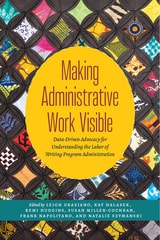
Making Administrative Work Visible
Data-Driven Advocacy for Understanding the Labor of Writing Program AdministrationLeigh Graziano
Utah State University Press, 2023
The collection has three parts, each of which focuses on the most confounding challenges facing WPAs as well as the most compelling sites of their contributions to administration, labor in higher education, and the discipline’s collective obligation to forwarding the goals of social justice and advocacy: Advocating through Representations of WPA Labor, Advocating by Accounting for Time and Labor, and Advocating in and through Complex Institutional Contexts. The chapters use data to share and track the work functions, job titles, grand narratives, program assessments, tenure and promotion, email practices, and more undertaken by WPAs in their administrative capacities. Chapters also surface narratives for future data and studies to be done by other scholars.
By taking up and answering questions about the range of WPA work—and the invisibility of much of that work—Making Administrative Work Visible creates avenues toward accounting for and acknowledging the complex activity systems in which WPAs lead the work of the university and advocate for data-driven strategies needed to sustain this foundational area of higher education.
Contributors: Kamila Albert, Brooke Anderson, Sheila Carter-Tod, Amy Cicchino, Ana Cortés Lagos, Kristi Murray Costello, Jennifer Cunningham, Ryan Dippre, Kimberly Emmons, Genevieve García de Müeller, Jill Gladstein, Caleb González, Michael Healy, Lyra Hilliard, Kristine Johnson, Seth Kahn, Rita Malenczyk, Troy Mikanovich, Lilian Mina, Angela Mitchell, Greer Murphy, Kate Navickas, Michael Neal, Patti Poblete, Jan Rieman, Heather Robinson, Katelyn Stark, Mary Stewart, Natalie Stillman-Webb, Lizbett Tinoco, Lisa Tremain, Martha Wilson Schaffer
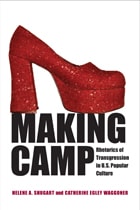
Making Camp
Rhetorics of Transgression in U.S. Popular CultureHelene A. Shugart and Catherine Egley Waggoner
University of Alabama Press, 2008
Making Camp examines the rhetoric and conventions of “camp” in contemporary popular culture and the ways it both subverts and is co-opted by mainstream ideology and discourse, especially as it pertains to issues of gender and sexuality.

Making Institutions Work in Peru
Democracy, Development and Inequality Since 1980Edited by John Crabtree
University of London Press, 2006
Contributors include Paulo Drino (University of Manchester), Cynthia Sanborn (Centro de Investigaciones, Universidad del Pacifico, Lima), Carlos Monge (Participacion Ciudadana, Lima), Fernando Rospigliosi (Instituto de Estudios Peruanos, Lima), Pedro Franck (Departamento de Economia, Universidad Catolica, Lima), Fernando Eguren (Centro Peruano de Ciencias Sociales, Lima), Rosemary Thorp (Queen Elizabeth House/St Antony's College, Oxford), Eduardo Dargent (University of Texas,Austin), Coletta Youngers (Washington Office on Latin America,Washington D.C.), Francisco Durand (University of Texas, San Antonio), Jose Tavara (Departamento de Economia, Universidad Catolica, Lima, and OSIPTEL), and Richard Webb (Instituto Cuanto and Central Bank of Peru).
Making Libraries Accessible
Char Booth
American Library Association, 2010
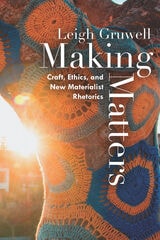
Making Matters
Craft, Ethics, and New Materialist RhetoricsLeigh Gruwell
Utah State University Press, 2022
To recast new materialist rhetorics as inherently crafty, Leigh Gruwell historicizes and locates the concept of craft both within rhetorical history as well as in the disciplinary history of writing studies. Her investigation centers on three specific case studies: craftivism, the fibercraft website Ravelry, and the 2017 Women’s March. These instances all highlight how a material, ecological understanding of rhetorical agency can enact political change.
Craft agency models how we humans might work with and alongside things—nonhuman, sometimes digital, sometimes material—to create more equitable relationships. Making Matters argues that craft is a useful starting point for addressing criticisms of new materialist rhetorics not only because doing so places rhetorical action as a product of complex relationships between a network of human and nonhuman actors, but also because it does so with an explicitly activist agenda that positions the body itself as a material interface.
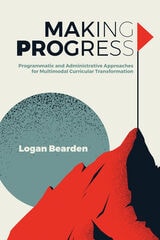
Making Progress
Programmatic and Administrative Approaches for Multimodal Curricular TransformationLogan Bearden
Utah State University Press, 2021
MCT can be achieved at the intersection of program documents and practices. Bearden details ten composition programs that have undergone MCT, offering interview data from the directors who oversaw and/or participated within the processes. He analyzes a corpus of outcomes statements to discover ways we can “make space” for multimodality and gives instructors and programs a broader understanding of the programmatic values for which they should strive if they wish to make space for multimodal composition in curricula. Making Progress also presents how other program documents like syllabi and program websites can bring those outcomes to life and make multimodal composing a meaningful part of first-year composition curricula.
First-year composition programs that do not help their students learn to compose multimodal texts are limiting their rhetorical possibilities. The strategies in Making Progress will assist writing program directors and faculty who are interested in using multimodality to align programs with current trends in disciplinary scholarship and deal with resistance to curricular revision to ultimately help students become more effective communicators in a digital-global age.
Making Sense of Business Reference
A Guide for Librarians and Research ProfessionalsCelia Ross
American Library Association, 2020
“It reads as if you have an expert coach in business reference helping you each step of the way." That’s how Academic BRASS summarized the first edition of this unique, unparalleled resource authored by Ross, a past winner of the Gale Cengage Learning Award for Excellence in Business Librarianship. Now she’s revised and updated it to tackle even more “bizref” headscratchers related to investment and finance, consumer behavior and statistics, company, and industry research. In addition to general reference strategies in each chapter that give you the lay of the land, inside you’ll find
- overviews of more than fifty databases for articles, company and industry, directories, consumer, international, or raw data;
- 33 real-life "Stumper" questions, all new for this edition, drawn from librarians in the field;
- why asking “who cares about this kind of question” reveals potential sources;
- techniques for applying reference interview techniques to business questions;
- advice on where to find the numbers for answering finance questions;
- expanded coverage of venture capital research and business information literacy;
- “Start Making Sense” suggestions for further skill-building; and
- questions to consider when building a bizref collection.
This is the guide to keep at your side when serving business students, job-seekers, investors, or entrepreneurs in your library.
Making Sense of Business Reference
A Guide for Librarians and Research ProfessionalsCelia Ross
American Library Association, 2013
Making Truth
Metaphor in ScienceTheodore L. Brown
University of Illinois Press, 2002
To illustrate the roles of metaphor in science, Brown presents a series of studies of scientific systems. These range from the atom, historically one of the most important ideas in science, through models in chemistry and biology, including current “hot” topics such as protein folding, chaperone proteins, and global warming. The case studies in Making Truth illustrate the deeply metaphorical nature of scientific reasoning and communication. They provide the basis for far-reaching conclusions about science as an intellectual and social practice and about the nature of scientific truth.
Making Values-Based Decisions in the Academic Library
Amanda Koziura
Assoc of College & Research Libraries, 2025
Making Values-Based Decisions in the Academic Library explores the decision-making process of librarians in both formal and informal leadership roles. Rather than trying to identify a singular “correct” answer, authors offer an exploration of their own processes and the tools they used to arrive at conclusions that fit their contexts and institutions. Their examples show how values can be central considerations in assessment, inform collection development, shape our spaces and services, influence policy, and be foundational for seeking a better way forward.
We have more power than we think to create change, and our values can be a touchstone for the decisions we make at every level. The strategies in Making Values-Based Decisions in the Academic Library can help you holistically consider available options and make choices that consider your personal, institutional, and professional values amid challenging and changing circumstances.
Making in School and Public Libraries
Edited by Kristin Fontichiaro, Caroline Wack, Tori Culler, and Nicole Sype
Michigan Publishing Services, 2020
Readers will gain practical insights about how to
- Define goals and target audiences
- Customize programs to meet community needs
- Equip a makerspace
- Document activities
- Assess achievements and areas for growth
- Engage makers in a variety of technology and hands-on activities, including robots, 3D printing, sewing, cardboard challenges, knitting and crochet, design thinking, and zines
The authors’ experiences include co-creating one of the nation’s first school library makerspaces; establishing after-school maker programs with elementary and middle school learners; co-designing one-off and ongoing maker events for community-building in diverse public libraries; engaging with senior citizens in a low-income Senior Summer Camp pilot; and state, national, and international workshops for teachers, librarians, and youth mentors.
Making the Case
Advocacy and Judgment in Public ArgumentKathryn M. Olson
Michigan State University Press, 2012
In an era when the value of the humanities and qualitative inquiry has been questioned in academia and beyond, Making the Case is an engaging and timely collection that brings together a veritable who’s who of public address scholars to illustrate the power of case-based scholarly argument and to demonstrate how critical inquiry into a specific moment speaks to general contexts and theories. Providing both a theoretical framework and a wealth of historically situated texts, Making the Case spans from Homeric Greece to twenty-first-century America. The authors examine the dynamic interplay of texts and their concomitant rhetorical situations by drawing on a number of case studies, including controversial constitutional arguments put forward by activists and presidents in the nineteenth century, inventive economic pivots by Franklin Roosevelt and Alan Greenspan, and the rhetorical trajectory and method of Barack Obama.
Making the Most of Your Library Career
Lois Stickell
American Library Association, 2014
Making the News Popular
Mobilizing U.S. News AudiencesAnthony Nadler
University of Illinois Press, 2016
Anthony Nadler charts a paradigm shift, from market research's reach into the editorial suite in the 1970s through contemporary experiments in collaborative filtering and social news sites like Reddit and Digg. As Nadler shows, the transition was and is a rocky one. It also goes back much further than many experts suppose. Idealized visions of demand-driven news face obstacles with each iteration. Furthermore, the post-professional philosophy fails to recognize how organizations mobilize interest in news and public life. Nadler argues that this civic function of news organizations has been neglected in debates on the future of journalism. Only with a critical grasp of news outlets' role in stirring broad interest in democratic life, he says, might journalism's digital crisis push us toward building a more robust and democratic news media.
Wide-ranging and original, Making the News Popular offers a critical examination of an important, and still evolving, media phenomenon.

Making the News
Politics, the Media, and Agenda SettingAmber E. Boydstun
University of Chicago Press, 2013
With Making the News, Amber Boydstun offers an eye-opening look at the explosive patterns of media attention that determine which issues are brought before the public. At the heart of her argument is the observation that the media have two modes: an “alarm mode” for breaking stories and a “patrol mode” for covering them in greater depth. While institutional incentives often initiate alarm mode around a story, they also propel news outlets into the watchdog-like patrol mode around its policy implications until the next big news item breaks. What results from this pattern of fixation followed by rapid change is skewed coverage of policy issues, with a few receiving the majority of media attention while others receive none at all. Boydstun documents this systemic explosiveness and skew through analysis of media coverage across policy issues, including in-depth looks at the waxing and waning of coverage around two issues: capital punishment and the “war on terror.”
Making the News shows how the seemingly unpredictable day-to-day decisions of the newsroom produce distinct patterns of operation with implications—good and bad—for national politics.
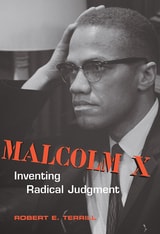
Malcolm X
Inventing Radical JudgmentRobert E. Terrill
Michigan State University Press, 2004
Few figures haunt the collective American psyche like Malcolm X. Hoodlum, convict, convert, prophet, nationalist, and martyr, Malcolm’s life spans the Civil Rights era like an index of America’s racial anxiety. Dozens of books and hundreds of articles have analyzed his life, his work, and the various ways that his image has been appropriated by American culture. Not much has been done, however, to analyze his speeches. This would be a glaring omission in the body of scholarship about almost any public figure, but is especially troubling with regard to Malcolm X. His legacy does not consist of marches preserved on newsreels, legislation passed by Congress, or holidays observed by the state; his legacy consists almost exclusively of his words.
Malcolm X, like any orator, did not fashion his discourse in a vacuum but worked within and modified modes fashioned by his predecessors. Malcolm X: Inventing Radical Judgment begins by exploring the interpretive strategies presented in key texts from the history of African American protest, establishing a spectrum against which Malcolm’s oratory can be assessed. The texts of speeches that Malcolm delivered while he was a minister for the Nation of Islam and the texts of speeches and statements he made after he left the Nation are analyzed carefully to discern the strategies of interpretation and judgment that he enacted and fostered in his audiences. Finally, this radical judgment, presented in and through Malcolm’s public discourse, is re-contextualized by using three disparate theoretical approaches. The purpose of this triangulation is not to contain the rhetoric of Malcolm X within the limitations of these vocabularies, but rather to show that the changing potential of Malcolm’s rhetoric lies, in part, in its iconoclastic refusal to be constrained by definitive boundaries.
Management Basics for Information Professionals
G. Edward Evans
American Library Association, 2020
The recipient of rave reviews from far and wide (Journal of Hospital Librarianship deemed it “a librarian’s dream … very forward-thinking”), since its initial publication this text has served as an essential resource for both LIS students and practitioners. The new fourth edition offers an updated, comprehensive examination of the myriad of basic skills effective library managers must exercise throughout their careers. Throughout, Evans and new co-author Greenwell pay close attention to management in "new normal" straitened economic conditions and the pervasive impact of technology on a library manager’s role. This book’s coverage includes
- a new focus on how being in the public/nonprofit sector influences the application of management basics such as planning, accountability, trust and delegation, decision making, principles of effective organizational communication, fostering change and innovation, quality control, and marketing;
- the managerial environment, organizational skill sets, the importance of a people-friendly organization, and legal issues;
- key points on leadership, team-building, and human resource management;
- budget, resource, and technology management;
- management ethics, with a lengthy discussion of why ethics matter; and
- tips for planning a library career, with a look at the work/life debate.
This book, to quote Australian Library Journal, is “a recommended text for library science students, but is also an excellent source of information for career librarians wanting to refresh their knowledge of library management in a fast-moving information services environment.”
Management Basics for Information Professionals
G. Edward Evans
American Library Association, 2013
Managing Budgets and Finances
A How-To-Do-It Manual for Librarians and Information ProfessionalsAmerican Library Association, 2005
Managing Creativity
The Innovative Research LibraryRonald Jantz
American Library Association, 2016
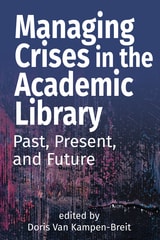
Managing Crises in the Academic Library
Past, Present, and FutureDoris Van Kampen-Breit
Assoc of College & Research Libraries, 2023
In 29 chapters from authors in all institution types and sizes, Managing Crises in the Academic Library can help library workers learn from the crises of the past and prepare for the next unexpected event. Chapters cover lessons from the COVID-19 pandemic, perpetual budget uncertainty, dealing with downsizing, merging departments, mold mitigation, and mental health issues, but also offer strategies applicable during any crisis, including:
- Responsive decision-making in academic library collections
- Managing stakeholder expectations
- Effective communication strategies
- Continuity of operations planning
- Utilizing library storage facilities
- Documentation and cross-training
- Mediating student technology needs
- Setting boundaries
Libraries and library workers are deeply sustaining lifelines for many students and faculty. Managing Crises in the Academic Library collects stories that demonstrate the tenacity, creativity, and ingenuity of academic library workers as they maintain this vital community lifeline and offers actionable ideas and approaches for planning for and sustaining the resources, services, and people in the library during difficult times.
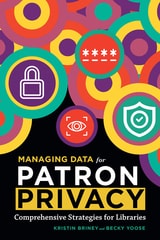
Managing Data for Patron Privacy
Comprehensive Strategies for LibrariesKristin Briney and Becky Yoose
American Library Association, 2022
- succinct summaries of major U.S. laws and other regulations and standards governing patron data management;
- information security practices to protect patrons and libraries from common threats;
- how to navigate barriers in organizational culture when implementing data privacy measures;
- sources for publicly available, customizable privacy training material for library workers;
- the data life cycle from planning and collecting to disposal;
- how to conduct a data inventory;
- understanding the associated privacy risks of different types of library data;
- why the current popular model of library assessment can become a huge privacy invasion;
- addressing key topics while keeping your privacy policy clear and understandable to patrons; and
- data privacy and security provisions to look for in vendor contracts.
Managing Electronic Government Information in Libraries
American Library Association, 2008
Managing Electronic Records
American Library Association, 2009
Managing Electronic Resources
Ryan Weir
American Library Association, 2012
Managing Facilities for Results
Optimizing Space for ServicesCheryl Bryan
American Library Association, 2007
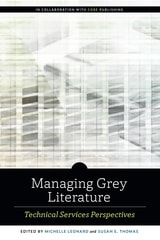
Managing Grey Literature
Technical Services PerspectivesMichelle Leonard
American Library Association, 2021
An important resource for scholarly research, grey literature is relevant to every discipline. It’s also often more current than commercial publications. Unfortunately, though it provides a richness of content, this type of scholarly resource is often overlooked when conducting research. This book aims to change that, describing the importance of grey literature and offering a holistic approach to successfully integrating it into library collections. Readers will learn
- an overview of grey literature that discusses its importance to researchers, scholars, and students;
- collections policies for selection and deselection, complete with a suggested workflow;
- information about vendors, OA, and other aspects of acquisitions;
- guidance on cataloging, such as collection categories in the public-facing catalog, and preservation; and
- methods for promoting grey literature in library collections, including institutional repositories; and
- tips for marketing, branding, outreach, and best communication practices for colleagues, administrators, and patrons.
Managing Library Volunteers
Preston Driggers
American Library Association, 2011
Managing Your Library Construction Project
A Step-by-Step GuideRichard C. McCarthy
American Library Association, 2007
Managing in the Middle
Robert Farrell
American Library Association, 2012
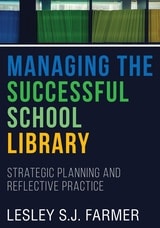
Managing the Successful School Library
Strategic Planning and Reflective PracticeLesley S. J. Farmer
American Library Association, 2016
Managing with Data
Using ACRLMetrics and PLAmetricsPeter Hernon
American Library Association, 2015
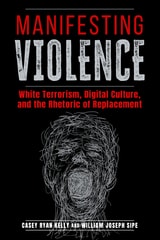
Manifesting Violence
White Terrorism, Digital Culture, and the Rhetoric of ReplacementCasey Ryan Kelly and William Joseph Sipe
University of Alabama Press, 2025
When communication becomes the engine of white supremacist violence.
Manifesting Violence: White Terrorism, Digital Culture, and the Rhetoric of Replacement by Casey Ryan Kelly and William Joseph Sipe is a compelling exploration of how the digital world has become a fertile ground for white supremacist ideology. Through an in-depth analysis of white supremacist manifestos, online rhetoric, and the myth of “white genocide,” Kelly and Sipe uncover the disturbing ways in which digital culture facilitates the spread of racist ideology and the radicalization of individuals. By examining the language of white nationalism—calls to defend the white race, family, and children—Kelly and Sipe reveal how these messages, often disguised as entertainment or humor, gradually transform passive consumers into active participants in a dangerous ideology.
Manifesting Violence sheds light on the alarming shift from organized white supremacist groups to a decentralized digital arena where hate speech is disguised as humor and online conversations foster a culture of violence. Kelly and Sipe’s thorough investigation of this growing digital ecosystem offers a chilling glimpse into the dark underbelly of online extremism. A must-read for anyone seeking to understand the growing threat of hate-motivated violence and the urgent need to address its roots in digital culture, Kelly and Sipe offer rich insights to readers, researchers, academics, and policymakers concerned about extremism, online radicalization, and white supremacy.
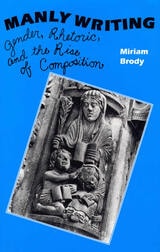
Manly Writing
Gender, Rhetoric and the Rise of CompostionMiriam Brody
Southern Illinois University Press, 1993
In this critical history of the gendered politics of rhetoric and the rise of composition, Miriam Brody argues that nothing about words or their arrangement is innately gendered. Yet since the English Enlightenment, teachers have encouraged their students to admire and imitate "manly" writing, writing that is plain, forceful, cogent, and true. Similarly, students have been enjoined to avoid so-called effeminate or feminine writing—writing characterized as vague, unorganized, ornate, and deceitful.
Such advice, part of what Brody terms the hidden curriculum, has served the interests of discourse communities as various as the early Enlightenment Royal Society in seventeenth-century London (by urging a clear and masculine style for the work of science) and the land-grant universities of nineteenth-century America (by claiming that the work of writing was similar to clearing the land and pushing back the frontier). Brody’s discussion in fact becomes a social history of canonical rhetorical essays and important late Enlightenment, nineteenth-century, and early modern school texts. She points out that in their advice to writers even the Strunks and Whites and Peter Elbows of more recent times have extolled masculine virtues and urged control over invasive and problematic feminine qualities.
Brody’s book not only clarifies rhetoric’s inheritance and transformation of the classical ideal of manliness, it also is the first critical work to explore the ideological significance of gendered imagery and to interpret in light of this imagery rhetorical essays and hard-to-locate early composition texts against a background of previously unpublished archival materials.
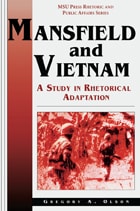
Mansfield and Vietnam
A Study in Rhetorical AdaptationGregory A. Olson
Michigan State University Press, 1995
Mansfield and Vietnam: A Study in Rhetorical Adaptation is the first major work to examine the role played by Senate Majority Leader Mike Mansfield, Democrat from Montana, in the formulation and execution of U.S. Vietnam policy. Drawing upon material from the Mansfield Papers, personal interviews, public speeches, and recently declassified documents, Olson traces Mansfield's journey from ardent supporter of Diem in the late 1950s to quiet critic of LBJ in the mid-1960s, and finally, to outspoken opponent of the Vietnam War in the late 1960s and early 1970s.
Olson focuses his attention on Mansfield's speaking ability and his use of the written word, analyzing the ways in which they proved crucial in shaping the policies of the Eisenhower, Kennedy, Johnson, Nixon, and Ford presidential administrations. He also examines the way personal and political situations converged to force Mansfield into the center of the stormy Vietnam controversy, and eventually into a position of leadership in the campaign to end America's military presence in Southeast Asia. To date, little has been done to evaluate the roles played by key congressional figures in the Vietnam War debate; thus, Mansfield and Vietnam is bound to become a significant contribution, not only to rhetorical studies, but also to twentieth-century diplomatic history and to the study of congressional-presidential relations.
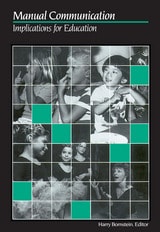
Manual Communication
Implications for EducationHarry Bornstein
Gallaudet University Press, 1990
Manual Communication: Implications for Education offers the first authoritative examination of sign systems used in the education of deaf students. Professionals, teachers, and parents will appreciate the individual, expert explanations of:
American Sign Language
Pidgin Sign (Contact Sign)
Signed English
Signing Exact English
Cued Speech.
The descriptions by the acknowledged designer, administrator, or scholar of each system ensures the highest accuracy and thoroughness, distinguishing Manual Communication as a significant, important resource.
The first chapter recounts the history of sign language, particularly American Sign Language (ASL), including foreign influences and conflicts about its use. An overview follows, describing factors that affect manual communication, such as learner characteristics. Also, an analysis of a nationwide survey of teachers shows the results of their use of the various forms of manual communication in different settings.
Many Ways to Be Deaf
International Variation in Deaf CommunitiesLeila Monaghan
Gallaudet University Press, 2003

Mao Zedong’s “Talks at the Yan’an Conference on Literature and Art”
A Translation of the 1943 Text with CommentaryBonnie S. McDougall
University of Michigan Press, 1980
Mapping Racial Literacies
College Students Write about Race and SegregationSophie R. Bell
Utah State University Press, 2020
This textual ethnography embeds early college students’ writing in deep historical and theoretical contexts and looks for new ways that their writing contributes to and reshapes contemporary understandings of how US and global citizens are thinking about race. The book is a teaching narrative, tracing a teaching journey that considers student writing not only in the moments it is assigned but also in continual revisions of the course, making it a useful tool in helping college-age students see, explore, and articulate the role of race in determining their life experiences and opportunities.
Sophie Bell’s work narrates the experiences of a white teacher making mistakes in teaching about race and moving forward through those mistakes, considering that process valuable and, in fact, necessary. Providing a model for future scholars on how to carve out a pedagogically responsive identity as a teacher, Mapping Racial Literacies contributes to the scholarship on race and writing pedagogy and encourages teachers of early college classes to bring these issues front and center on the page, in the classroom, and on campus.
Mapping the Stars
Celebrity, Metonymy, and the Networked Politics of IdentityClaire Sisco King
The Ohio State University Press, 2023
King considers three stars with popular and controversial personas: Norman Rockwell, Will Smith, and Kim Kardashian. Working in very different contexts and with very different public images, these figures nonetheless share a consistent, if not conspicuous, interest in celebrity as a construct. Offering intertextual readings of their public images across such sites as movie posters, magazines, cinema, and social media—and deploying rhetorical theories of metonymy (a linguistic device linking signifiers by shared associations)—King argues that these stars’ self-reflexive attention to the processes by which celebrity is created and constrained creates opportunities for reframing public discourse about what it means to be famous and what it means to be a person.
Maps with the News
The Development of American Journalistic CartographyMark Monmonier
University of Chicago Press, 1989
"A most welcome and thorough investigation of a neglected aspect of both the history of cartography and modern cartographic practice."—Mapline
"A well-written, scholarly treatment of journalistic cartography. . . . It is well researched, thoroughly indexed and referenced . . . amply illustrated."—Judith A. Tyner, Imago Mundi
"There is little doubt that Maps with the News should be part of the training and on the desks of all those concerned with producing maps for mass consumption, and also on the bookshelves of all journalists, graphic artists, historians of cartography, and geographic educators."—W. G. V. Balchin, Geographical Journal
"A definitive work on journalistic cartography."—Virginia Chipperfield, Society of University Cartographers Bulletin
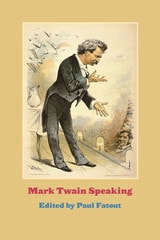
Mark Twain Speaking
Paul Fatout
University of Iowa Press, 1976