Results by title
107 books match the query 'Latter Day Saints' and 12 start with m
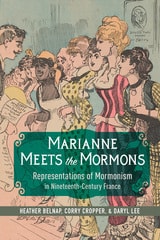
Marianne Meets the Mormons
Representations of Mormonism in Nineteenth-Century FranceHeather Belnap, Corry Cropper, and Daryl Lee
University of Illinois Press, 2022
Surprising and innovative, Marianne Meets the Mormons looks at how nineteenth-century French observers engaged with the idea of Mormonism in order to reframe their own cultural preoccupations.
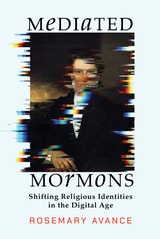
Mediated Mormons
Shifting Religious Identities in the Digital AgeRosemary Avance
University of Utah Press, 2024
Mediated Mormons uses a case study approach to consider various iterations of Mormon identity as presented by church authorities, faithful members, the secular media, and heterodox and former adherents. These often-conflicting perspectives challenge traditional models of LDS authority, dismantling a monolithic view of Mormons and offering a window into processes of social activism and institutional change in the internet era.
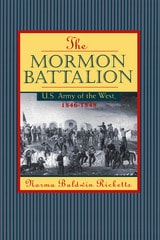
Mormon Battalion
United States Army of the West, 1846-1848Norma Baldwin Ricketts
Utah State University Press, 1997

Mormon Enigma
Emma Hale SmithLinda King Newell and Valeen Tippetts Avery
University of Illinois Press, 1994
Winner of the Evans Biography Award, the Mormon History Association Best Book Award, and the John Whitmer Association (RLDS) Best Book Award.
Mormon Enigma is the bestselling biography of Emma Hale Smith, wife of the Mormon prophet Joseph Smith. It was Joseph Smith who announced that an angel of the Lord had commanded him to introduce a 'new order of marriage.' And it was Emma Hale Smith who confronted the practice of polygamy head on.
As the authors note in their introduction, "Early leaders in Utah castigated Emma from their pulpits for opposing Brigham Young and the practice of polygamy, and for lending support to the Reorganization. As these attitudes filtered down through the years, Emma was virtually written out of official Utah histories. In this biography, we have attempted to reconstruct the full story of this remarkable and much misunderstood woman's experiences.
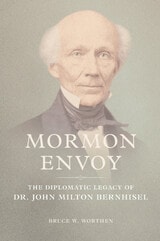
Mormon Envoy
The Diplomatic Legacy of Dr. John Milton BernhiselBruce W. Worthen
University of Illinois Press, 2023
Having risen from a Pennsylvania backcountry upbringing to become a respected member of the upper class, Bernhisel possessed a personal history that allowed him to reach common ground with politicians and other outsiders. He negotiated for Joseph Smith’s life and, after the Church’s relocation to the Utah Territory, took on the task of rehabilitating the public image of the Latter-day Saints. Brigham Young’s defiance of the government undermined Bernhisel’s work, but their close if sometimes turbulent relationship ultimately allowed Bernhisel to make peace with Washington, secure a presidential pardon for Young, and put Utah and the Latter-day Saints on the road to formally joining the United States.
Mormon Garments
Sacred and SecretNancy Ross, Jessica Finnigan, and Larissa Kanno Kindred
University of Illinois Press, 2026
Mormon Healer Folk Poet
Mary Susannah Fowler's Life of 'Unselfish Usefulness'Margaret Brady
Utah State University Press, 2000
Mormon Mavericks
Essays on DissentersJohn Sillito
Signature Books, 2002
Mormon Mavericks summarizes a few famous flashpoints in Mormon history; more importantly, it provides a telling study in human nature. Each contributor is an expert in his or her discipline, and all approach their topic with equal doses of sympathy and objectivity.
The following mavericks are featured in this collection of biographical essays:
Fawn McKay BrodieJuanita Brooks
Thomas Stuart Ferguson
Amasa Mason Lyman
Sterling M. McMurrin
John E. Page
Sarah M. Pratt D. Michael Quinn
William Smith
Fanny Stenhouse
T. B. H. Stenhouse
James Strang
Samuel Woolley Taylor
Moses Thatcher
Mormonism's Last Colonizer
The Life and Times of William H. SmartWilliam B. Smart
Utah State University Press, 2008
Winner of the Evans Handcart Prize 2009
Winner of the Mormon History Assn Best Biography Award 2009
By the early twentieth century, the era of organized Mormon colonization of the West from a base in Salt Lake City was all but over. One significant region of Utah had not been colonized because it remained in Native American hands--the Uinta Basin, site of a reservation for the Northern Utes. When the federal government decided to open the reservation to white settlement, William H. Smart--a nineteenth-century Mormon traditionalist living in the twentieth century, a polygamist in an era when it was banned, a fervently moral stake president who as a youth had struggled mightily with his own sense of sinfulness, and an entrepreneurial businessman with theocratic, communal instincts--set out to ensure that the Uinta Basin also would be part of the Mormon kingdom.
Included with the biography is a searchable CD containing William H. Smart's extensive journals, a monumental personal record of Mormondom and its transitional period from nineteenth-century cultural isolation into twentieth-century national integration.
Mormonisms in Asia
Stories of Global Faith and Local LivesEdited by Melissa Wei-Tsing Inouye and Laurie F. Maffly-Kipp
University of Illinois Press, 2026
This volume focuses on Asia, a region that includes more than half the world's population, but where Restoration traditions specifically and Christianity broadly are minority faiths. It uses a combination of focused case studies and theoretical analysis to highlight broader trends and themes that those studies suggest about the meaning of a globalized faith in the twenty-first century. The first section of this book lays out ways of thinking about Mormonism’s global presence in terms of the nation-state, and the essays explore where and how Restoration traditions as institutional actors have made their way into new political and social contexts. The second section studies the tensions created by the encounters of LDS norms with preexisting cultural and political values in local settings. These essays burrow more deeply into political and religious realities and explore the variations in Mormon cultural assumptions about politics and society, as well as the relationship between local congregants and the Mormon administrative center. The final section presents fine-grained
studies that focus attention on one of the central features of LDS lived religion: the role of gender and the family in the religious community. In each case, divine dictates necessarily bump up against traditional societal norms that converts must navigate.
Contributors: John-Charles Duffy, Stacilee Ford, Taunalyn Ford, Conan Grames, David J. Howlett, Melissa Wei-Tsing Inouye, Keisha Lai, Laurie Maffly-Kipp, Matthew Martinich, Meagan Rainock, Shinji Takagi, Pierre Vendassi
Mormons, Musical Theater, and Belonging in America
Jake Johnson
University of Illinois Press, 2019
Murder by Sacrament
Another Toom Taggart MysteryPaul M. Edwards
Signature Books, 2014
Taggart is annoyed at having to navigate the political structure of the bureaucracy, but he cannot bring himself to leave. He is able to teach, and he likes his proximity to Church archives, local bookstores, and the woman who, according to fate, is still seeing the policeman from The Angel Acronym. All the major characters are back, and Taggart’s romantic rival is given the new murder case, meaning that he has to rely once again on Taggart for his knowledge of the Church’s secrets. This gives both men a reason to keep an eye on the other, making for entertaining situations in a funny, insider send-up of the RLDS community.