Results by title
458 books match the query 'Literature' and 20 start with m
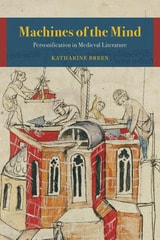
Machines of the Mind
Personification in Medieval LiteratureKatharine Breen
University of Chicago Press, 2021
In Machines of the Mind, Katharine Breen proposes that medieval personifications should be understood neither as failed novelistic characters nor as instruments of heavy-handed didacticism. She argues that personifications are instead powerful tools for thought that help us to remember and manipulate complex ideas, testing them against existing moral and political paradigms. Specifically, different types of medieval personification should be seen as corresponding to positions in the rich and nuanced medieval debate over universals. Breen identifies three different types of personification—Platonic, Aristotelian, and Prudentian—that gave medieval writers a surprisingly varied spectrum with which to paint their characters.
Through a series of new readings of major authors and works, from Plato to Piers Plowman, Breen illuminates how medieval personifications embody the full range of positions between philosophical realism and nominalism, varying according to the convictions of individual authors and the purposes of individual works. Recalling Gregory the Great’s reference to machinae mentis (machines of the mind), Breen demonstrates that medieval writers applied personification with utility and subtlety, employing methods of personification as tools that serve different functions. Machines of the Mind offers insight for medievalists working at the crossroads of religion, philosophy, and literature, as well as for scholars interested in literary character-building and gendered relationships among characters, readers, and texts beyond the Middle Ages.
Macroanalysis
Digital Methods and Literary HistoryMatthew L. Jockers
University of Illinois Press, 2013
Made Under Pressure
Literary Translation in the Soviet Union, 1960–1991Natalia Kamovnikova
University of Massachusetts Press, 2019
Natalia Kamovnikova chronicles the literary translation process from the selection of foreign literary works to their translation, censorship, final approval, and publication. Interviews with Soviet translators of this era provide insight into how the creative work of translating and the practical work of publishing were undertaken within a politically restricted environment, and recall the bonds of community and collaboration that they developed.
Making History
Studies in Rabbinic History, Literature, and Culture in Honor of Richard L. KalminCarol Bakhos
SBL Press, 2024
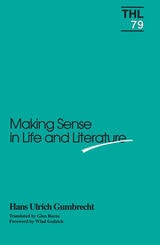
Making Sense in Life and Literature
Hans Ulrich Gumbrecht
University of Minnesota Press, 1992
“The translation of these essays by Gumbrecht on literary theory and history marks the appearance in English of one of Europe’s most learned, productive, and inventive scholars. Their range is extraordinary. They show that Gumbrecht is not only a sophisticated theorist and historian of literature, but a master practitioner of cultural studies.” --Hayden White, University of California, Santa Cruz
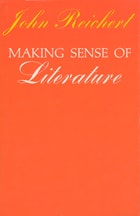
Making Sense of Literature
John Reichert
University of Chicago Press, 1978
Reichert considers criticism broadly as the imparting of one's understanding of a poem or play or novel to another reader. When the rhetorical function of critical language is recognized, seemingly distinct approaches to literature can be seen as different though often compatible means to a single end. He contends that the critic's job is not to report a personal response but to describe how a reader—any reader—ought to respond to a particular work. This necessitates postulating the author's intention at every turn, so that criticism becomes an account of what the author does to the reader by means of the work.
Taking off from recent developments in the philosophy of language, Reichert proposes answers to questions such as: What is involved in the understanding of metaphor, irony, and fiction? What knowledge must the reader bring to the text to understand it? And in what ways may the meaning of the text be regarded as stable? He sets out to refute attempts by Beardsley, Peckham, Kermode, Culler, and Ellis, among others, to define the essential nature or function of literature. Finally, with a simple account of how the everyday assessments we make of people and actions apply to literary works, Reichert demonstrates that full evaluative arguments are never purely formal or "literary," but always, in a broad sense, moral.
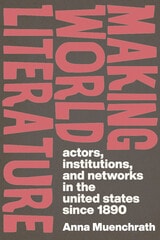
Making World Literature
Actors, Institutions, and Networks in the United States since 1890Anna Muenchrath
University of Massachusetts Press, 2024
From universities to governments, the Big Five publishers to Amazon, the influence of institutions abounds in US publishing. A diverse array of books from around the globe have been made into world literature in the US, selected by editors, publishers, and bureaucrats, produced by non-profits and for-profit presses of all sizes, and distributed through schools, publishing programs, and bookstores. The resulting world literary canon is the product of complex negotiations between individual preferences and institutional mandates, as well as economic, cultural, and pedagogical logics. While book publishing has fallen increasingly under the sway of global capitalism, yet the literary world remains made up of a series of individuals making choices about whom to fund, teach, translate, edit, and publish. The “world” of world literature, Anna Muenchrath argues, is a heterogeneous network of people whose circulation of literature is necessarily imbricated in the market economy, but whose selections might resist that economy and open new literary futures. Through archival research and close readings, this book considers what those participating are trying to do in circulating a text, and what communities they are helping to form or strengthen.
Making World Literature posits that network theory can effectively model the agency of actors and institutions in the literary field, making visible both the long-term accrual of power, as well as the choices of authors, translators, editors, and readers who do not simply replicate the values of a global literary marketplace, but divert, question, and undermine them. Muenchrath closely examines the paratexts and archival documents surrounding moments of global circulation in and through institutions like US world literature anthologies, the Council of Books in Wartime, the Iowa Writer’s Workshop, Oprah’s Book Club, and Amazon’s translation imprint. The granularity of these case studies reveals the increasingly limited agency of the individual in the global literary field, demonstrating how such players are important actors, and how their choices open up further options for later actors seeking to take texts down new paths toward or after publication.
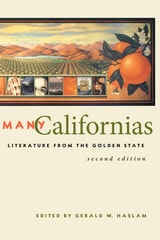
Many Californias
Literature from the Golden StateGerald W. Haslam
University of Nevada Press, 1999
Mao Zedong’s “Talks at the Yan’an Conference on Literature and Art”
A Translation of the 1943 Text with CommentaryBonnie S. McDougall
University of Michigan Press, 1980

Margins in the Classroom
Teaching LiteratureKostas Myrsiades and Linda S. Myrsiades, Editors
University of Minnesota Press, 1994
Margins in the Classroom was first published in 1994. Minnesota Archive Editions uses digital technology to make long-unavailable books once again accessible, and are published unaltered from the original University of Minnesota Press editions.
For today's teacher of literature, facing a minefield of politics and theory, this book arrives as a much needed guide through the multiplying cultural anxieties of the college classroom. Margins in the Classroom brings together established scholars and emerging voices from diverse backgrounds to show how politics and theory can and do affect the most pressing problems confronting the contemporary teacher of literature. The essays in this volume go beyond questioning and examining existing practices to suggest fresh approaches to teaching the expanding literary canon within the context of the politics of the educational institution.
Grounded in literary criticism, psychoanalysis, feminist theory, political economy, sociology, and philosophy, these essays apply new theoretical models to the traditional canon, identify new bodies of literature, and show how theory can be used to analyze these new literatures. Focusing on the politics of teaching and theory in the classroom, the authors explore the present practice and future implications of changing textual analysis, literary theory, and pedagogy. Their essays address the politics of literature as it affects the classroom, the design of courses, and the creation of new courses. They mold theory to the variety of classroom populations and materials the teacher of literature encounters today. The resulting volume bridges the differences between the languages of the classroom instructor and the contemporary theorist. Margins in the Classroom is unique in both the breadth and the depth of its concern over the disturbing, if electric, impact of changes in criticism, theory, and pedagogy in college literature classes as we approach the next century of academic instruction.Kostas Myrsiades is professor of comparative literature, and Linda S. Myrsiades is professor of English, both at West Chester University. Kostas Myrsiades is editor of College Literature, where Linda S. Myrsiades is an associate editor.
Marx for Cats
A Radical BestiaryLeigh Claire La Berge
Duke University Press, 2023
Marxist Literary Criticism Today
Barbara Foley
Pluto Press, 2019
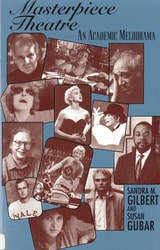
Masterpiece Theatre
An Academic MelodramaSandra M Gilbert and Susan Gubar
Rutgers University Press, 1995
Is there a plot against the life of letters today?!!!! A mysterious assailant has tied a nameless text to a railroad track near Boondock State University. While young untenured English professor Jane Marple enlists a group of odd and oddly rivalrous academicians to help her identify and save the text, a coalition of powerful conservatives begins to suspect and rally against a left-wing conspiracy. But all are foiled when the amnesiac text is abducted on the Euro-Centric Express, where Ms. Marple encounters a number of suspiciously eccentric theorists temporarily set loose from their usual haunts in Marxist, deconstructionist, new historicist, and postcolonial circles. You'll laugh with our heroine, you'll cry with her, but you'll never guess how--using the very latest technology and in the midst of sometimes sinister stage and screen celebrities--she brings the last of three thrilling episodes in the canon wars to an end at a WOW (Writers of the World) conference set in the heart of the Big Apple.
In this hilarious romp through the culture wars, Sandra M. Gilbert and Susan Gubar send up everyone including, sometimes, themselves, while at the same time they speculate seriously on the future of literature and literacy in a society where both are increasingly endangered. The cast includes well-known critics, politicians, writers, pop stars, media personalities, and a juicy assortment of technocrats, CEOs, and other culture vultures. Any similarities you find between these characters and actual persons, living or dead, are probably glaring. So, hum the opening notes of Masterpiece Theatre as you sit back, relax, and consider (yes!) the fate of the printed word in Western civilization.
Masterpiece Theatre is the latest--and funniest--round in the culture wars. No member of Modern Language Association, lover of literature and literacy, cultural pundit, or talking head should be without a copy.
Matthew Arnold and the Classical Tradition
Warren D. Anderson
University of Michigan Press, 1988
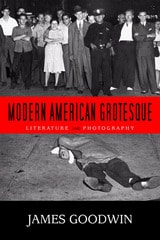
Modern American Grotesque
Literature and PhotographyJames Goodwin
The Ohio State University Press, 2009
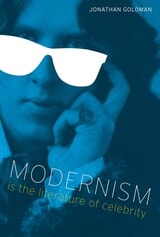
Modernism Is the Literature of Celebrity
By Jonathan Goldman
University of Texas Press, 2011
The phenomenon of celebrity burst upon the world scene about a century ago, as movies and modern media brought exceptional, larger-than-life personalities before the masses. During the same era, modernist authors were creating works that defined high culture in our society and set aesthetics apart from the middle- and low-brow culture in which celebrity supposedly resides. To challenge this ingrained dichotomy between modernism and celebrity, Jonathan Goldman offers a provocative new reading of early twentieth-century culture and the formal experiments that constitute modernist literature's unmistakable legacy. He argues that the literary innovations of the modernists are indeed best understood as a participant in the popular phenomenon of celebrity.
Presenting a persuasive argument as well as a chronicle of modernism's and celebrity's shared history, Modernism Is the Literature of Celebrity begins by unraveling the uncanny syncretism between Oscar Wilde's writings and his public life. Goldman explains that Wilde, in shaping his instantly identifiable public image, provided a model for both literary and celebrity cultures in the decades that followed. In subsequent chapters, Goldman traces this lineage through two luminaries of the modernist canon, James Joyce and Gertrude Stein, before turning to the cinema of mega-star Charlie Chaplin. He investigates how celebrity and modernism intertwine in the work of two less obvious modernist subjects, Jean Rhys and John Dos Passos. Turning previous criticism on its head, Goldman demonstrates that the authorial self-fashioning particular to modernism and generated by modernist technique helps create celebrity as we now know it.
Modernism
An Anthology of Sources and DocumentsEdited by Vassiliki Kolocotroni, Jane Goldman, and Olga Taxidou
University of Chicago Press, 1998
By favoring short extracts over lengthier originals, the editors cover a remarkable range and variety of modernist thinking. Included are not just the familiar high modernist landmarks such as Gustave Flaubert, Ezra Pound, and James Joyce, but also a diverse representation from the sciences, politics, philosophy, and the arts, including Charles Darwin, Thorstein Veblen, W. E. B. Du Bois, Isadora Duncan, John Reed, Adolf Hitler, and Sergei Eisenstein. Another welcome feature is a substantial selection of hard-to-find manifestos from the many modernist movements, among them futurism, cubism, Dada, surrealism, and anarchism.
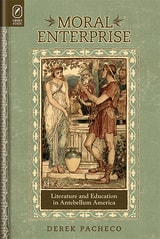
Moral Enterprise
Literature and Education in Antebellum AmericaDerek Pacheco
The Ohio State University Press, 2013
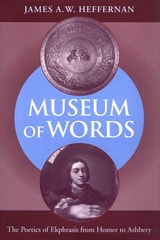
Museum of Words
The Poetics of Ekphrasis from Homer to AshberyJames A. W. Heffernan
University of Chicago Press, 1993
In the first book ever to explore this museum, James Heffernan argues that ekphrasis stages a battle for mastery between the image and the word. Moving from the epics of Homer, Virgil, and Dante to contemporary American poetry, this book treats the history of struggle between rival systems of representation. Readable and well illustrated, this study of how poets have represented painting and sculpture is a major contribution to our understanding of the relation between the arts.
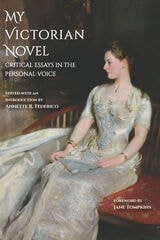
My Victorian Novel
Critical Essays in the Personal VoiceAnnette R. Federico
University of Missouri Press, 2020
These are essays in the original sense of the word, attempts: individual and experiential approaches to literary works that have subjective meanings beyond social facts. By reflecting on their own histories with novels taught, studied, researched, and re-experienced in different contexts over many years, the contributors reveal how an aesthetic object comes to inhabit our critical, pedagogical, and personal lives.
By inviting scholars to share their experiences with a favorite novel without the pressure of an analytical agenda, the sociable essays in My Victorian Novel seek to restore some vitality to the act of literary criticism, and encourage other scholars to talk about the importance of reading in their lives and the stories that have enchanted and transformed them.
The novels in this collection include:
Jane Eyre by Charlotte Brontë
The Duke’s Children by Anthony Trollope
The Adventures of Sherlock Holmes by Arthur Conan Doyle
The Newcomes by William Makepeace Thackeray
Middlemarch by George Eliot
Daniel Deronda by George Eliot
The Return of the Native by Thomas Hardy
Vanity Fair by William Makepeace Thackeray
North and South by Elizabeth Gaskell
Bleak House by Charles Dickens
David Copperfield by Charles Dickens
New Grub Street by George Gissing
The Pickwick Papers by Charles Dickens
Dracula by Bram Stoker
Wuthering Heights by Emily Brontë