Results by title
178 books match the query 'Media' and 24 start with m

MEDIA
A Transdisciplinary InquiryEdited by Jeremy Swartz and Janet Wasko
Intellect Books, 2020
MEDIA: A Transdisciplinary Inquiry explores evolving definitions of media and interrogates how media technologies are transforming media theory and practice. The collection addresses the emerging roles of media across a wide range of disciplines, featuring contributions from an array of internationally known scholars and practitioners.
The definition of media itself is in a constant state of flux, expanding to include an ever-widening range of concepts, products, services, and institutions. Here, the authors reconceptualize media, drawing not only on media and communication studies, but also philosophy, sociology, political science, biology, art, computer science, and information studies, among other disciplines. The collection challenges traditional notions of media, explores emerging media, and reexamines concepts including technology, environment, and ecology; multimedia, mediation, and labor; and participation, repair, and curation. These timely and original discussions by established scholars in the field provide a valuable contribution to the fusion of media across disciplines.
Making the News
Politics, the Media, and Agenda SettingAmber E. Boydstun
University of Chicago Press, 2013
With Making the News, Amber Boydstun offers an eye-opening look at the explosive patterns of media attention that determine which issues are brought before the public. At the heart of her argument is the observation that the media have two modes: an “alarm mode” for breaking stories and a “patrol mode” for covering them in greater depth. While institutional incentives often initiate alarm mode around a story, they also propel news outlets into the watchdog-like patrol mode around its policy implications until the next big news item breaks. What results from this pattern of fixation followed by rapid change is skewed coverage of policy issues, with a few receiving the majority of media attention while others receive none at all. Boydstun documents this systemic explosiveness and skew through analysis of media coverage across policy issues, including in-depth looks at the waxing and waning of coverage around two issues: capital punishment and the “war on terror.”
Making the News shows how the seemingly unpredictable day-to-day decisions of the newsroom produce distinct patterns of operation with implications—good and bad—for national politics.

Media and Dependency in South Africa
A Case Study of the Press and the Ciskei “Homeland”Les Switzer
Ohio University Press, 1985
Media and Identity in Contemporary Europe
Consequences of global convergenceRichard Collins
Intellect Books, 1995
Because technological change in broadcasting has enabled us to open up media markets, the shape of media and of society has become more internationally-oriented. Indeed, modern international media has bought into question the very legitimacy of national communities and ideologies. And this is a phenomenon whose greatest impact has been in Europe.
These studies address the future of public service broadcasting and the power of national regulators to shape trans-national media relationships. The author takes an empirical approach to analysis of these issues, exploring media and communication studies very much as a social science.

Media and Management
Rutvica Andrijasevic
University of Minnesota Press, 2021
An essential account of how the media devices we use today inherit the management practices governing factory labor
This book argues that management is enabled by media forms, just as media gives life to management. Media technologies central to management have included the stopwatch, the punch card, the calculator, and the camera, while management theories are taught in printed and virtual textbooks and online through TED talks. In each stage of the evolving relationship between workers and employers, management innovations are learned through media, with media formats producing fresh opportunities for management.
Drawing on rich historical and ethnographic case studies, this book approaches key instances of the industrial and service economy—the legacy of Toyotism in today’s software industry, labor mediators in electronics manufacturing in Central and Eastern Europe, and app-based food-delivery platforms in China—to push media and management studies in new directions. Media and Management offers a provocative insight on the future of labor and media that inevitably cross geographical boundaries.
Media and Values
Intimate Transgressions in a Changing Moral and Cultural LandscapeDavid E. Morrison, Matthew Kieran, Michael Svennevig and Sarah Ventress
Intellect Books, 2007
Media and the Affective Life of Slavery
Allison Page
University of Minnesota Press, 2022
How media shapes our actions and feelings about race
Amid fervent conversations about antiracism and police violence, Media and the Affective Life of Slavery delivers vital new ideas about how our feelings about race are governed and normalized by our media landscape. Allison Page examines U.S. media from the 1960s to today, analyzing how media culture instructs viewers to act and feel in accordance with new racial norms created for an era supposedly defined by an end to legal racism.
From the classic television miniseries Roots to the edutainment video game Mission 2: Flight to Freedom and the popular website slaveryfootprint.org, Media and the Affective Life of Slavery provides an in-depth look at the capitalist and cultural artifacts that teach the U.S. public about slavery. Page theorizes media not only as a system of representation but also as a technology of citizenship and subjectivity, wherein race is seen as a problem to be solved. Ultimately, she argues that visual culture works through emotion, a powerful lever for shaping and managing racialized subjectivity.
Media and the Affective Life of Slavery delivers compelling, provocative material and includes a wealth of archival research into such realms as news, entertainment, television, curricula, video games, and digital apps, providing new and innovative scholarship where none currently exists.
Media and the Global Cold War
Edited by Rossen Djagalov and Arvind Rajagopal
University of Illinois Press, 2027
Arvind Rajagopal and Rossen Djagalov present essays on the uses of Cold War media. Focusing on the Global South, the contributors illuminate how postcolonial nations and others defied superpower pressure to use media for nation-building and international cooperation. At the same time, communication infrastructures linked global regions in unequal ways that often reinforced the power of the United States. Throughout, the essays show how Cold War media practices like secrecy, propaganda, and cultural diplomacy cemented patterns that still influence global communication systems and international politics today.
Cutting-edge and timely, Media and the Global Cold War reveals the workings of media beyond the superpower rivalry.
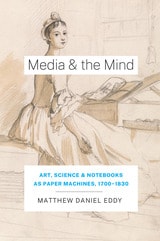
Media and the Mind
Art, Science, and Notebooks as Paper Machines, 1700-1830Matthew Daniel Eddy
University of Chicago Press, 2022
We often think of reason as a fixed entity, as a definitive body of facts that do not change over time. But during the Enlightenment, reason also was seen as a process, as a set of skills enacted on a daily basis. How, why, and where were these skills learned? Concentrating on Scottish students living during the long eighteenth century, this book argues that notebooks were paper machines and that notekeeping was a capability-building exercise that enabled young notekeepers to mobilize everyday handwritten and printed forms of material and visual media in a way that empowered them to judge and enact the enlightened principles they encountered in the classroom. Covering a rich selection of material ranging from simple scribbles to intricate watercolor diagrams, the book reinterprets John Locke’s comparison of the mind to a blank piece of paper, the tabula rasa. Although one of the most recognizable metaphors of the British Enlightenment, scholars seldom consider why it was so successful for those who used it. Each chapter uses one core notekeeping skill to reveal the fascinating world of material culture that enabled students in the arts, sciences, and humanities to transform the tabula rasa metaphor into a dynamic cognitive model. Starting in the home, moving to schools, and ending with universities, the book reconstructs the relationship between media and the mind from the bottom up. It reveals that the cognitive skills required to make and use notebooks were not simply aids to reason; rather, they were part of reason itself.
Media in Europe Today
Edited by Josef Trappel, Werner A. Meier, Leen d’Haenens, Jeanette Steemers, and Barbara Thomass for the Euromedia Research Group
Intellect Books, 2011
Media in Europe Today provides a comprehensive overview of European media in its current state of transformation. Through a focus on specific European media sectors, it assesses the impact of new technologies across industries and addresses a wide range of practices, strategies, and challenges facing European media today. The Euromedia Research Group has more than twenty years of experience in the observation of trends affecting media today, and this book marks the strong continuation of that long tradition.
Media in New Turkey
The Origins of an Authoritarian Neoliberal StateBilge Yesil
University of Illinois Press, 2016
Yesil confronts essential questions regarding: the role of the state and military in building the structures that shaped Turkey's media system; media adaptations to ever-shifting contours of political and economic power; how the far-flung economic interests of media conglomerates leave them vulnerable to state pressure; and the ways Turkey's politicized judiciary criminalizes certain speech.
Drawing on local knowledge and a wealth of Turkish sources, Yesil provides an engrossing look at the fault lines carved by authoritarianism, tradition, neoliberal reform, and globalization within Turkey's increasingly far-reaching media.
Media in the Enlarged Europe
Politics, Policy and IndustryEdited by Alec Charles
Intellect Books, 2009
Looking beyond national and cultural boundaries, Media in the Enlarged Europe focuses on the complexity and instability of the European Union and its relationship with the mass media. Contributors to this volume address the continuing growth and expansion of the European Union, relationships between old and new Europe, and social and political developments in the former communist countries. Media in the Enlarged Europe presents snapshots of media politics, policies, industries, and cultures in the European Union as a whole, while incorporating case studies of the history and current state of mass media in specific nations. This will be an essential volume for students and experts in media studies, international relations, and international studies.
Media of Serial Narrative
Frank Kelleter
The Ohio State University Press, 2017
Media of Serial Narrative focuses on key sites and technologies of popular seriality since the mid-nineteenth century and up to today: newspapers, comics, cinema, television, and digital communication. Paying close attention to the affordances of individual media, as well as to their historical interactions, the fourteen chapters survey the forms, processes, and functions of popular serial storytelling. With individual chapters by Frank Kelleter, Jared Gardner, Daniel Stein, Christina Meyer, Scott Higgins, Shane Denson, Ruth Mayer, Kathleen Loock, Constantine Verevis, Jason Mittell, Sudeep Dasgupta, Sean O’Sullivan, Henry Jenkins, Christine Hämmerling, Mirjam Nast, and Andreas Sudmann, Media of Serial Narrative is an exciting and broad-ranging intervention in the fields of seriality, media, and narrative studies.
Media, Culture, and Decolonization
Re-righting the Subaltern Histories of GhanaWunpini Fatimata Mohammed
Rutgers University Press, 2026
Media, Culture, and Decolonization: Re-righting the Subaltern Histories of Ghana invites us to look at media and culture from a decolonial perspective. Through Dagbaŋ epistemologies and knowledge systems, this book examines media by highlighting how African languages, cultures, and traditions can shift how we think of knowledge. It is an offering to anyone curious about the relationship between culture, language, and media. By focusing on African language media in Ghana such as film, television, and radio, the book emphasizes the importance of espousing a decolonial politic and praxis in the process of co-creating knowledge with Indigenous communities. It connects the struggles of global majority countries and demonstrates the ways in which (neo)colonialism and imperialism impede the work toward liberatory futures. This book demonstrates the potential that African language media hold as tools of cultural and epistemological decolonization.
Media, Culture, and the Environment
Anderson, Alison
Rutgers University Press, 1997
Media, Culture and the Environment provides an accessible introduction to key issues and debates surrounding the media politics of risk assessment and the environment. Anderson looks at nature as contested terrain and reveals how news sources use it to compete for our emotions and attention. She shows how framings of risk in relation to the environment are influenced by social, political, and cultural factors, but she also rejects extreme versions of social constructionism.
The book moves beyond traditional disciplinary boundaries by synthesizing recent debates in cultural theory and media studies with key developments in human geography. It offers an in-depth analysis of pressure politics and environmental lobbying groups, while examining the production, transmission and negotiation language of news discourse. The examples, drawn from both Europe and North America, include the tremendous headline controversies over oil spills and killing of baby seals. Difficult issues, clearly surveyed and incisively presented, make this book essential reading for anyone interested in how and why journalists handle environmental news in the ways they do.
Media, Democracy and European Culture
Edited by Ib Bondebjerg and Peter Madsen
Intellect Books, 2008
Media, Democracy and European Culture presents up-to-date and cutting-edge research on the political and cultural dimension of democracy in Europe and its representation in the media. This interdisciplinary volume brings together the work of some of the most prominent European scholars in media, political science, sociology, cultural studies and law. The contributors explore issues of globalization, the role of the media and communication policy to order to provide a comparative country-to-country look at how the media constructs European identity. This timely and forward-looking collection will be of interest to scholars of media, international and cultural studies.

Media, Erotics, and Transnational Asia
Purnima Mankekar and Louisa Schein, eds.
Duke University Press, 2012
Judith Farquhar examines how health magazines serve as sources of both medical information and erotic titillation to readers in urban China. Tom Boellstorff analyzes how queer zines produced in Indonesia construct the relationship between same-sex desire and citizenship. Purnima Mankekar examines the rearticulation of commodity affect, erotics, and nation on Indian television. Louisa Schein describes how portrayals of Hmong women in videos shot in Laos create desires for the homeland among viewers in the diaspora. Taken together, the essays offer fresh insights into research on gender, erotics, media, and Asia transnationally conceived.
Contributors. Anne Allison, Tom Boellstorff, Nicole Constable, Heather Dell, Judith Farquhar, Sarah L. Friedman, Martin F. Manalansan IV, Purnima Mankekar, Louisa Schein, Everett Yuehong Zhang
Media, Geopolitics, and Power
A View from the Global SouthHerman Wasserman
University of Illinois Press, 2018
Herman Wasserman analyzes the debates surrounding South Africa's new media presence against the backdrop of rapidly changing geopolitics. His exploration reveals how South African disputes regarding access to, and representation in, the media reflect the domination and inequality in the global communication sphere. Optimists see post-apartheid media as providing a vital space that encourages exchanges of opinion in a young democracy. Critics argue the public sphere mirrors South Africa's past divisions and privileges the viewpoints of the elite. Wasserman delves into the ways these simplistic narratives obscure the country's internal tensions, conflicts, and paradoxes even as he charts the diverse nature of South African entry into the global arena.

Media, Market, and Democracy in China
Between the Party Line and the Bottom LineYuezhi Zhao
University of Illinois Press, 1998
How do market forces influence the media in China? How does the Party both introduce and try to contain the market's influence? How do commercial imperatives both accommodate and challenge Party control?
Yuezhi Zhao interviewed a wide range of scholars, media administrators, and media professionals to answer these and other questions. Working in China in 1994 and 1995, she monitored media content, carried out extensive documentary research in Beijing, and held off-the-record meetings with Chinese media insiders. What she found informs an in-depth look at the intertwining nature of the Communist Party and the news media in China, how they affect each other, and what the future might hold for each.
A rare on-the-ground portrait, Media, Market, and Democracy in China is must reading for scholars, media and business professionals, and policymakers who need to understand what happened to China and its mass media during a period of dynamic growth and change.
Media, Markets and Public Spheres
European Media at the CrossroadsEdited by Jostein Gripsrud and Lennart Weibull
Intellect Books, 2010
Using a sample of European newspapers and their TV listings as a stepping stone, Media, Markets and Public Spheres presents an overview of changes in European public spheres over the last fifty years. With in-depth analyses of structural changes in press and broadcasting, changing relations between media, and changes in media policies, this book explores how and why the media decisively influence most aspects of society. Media, Markets and Public Spheres will be useful to students in media and communication studies and European studies, as well as for those studying sociology and political science.
Media, Monarchy and Power
Neil Blain and Hugh O'Donnell
Intellect Books, 2013
Media, Nationalism and European Identities
Karol Jakubowicz
Central European University Press, 2011
Media, Technology, and Society
Theories of Media EvolutionW. Russell Neuman
University of Michigan Press, 2010
"This book is the perfect primer for understanding media in the digital age. We are in an era when newspaper, radio, and television are fast becoming archeological concepts. Herein are the reasons why."
---Nicholas Negroponte, founder and chairman of One Laptop per Child and cofounder of the MIT Media Laboratory
"Congratulations to Neuman and colleagues for a fascinating exploration of how previous new media were constructed, whether things could have been otherwise, and what can be learned for future media."
---Sonia Livingstone, Department of Media and Communications, the London School of Economics and Political Science
In Media, Technology, and Society, some of the most prominent figures in media studies explore the issue of media evolution. Focusing on a variety of compelling examples in media history, ranging from the telephone to the television, the radio to the Internet, these essays collectively address a series of notoriously vexing questions about the nature of technological change. Is it possible to make general claims about the conditions that enable or inhibit innovation? Does government regulation tend to protect or thwart incumbent interests? What kinds of concepts are needed to address the relationship between technology and society in a nonreductive and nondeterministic manner? To what extent can media history help us to understand and to influence the future of media in constructive ways? The contributors' historically grounded responses to these questions will be relevant to numerous fields, including history, media and communication studies, management, sociology, and information studies.
W. Russell Neuman is John Derby Evans Professor of Media Technology and Research Professor, Center for Political Studies, Institute for Social Research, at the University of Michigan.
DIGITALCULTUREBOOKS: a collaborative imprint of the University of Michigan Press and the University of Michigan Library
Money Talks
Media, Markets, CrisisEdited by Graham Murdock andJostein Gripsrud
Intellect Books, 2014