94 books match the query 'Middle Ages, 600-1500' and 7 start with m
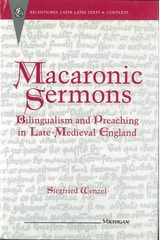
cover of Macaronic Sermons: Bilingualism and Preaching in Late-Medieval England

Macaronic Sermons

Bilingualism and Preaching in Late-Medieval England

Siegfried Wenzel

University of Michigan Press, 2010
Siegfried Wenzel's groundbreaking study seeks to describe and analyze the linguistically mixed, or macaronic, sermons in late fourteenth-century England.  Not only are these works of considerable religious interest, they provide extensive information on their literary, linguistic, and cultural milieux.
 
Macaronic Sermons begins by offering a typology of such works: those in which English words offer glosses, or offer structural functions, or offer neither of the two but yet are syntactically integrated.  This last group is then examined in detail: reasons are given for this usage and for its origins, based on the realities of fourteenth-century England.
 
Siefriend Wenzel draws valuable conclusions about the linguistic status quo of the era, together with the extent of education, the audiences' expectations, and the ways in which the authors' minds worked.
 
Obviously of interest to scholars and students of early English literature, Macaronic Sermons also contains much valuable information for specialists in language development or oral theory, and for those interested in multicultural societies.
[more]
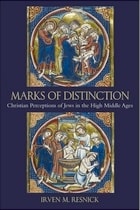
cover of Marks of Distinctions: Christian Perceptions of Jews in the High Middle Ages

Marks of Distinctions

Christian Perceptions of Jews in the High Middle Ages

Irven M. Resnick

Catholic University of America Press, 2012
Through the use of several illustrations from illuminated manuscripts and other media, Resnick engages readers in a discussion of the later medieval notion of Jewish difference.
[more]
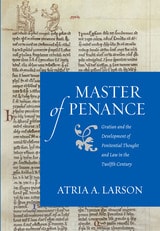
cover of Master of Penance

Master of Penance

Arrai A. Larson

Catholic University of America Press, 2014
This book presents the first full-scale study of the Tractatus de penitentia (C.33 q.3) in Gratian's Decretum, which became the textbook for canon law and served as the basis of the church's developing jurisprudence, in theory and in practice
[more]
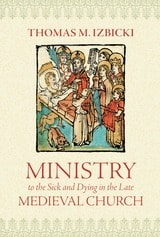
cover of Ministry to the Sick and Dying in the Late Medieval Church

Ministry to the Sick and Dying in the Late Medieval Church

Thomas M. Izbicki

Catholic University of America Press, 2023
The focus of this volume is on ministry to the sick and dying in the later Middle Ages, especially providing them with the sacraments. Medieval writers linked illness to sin and its forgiveness. The priest, as physician of souls, was expected to heal the soul, preparing it for the hereafter. His ministry might also effect healing of bodies, when that healing did not endanger the soul. This book treats how a priest prepared to visit sick persons and went to them in procession with the Eucharist and oil of the sick. The priest was to comfort the patient and, if death was imminent, prepare the soul for the hereafter. Canon law, theology, and ritual sources are employed. Three sacraments, penance, viaticum, (final communion) and extreme unction (anointing of the sick) are treated in detail. Sickbed confession was designed to forgive the ailing person's mortal sins. A priest could absolve a dying person of all sins, even those reserved to a bishop or the pope. Viaticum was to strengthen a suffering Christian for life's last conflict, that between angels and demons for the soul of the dying person. The deathbed thus was a spiritual battlefield. Extreme unction was reserved for those in danger of death, relieving the soul of venial sins or "the remains of sin," even after confession and absolution. The commendatio animae (commendation of the soul) used with the dying was to usher the soul into the afterlife. Many works have been written about attitudes toward death, dying, and the afterlife in the Middle Ages. Likewise, there is a good deal of literature about individual sacraments. This study aims at bridging between these literatures, with a focus on the priest and parishioner in both theory and practice at the sickbed.
[more]
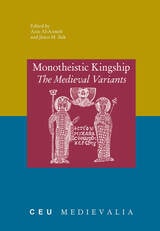
cover of Monotheistic Kingship: The Medieval Variants

Monotheistic Kingship

The Medieval Variants

Aziz Al-Azmeh

Central European University Press, 2004

This volume of essays intends to present diverse aspects of monotheistic kingship during the Middle Ages in two general-theoretical articles and a series of “case studies” on the relationship of religion and rulership. The authors discuss examples of the role of religion—based on both textual and iconic evidence—in Carolingian, Ottonian and late medieval western Europe; in Byzantium and Armenia; Georgia; Hungary; the Khazar Khanate; Poland, and Rus’. Two studies explore the issue in medieval Jewish and Islamic political thought. The editors hope that these special inquiries will engender more comparative studies on the subject.
[more]
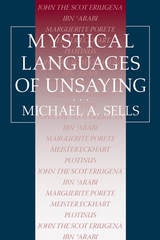
cover of Mystical Languages of Unsaying

Mystical Languages of Unsaying

Michael A. Sells

University of Chicago Press, 1994

The subject of Mystical Languages of Unsaying is an important but neglected mode of mystical discourse, apophasis. which literally means "speaking away." Sometimes translated as "negative theology," apophatic discourse embraces the impossibility of naming something that is ineffable by continually turning back upon its own propositions and names. In this close study of apophasis in Greek, Christian, and Islamic texts, Michael Sells offers a sustained, critical account of how apophatic language works, the conventions, logic, and paradoxes it employs, and the dilemmas encountered in any attempt to analyze it.

This book includes readings of the most rigorously apophatic texts of Plotinus, John the Scot Eriugena, Ibn Arabi, Marguerite Porete, and Meister Eckhart, with comparative reference to important apophatic writers in the Jewish tradition, such as Abraham Abulafia and Moses de Leon. Sells reveals essential common features in the writings of these authors, despite their
wide-ranging differences in era, tradition, and theology.

By showing how apophasis works as a mode of discourse rather than as a negative theology, this work opens a rich heritage to reevaluation. Sells demonstrates that the more radical claims of apophatic writers—claims that critics have often dismissed as hyperbolic or condemned as pantheistic or nihilistic—are vital to an adequate account of the mystical languages of unsaying. This work also has important implications for the relationship of classical apophasis to contemporary languages of the unsayable. Sells challenges many widely circulated characterizations of apophasis among deconstructionists as well as a number of common notions about medieval thought and gender relations in medieval mysticism.
[more]
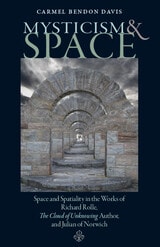
cover of Mysticism and Space: Space and Spatiality in the Works of Richard Rolle, The Cloud of Unknowing Author, and Julian of Norwich

Mysticism and Space

Space and Spatiality in the Works of Richard Rolle, The Cloud of Unknowing Author, and Julian of Norwich

Carmel Bendon Davis

Catholic University of America Press, 2008

Mysticism and Space examines the influence and representation of space in the texts of three medieval mystics, Richard Rolle, Julian of Norwich, and The Cloud of Unknowing author
[more]