Results by title
100 books match the query 'Missions' and 11 start with m
Making Men, Making Class
The YMCA and Workingmen, 1877-1920Thomas Winter
University of Chicago Press, 2002
Starting in the 1870s, the leaders ("secretaries") of the YMCA sought to reduce political radicalism and labor unrest by instilling new ideals of manliness among workers. By involving workingmen in a range of activities on the job and off, the YMCA hoped to foster team spirit, moral conduct, and new standards of manhood that would avoid conflict and instead encourage cooperation along the lines of a Christian, pious manliness. In their efforts to make better men, the secretaries of the YMCA also crafted new ideals of middle-class manliness for themselves that involved a sense of mission and social purpose. In doing so, they ended up "making" class, too, as they began to speak a language of manhood structured by class differences.
Making War and Minting Christians
Masculinity, Religion, and Colonialism in Early New EnglandR. Todd Romero
University of Massachusetts Press, 2011
In this book, R. Todd Romero traces the interaction of notions of gender, the practice of religion, and the conduct of warfare in colonial America. He shows how Native and Anglo-American ideas of manhood developed in counterpoint, in the context of Christian evangelization, colonial expansion, and recurrent armed conflict.
For the English, the cultivation of manliness became an important aspect of missionary efforts. Conversion demanded that the English “make men” of the Indians before they could “make them Christians,” a process that involved reshaping Native masculinity according to English patriarchal ideals that the colonists themselves rarely matched. For their part, Native Americans held on to older ways of understanding the divine and defining gender even as they entered English “praying towns” and negotiated the steep demands of the missionaries.
Evolving ideas of masculinity resonated with religious significance and shaped the meaning of warfare for Natives and colonists alike. Just as the English believed that their territorial expansion was divinely sanctioned, Indians attributed a string of victories in King Philip's War to “the Great God” and the perception that their enemies “were like women.” Trusting that war and manliness were necessarily linked, both groups engaged in ritual preparations for battle, believed deeply in the efficacy of the supernatural to affect the outcome of combat, and comprehended the meaning of war in distinctly religious ways.
Mapping Identity
The Creation of the Coeur d'Alene Indian Reservation, 1805-1902Laura Woodworth-Ney
University Press of Colorado, 2004
Mapping Identity builds on the growing body of literature that presents a more complex picture of federal policy, native identity, and the creation of Indian reservations in the western United States. It will be important to readers interested in western U.S. history, legal and administrative history, Native American history, and interior Northwest history.

Massacre at the Yuma Crossing
Spanish Relations with the Quechans, 1779-1782Mark Santiago
University of Arizona Press, 1998
The route from the Spanish presidial settlements in upper Sonora to the Colorado River was called the Camino del Diablo, the "Road of the Devil." Running through the harshest of deserts, this route was the only way for the Spanish to transport goods overland to their settlements in California. At the end of the route lay the only passable part of the lower Colorado, and the people who lived around the river, the Yumas or Quechans, initially joined into a peaceful union with the Spanish. When the relationship soured and the Yumas revolted in 1781, it essentially ended Spanish settlement in the area, dashed the dreams of the mission builders, and limited Spanish expansion into California and beyond.
In Massacre at the Yuma Crossing, Mark Santiago introduces us to the important and colorful actors involved in the dramatic revolt of 1781: Padre Francisco Garcés, who discovered a path from Sonora to California, made contact with the Yumas and eventually became their priest; Salvador Palma, the informal leader of the Yuman people, whose decision to negotiate with the Spanish earned him a reputation as a peacebuilder in the region, which eventually caused his downfall; and Teodoro de Croix, the Spanish commandant-general, who, breaking with traditional settlement practice, established two pueblos among the Quechans without an adequate garrison or mission, thereby leaving the settlers without any sort of defense when the revolt finally took place.
Massacre at the Yuma Crossing not only tells the story of the Yuma Massacre with new details but also gives the reader an understanding of the pressing questions debated in the Spanish Empire at the time: What was the efficacy of the presidios? How extensive should the power of the Catholic mission priests be? And what would be the future of Spain in North America?
Michoacán and Eden
Vasco de Quiroga and the Evangelization of Western MexicoBy Bernardino Verástique
University of Texas Press, 2000
Don Vasco de Quiroga (1470-1565) was the first bishop of Michoacán in Western Mexico. Driven by the desire to convert the native Purhépecha-Chichimec peoples to a purified form of Christianity, free of the corruptions of European Catholicism, he sought to establish New World Edens in Michoacán by congregating the people into pueblo-hospital communities, where mendicant friars could more easily teach them the fundamental beliefs of Christianity and the values of Spanish culture.
In this broadly synthetic study, Bernardino Verástique explores Vasco de Quiroga's evangelizing project in its full cultural and historical context. He begins by recreating the complex and not wholly incompatible worldviews of the Purhépecha and the Spaniards at the time of their first encounter in 1521. With Quiroga as a focal point, Verástique then traces the uneasy process of assimilation and resistance that occurred on both sides as the Spaniards established political and religious dominance in Michoacán. He describes the syncretisms, or fusions, between Christianity and indigenous beliefs and practices that arose among the Purhépecha and relates these to similar developments in other regions of Mexico.
Written especially for students and general readers, this book demonstrates how cultural and geographical environments influence religious experience, while it adds to our understanding of the process of indigenous appropriation of Christian theological concepts in the New World.
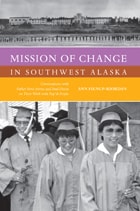
Mission of Change in Southwest Alaska
Conversations with Father René Astruc and Paul Dixon on Their Work with Yup’ik PeopleEdited by Ann Fienup-Riordan
University of Alaska Press, 2012
Mission of Change is an oral history describing various types of change—political, social, cultural, and religious—as seen through the eyes of Father Astruc and Paul Dixon, non-Natives who dedicated their lives to working with the Yup’ik people. Their stories are framed by the an analytic history of regional changes, together with current anthropological theory on the nature of cultural change and the formation of cultural identity. The book presents a subtle and emotionally moving account of the region and the roles of two men, both of whom view issues from a Catholic perspective yet are closely attuned to and involved with changes in the Yup’ik community.
Mission of Sorrows
Jesuit Guevavi and the Pimas, 1691–1767John L. Kessell; Foreword by Ernest J. Burrus, S.J.
University of Arizona Press, 1970
For three-quarters of a century, from the first visit by the renowned Eusebio Francisco Kino in 1691 until the Jesuit Expulsion in 1767, the difficult process of replacing one culture with another—the heart of the Spanish mission system—went on at Guevavi. Yet all but the initial years presided over by Father Kino have been forgotten.
Drawing upon archival materials in Mexico, Spain, and the United States—including accounts by the missionaries themselves and the surviving pages of the Guevavi record books—Kessell brings to life those forgotten years and forgotten men who struggled to transform a native ranchería into an ordered mission community.
Of the eleven Black Robes who resided at Guevavi between 1701 and 1767, only a few are well known to history. Others—such as Joseph Garrucho, who presided more years at Guevavi than any other Padre; Alexandro Rapicani, son of a favorite of Sweden's Queen Christina; Custodio Zimeno, Guevavi's last Jesuit—have the details of their roles filled in here for the first time.
In this in-depth study of a single missionary center, Kessell describes in detail the daily round of the Padres in their activities as missionaries, educators, governors, and intercessors among the often-indifferent and occassionally hostile Pimas. He discusses the Pima uprising of 1751 and the events that led up to it, concluding that it actually continued sporadically for some ten years.
The growing ferocity of the Apache, the disastrous results of certain government policies—especially the removal of the Sobaípuri Indians from the San Pedro Valley—and the declining native population due to a combination of enforced culture change and epidemics of European diseases are also carefully explored.
The story of Guevavi is one of continuing adversity and triumph. It is the story, finally, of explusion for the Jesuits and, a few short years later, the end of Mission Guevavi at the hands of the Apaches.
In Mission of Sorrows Kessell has projected meticulous research into a highly readable narrative to produce an important contribution to the history of the Spanish Borderlands.
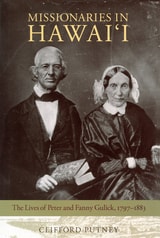
Missionaries in Hawai'i
The Lives of Peter and Fanny Gulick, 1797-1883Clifford Putney
University of Massachusetts Press, 2010
Ever since Protestant missionaries from the United States first reached Hawai'i in 1820, they have inspired conflicting passions. In evangelical circles, the missionaries are praised for Christianizing Hawai'i, transforming Hawaiian into a written language, and inoculating the islanders against smallpox. But this celebratory assessment is rejected by modern-day Hawaiian nationalists, who excoriate the missionaries as advance agents of U.S. imperialism.
In this biography of pioneer missionaries Peter and Fanny Gulick, Clifford Putney offers a balanced view of their contributions. He says the nationalists are right to credit the missionaries with drawing Hawai'i into America's political orbit, but argues that the missionary enterprise helped in some ways to preserve key elements of Hawaiian culture.
Based primarily on letters, journals, and other archival materials, Putney's book provides readers with a detailed portrait of the lives of Peter and Fanny Gulick. Inspired by America's Second Great Awakening to spread the Gospel overseas, the Gulicks voyaged to Hawai'i in 1828 and lived there for the next forty-six years, actively proselytizing and working to change the islands. On Kaua'i, they helped to ensure the success of Hawai'i's first sugar plantation and acquainted Hawaiians with inventions such as the wagon. On Moloka'i (later the site of a leper colony) the couple struggled merely to survive. And on O'ahu, they took up ranching and helped to found Punahou School, the alma mater of President Barack Obama.
While laboring in Hawai'i, the Gulicks interacted with kings, queens, and other historically important figures, and Putney chronicles those relationships. He also explores issues of race and gender, and sheds new light on the democratization of government, the spread of capitalism, and the privatization of land. From these last two developments, a number of missionaries grew immensely rich, but the Gulicks did not, and neither did their descendants. A group that includes influential missionaries, educators, and physical fitness experts, the descendants of Peter and Fanny have had numerous books written about them, but Putney is the first to write extensively about the progenitors of the Gulick clan.
Missionaries, Miners, and Indians
Spanish Contact with the Yaqui Nation of Northwestern New Spain, 1533–1820Evelyn Hu-DeHart
University of Arizona Press, 1981
More than a tale of Yaqui Indian resistance, Missionaries, Miners, and Indians documents the history of the Jesuit missions during a period of encroaching secularization. The Yaqui rebellion of 1740, analyzed here in detail, enabled the Yaqui to work for the mines without repudiating the missions; however, the erosion of the mission system ultimately led to the Jesuits’ expulsion from New Spain in 1767, and through their own perseverance, the Yaqui were able to bring their culture intact into the nineteenth century.
Missionary Scientists
Jesuit Science in Spanish South America, 1570-1810Andres I. Prieto
Vanderbilt University Press, 2011
What becomes clear throughout Missionary Scientists is that early missionaries were adept in adapting to local practices, in order to both understand the scientific foundations of these techniques and ingratiate themselves to the native communities.
Spanning the disciplines of history, religion, and Latin American studies, Missionary Scientists reshapes our understanding of the importance of the Jesuit missions in establishing early scientific traditions in the New World.
More Than God Demands
Politics and Influence of Christian Missions in Northwest Alaska, 1897-1918Anthony Urvina with Sally Urvina
University of Alaska Press, 2016
Anthony Urvina, whose mother was an orphan raised at one of the missions established as part of this program, draws on details from her life in order to present the first full history of this missionary effort. Smoothly combining personal and regional history, he tells the story of his mother’s experience amid a fascinating account of Alaska Native life and of the men and women who came to Alaska to spread the word of Christ, confident in their belief and unable to see the power of the ancient traditions they aimed to supplant.