Results by title
2335 books match the query 'Modern' and 147 start with m
MAKING STORIES, MAKING SELVES
FEMINIST REFLECTIONS ON THE HOLOCAUSTR. Ruth Linden
The Ohio State University Press, 1995
Urged forward by these silences, Linden, a feminist and sociologist, began to interview Jewish Holocaust survivors in 1983. As Linden interprets survivors' accounts of the death camps and the resistance, she reveals complex ways in which selves are constructed through storytelling. The stories that unfold are continuously fashioned and refashioned—never stripped of context or frozen in time. What emerges is an unexpectedly elegant montage in which interviewee, interviewer, and author are intertwined.
Linden's meetings with survivors and her encounters with their stories transformed her as a feminist, a Jew, and a social scientist. Her analysis reveals the intimate connections between an ethnographer's lived experience and her interpretations of others'. Linden's reflections on the process of ethnography belie the rhetoric of positivism in the social sciences. They will inspire other scholars to break free of research and writing practices in their own disciplines that efface the ineluctable bond between knower and known. All readers will be challenged to reexamine the Holocaust in an intensely personal light and to reconsider the meanings of survival in our own time.
Cutting across the boundaries of ethnography and autobiography to create a new kind of text, Making Stories, Making Selves offers a significant contribution to interpretive social science and the literature of the Holocaust. Linden's original and courageous work is vital reading for Holocaust scholars, students of modern Jewish life, sociologists, feminist theorists, and all readers seeking to understand their own relationship to the Holocaust.
MAKING THE “AMERICA OF ART”
Cultural Nationalism and Nineteenth-Century Women WritersNaomi Z. Sofer
The Ohio State University Press, 2005
By the end of the 19th century it had become possible for American women to identify themselves as serious Artists. This was a relatively new phenomenon, one that became possible only after American women writers had dismantled the conceptual frameworks that had authorized their artistic production since the early days of the Republic.
Making the “America of Art” demonstrates that beginning in the 1850s, women writers challenged the terms of the Scottish Common Sense philosophy, which had made artistic endeavors acceptable in the new Republic by subordinating aesthetic motivation to moral and educational goals. Harriet Beecher Stowe and Augusta Jane Evans drew on Ruskin to argue for the creation of a religiously based national aesthetic. In the postbellum years Louisa May Alcott, Rebecca Harding Davis, Elizabeth Stuart Phelps, and Constance Fenimore Woolson continued the process in a series of writings that revolved around three central areas of concern: the place of the popular in the realm of high art; the role of the genius; and the legacy of the Civil War.
Sofer significantly revises the history of 19th-century American women’s authorship by detailing the gradual process that produced women writers wholly identified with literary high culture at the century’s end. Sofer argues that, counter to conventional wisdom, American women writers produced a large body of theoretical writing on the central aesthetic questions of the day. Although the writers Sofer studies were finally unable to construct viable new models for women’s artistic production, their attempts to do so are an essential piece of American literary history.
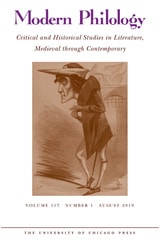
MP vol 117 num 1
The University of Chicago Press
University of Chicago Press Journals, 2019
MUSE IN THE MACHINE
AMERICAN FICTION AND MASS PUBLICITYMARK CONROY
The Ohio State University Press, 2004
Machado de Assis and Narrative Theory
Language, Imitation, Art, and Verisimilitude in the Last Six NovelsEarl E. Fitz
Bucknell University Press, 2019
Published by Bucknell University Press. Distributed worldwide by Rutgers University Press.
Madness, Language, Literature
Michel Foucault
University of Chicago Press, 2023
Perceiving an enigmatic relationship between madness, language, and literature, French philosopher Michel Foucault developed ideas during the 1960s that are less explicit in his later, more well-known writings. Collected here, these previously unpublished texts reveal a Foucault who undertakes an analysis of language and experience detached from their historical constraints. Three issues predominate: the experience of madness across societies; madness and language in Artaud, Roussel, and Baroque theater; and structuralist literary criticism. Not only do these texts pursue concepts unique to this period such as the “extra-linguistic,” but they also reveal a far more complex relationship between structuralism and Foucault than has typically been acknowledged.
Magical Realism and the History of the Emotions in Latin America
Jerónimo Arellano
Bucknell University Press, 2026
Published by Bucknell University Press. Distributed worldwide by Rutgers University Press.
Making Ideas Visible in the Eighteenth Century
Jennifer Milam
University of Delaware Press, 2022
Making Meaning
"Printers of the Mind" and Other EssaysD. F. McKenzie
University of Massachusetts Press, 2002
The greatest bibliographer of our time, was how historian Robert Darnton described D. F. McKenzie. Yet until now many of McKenzie's major essays, scattered in specialist journals and inaccessible publications, have circulated mainly in tattered photocopies. This volume, edited by two of McKenzie's former students, brings together for the first time a wide range of his writings on bibliography, the book trade, and the “sociology of texts.” Selected by the author himself before his sudden death in 1999, the essays range from the material transmission of Shakespeare's plays in the seventeenth century to the connections among oral, manuscript, and print cultures.
Making Meaning reflects McKenzie's virtuosity as a traditional bibliographer and reveals how his thought-provoking scholarship made him a driving force in the genesis and development of the new interdisciplinary field of book history. His refusal to recognize the traditional boundary between bibliography and literary history re-energized the study of the social, political, economic, and cultural aspects of book production and reception.
The editors' introduction and headnotes situate McKenzie's innovative and controversial thinking in the debates of his time.
Making Modern Love
Sexual Narratives and Identities in Interwar BritainLisa Z. Sigel
Temple University Press, 2012
After the Great War, British men and women grappled with their ignorance about sexuality and desire. Seeking advice and information from doctors, magazines, and each other, they wrote tens of thousands of letters about themselves as sexual subjects. In these letters, they disclosed their uncertainties, their behaviors, and the role of sexuality in their lives. Their fascinating narratives tell how people sought to unleash their imaginations and fashion new identities.
Making Modern Love shows how readers embraced popular media—self-help books, fetish magazines, and advice columns—as a source of information about sexuality and a means for telling their own stories. From longings for transcendent marital union to fantasies of fetish-wear, cross-dressing, and whipping, men and women revealed a surprising range of desires and behaviors (queer and otherwise) that have been largely disregarded until now.
Lisa Sigel mines these provocative narratives to understand how they contributed to new subjectivities and the development of modern sexualities.
Making Modern Spain
Religion, Secularization, and Cultural ProductionAzariah Alfante
Bucknell University Press, 2024
Making Money
Life, Death, and Early Modern Trade on Africa’s Guinea CoastColleen E. Kriger
Ohio University Press, 2017
A new era in world history began when Atlantic maritime trade among Africa, Asia, Europe, and the Americas opened up in the fifteenth century, setting the stage for massive economic and cultural change. In Making Money, Colleen Kriger examines the influence of the global trade on the Upper Guinea Coast two hundred years later—a place and time whose study, in her hands, imparts profound insights into Anglo-African commerce and its wider milieu.
A stunning variety of people lived in this coastal society, struggling to work together across deep cultural divides and in the process creating a dynamic creole culture. Kriger digs further than any previous historian of Africa into the records of England’s Royal African Company to illuminate global trade patterns, the interconnectedness of Asian, African, and European markets, and—most remarkably—the individual lives that give Making Money its human scale.
By inviting readers into the day-to-day workings of early modern trade in the Atlantic basin, Kriger masterfully reveals the rich social relations at its core. Ultimately, this accessible book affirms Africa’s crucial place in world history during a transitional period, the early modern era.
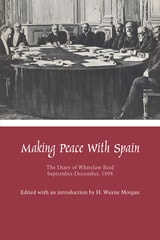
Making Peace with Spain
The Diary of Whitelaw Reid, September-December, 1898By Whitelaw Reid; edited by H. Wayne Morgan
University of Texas Press, 1965
Whitelaw Reid, according to H. Wayne Morgan, was a “leading newspaperman, more than an occasional diplomat, a power in his party’s politics, a supporter of some of the best in his era’s culture . . . Of all his legacy, perhaps the record he left of his part in the Peace of Paris is the most significant and most interesting. It not only reveals the workings of his mind and of the peace conference, but also suggests the complex currents that carried his country into the realities of world power in the twentieth century.”
In editing Reid’s diary, Morgan used much material pertinent to the Paris Peace Conference of 1898, employed here for the first time. This material is a rich assortment of archival matter: the Reid Papers, the John Hay Papers, the John Bassett Moore Papers, and the McKinley Papers, in the Library of Congress; the Peace Commission records, in the National Archives; and unpublished materials in the Central Files of the Department of State.
Whitelaw Reid, as a war correspondent during the Civil War, as clerk of the House Military Affairs Committee, and later as a successor to Horace Greeley on the Tribune, gained access to the leaders of his times and insight into their actions. In 1889 he was appointed U.S. Minister to France by Harrison, and in 1892 he had the dubious honor of being chosen as Harrison’s running mate on the losing presidential ticket. An influential friend and supporter of President McKinley and an occasional advisor to him, Reid was no stranger to politics and to international diplomacy when McKinley appointed him to the Peace Commission that wrote the treaty concluding the Spanish-American War. As a matter of fact, Reid’s opinion reflected the administration’s attitude of expansionism, the policy of Manifest Destiny—or “imperialism,” as it was later called.
Reid’s diary records the details of the sessions of the Joint Peace Commission of Paris from September through a large part of December of 1898. His day-by-day entries reveal the complexity of issues to be considered, the tactics of both the Spanish and the American Commissions in attempting to gain advantage for their respective governments, the interplay of the personalities of the once-proud Spaniards and the brash Americans, the political objectives influencing the points of view of the various members, and the maneuverings that brought about the final resolution of debated issues.
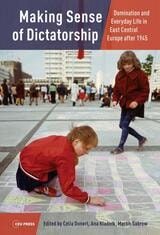
Making Sense of Dictatorship
Domination and Everyday Life in East Central Europe after 1945Celia Donert
Central European University Press, 2022
How did political power function in the communist regimes of East Central Europe after 1945? Making Sense of Dictatorship addresses this question with a particular focus on the acquiescent behavior of the majority of the population until, at the end of the 1980s, their rejection of state socialism and its authoritarian world.
The authors refer to the concept of Sinnwelt, the way in which groups and individuals made sense of the world around them. The essays focus on the dynamics of everyday life and the extent to which the relationship between citizens and the state was collaborative or antagonistic. Each chapter addresses a different aspect of life in this period, including modernization, consumption and leisure, and the everyday experiences of “ordinary people,” single mothers, or those adopting alternative lifestyles.
Empirically rich and conceptually original, the essays in this volume suggest new ways to understand how people make sense of everyday life under dictatorial regimes.
Making Stars
Biography and Celebrity in Eighteenth-Century BritainNora Nachumi
University of Delaware Press, 2022
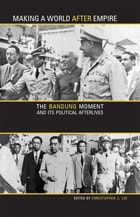
Making a World after Empire
The Bandung Moment and Its Political AfterlivesChristopher J. Lee
Ohio University Press, 2010
In April 1955, twenty-nine countries from Africa, Asia, and the Middle East came together for a diplomatic conference in Bandung, Indonesia, intending to define the direction of the postcolonial world. Representing approximately two-thirds of the world’s population, the Bandung conference occurred during a key moment of transition in the mid-twentieth century—amid the global wave of decolonization that took place after the Second World War and the nascent establishment of a new cold war world order in its wake. Participants such as Jawaharlal Nehru of India, Gamal Abdel Nasser of Egypt, Zhou Enlai of China, and Ahmed Sukarno of Indonesia seized this occasion to attempt the creation of a political alternative to the dual threats of Western neocolonialism and the cold war interventionism of the United States and the Soviet Union.
The essays in this volume explore the diverse repercussions of this event, tracing the diplomatic, intellectual, and sociocultural histories that have emanated from it. Making a World after Empire consequently addresses the complex intersection of postcolonial history and cold war history and speaks to contemporary discussions of Afro-Asianism, empire, and decolonization, thus reestablishing the conference’s importance in twentieth-century global history.
Contributors: Michael Adas, Laura Bier, James R. Brennan, G. Thomas Burgess, Antoinette Burton, Dipesh Chakrabarty, Julian Go, Christopher J. Lee, Jamie Monson, Jeremy Prestholdt, Denis M. Tull
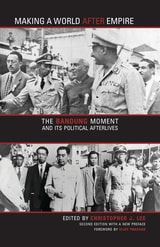
Making a World after Empire
The Bandung Moment and Its Political AfterlivesChristopher J. Lee
Ohio University Press, 2019
With a new foreword by Vijay Prashad
In April 1955, twenty-nine countries from Africa, Asia, and the Middle East came together for a diplomatic conference in Bandung, Indonesia, intending to define the direction of the postcolonial world. Ostensibly representing two-thirds of the world’s population, the Bandung conference occurred during a key moment of transition in the mid-twentieth century—amid the global wave of decolonization that took place after the Second World War and the nascent establishment of a new Cold War world order in its wake. Participants such as Jawaharlal Nehru of India, Gamal Abdel Nasser of Egypt, Zhou Enlai of China, and Sukarno of Indonesia seized this occasion to attempt the creation of a political alternative to the dual threats of Western neocolonialism and the Cold War interventionism of the United States and the Soviet Union.
The essays collected here explore the diverse repercussions of this event, tracing diplomatic, intellectual, and sociocultural histories that ensued as well as addressing the broader intersection of postcolonial and Cold War history. With a new foreword by Vijay Prashad and a new preface by the editor, Making a World after Empire speaks to contemporary discussions of decolonization, Third Worldism, and the emergence of the Global South, thus reestablishing the conference’s importance in twentieth-century global history.
Contributors: Michael Adas, Laura Bier, James R. Brennan, G. Thomas Burgess, Antoinette Burton, Dipesh Chakrabarty, Julian Go, Christopher J. Lee, Jamie Monson, Jeremy Prestholdt, and Denis M. Tull.
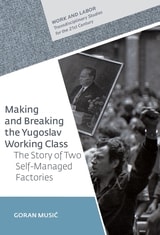
Making and Breaking the Yugoslav Working Class
The Story of Two Self-Managed FactoriesGoran Music
Central European University Press, 2021
Workers' self-management was one of the unique features of communist Yugoslavia. Goran Musić has investigated the changing ways in which blue-collar workers perceived the recurring crises of the regime. Two self-managed metal enterprises, one in Serbia another in Slovenia, provide the frame of the analysis in the time span between 1945 and 1989. These two factories became famous for strikes in 1988 that evoked echoes in popular discourses in former Yugoslavia. Drawing on interviews, factory publications and other media, local archives, and secondary literature, Musić analyzes the two cases, going beyond the clichés of political manipulation from the top and workers' intrinsic attraction to nationalism.
The author explains how, in the later phase of communist Yugoslavia, growing social inequalities among the workers and undemocratic practices inside the self-managed enterprises facilitated the spread of a nationalist and pro-market ideology on the shop floors. Yet rather than being a mass taken advantage of by populist leaders, the working class Musić presents is one with agency and voice, a force that played an important role in shaping the fate of the country. The book thus seeks to open a debate on the social processes leading up to the dissolution of Yugoslavia.
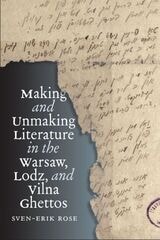
Making and Unmaking Literature in the Warsaw, Lodz, and Vilna Ghettos
Sven-Erik Rose
Brandeis University Press, 2025
A study of literature written by Jewish authors while interned in Nazi ghettos emphasizes how authors processed their horrific experiences through poetry and prose.
Published in Association with the United States Holocaust Memorial Museum
This is the first study devoted to how little known but essential authors grappled with the destitution of ghetto existence by writing within, at the limits of, and against an array of literary scenarios, tropes, plot lines, and generic conventions, including those of nature lyric, modernist interior monologue, the realist social novel, the detective story, and the gothic horror tale. Contending with starvation, disease, desperate housing conditions and the looming threat of being murdered, inhabitants of ghettos in Poland nonetheless made them sites of rich Jewish cultural production. Rose’s readings of these literary works reveal how authors asserted their humanity by insisting on writing works of literature. In such radically dehumanizing circumstances, however, their recourse to established literary genres was not naive. Rather, ghetto authors brilliantly meditated on the grotesque incongruities between established literary models and the extreme conditions of ghetto existence.
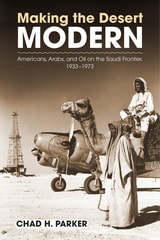
Making the Desert Modern
Americans, Arabs, and Oil on the Saudi Frontier, 1933–1973Chad Parker
University of Massachusetts Press, 2015
In 1933 American oilmen representing what later became the Arabian American Oil Company (Aramco) signed a concession agreement with the Saudi Arabian king granting the company sole proprietorship over the oil reserves in the country's largest province. As drilling commenced and wells proliferated, Aramco soon became a major presence in the region. In this book Chad H. Parker tells Aramco's story, showing how an American company seeking resources and profits not only contributed to Saudi “nation building” but helped define U.S. foreign policy during the early Cold War.
In the years following World War II, as Aramco expanded its role in Saudi Arabia, the idea of “modernization” emerged as a central component of American foreign policy toward newly independent states. Although the company engaged in practices supportive of U.S. goals, its own modernizing efforts tended to be pragmatic rather than policy-driven, more consistent with furthering its business interests than with validating abstract theories. Aramco built the infrastructure necessary to extract oil and also carved an American suburb out of the Arabian desert, with all the air-conditioned comforts of Western modern life. At the same time, executives cultivated powerful relationships with Saudi government officials and, to the annoyance of U.S. officials, even served the monarchy in diplomatic disputes. Before long the company became the principal American diplomatic, political, and cultural agent in the country, a role it would continue to play until 1973, when the Saudi government took over its operation.
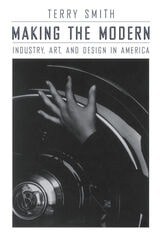
Making the Modern
Industry, Art, and Design in AmericaTerry Smith
University of Chicago Press, 1993
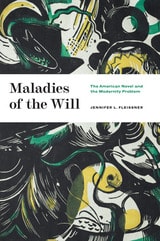
Maladies of the Will
The American Novel and the Modernity ProblemJennifer L. Fleissner
University of Chicago Press, 2022
What if the modern person were defined not by reason or sentiment, as Enlightenment thinkers hoped, but by will? Western modernity rests on the ideal of the autonomous subject, charting a path toward self-determination. Yet novelists have portrayed the will as prone to insufficiency or excess—from indecision to obsession, wild impulse to melancholic inertia. Jennifer Fleissner’s ambitious book shows how the novel’s attention to the will’s maladies enables an ongoing interrogation of modern premises from within.
Maladies of the Will reveals the nineteenth-century American novel’s relation to a wide-ranging philosophical tradition, highly relevant to our own tumultuous present. In works from Moby-Dick and The Scarlet Letter to Elizabeth Stoddard’s The Morgesons and Charles W. Chesnutt’s The Marrow of Tradition, the will’s grandeur and its perversity emerge as it alternately aligns itself with and pits itself against a bigger Will—whether of God, the state, society, history, or life itself. Today, when invocations of autonomy appear beside the medicalization of many behaviors, and democracy’s tenet of popular will has come into doubt, Maladies of the Will provides a map to how we got here, and how we might think these vital dilemmas anew.
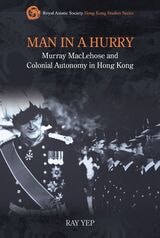
Man in a Hurry
Murray MacLehose and Colonial Autonomy in Hong KongRay Yep
Hong Kong University Press, 2024
Man in a Hurry explores the latest available archival materials and re-examines MacLehose’s pivotal governorship in Hong Kong (1971–1982). MacLehose arrived in the challenging 1970s, when there were expectations for social reforms, uneasiness in the relationship between Hong Kong and London, and the 1997 factor looming large. The governor successfully carried out various social reforms and he also handled various major issues, including the anti-corruption campaign, the Vietnamese refugee crisis, and the granting of land lease of the New Territories beyond 1997. Yep unveils the tension and bargaining between the British government and explains how interest of the colony could be asserted, defended, and negotiated. This book is an important study of Hong Kong’s "golden years" when the city’s economy took off. It is a significant contribution to our understanding of how local autonomy was defined.
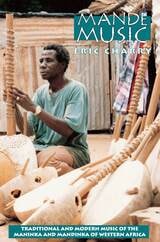
Mande Music
Traditional and Modern Music of the Maninka and Mandinka of Western AfricaEric Charry
University of Chicago Press, 2000
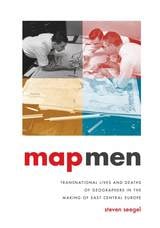
Map Men
Transnational Lives and Deaths of Geographers in the Making of East Central EuropeSteven Seegel
University of Chicago Press, 2018
Taking us deep into cartographical archives, Seegel re-creates the public and private worlds of these five mapmakers, who interacted with and influenced one another even as they played key roles in defining and redefining borders, territories, nations—and, ultimately, the interconnection of the world through two world wars. Throughout, he examines the transnational nature of these processes and addresses weighty questions about the causes and consequences of the world wars, the rise of Nazism and Stalinism, and the reasons East Central Europe became the fault line of these world-changing developments.
At a time when East Central Europe has surged back into geopolitical consciousness, Map Men offers a timely and important look at the historical origins of how the region was defined—and the key people who helped define it.
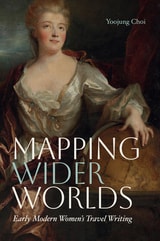
Mapping Wider Worlds
Early Modern Women's Travel WritingYoojung Choi
University of Delaware Press, 2027
Mapping Wider Worlds uncovers how early professional women writers in Britain invented a genre of women’s travel fiction in an era of increased mobility and exploration. As marketplace authorship began to take shape, writers such as Delarivier Manley, Mary Davys, Penelope Aubin, and Eliza Haywood turned to this genre to challenge the link between women’s travel and promiscuity, positioning travel instead as a site of knowledge production and self-discovery. In this book, Yoojung Choi reveals how these women authors not only reshaped cultural attitudes toward women’s mobility, but also redefined professional authorship in the late seventeenth and early eighteenth centuries, preceding and paving the way for travel literature by Lady Mary Wortley Montagu, Hester Piozzi, and Mary Wollstonecraft.

Mapping the State
English Boundaries and the 1832 Reform ActMartin Spychal
University of London Press, 2024
The 1832 Reform Act was a landmark moment in the development of modern British politics. By overhauling the country’s ancient representative system, the legislation reshaped constitutional arrangements at Westminster, reinvigorated political relationships between the center and the provinces, and established the political structures and precedents that both shaped and hindered Britain’s slow lurch towards democracy by 1928.
Mapping the State leads to a fundamental rethinking of the 1832 Reform Act by demonstrating how boundary reform and the reconstruction of England’s electoral map by the little-known 1831–1832 boundary commission underpinned this turning point in the development of the British political nation. Eschewing traditional approaches to the 1832 Reform Act, it draws from a significant new archival discovery—the working papers of the boundary commission—and a range of innovative quantitative techniques to provide a major reassessment of why and how the 1832 Reform Act passed, its impact on reformed politics both at Westminster and in the constituencies, and its significance to the expansion of the modern British state.
Margins of Philosophy
Jacques Derrida
University of Chicago Press, 1982
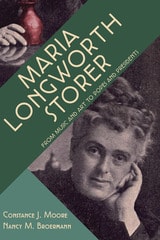
Maria Longworth Storer
From Music and Art to Popes and PresidentsConstance J. Moore; Nancy M. Broermann
Ohio University Press, 2019
Published by the University of Cincinnati Press
While the adage may go, “Behind every great man is a great woman,” the story of Maria Longworth Storer necessitates a new adage—at the front of every great city is a great woman. After being shunted into the biographies and history books of other people, Longworth Storer is now finally given center stage on the one hundred and seventieth anniversary of her birth.
Maria Longworth Storer: From Music and Art to Popes and Presidents is the most comprehensive biography of this one of a kind Cincinnatian. Known as the founder of the first female-run manufacturing company in the United States, Rookwood Pottery, Longworth Storer was passionate about women’s rights, her city, and issues of poverty and the arts. She owned Rookwood pottery for nine years, and then transferred ownership after earning recognition at the Exhibition of American Art Industry in Philadelphia and receiving a gold medal at the Exposition Universelle in Paris. Aside from her success with Rookwood, Longworth Storer was central to making the Queen City the major cultural landmark it is today. Although the rest of her life was no less remarkable as the wife of notorious diplomat Bellamy Storer, later embroiled in the famous Roosevelt-Storer scandal, little has been written about her contributions and exploits in diplomatic relations and her powerful influence on turn-of-the-twentieth-century political leaders.
Featuring new archival research, and never before seen photos of the Storer family, authors Constance J. Moore and Nancy M. Broermann have compiled a portrait of Maria Longworth Storer that is rich in detail, fitting to both the wide, often eclectic, breadth of Longworth Storer’s projects, and to the depth of her impact on leaders from Washington D.C. to Europe.
Moving through major moments in both American and Cincinnati history, and intersecting with significant historical figures including Teddy Roosevelt and William Howard Taft, Moore and Broermann expose the broader historical narrative of Longworth Storer’s life without letting her unique spirit and individual accomplishments become overshadowed by them.
Through thoughtful, balanced narrative, readers get to know a remarkable woman whose fascinating and dramatic life as a political figure, women’s rights advocate, and patron of the arts has had a long lasting legacy on the Queen City and the Shaping of our nation’s diplomatic policies.
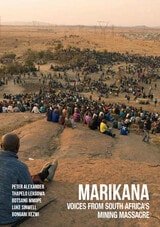
Marikana
Voices from South Africa’s Mining MassacrePeter Alexander
Ohio University Press, 2013
The Marikana Massacre of August 16, 2012, was the single most lethal use of force by South African security forces against civilians since the end of apartheid. Those killed were mineworkers in support of a pay raise. Through a series of interviews conducted with workers who survived the attack, this account documents and examines the controversial shootings in great detail, beginning with a valuable history of the events leading up to the killing of workers, and including eyewitness accounts of the violence and interviews with family members of those who perished.
While the official Farlam Commission investigation of the massacre is still ongoing, many South Africans do not hold much confidence in the government’s ability to examine its own complicity in these events. Marikana, on the other hand, examines the various roles played by the African National Congress, the mine company, and the National Union of Mineworkers in creating the conditions that led to the massacre. While the commission’s investigations take place in a courtroom setting tilted toward those in power, Marikana documents testimony from the mineworkers in the days before official statements were even gathered, offering an unusually immediate and unfiltered look at the reality from the perspective of those most directly affected. Enhanced by vivid maps that make clear the setting and situation of the events, Marikana is an invaluable work of history, journalism, sociology, and activism.
Mariupol 2013-2022
Stories of Mobilization and ResistanceHana Josticova
Central European University Press, 2024
The chapters in this book represent successive phases of one story – that of Mariupol, formerly Ukraine’s tenth largest city, and the second largest in the Donbas region. The author, a young Slovak academic, conducted her ethnographic fieldwork in this coastal town between November 2018 and August 2021. She was one of the last academics to do research in Mariupol before its invasion and eventual occupation by Russia.
During these years, Hana Jošticová was overwhelmed by acts of mobilization and resistance that went in opposite directions: support for a Western direction of Ukraine’s future, and support for the status quo that the victory of the Euromaidan seemed to threaten.
She noted the sequence of events presented in the media and through the lens of individual frames and narratives. Her book is a collection and interpretation of memories and testimonies from both sides: those who actively resisted Russian influence; and those who sparked their own revolution, the ‘Russian Spring.’ Her focus is on self-mobilized individuals who resorted to action outside of established organizational structures spontaneously, autonomously, without resources and guarantees of safety. Her evidence indicates that popular support for the Russian Spring had less to do with Russia than with the social, economic, or cultural characteristics of the Donetsk region.
Years of immersive research convinced the author that individuals are as important as masses, ideas are as powerful as material resources, and beliefs and emotions are as critical as weapons.
Mark Twain's 1884
A Pivotal Year in the LifeJohn Bird
University of Missouri Press, 2026
Many biographies of Mark Twain cover his entire life, while others focus on specific periods, especially his later years. In this innovative new work, John Bird takes an entirely different approach. Mark Twain’s 1884: A Pivotal Year in the Life is a “micro-biography” that homes in on a single—and pivotal—year.
In 1884, Twain stood at the height of his powers as a writer and enjoyed one of the happiest years in his domestic family life. During the course of the year he was readying his greatest work, Adventures of Huckleberry Finn, for publication, which occurred in England near the end of the year; he was launching his own publishing house, Charles L. Webster and Company, after becoming disillusioned with his previous publishers; and he publicly embroiled himself in presidential politics in a way that presaged his later involvement with American and international politics. Finally, Twain’s 1884 ended with a great deal more public exposure thanks to an extensive multi-city lecture tour he undertook with George Washington Cable, as well as the beginnings of his ultimately successful attempt to secure publishing rights for Ulysses S. Grant’s memoirs.
The level of detail provided by a day-to-day narrative gives the reader a chance to imaginatively live that year in Twain’s life: his work, his family life, his correspondence, his business dealings, his travels, his recreational pursuits, and his political involvement. Bird enlarges upon a great many moments in and aspects of Twain’s life that other biographies barely touch on or ignore completely.
In this new approach to biography, Bird gives readers a broader appreciation not only of Mark Twain the author but of Mark Twain the husband, father, uncle, and friend, and national celebrity and persona.
Mark Twain, Travel Books, and Tourism
The Tide of a Great Popular MovementJeffrey Alan Melton
University of Alabama Press, 2008
With the publication of The Innocents Abroad (1869), Mark Twain embarked on a long and successful career as the 19th century's best-selling travel writer. Jeffrey Melton treats Twain's travel narratives in depth, and in the context of his contemporary travel writers and a burgeoning tourism culture. As Melton shows, Twain's five major travel narratives--The Innocents Abroad, Roughing It, Life on the Mississippi, A Tramp Abroad, and Following the Equator--demonstrate Twain's mastery and reinvention of the genre.
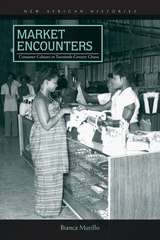
Market Encounters
Consumer Cultures in Twentieth-Century GhanaBianca Murillo
Ohio University Press, 2017
In Market Encounters, Bianca Murillo explores the shifting social terrains that made the buying and selling of goods in modern Ghana possible. Fusing economic and business history with social and cultural history, she traces the evolution of consumerism in the colonial Gold Coast and independent Ghana from the late nineteenth century through to the political turmoil of the 1970s.
Murillo brings sales clerks, market women, and everyday consumers in Ghana to the center of a story that is all too often told in sweeping metanarratives about what happens when African businesses are incorporated into global markets. By emphasizing the centrality of human relationships to Ghana’s economic past, Murillo introduces a radical rethinking of consumption studies from an Africa-centered perspective. The result is a keen look at colonial capitalism in all of its intricacies, legacies, and contradictions, including its entanglement with gender and race.
Martin Heidegger
George Steiner
University of Chicago Press, 1987
Acquaintance with the work of Martin Heidegger is indispensable to an understanding of contemporary thought and culture. His work has had a profound influence on a number of disciplines, including theology, Sartrean existentialism, linguistics, Hellenic studies, the structuralist and hermeneutic schools of textual interpretation, literary theory, and literature itself. With characterisitc lucidity and style, George Steiner makes this philosopher’s immensely difficult body of work accessible to the general reader. The breadth of Steiner’s learning and interests also allows him to place Heidegger in a broader Continental literary-cultural context. In a new Introduction, Steiner addresses language and philosophy and the rise of Nazism

Martin Mariner
Nico Braas
Amsterdam University Press, 2023
Marxism and the Interpretation of Culture
Edited by Cary Nelson and Lawrence Grossberg
University of Illinois Press, 1988
Masculine Births
Milton, Women, and the LawLynne Greenberg
Northwestern University Press, 2026
Examining the legal lives of early modern women through Milton’s literary works
In his History of Britain, John Milton writes, “Laws are Masculin Births . . . nothing [is] more awry from the Law of God and Nature, then that a Woman should give Laws to Men.” In this interdisciplinary study, Lynne Greenberg explores the normative and nonnormative legal lives of early modern women as depicted in Milton’s works—unmarried and married women, mothers, heiresses, widows, and queens—providing cogent overviews of the laws of multiple jurisdictions to offer critical context for each case study. Greenberg explores a wide range of legal-juridical materials and previously unexplored archival and private family documents. As she demonstrates, while Milton’s narratives are at times enmeshed in existing jural paradigms, they also offer resistant responses to marital, custodial, property, inheritance, and criminal laws and even imagine alternative jural paradigms for women. Through Masculine Births: Milton, Women and the Law, Greenberg deftly reveals that Milton both reproduces seventeenth-century legal constructs and gives birth to laws that move us toward greater equality for women.
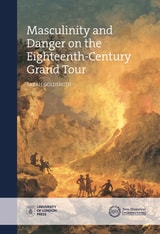
Masculinity and Danger on the Eighteenth-Century Grand Tour
Sarah Goldsmith
University of London Press, 2020
Goldsmith demonstrates that the Grand Tour was a means of constructing Britain’s next generation of leaders. Influenced by aristocratic concepts of honor and inspired by military-style leadership, elite society viewed experiences of danger and hardship as powerfully transformative and therefore as central to constructing masculinity. Scaling mountains, volcanoes, and glaciers, and even encountering war and disease, Grand Tourists willingly tackled a variety of perils. Through her study of these dangers, Goldsmith offers a bold revision of eighteenth-century elite masculine culture and the critical role the Grand Tour played within it.
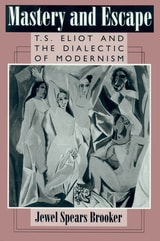
Mastery and Escape
T. S. Eliot and the Dialectic of ModernismJewel Spears Brooker
University of Massachusetts Press, 1994
This seminal scholarly work examines T. S. Eliot's literary development and philosophical outlook through the lens of modernist dialectics, exploring the tension between mastery and escape as central to understanding both his poetry and critical thought. Edited and written by acclaimed Eliot scholar Jewel Spears Brooker, this volume presents expert studies of key intellectual influences on Eliot's modernism—particularly Stéphane Mallarmé, Sir James George Frazer, F. H. Bradley, and T. E. Hulme—yielding fresh and original insights into how these thinkers shaped the poet's artistic vision.
Through careful textual analysis and intellectual history, Brooker investigates how Eliot grappled with fundamental modernist anxieties: the desire for artistic mastery and transcendence alongside the simultaneous impulse toward escape from the constraints of tradition, rationality, and conventional form. She demonstrates how Eliot's poetry and prose reflect a dialectical movement, a constant interplay between opposing forces, that defines both his modernist aesthetics and his philosophical positions.
An essential resource for scholars seeking comprehensive understanding of modernism's philosophical foundations and poetic achievements, Brooker is devoted to tracing both dialectical movements and biographical developments in Eliot's career.
Matthew Arnold the Ethnologist
Frederic E. Faverty
Northwestern University Press, 1951
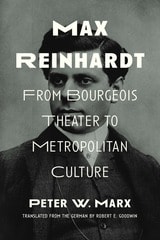
Max Reinhardt
From Bourgeois Theater to Metropolitan CulturePeter W. Marx, translated from the German by Robert E. Goodwin
Northwestern University Press, 2024
At the same time, Reinhardt soon longed for an international range: guest performances throughout Europe and to the US soon made him into a global star – and even a brand. He represents a metropolitan culture that roots in the late nineteenth century but comes to an end when Fasicsm in Europe ended any hopes for an international culture. As a Jew, Reinhardt himself had to flee the Nazis but when he eventually arrived in the US, he could not follow up with his earlier successes. Marx provides a broad panorama of Reinhardt's work, portraying not only his work method and some of his best known productions, but also the cultural conditions of his visionary enterprise.

May '68
Donald M. Reid and Daniel J. Sherman, special issue editors
Duke University Press, 2018
Contributors: Ludivine Bantigny, Françoise Blum, Tony Côme, Boris Gobille, Bethany Keenan, Salar Mohandesi, Donald Reid, Sandrine Sanos, Daniel Sherman
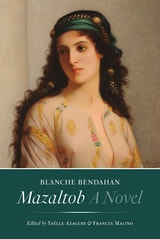
Mazaltob
A NovelBlanche Bendahan
Brandeis University Press, 2024
Raised in the Judería or Jewish quarter of Tetouan, Morocco, at the turn of the 20th-century, sixteen-year-old Mazaltob finds herself betrothed to José, an uncouth man from her own community who has returned from Argentina to take a wife. Mazaltob, however, is in love with Jean, who is French, half-Jewish, and a free spirit. In this classic of North African Jewish fiction, Blanche Bendahan evokes the two compelling forces tearing Mazaltob apart in her body and soul: her loyalty to the Judería and her powerful desire to follow her own voice and find true love. Bendahan’s nuanced and moving novel is a masterly exploration of the language, religion, and quotidian customs constraining North African Jewish women on the cusp of emancipation and decolonization. Yaëlle Azagury and Frances Malino provide the first English translation of this modern coming-of-age tale, awarded a prize by the Académie Française in 1930, and analyze the ways in which Mazaltob, with its disconcerting blend of ethnographic details and modernist experimentation, is the first of its genre—that of the feminist Sephardi novel. A historical introduction, a literary analysis, and annotations elucidate historical and cultural terms for readers, supplementing the author’s original notes.
Meaning, Basic Self-Knowledge, and Mind
Essays on Tyler BurgeEdited by María Frápolli and Esther Romero
CSLI, 2003
The authors of the eleven papers here expound their versions of this position and go on to critique Burge's version. Together with Burge's replies, this volume offers a major contribution to contemporary philosophy.
Medbh McGuckian
Borbála Faragó
Bucknell University Press, 2025
Published by Bucknell University Press. Distributed worldwide by Rutgers University Press.
Meddling in Middle Europe
Britain and the 'Lands Between' 1919-1925Miklos Lojkó
Central European University Press, 2006
Media Constrained by Context
International Assistance and Democratic Media Transition in the Western BalkansKristina Irion
Central European University Press, 2018
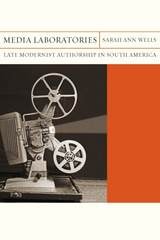
Media Laboratories
Late Modernist Authorship in South AmericaSarah Ann Wells
Northwestern University Press, 2017
Media Laboratories explores a pivotal time for South American literature of the 1930s and ’40s. Cinema, radio, and the typewriter, once seen as promising catalysts for new kinds of writing, began to be challenged by authors, workers, and the public. What happens when media no longer seem novel and potentially democratic but rather consolidated and dominant? Moving among authors from Brazil, Argentina, and Uruguay, and among the genres of fiction, the essay, popular journalism, and experimental little magazines, Sarah Ann Wells shows how writers on the periphery of global modernity were fashioning alternative approaches to these media. Analyzing authors such as Clarice Lispector, Jorge Luis Borges, and Felisberto Hernández, along with their lesser-known contemporaries, Media Laboratories casts a wide net: from spectators of Hollywood and Soviet montage films, to inventors of imaginary media, to proletarian typists who embodied the machine-human encounters of the period. The text navigates contemporary scholarly and popular debates about the relationship of literature to technological innovation, media archaeology, sound studies, populism, and global modernisms. Ultimately, Wells underscores a question that remains relevant: what possibilities emerge when the enthusiasm for new media has been replaced by anxiety over their potentially pernicious effects in a globalizing, yet vastly unequal, world?
Media and the Global Cold War
Edited by Rossen Djagalov and Arvind Rajagopal
University of Illinois Press, 2027
Arvind Rajagopal and Rossen Djagalov present essays on the uses of Cold War media. Focusing on the Global South, the contributors illuminate how postcolonial nations and others defied superpower pressure to use media for nation-building and international cooperation. At the same time, communication infrastructures linked global regions in unequal ways that often reinforced the power of the United States. Throughout, the essays show how Cold War media practices like secrecy, propaganda, and cultural diplomacy cemented patterns that still influence global communication systems and international politics today.
Cutting-edge and timely, Media and the Global Cold War reveals the workings of media beyond the superpower rivalry.