“This is an excellent scholarly contribution that does not limit itself to regional contexts and instead traces transcultural and transnational connections in the study and reevaluation of the Latin American chronicle and magical realist narratives. . . . Essential.”— CHOICE
"This study sheds a novel light on an already extensively researched topic. The argument is daring, subtle and remains engaging throughout the book."— Forum for Modern Language Studies
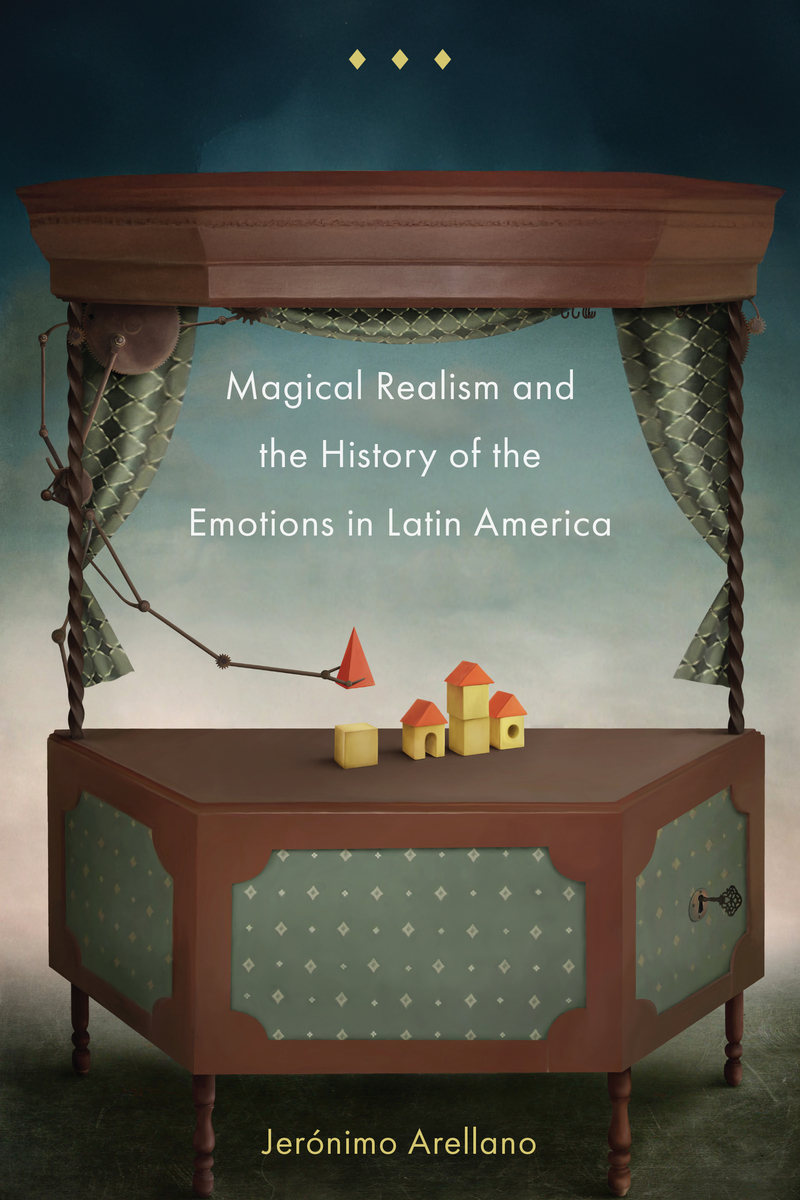
"This book makes a valuable contribution to a crowded area of research by approaching magical realism through affect studies, the history of the emotions, and new materialist studies. Impeccably researched in all areas of expertise, Magical Realism and the History of the Emotions in Latin America is a sophisticated study that models the kinds of innovative readings that new emotions-based and object-oriented theories may facilitate in Latin American literary and cultural studies."
— Modern Language Quarterly
"Magical Realism and the History of the Emotions in Latin America successfully directs the insights of the affective turn in the humanities towards magical realism and Latin America. This changes the game as far as our thinking about magical realism is concerned."— Chris Warnes, coeditor of Magical Realism and Literature
“Magical Realism and the History of Emotions in Latin America is an erudite, thought-provoking, and intellectually-probing volume. Jerónimo Arellano succeeded in bringing to the fore the theory of affect to the cultural history of Latin America and, in doing so, shed new light on both canonical and less canonical works from different times. It is a contribution to Latin American studies meant to last.”— Revista de Estudios Hispánicos
“Una de las más convincentes demostraciones de la productividad del llamdo 'giro afectivo' en el pensamiento crítico latinoamericano contemporáneo. Un acercamiento pionero a la maravilla en el marco de la cuestión del afecto y las emociones en la historia de América Latina.”
["One of the most convincing demonstrations of the productivity of the so-called 'affective turn' in contemporary Latin American critical thought. A pioneering approach to wonder in the context of the question of affect and emotions in the history of Latin America."]— Revista de crítica literaria latinoamericana
"Jerónimo Arellano's refreshing study is a subtle, thoughtful, and stimulating reassessment of Latin American literary history. Using notions of both affectivity and emotion, Arellano sheds new light on the wonder discourse of the 'New World' and comprehensively punctures and problematizes the common assumption that modern Magical Realist writing is essentially rooted in traditional versions of such a discourse."— Philip Swanson, Hughes Professor of Spanish, University of Sheffield, UK
“Arellano resoundingly proves that the experience of wonder is neither historically uniform nor an independent individual emotion. His work makes it clear that affect theory can be fruitfully brought to bear upon colonial and magical realist texts.”— Transmodernity
“Arellano’s discussion on the history of the marvelous ordinary and the ordinary marvel in Latin American history and literature adds to the discussion about magical realism, its origins and its impact on the Americas. The innovative interdisciplinary approach . . . offers a significant contribution to the studies of affectivity in Latin American and cultural studies."— The Latin Americanist
"Arellano’s brilliant study recasts the genealogy of the marvelous ordinary in Latin American literature. It provides a fresh, new look at a seemingly overanalyzed literary mode, Magical Realism, by contextualizing it with contemporary theories of affect, the cultural history of wonder, the sociality of emotions, as well as the changing structures of feeling and material practices. This book reveals a new history of wonder from the margins of the colonial/modern world-system, by revisiting the historical relationship—in both temporal and spatial terms—among magical realist narratives' expression of wonder and those of the early modern Wunderkammer (cabinet of wonder) and the chronicles of the New World."— Ignacio López-Calvo, University of California, Merced
“La alta calidad teórica y la profundidad de las reflexiones, además de la acertada combinación de la historia de las emociones con los estudios de los afectos, hacen de este libro una aportación significante para los estudios culturales y una aplicación inteligente del estudio de los sentimientos a un ámbito interdisciplinario.”
[“The high theoretical quality and depth of the reflections, as well as the successful combination of the history of emotions with the study of affect, make this book a significant contribution to cultural studies and an intelligent application of the study of feelings to an interdisciplinary field.”]— Iberoamericana
“A very well researched study . . . contributing to the current critical re-examination and re-assessment of magical realism.”— Bulletin of Latin American Research