Results by title
95 books match the query 'Money' and 25 start with m
Marginal Gains
Monetary Transactions in Atlantic AfricaJane I. Guyer
University of Chicago Press, 2004
The answer is a rich diversity of economic practices responsive to both local and global circumstances. In Marginal Gains, Jane I. Guyer explores and explains these often bewildering practices, including trade with coastal capitalism and across indigenous currency zones, and within the modern popular economy. Drawing on a wide range of evidence, Guyer demonstrates that the region shares a coherent, if loosely knit, commercial culture. She shows how that culture actually works in daily practice, addressing both its differing scales of value and the many settings in which it operates, from crisis conditions to ordinary household budgets. The result is a landmark study that reveals not just how popular economic systems work in Africa, but possibly elsewhere in the Third World.
Mark Twain and Money
Language, Capital, and CultureEdited by Henry B. Wonham and Lawrence Howe
University of Alabama Press, 2017
Mark Twain and Money: Language, Capital, and Culture focuses on an overlooked feature of the story of one of America’s most celebrated writers. Investigating Samuel Clemens’s often conflicting but insightful views on the roles of money in American culture and identity, this collection of essays shows how his fascination with the complexity of nineteenth-century economics informs much of Mark Twain’s writing.
While most readers are familiar with Mark Twain the worldly wise writer, fewer are acquainted with Samuel Clemens the avid businessman. Throughout his life, he sought to strike it rich, whether mining for silver in Nevada, founding his own publishing company, or staking out ownership in the Paige typesetting machine. He was ever on the lookout for investment schemes and was intrigued by inventions, his own and those of others, that he imagined would net a windfall. Conventional wisdom has held that Clemens’s obsession with business and material wealth hindered his ability to write more and better books. However, this perspective fails to recognize how his interest in economics served as a rich source of inspiration for his literary creativity and is inseparable from his achievements as a writer. In fact, without this preoccupation with monetary success, Henry B. Wonham and Lawrence Howe argue, Twain’s writing would lack an important connection to a cornerstone of American culture.
The contributors to this volume examine a variety of topics, such as a Clemens family myth of vast landholdings, Clemens’s strategies for protecting the Mark Twain brand, his insights into rapidly evolving nineteenth-century financial practices, the persistence of patronage in the literary marketplace, the association of manhood and monetary success, Clemens’s attitude and actions toward poverty, his response to the pains of bankruptcy through writing, and the intersection of racial identity and economics in American culture. These illuminating essays show how pecuniary matters invigorate a wide range of Twain’s writing from The Gilded Age, Roughing It,The Adventures of Tom Sawyer, The Prince and the Pauper, and A Connecticut Yankee in King Arthur’s Court, to later stories like “The £1,000,000 Banknote” and the Autobiography.
Mavericks, Money, and Men
The AFL, Black Players, and the Evolution of Modern FootballCharles Ross
Temple University Press, 2016
The American Football League, established in 1960, was innovative both in its commitment to finding talented, overlooked players—particularly those who played for historically black colleges and universities—and in the decision by team owners to share television revenues.
In Mavericks, Money and Men, football historian Charles Ross chronicles the AFL’s key events, including Buck Buchanan becoming the first overall draft pick in 1963, and the 1965 boycott led by black players who refused to play in the AFL-All Star game after experiencing blatant racism. He also recounts how the success of the AFL forced a merger with the NFL in 1969, which arguably facilitated the evolution of modern professional football.
Ross shows how the league, originally created as a challenge to the dominance of the NFL, pressured for and ultimately accelerated the racial integration of pro football and also allowed the sport to adapt to how African Americans were themselves changing the game.

Mayors and Money
Fiscal Policy in New York and ChicagoEster R. Fuchs
University of Chicago Press, 1992

Medieval Merchants and Money
Essays in Honour of James L. BoltonEdited by Matthew Davies
University of London Press, 2016

Milton Friedman's Monetary Framework
A Debate with His CriticsEdited by Robert J. Gordon, with essays by Milton Friedman, Karl Brunner and All
University of Chicago Press, 1975
Because his statement was important and controversial both as a commentary on the history of economic thought and as a theoretical contribution in its own right, the Journal of Political Economy in 1972 presented critical reviews from noted monetary theorists, including Karl Brunner and Allan H. Meltzer, James Tobin, Paul Davidson, and Don Patinkin. Their studies, which are printed in the present volume, focus on substantive issues, covering a variety of topics. All of their major points are discussed in Friedman's reply, which clarifies and expands upon his original themes and introduces interesting new material. Thus the synthesis of his two articles, the critical comments, and his response, together with an introduction by Robert J. Gordon, are combined in one volume for the convenience of scholars and students.
Monetary Interpretations of the Great Depression
Frank G. Steindl
University of Michigan Press, 1996
Money and Liberation
The Micropolitics of Alternative Currency MovementsPeter North
University of Minnesota Press, 2007
Is conventional money simply a discourse? Is it merely a socially constructed unit of exchange? If money is not an actual thing, are people then free to make collective agreements to use other forms of currency that might work more effectively for them? Proponents of “better money” argue that they have created currencies that value people more than profitability, ensuring that human needs are met with reasonable costs and decent wages—and supporting local economies that emphasize local sustainability. How did proponents develop these new economies? Are their claims valid?
Grappling with these questions and more, Money and Liberation examines the experiences of groups who have tried to build a more equitable world by inventing new forms of money. Presenting in-depth profiles of the trading networks that have been constructed both historically and more recently, including Local Exchange Trading Schemes (England), Green Dollars (New Zealand), Talente (Hungary), and the barter system in Argentina, Peter North shows how the use of currency has been redefined as part of political action, revealing surprising political ambiguity and a nuanced understanding of the potential and limits on alternative currencies as a resistance practice.
Peter North is lecturer in geography at the University of Liverpool.
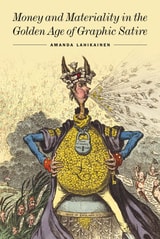
Money and Materiality in the Golden Age of Graphic Satire
Amanda Lahikainen
University of Delaware Press, 2022
This book examines the entwined and simultaneous rise of graphic satire and cultures of paper money in late eighteenth- and early nineteenth-century Britain. Asking how Britons learned to value both graphic art and money, the book makes surprising connections between two types of engraved images that grew in popularity and influence during this time. Graphic satire grew in visual risk-taking, while paper money became a more standard carrier of financial value, courting controversy as a medium, moral problem, and factor in inflation. Through analysis of satirical prints, as well as case studies of monetary satires beyond London, this book demonstrates several key ways that cultures attach value to printed paper, accepting it as social reality and institutional fact. Thus, satirical banknotes were objects that broke down the distinction between paper money and graphic satire altogether.
Money and Modernity
Pound, Williams, and the Spirit of JeffersonAlec Marsh
University of Alabama Press, 1998

Money and Power
Great Predators in the Political Economy of DevelopmentSarah Bracking
Pluto Press, 2009
Sarah Bracking explores the role of governments and development finance institutions in managing the markets in which the poorest countries operate. These institutions -- the 'Great Predators' -- are trapping the populations of the south in a permanent cycle of austerity.
Bracking examines the political economy relations between states. She shows how pseudo-public 'development' institutions retain complete economic control over Southern markets, yet the international system is itself unregulated. Operating in the interests of North America and the European Union, they have a political purpose, and yet serve to cloud the brute power relations between states.
This book will be of interest to anyone studying debt and development, global financial institutions, and the way the world economy is regulated and governed.
Money and Society
A Critical CompanionAxel T. Paul
Pluto Press, 2021
Money in Historical Perspective
Anna J. Schwartz
University of Chicago Press, 1987
In the papers in part I, dating from 1947 to the present, Dr. Schwartz examines money and banking in the United States and the United Kingdom from a historical perspective. Her investigation of the historical evidence linking economic instability to erratic monetary behavior—this behavior itself a product of discretionary monetary policy—has led her to argue for the importance of stable money, and her writings on these issues over the last two decades form part II. The volume concludes with four recent articles on international monetary arrangements, including Dr. Schwartz's well-known work on the gold standard.
This volume of classic essays by Anna Schwartz will be a useful addition to the libraries of scholars and students for its exemplary historical research and commentary on monetary systems.
Money in the Air
Art Dealers and the Making of a Transatlantic Market, 1880–1930Gail Feigenbaum
J. Paul Getty Trust, The, 2024
“There was money in the air, ever so much money,” wrote Henry James in 1907, reflecting on the American appetite for art acquisitions. Indeed, collectors such as Henry Clay Frick and Andrew W. Mellon are credited with bringing noteworthy European art to the United States, with their collections forming the backbone of major American museums today. But what of the dealers, who possessed the expertise in art and recognized the potential of developing a new market model on both sides of the Atlantic?
Money in the Air investigates the often-overlooked role of these dealers in creating an international art world. Contributors examine the histories of well-known international firms like Duveen Brothers, M. Knoedler & Co., and Goupil & Cie and their relationships with American clients, as well as accounts of other remarkable dealers active in the transatlantic art market. Drawing on dealer archives, scholars reveal compelling findings, including previously unknown partnerships and systems of cooperation. This volume offers new perspectives on the development of art collections that formed the core of American art museums, such as the National Gallery of Art, the Metropolitan Museum of Art, and the Frick Collection.
Money, Capital, and Fluctuations
Early EssaysF. A. Hayek
University of Chicago Press, 1984
EDITOR'S INTRODUCTION
INTRODUCTION
1. THE MONETARY POLICY OF THE UNITED STATES AFTER THE RECOVERY FROM THE 1920 CRISIS (1925)
2. SOME REMARKS ON THE PROBLEM OF IMPUTATION (1926)
3. ON THE PROBLEM OF THE THEORY OF INTEREST (1927)
4. INTERTEMPORAL PRICE EQUILIBRIUM AND MOVEMENTS IN THE VALUE OF MONEY (1928)
5. THE FATE OF THE GOLD STANDARD (1932)
6. CAPITAL CONSUMPTION (1932)
7. ON 'NEUTRAL MONEY' (1933)
8. TECHNICAL PROGRESS AND EXCESS CAPACITY (1936)
Two reviews
MARGINAL UTILITY AND ECONOMIC CALCULATION (1925)
THE EXCHANGE VALUE OF MONEY (1929)
NAME INDEX
Money, History, and International Finance
Essays in Honor of Anna J. SchwartzEdited by Michael D. Bordo
University of Chicago Press, 1989
Money, Mandates, and Local Control in American Public Education
Bryan Shelly
University of Michigan Press, 2013
Pointing to the disparities between wealthy and impoverished school districts in areas where revenue depends primarily upon local taxes, reformers repeatedly call for the centralization of school funding. Their proposals meet resistance from citizens, elected officials, and school administrators who fear the loss of local autonomy.
Bryan Shelly finds, however, that local autonomy has already been compromised by federal and state governments, which exercise a tremendous amount of control over public education despite their small contribution to a school system's funding. This disproportionate relationship between funding and control allows state and federal officials to pass education policy yet excuses them from supplying adequate funding for new programs. The resulting unfunded and underfunded mandates and regulations, Shelly insists, are the true cause of the loss of community control over public education.
Shelly outlines the effects of the most infamous of underfunded federal mandates, the No Child Left Behind Act of 2001 (NCLB), and explores why schools implemented it despite its unpopularity and out-of-pocket costs. Shelly's findings hold significant implications for school finance reform, NCLB, and the future of intergovernmental relations.
Money, Marriage, and Madness
The Life of Anna OttKim E. Nielsen
University of Illinois Press, 2020
Kim E. Nielsen explores a life at once irregular and unexceptional. Historical and institutional structures, like her whiteness and laws that liberalized divorce and women's ability to control their property, opened up uncommon possibilities for Ott. Other structures, from domestic violence in the home to rampant sexism and ableism outside of it, remained a part of even affluent women's lives. Money, Marriage, and Madness tells a forgotten story of how the legal and medical cultures of the time shaped one woman—and what her life tells us about power and society in nineteenth century America.
Money, Money, Money!
A Short Lesson in EconomicsHans Magnus Enzensberger
Seagull Books, 2020
The Federmanns live a pleasant but painfully normal life in the Munich suburbs. All that the three children really know about money is that there’s never enough of it in their family.
Every so often, their impish Great-Aunt Fé descends on the city. After repeated cycles of boom and bust, profligacy and poverty, the grand old lady has become enormously wealthy and lives alone in a villa on the shore of Lake Geneva. But what does Great-Aunt Fé want from the Federmanns, her only surviving relatives? This time, she invites the children to tea at her luxury hotel where she spoils, flummoxes, and inspires them. Dismayed at their ignorance of the financial ways of the world, she gives them a crash course in economics that piques their curiosity, unsettles their parents, and throws open a whole new world. The young Federmanns are for once taken seriously and together they try to answer burning questions: Where does money come from? Why are millionaires and billionaires never satisfied? And why are those with the most always showered with more?
In this rich volume, the renowned poet, translator, and essayist Hans Magnus Enzensberger turns his gimlet eye on the mechanisms and machinations of banks and politicians—the human greed, envy, and fear that fuels the global economy. A modern, but moral-less fable, Money, Money, Money! is shot through with Enzensberger’s trademark erudition, wit, and humanist desire to cut through jargon and forearm his readers against obscurantism.
Money, Morals, and Manners
The Culture of the French and the American Upper-Middle ClassMichèle Lamont
University of Chicago Press, 1992
Money, Morals, and Manners is an ambitious and sophisticated attempt to illuminate the nature of social class in modern society. For all those who downplay the importance of unequal social groups, it will be a revelation.
"A powerful, cogent study that will provide an elevated basis for debates in the sociology of culture for years to come."—David Gartman, American Journal of Sociology
"A major accomplishment! Combining cultural analysis and comparative approach with a splendid literary style, this book significantly broadens the understanding of stratification and inequality. . . . This book will provoke debate, inspire research, and serve as a model for many years to come."—R. Granfield, Choice
"This is an exceptionally fine piece of work, a splendid example of the sociologist's craft."—Lewis Coser, Boston College
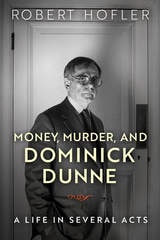
Money, Murder, and Dominick Dunne
A Life in Several ActsRobert Hofler
University of Wisconsin Press, 2019
Dunne admitted to inventing himself, and it was that public persona he wrote about in his own memoir, The Way We Lived Then. Left out of that account, but brought to light here, were his intense rivalry with his brother John Gregory, the gay affairs and relationships he had throughout his marriage and beyond, and his fights with editors at Vanity Fair. Robert Hofler also reveals the painful rift in the family after the murder of Dominick's daughter, Dominique—compounded by his coverage of her killer's trial, which launched his career as a reporter.
Money, Myths, and Change
The Economic Lives of Lesbians and Gay MenM.V. Lee Badgett
University of Chicago Press, 2001
Money, Myths, and Change provides new answers to these complex questions. This is the first comprehensive work to explore the economic lives of gays and lesbians in the United States. M. V. Lee Badgett weaves through and debunks common stereotypes about gay privilege, income, and consumer behavior. Studying the ends and means of gay life from an economic perspective, she disproves the assumption that gay men and lesbians are more affluent than heterosexuals, that they inspire discrimination when they come out of the closet, that they consume more conspicuously, that they enjoy a more self-indulgent, even hedonistic lifestyle. Badgett gets to the heart of these misconceptions through an analysis of the crucial issues that affect the livelihood of gay men and lesbians: discrimination in the workplace, denial of health care benefits to domestic partners and children, lack of access to legal institutions such as marriage, the corporate wooing of gay consumer dollars, and the use of gay economic clout to inspire social and political change.
Both timely and readable, Money, Myths, and Change stands as a much-needed corrective to the assumptions that inhibit gay economic equality. It is a definitive work that sheds new light on just what it means to be gay or lesbian in the United States.
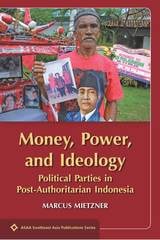
Money, Power, and Ideology
Political Parties in Post-Authoritarian IndonesiaMarcus Mietzner
National University of Singapore Press, 2013
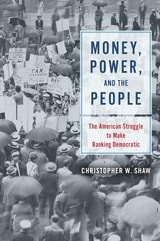
Money, Power, and the People
The American Struggle to Make Banking DemocraticChristopher W. Shaw
University of Chicago Press, 2019
Yet the situation was vastly different a century ago, as Christopher W. Shaw shows. This book upends the conventional thinking that financial policy in the early twentieth century was set primarily by the needs and demands of bankers. Shaw shows that banking and politics were directly shaped by the literal and symbolic investments of the grassroots. This engagement remade financial institutions and the national economy, through populist pressure and the establishment of federal regulatory programs and agencies like the Farm Credit System and the Federal Deposit Insurance Corporation. Shaw reveals the surprising groundswell behind seemingly arcane legislation, as well as the power of the people to demand serious political repercussions for the banks that caused the Great Depression. One result of this sustained interest and pressure was legislation and regulation that brought on a long period of relative financial stability, with a reduced frequency of economic booms and busts. Ironically, this stability led to the decline of the very banking politics that brought it about.
Giving voice to a broad swath of American figures, including workers, farmers, politicians, and bankers alike, Money, Power, and the People recasts our understanding of what might be possible in balancing the needs of the people with those of their financial institutions.
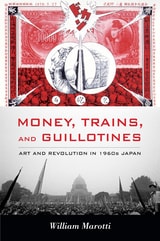
Money, Trains, and Guillotines
Art and Revolution in 1960s JapanWilliam Marotti
Duke University Press, 2013