Results by title
221 books match the query 'Personal narratives' and 12 start with m
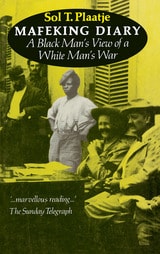
Mafeking Diary
A Black Man’s View of a White Man’s WarSol T. Plaatje
Ohio University Press, 1990
“Sol Plaatje’s Mafeking Diary is a document of enduring importance and fascination. The product of a young black South African court interpreter, just turned 23 years old when he started writing, it opens an entirely new vista on the famous Siege of Mafeking. By shedding light on the part played by the African population of the town, Plaatje explodes the myth, maintained by belligerents, and long perpetuated by both historians and the popular imagination, this this was a white man’s affair. One of the great epics of British imperial history, and perhaps the best remembered episode of the Anglo-Boer war of 1899–1902, is presented from a wholly novel perspective.
“At the same time, the diary provides an intriguing insight into the character of a young man who was to play a key role in South African political and literary history during the first three decades of this century. It reveals much of the perceptions and motives that shaped his own attitudes and intellectual development and, indeed, those of an early generation of African leaders who sought to build a society which did not determine the place of its citizens by the colour of their skin. The diary therefore illuminates the origins of a struggle which continues to this day.”
— John L. Comaroff (ed.) in his preface

Makhno and Memory
Anarchist and Mennonite Narratives of Ukraine's Civil War, 1917–1921Sean Patterson
University of Manitoba Press, 2020
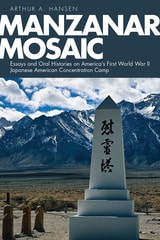
Manzanar Mosaic
Essays and Oral Histories on America's First World War II Japanese American Concentration CampArthur A. Hansen
University Press of Colorado, 2023
To begin, Hansen presents two essays, the first centering on his work with Ronald Larson in the mid-1970s on the history of Doho, a Japanese and English dual-language newspaper, and the second an article with David Hacker on revisionist ethnic perspectives of the Manzanar “riot.” A second section is composed of five oral history interviews of selected camp personalities—a female Nisei journalist, a male Nisei historical documentarian, a male Kibei Communist block manager, the Caucasian wife and comrade of the block manager, and the male Kibei who was the central figure in the Manzanar Riot/Revolt—that offer powerful insight into the controversial content of the two essays that precede them.
Manzanar can be understood only by being considered within the much wider context of Japanese American community formation and contestation before, during, and after World War II. A varied collection of scholarly articles and interviews, Manzanar Mosaic engages diverse voices and considers multiple perspectives to illuminate aspects of the Japanese American community, the ethnic press, the Manzanar concentration camp, and the movement for redress and reparations.
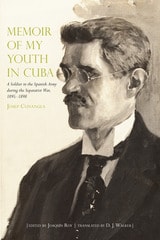
Memoir of My Youth in Cuba
A Soldier in the Spanish Army during the Separatist War, 1895–1898Dolores J. Walker
University of Alabama Press, 2017
A historically significant memoir offering a firsthand perspective on life, identity, and cultural transformation in nineteenth-century Cuba.
Memoir of My Youth in Cuba: A Soldier in the Spanish Army during the Separatist War, 1895–1898 is a translation of the memoir Memorias de mi juventud en Cuba: Un soldado del ejército español en la guerra separatista (1895–1898) by Josep Conangla. The English edition is based on the Spanish version edited by Joaquín Roy, who found the memoir and was given access to the Conangla family archives. Conangla’s memoir, now available in English, is an important addition to the accounts of Spanish and Cuban soldiers who served in Cuba’s second War of Independence.
Spaniard Josep Conangla was conscripted at the age of twenty and sent to Cuba. In the course of his time there, he reaffirmed his pacifism and support of Cuban independence. The young man was a believer who unfailingly connected his view of events to the Christian humanitarianism on which he prided himself. Conangla’s advanced education and the influence of well-placed friends facilitated his assignment to safe bureaucratic positions during the war, ensuring that he would not see combat. From his privileged position, he was a keen observer of his surroundings. He described some of the decisions he made—which at times put him at odds with the military bureaucracy he served—along with what he saw as the consequences of General Valeriano Weyler’s decree mandating the reconcentración, an early version of concentration camps. What Conangla saw fueled his revulsion at the collusion of the Spanish state and its state-sponsored religion in that policy. “Red Mass,” published six years after the War of Independence and included in his memoir, is a vivid expression in verse of his abhorrence.
Conangla’s recollections of the contacts between Spaniards and Cubans in the areas to which he was assigned reveal his ability to forge friendships even with Creole opponents of the insurrection. As an aspiring poet and writer, Conangla included material on fellow writers, Cuban and Spanish, who managed to meet and exchange ideas despite their circumstances. His accounts of the Spanish defeat, the scene in Havana around the end of the war, along with his return to Spain, are stirring.
Minor Salvage
The Korean War and Korean American Life WritingsStephen Hong Sohn
University of Michigan Press, 2022
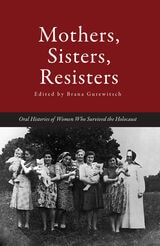
Mothers, Sisters, Resisters
Oral Histories of Women Who Survived the HolocaustBrana Gurewitsch
University of Alabama Press, 1999
Powerful oral histories revealing the unique experiences of women during the Holocaust.
In Mothers, Sisters, Resisters, 25 survivors of the Holocaust furnish compelling and historically vital testimony that illuminates and explores Jewish women's experiences during that terrible period. In entries that preserve each voice, personality, and style, survivors describe their efforts to evade Nazi laws and subsequent dehumanization, protect their children and siblings, and maintain their Jewish identity.
Throughout each narrative, from Brandla Small's description of having her child dragged from her arms at Auschwitz, to Eva Schonbrun's remembrances of her sister who refused to leave her siblings and save herself, to Emilie Schindler's account of rescuing Jews left abandoned on a cattle car, we become intimately involved with each woman's struggle and eventual survival. We also gain a new appreciation and understanding of the Holocaust experiences unique to women.
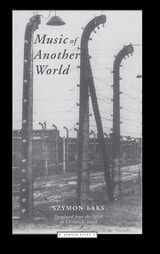
Music of Another World
Szymon Laks
Northwestern University Press, 2000
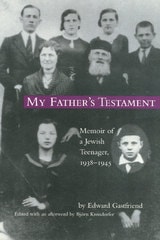
My Fathers Testament
Edward Gastfriend
Temple University Press, 1999
The accelerating Nazi assault on the Jews abruptly shattered Lolek's life. Jews were randomly beaten and arrested, forced out of their homes, deported to slave labor camps, and shot on the streets. During this time, Lolek lost his family, friends, and neighbors, the whole while struggling to hold onto a promise he made to his father before his father was deported. Lolek pledged never to denounce God and to maintain his faith. This covenant proved to be the key to his remarkable survival in several slave labor camps including Auschwitz and several satellite camps of Auschwitz-Birkenau.
My Father's Testament is an intimate portrayal of a teenage boy trying to stay alive without losing his humanity - in hiding, in the camps, and during the death marches at the end of the war.
Embedded in this unique memoir are two other stories of fathers and sons. One lies in the moving Foreword by David R. Gastfriend, Ed's son, now a psychiatrist at Harvard Medical School. The other lies in Bjorn Krondorfer's Afterword. Years after he met Edward Gastfriend, Krondorfer was startled to hear his father mention Blechhammer as one of the places where he was stationed as a young German soldier. Blechhammer was where Lolek was held in a slave labor camp. The coincidence led this German father and son to travel back to the site to confront the Holocaust.
My Father's Testament will engage readers interested in history, the Holocaust, and religion.
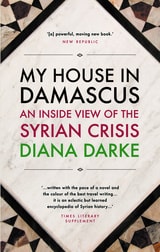
My House in Damascus
An Inside View of the Syrian CrisisDiana Darke
Haus Publishing, 2014
Diana Darke, a fluent Arabic speaker who moved to Damascus in 2004 after decades of regular visits, details how the Assad regime, and its relationship to the people, differs from the regimes in Egypt, Tunisia, and Libya—and why it was thus always less likely to collapse quickly, even in the face of widespread unrest and violence. Through the author’s firsthand experiences of buying and restoring a house in the old city of Damascus, which she later offered as a sanctuary to friends, Darke presents a clear picture of the realities of life on the ground and what hope there is for Syria’s future. Including additional material on topics like the advance of the Islamic State, as well as a new epilogue describing the current turmoil surrounding her house and the refugees she tried to help, this edition of My House in Damascus powerfully documents the human cost of the ongoing civil war.
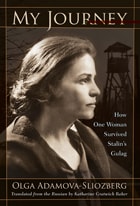
My Journey
How One Woman Survived Stalin's GulagOlga Adamova-Sliozberg
Northwestern University Press, 2011
Arrested along with her husband (who, she would much later learn, was shot the next day) in the great purges of the thirties, Adamova-Sliozberg decided to record her Gulag experiences a year after her arrest, and she “wrote them down in her head” (paper and pencils were not available to prisoners) every night for years. When she returned to Moscow after the war in 1946, she composed the memoir on paper for the first time and then buried it in the garden of the family dacha. After her re-arrest and seven more years of banishment to Kazakhstan, she returned to the dacha to dig up the buried memoir, but could not find it. She sat down and wrote it all over again.
In her later years she also added a collection of stories about her family. Concluding on a hopeful note—Adamova-Sliozberg’s record is cleared, she re-marries a fellow former-prisoner, and she is reunited with her children—this story is a stunning account of perseverance in the face of injustice and unimaginable hardship. This vital primary source continues to fascinate anyone interesting in the tumultuous history of Russia and the Soviet Union in the twentieth century.
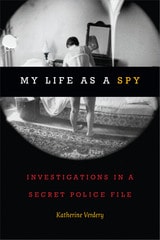
My Life as a Spy
Investigations in a Secret Police FileKatherine Verdery
Duke University Press, 2018
My Version of the Facts
Carla Pekelis, translated from the Italian by George Hochfield
Northwestern University Press, 2005