Results by title
59 books match the query 'Philosophy and aesthetics' and 9 start with m
Making Light
Haydn, Musical Camp, and the Long Shadow of German IdealismRaymond Knapp
Duke University Press, 2018
Metaphor and Musical Thought
Michael Spitzer
University of Chicago Press, 2004
The experience of music is an abstract and elusive one, enough so that we're often forced to describe it using analogies to other forms and sensations: we say that music moves or rises like a physical form; that it contains the imagery of paintings or the grammar of language. In these and countless other ways, our discussions of music take the form of metaphor, attempting to describe music's abstractions by referencing more concrete and familiar experiences.
Michael Spitzer's Metaphor and Musical Thought uses this process to create a unique and insightful history of our relationship with music—the first ever book-length study of musical metaphor in any language. Treating issues of language, aesthetics, semiotics, and cognition, Spitzer offers an evaluation, a comprehensive history, and an original theory of the ways our cultural values have informed the metaphors we use to address music. And as he brings these discussions to bear on specific works of music and follows them through current debates on how music's meaning might be considered, what emerges is a clear and engaging guide to both the philosophy of musical thought and the history of musical analysis, from the seventeenth century to the present day. Spitzer writes engagingly for students of philosophy and aesthetics, as well as for music theorists and historians.
Music Grooves
Essays and DialoguesCharles Keil and Steven Feld
University of Chicago Press, 1994
Music Grooves ranges from jazz, blues, polka, soul, rock, world beat, rap, karaoke, and other familiar genres to major scholarly debates in music theory, ethnomusicology, and popular culture studies. The authors develop and create links between the fields of ethnomusicology and popular culture studies and relate the contents of musics from America, Greece, Cuba, Africa, and Papua New Guinea to artists as diverse as James Brown, Aretha Franklin, L'il Wally Jagiello, Bo Diddley, Walt Solek, Madonna, Paul Simon, Miles Davis, Thelonious Monk, and Billie Holiday.
Keil and Feld offer a fascinating view of the shaping of central ideas and terms in ethnomusicology such as "engendered feeling," "interpretive moves," "participatory discrepancies," "iconicity of style," "people's music," "schizophonia," and "lift-up-over sounding." From Keil's critique of Leonard Meyer's musicological approach to Feld's recent work on world beat, this volume covers an array of vital issues in media studies, musicology and ethnomusicology, popular culture, anthropology, and sociology. It will interest anyone concerned with the nature and meaning of music in the modern world.
Music Lessons
The Collège de France LecturesPierre Boulez
University of Chicago Press, 2018
Music Lessons marks the first publication in English of Pierre Boulez’s Collège de France lectures, written while he held the chair of Invention, Technique and Language in Music at the Collège between 1976 and 1995. Representing Boulez’s most significant writings from the period, the lectures offer a sustained intellectual engagement with one of the dominant figures of twentieth-century music, a consummate composer-conductor who remained central to the conversation around contemporary music until his death in 2016. Boulez explores, among other topics, the process through which a musical idea is realized in a full-fledged composition, the complementary roles of craft and inspiration and the degree to which the memory of other musical works can influence and change the act of creation. Boulez also gives a penetrating account of problems in classical music that are still present today, such as the conservatism of a musical community fixated on the repertory of the past. Woven into the discussion are stories of his own compositions and those of fellow composers whose work he engaged with in his many roles as teacher, thinker, and conductor: from Stravinsky to Stockhausen and Varèse, from Bartók to Berg, Debussy to Mahler and Wagner, and all the way back to his beloved J. S. Bach.
Including a foreword by semiologist Jean-Jacques Nattiez, who was for years close to the composer, this edition is also enriched by an illuminating preface by Jonathan Goldman. With an authoritative translation retaining Boulez’s fierce convictions, cutting opinions and signature wit, Music Lessons is an essential and entertaining volume.
Music in German Philosophy
An IntroductionEdited by Stefan Lorenz Sorgner and Oliver Fürbeth
University of Chicago Press, 2011
Though many well-known German philosophers have devoted considerable attention to music and its aesthetics, surprisingly few of their writings on the subject have been translated into English. Stefan Lorenz Sorgner, a philosopher, and Oliver Fürbeth, a musicologist, here fill this important gap for musical scholars and students alike with this compelling guide to the musical discourse of ten of the most important German philosophers, from Kant to Adorno.
Music in German Philosophy includes contributions from a renowned group of ten scholars, including some of today’s most prominent German thinkers, all of whom are specialists in the writers they treat. Each chapter consists of a short biographical sketch of the philosopher concerned, a summary of his writings on aesthetics, and finally a detailed exploration of his thoughts on music. The book is prefaced by the editors’ original introduction, presenting music philosophy in Germany before and after Kant, as well as a new introduction and foreword to this English-language addition, which places contemplations on music by these German philosophers within a broader intellectual climate.
Music in the Flesh
An Early Modern Musical PhysiologyBettina Varwig
University of Chicago Press, 2023
Music in the Flesh reimagines the lived experiences of music-making subjects—composers, performers, listeners—in the long seventeenth century. There are countless historical testimonies of the powerful effects of music upon the early modern body; it is described as moving, ravishing, painful, dangerous, curative, and miraculous while affecting “the circulation of the humors, the purification of the blood, the dilation of the vessels and pores.”
How were these early modern European bodies constituted that music generated such potent bodily-spiritual effects? Bettina Varwig argues that early modern music-making practices challenge our modern understanding of human nature as a mind-body dichotomy. Instead, they persistently affirm a more integrated anthropology, in which body, soul, and spirit remain inextricably entangled. Moving with ease across repertories and regions, sacred and vernacular musics, and domestic and public settings, Varwig sketches a “musical physiology” that is as historically illuminating as it is relevant for present-day performance. This book makes a significant contribution not just to the history of music, but also to the history of the body, the senses, and the emotions, revealing music as a unique access point for reimagining early modern modes of being-in-the-world.
Music's Monisms
Disarticulating ModernismDaniel Albright
University of Chicago Press, 2021
Daniel Albright was one of the preeminent scholars of musical and literary modernism, leaving behind a rich body of work before his untimely passing. In Music’s Monisms, he shows how musical and literary phenomena alike can be fruitfully investigated through the lens of monism, a philosophical conviction that does away with the binary structures we use to make sense of reality. Albright shows that despite music’s many binaries—diatonic vs. chromatic, major vs. minor, tonal vs. atonal—there is always a larger system at work that aims to reconcile tension and resolve conflict.
Albright identifies a “radical monism” in the work of modernist poets such as T. S. Eliot and musical works by Wagner, Debussy, Britten, Schoenberg, and Stravinsky. Radical monism insists on the interchangeability, even the sameness, of the basic dichotomies that govern our thinking and modes of organizing the universe. Through a series of close readings of musical and literary works, Albright advances powerful philosophical arguments that not only shed light on these specific figures but also on aesthetic experience in general. Music’s Monisms is a revelatory work by one of modernist studies’ most distinguished figures.
Music, the Arts, and Ideas
Patterns and Predictions in Twentieth-Century CultureLeonard B. Meyer
University of Chicago Press, 1994
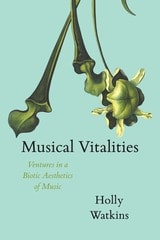
Musical Vitalities
Ventures in a Biotic Aesthetics of MusicHolly Watkins
University of Chicago Press, 2018
Redefining music as “the art of possibly animate things,” Musical Vitalities charts a new path for music studies that blends musicological methods with perspectives drawn from the life sciences. In opposition to humanist approaches that insist on a separation between culture and nature—approaches that appear increasingly untenable in an era defined by human-generated climate change—Musical Vitalities treats music as one example of the cultural practices and biotic arts of the animal kingdom rather than as a phenomenon categorically distinct from nonhuman forms of sonic expression. The book challenges the human exceptionalism that has allowed musicologists to overlook music’s structural resemblances to the songs of nonhuman species, the intricacies of music’s physiological impact on listeners, and the many analogues between music’s formal processes and those of the dynamic natural world. Through close readings of Austro-German music and aesthetic writings that suggest wide-ranging analogies between music and nature, Musical Vitalities seeks to both rekindle the critical potential of nineteenth-century music and rejoin the humans at the center of the humanities with the nonhumans whose evolutionary endowments and planetary fates they share.