Results by title
56 books match the query 'Press' and 7 start with m
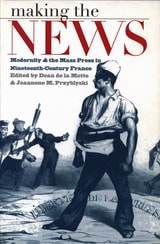
Making the News
Modernity and the Mass Press in Nineteenth-Century FranceDean de la Motte
University of Massachusetts Press, 1999
Much recent writing on print culture has focused on the social and political implications of the transition from “elite” to “mass” culture in the 1800s. The essays in this volume add significantly to our understanding of the role of the nineteenth-century French press in producing the commodities, consumers, and ideological frameworks that are the hallmarks of this shift. The book also offers an opportunity for useful comparisons with recent scholarship on the rise on the popular press in the United States, Great Britain, and Germany.
The essays address a wide range of topics, from the emergence of commercial daily newspapers during the July Monarchy to the photographic representation of women in the Paris Commune. Together they demonstrate that the French mass press was far more heterogeneous than previously supposed, tapping into an expanding readership composed of a variety of publics—from affluent bourgeois to disaffected workers to disenfranchised women. It was also relentlessly innovative, using caricature, argot, advertisements, and other attention-grabbing techniques that blurred the lines separating art, politics, and the news.
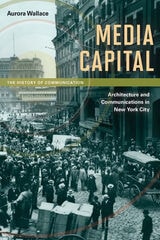
Media Capital
Architecture and Communications in New York CityAurora Wallace
University of Illinois Press, 2012

Media and Dependency in South Africa
A Case Study of the Press and the Ciskei “Homeland”Les Switzer
Ohio University Press, 1985

Media, Market, and Democracy in China
Between the Party Line and the Bottom LineYuezhi Zhao
University of Illinois Press, 1998
How do market forces influence the media in China? How does the Party both introduce and try to contain the market's influence? How do commercial imperatives both accommodate and challenge Party control?
Yuezhi Zhao interviewed a wide range of scholars, media administrators, and media professionals to answer these and other questions. Working in China in 1994 and 1995, she monitored media content, carried out extensive documentary research in Beijing, and held off-the-record meetings with Chinese media insiders. What she found informs an in-depth look at the intertwining nature of the Communist Party and the news media in China, how they affect each other, and what the future might hold for each.
A rare on-the-ground portrait, Media, Market, and Democracy in China is must reading for scholars, media and business professionals, and policymakers who need to understand what happened to China and its mass media during a period of dynamic growth and change.
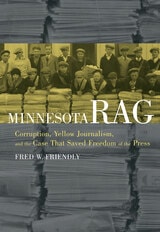
Minnesota Rag
Corruption, Yellow Journalism, and the Case That Saved Freedom of the PressFred W. Friendly
University of Minnesota Press, 2003
The fascinating behind-the-scenes story of this landmark First Amendment case
Minnesota Rag takes the reader on an exhilarating tour of the seamy underside of a dark period in Minnesota’s past, one rife with crooked public officials, vengeful gangsters, and yellow journalists. Featuring notorious characters such as Jay M. Near, racist and antilabor publisher of Minneapolis’s Saturday Press, pioneering newsman Fred W. Friendly weaves the tale of a court case that molded our understanding of freedom of the press and set a precedent for the publication of the Pentagon Papers.
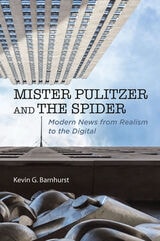
Mister Pulitzer and the Spider
Modern News from Realism to the DigitalKevin G. Barnhurst
University of Illinois Press, 2018
To solve the mystery, Kevin Barnhurst spent thirty years studying news going back to the realism of the 1800s. The usual suspects--technology, business competition, and the pursuit of scoops--are only partly to blame for the fate of news. The main culprit is modernism from the "Mister Pulitzer" era, which transformed news into an ideology called "journalism." News is no longer what audiences or experts imagine. Stories have grown much longer over the past century and now include fewer events, locations, and human beings. Background and context rule instead.
News producers adopted modernism to explain the world without recognizing how modernist ideas influence the knowledge they produce. When webs of networked connectivity sparked a resurgence in realist stories, legacy news stuck to big-picture analysis that can alienate audience members accustomed to digital briefs.

Murder, Courts, and the Press
Issues in Free Press/Fair TrialPeter E. Kane. Foreword by Franklyn S. Haiman
Southern Illinois University Press, 1992
When murder is the crime, the clash in the courts is likely to be between two constitutionally enshrined rights—freedom of speech and the right to a fair trial.
Peter E. Kane shows what happened in seven famous court cases when First Amendment rights (concerning freedom of speech) conflicted with Sixth Amendment rights (concerning fair trial). He reports the circumstances of each crime, the court proceedings, and the conduct of the press in the trials of Sam Sheppard, Charles Manson and his followers, John Paul Stevenson, Claus von Bülow, and Arthur Shawcross and the cases involving the Kellie family and the Wayne Clapp murders. Kane’s narrative and analytical approach illuminates legal principles and shows the roles of actual human beings underlying the abstractions of court opinions.
In this revised and expanded edition, Kane considers two new topics stemming from recent court cases: cameras in the courtroom and a code of ethics for crime reporting. Kane explores the issue of cameras through the famous Claus von Bülow retrial, which featured live television broadcasts; regarding a journalistic code, Kane examines the massive pretrial reporting of the serial murders of Arthur Shawcross. Kane notes that sensational crime stories serve the interests of many people: the public wants to read them; journalists want to write them because they can make a reporter’s fortune and reputation; and editors and publishers want to sell papers. The sensational crime story serves everyone’s purpose except that of the accused.
In addition to exploring journalistic ethics and the proper procedures for trial judges in guaranteeing a fair trial, these cases also provide an introduction to the operation of the courts in criminal justice. "The trial court is the arena in which the conflicts between a free press and a fair trial are played out," Kane writes. "This play is described here as are the subsequent evaluations of that play by the appellate courts. Thus the legal process is considered from its beginning with the original crime to the final resolution of the case in the United States Supreme Court."