Results by title
248 books match the query 'Theology' and 7 start with m

Maimonides' Ethics
The Encounter of Philosophic and Religious MoralityRaymond L. Weiss
University of Chicago Press, 1991
The gulf between classical philosophy and the Torah made the task of Maimonides extraordinarily difficult. Weiss shows that Maimonides subtly preserves the tension between those traditions while producing a practical accommodation between them. To explain how Maimonides was able to accomplish this twofold goal, Weiss takes seriously the multilevel character of Maimonides' works. Weiss interprets Maimonides as a heterodox thinker who, with utter integrity, faces the Law's encounter with philosophy and gives both the Torah and philosophy their due.
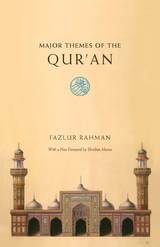
Major Themes of the Qur'an
Second EditionFazlur Rahman
University of Chicago Press, 2009
Major Themes of the Qur’an is Fazlur Rahman’s introduction to one of the richest texts in the history of religious thought. In this classic work, Rahman unravels the Qur’an’s complexities on themes such as God, society, revelation, and prophecy with the deep attachment of a Muslim educated in Islamic schools and the clarity of a scholar who taught for decades in the West.
“Generations of scholars have profited from [Rahman’s] pioneering scholarly work by taking the questions he raised and the directions he outlined to new destinations.”--Ebrahim Moosa, from his new foreword
“The religious future of Islam and the future of interfaith relationship . . . will be livelier and saner for the sort of Quranic centrality which Major Themes of the Qur’an exemplifies and serves.”--Kenneth Cragg, Middle East Journal
“There shines through [a] rare combination of balanced scholarly judgment and profound personal commitment. . . . [Rahman is] eager to open up the mysteries of the Qur’an to a shrinking world sorely in need of both moral regeneration and better mutual understanding.”--Patrick D. Gaffney, Journal of Religion
“I can’t think of any book more important, still, than Major Themes of the Qur’an.”--Michael Sells, author of Approaching the Qur’an
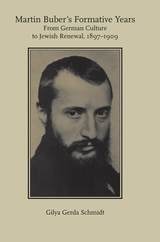
Martin Buber's Formative Years
From German Culture to Jewish Renewal, 1897–1909Gilya Gerda Schmidt
University of Alabama Press, 1995
Martin Buber (1878–1965) has had a tremendous impact on the development of Jewish thought as a highly influential figure in 20th-century philosophy and theology. However, most of his key publications appeared during the last forty years of his life and little is known of the formative period in which he was searching for, and finding, the answers to crucial dilemmas affecting Jews and Germans alike. Now available in paperback, Martin Buber’s Formative Years illuminates this critical period in which the seeds were planted for all of his subsequent work.
During the period from 1897 to 1909, Buber's keen sense of the crisis of humanity, his intimate knowledge of German culture and Jewish sources, and his fearlessness in the face of possible ridicule challenged him to behave in a manner so outrageous and so contrary to German-Jewish tradition that he actually achieved a transformation of himself and those close to him. Calling on spiritual giants of great historical periods in German, Christian, and Jewish history—such as Nicolas of Cusa, Jakob Boehme, Israel Baal Shem Tov, Rabbi Nachman of Brazlav, Johann Wolfgang von Goethe, and Friedrich Nietzsche—Buber proceeded to subvert the existing order by turning his upside-down world of slave morality right side up once more.
By examining the multitude of disparate sources that Buber turned to for inspiration, Gilya Gerda Schmidt elucidates Buber's creative genius and his contribution to turn-of-the-century Jewish renewal. This comprehensive study concludes that Buber was successful in creating the German-Jewish symbiosis that emancipation was to have created for the two peoples but that this synthesis was tragic because it came too late for practical application by Jews in Germany.
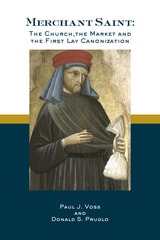
Merchant Saint
The Church, the Market, and the First Lay Canonizationprudlo
St. Augustine's Press, 2024
Voss and Prudlo provide a rich resource for readers concerned with the proper aims and boundaries of a life in the world of commerce, the nature of work, the ethics of profit, the problem of money-lending, the virtues needed for moral capitalism, and the tension between otium and negotium. Voss and Prudlo have accumulated a veritable trove of primary text materials relating to the life of Omobono, and provide translations and commentary to complete their analysis. This fascinating account crosses the threshold of pure history and stimulates inquiry in the fields of philosophy, economics, and theology.
Messianism, Zionism, and Jewish Religious Radicalism
Aviezer Ravitzky
University of Chicago Press, 1996
Ravitzky traces the roots of Haredi ideology, which opposes the Zionist enterprise, and shows how Haredim living in Israel have come to terms with a state to them unholy and therefore doomed. Ravitzky also examines radical religious movements, including the Gush Emunim, to whom the State of Israel is a divine agent. He concludes with a discussion of the recent transformation of Habad Hassidism from conservatism to radical messianism.
This book is indispensable to anyone concerned with the complex confrontation between Jewish fundamentalism and Israeli political sovereignty, especially in light of the tragic death of Israeli Prime Minister Yitzhak Rabin.
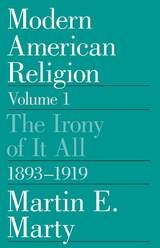
Modern American Religion, Volume 1
The Irony of It All, 1893-1919Martin E. Marty
University of Chicago Press, 1986
"Marty writes with the highest standards of scholarship and with his customary stylistic grace. No series of books is likely to tell us as much about the religious condition of our own time as "Modern American Religion."—Robert L. Spaeth, Minneapolis Star Tribune
"The wealth of material and depth of insight are beyond reproach. This book will clearly stand as an important meteorological guide to the storm front of modernity as it swept Americans into the twentieth century."—Belden C. Lane, Review of Religions
"Whatever one thinks about Marty's theological or philosophical position as a historian, the charm of his friendly circumspective approach to American religious history is irresistible."—John E. Wilson, Theological Studies
"Marty attempts to impose historical order on the divergent ways a century of Americans have themselves tried to find order in their worlds. . . . [He] meets the challenge deftly. . . . It is a book relevant to our time. . . . Engages the heart and mind jointly."—Andy Solomon, Houston Post
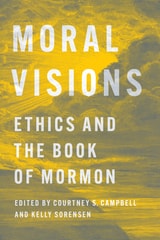
Moral Visions
Ethics and the Book of MormonEdited by Courtney S. Campbell and Kelly Sorensen
University of Illinois Press, 2025
Contributors in the first section discuss foundational issues such as the Book of Mormon’s moral psychology, its minimalist and covenantal moralities, the nature of the good and how the good is known, the question of whether value depends on a certain kind of future, the Book of Mormon's strategy for moral persuasion, and God’s participation in human choices. In the second section, the essayists turn to everyday ethical questions concerning resistance to forced cultural assimilation, clothing and dress, authority, and memory. The final chapter further explores practical moral visions.
A rich and thought-provoking analysis, Moral Visions examines the Book of Mormon through a variety of methods while aiming to deepen understanding of both the text’s messages and its potential place in future discussions of ethics. Contributors: Daniel Becerra, Courtney S. Campbell, Ryan Davis, Michael D. K. Ing, Ariel Bybee Laughton, Kimberly Matheson, Rachel Esplin Odell, Kelly Sorensen, Joseph M. Spencer