Results by title
134 books match the query 'Transformation' and 11 start with m
MIT and the Transformation of American Economics
E. Roy Weintraub
Duke University Press, 0

Making Minnesota Liberal
Civil Rights And The Transformation Of The Democratic PartyJennifer A. Delton
University of Minnesota Press, 2002
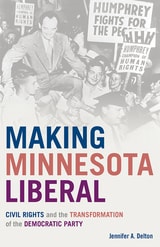
Making Minnesota Liberal
Civil Rights and the Transformation of the Democratic PartyJennifer A. Delton
University of Minnesota Press, 2002
The surprising story of how Minnesota politicians in the 1950s helped redirect American politics—now in paperback
How did a largely white state like Minnesota become a springboard for leadership in civil rights? Why did it produce a generation of liberals—Hubert Humphrey, Walter Mondale, Donald Fraser, Orville Freeman, and Eugene McCarthy—whose ideals transformed the Democratic party?
In Making Minnesota Liberal, Jennifer A. Delton delves into the roots of Minnesota politics for the answer, tracing the change from the regional, third-party, class-oriented politics of the Farmer-Labor party to the national, two-party, pluralistic liberalism of the Democratic-Farmer-Labor party (DFL). While others have examined how anticommunism and the Cold War shaped this transformation, Delton takes a new approach, showing the key roles played by antiracism and the civil rights movement. In telling this story, Delton contributes to our understanding not only of Minnesota’s political history but also of the relationship between antiracism and American politics in the twentieth century.
Making Minnesota Liberal combines political history with a discussion of the symbolic role played by race in political battles between whites. Delton recounts the creation of Minnesota’s Farmer-Labor party, its merger with the Democrats, and the acrimonious battle for control of the DFL just after World War II. She argues that the Humphrey liberals won this battle in part because antiracism activities enabled previously antagonistic groups, divided by ethnicity, religion, and class, to unify around a common cause.
Delton contends that although liberal Minnesotans’s concern for racial justice was genuine, it also provided them with national political relevance and imbued their bid for power with a sense of morality. Ultimately the language of tolerance and diversity that emerged from antiracism prepared Minnesotans for Humphrey’s vision of a pluralistic and state-centered liberalism, which eventually became the model for Democratic politics nationwide. Making Minnesota Liberal is an absorbing and trenchant account of a key moment in American history, one that continues to resonate in our time.

Managing Madness
Weyburn Mental Hospital and the Transformation of Psychiatric Care in CanadaErika Dyck
University of Manitoba Press, 2017

Marfa
The Transformation of a West Texas TownBy Kathleen Shafer
University of Texas Press, 2019
A small town in the vast desert of West Texas, Marfa attracts visitors from around the world to its art foundations and galleries, film and music festivals, and design and architecture symposiums. While newcomers sometimes see it as “another Santa Fe,” long-time residents often take a bemused, even disapproving attitude toward the changes that Marfa has undergone since artist Donald Judd came to town in the 1970s and began creating spaces for his own and other artists’ work. They remember when ranching and the military formed the basis of the town’s economy, even as they acknowledge that tourist dollars are now essential to Marfa’s sustainability
Marfa tells an engaging story of how this isolated place became a beacon in the art world, like the famous Marfa Lights that draw curious spectators into the West Texas night. As Kathleen Shafer delves into the town’s early history, the impact of Donald Judd, the expansion of arts programming, and the increase in tourism, she unlocks the complex interplay between the particularities of the place, the forces of commerce and growth, the textures of local culture and tradition, and the transformative role of artists and creative work. Bookending her story between two iconic artworks—the whimsical Prada Marfa and the crass Playboy Marfa—Shafer illuminates the shifting cultural landscape of Marfa, showing why this place has become a mecca for so many and how the influx of newcomers has transformed its character.

Merchants, Pirates, and Smugglers
Criminalization, Economics, and the Transformation of the Maritime World (1200–1600)Edited by Thomas Heebøll-Holm, Philipp Höhn, and Gregor Rohmann
Campus Verlag, 2019

Militant Visions
Black Soldiers, Internationalism, and the Transformation of American CinemaReich, Elizabeth
Rutgers University Press, 2016
Offering a nuanced reading of a figure that was simultaneously conservative and radical, Reich considers how the cinematic black soldier lent a human face to ongoing debates about racial integration, black internationalism, and American militarism. Militant Visions thus not only presents a new history of how American cinema represented race, but also demonstrates how film images helped to make history, shaping the progress of the civil rights movement itself.
Moderate Modernity
The Newspaper Tempo and the Transformation of Weimar DemocracyJochen Hung
University of Michigan Press, 2023
The newspaper’s idea of a modern, democratic Germany was undermined by the political and economic crises that hit Germany at the beginning of the 1930s. The way the newspaper described German democracy changed under these pressures. Flappers, American fridges, and modern music—the things that Tempo had once marshalled as representatives of a German future—were now rejected by the newspaper as emblems of a bygone age. The changes in Tempo’s vision of Germany’s future show that descriptions of Weimar politics as a standoff between upright democrats and rabid extremists do not do justice to the historical complexity of the period. Rather, we need to accept the Nazis as a lethal product of a German democracy itself. The history of Tempo teaches us how liberal democracies can create and nurture their own worst enemies.

Mom
The Transformation of Motherhood in Modern AmericaRebecca Jo Plant
University of Chicago Press, 2010

More Than a Feeling
Personality, Polarization, and the Transformation of the US CongressAdam J. Ramey, Jonathan D. Klingler, and Gary E. Hollibaugh Jr.
University of Chicago Press, 2017
With More Than a Feeling, Adam J. Ramey, Jonathan D. Klingler, and Gary E. Hollibaugh, Jr. have developed an innovative framework incorporating what are known as the Big Five dimensions of personality—openness to experience, conscientiousness, extraversion, agreeableness, and neuroticism—to improve our understanding of political behavior among members of Congress. To determine how strongly individuals display these traits, the authors identified correlates across a wealth of data, including speeches, campaign contributions and expenditures, committee involvement, willingness to filibuster, and even Twitter feeds. They then show how we might expect to see the influence of these traits across all aspects of Congress members’ political behavior—from the type and quantity of legislation they sponsor and their style of communication to whether they decide to run again or seek a higher office. They also argue convincingly that the types of personalities that have come to dominate Capitol Hill in recent years may be contributing to a lot of the gridlock and frustration plaguing the American political system.

Mule South to Tractor South
Mules, Machines, and the Transformation of the Cotton SouthGeorge B. Ellenberg
University of Alabama Press, 2013
The adoption of the mule as the major agricultural resource in the American South and its later displacement by the mechanical tractor.
The author describes the adoption of the mule as the major agricultural resource in the American South and its later displacement by the mechanical tractor. After describing the surprising slowness of southern farmers to realize the superiority of the mule over the horse for agricultural labor, Ellenberg strives to capture the symbiosis that emerged between animal and man to illuminate why and how the mule became a standard feature in Southern folk culture.
Having been slow to adopt the mule, southern farmers were then reluctant to set it aside in favor of the tractor. Ellenberg describes the transformation as the tractor gradually displaced the mule and the role of the U.S. Department of Agriculture in this process.
The work not only becomes a survey of the development of southern agriculture as revealed through an examination of this premier work animal but also follows the emergence of the animal as a cultural icon, as it figures in southern literature, folklore, and music.