Results by title
62 books match the query 'Twain, Mark' and 25 start with m
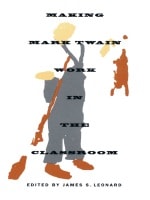
Making Mark Twain Work in the Classroom
James S. Leonard, ed.
Duke University Press, 1999
The essays in Making Mark Twain Work in the Classroom reaffirm the importance of Twain in the American literature curriculum from high school through graduate study. Addressing slavery and race, gender, class, religion, language and ebonics, Americanism, and textual issues of interest to instructors and their students, the contributors offer guidance derived from their own demographically diverse classroom experiences. Although some essays focus on such works as A Connecticut Yankee in King Arthur’s Court and The Innocents Abroad, most discuss the hotly debated Adventures of Huckleberry Finn, viewed alternately in this volume as a comic masterpiece or as evidence of Twain’s growing pessimism—but always as an effective teaching tool.
By placing Twain’s work within the context of nineteenth-century American literature and culture, Making Mark Twain Work in the Classroom will interest all instructors of American literature. It will also provoke debate among Americanists and those concerned with issues of race, class, and gender as they are represented in literature.
Contributors. Joseph A. Alvarez, Lawrence I. Berkove, Anthony J. Berret, S.J., Wesley Britton, Louis J. Budd, James E. Caron, Everett Carter, Jocelyn Chadwick-Joshua, Pascal Covici Jr., Beverly R. David, Victor Doyno, Dennis W. Eddings, Shelley Fisher Fishkin, S. D. Kapoor, Michael J. Kiskis, James S. Leonard, Victoria Thorpe Miller, Stan Poole, Tom Reigstad, David E. E. Sloane, David Tomlinson
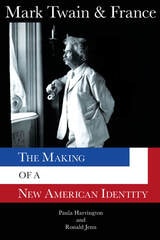
Mark Twain & France
The Making of a New American IdentityPaula Harrington and Ronald Jenn
University of Missouri Press, 2017
While critics have generally dismissed Mark Twain’s relationship with France as hostile, Harrington and Jenn see Twain’s use of the French as a foil to help construct his identity as “the representative American.” Examining new materials that detail his Montmatre study, the carte de visite album, and a chronology of his visits to France, the book offers close readings of writings that have been largely ignored, such as The Innocents Adrift manuscript and the unpublished chapters of A Tramp Abroad, combining literary analysis, socio-historical context and biographical research.
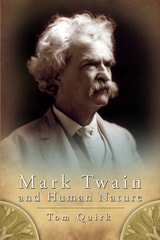
Mark Twain and Human Nature
Tom Quirk
University of Missouri Press, 2007
Mark Twain once claimed that he could read human character as well as he could read the Mississippi River, and he studied his fellow humans with the same devoted attention. In both his fiction and his nonfiction, he was disposed to dramatize how the human creature acts in a given environment—and to understand why.
Now one of America’s preeminent Twain scholars takes a closer look at this icon’s abiding interest in his fellow creatures. In seeking to account for how Twain might have reasonably believed the things he said he believed, Tom Quirk has interwoven the author’s inner life with his writings to produce a meditation on how Twain’s understanding of human nature evolved and deepened, and to show that this was one of the central preoccupations of his life.
Quirk charts the ways in which this humorist and occasional philosopher contemplated the subject of human nature from early adulthood until the end of his life, revealing how his outlook changed over the years. His travels, his readings in history and science, his political and social commitments, and his own pragmatic testing of human nature in his writing contributed to Twain’s mature view of his kind. Quirk establishes the social and scientific contexts that clarify Twain’s thinking, and he considers not only Twain’s stated intentions about his purposes in his published works but also his ad hoc remarks about the human condition.
Viewing both major and minor works through the lens of Twain’s shifting attitude, Quirk provides refreshing new perspectives on the master’s oeuvre. He offers a detailed look at the travel writings, including The Innocents Abroad and Following the Equator, and the novels, including The Adventures of Tom Sawyer, Adventures of Huckleberry Finn, and Pudd’nhead Wilson, as well as an important review of works from Twain’s last decade, including fantasies centering on man’s insignificance in Creation, works preoccupied with isolation—notably No. 44,The Mysterious Stranger and “Eve’s Diary”—and polemical writings such as What Is Man?
Comprising the well-seasoned reflections of a mature scholar, this persuasive and eminently readable study comes to terms with the life-shaping ideas and attitudes of one of America’s best-loved writers. Mark Twain and Human Nature offers readers a better understanding of Twain’s intellect as it enriches our understanding of his craft and his ineluctable humor.
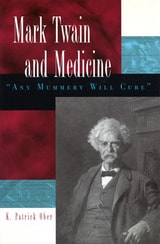
Mark Twain and Medicine
"Any Mummery Will Cure"K. Patrick Ober
University of Missouri Press, 2003
Mark Twain has always been America’s spokesman, and his comments on a wide range of topics continue to be accurate, valid, and frequently amusing. His opinions on the medical field are no exception. While Twain’s works, including his popular novels about Tom Sawyer and Huckleberry Finn, are rich in medical imagery and medical themes derived from his personal experiences, his interactions with the medical profession and his comments about health, illness, and physicians have largely been overlooked.
In Mark Twain and Medicine, K. Patrick Ober remedies this omission. The nineteenth century was a critical time in the development of American medicine, with much competition among the different systems of health care, both traditional and alternative. Not surprisingly, Mark Twain was right in the middle of it all. He experimented with many of the alternative care systems that were available in his day—in part because of his frustration with traditional medicine and in part because he hoped to find the “perfect” system that would bring health to his family.
Twain’s commentary provides a unique perspective on American medicine and the revolution in medical systems that he experienced firsthand. Ober explores Twain’s personal perspective in this area, as he expressed it in fiction, speeches, and letters. As a medical educator, Ober explains in sufficient detail and with clarity all medical and scientific terms, making this volume accessible to the general reader.
Ober demonstrates that many of Twain’s observations are still relevant to today’s health care issues, including the use of alternative or complementary medicine in dealing with illness, the utility of placebo therapies, and the role of hope in the healing process.
Twain’s evaluation of the medical practices of his era provides a fresh, humanistic, and personalized view of the dramatic changes that occurred in medicine through the nineteenth century and into the first decade of the twentieth. Twain scholars, general readers, and medical professionals will all find this unique look at his work appealing.
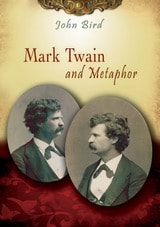
Mark Twain and Metaphor
John Bird
University of Missouri Press, 2007
Metaphor theory, observes John Bird, is like Mark Twain: both seem simple upon first introduction. Now, in the most complete study to date of Twain’s use of figurative language, a veteran Twain scholar tackles the core of his writing and explores it with theoretical approaches that have rarely been applied to Twain, providing new insights into how he imagined his world—and the singular ways in which he expressed himself.
From “The Jumping Frog” to the late dream narratives, Bird considers Twain’s metaphoric construction over his complete career and especially sheds new light on his central texts: Roughing It; The Adventures of Tom Sawyer; Adventures of Huckleberry Finn; A Connecticut Yankee in King Arthur’s Court; Pudd’nhead Wilson; and No. 44,The Mysterious Stranger. He reconsiders “Old Times on the Mississippi” as the most purely metaphorical of Twain’s writings, goes on to look at how Twain used metaphor and talked about it in a variety of works and genres, and even argues that Clemens’s pseudonym is not so much an alter ego as a metaphorized self.
By offering insight into how Twain handled figurative language during the composing process, Bird reveals not only hidden facets of his artistry but also new aspects of works that we think we know well—including some entirely new ideas regarding Huck Finn that draw on the recent discovery of the first half of the manuscript. In addition to dealing with issues currently central to Twain studies, such as race and gender, he also links metaphor to humor and dream theory to further illuminate topics central to his work.
More than a study of Twain’s language, the book delves into the psychological aspects of metaphor to reveal the writer’s attitudes and thoughts, showing how using metaphor as a guide to Twain reveals much about his composition process. Applying the insights of metaphor theorists such as Roman Jakobson and Colin M. Turbayne, Bird offers readers not only new insights into Twain but also an introduction to this interdisciplinary field.
In lively prose, Mark Twain and Metaphor provides a vital way to read Twain’s entire corpus, allowing readers to better appreciate his style, humor, and obsession with dreams. It opens new ground and makes old ground fresh again, offering ways to see and resee this essential American writer.
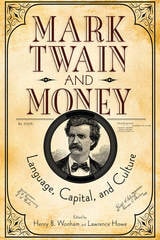
Mark Twain and Money
Language, Capital, and CultureEdited by Henry B. Wonham and Lawrence Howe
University of Alabama Press, 2017
Mark Twain and Money: Language, Capital, and Culture focuses on an overlooked feature of the story of one of America’s most celebrated writers. Investigating Samuel Clemens’s often conflicting but insightful views on the roles of money in American culture and identity, this collection of essays shows how his fascination with the complexity of nineteenth-century economics informs much of Mark Twain’s writing.
While most readers are familiar with Mark Twain the worldly wise writer, fewer are acquainted with Samuel Clemens the avid businessman. Throughout his life, he sought to strike it rich, whether mining for silver in Nevada, founding his own publishing company, or staking out ownership in the Paige typesetting machine. He was ever on the lookout for investment schemes and was intrigued by inventions, his own and those of others, that he imagined would net a windfall. Conventional wisdom has held that Clemens’s obsession with business and material wealth hindered his ability to write more and better books. However, this perspective fails to recognize how his interest in economics served as a rich source of inspiration for his literary creativity and is inseparable from his achievements as a writer. In fact, without this preoccupation with monetary success, Henry B. Wonham and Lawrence Howe argue, Twain’s writing would lack an important connection to a cornerstone of American culture.
The contributors to this volume examine a variety of topics, such as a Clemens family myth of vast landholdings, Clemens’s strategies for protecting the Mark Twain brand, his insights into rapidly evolving nineteenth-century financial practices, the persistence of patronage in the literary marketplace, the association of manhood and monetary success, Clemens’s attitude and actions toward poverty, his response to the pains of bankruptcy through writing, and the intersection of racial identity and economics in American culture. These illuminating essays show how pecuniary matters invigorate a wide range of Twain’s writing from The Gilded Age, Roughing It,The Adventures of Tom Sawyer, The Prince and the Pauper, and A Connecticut Yankee in King Arthur’s Court, to later stories like “The £1,000,000 Banknote” and the Autobiography.

Mark Twain and Orion Clemens
Brothers, Partners, StrangersPhilip Ashley Fanning
University of Alabama Press, 2003
One became America’s greatest writer. The other died in obscurity and failure. As brothers, they shaped each other's lives and work.
In a compelling way, Philip Fanning traces the fraternal relationship of Orion and Samuel Clemens from its beginning in Hannibal, Missouri, in the 1830s to Orion's death in Iowa in 1897. He demonstrates that Orion’s influence on the writer known as Mark Twain was profound, pervasive, and prolonged.
In some respects, Samuel defined himself against Orion’s formidable background. It was Orion who became the chief financial and spiritual support of the Clemens family following the father's controversial death in 1847. It was Orion who led the way for his brother into printing, journalism, and mine speculation. And it was Orion who served as Sam’s first real editor and literary mentor, recognizing and encouraging his younger brother’s talents as a writer.
The two siblings had much in common, and they often appeared to be codependent, so much so that their attitudes veered sharply from mutual admiration to mutual disdain and rivalry. Whereas Orion was self-effacing, easygoing, humble, and adventurous in his politics and progressive in his views, Twain was often ill-tempered and antagonistic toward those around him and conservative in his outlook. He frequently portrayed his older brother in autobiographical writings and letters as a buffoon and a laughingstock.
Fanning—who drew upon extensive archival sources, unpublished letters between the two brothers, and the Mark Twain Papers at the University of California, Berkeley—charts these divergences in their characters and in their fortunes. As Twain rose to become a national celebrity and a financial success, Orion's finances and self-esteem disintegrated, and Twain’s treatment of his brother became evermore harsh and mocking. Fanning’s study stands as both a biography of a fractious fraternal relationship and a work of scholarship that highlights for the first time how significantly Orion Clemens influenced Twain’s psychic and artistic economy.
Mark Twain and the American West
Joseph L. Coulombe
University of Missouri Press, 2003
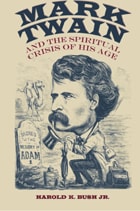
Mark Twain and the Spiritual Crisis of His Age
Harold K. Bush
University of Alabama Press, 2007
Discover the spiritual depths behind America’s greatest humorist.
Mark Twain is often pictured as a severe critic of religious piety, shaking his fist at God and mocking the devout. Such a view, however, is only partly correct. It ignores the social realities of Twain’s major period as a writer and his own spiritual interests: his participation in church activities, his socially progressive agenda, his reliance on religious themes in his major works, and his friendships with clergymen, especially his pastor and best friend, Joe Twichell. It also betrays a conception of religion that is more contemporary than that of the period in which he lived.
Harold K. Bush Jr. highlights Twain’s attractions to and engagements with the wide variety of religious phenomena of America in his lifetime, and how these matters affected his writings. Though Twain lived in an era of tremendous religious vigor, it was also a time of spiritual upheaval and crisis. The rise of biological and psychological sciences, the criticism of biblical texts as literary documents, the influx of world religions and immigrant communities, and the trauma of the Civil War all had dramatic effects on America’s religious life. At the same time mass urban revivalism, the ecumenical movement, Social Christianity, and occultic phenomena, like spiritualism and mind sciences, all rushed in to fill the voids. The rapid growth of agnosticism in the 1870s and 1880s is also clearly reflected in Twain’s life and writings. Thus Twain’s career reflects in an unusually resonant way the vast changes in American belief during his lifetime.
Bush’s study offers both a new and more complicated understanding of Twain and his literary output and serves as the cultural biography of an era.
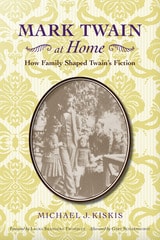
Mark Twain at Home
How Family Shaped Twain’s FictionMichael J. Kiskis, Foreword by Laura Skandera Trombley, Afterword by Gary Scharnhorst
University of Alabama Press, 2016
Mark Twain was the child of a loveless marriage and a homelife over which hovered the constant specter of violence. Informed by his difficult childhood, orthodox readings of The Adventures of Tom Sawyer and Adventures of Huckleberry Finn frame these canonical literary figures as nostalgic—autobiographical fables of heroic individualists slipping the bonds of domestic life.
Kiskis, however, presents a wealth of biographical details about Samuel Clemens and his family that reinterpret Twain’s work as a robust affirmation of domestic spheres of life. Among Kiskis’s themes are that, as the nineteenth century witnessed high rates of orphanhood and childhood mortality, Clemens’s work often depicted unmoored children seeking not escape from home but rather seeking the redemption and safety available only in familial structures. Similarly, Mark Twain at Home demonstrates that, following the birth of his first daughter, Twain began to exhibit in his writing an anxiety with social ills, notably those that affected children.
In vigorous and accessible descriptions of Twain’s life as it became reflected in his prose, Kiskis offers a compelling and fresh understanding of this work of this iconic American author.
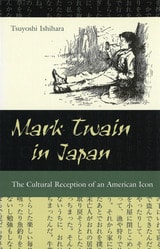
Mark Twain in Japan
The Cultural Reception of an American IconTsuyoshi, Ishihara
University of Missouri Press, 2005
Best known for his sharp wit and his portrayals of life along the banks of the Mississippi River, Mark Twain is indeed an American icon, and many scholars have examined how he and his work are perceived in the United States. In Mark Twain in Japan, however, Tsuyoshi Ishihara explores how Twain’s uniquely American work is viewed in a completely different culture.
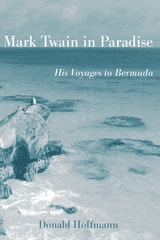
Mark Twain in Paradise
His Voyages to BermudaDonald Hoffman
University of Missouri Press, 2006
This book is the first comprehensive study of Clemens’s love affair with Bermuda, a vivid depiction of a celebrated author on recurring vacations. Donald Hoffmann has culled and clarified passages from Mark Twain’s travel pieces, letters, and unpublished autobiographical dictation—with cross-references to his fiction and infrequently cited short pieces—to create a little-known view of the author at leisure on his fantasy island.
Mark Twain in Paradise sheds light on both Clemens’s complex character and the topography and history of the islands. Hoffmann has plumbed the voluminous Mark Twain scholarship and Bermudian archives to faithfully re-create turn-of-the-century Bermuda, supplying historical and biographical background to give his narrative texture and depth. He offers insight into Bermuda’s natural environment, traditional stone houses, and romantic past, and he presents dozens of illustrations, both vintage and new, showing that much of what Mark Twain described can still be seen today.
Hoffmann also provides insight into the social circles Clemens moved in—and sometimes collected around himself. When visiting the islands, he rubbed shoulders with the likes of socialist Upton Sinclair and multimillionaire Henry H. Rogers; with Woodrow Wilson and his lover, socialite Mary Peck; as well as with the young girls to whom he enjoyed playing grandfather.
“You go to heaven if you want to,” Mark Twain wrote from Bermuda in 1910 during his long last visit. “I’d druther stay here.” And because much of what Clemens enjoyed in the islands is still available to experience today, visitors to Bermuda can now have America’s favorite author as their guide. Mark Twain in Paradise is an unexpected addition to the vast literature by and about Mark Twain and a work of travel literature unlike any other.
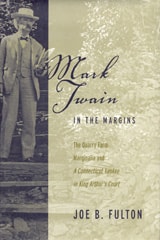
Mark Twain in the Margins
The Quarry Farm Marginalia and a Connecticut Yankee in King Arthur's CourtJoe B. Fulton
University of Alabama Press, 2007
Revealing the notes behind the novel and the scholar behind the legend.
The common characterization of Mark Twain as an uneducated and improvisational writer took hold largely because of the novelist's own frequent claims about his writing practices. But using recently discovered evidence--Twain's marginal notes in books he consulted as he worked on A Connecticut Yankee in King Arthur's Court—Joe Fulton argues for a reconsideration of scholarly views about Twain's writing process, showing that this great American author crafted his novels with careful research and calculated design.
Fulton analyzes Twain's voluminous marginalia in the copies of Macaulay's History of England, Carlyle's History of the French Revolution, and Lecky's History of the Rise of Rationalism and England in the Eighteenth Century available to Twain in the library of Quarry Farm, the New York farm where the novelist and his family routinely spent their summers. Comparing these marginal notes to entries in Twain's writing journal, the manuscript of Connecticut Yankee, and the book as published in 1889, Fulton establishes that Twain's research decisively influenced the novel. Fulton reveals Twain to be both the writer from experience he claimed to be and the careful craftsman that he attempted to downplay. By redefining Twain's aesthetic, Fulton reinvigorates current debates about what constitutes literary realism.
Fulton's transcriptions of the marginalia appear in an appendix; together with his analysis, they provide a valuable new resource for Twain scholars.
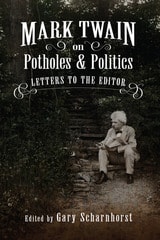
Mark Twain on Potholes and Politics
Letters to the EditorEdited by Gary Scharnhorst
University of Missouri Press, 2014
A frequent outlet for Twain’s wit was in letters to the editors of various newspapers and periodicals. Sharing his thoughts and opinions on topical issues ranging from national affairs to local social events, with swipes along the way at woman suffrage, potholes, literary piracy and other scams, slow mail delivery, police corruption, capital punishment, and the removal of Huck Finn from libraries, Twain never hesitated to speak his mind. And now thanks to Gary Scharnhorst, more than a hundred of these letters are available in one place for us to enjoy.
From his opinions on the execution of an intellectually brilliant murderer, to his scathing review of a bureau he perceived as “a pack of idiots” running on a currency of doughnuts, Twain’s pure, unbridled voice is evident throughout his letters. Mark Twain on Potholes and Politicsgives readers a chance to delve further than ever before into the musings of the most recognizable voice in American literature.

Mark Twain on the Loose
A Comic Writer and the American SelfBruce Michelson
University of Massachusetts Press, 1995
Can we rediscover the wildness in Mark Twain’s humor? Can we understand how that wildness helped make him a national legend and a key figure in the expression of an American self? In Mark Twain on the Loose, Bruce Michelson writes about Twain as a body of literature, as a public personality, and as a myth. Michelson shows that many of Twain’s most ambitious and memorable works, from the very beginning to the end of his career, express a drive for absolute liberation from every social, psychological, and artistic limit.
The outrageous and anarchic sides of Twain play a vital role in his art. But these traits are undervalued even by his admirers, who often favor clean shapes and steady affirmations in Twain’s writing —not the dangerous comic outbreak, or the deep yearning to free the self from every definition and confinement.
Reviewing works from a wide range of Twain’s writings, Michelson brings to light those wild dimensions, their literary consequences, and their cultural importance. He reveals this great author as “the best escape artist in the American canon,” a reflexive, paradoxical, rule-shattering comic genius.
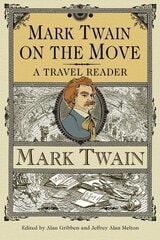
Mark Twain on the Move
A Travel ReaderAlan Gribben
University of Alabama Press, 2008
Journeys, humor, and insight from Mark Twain's travel narratives - America’s literary master.
Mark Twain on the Move gathers the very best passages from all five of Mark Twain’s travel narratives: The Innocents Abroad (1869), Roughing It (1872), A Tramp Abroad (1880), Life on the Mississippi (1883), and Following the Equator (1897). Although Twain’s travel narratives were his best sellers throughout his career, modern readers are largely unfamiliar with them. Thus, readers are not only missing some of Twain’s most hilarious and insightful material, they are also missing a complete understanding of a beloved literary and cultural icon.
Mark Twain on the Move presents the best of these works—sometimes respectful, often irreverent and outlandish—at their most lively and captures his renowned experiences as an American tourist. And they demonstrate why Twain’s greatest popularity in his lifetime derived from his travel writings rather than from his novels. Twain was always entertaining and provocative while on the move and this collection captures that fabled energy for modern readers.
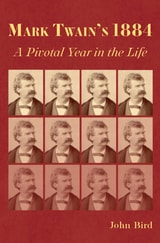
Mark Twain's 1884
A Pivotal Year in the LifeJohn Bird
University of Missouri Press, 2026
Many biographies of Mark Twain cover his entire life, while others focus on specific periods, especially his later years. In this innovative new work, John Bird takes an entirely different approach. Mark Twain’s 1884: A Pivotal Year in the Life is a “micro-biography” that homes in on a single—and pivotal—year.
In 1884, Twain stood at the height of his powers as a writer and enjoyed one of the happiest years in his domestic family life. During the course of the year he was readying his greatest work, Adventures of Huckleberry Finn, for publication, which occurred in England near the end of the year; he was launching his own publishing house, Charles L. Webster and Company, after becoming disillusioned with his previous publishers; and he publicly embroiled himself in presidential politics in a way that presaged his later involvement with American and international politics. Finally, Twain’s 1884 ended with a great deal more public exposure thanks to an extensive multi-city lecture tour he undertook with George Washington Cable, as well as the beginnings of his ultimately successful attempt to secure publishing rights for Ulysses S. Grant’s memoirs.
The level of detail provided by a day-to-day narrative gives the reader a chance to imaginatively live that year in Twain’s life: his work, his family life, his correspondence, his business dealings, his travels, his recreational pursuits, and his political involvement. Bird enlarges upon a great many moments in and aspects of Twain’s life that other biographies barely touch on or ignore completely.
In this new approach to biography, Bird gives readers a broader appreciation not only of Mark Twain the author but of Mark Twain the husband, father, uncle, and friend, and national celebrity and persona.

Mark Twain's Homes and Literary Tourism
Hilary Iris Lowe
University of Missouri Press, 2025
A century after Samuel Clemens’s death, Mark Twain thrives. One way fans still celebrate the first true American writer and his work is by visiting any number of Mark Twain destinations. They believe they can learn something unique by visiting the places where he lived. Mark Twain’s Homes and Literary Tourism untangles the complicated ways that Clemens’s houses, now museums, have come to tell the stories that they do about Twain and, in the process, reminds us that the sites themselves are the products of multiple agendas and, in some cases, unpleasant histories.
Hilary Iris Lowe leads us through four Twain homes, beginning at the beginning—Florida, Missouri, where Clemens was born. Today the site is simply a concrete pedestal missing its bust, a plaque, and an otherwise-empty field. Though the original cabin where he was born likely no longer exists, Lowe treats us to an overview of the history of the area and the state park challenged with somehow marking this site. Next, we travel with Lowe to Hannibal, Missouri, Clemens’s childhood home, which he saw become a tourist destination in his own lifetime. Today mannequins remind visitors of the man that the boy who lived there became and the literature that grew out of his experiences in the house and little town on the Mississippi.
Literary historic sites pin their authority on the promise of exclusive insight into authors and texts through firsthand experience. As tempting as it is to accept the authenticity of Clemens’s homes, Mark Twain’s Homes and Literary Tourism argues that house museums are not reliable critical texts but are instead carefully constructed spaces designed to satisfy visitors. This volume shows us how these houses’ portrayals of Clemens change frequently to accommodate and shape our own expectations of the author and his work.
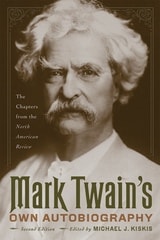
Mark Twain's Own Autobiography
The Chapters from the North American ReviewMark Twain; Edited by Michael J. Kiskis; Foreword by Sheila Leary
University of Wisconsin Press, 2010
More than the story of a literary career, this memoir is anchored in the writer’s relation to his family—what they meant to him as a husband, father, and artist. It also brims with many of Twain’s best comic anecdotes about his rambunctious boyhood in Hannibal, his misadventures in the Nevada territory, his notorious Whittier birthday speech, his travels abroad, and more.
Twain published twenty-five “Chapters from My Autobiography” in the North American Review in 1906 and 1907. “I intend that this autobiography . . . shall be read and admired a good many centuries because of its form and method—form and method whereby the past and the present are constantly brought face to face, resulting in contrasts which newly fire up the interest all along, like contact of flint with steel.”
For this second edition, Michael Kiskis’s introduction references a wealth of critical work done on Twain since 1990. He also adds a discussion of literary domesticity, locating the autobiography within the history of Twain’s literary work and within Twain’s own understanding and experience of domestic concerns.
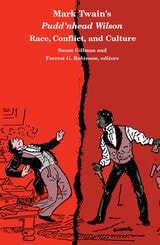
Mark Twain's Pudd'nhead Wilson
Race, Conflict and CultureSusan Gillman and Forrest Robinson, eds.
Duke University Press, 1990
In a variety of ways the essays build arguments out of, not in spite of, the anomalies, inconsistencies, and dead ends in the text itself. Such wrinkles and gaps, the authors find, are the symptoms of an inconclusive, even evasive, but culturally illuminating struggle to confront and resolve difficult questions bearing on race and sex. Such fresh, intellectually enriching perspectives on the novel arise directly from the broad-based interdisciplinary foundations provided by the participating scholars. Drawing on a wide variety of critical methodologies, the essays place the novel in ways that illuminate the world in which it was produced and that further promise to stimulate further study.
Contributors. Michael Cowan, James M. Cox, Susan Gillman, Myra Jehlen, Wilson Carey McWilliams, George E. Marcus, Carolyn Porter, Forrest Robinson, Michael Rogin, John Carlos Rowe, John Schaar, Eric Sundquist
Mark Twain, Travel Books, and Tourism
The Tide of a Great Popular MovementJeffrey Alan Melton
University of Alabama Press, 2008
With the publication of The Innocents Abroad (1869), Mark Twain embarked on a long and successful career as the 19th century's best-selling travel writer. Jeffrey Melton treats Twain's travel narratives in depth, and in the context of his contemporary travel writers and a burgeoning tourism culture. As Melton shows, Twain's five major travel narratives--The Innocents Abroad, Roughing It, Life on the Mississippi, A Tramp Abroad, and Following the Equator--demonstrate Twain's mastery and reinvention of the genre.
Mark Twain, Unsanctified Newspaper Reporter
James E. Caron
University of Missouri Press, 2008
Before Mark Twain became a national celebrity with his best-selling The Innocents Abroad, he was just another struggling writer perfecting his craft—but already “playin’ hell” with the world. In the first book in more than fifty years to examine the initial phase of Samuel Clemens’s writing career, James Caron draws on contemporary scholarship and his own careful readings to offer a fresh and comprehensive perspective on those early years—and to challenge many long-standing views of Mark Twain’s place in the tradition of American humor.
Tracing the arc of Clemens’s career from self-described “unsanctified newspaper reporter” to national author between 1862 and 1867, Caron reexamines the early and largely neglected writings—especially the travel letters from Hawaii and the letters chronicling Clemens’s trip from California to New York City. Caron connects those sets of letters with comic materials Clemens had already published, drawing on all known items from this first phase of his career—even the virtually forgotten pieces from the San Francisco Morning Call in 1864—to reveal how Mark Twain’s humor was shaped by the sociocultural context and how it catered to his audience’s sensibilities while unpredictably transgressing its standards.
Caron reveals how Sam Clemens’s contemporaries, notably Charles Webb, provided important comic models, and he shows how Clemens not only adjusted to but also challenged the guidelines of the newspapers and magazines for which he wrote, evolving as a comic writer who transmuted personal circumstances into literary art. Plumbing Mark Twain’s cultural significance, Caron draws on anthropological insights from Victor Turner and others to compare the performative aspects of Clemens’s early work to the role of ritual clowns in traditional societies
Brimming with fresh insights into such benchmarks as “Our Fellow Savages of the Sandwich Islands” and “Jim Smiley and His Jumping Frog,” this book is a gracefully written work that reflects both patient research and considered judgment to chart the development of an iconic American talent. Mark Twain, Unsanctified Newspaper Reporter should be required reading for all serious scholars of his work, as well as for anyone interested in the interplay between artistic creativity and the literary marketplace.
Mark Twain, the World, and Me
"Following the Equator," Then and NowSusan K. Harris
University of Alabama Press, 2020
A scholar accompanies Twain on his journey around the world
In Mark Twain, the World, and Me: “Following the Equator,” Then and Now, Susan K. Harris follows Twain’s last lecture tour as he wound his way through the British Empire in 1895–1896. Deftly blending history, biography, literary criticism, reportage, and travel memoir, Harris gives readers a unique take on one of America’s most widely studied writers.
Structured as a series of interlocking essays written in the first person, this engaging volume draws on Twain’s insights into the histories and cultures of Australia, India, and South Africa and weaves them into timely reflections on the legacies of those countries today. Harris offers meditations on what Twain’s travels mean for her as a scholar, a white woman, a Jewish American, a wife, and a mother. By treating topics as varied as colonial rule, the clash between indigenous and settler communities, racial and sexual “inbetweenness,” and species decimation, Harris reveals how the world we know grew out of the colonial world Twain encountered. Her essays explore issues of identity that still trouble us today: respecting race and gender, preserving nature, honoring indigenous peoples, and respecting religious differences.
Mark Twain
God's FoolHamlin Hill
University of Chicago Press, 2010
After laughing their way through his classic and beloved depictions of nineteenth-century American life, few readers would suspect that Mark Twain’s last years were anything but happy and joyful. They would be wrong. Contrary to the myth perpetrated by his literary executors Twain ended his life as a frustrated writer plagued by paranoia. He suffered personal tragedies, got involved in questionable business ventures, and was a demanding and controlling father and husband. As Mark Twain: God’s Fool demonstrates, the difficult circumstances of Twain’s personal life make his humorous output all the more surprising and admirable.
“Ham[lin] Hill remains among the smartest, most honest, and most humane of Twain scholars—and . . . God’s Fool parades those qualities on every page.” Jeff Steinbrink, Franklin & Marshall College
“Fills a great, long-standing need for a thoroughly researched book about Mark Twain’s twilight years. . . . Splendidly, grippingly written and excellently documented. . . . Likely to be a standard work for as long as anyone can foresee.” Choice
Mark Twain
The Complete InterviewsEdited by Gary Scharnhorst
University of Alabama Press, 2006
Mark Twain: The Complete Interviews is an annotated and indexed scholarly edition of every known interview with Mark Twain. In these interviews that span his entire career, Twain discusses matters as varied as his lecture style, his writings, and his bankruptcy, while holding forth on such timeless issues as human nature, politics, war and peace, government corruption, humor, race relations, imperialism, international copyright, the elite, and his impressions of other writers.
These interviews are oral performances in their own right and a new basis for evaluating contemporary responses to Twain’s writings. The interviews are records of verbal conversations rather than texts written in Twain’s hand. Four interviews are new to scholarship; fewer than a fifth have ever been reprinted.
.