Results by title
28167 books match the query 'History' and 1583 start with m
Melancholy, Love, and Time
Boundaries of the Self in Ancient LiteraturePeter Toohey
University of Michigan Press, 2004
Melayu
The Politics, Poetics and Paradoxes of MalaynessEdited by Maznah Mohamad and Syed Muhd Khairudin Aljunied
National University of Singapore Press, 2012
In Melayu: The Politics, Poetics and Paradoxes of Malayness, the contributors examine the checkered, wavering and changeable understanding of the word Melayu by considering hitherto unexplored case studies dealing with use of the term in connection with origins, nations, minority-majority politics, Filipino Malays, Riau Malays, Orang Asli, Straits Chinese literature, women's veiling, vernacular television, social dissent, literary women, and modern Sufism. Taken as a whole, this volume offers a creative approach to the study of Malayness while providing new perspectives to the studies of identity formation and politics of ethnicity that have wider implications beyond the Southeast Asian region.
Melodramatic Formations
American Theatre and Society, 1820-1870Bruce A. Mcconachie
University of Iowa Press, 1992
Melodramatic Imperial Writing
From the Sepoy Rebellion to Cecil RhodesNeil Hultgren
Ohio University Press, 2014
Melt with Me
Coming of Age and Other ’80s PerilsPaul Crenshaw
The Ohio State University Press, 2023
Meltdown Expected
Crisis, Disorder, and Upheaval at the end of the 1970sAaron J. Leonard
Rutgers University Press, 2024
Meltdown Expected tells the story of the power shifts from late 1978 through 1979 whose repercussions are still being felt. Iran’s revolution led to a hostage crisis while neighbouring Afghanistan became the site of a proxy war between the USSR and the US, who supplied aid to Islamic mujahideen fighters that would later form the Taliban. Meanwhile, as tragedies like the Jonestown mass suicide and the assassination of Harvey Milk captured the nation’s attention, the government quietly reasserted and expanded the FBI’s intelligence powers. Drawing from recently declassified government documents and covering everything from Three Mile Island to the rise of punk rock, Aaron J. Leonard paints a vivid portrait of a tumultuous yet pivotal time in American history.
Melting the Ice Curtain
The Extraordinary Story of Citizen Diplomacy on the Russia-Alaska FrontierDavid Ramseur
University of Alaska Press, 2017
Melting the Ice Curtain tells the story of how inspiration, courage, and persistence by citizen-diplomats bridged a widening gap in superpower relations. David Ramseur was a first-hand witness to the danger and political intrigue, having flown on that first Friendship Flight, and having spent thirty years behind the scenes with some of Alaska’s highest officials. As Alaska celebrates the 150th anniversary of its purchase, and as diplomatic ties with Russia become perilous, Melting the Ice Curtain shows that history might hold the best lessons for restoring diplomacy between nuclear neighbors.
Melville Biography
An Inside NarrativeHershel Parker
Northwestern University Press, 2013
Melville Biography: An Inside Narrative is Hershel Parker’s history of the writing of Melville biographies, enriched by a lifetime of intimate working partnerships with great Melville scholars of different generations and by the author’s experience of successive phases of literary criticism. Throughout this bold book, Hershel Parker champions archival-based biography and the all-but-lost art of embodying such scholarship in literary criticism. First is a mesmerizing autobiographical account of what went into creating the award-winning and comprehensive Herman Melville: A Biography. Then Parker traces six decades of the “unholy war” waged against biographical scholarship, in which critics repeatedly imposed the theory of organic unity on Melville’s disrupted life—not just on his writings—while truncating his body of work and ignoring his study of art and aesthetics. In this connection, Parker celebrates discoveries made by “divine amateurs,” before throwing open his workshop to challenge ambitious readers with research projects. This is a book for Melville fans and Parker fans, as well as for readers, writers, and would-be writers of biography.
Membranes to Molecular Machines
Active Matter and the Remaking of LifeMathias Grote
University of Chicago Press, 2019
Membranes to Molecular Machines explores just how late twentieth-century science came to think of our cells and bodies this way. This story is told through the lens of membrane research, an unwritten history at the crossroads of molecular biology, biochemistry, physiology, and the neurosciences, that directly feeds into today's synthetic biology as well as nano- and biotechnology. Mathias Grote shows how these sciences not only have made us think differently about life, they have, by reworking what membranes and proteins represent in laboratories, allowed us to manipulate life as "active matter" in new ways. Covering the science of biological membranes in the United States and Europe from the mid-1960s to the 1990s, this book connects that history to contemporary work with optogenetics, a method for stimulating individual neurons using light, and will enlighten and provoke anyone interested in the intersection of chemical research and the life sciences—from practitioner to historian to philosopher.
The research described in the book and its central actor, Dieter Oesterhelt, were honored with the 2021 Albert Lasker Basic Medical Research Award for his contribution to the development of optogenetics. The 2026 Nobel Prize in Physiology or Medicine was awarded to three scientists for discoveries leading to optogenetics. Membranes to Molecular Machines can be read as a prehistory of this research.
Memoir of Hungary
1944-1948Sándor Márai
Central European University Press, 1996
This scathing, at times humorous, and always insightful memoir by exiled Hungarian novelist Sándor Márai, provides one of the most poignant and human portraits of life in Hungary between the German occupation in 1944 and the solidification of communist power in 1948. Both a fervent anti-fascist and anti-communist, Márai draws a vivid portrait of the Hungarian peasantry and middle-class during this period, while delivering a telling indictment of the communist system from which he fled. Witty, aphoristic and psychologically clear-sighted, this memoir depicts the tragedy and pathos of a crucial period in the post-war history of a nation which has been 'central' to both the communists and the post-communist history of our times.
Memoir of My Youth in Cuba
A Soldier in the Spanish Army during the Separatist War, 1895–1898Dolores J. Walker
University of Alabama Press, 2017
A historically significant memoir offering a firsthand perspective on life, identity, and cultural transformation in nineteenth-century Cuba.
Memoir of My Youth in Cuba: A Soldier in the Spanish Army during the Separatist War, 1895–1898 is a translation of the memoir Memorias de mi juventud en Cuba: Un soldado del ejército español en la guerra separatista (1895–1898) by Josep Conangla. The English edition is based on the Spanish version edited by Joaquín Roy, who found the memoir and was given access to the Conangla family archives. Conangla’s memoir, now available in English, is an important addition to the accounts of Spanish and Cuban soldiers who served in Cuba’s second War of Independence.
Spaniard Josep Conangla was conscripted at the age of twenty and sent to Cuba. In the course of his time there, he reaffirmed his pacifism and support of Cuban independence. The young man was a believer who unfailingly connected his view of events to the Christian humanitarianism on which he prided himself. Conangla’s advanced education and the influence of well-placed friends facilitated his assignment to safe bureaucratic positions during the war, ensuring that he would not see combat. From his privileged position, he was a keen observer of his surroundings. He described some of the decisions he made—which at times put him at odds with the military bureaucracy he served—along with what he saw as the consequences of General Valeriano Weyler’s decree mandating the reconcentración, an early version of concentration camps. What Conangla saw fueled his revulsion at the collusion of the Spanish state and its state-sponsored religion in that policy. “Red Mass,” published six years after the War of Independence and included in his memoir, is a vivid expression in verse of his abhorrence.
Conangla’s recollections of the contacts between Spaniards and Cubans in the areas to which he was assigned reveal his ability to forge friendships even with Creole opponents of the insurrection. As an aspiring poet and writer, Conangla included material on fellow writers, Cuban and Spanish, who managed to meet and exchange ideas despite their circumstances. His accounts of the Spanish defeat, the scene in Havana around the end of the war, along with his return to Spain, are stirring.
Memoirs
Marie Mancini and Hortense Mancini
University of Chicago Press, 2008
Through their writings, the Mancinis sought to rehabilitate their reputations and reclaim the right to define their public images themselves, rather than leave the stories of their lives to the intrigues of the court—and to their disgruntled ex-husbands. First translated in 1676 and 1678 and credited largely to male redactors, the two memoirs reemerge here in an accessible English translation that chronicles the beginnings of women’s rights to personal independence within the confines of an otherwise circumscribed early modern aristocratic society.
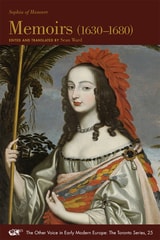
Memoirs (1630-1680)
Sophia of Hanover
Iter Press, 2013
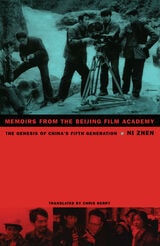
Memoirs from the Beijing Film Academy
The Genesis of China's Fifth GenerationZhen Ni
Duke University Press, 2002
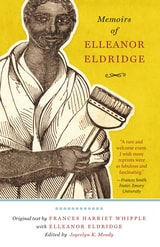
Memoirs of Elleanor Eldridge
Joycelyn K. Moody
University of Delaware Press, 0
Elleanor Eldridge, born of African and US indigenous descent in 1794, operated a lucrative domestic services business in nineteenth century Providence, Rhode Island. In defiance of her gender and racial background, she purchased land and built rental property from the wealth she gained as a business owner. In the 1830s, Eldridge was defrauded of her property by a white lender. In a series of common court cases as defendant and plaintiff, she managed to recover it through the Rhode Island judicial system. In order to raise funds to carry out this litigation, her memoir, which includes statements from employers endorsing her respectable character, was published in 1838. Frances Harriet Whipple, an aspiring white writer in Rhode Island, narrated and co-authored Eldridge’s story, expressing a proto-feminist outrage at the male “extortioners” who caused Eldridge’s loss and distress.
With the rarity of Eldridge’s material achievements aside, Memoirs of Elleanor Eldridge forms an exceptional antebellum biography, chronicling Eldridge’s life from her birth. Because of Eldridge’s exceptional life as a freeborn woman of color entrepreneur, it constitutes a counter-narrative to slave narratives of early nineteenth-century New England, changing the literary landscape of conventional American Renaissance studies and interpretations of American Transcendentalism.
With an introduction by Joycelyn K. Moody, this new edition contextualizes the extraordinary life of Elleanor Eldridge—from her acquisition of wealth and property to the publication of her biography and her legal struggles to regain stolen property. Because of her mixed-race identity, relative wealth, local and regional renown, and efficacy in establishing a collective of white women patrons, this biography challenges typical African and Indigenous women’s literary production of the early national period and resituates Elleanor Eldridge as an important cultural and historical figure of the nineteenth century.
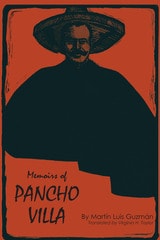
Memoirs of Pancho Villa
By Martín Luis Guzmán
University of Texas Press, 1965
This is a tale that might be told around a campfire, night after night in the midst of a military campaign. The kinetic and garrulous Pancho Villa talking on and on about battles and men; bursting out with hearty, masculine laughter; weeping unashamed for fallen comrades; casually mentioning his hotheadedness—"one of my violent outbursts"—which sent one, two, or a dozen men before the firing squad; recounting amours; and always, always protesting dedication to the Revolutionary cause and the interests of "the people."
Villa saw himself as the champion, eventually almost the sole champion, of the Mexican people. He fought for them, he said, and opponents who called him bandit and murderer were hypocrites.
This is his story, his account of how it all began when as a peasant boy of sixteen he shot a rich landowner threatening the honor of his sister. This lone, starved refugee hiding out in the mountains became the scourge of the Mexican Revolution, the leader of thousands of men, and the hero of the masses of the poor.
Great battles of the Revolution are described, sometimes as broad sweeps of strategy, sometimes as they developed half hour by half hour. Long, dusty horseback forays and cold nights spent pinned down under enemy fire on a mountainside are made vivid and gripping. The assault on Ciudad Juárez in 1911, the battles of Tierra Blanca, of Torreón, of Zacatecas, of Celaya, all are here, told with a feeling of great immediacy. This volume ends as Villa and Obregón prepare to engage each other in the war between victorious generals into which the Revolution degenerated before it finally ended.
Martín Luis Guzmán, eminent historian of Mexico, knew and traveled with Pancho Villa at various times during the Revolution. General Villa offered young Martín Luis a position as his secretary, but he declined. When many years later some of Villa's private papers, records, and what was apparently the beginning of an autobiography came into Guzmán's hands, he was ideally suited to blend all these into an authentic account of the Revolution as Pancho Villa saw it, and of the General's life as known only to Villa himself.
The Memoirs were first published in Mexico in 1951, where they were extremely popular; this volume was the first English publication. Virginia H. Taylor, translator in the Spanish Archives of the State of Texas Land Office, has accurately captured in English the flavor of the narrative.
Memoirs of a Fortunate Jew
An Italian StoryDan Vittorio Segre
University of Chicago Press, 2008
“Taut and illuminating . . . memorable . . . written with the humility of he who confesses himself and with the honesty of he who bore witness.”—Primo Levi
“The writing of memoirs is a difficult art that Dan Segre fully possesses. Under his pen, history and psychology merge in one captivating narrative which illuminates the turmoils, fears and triumphs of his generation.”—Elie Wiesel
“Beautifully written. . . . [A] labyrinthine, spell-binding autobiography, full of passionate tenderness.”—New York Review of Books
“An unusually attractive book—attractive in its irony, its energy and its moral insight. Mr. Segre had some rich material to work with, and he has done it justice.”—New York Times
Memoirs of a Palestinian Communist
The Secret Life of Najati SidqiNajati Sidqi; translated by Margaret Litvin, Gideon Gordon, and Anas Farhan
University of Texas Press, 2025
The secret life of a Palestinian Communist activist during the leadup to World War II.
In the public eye, Najati Sidqi was known as a journalist and writer, a translator of Russian classics, and an outspoken opponent of Nazism. However, Sidqi concealed a critical component of his life from the world and his family. He was an underground activist for the Palestinian Communist Party, a risky and influential pursuitthat took him to early Bolshevik Moscow, British courts and prison cells in Palestine, Nazi Germany, intrigue-heavy interwar Paris, and Civil War Spain, Morocco, and Algeria. Throughout his journey, Sidqi continued to write, even as he faced fascism, intense surveillance, active warzones, the death of friends, and exile.
Memoirs of a Palestinian Communist brings Sidqi’s incredible life and work to light, wryly narrating his international travels, his work as an activist, and his political dealings at a crucial moment for Palestine and the international fight against fascism. Translated from Arabic into English for the first time, it is a riveting firsthand account of an often-overlooked aspect of the history of the global left. Generous supplementary materials make the memoir accessible to students and non-specialist scholars: a preface by Sidqi’s grandson, a foreword by renowned historian Joel Beinin, a translators’ introduction that presents new research on Sidqi’s family history, a map of his travels, and a timeline, as well as a bibliographic essay offering pointers for further research.
Memoirs of a Revolutionary
Victor Serge
University of Iowa Press, 2002

Memoirs of an Early Arab Feminist
The Life and Activism of Anbara Salam KhalidiAnbara Salam Khalidi
Pluto Press, 2013
Memoirs of an Early Arab Feminist is the first English translation of the memoirs of Anbara Salam Khalidi, the iconic Arab feminist. At a time when women are playing a leading role in the Arab Spring, this book brings to life an earlier period of social turmoil and women's activism through one remarkable life.
Anbara Salam was born in 1897 to a notable Sunni Muslim family of Beirut. She grew up in 'Greater Syria', in which unhindered travel between Beirut, Jerusalem and Damascus was possible, and wrote a series of newspaper articles calling on women to fight for their rights within the Ottoman Empire. In 1927 she caused a public scandal by removing her veil during a lecture at the American University of Beirut.
Later she translated Homer and Virgil into Arabic and fled from Jerusalem to Beirut following the establishment of Israel in 1948. She died in Beirut in 1986. These memoirs have long been acclaimed by Middle East historians as an essential resource for the social history of Beirut and the larger Arab world in the 19th and 20th centuries.
Memoirs of the Civil War
Between the Northern and Southern Sections of the United States of America 1861 to 1865William W. Chamberlaine
University of Alabama Press, 2011
Memoirs of the Civil War, though relatively little known because of its rarity in the original edition, contains much valuable information and engaging narrative passages. A Virginian whose Confederate career included service in an infantry regiment early in the war, Chamberlaine’s most important military service was as a staff officer attached to Brigadier General Reuben Lindsay Walker, who commanded the Third Corps artillery in the Army of Northern Virginia.
Includes excellent material on the duties of staff officers, operation of Confederate conscription, and the role of artillery in Lee’s campaigns. He is especially eloquent and revealing about a number of famous battles: the Seven Days; Antietam, where Chamberlaine distinguished himself and was wounded; and the Wilderness, where he had a memorable encounter with Lee.
Memoirs of the Life, Religious Experience, Ministerial Travels, and Labours of Mrs. Elaw
Zilpha Elaw
West Virginia University Press, 2021
As a young Black orphan indentured to a Quaker family in Bristol, Pennsylvania, Zilpha Elaw (c. 1793–1873) decided to join the upstart Methodists in 1808. She preached her first sermon a decade later, ignoring her husband and the many church leaders, clergy, and laity who tried to silence her. Elaw’s memoir chronicles the first twenty years of her forty-year itinerant ministry during massive Protestant revivalism in the United States and England.
Elaw preached from Maine to Virginia, attracting multiracial and multidenominational audiences that included powerful men, wealthy White women, poor families, and enslaved communities. She moved from Bristol to Burlington, New Jersey, then to Nantucket, Massachusetts, and finally, in 1840, to London’s East End. In England, Elaw’s celebrity expanded, and at least twice she drew crowds so large they caused human stampedes and multiple injuries.
Blockett’s introduction and extensive annotations draw on newly unearthed information about the entirety of Elaw’s evangelism to provide context for this remarkable story of an antebellum Black woman’s personal and professional mobility.
Memoirs of the Life, Religious Experience, Ministerial Travels, and Labours of Mrs. Elaw
Kimberly D. Blockett
University of Delaware Press, 0
Elaw preached from Maine to Virginia, attracting multiracial and multidenominational audiences that included powerful men, wealthy White women, poor families, and enslaved communities. She moved from Bristol to Burlington, New Jersey, then to Nantucket, Massachusetts, and finally, in 1840, to London’s East End. In England, Elaw’s celebrity expanded, and at least twice she drew crowds so large they caused human stampedes and multiple injuries.
Kimberly D. Blockett’s introduction and extensive annotations draw on newly unearthed information about the entirety of Elaw’s evangelism to provide context for this remarkable story of an antebellum Black woman’s personal and professional mobility.
Memorandoms by James Martin
An Astonishing Escape from Early New South WalesEdited by Tim Causer
University College London, 2017
Memoria Romana
Memory in Rome and Rome in Memoryedited by Karl Galinsky
University of Michigan Press, 2014
Concern with memory permeated Roman literature, history, rhetorical training, and art and architecture. This is the first book to look at the phenomenon from a variety of perspectives, including cognitive science. There is no orthodoxy in memory studies and the approaches are both empirical and theoretical. A central issue is: who and what preserved and shaped cultural memory in Rome, and how did that process work? Areas and subjects covered include the Romans' view of the changing physical fabric of the city, monuments (by etymology related to memory) such as the Arch of Constantine, memory and the Roman triumph, Roman copies of Greek sculpture and their relation to memory, the importance of written information and of continuing process, the creation of memory in Republican memoirs and Flavian poetry, the invention of traditions, and the connection of cultural and digital memory.
The ten chapters present original findings that complement earlier scholarship from the perspective of memory and open up new horizons for inquiry. The introduction by volume editor Karl Galinsky situates the work within current studies on cultural and social memory, and the concluding chapter by Daniel Libeskind provides the perspective of a contemporary practitioner.
Additional contributors include Richard Jenkyns, Harriet I. Flower, T. P. Wiseman, Karl-J. Hölkeskamp, Gianpiero Rosati, Diane Favro, Jessica Hughes, Anna Anguissola, Lisa Marie Mignone, and Bernard Frischer.
Memorial Mania
Public Feeling in AmericaErika Doss
University of Chicago Press, 2010
In the past few decades, thousands of new memorials to executed witches, victims of terrorism, and dead astronauts, along with those that pay tribute to civil rights, organ donors, and the end of Communism have dotted the American landscape. Equally ubiquitous, though until now less the subject of serious inquiry, are temporary memorials: spontaneous offerings of flowers and candles that materialize at sites of tragic and traumatic death. In Memorial Mania, Erika Doss argues that these memorials underscore our obsession with issues of memory and history, and the urgent desire to express—and claim—those issues in visibly public contexts.
Doss shows how this desire to memorialize the past disposes itself to individual anniversaries and personal grievances, to stories of tragedy and trauma, and to the social and political agendas of diverse numbers of Americans. By offering a framework for understanding these sites, Doss engages the larger issues behind our culture of commemoration. Driven by heated struggles over identity and the politics of representation, Memorial Mania is a testament to the fevered pitch of public feelings in America today.
Memorializing Motherhood
Anna Jarvis and the Struggle for Control of Mother's DayKatharine Lane Antolini
West Virginia University Press, 2017
Few know the name Anna Jarvis, yet on the second Sunday in May, we mail the card, buy the flowers, place the phone call, or make the brunch reservation to honor our mothers, all because of her.
Anna Jarvis organized the first official Mother’s Day celebration in Grafton, West Virginia in 1908 and then spent decades promoting the holiday and defending it from commercialization. She designed her Mother’s Day celebration around a sentimental view of motherhood and domesticity, envisioning a day venerating the daily services and sacrifices of mothers within the home.
After Mother’s Day became a national holiday in 1914, many organizations sought to align the holiday’s meaning with changing perceptions of modern motherhood in the twentieth century. Instead of restricting a mother’s service and influence solely to the domestic sphere, they emphasized the power of mothers both within their homes and throughout their communities.
Jarvis refused to accept this changing interpretation, claiming both intellectual and legal ownership of Mother’s Day. Her obsession with protecting the purity of her vision sustained a war of verbal and legal assaults against rival holiday promoters, patriotic women’s organizations, charitable foundations, public health reformers, and the Franklin D. Roosevelt administration. The struggle for control of Mother’s Day ultimately threatened her livelihood, physical health, and emotional stability.
Memorializing Motherhood explores the complicated history of Anna Jarvis’s movement to establish and control Mother’s Day, as well as the powerful conceptualization of this day as both a holiday and a cultural representation of motherhood.
Memorializing Pearl Harbor
Unfinished Histories and the Work of RemembranceGeoffrey M. White
Duke University Press, 2016
Memorializing Violence
Transnational Feminist ReflectionsAlison Crosby
Rutgers University Press, 2025
Memories before the State
Postwar Peru and the Place of Memory, Tolerance, and Social InclusionJoseph P. Feldman
Rutgers University Press, 2021
Memories before the State examines the discussions and debates surrounding the creation of the Place of Memory, Tolerance, and Social Inclusion (LUM), a national museum in Peru that memorializes the country’s internal armed conflict of the 1980s and 1990s. Emerging from a German donation that the Peruvian government initially rejected, the Lima-based museum project experienced delays, leadership changes, and limited institutional support as planners and staff devised strategies that aligned the LUM with a new class of globalized memorial museums and responded to political realities of the country’s postwar landscape. The book analyzes forms of authority that emerge as an official institution seeks to incorporate and manage diverse perspectives on recent violence.
Memories of Buenos Aires
Signs of State Terrorism in ArgentinaMax Page
University of Massachusetts Press, 2013
In the 1970s, Argentina was the leader in the “Dirty War,” a violent campaign by authoritarian South American regimes to repress left-wing groups and any others who were deemed subversive. Over the course of a decade, Argentina's military rulers tortured and murdered upwards of 30,000 citizens. Even today, after thirty years of democratic rule, the horror of that time continues to roil Argentine society.
Argentina has also been in the vanguard in determining how to preserve sites of torture, how to remember the “disappeared,” and how to reflect on the causes of the Dirty War. Across the capital city of Buenos Aires are hundreds of grassroots memorials to the victims, documenting the scope of the state's reign of terror. Although many books have been written about this era in Argentina's history, the original Spanish-language edition of Memories of Buenos Aires was the first to identify and interpret all of these sites. It was published by the human rights organization Memoria Abierta, which used interviews with survivors to help unearth that painful history.
This translation brings this important work to an English-speaking audience, offering a comprehensive guidebook to clandestine sites of horror as well as innovative sites of memory. The book divides the 48 districts of the city into 9 sectors, and then proceeds neighborhood-by-neighborhood to offer descriptions of 202 known “sites of state terrorism” and 38 additional places where people were illegally detained, tortured, and killed by the government.
Memories of Buenos Aires
Signs of State Terrorism in ArgentinaMax Page
University of Massachusetts Press, 2013
In the 1970s, Argentina was the leader in the “Dirty War,” a violent campaign by authoritarian South American regimes to repress left-wing groups and any others who were deemed subversive. Over the course of a decade, Argentina's military rulers tortured and murdered upwards of 30,000 citizens. Even today, after thirty years of democratic rule, the horror of that time continues to roil Argentine society.
Argentina has also been in the vanguard in determining how to preserve sites of torture, how to remember the “disappeared,” and how to reflect on the causes of the Dirty War. Across the capital city of Buenos Aires are hundreds of grassroots memorials to the victims, documenting the scope of the state's reign of terror. Although many books have been written about this era in Argentina's history, the original Spanish-language edition of Memories of Buenos Aires was the first to identify and interpret all of these sites. It was published by the human rights organization Memoria Abierta, which used interviews with survivors to help unearth that painful history.
This translation brings this important work to an English-speaking audience, offering a comprehensive guidebook to clandestine sites of horror as well as innovative sites of memory. The book divides the 48 districts of the city into 9 sectors, and then proceeds neighborhood-by-neighborhood to offer descriptions of 202 known “sites of state terrorism” and 38 additional places where people were illegally detained, tortured, and killed by the government.
Memories of Earth and Sea
An Ethnographic History of the Islands of ChiloéAnton Daughters
University of Arizona Press, 2019
Staring in the 1980s, Chiloé was thrust into the global economy when major companies moved into the region to extract wild stocks of fish and to grow salmon and shellfish for export. The archipelago’s economy shifted abruptly from one of subsistence farming and fishing to wage labor in export industries. Local knowledge, traditions, memories, and identities similarly shifted, with young islanders expressing a more critical view of the rural past than their elders.
This book highlights the region’s unique past, emphasizing the generational tensions, disconnects, and continuities of the last half century. Drawing on interviews, field observations, and historical documents, Anton Daughters brings to life one of South America’s most culturally distinct regions.
Memories of Eden
A Journey Through Jewish BaghdadViolette Shamash
Northwestern University Press, 2010
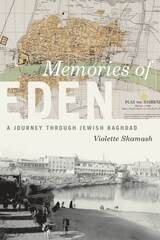
According to legend, the Garden of Eden was located in Iraq, and for millennia, Jews resided peacefully in metropolitan Baghdad. Memories of Eden: A Journey Through Jewish Baghdad reconstructs the last years of the oldest Jewish Diaspora community in the world through the recollections of Violette Shamash, a Jewish woman who was born in Baghdad in 1912, sent to her daughter Mira Rocca and son-in-law, the British journalist Tony Rocca. The result is a deeply textured memoir—an intimate portrait of an individual life, yet revealing of the complex dynamics of the Middle East in the twentieth century.
Toward the end of her long life, Violette Shamash began writing letters, notes, and essays and sending them to the Roccas. The resulting book begins near the end of Ottoman rule and runs through the British Mandate, the emergence of an independent Iraq, and the start of dictatorial government. Shamash clearly loved the world in which she grew up but is altogether honest in her depiction of the transformation of attitudes toward Baghdad’s Jewish population. Shamash’s world is finally shattered by the Farhud, the name given to the massacre of hundreds of Iraqi Jews over three days in 1941. An event that has received very slight historical coverage, the Farhud is further described and placed in context in a concluding essay by Tony Rocca.
Memories of Lac du Flambeau Elders
Edited by Elizabeth M. Tornes
University of Wisconsin Press, 2004
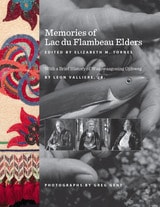
Most historical accounts of the Ojibwe have been written by Americans of European descent. This book tells the history of the Lac du Flambeau Ojibwe in their own words. It also includes a historical introduction, by Leon Valliere, Jr., going back four hundred years to Lac du Flambeau’s original settlement. A black-and-white photographic portrait of each elder prefaces each interview, and historical photos from the George W. Brown Jr. Ojibwe Museum Cultural Center and collection illustrate the text.
Distributed for the Center for the Study of Upper Midwestern Cultures.
Memories of Madagascar and Slavery in the Black Atlantic
Wendy Wilson-Fall
Ohio University Press, 2015
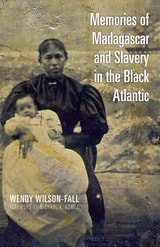
From the seventeenth century into the nineteenth, thousands of Madagascar’s people were brought to American ports as slaves. In Memories of Madagascar and Slavery in the Black Atlantic, Wendy Wilson-Fall shows that the descendants of these Malagasy slaves in the United States maintained an ethnic identity in ways that those from the areas more commonly feeding the Atlantic slave trade did not. Generations later, hundreds, if not thousands, of African Americans maintain strong identities as Malagasy descendants, yet the histories of Malagasy slaves, sailors, and their descendants have been little explored.
Wilson-Fall examines how and why the stories that underlie this identity have been handed down through families—and what this says about broader issues of ethnicity and meaning-making for those whose family origins, if documented at all, have been willfully obscured by history.
By analyzing contemporary oral histories as well as historical records and examining the conflicts between the two, Wilson-Fall carefully probes the tensions between the official and the personal, the written and the lived. She suggests that historically, the black community has been a melting pot to which generations of immigrants—enslaved and free—have been socially assigned, often in spite of their wish to retain far more complex identities. Innovative in its methodology and poetic in its articulation, this book bridges history and ethnography to take studies of diaspora, ethnicity, and identity into new territory.
Memories of Odysseus
Frontier Tales From Ancient GreeceFrançois Hartog
University of Chicago Press, 2001
Memories of Revolt
The 1936–1939 Rebellion and the Palestinian National PastTed Swedenburg
University of Arkansas Press, 2003
Memories of a Bygone Age
Qajar Persia and Imperial Russia 1853-1902Prince Arfa
Gingko, 2016
Prince Arfa writes with arresting wit about the deadly intrigues of the Qajar court. Lamentingly, but resolutely, he chronicles the decline of Iran from a once great empire to an almost bankrupt, lawless state, in which social unrest is channelled and exploited by the clergy. He describes the complex interactions between Iran and Europe, including an account of Naser-od-Din Shah’s profligate visits to Britain and France; the splendor and eccentricities of the doomed Tsar Nicholas II’s court; the Tsar’s omen-laden coronation; and his own favor with the Tsarina, who would grant him concessions on matters of vital importance to his country. The result is a memoir of extraordinary political intrigue.

Memories of a Gay Catholic Boyhood
Coming of Age in the SixtiesJohn D'Emilio
Duke University Press, 2022
Memories of a Gay Catholic Boyhood is D’Emilio’s coming-of-age story in which he takes readers from his working-class Bronx neighborhood to an elite Jesuit high school in Manhattan to Columbia University and the political and social upheavals of the late 1960s. He shares his personal experiences of growing up in a conservative, tight-knit, multigenerational family, how he went from considering entering the priesthood to losing his faith and coming to terms with his same-sex desires. Throughout, D’Emilio outlines his complicated relationship with his family while showing how his passion for activism influenced his decision to use research, writing, and teaching to build a strong LGBTQ movement.
This is not just John D’Emilio’s personal story; it opens a window into how the conformist baby boom decade of the 1950s transformed into the tumultuous years of radical social movements and widespread protest during the 1960s. It is the story of what happens when different cultures and values collide and the tensions and possibilities for personal discovery and growth that emerge. Intimate and honest, D’Emilio’s story will resonate with anyone who has had to chart their own path in a world they did not expect to find.
Memories of the Slave Trade
Ritual and the Historical Imagination in Sierra LeoneRosalind Shaw
University of Chicago Press, 2002
Drawing on extensive fieldwork and archival research, Shaw argues that memories of the slave trade have shaped (and been reshaped by) experiences of colonialism, postcolonialism, and the country's ten-year rebel war. Thus money and commodities, for instance, are often linked to an invisible city of witches whose affluence was built on the theft of human lives. These ritual and visionary memories make hitherto invisible realities manifest, forming a prism through which past and present mutually configure each other.
Memory Activism
Reimagining the Past for the Future in Israel-PalestineYifat Gutman
Vanderbilt University Press, 2017
Set in Israel in the first decade of the twenty-first century and based on long-term fieldwork, this rich ethnographic study offers an innovative analysis of the Israeli-Palestinian conflict. It explores practices of "memory activism" by three groups of Jewish-Israeli and Arab-Palestinian citizens--Zochrot, Autobiography of a City, and Baladna--showing how they appropriated the global model of truth and reconciliation while utilizing local cultural practices such as tours and testimonies.
These activist efforts gave visibility to a silenced Palestinian history in order to come to terms with the conflict's origins and envision a new resolution for the future. This unique focus on memory as a weapon of the weak reveals a surprising shift in awareness of Palestinian suffering among the Jewish majority of Israeli society in a decade of escalating violence and polarization--albeit not without a backlash.
Contested memories saturate this society. The 1948 war is remembered as both Independence Day by Israelis and al-Nakba ("the catastrophe") by Palestinians. The walking tour and survivor testimonies originally deployed by the state for national Zionist education that marginalized Palestinian citizens are now being appropriated by activists for tours of pre-state Palestinian villages and testimonies by refugees.
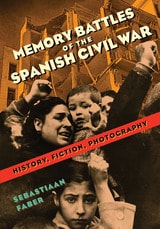
Memory Battles of the Spanish Civil War
History, Fiction, PhotographySebastiaan Faber
Vanderbilt University Press, 2017
Faber traces the curious trajectories of iconic Spanish Civil War photographs by Robert Capa, Gerda Taro, and David Seymour; critically reads a dozen recent Spanish novels and essays; interrogates basic scholarly assumptions about history, memory, and literature; and interviews nine scholars, activists, and documentarians who in the past decade and a half have helped redefine Spain's relationship to its past. In this book Faber argues that recent political developments in Spain--from the grassroots call for the recovery of historical memory to the indignados movement and the foundation of Podemos--provide an opportunity for scholars in the humanities to engage in a more activist, public, and democratic practice.
Memory Bytes
History, Technology, and Digital CultureLauren Rabinovitz and Abraham Geil, eds.
Duke University Press, 2004
These essays from scholars in the social sciences and humanities cover topics related to science and medicine, politics and war, mass communication, philosophy, film, photography, and art. Whether describing how the cultural and legal conflicts over player piano rolls prefigured controversies over the intellectual property status of digital technologies such as mp3 files; comparing the experiences of watching QuickTime movies to Joseph Cornell’s “boxed relic” sculptures of the 1930s and 1940s; or calling for a critical history of electricity from the Enlightenment to the present, Memory Bytes investigates the interplay of technology and culture. It relates the Information Age to larger and older political and cultural phenomena, analyzes how sensory effects have been technologically produced over time, considers how human subjectivity has been shaped by machines, and emphasizes the dependence of particular technologies on the material circumstances within which they were developed and used.
Contributors. Judith Babbitts, Scott Curtis, Ronald E. Day, David Depew, Abraham Geil, Sharon Ghamari-Tabrizi, Lisa Gitelman, N. Katherine Hayles, John Durham Peters, Lauren Rabinovitz, Laura Rigal, Vivian Sobchack, Thomas Swiss
Memory Construction and the Politics of Time in Neoliberal South Korea
Namhee Lee
Duke University Press, 2022
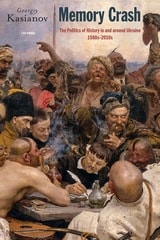
Memory Crash
Politics of History in and around Ukraine, 1980s–2010sGeorgiy Kasianov
Central European University Press, 2022
This account of historical politics in Ukraine, framed in a broader European context, shows how social, political, and cultural groups have used and misused the past from the final years of the Soviet Union to 2020. Georgiy Kasianov details practices relating to history and memory by a variety of actors, including state institutions, non-governmental organizations, political parties, historians, and local governments. He identifies the main political purposes of these practices in the construction of nation and identity, struggles for power, warfare, and international relations.
Kasianov considers the Ukrainian case in the context of a global increase in the politics of history and memory, with particular emphasis on a distinctive East-European variety. He pays special attention to the use and abuse of history in relations between Ukraine, Russia, and Poland.
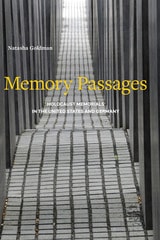
Memory Passages
Holocaust Memorials in the United States and GermanyNatasha Goldman
Temple University Press, 2020
For decades, artists and architects have struggled to relate to the Holocaust in visual form, resulting in memorials that feature a diversity of aesthetic strategies. In Memory Passages, Natasha Goldman analyzes both previously-overlooked and internationally-recognized Holocaust memorials in the United States and Germany from the postwar period to the present, drawing on many historical documents for the first time. From the perspectives of visual culture and art history, the book examines changing attitudes toward the Holocaust and the artistic choices that respond to it.
The book introduces lesser-known sculptures, such as Nathan Rapoport’s Monument to the Six Million Jewish Martyrs in Philadelphia, as well as internationally-acclaimed works, such as Peter Eisenman’s Memorial to the Murdered Jews of Europe in Berlin. Other artists examined include Will Lammert, Richard Serra, Joel Shapiro, Gerson Fehrenbach, Margit Kahl, and Andy Goldsworthy.Archival documents and interviews with commissioners, survivors, and artists reveal the conversations and decisions that have shaped Holocaust memorials.
Memory Passages suggests that memorial designers challenge visitors to navigate and activate spaces to engage with history and memory by virtue of walking or meandering. This book will be valuable for anyone teaching—or seeking to better understand—the Holocaust.
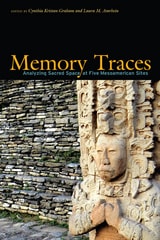
Memory Traces
Analyzing Sacred Space at Five Mesoamerican SitesCynthia Kristan-Graham
University Press of Colorado, 2015
In Memory Traces, art historians and archaeologists come together to examine the nature of sacred space in Mesoamerica. Through five well-known and important centers of political power and artistic invention in Mesoamerica—Tetitla at Teotihuacan, Tula Grande, the Mound of the Building Columns at El Tajín, the House of the Phalli at Chichén Itzá, and Tonina—contributors explore the process of recognizing and defining sacred space, how sacred spaces were viewed and used both physically and symbolically, and what theoretical approaches are most useful for art historians and archaeologists seeking to understand these places.
Memory Traces acknowledges that the creation, use, abandonment, and reuse of sacred space have a strongly recursive relation to collective memory and meanings linked to the places in question and reconciles issues of continuity and discontinuity of memory in ancient Mesoamerican sacred spaces. It will be of interest to students and scholars of Mesoamerican studies and material culture, art historians, architectural historians, and cultural anthropologists.
Contributors: Laura M. Amrhein, Nicholas P. Dunning, Rex Koontz, Cynthia Kristan-Graham, Matthew G. Looper, Travis Nygard, Keith M. Prufer, Matthew H. Robb, Patricia J. Sarro, Kaylee Spencer, Eric Weaver, Linnea Wren

Memory and Dreams
The Creative Human MindGeorge Christos
Rutgers University Press, 2003
Why do we sleep? Why do we dream? How does the brain turn a collection of new experiences into memories, dreams, and creative thoughts?
After synthesizing much of what is known about the neurobiological basis of memory and dreaming, Memory and Dreams: The Creative Human Mind offers new interpretations of how memories are formed, the nature of creativity, the purpose of dream sleep, and, in its most original section, the causes of SIDS.
Memory is represented in the brain by specific neural firing patterns that share common neurons and connections. Mathematical models therefore suggest that the brain can generate its own set of “spurious memories” by combining various features of stored memories. George Christos suggests that these spurious memories represent the basis for creativity.
The function of dreaming in humans and almost all other mammals is one of the great unsolved biological mysteries. Christos argues that we dream in order to process recently acquired memories, to forget unimportant memories, and to generate more creative states. By organizing our memories, dreaming allows us to be more predisposed for learning the next day.
The last section of the book deals with one of the most puzzling and heartbreaking problems in medical science, SIDS. Christos posits that infants, through dreaming, may trigger fetal breathing pathways and stop breathing without any alarms going off. In other words, SIDS has no physical cause; the cause is in the mind of the infant, who “dreams” it is back in the safety of its mother’s womb—a state in which it does not breathe. Christos asserts that this is the only theory that explains the causes as well as the trigger mechanisms of SIDS and is consistent with all of the known facts. The book concludes with a list of suggested preventative measures derived from this provocative theory.
Memory and Identity in Ancient Judaism and Early Christianity
A Conversation with Barry SchwartzTom Thatcher
SBL Press, 2014
Essential reading for scholars and students interested in sociology and biblical studies
In this collection scholars of biblical texts and rabbinics engage the work of Barry Schwartz, Professor Emeritus in the Department of Sociology at the University of Georgia. Schwartz provides an introductory essay on the study of collective memory. Articles that follow integrate his work into the study of early Jewish and Christian texts. The volume concludes with a response from Schwartz that continues this warm and fruitful dialogue between fields.
Features:
- Articles that integrate the study of collective memory and social psychology into religious studies
- Essays from Barry Schwartz
- Theories applied rather than left as abstract principles