Results by title
22279 books match the query 'Social Science' and 1258 start with m

Modern Argentine Masculinities
Edited by Carolina Rocha
Intellect Books, 2013
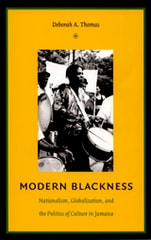
Modern Blackness
Nationalism, Globalization, and the Politics of Culture in JamaicaDeborah A. Thomas
Duke University Press, 2004
Thomas combines historical research with fieldwork she conducted in Jamaica between 1993 and 2003. Drawing on her research in a rural hillside community just outside Kingston, she looks at how Jamaicans interpreted and reproduced or transformed on the local level nationalist policies and popular ideologies about progress. With detailed descriptions of daily life in Jamaica set against a backdrop of postcolonial nation-building and neoliberal globalization, Modern Blackness is an important examination of the competing identities that mobilize Jamaicans locally and represent them internationally.
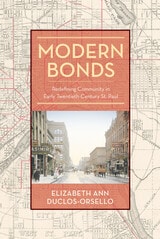
Modern Bonds
Redefining Community in Early Twentieth-Century St. PaulElizabeth Ann Duclos-Orsello
University of Massachusetts Press, 2018
What does community mean, exactly? In this interdisciplinary study, Elizabeth Ann Duclos-Orsello takes seriously the concept of community as an object of historical analysis.
Focusing on St. Paul, Minnesota, from 1900 to 1920, Modern Bonds explores the diverse ways that its people renegotiated private and public affiliations during a period of modernization. The book examines a wide range of subjects and materials, including photographs from an African American family, fictional depictions of middle-class women, built environments that created enclaves of immigrants, and public festivals designed to unite all citizens. As Duclos-Orsello demonstrates, it was in this period that a complex set of activities, policies, and practices led to new understandings of community that continue to shape life today.
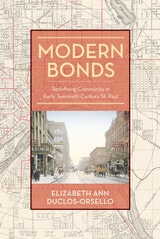
Modern Bonds
Redefining Community in Early Twentieth-Century St. PaulElizabeth Ann Duclos-Orsello
University of Massachusetts Press, 2018
What does community mean, exactly? In this interdisciplinary study, Elizabeth Ann Duclos-Orsello takes seriously the concept of community as an object of historical analysis.
Focusing on St. Paul, Minnesota, from 1900 to 1920, Modern Bonds explores the diverse ways that its people renegotiated private and public affiliations during a period of modernization. The book examines a wide range of subjects and materials, including photographs from an African American family, fictional depictions of middle-class women, built environments that created enclaves of immigrants, and public festivals designed to unite all citizens. As Duclos-Orsello demonstrates, it was in this period that a complex set of activities, policies, and practices led to new understandings of community that continue to shape life today.
Modern China and Opium
A ReaderAlan Baumler, Editor
University of Michigan Press, 2001

Modern China, 1840–1972
An Introduction to Sources and Research AidsAndrew J. Nathan
University of Michigan Press, 1973
Modern Chinese Literary and Cultural Studies in the Age of Theory
Reimagining a FieldRey Chow, ed.
Duke University Press, 2000
One of the volume’s provocative suggestions is that the old model of area studies—an offshoot of U.S. Cold War strategy that found its anchorage in higher education—is no longer feasible for the diverse and multifaceted experiences that are articulated under the rubric of “Chineseness.” As Rey Chow argues in her introduction, the notion of a monolithic Chineseness bound ultimately to mainland China is, in itself, highly problematic because it recognizes neither the material realities of ethnic minorities within China nor those of populations in places such as Tibet, Taiwan, and post–British Hong Kong. Above all, this book demonstrates that, as the terms of a chauvinistic sinocentrism become obsolete, the critical use of theory—particularly by younger China scholars whose enthusiasm for critical theory coincides with changes in China’s political economy in recent years—will enable the emergence of fresh connections and insights that may have been at odds with previous interpretive convention.
Originally published as a special issue of the journal boundary 2, this collection includes two new essays and an afterword by Paul Bové that places its arguments in the context of contemporary cultural politics. It will have far-reaching implications for the study of modern China and will be of interest to scholars of theory and culture in general.
Contributors. Stanley K. Abe, Ien Ang, Chris Berry, Paul Bové, Sung-cheng Yvonne Chang, Rey Chow, Dorothy Ko, Charles Laughlin, Leung Ping-kwan, Kwai-cheung Lo, Christopher Lupke, David Der-wei Wang, Michelle Yeh
Modern Dance, Negro Dance
Race in MotionSusan Manning
University of Minnesota Press, 2006
Modern French Jewish Thought
Writings on Religion and PoliticsEdited by Sarah Hammerschlag
Brandeis University Press, 2018
Modern Housing for America
Policy Struggles in the New Deal EraGail Radford
University of Chicago Press, 1996
Modern Hungarian Society in the Making
András Gero
Central European University Press, 1995
Modern Loves
The Anthropology of Romantic Courtship and Companionate MarriageJennifer S. Hirsch and Holly Wardlow, Editors
University of Michigan Press, 2006
In this first comparative ethnographic look at the global transformation toward marital ideals characterized by emotional intimacy, companionship, and mutual choice—discussed here as "companionate marriage"—Modern Loves asks how this shift is occurring and explores the factors that promote and hinder it, just who is pushing for these more companionate relationships, and what advantages men and women see in modern love. The contributors analyze the intricate negotiations surrounding love, marriage, and sex in Mexico, India, Papua New Guinea, Brazil, Pakistan, Nigeria, Singapore, and Hong Kong and among Latino youth in East Los Angeles. Modern Loves presents the new global approach to kinship studies, examining both the microlevel practices that constitute and bind relationships and the macrolevel forces that shape the landscape of love.
Jennifer S. Hirsch is Associate Professor in the Department of Sociomedical Sciences, Mailman School of Public Health, Columbia University. Holly Wardlow is Assistant Professor of Anthropology at the University of Toronto.
"What‘s love got to do with it? Hirsch and Wardlow answer this question by demonstrating the relevance—indeed, centrality—of the ideologies and practices surrounding romantic love and companionate marriage to the study of social transformation more broadly. The essays compiled in this volume explore the material, structural, and demographic underpinnings of the global shift in marital ideals while also tracing some of the sources of this marital shift in mass media, missionization, and the spread of individualism. The contributors of the chapters provide ethnographically rich examples of the ways in which people living in different societies interpret and act upon these global forces and images in sometimes overlapping and sometimes varying ways. This volume is an important and thoughtful contribution to the study of emotion, gender, kinship, and social change." —Laura M. Ahearn, Department of Anthropology, Rutgers University
"With its rich descriptions of the nuances in romantic love and its lucid analysis of the political economy of conjugal relations, this book will be widely read and loved by anthropologists as well as the concerned public."
—Yunxiang Yan, Department of Anthropology, UCLA
"Modern Loves offers an overview of current scholarship on love in the context of sexual relationships cross-culturally, and provides a view of the complexity of varied aspects of emotion, social structure, and social change in contemporary sexual relationships. It clearly makes the case for a political economic understanding of the emergence of ideologies of love, marriage, and courtship as part of expanding global economies."
—Linda-Anne Rebhun, Department of Anthropology, Yale University
Modern Luck
Narratives of Fortune in the Long Twentieth CenturyRobert S. C. Gordon
University College London, 2023
Beliefs, superstitions, and tales about luck are present across all human cultures. Humans are perennially fascinated by luck and by its association with happiness and danger, uncertainty and aspiration. Yet it remains an elusive, ungraspable idea, one that slips and slides over time: all cultures reimagine what luck is and how to tame it at different stages in their history, and our own era is no exception to the rule.
Modern Luck sets out to explore the enigma of luck’s presence in modernity, examining the hybrid forms it has taken on in the modern imagination, and in particular in the field of modern stories. Analyzing a rich and unusually eclectic range of narratives taken from literature, film, music, television, and theatre, from Dostoevsky to Philip K. Dick, Pinocchio to Cimino, Curtiz to Kieslowski, it lays out first the usages and meanings of the language of luck, and then the key figures, patterns, and motifs that govern the stories told about it, from the late nineteenth century to the present day.
Modern Melbourne
City and Site of Nature and CultureRod Giblett
Intellect Books, 2020
It places Melbourne within an international context by comparing and contrasting it to other cities built on or beside wetlands, including London, New York, Paris, Los Angeles, and Toronto. Further, it is the first book to apply the work of European thinkers and writers on modernity and the modern city—such as Walter Benjamin and Peter Sloterdijk—to an analysis of Melbourne. Giblett considers the intertwining of nature and culture, people and place, and cities and wetlands in this bioregional and ecocultural analysis. Placing the city in its proper bioregional and international contexts, Modern Melbourne provides a rich historical analysis of the cultural capital of Australia.
Modern Middle Eastern Jewish Thought
Writings on Identity, Politics, and Culture, 1893–1958Edited by Moshe Behar and Zvi Ben-Dor Benite
Brandeis University Press, 2013
Modern Migrations, Black Interrogations
Revisioning Migrants and Mobilities through the Critique of AntiblacknessEdited by Philip Kretsedemas and Jamella N. Gow
Temple University Press, 2024
Focusing on antiblackness in immigration and examining restrictions on freedom of movement and on settling alike, chapters address how Black im/mobility operates and how it can be distinguished from that of the migrant and the colonial settler, as well as from the transgressive mobilities of Indigenous populations. Looking at blackness, borders and border practices, and displacement, Modern Migrations, Black Interrogations investigates racialized boundaries that determine immigration policy, citizenship, legality, and inclusion. Additional chapters analyze communities, such as the Haitian diaspora in Miami, antiblackness in the context of Australian migration, and explore literary representations of justice, slavery and Black feminist consciousness.
Modern Migrations, Black Interrogations uses (anti)blackness to rethink the way we understand borders, immigrant identity, barriers to integration, and the dynamics of migrant exclusion, while also providing an understanding of “otherness” for Black populations across nationalities.
Contributors: Maya Hislop, P. Khalil Saucier, Hyacinth Udah, Paula von Gleich, Tryon P. Woods, and the editors
Modern Mobility Aloft
Elevated Highways, Architecture, and Urban Change in Pre-Interstate AmericaAmy D. Finstein
Temple University Press, 2020
In the first half of the twentieth century, urban elevated highways were much more than utilitarian infrastructure, lifting traffic above the streets; they were statements of civic pride, asserting boldly modern visions for a city’s architecture, economy, and transportation network. Yet three of the most ambitious projects, launched in Chicago, New York, and Boston in the spirit of utopian models by architects such as Le Corbusier and Hugh Ferriss, ultimately fell short of their ideals.
Modern Mobility Aloft is the first study to focus on pre-Interstate urban elevated highways within American architectural and urban history. Amy Finstein traces the idealistic roots of these superstructures, their contrasting realities once built, their impacts on successive development patterns, and the recent challenges they have posed to contemporary urban designers.
Filled with more than 100 historic photographs and illustrations of beaux arts and art deco architecture, Modern Mobility Aloft provides a critical understanding of urban landscapes, transportation, and technological change as cities moved into the modern era.

Modern Moonshine
The Revival of White Whiskey in the Twenty-First CenturyCameron D. Lippard
West Virginia University Press, 2019
The craft of making moonshine—an unaged white whiskey, often made and consumed outside legal parameters—nearly went extinct in the late twentieth century as law enforcement cracked down on illicit producers, and cheaper, lawful alcohol became readily available. Yet the twenty-first century has witnessed a resurgence of artisanal distilling, as both connoisseurs and those reconnecting with their heritage have created a vibrant new culture of moonshine. While not limited to Appalachia, moonshine is often entwined with the region in popular understandings.
The first interdisciplinary examination of the legal moonshine industry, Modern Moonshine probes the causes and impact of the so-called moonshine revival. What does the moonshine revival tell us about our national culture? How does it shape the image of Appalachia and rural America? Focusing mostly on southern Appalachia, the book’s eleven essays chronicle such popular figures as Popcorn Sutton and explore how and why distillers promote their product as “traditional” and “authentic.” This edited collection draws from scholars across the disciplines of anthropology, history, geography, and sociology to make sense of the legal, social, and historical shifts behind contemporary production and consumption of moonshine, and offers a fresh perspective on an enduring topic of Appalachian myth and reality.

Modern Motherhood
An American HistoryVandenberg-Daves, Jodi
Rutgers University Press, 2014
Modern Motherhood travels through redefinitions of motherhood over time, as mothers encountered a growing cadre of medical and psychological experts, increased their labor force participation, gained the right to vote, agitated for more resources to perform their maternal duties, and demonstrated their vast resourcefulness in providing for and nurturing their families. Navigating rigid gender role prescriptions and a crescendo of mother-blame by the middle of the twentieth century, mothers continued to innovate new ways to combine labor force participation and domestic responsibilities. By the 1960s, they were poised to challenge male expertise, in areas ranging from welfare and abortion rights to childbirth practices and the confinement of women to maternal roles. In the twenty-first century, Americans continue to struggle with maternal contradictions, as we pit an idealized role for mothers in children’s development against the social and economic realities of privatized caregiving, a paltry public policy structure, and mothers’ extensive employment outside the home.
Building on decades of scholarship and spanning a wide range of topics, Vandenberg-Daves tells an inclusive tale of African American, Native American, Asian American, working class, rural, and other hitherto ignored families, exploring sources ranging from sermons, medical advice, diaries and letters to the speeches of impassioned maternal activists. Chapter topics include: inventing a new role for mothers; contradictions of moral motherhood; medicalizing the maternal body; science, expertise, and advice to mothers; uplifting and controlling mothers; modern reproduction; mothers’ resilience and adaptation; the middle-class wife and mother; mother power and mother angst; and mothers’ changing lives and continuous caregiving. While the discussion has been part of all eras of American history, the discussion of the meaning of modern motherhood is far from over.
Modern Noise, Fluid Genres
Popular Music in Indonesia, 1997–2001Jeremy Wallach
University of Wisconsin Press, 2008
Modern Occult Rhetoric
Mass Media and the Drama of Secrecy in the Twentieth CenturyJoshua Gunn
University of Alabama Press, 2005
Uncovering how secrecy, symbolism, and hidden meanings shape modern culture and communication.
The occult has traditionally been understood as the study of secrets of the practice of mysticism or magic. This book broadens our understanding of the occult by treating it as a rhetorical phenomenon tied to language and symbols and more central to American culture than is commonly assumed.
Joshua Gunn approaches the occult as an idiom, examining the ways in which acts of textual criticism and interpretation are occultic in nature, as evident in practices as diverse as academic scholarship, Freemasonry, and television production. Gunn probes, for instance, the ways in which jargon employed by various social and professional groups creates barriers and fosters secrecy. From the theory wars of cultural studies to the Satanic Panic that swept the national mass media in the late 1980s and early 1990s, Gunn shows how the paradox of a hidden, buried, or secret meaning that cannot be expressed in language appears time and time again in Western culture.
These recurrent patterns, Gunn argues, arise from a generalized, popular anxiety about language and its limitations. Ultimately, Modern Occult Rhetoric demonstrates the indissoluble relationship between language, secrecy, and publicity, and the centrality of suspicion in our daily lives.

Modern Oceans, Ancient Sites
Archaeology and Marine Conservation on San Miguel Island, CaliforniaTodd J Braje
University of Utah Press, 2010

Modern Odysseys
Cavafy, Woolf, Césaire, and a Poetics of IndirectionMichelle Zerba
The Ohio State University Press, 2021
Modern Peru
A New HistoryPaulo Drinot and Alberto Vergara, editors
Duke University Press, 2025
Contributors. Eduardo Dargent, Paulo Drinot, Cynthia McClintock, José Luis Rénique, Natalia Sobrevilla Perea, Alberto Vergara, Charles Walker
Modernism Is the Literature of Celebrity
By Jonathan Goldman
University of Texas Press, 2011
The phenomenon of celebrity burst upon the world scene about a century ago, as movies and modern media brought exceptional, larger-than-life personalities before the masses. During the same era, modernist authors were creating works that defined high culture in our society and set aesthetics apart from the middle- and low-brow culture in which celebrity supposedly resides. To challenge this ingrained dichotomy between modernism and celebrity, Jonathan Goldman offers a provocative new reading of early twentieth-century culture and the formal experiments that constitute modernist literature's unmistakable legacy. He argues that the literary innovations of the modernists are indeed best understood as a participant in the popular phenomenon of celebrity.
Presenting a persuasive argument as well as a chronicle of modernism's and celebrity's shared history, Modernism Is the Literature of Celebrity begins by unraveling the uncanny syncretism between Oscar Wilde's writings and his public life. Goldman explains that Wilde, in shaping his instantly identifiable public image, provided a model for both literary and celebrity cultures in the decades that followed. In subsequent chapters, Goldman traces this lineage through two luminaries of the modernist canon, James Joyce and Gertrude Stein, before turning to the cinema of mega-star Charlie Chaplin. He investigates how celebrity and modernism intertwine in the work of two less obvious modernist subjects, Jean Rhys and John Dos Passos. Turning previous criticism on its head, Goldman demonstrates that the authorial self-fashioning particular to modernism and generated by modernist technique helps create celebrity as we now know it.
Modernism and the Harlem Renaissance
Houston A. Baker Jr.
University of Chicago Press, 1989
Modernism and the Women’s Popular Romance in Britain, 1885–1925
Martin Hipsky
Ohio University Press, 2011
Today’s mass-market romances have their precursors in late Victorian popular novels written by and for women. In Modernism and the Women’s Popular Romance Martin Hipsky scrutinizes some of the best-selling British fiction from the period 1885 to 1925, the era when romances, especially those by British women, were sold and read more widely than ever before or since.
Recent scholarship has explored the desires and anxieties addressed by both “low modern” and “high modernist” British culture in the decades straddling the turn of the twentieth century. In keeping with these new studies, Hipsky offers a nuanced portrait of an important phenomenon in the history of modern fiction. He puts popular romances by Mrs. Humphry Ward, Marie Corelli, the Baroness Orczy, Florence Barclay, Elinor Glyn, Victoria Cross, Ethel Dell, and E. M. Hull into direct relationship with the fiction of Virginia Woolf, Katherine Mansfield, James Joyce, and D. H. Lawrence, among other modernist greats.
Modernist Art in Ethiopia
Elizabeth W. Giorgis
Ohio University Press, 2019
Short-listed for the Fage & Oliver Prize for outstanding scholarly work published on Africa.
Finalist, African Studies Association Book Prize.
Finalist, ASA Bethwell A. Ogot Prize for best book in east African studies.
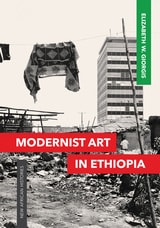
If modernism initially came to Africa through colonial contact, what does Ethiopia’s inimitable historical condition—its independence save for five years under Italian occupation—mean for its own modernist tradition? In Modernist Art in Ethiopia—the first book-length study of the topic—Elizabeth W. Giorgis recognizes that her home country’s supposed singularity, particularly as it pertains to its history from 1900 to the present, cannot be conceived outside the broader colonial legacy. She uses the evolution of modernist art in Ethiopia to open up the intellectual, cultural, and political histories of it in a pan-African context.
Giorgis explores the varied precedents of the country’s political and intellectual history to understand the ways in which the import and range of visual narratives were mediated across different moments, and to reveal the conditions that account for the extraordinary dynamism of the visual arts in Ethiopia. In locating its arguments at the intersection of visual culture and literary and performance studies, Modernist Art in Ethiopia details how innovations in visual art intersected with shifts in philosophical and ideological narratives of modernity. The result is profoundly innovative work—a bold intellectual, cultural, and political history of Ethiopia, with art as its centerpiece.
Modernity At Large
Cultural Dimensions of GlobalizationArjun Appadurai
University of Minnesota Press, 1996
Examines the role of imagination in the cultural development of our shrinking world.
The world is growing smaller. Every day we hear this idea expressed and witness its reality in our lives-through the people we meet, the products we buy, the foods we eat, and the movies we watch. In this bold look at the cultural effects of a shrinking world, leading cultural theorist Arjun Appadurai places these challenges and pleasures of contemporary life in a broad global perspective.
Offering a new framework for the cultural study of globalization, Modernity at Large shows how the imagination works as a social force in today's world, providing new resources for identity and energies for creating alternatives to the nation-state, whose era some see as coming to an end. Appadurai examines the current epoch of globalization, which is characterized by the twin forces of mass migration and electronic mediation, and provides fresh ways of looking at popular consumption patterns, debates about multiculturalism, and ethnic violence. He considers the way images-of lifestyles, popular culture, and self-representation-circulate internationally through the media and are often borrowed in surprising (to their originators) and inventive fashions.
Appadurai simultaneously explores and explodes boundaries-between how we imagine the world and how that imagination influences our self-understanding, between social institutions and their effects on the people who participate in them, between nations and peoples that seem to be ever more homogeneous and yet ever more filled with differences. Modernity at Large offers a path to move beyond traditional oppositions between culture and power, tradition and modernity, global and local, pointing out the vital role imagination plays in our construction of the world of today-and tomorrow.
Modernity and Its Malcontents
Ritual and Power in Postcolonial AfricaEdited by Jean Comaroff and John L. Comaroff
University of Chicago Press, 1993
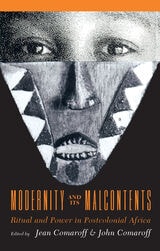
Some of the essays in Modernity and Its Malcontents address familiar anthropological issues—like witchcraft, myth, and the politics of reproduction—but treat them in fresh ways, situating them amidst the polyphonies of contemporary Africa. Others explore distinctly nontraditional subjects—among them the Nigerian popular press and soul-eating in Niger—in such a way as to confront the conceptual limits of Western social science. Together they demonstrate how ritual may be powerfuly mobilized in the making of history, present, and future.
Addressing challenges posed by contemporary African realities, the authors subject such concepts as modernity, ritual, power, and history to renewed critical scrutiny. Writing about a variety of phenomena, they are united by a wish to preserve the diversity and historical specificity of local signs and practices, voices and perspectives. Their work makes a substantial and original contribution toward the historical anthropology of Africa.
The contributors, all from the Africanist circle at the University of Chicago, are Adeline Masquelier, Deborah Kaspin, J. Lorand Matory, Ralph A. Austen, Andrew Apter, Misty L. Bastian, Mark Auslander, and Pamela G. Schmoll.
Modernity and the Jews in Western Social Thought
Chad Alan Goldberg
University of Chicago Press, 2017
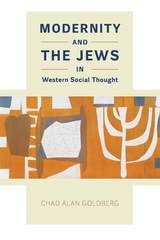
In Modernity and the Jews in Western Social Thought, Chad Alan Goldberg brings us a major new study of Western social thought through the lens of Jews and Judaism. In France, where antisemites decried the French Revolution as the “Jewish Revolution,” Émile Durkheim challenged depictions of Jews as agents of revolutionary subversion or counterrevolutionary reaction. When German thinkers such as Karl Marx, Georg Simmel, Werner Sombart, and Max Weber debated the relationship of the Jews to modern industrial capitalism, they reproduced, in secularized form, cultural assumptions derived from Christian theology. In the United States, William Thomas, Robert Park, and their students conceived the modern city and its new modes of social organization in part by reference to the Jewish immigrants concentrating there. In all three countries, social thinkers invoked real or purported differences between Jews and gentiles to elucidate key dualisms of modern social thought. The Jews thus became an intermediary through which social thinkers discerned in a roundabout fashion the nature, problems, and trajectory of their own wider societies. Goldberg rounds out his fascinating study by proposing a novel explanation for why Jews were such an important cultural reference point. He suggests a rethinking of previous scholarship on Orientalism, Occidentalism, and European perceptions of America, arguing that history extends into the present, with the Jews—and now the Jewish state—continuing to serve as an intermediary for self-reflection in the twenty-first century.
Modernity in Motion
Reading Gerald Vizenor in Global ContextsDavid J. Carlson
Michigan State University Press, 2026
Modernity in Motion offers a groundbreaking exploration of Anishinaabe writer Gerald Vizenor’s richly layered body of work spanning fiction, nonfiction, and poetry. Through the lens of transnational Indigenous studies, this compelling study reveals how Vizenor’s concept of transmotion, which he defines as the interplay between local and global identities, reconstructs modernity as a dynamic force of transformation.
Close readings illuminate Vizenor’s radical storytelling, which bridges seemingly disparate worlds: the White Earth Reservation, Nazi-occupied Paris, post-Hiroshima Japan, and beyond. By weaving these far-flung geographies into unexpected constellations, Vizenor challenges readers to rethink Indigenous history, sovereignty, and creative expression within a global framework.
Positioned at the intersection of tribal-centric and world literature paradigms, Modernity in Motion is essential reading for scholars of Indigenous studies and comparative literature.
Modernity on Endless Trial
Leszek Kolakowski
University of Chicago Press, 1990
"Exemplary. . . . It should be celebrated." —Arthur C. Danto, New York Times Book Review
"This book . . . express[es] Kolakowski's thought on God, man, reason, history, moral truth and original sin, prompted by observation of the dramatic struggle among Christianity, the Enlightenment and modern totalitarianism. It is a wonderful collection of topics." —Thomas Nagel, Times Literary Supplement
"No better antidote to bumper-sticker thinking exists than this collection of 24 'appeals for moderation in consistency,' and never has such an antidote been needed more than it is now." —Joseph Coates, Chicago Tribune
"Whether learned or humorous, these essays offer gems in prose of diamond hardness, precision, and brilliance." —Thomas D'Evelyn, The Christian Science Monitor
A "Notable Books of the Year 1991" selection, New York Times Book Review—a "Noted with Pleasure" selection, New York Times Book Review—a "Summer Reading 1991" selection, New York Times Book Review—a "Books of the Year" selection, The Times.
Modernization and the Working Class
The Politics of LegitimacyBy Carlos H. Waisman
University of Texas Press, 1982
This is a fascinating inquiry into the factors that determine the acceptance or rejection of capitalism by the industrial working class. Combining classical social theory, historical evidence, and survey data, Waisman explores the relationship between the degree of modernization and the legitimacy of the capitalist social order.
Propositions about the interaction between established elites and emerging working classes are illustrated with three typical cases: Disraelian Britain, Bismarckian Germany, and Peronist Argentina. From the contrasting theories of Marx and Bakunin, the author derives hypotheses concerning the position of the working class in the economy and the consequences this has for legitimacy. He finds that countries at middle levels of industrial development—mostly latecomers to industrialization in Southern Europe and advanced areas of Latin America—have the greatest difficulty in establishing capitalism as a legitimate social order. They are advanced enough to have a large working class, yet underdeveloped enough to have a dissatisfied one.

Modernizing Medicine in Zimbabwe
HIV/AIDS and Traditional HealersDavid S. Simmons
Vanderbilt University Press, 2012
Combining anthropological, historical, and public health perspectives, Modernizing Medicine in Zimbabwe explores the intersection of African healing traditions and Western health development, emphasizing the role of this historical relationship in current debates about HIV/AIDS. Drawing on diverse sources including colonial records, missionary correspondence, international health policy reports, and interviews with traditional healers, anthropologist David S. Simmons demonstrates the remarkable adaptive qualities of these disparate communities as they try to meet the urgent needs of the people.
Modernizing Patriarchy
The Politics of Women's Rights in MoroccoBy Katja Žvan Elliott
University of Texas Press, 2015
Morocco is hailed by academics, international NGO workers, and the media as a trailblazer in women’s rights and legal reforms. The country is considered a model for other countries in the Middle East and North African region, but has Morocco made as much progress as experts and government officials claim? In Modernizing Patriarchy, Katja Žvan Elliott examines why women’s rights advances are lauded in Morocco in theory but are often not recognized in reality, despite the efforts of both Islamist and secular feminists.
In Morocco, female literacy rates remain among the lowest in the region; many women are victims of gender-based violence despite legal reforms; and girls as young as twelve are still engaged to adult men, despite numerous reforms. Based on extensive ethnographic research and fieldwork in Oued al-Ouliya, Modernizing Patriarchy offers a window into the life of Moroccan Muslim women who, though often young and educated, find it difficult to lead a dignified life in a country where they are expected to have only one destiny: that of wife and mother. Žvan Elliott exposes their struggles with modernity and the legal reforms that are supposedly ameliorating their lives. In a balanced approach, she also presents male voices and their reasons for criticizing the prevailing women’s rights discourse. Compelling and insightful, Modernizing Patriarchy exposes the rarely talked about reality of Morocco’s approach toward reform.
Modes of Uncertainty
Anthropological CasesEdited by Limor Samimian-Darash and Paul Rabinow
University of Chicago Press, 2015
Organizing contributions from various anthropological subfields—including economics, business, security, humanitarianism, health, and environment—Limor Samimian-Darash and Paul Rabinow offer new tools with which to consider uncertainty, its management, and the differing modes of subjectivity appropriate to it. Taking up policies and experiences as objects of research and analysis, the essays here seek a rigorous inquiry into a sound conceptualization of uncertainty in order to better confront contemporary problems. Ultimately, they open the way for a participatory anthropology that asks crucial questions about our contemporary state.
Mogollon Communal Spaces and Places in the Greater American Southwest
Edited by Robert J. Stokes, Katherine A. Dungan, and Jakob W. Sedig
University of Utah Press, 2023
This volume presents the latest research on the development and use of communal spaces and places across the Mogollon region, located in what is now the southwestern United States and northwestern Mexico. New data demonstrate that these spaces and places, though diverse in form and function, were essential to community development and cohesion, particularly during critical formative periods associated with increasing sedentism and farming, and during comparable periods of social change.
The authors ask questions crucial to understanding past communities: What is a communal space or place? How did villagers across the Mogollon region use such places? And how do modern archaeologists investigate the past to learn how ancient people thought about themselves and the world around them? Contributors use innovative approaches to explore the development patterns and properties of communal spaces and places, as well as how and why these places were incorporated into the daily lives of village residents. Buildings and other types of communal spaces are placed into broader cultural and social contexts, acknowledging the enduring importance of the kiva-type structure to many Native American societies of the southwestern United States and northwestern Mexico.
Mogollon Culture in the Forestdale Valley, East-Central Arizona
Emil W. Haury
University of Arizona Press, 1985
Classic site reports establish the Mogollon on their own cultural track distinct from the Anasazi and also document the earliest known association of tree-ring dates with pottery in the Southwest. The excavations of Mogollon sites reported on in this volume were conducted at the early (1939–1941) field schools in Forestdale, Arizona.
Mohawk Interruptus
Political Life Across the Borders of Settler StatesAudra Simpson
Duke University Press, 2014
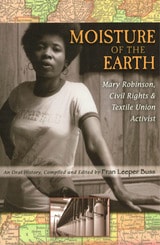
Moisture of the Earth
Mary Robinson, Civil Rights and Textile Union ActivistAn Oral History, Compiled and Edited by Fran Leeper Buss
University of Michigan Press, 2009
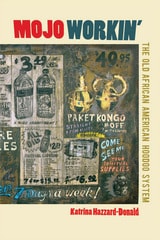
Mojo Workin'
The Old African American Hoodoo SystemKatrina Hazzard-Donald
University of Illinois Press, 2013
A bold reconsideration of Hoodoo belief and practice
Katrina Hazzard-Donald explores African Americans' experience and practice of the herbal, healing folk belief tradition known as Hoodoo. She examines Hoodoo culture and history by tracing its emergence from African traditions to religious practices in the Americas. Working against conventional scholarship, Hazzard-Donald argues that Hoodoo emerged first in three distinct regions she calls "regional Hoodoo clusters" and that after the turn of the nineteenth century, Hoodoo took on a national rather than regional profile. The spread came about through the mechanism of the "African Religion Complex," eight distinct cultural characteristics familiar to all the African ethnic groups in the United States.
The first interdisciplinary examination to incorporate a full glossary of Hoodoo culture, Mojo Workin': The Old African American Hoodoo System lays out the movement of Hoodoo against a series of watershed changes in the American cultural landscape. Hazzard-Donald examines Hoodoo material culture, particularly the "High John the Conquer" root, which practitioners employ for a variety of spiritual uses. She also examines other facets of Hoodoo, including rituals of divination such as the "walking boy" and the "Ring Shout," a sacred dance of Hoodoo tradition that bears its corollaries today in the American Baptist churches. Throughout, Hazzard-Donald distinguishes between "Old tradition Black Belt Hoodoo" and commercially marketed forms that have been controlled, modified, and often fabricated by outsiders; this study focuses on the hidden system operating almost exclusively among African Americans in the Black spiritual underground.
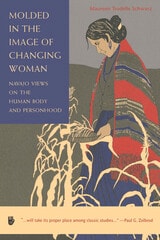
Molded in the Image of Changing Woman
Navajo Views on the Human Body and PersonhoodMaureen Trudelle Schwarz
University of Arizona Press, 1997
This book focuses on the complex interweaving of the cosmological, social, and bodily realms that Navajo people navigate in an effort alternately to control, contain, or harness the power manifested in various effects. Following the Navajo life-course from conception to puberty, Maureen Trudelle Schwarz explores the complex rules defining who or what can affect what or whom in specific circumstances as a means of determining what these effects tell us about the cultural construction of the human body and personhood for the Navajo.
Schwarz shows how oral history informs Navajo conceptions of the body and personhood, showing how these conceptions are central to an ongoing Navajo identity. She treats the vivid narratives of emergence life-origins as compressed metaphorical accounts, rather than as myth, and is thus able to derive from what individual Navajos say about the past their understandings of personhood in a worldview that is actually a viable philosophical system. Working with Navajo religious practitioners, elders, and professional scholars. Schwarz has gained from her informants an unusually firm grasp of the Navajo highlighted by the foregrounding of Navajo voices through excerpts of interviews. These passages enliven the book and present Schwarz and her Navajo consultants as real, multifaceted human beings within the ethnographic context.

Molecular Capture
The Animation of BiologyAdam Nocek
University of Minnesota Press, 2021
How computer animation technologies became vital visualization tools in the life sciences
Who would have thought that computer animation technologies developed in the second half of the twentieth century would become essential visualization tools in today’s biosciences? This book is the first to examine this phenomenon. Molecular Capture reveals how popular media consumption and biological knowledge production have converged in molecular animations—computer simulations of molecular and cellular processes that immerse viewers in the temporal unfolding of molecular worlds—to produce new regimes of seeing and knowing.
Situating the development of this technology within an evolving field of historical, epistemological, and political negotiations, Adam Nocek argues that molecular animations not only represent a key transformation in the visual knowledge practices of life scientists but also bring into sharp focus fundamental mutations in power within neoliberal capitalism. In particular, he reveals how the convergence of the visual economies of science and entertainment in molecular animations extends neoliberal modes of governance to the perceptual practices of scientific subjects. Drawing on Alfred North Whitehead’s speculative metaphysics and Michel Foucault’s genealogy of governmentality, Nocek builds a media philosophy well equipped to examine the unique coordination of media cultures in this undertheorized form of scientific media. More specifically, he demonstrates how governmentality operates across visual practices in the biosciences and the popular mediasphere to shape a molecular animation apparatus that unites scientific knowledge and entertainment culture.
Ultimately, Molecular Capture proposes that molecular animation is an achievement of governmental design. It weaves together speculative media philosophy, science and technology studies, and design theory to investigate how scientific knowledge practices are designed through media apparatuses.
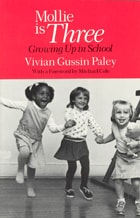
Mollie Is Three
Growing Up in SchoolVivian Gussin Paley
University of Chicago Press, 1986
Mollie Is Three describes a year in the life of a little girl and her preschool classmates in a nursery school classroom run by Vivian Gussin Paley, whose groundbreaking ideas about the best way to teach young children continue to be influential today. We first encounter Mollie on the first day of school, just before her third birthday, and we follow her and her classmates for the next year. Alongside her, we go from confusion and uncertainty in new surroundings to growing understanding and confidence, as patterns emerge and Mollie begins to grasp their significance--and her teacher begins to understand how to track her growth and development.
Rather than offer an account of an idealized, all but imaginary child, Paley presents us with one actual kid, in all their complexity and confusion. The result is a landmark contribution to our understanding of child development and the role early education can play in fostering it.
Mom
The Transformation of Motherhood in Modern AmericaRebecca Jo Plant
University of Chicago Press, 2010

Moment of Action
Riddles of Cinematic PerformancePomerance, Murray
Rutgers University Press, 2016
Money Has No Smell
The Africanization of New York CityPaul Stoller
University of Chicago Press, 2002
Blending fascinating ethnographic description with incisive social analysis, Stoller shows how these savvy West African entrepreneurs have built cohesive and effective multinational trading networks, in part through selling a simulated Africa to African Americans. These and other networks set up by the traders, along with their faith as devout Muslims, help them cope with the formidable state regulations and personal challenges they face in America. As Stoller demonstrates, the stories of these West African traders illustrate and illuminate ongoing debates about globalization, the informal economy, and the changing nature of American communities.
Money Jungle
Imagining the New Times SquareChesluk, Benjamin
Rutgers University Press, 2008
For more than a century, Times Square has mesmerized the world with the spectacle of its dazzling supersigns, its theaters, and its often-seedy nightlife. New York City’s iconic crossroads has drawn crowds of revelers, thrill-seekers, and other urban denizens, not to mention lavish outpourings of advertising and development money.
Many have hotly debated the recent transformation of this legendary intersection, with voices typically falling into two opposing camps. Some applaud a blighted red-light district becoming a big-budget, mainstream destination. Others lament an urban zone of lawless possibility being replaced by a Disneyfied, theme-park version of New York. In Money Jungle, Benjamin Chesluk shows that what is really at stake in Times Square are fundamental questions about city life—questions of power, pleasure, and what it means to be a citizen in contemporary urban space.
Chesluk weaves together surprising stories of everyday life in and around the Times Square redevelopment, tracing the connections between people from every level of this grand project in social and spatial engineering: the developers, architects, and designers responsible for reshaping the urban public spaces of Times Square and Forty-second Street; the experimental Midtown Community Court and its Times Square Ink. job-training program for misdemeanor criminals; encounters between NYPD officers and residents of Hell’s Kitchen; and angry confrontations between city planners and neighborhood activists over the future of the area.
With an eye for offbeat, telling details and a perspective that is at once sympathetic and critical, Chesluk documents how the redevelopment has tried, sometimes successfully and sometimes not, to reshape the people and places of Times Square. The result is a colorful and engaging portrait, illustrated by stunning photographs by long-time local photographer Maggie Hopp, of the street life, politics, economics, and cultural forces that mold America’s urban centers.
Money and Liberation
The Micropolitics of Alternative Currency MovementsPeter North
University of Minnesota Press, 2007
Is conventional money simply a discourse? Is it merely a socially constructed unit of exchange? If money is not an actual thing, are people then free to make collective agreements to use other forms of currency that might work more effectively for them? Proponents of “better money” argue that they have created currencies that value people more than profitability, ensuring that human needs are met with reasonable costs and decent wages—and supporting local economies that emphasize local sustainability. How did proponents develop these new economies? Are their claims valid?
Grappling with these questions and more, Money and Liberation examines the experiences of groups who have tried to build a more equitable world by inventing new forms of money. Presenting in-depth profiles of the trading networks that have been constructed both historically and more recently, including Local Exchange Trading Schemes (England), Green Dollars (New Zealand), Talente (Hungary), and the barter system in Argentina, Peter North shows how the use of currency has been redefined as part of political action, revealing surprising political ambiguity and a nuanced understanding of the potential and limits on alternative currencies as a resistance practice.
Peter North is lecturer in geography at the University of Liverpool.