Results by title
3258 books match the query 'Art' and 191 start with m

Marsden Hartley
Race, Region, and NationDonna M. Cassidy
University of New Hampshire Press, 2005
Cassidy, sensitive to the psychological and gender analysis traditionally central to interpretations of Hartley, becomes the first scholar to reassess his late work in light of contemporary American perceptions of race, ethnicity, place, and history. This remarkable new book resonates not only as a seminal Hartley study and a complex art and cultural period history, but as a superb example of applied early twentieth-century American intellectual history informed by an impressive command of primary and secondary interdisciplinary literature. Numerous and rich illustrations, as well as transcriptions of several key essays by Hartley, some never before published, including "This Country of Maine" (1937–38), round out this insightful, nuanced, and revolutionary treatment. Donna M. Cassidy's Marsden Hartley will engage general readers as well as scholars and students.
Marshall Plan Modernism
Italian Postwar Abstraction and the Beginnings of AutonomiaJaleh Mansoor
Duke University Press, 2016
Martin Lister and his Remarkable Daughters
The Art of Science in the Seventeenth CenturyAnna Marie Roos
Bodleian Library Publishing, 2018
Susanna and Anna portrayed the shells of this collection not only as curious and beautiful objects, but also as specimens of natural history, rendering them with sensitivity and keen scientific empiricism. Beautiful in their own right, their illustrations and engravings reveal the early techniques behind scientific illustration and offer fascinating insight into the often hidden role of women in the scientific revolution.
Martin Scorsese and the American Dream
Jim Cullen
Rutgers University Press, 2021
This book is the first study of Scorsese’s profound ambivalence toward the American Dream, the ways it drives some men and women to aspire to greatness, but leaves others seduced and abandoned. Showing that Scorsese understands the American dream in terms of a tension between provincialism and cosmopolitanism, Jim Cullen offers a new lens through which to view such seemingly atypical Scorsese films as The Age of Innocence, Hugo, and Kundun. Fast-paced, instructive, and resonant, Martin Scorsese and the American Dream illuminates an important dimension of our national life and how a great artist has brought it into focus.
Martín Ramírez
Framing His Life and ArtBy Víctor M. Espinosa
University of Texas Press, 2015
Martín Ramírez, a Mexican migrant worker and psychiatric patient without formal artistic training, has been hailed by leading New York art critics as one of the twentieth century’s greatest artists. His work has been exhibited alongside masters such as José Clemente Orozco, Diego Rivera, Rufino Tamayo, Salvador Dalí, Marc Chagall, Paul Klee, and Joan Miró. A landmark exhibition of Ramírez’s work at the American Folk Art Museum in 2007 broke attendance records and garnered praise from major media, including the New York Times, New Yorker, and Village Voice.
Martín Ramírez offers the first sustained look at the life and critical reception of this acclaimed artist. Víctor Espinosa challenges the stereotype of outsider art as an indecipherable enigma by delving into Ramírez’s biography and showing how he transformed memories of his life in Mexico, as well as his experiences of displacement and seclusion in the United States, into powerful works of art. Espinosa then traces the reception of Ramírez’s work, from its first anonymous showings in the 1950s to contemporary exhibitions and individual works that have sold for as much as a half-million dollars. This eloquently told story reveals how Ramírez’s three-decades-long incarceration in California psychiatric institutions and his classification as “chronic paranoid schizophrenic” stigmatized yet also protected what his hands produced. Stripping off the labels “psychotic artist” and “outsider master,” Martín Ramírez demonstrates that his drawings are not passive manifestations of mental illness. Although he drew while confined as a psychiatric patient, the formal elements and content of Ramírez’s artwork are shaped by his experiences of cultural and physical displacement.

Marxism and the History of Art
From William Morris to the New LeftEdited by Andrew Hemingway
Pluto Press, 2006
This book encompasses a range of influential thinkers and historians from the period of the Second and Third Internationals down to the heyday of the New Left. Among the individuals it covers are William Morris, Mikhail Lifshits, Frederick Antal, Francis Klingender, Max Raphael, Meyer Schapiro, Walter Benjamin, Henri Lefebvre, and Arnold Hauser. It also includes three essays addressing the heritage of the New Left. In the spirit of Marxism itself, the authors interpret the achievements and limitations of Marxist art history in relation to the historical and political circumstances of its production and provide an indispensable and lucid introduction to contemporary radical practices in the field.
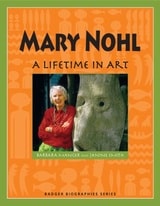
Mary Nohl
A Lifetime in ArtBarbara Manger
Wisconsin Historical Society Press, 2013
LOOK INSIDE THE LIFE — AND HOME — OF LEGENDARY 'OUTSIDER' ARTIST MARY NOHL
"Mary Nohl: A Lifetime in Art" by Barbara Manger and Janine Smith, tells the story of Milwaukee-born artist, Mary Nohl. A prolific and fanciful maker who worked in a variety of media, Nohl was both a mysterious figure and an iconic "outsider" artist. This new addition to the Badger Biographies series captures her life and will capture the imagination of readers, and artists, of all ages.
Nohl didn't just make art — she lived it. From the time she was young, Mary enjoyed making things, from the model airplane that won her a citywide prize to assignments in shop class, where she learned to work with tools.
Her interests in art blossomed during the years she spent training at the Art Institute of Chicago, leading to a lifetime of curiosity and ventures into new artistic media. From pottery to silver jewelry and oil painting to concrete sculpture, Mary explored new ways of making art. Many of her pieces were made from found objects that other people might think of as junk — like chicken bones, bedsprings and sand that she made into concrete.
Nohl, who made her home on the shores of Lake Michigan, decorated the interior of her cottage with bright colors and eye-catching figures in driftwood and glass. During her later years, her home became known as the "Witch's House" — a place of local legend known far beyond Fox Point. Though she died in 2001, Mary's legacy continues. Her art is held at the John Michael Kohler Arts Center in Sheboygan, and her home is listed on the National Register of Historic Places.
The popular Badger Biographies series for young readers explores the lives of famous and not-so-famous figures in Wisconsin history. The Wisconsin Historical Society Press is proud to celebrate the release of this, the 21st book in the series.
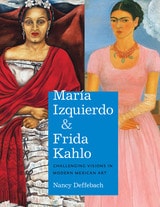
María Izquierdo and Frida Kahlo
Challenging Visions in Modern Mexican ArtBy Nancy Deffebach
University of Texas Press, 2015
María Izquierdo (1902–1955) and Frida Kahlo (1907–1954) were the first two Mexican women artists to achieve international recognition. During the height of the Mexican muralist movement, they established successful careers as easel painters and created work that has become an integral part of Mexican modernism. Although the iconic Kahlo is now more famous, the two artists had comparable reputations during their lives. Both were regularly included in major exhibitions of Mexican art, and they were invariably the only women chosen for the most important professional activities and honors.
In a deeply informed study that prioritizes critical analysis over biographical interpretation, Nancy Deffebach places Kahlo’s and Izquierdo’s oeuvres in their cultural context, examining the ways in which the artists participated in the national and artistic discourses of postrevolutionary Mexico. Through iconographic analysis of paintings and themes within each artist’s oeuvre, Deffebach discusses how the artists engaged intellectually with the issues and ideas of their era, especially Mexican national identity and the role of women in society. In a time when Mexican artistic and national discourses associated the nation with masculinity, Izquierdo and Kahlo created images of women that deconstructed gender roles, critiqued the status quo, and presented more empowering alternatives for women. Deffebach demonstrates that, paradoxically, Kahlo and Izquierdo became the most successful Mexican women artists of the modernist period while most directly challenging the prevailing ideas about gender and what constitutes important art.
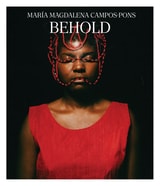
María Magdalena Campos-Pons
BeholdCarmen Hermo
J. Paul Getty Trust, The, 2023
María Magdalena Campos-Pons (b. 1959) makes powerful work that holds and beholds the stories of historically silenced peoples and urges societal change. Her journey as an artist, teacher, and activist has taken her from Cuba through the United States, and her autobiographical compositions honor her Nigerian and Chinese ancestors while also facing the future. With an artistic practice that crosses boundaries, intertwines media—from photography to sculpture, film to performance—and references traditions and beliefs ranging from feminism to Santería, Campos-Pons’s work is deeply layered and complex.
This volume, the first critical look at the artist’s oeuvre in nearly two decades, surveys the concerns, materials, and places invoked throughout her forty-year career. Thoughtful essays explore her vibrant, arresting artwork, which confronts issues of agency and the construction of race and belonging and challenges us to reckon with these issues in our own lives.
This volume, copublished with the Brooklyn Museum, accompanies an exhibition on view at the Brooklyn Museum from September 15, 2023, to January 14, 2024, the Nasher Museum of Art at Duke University from February 15 to June 9, 2024, the Frist Art Museum from September 27, 2024, to January 5, 2025, and the J. Paul Getty Museum at the Getty Center from February 11 to May 4, 2025.
Mass Performance
Systems and CitizensKimberly Jannarone
University of Michigan Press, 2025
Although not a comprehensive study of such events, Jannarone’s analysis of the selected mass performance systems yields new theoretical perspectives on these phenomena, a central focus of her study being how political leaders find ways to create a physically coordinated mass body politic, even during times of hardship and war. By interpreting and historicizing mass assemblies of bodies, this study analyzes the choreographies and organizations that brought thousands of people together as an ensemble and kept them together in meaning-making motion.

Material Media-Making in the Digital Age
Daniel Binns
Intellect Books, 2024
Today’s world offers no shortage of media for us to consume, and the ever-expanding array of available media has changed the way scholars think about its production and reception. Missing from these conversations about new media, however, is the maker—the one with the power to produce media from their own pocket.
In Material Media-Making in the Digital Age, Daniel Binns looks at the current media landscape in order to understand his own media practice. The result is a personal journey through media theory, history, and technology, furnished with practical lessons on the digital form for teachers, students, professionals, and enthusiasts. A refreshing combination of theory and practice written in a personal, engaging style, this book will enable readers to understand how a personal creative practice might unlock deeper thinking about media and its place in the world.
Material Witness
The Selected Letters of Fairfield PorterTed Leigh, Editor
University of Michigan Press, 2005
---From the introduction by David Lehman
"In this lifetime of letters, Fairfield Porter reveals the complexity and passion of a protagonist in a novel by Dostoevsky or Henry James."
---Jane Freilicher
Fairfield Porter (1907-75) has been called by poet John Ashbery "perhaps the major American artist of the century." He was also known as a gifted art critic.
Beyond shedding light on his personal views, this collection of Fairfield Porter's letters demonstrates his profound contribution to American art and literature and displays his acumen as a political critic. The letters tell the story of a reserved artist and intellectual, torn between the tensions and pressures he felt among politics, family life, and painting-a man who forged a painting style outside the politically correct artistic perceptions of both left and right.
The collection includes letters from Porter's early travels to the Soviet Union, including a description of an interview with Trotsky, as well as some of his later letters to close friends, including Frank O'Hara, Kenneth Koch, Rod Padgett, Larry Rivers, and James Schuyler, among others. While the letters reveal many sides of the brilliant and independent-minded Porter, they also provide a cultural context for the time period and the circle of artists and poets with whom Porter associated. The letters not only tell a story of the artist himself but are also valuable documents of the political and artistic upheavals of the 1930s, 40s, and 50s.
This rich collection is introduced by poet and critic David Lehman and includes notes by Justin Spring, author of Porter's biography.

Materials & Techniques in the Decorative Arts
An Illustrated DictionaryEdited by Lucy Trench
University of Chicago Press, 2000
Compiled by a team of experts, each with an intimate knowledge of his or her subject, the entries are written in clear, accessible language and supplemented by numerous photographs and drawings. Each core material (glass, ceramics, textiles, paper, plastics, leather, metal, stone, wood, and paint) is covered from its raw state through any processing or preparation to various craft stages and finally, to any surface finishing.
Traditionally, the kind of information found in these pages has been passed on from craftsman to craftsman or confined to highly specialized books, and even common terms are often misunderstood. This dictionary makes the subject accessible to all—from art and architectural historians, curators, collectors, restoration specialists, artists, and museum staff to decorators, aficionados, and those who enjoy watching Antiques Roadshow. In short, this book is for all those who are intrigued by the materials and techniques used to create the beautiful objects that surround us.
Matisse
The BooksLouise Rogers Lalaurie
University of Chicago Press, 2020
With deftness and sensitivity, Louise Rogers Lalaurie reintroduces us to Matisse by considering how in each volume, Matisse constructed an intriguing dialogue between word and image. Examining this page-by-page interplay, translating key sequences, and discussing the books’ distinct themes and production histories, Lalaurie offers the thoughtful analysis these works deserve. Together Matisse’s artist books reveal his deep engagement with questions of beauty and truth; his faith; his perspectives on aging, loss, and inspiration; and his relationship to his critics, the French art establishment, and the women in his life. In addition, Lalaurie illuminates Matisse’s often misunderstood political affinities—though Matisse was vilified in his time for choosing to live in the collaborationist Vichy zone, his wartime books reveal a body of work that stands as a deeply personal statement of resistance.
Lavishly illustrated, Matisse: The Books showcases a rich group of underappreciated works and brings unprecedented clarity to a controversial period in the artist’s life.
Matt Saunders
Parallel PlotMatt Saunders
University of Chicago Press, 2013
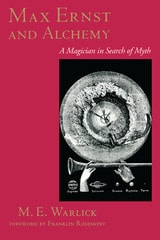
Max Ernst and Alchemy
A Magician in Search of MythBy M. E. Warlick
University of Texas Press, 2001
Surrealist artist Max Ernst defined collage as the "alchemy of the visual image." Students of his work have often dismissed this comment as simply a metaphor for the transformative power of using found images in a new context. Taking a wholly different perspective on Ernst and alchemy, however, M. E. Warlick persuasively demonstrates that the artist had a profound and abiding interest in alchemical philosophy and often used alchemical symbolism in works created throughout his career.
A revival of interest in alchemy swept the artistic, psychoanalytic, historical, and scientific circles of the late nineteenth and early twentieth centuries, and Warlick sets Ernst's work squarely within this movement. Looking at both his art (many of the works she discusses are reproduced in the book) and his writings, she reveals how thoroughly alchemical philosophy and symbolism pervade his early Dadaist experiments, his foundational work in surrealism, and his many collages and paintings of women and landscapes, whose images exemplify the alchemical fusing of opposites. This pioneering research adds an essential key to understanding the multilayered complexity of Ernst's works, as it affirms his standing as one of Germany's most significant artists of the twentieth century.
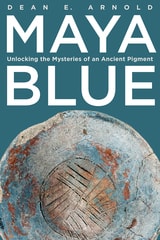
Maya Blue
Unlocking the Mysteries of an Ancient PigmentDean E. Arnold
University Press of Colorado, 2025
Combining the organic dye indigo and the inorganic clay mineral palygorskite in a highly stable chemical hybrid that, unlike indigo, resists attacks by acids, alkalines, and organic solvents and endures without fading, Maya Blue has a rich blue color that has survived for centuries in one of the world’s harshest climates. First used at the site of Calakmul in the tropical forest of southern Mexico during the Late Preclassic period, the Maya’s abiding hue diffused across Mesoamerica over a period of 1,700 years. It appears on Maya pottery, sculpture, murals, and codices and carries multiple meanings, standing as a symbol for cultural cornerstones such as sacrifice and the rain god Chaak. It was discovered in 1931 at Chichén Itzá, and its composition was a mystery for more than three decades, then questions about its source, how and why it achieved such stability, and how and why the Maya made the pigment persisted even longer.
In Maya Blue, Arnold summarizes ethnographic, archaeological, chemical, and material science research over the last century from an anthropological perspective. This thorough, engaging, and accessible book chronicles the history of this pigment as no work has done before.
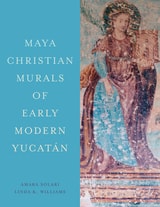
Maya Christian Murals of Early Modern Yucatán
Amara SolariLinda K. Williams
University of Texas Press, 2024
The first study of Christian murals created by indigenous artists in sixteenth and seventeenth century Yucatán.
In the sixteenth and seventeenth centuries, Maya artists painted murals in churches and conventos of Yucatán using traditional techniques to depict iconography brought from Europe by Franciscan friars. The fragmentary visual remains and their placement within religious structures embed Maya conceptions of sacredness beyond the didactic imagery. Mobilizing both cutting-edge technology and tried-and-true analytical methods, art historians Amara Solari and Linda K. Williams reexamine the Maya Christian murals, centering the agency of the people who created them.
The first volume to comprehensively document the paintings, Maya Christian Murals of Early Modern Yucatán collects new research on the material composition of the works, made possible by cutting-edge imaging methods. Solari and Williams investigate pigments and other material resources, as well as the artists and historical contexts of the murals. The authors uncover numerous local innovations in form and content, including images celebrating New World saints, celestial timekeeping, and ritual processions. Solari and Williams argue that these murals were not simply vehicles of coercion, but of cultural “grafting,” that allowed Maya artists to shape a distinctive and polyvocal legacy in their communities.
Meadows of Memory
Images of Time and Tradition in American Art and CultureBy Michael Kammen
University of Texas Press, 1992
"History painting," for many people, conjures up Washington Crossing the Delaware and other paintings of heroic historical events. But history has made its way into considerably more American art than such obvious examples, in the view of Michael Kammen. In three thought-provoking and innovative essays, Kammen ranges from the Renaissance to the twentieth century, from central Europe to the western United States, and from elegant oil painting to folk sculpture to show the transformations of Old World icons of time into New World images of social memory and tradition.
In the first essay, Kammen demonstrates how American artists and artisans modified European emblems of time in response to their New World setting. In the second essay concerning nineteenth-century landscape art, he explores how artists used space to represent the movement of American culture through time. In the final essay, he looks at two distinctively American motifs of collective memory and tradition—old houses and elm trees. Throughout this interdisciplinary study, Kammen draws his examples from well-known and lesser-known artists, as well as from diverse American writers. Over 100 black-and-white illustrations accompany the text.
Of interest to all students of American culture, Meadows of Memory raises intriguing questions about the American paradox of desiring to conquer mutability while yearning for emblems of a (perhaps imagined?) past.
Meaning in the Visual Arts
Erwin Panofsky
University of Chicago Press, 1983
The papers in this volume represent a cross-section of Panofsky's major work. Included are selections from his well-known Studies in Iconology and The Life and Art of Albrecht Dürer, plus an introduction and an epilogue—"The History of Art as a Humanistic Discipline" and "Three Decades of Art History in the United States: Impressions of a Transplanted European"—as well as pieces written especially for this collection. All display Panofsky's vast erudition and deep commitment to a humanistic conception of art and art history.
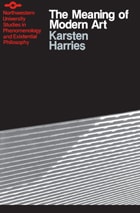
Meaning of Modern Art
Karsten Harries
Northwestern University Press, 1979
Art expresses an ideal image of man, and an essential part of understanding the meaning of a work of art is understanding this image. When the ideal image changes, art, too, must change. It is thus possible to look at the emergence of modern art as a function of the disintegration of the Platonic-Christian conception of man. The artist no longer has an obvious, generally accepted route to follow. One sign of this is that there is no one style today comparable to Romanesque, Gothic, Renaissance, or Baroque. This lack of direction has given the artist a new freedom. Today there is a great variety of answers to the question, "What is art?" Such variety, however, betrays an uncertainty about the meaning of art. An uneasiness about the meaning of art has led modern artists to enter into dialogue with art historians, psychologists and philosophers. Perhaps this interpretation can contribute to that dialogue.
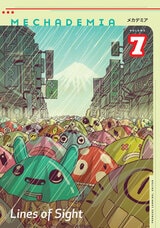
Mechademia 7
Lines of SightFrenchy Lunning
University of Minnesota Press, 2012
Lines of Sight—the seventh volume in the Mechademia series, an annual forum devoted to Japanese anime and manga—explores the various ways in which anime, manga, digital media, fan culture, and Japanese art—from scroll paintings to superflat—challenge, undermine, or disregard the concept of Cartesian (or one-point) perspective, the dominant mode of visual culture in the West since the seventeenth century. More than just a visual mode or geometric system, Cartesianism has shaped nearly every aspect of modern rational thought, from mathematics and science to philosophy and history.
Framed by Thomas Lamarre’s introduction, “Radical Perspectivalism,” the essays here approach Japanese popular culture as a visual mode that employs non-Cartesian formations, which by extension make possible new configurations of perception and knowledge. Whether by shattering the illusion of visual or narrative seamlessness through the use of multiple layers or irregular layouts, blurring the divide between viewer and creator, providing diverse perspectives within a single work of art, or rejecting dualism, causality, and other hallmarks of Cartesianism, anime and manga offer in their radicalization of perspective the potential for aesthetic and even political transformation.
Contributors: David Beynon, Deakin U; Fujimoto Yukari, Meiji U; Yuriko Furuhata, McGill U; Craig Jackson, Ohio Wesleyan U; Reginald Jackson, U of Chicago; Thomas Lamarre, McGill U; Jinying Li; Waiyee Loh; Livia Monnet, U of Montreal; Sharalyn Orbaugh, U of British Columbia; Stefan Riekeles; Atsuko Sakaki, U of Toronto; Miryam Sas, U of California, Berkeley; Timon Screech, U of London; Emily Somers; Marc Steinberg, Concordia U.
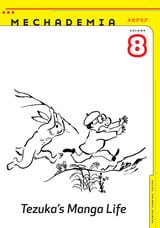
Mechademia 8
Tezuka’s Manga LifeFrenchy Lunning
University of Minnesota Press, 2013
Known as the “Walt Disney of Japan” it is no surprise that Tezuka Osamu is still the best-known manga creator to Western fans. Current scholarship has uncovered the profound complexity and ambiguity not only of his work but of the man, the artist, and his life—dismantling his position as the god of manga.
Contributors to this volume of Mechademia—a series devoted to creative and critical work on anime, manga, and the fan arts—analyze Tezuka and his complicated approaches toward life and nonlife on earth, as well as his effect on the lives of other manga artists. Using essays and reprints of Japanese manga on Tezuka, this book questions his influence and attitudes toward the nonhuman, evolutionary theory, the aesthetic lineage of contemporary manga, incipient feminism in the reinscription of the nonhuman feminine, the sexual politics of manga bodies, the origins of the moe culture, and the styles of didacticism revealing the digressions of insects and classical modes, among others.
The authors offer varying perspectives on the historical transformations in production, distribution, and reception that gradually integrated and differentiated an overlapping series of markets and readerships in the postwar era. Divided into four sections that explore different “lives”—“Nonhuman Life,” “Media Life,” “A Life in Manga,” and “Everyday Life”—Mechademia 8 serves as a prehistory of the impersonal politics of the present while tracing Tezuka’s legacy.
Contributors: Akatsuka Fujio; Anno Moyoko; Linda H. Chance, U of Pennsylvania; Jonathan Clements; Hideaki Fujiki, Nagoya U; Patrick W. Galbraith; Verina Gfader, U of Huddersfield; Alicia Gibson; G. Clinton Godart, USC; Yorimitsu Hashimoto, Osaka U; Ryan Holmberg; Hikari Hori, Columbia U; Mary A. Knighton, College of William and Mary; Thomas Lamarre, McGill U; Christine L. Marran, U of Minnesota; Natsume Fusanosuke, Gakushuin U, Tokyo; Ōtsuka Eiji, Kobe Design U; Baryon Tensor Posadas; Renato Rivera Rusca, Meiji U; Frederik L. Schodt; Marc Steinberg, Concordia U; Tezuka Osamu; Toshiya Ueno, Wako U, Tokyo; Matthew Young.
Media Poetry
An International AnthologyEdited by Eduardo Kac
Intellect Books, 2007
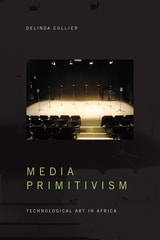
Media Primitivism
Technological Art in AfricaDelinda Collier
Duke University Press, 2020
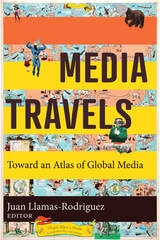
Media Travels
Toward an Atlas of Global MediaJuan Llamas-Rodriguez
Amherst College Press, 2025
Media studies courses, particularly introductory courses, are often narrowly focused on US and Western European canons. Instructors for introductory media studies courses wishing to expand the offerings in their curricula will find in these essays new ways of approaching foundational concepts and issues in the field, including globalization, social difference, and diverse media cultures. Scholars wishing to expand their research into specific media forms or representational issues can also turn to these case studies for approaches from beyond the US. By including a variety of media and several geographical areas, the collection introduces readers to the formal, technological, and cultural diversity of global media studies.
Edited by Juan Llamas-Rodriguez with contributions from Anthony Adah and Añulika Agina, Maria Corrigan, Benjamin Han, Anna Shah Hoque, Meryem Kamil, Angelica Marie Lawson, Lilia Adriana Perez Limon, Sonia Robles, Kuhu Tanvir, David Tenorio, and Rachel van der Merwe.
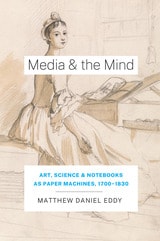
Media and the Mind
Art, Science, and Notebooks as Paper Machines, 1700-1830Matthew Daniel Eddy
University of Chicago Press, 2022
We often think of reason as a fixed entity, as a definitive body of facts that do not change over time. But during the Enlightenment, reason also was seen as a process, as a set of skills enacted on a daily basis. How, why, and where were these skills learned? Concentrating on Scottish students living during the long eighteenth century, this book argues that notebooks were paper machines and that notekeeping was a capability-building exercise that enabled young notekeepers to mobilize everyday handwritten and printed forms of material and visual media in a way that empowered them to judge and enact the enlightened principles they encountered in the classroom. Covering a rich selection of material ranging from simple scribbles to intricate watercolor diagrams, the book reinterprets John Locke’s comparison of the mind to a blank piece of paper, the tabula rasa. Although one of the most recognizable metaphors of the British Enlightenment, scholars seldom consider why it was so successful for those who used it. Each chapter uses one core notekeeping skill to reveal the fascinating world of material culture that enabled students in the arts, sciences, and humanities to transform the tabula rasa metaphor into a dynamic cognitive model. Starting in the home, moving to schools, and ending with universities, the book reconstructs the relationship between media and the mind from the bottom up. It reveals that the cognitive skills required to make and use notebooks were not simply aids to reason; rather, they were part of reason itself.
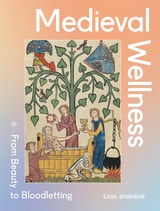
Medieval Wellness
From Beauty to BloodlettingLarisa Grollemond
J. Paul Getty Trust, The, 0
Dispelling myths of a dirty, superstitious Middle Ages, this entertaining volume explores medieval approaches to health and wellness.
Often maligned as an era of darkness and superstition, the Middle Ages in Europe have been stereotyped as lacking standards for basic hygiene, or, at the very least, for having a laughably simplistic approach to self-care and medicine. With wit and expert analysis, medievalist Larisa Grollemond explores everyday practices and beliefs of medieval life. She uncovers a world as nuanced and self-aware as our own while playfully connecting traditions from the Middle Ages to modern wellness culture.
- Challenges misconceptions of medieval Europe with engaging, evidence-based insights into hygiene and healthcare practices.
- Answers popular questions about daily life, including bathing, cosmetics, contraception, and the realities of medieval medical treatments.
- Features over 130 illustrations of illuminated manuscripts, medieval artifacts, and other art works that bring the past vividly to life.
- Connects medieval wellness practices to contemporary self-care trends, offering surprising parallels and fresh perspective.
If you think the Middle Ages were primitive and unsophisticated, this book will change your mind. With Medieval Wellness, you’ll discover a world of care, curiosity, and complexity that will feel familiar to your own.
Medium Cool, Volume 101
Andrew McNamara and Peter Krapp, eds.
Duke University Press, 0
Contributors. Keith Broadfoot, Rex Butler, Patrick Crogan, Wolfgang Ernst, Gary Hall, Rosemary Hawker, Peter Krapp, Catherine Liu, John MacArthur, Andrew McNamara, Toni Ross, Lisa Trahair, Georg Stanitzek, Georg Christoph Tholen, Lisa Trahair, Samuel Weber, Simon Morgan Wortham
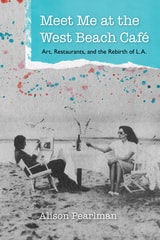
Meet Me at the West Beach Café
Art, Restaurants, and the Rebirth of L.A.Alison Pearlman
University of Nevada Press, 2027
When fine dining met fine art, a new Los Angeles was born.
Between 1979 and 1987, the city witnessed two cultural breakthroughs that may seem unrelated. A wave of bold, design‑forward restaurants helped launch the nationwide “New American” movement, serving innovative cuisine in sleek, modern spaces adorned with contemporary art. At the same time, Los Angeles celebrated a milestone: the opening of the Museum of Contemporary Art (MOCA), its first major museum devoted solely to contemporary art—an institution long missing from a city with global ambitions.
Though often told separately, these stories are deeply intertwined. In this lively, revelatory book, Alison Pearlman uncovers how restaurants became galleries as well as vital crossroads for the chefs, artists, collectors, architects, and civic leaders who reshaped L.A.’s cultural identity. Together, they revived hopes that L.A. could reclaim the creative energy of its 1960s heyday and join the ranks of the world’s cultural capitals.
Drawing on extensive interviews with those who built this transformative era, Pearlman shows how L.A.—through distinctive architecture, daring personalities, and unconventional collaborations—created a cultural moment with national impact. Vivid, engaging, and richly researched, this book brings to life a heady period in the city’s history.
A must‑read for lovers of art, food, and the vibrant alchemy that emerges when creative worlds collide.
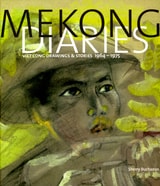
Mekong Diaries
Viet Cong Drawings and Stories, 1964-1975Sherry Buchanan
University of Chicago Press, 2008
These guerrilla artists—some military officers and some civilians—lived clandestinely with the fighters, moving camp alongside them, going on reconnaissance missions, and carrying their sketchbooks, ink, and watercolors into combat. Trained by professors from the Hanoi Institute of Fine Arts who journeyed down the perilous Ho Chi Minh Trail to ensure a pictorial history of the war, they recorded battles and events from Operation Junction City to Khe Sanh to the Tet Offensive. They also sketched as the spirit moved them, rendering breathtaking landscapes, hut and bunker interiors, activities at base camps, troops on the move, portraits for the families of fallen soldiers, and the unimaginable devastation that the conflict left in its wake.
Their collective record—which Sherry Buchanan skillfully compiles here—is an extraordinary historical and artistic document of people at war. As such, it serves as a powerful response to the self-centeredness of American accounts of Vietnam, filling a profound gap in our national memory by taking us into the misunderstood worlds of those whom we once counted among our worst enemies.
Melancholy, Love, and Time
Boundaries of the Self in Ancient LiteraturePeter Toohey
University of Michigan Press, 2004
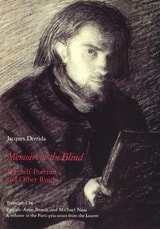
Memoirs of the Blind
The Self-Portrait and Other RuinsJacques Derrida
University of Chicago Press, 1993
vision, blindness, self-representation, and their relation to
drawing, while offering detailed readings of an extraordinary
collection of images. Selected by Derrida from the prints
and drawings department of the Louvre, the works depict
blindness—fictional, historical, and biblical. From Old
and New Testament scenes to the myth of Perseus and the
Gorgon and the blinding of Polyphemus, Derrida uncovers in
these images rich, provocative layers of interpretation.
For Derrida drawing is itself blind; as an act rooted in
memory and anticipation, drawing necessarily replaces one
kind of seeing (direct) with another (mediated). Ultimately,
he explains, the very lines which compose any drawing are
themselves never fully visible to the viewer since they exist
only in a tenuous state of multiple identities: as marks on
a page, as indicators of a contour. Lacking a "pure"
identity, the lines of a drawing summon the supplement of the
word, of verbal discourse, and, in doing so, obscure the
visual experience. Consequently, Derrida demonstrates, the
very act of depicting a blind person undertakes multiple
enactments and statements of blindness and sight.
Memoirs of the Blind is both a sophisticated
philosophical argument and a series of detailed readings.
Derrida provides compelling insights into famous and lesser
known works, interweaving analyses of texts—including
Diderot's Lettres sur les aveugles, the notion of
mnemonic art in Baudelaire's The Painter of Modern
Life, and Merleau-Ponty's The Visible and the
Invisible. Along with engaging meditations on the history
and philosophy of art, Derrida reveals the ways viewers
approach philosophical ideas through art, and the ways art
enriches philosophical reflection.
An exploration of sight, representation, and art,
Memoirs of the Blind extends and deepens the
meditation on vision and painting presented in Truth and
Painting. Readers of Derrida, both new and familiar, will
profit from this powerful contribution to the study of the
visual arts.
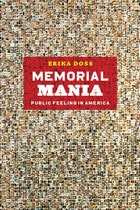
Memorial Mania
Public Feeling in AmericaErika Doss
University of Chicago Press, 2010
In the past few decades, thousands of new memorials to executed witches, victims of terrorism, and dead astronauts, along with those that pay tribute to civil rights, organ donors, and the end of Communism have dotted the American landscape. Equally ubiquitous, though until now less the subject of serious inquiry, are temporary memorials: spontaneous offerings of flowers and candles that materialize at sites of tragic and traumatic death. In Memorial Mania, Erika Doss argues that these memorials underscore our obsession with issues of memory and history, and the urgent desire to express—and claim—those issues in visibly public contexts.
Doss shows how this desire to memorialize the past disposes itself to individual anniversaries and personal grievances, to stories of tragedy and trauma, and to the social and political agendas of diverse numbers of Americans. By offering a framework for understanding these sites, Doss engages the larger issues behind our culture of commemoration. Driven by heated struggles over identity and the politics of representation, Memorial Mania is a testament to the fevered pitch of public feelings in America today.
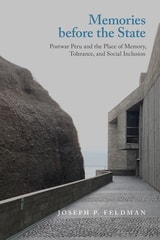
Memories before the State
Postwar Peru and the Place of Memory, Tolerance, and Social InclusionJoseph P. Feldman
Rutgers University Press, 2021
Memories before the State examines the discussions and debates surrounding the creation of the Place of Memory, Tolerance, and Social Inclusion (LUM), a national museum in Peru that memorializes the country’s internal armed conflict of the 1980s and 1990s. Emerging from a German donation that the Peruvian government initially rejected, the Lima-based museum project experienced delays, leadership changes, and limited institutional support as planners and staff devised strategies that aligned the LUM with a new class of globalized memorial museums and responded to political realities of the country’s postwar landscape. The book analyzes forms of authority that emerge as an official institution seeks to incorporate and manage diverse perspectives on recent violence.

Memories of Violence
Artists and the Curation of Mnemonic PeaceStefanie Kappler
University of Michigan Press, 2027
In wartime, artists often play an important role in keeping social structures alive and mitigating suffering. Yet art can also be used as a tool for the propagation of violence or the consolidation of an unjust status quo; the brutal iconography used on the murals in Belfast during the Troubles being a prominent example. Memories of Violence investigates the potential of artwork to bring to the fore often-invisible configurations of violence that span across the globe.
Many peace processes fail to address the legacies of violence and to offer meaningful avenues of repair on the part of perpetrators, some of whom are outside the physical space in which violence was, or continues to be, experienced. Stefanie Kappler looks at situations of violence where societies are implicated in and continue to benefit from the legacies of violence, particularly the peace processes of South Africa, Bosnia-Herzegovina, and Northern Ireland. Bringing together Peace and Conflict Studies with Memory Studies, Kappler examines how art offers an opportunity to achieve a mnemonic peace—a memory-oriented peace that acknowledges the complex ways in which historical violence and its legacies are constituted. While recognizing the power structures that limit artists and curators, Memories of Violence reveals how they can play a role in addressing situations of complex implication; amplify the voices that call for acknowledgment, reparations, and solidarity; and suggest avenues for facilitating this process.

Memory Effects
The Holocaust and the Art of Secondary WitnessingDora Apel
Rutgers University Press, 2002
Drawing on projects that employ a variety of unorthodox artistic strategies, the author provides a unique understanding of contemporary representations of the Holocaust. She demonstrates how these artists frame the past within the conditions of the present, the subversive use of documentary and the archive, the effects of the Jewish genocide on issues of difference and identity, and the use of representation as a form of resistance to historical closure.
Memory Fragments
Visualising Difference in Australian HistoryMarita Bullock
Intellect Books, 2012
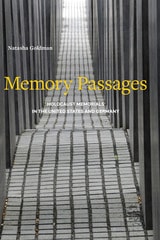
Memory Passages
Holocaust Memorials in the United States and GermanyNatasha Goldman
Temple University Press, 2020
For decades, artists and architects have struggled to relate to the Holocaust in visual form, resulting in memorials that feature a diversity of aesthetic strategies. In Memory Passages, Natasha Goldman analyzes both previously-overlooked and internationally-recognized Holocaust memorials in the United States and Germany from the postwar period to the present, drawing on many historical documents for the first time. From the perspectives of visual culture and art history, the book examines changing attitudes toward the Holocaust and the artistic choices that respond to it.
The book introduces lesser-known sculptures, such as Nathan Rapoport’s Monument to the Six Million Jewish Martyrs in Philadelphia, as well as internationally-acclaimed works, such as Peter Eisenman’s Memorial to the Murdered Jews of Europe in Berlin. Other artists examined include Will Lammert, Richard Serra, Joel Shapiro, Gerson Fehrenbach, Margit Kahl, and Andy Goldsworthy.Archival documents and interviews with commissioners, survivors, and artists reveal the conversations and decisions that have shaped Holocaust memorials.
Memory Passages suggests that memorial designers challenge visitors to navigate and activate spaces to engage with history and memory by virtue of walking or meandering. This book will be valuable for anyone teaching—or seeking to better understand—the Holocaust.
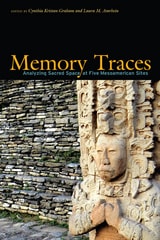
Memory Traces
Analyzing Sacred Space at Five Mesoamerican SitesCynthia Kristan-Graham
University Press of Colorado, 2015
In Memory Traces, art historians and archaeologists come together to examine the nature of sacred space in Mesoamerica. Through five well-known and important centers of political power and artistic invention in Mesoamerica—Tetitla at Teotihuacan, Tula Grande, the Mound of the Building Columns at El Tajín, the House of the Phalli at Chichén Itzá, and Tonina—contributors explore the process of recognizing and defining sacred space, how sacred spaces were viewed and used both physically and symbolically, and what theoretical approaches are most useful for art historians and archaeologists seeking to understand these places.
Memory Traces acknowledges that the creation, use, abandonment, and reuse of sacred space have a strongly recursive relation to collective memory and meanings linked to the places in question and reconciles issues of continuity and discontinuity of memory in ancient Mesoamerican sacred spaces. It will be of interest to students and scholars of Mesoamerican studies and material culture, art historians, architectural historians, and cultural anthropologists.
Contributors: Laura M. Amrhein, Nicholas P. Dunning, Rex Koontz, Cynthia Kristan-Graham, Matthew G. Looper, Travis Nygard, Keith M. Prufer, Matthew H. Robb, Patricia J. Sarro, Kaylee Spencer, Eric Weaver, Linnea Wren
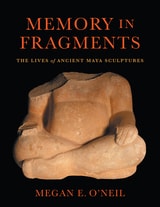
Memory in Fragments
The Lives of Ancient Maya SculpturesMegan E. O'Neil
University of Texas Press, 2024
An exploration of how the ancient Maya engaged with their history by using, altering, and burying stone sculptures.
For the ancient Maya, monumental stone sculptures were infused with agency. As they were used, reused, altered, and buried, such sculptures retained ceremonial meaning. In Memory in Fragments, Megan E. O'Neil explores how ancient Maya people engaged with history through these sculptures, as well as how they interacted with the stones themselves over the course of the sculptures’ long “lives.” Considering Maya religious practices, historiography, and conceptions of materials and things, O’Neil explores how Maya viewers perceived sculptures that were fragmented, scarred, burned, damaged by enemies, or set in unusual locations. In each case, she demonstrates how different human interactions, amid dynamic religious, political, and historical contexts, led to new episodes in the sculptures' lives.
A rare example of cross-temporal and geographical work in this field, Memory in Fragments both compares sculptures within ancient Maya culture across Honduras, Guatemala, Mexico, and Belize over hundreds of years and reveals how memory may accrue around and be evoked in material remains.
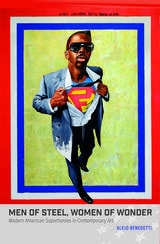
Men of Steel, Women of Wonder
Modern American Superheroes in Contemporary ArtAlejo Benedetti
University of Arkansas Press, 2019
Saturated in patriotic colors, Superman and Wonder Woman are about as American as baseball and apple pie. Superman, created in 1938, materialized as the brawny answer to the Great Depression, and when Wonder Woman arrived three years later, she supported her adopted country by fighting alongside Allied troops in World War II. As the proverbial mother and father of the superhero genre, these icons appeared to a society in crisis as unwavering beacons of national morality, a quality that lent them success on the battlefield—and on the newsstand.
As new crises arise our comic-book champions continue to be called into action. They adapt and evolve but remain the same potent, if flawed, symbols of the American way. The artists in Men of Steel, Women of Wonder, an exhibition organized by Crystal Bridges Museum of American Art, wrestle with Wonder Woman’s standing as a feminist icon, position Superman as a Soviet-era weapon, and question the immigration status of both characters. Featuring more than seventy artworks that range from loving endorsements to brutal critiques of American culture, this exhibition catalog reveals the enduring presence of these characters and the diverse ways artists employ them.
Men, War and Film
The Calling Blighty Films of World War IISteve Hawley
Intellect Books, 2025
The Calling Blighty series of films produced by the Combined Kinematograph Service around the end of World War II were one-reel films in which soldiers of the “Forgotten Army” gave short spoken messages to the camera as a means of connecting the front line and the home front. Shown in local cinemas, these were the first films in which men spoke openly in their regional accents, and they hold profound meaning for remembrance, documentary representation, and the ecology of film in wartime. Of the four hundred films made on the Far Eastern Front, only sixty-four survive. Until now, however, these films have barely been researched, despite being a valuable source of social history. This book expands the history of Calling Blighty, placing it in a broader context for contemporary audiences.
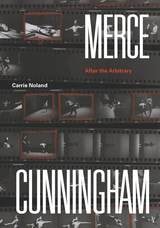
Merce Cunningham
After the ArbitraryCarrie Noland
University of Chicago Press, 2019
Examining a rich and previously unseen archive that includes photographs, film footage, and unpublished writing by Cunningham, Noland counters prior understandings of Cunningham’s influential embrace of the unintended, demonstrating that Cunningham in fact set limits on the role chance played in his dances. Drawing on Cunningham’s written and performed work, Noland reveals that Cunningham introduced variables before the chance procedure was applied and later shaped and modified the chance results. Chapters explore his relation not only to Cage, but also Marcel Duchamp, Robert Rauschenberg, James Joyce, and Bill T. Jones. Ultimately, Noland shows that Cunningham approached movement as more than “movement in itself,” and that his work enacted archetypal human dramas. This remarkable book will forever change our appreciation of the choreographer’s work and legacy.
Mere and Easy
Collage as a Critical Practice in PedagogyEdited by Jorge Lucero
University of Illinois Press, 2017
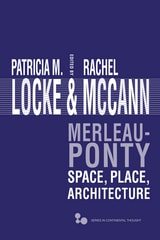
Merleau-Ponty
Space, Place, ArchitecturePatricia M. Locke
Ohio University Press, 2015
Phenomenology has played a decisive role in the emergence of the discourse of place, now indispensable to many disciplines in the humanities and social sciences, and the contribution of Merleau-Ponty’s thought to architectural theory and practice is well established. Merleau-Ponty: Space, Place, Architecture is a vibrant collection of original essays by twelve eminent philosophers who mine Merleau-Ponty’s work to consider how we live and create as profoundly spatial beings. The resulting collection is essential to philosophers and creative artists as well as those concerned with the pressing ethical issues of our time.
Each contributor presents a different facet of space, place, or architecture. These essays carve paths from Merleau-Ponty to other thinkers such as Irigaray, Deleuze, Ettinger, and Piaget. As the first collection devoted specifically to developing Merleau-Ponty’s contribution to our understanding of place and architecture, this book will speak to philosophers interested in the problem of space, architectural theorists, and a wide range of others in the arts and design community.
Contributors: Nancy Barta-Smith, Edward S. Casey, Helen Fielding, Lisa Guenther, Galen A. Johnson, Randall Johnson, D. R. Koukal, Suzanne Cataldi Laba, Patricia M. Locke, Glen Mazis, Rachel McCann, David Morris, and Dorothea Olkowski.
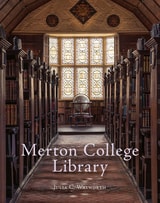
Merton College Library
Julia C. Walworth
Bodleian Library Publishing, 2020
Drawing on the remarkable wealth of documentation in the college’s archives, this is the first history of the library to explore collections, buildings, readers, and staff across more than seven hundred years. The story is told in part through stunning color images that depict not only exceptional treasures but also the library furnishings and decorations, and which show manuscripts, books, bindings, and artifacts of different periods in their changing contexts. Featuring a historical timeline and a floor plan of the college, this book will be of interest to historians, alumni, and tourists alike.
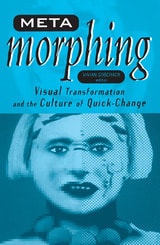
Meta-Morphing
Visual Transformation and the Culture of Quick-ChangeVivian Sobchack
University of Minnesota Press, 2000
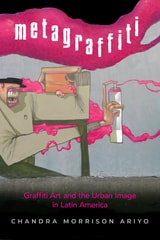
Metagraffiti
Graffiti Art and the Urban Image in Latin AmericaChandra Morrison Ariyo
Rutgers University Press, 2025
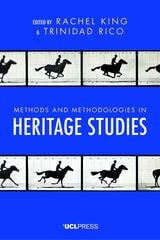
Methods and Methodologies in Heritage Studies
Edited by Rachel King and Trinidad Rico
University College London, 2024
Methods and Methodologies in Heritage Studies offers succinct and accessible analyses of the current debates, intellectual legacies, and practical innovations on heritage value today. Using archaeology, anthropology, history, and geography, this multidisciplinary textbook is designed to support students, researchers, and practitioners, inviting them to review discussions of key problems and argumentative interventions in heritage studies.