Results by title
5159 books match the query 'Biography' and 312 start with m
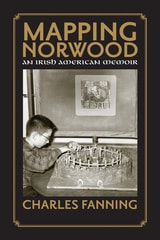
Mapping Norwood
An Irish-American MemoirCharles Fanning
University of Massachusetts Press, 2010
This memoir is an act of map making, of plotting out overlapping territories—topographical, temporal, and psychological. Centered on family life in a Massachusetts town from the 1920s to the 1960s, the author's investigation extends outward to include the Boston area from colonial times to the recent past, encounters with Boston's Museum of Fine Arts and with Harvard College, the American Civil War, and Ireland and Germany in the nineteenth century.
Charles Fanning re-creates the landscape of childhood and adolescence in a place and time both ordinary and rich with possibility. An expert on Irish immigration, he was born and raised in Norwood, Massachusetts, twelve miles outside of Boston, where Yankee and Irish cultures bumped against each other. The narrative traces his personal growth, shaped by family, school, baseball, radio drama, and art. He was the first in his family to attend college, and the book ends with his undergraduate experience at Harvard, class of 1964.
Along with this coming-of-age story, Mapping Norwood features forays back in time, including chapters on each of Fanning's parents and historical excavations and meditations on three ancestors. Guided by his own experience as a scholar, the pressure of these chapters is epistemological—the thrill of the hunt toward knowing. Fanning's great-grandfather, John Fanning, disappeared from the family in the late 1880s, and a chapter chronicles the discovery of “Walking John's” fifty years of hidden later life in East St. Louis, Illinois, where he died alone in 1946. Fanning's great-great-grandfather, Winslow Radcliffe, was a veteran of the 35th Massachusetts Infantry in the Civil War, and the author traces this regiment through the horrors of Antietam and Fredericksburg, by means of diaries and letters by four men from Winslow's company. The evidence gleaned helps explain Winslow's suicide after the war. An Irish immigrant ancestor, Phillip Fanning, came to Boston from County Monaghan just after the Great Famine of the late 1840s. Relying on historical research, Fanning imagines vividly the lives led by Phillip's family and thousands like them in the wake of Ireland's nineteenth-century catastrophe.
Marga Richter
Sharon Mirchandani
University of Illinois Press, 2012
This is the first full-length introduction to the life and works of significant American composer Marga Richter (born 1926), who has written more than one hundred works for orchestra, chamber ensemble, dance, opera, voice, chorus, piano, organ, and harpsichord. Still actively composing in her eighties, Richter is particularly known for her large-scale works performed by ensembles such as the London Philharmonic Orchestra and the Civic Orchestra of Chicago and for other pieces performed by prominent artists including pianist Menahem Pressler, conductor Izler Solomon, and violinist Daniel Heifetz.
Interspersing consideration of Richter's musical works with discussion of her life, her musical style, and the origins and performances of her works, Sharon Mirchandani documents a successful composer's professional and private life throughout the twentieth century. Covering Richter's formative years, her influences, and the phases of her career from the 1950s to the present, Mirchandani closely examines Richter's many interesting, attractive musical works that draw inspiration from distinctly American, Irish/English, and Asian sources. Drawing extensively on interviews with the composer, Mirchandani also provides detailed descriptions of Richter's scores and uses reviews and other secondary sources to provide contexts for her work, including their relationship to modern dance, to other musical styles, and to 1970s feminism.
Margaret Mead Made Me Gay
Personal Essays, Public IdeasEsther Newton
Duke University Press, 2000
Newton’s provocative essays detail a queer academic career while offering a behind-the-scenes view of academic homophobia. In four sections that correspond to major periods and interests in her life—”Drag and Camp,” “Lesbian-Feminism,” “Butch,” and “Queer Anthropology”—the volume reflects her successful struggle to create a body of work that uses cultural anthropology to better understand gender oppression, early feminism, theatricality and performance, and the sexual and erotic dimensions of fieldwork. Combining personal, theoretical, and ethnographic perspectives, Margaret Mead Made Me Gay also includes photographs from Newton’s personal and professional life.
With wise and revealing discussions of the complex relations between experience and philosophy, the personal and the political, and identities and practices, Margaret Mead Made Me Gay is important for anyone interested in the birth and growth of gay and lesbian studies.
Margaret Webster
A Life in the TheaterMilly S. Barranger
University of Michigan Press, 2004
-Marian Seldes
"Margaret Webster is a highly welcome addition to our knowledge of the first important female director in American theater. Remembered now especially for her staging of Othello with Paul Robeson, Uta Hagen, and Jose Ferrer, Margaret Webster was probably the best-known, in-demand, and admired director of Shakespeare in America in the 1940s and 1950s. Fascinating throughout, the book's discussions of working with Robeson, and of HUAC, which targeted her just as her career was reaching a peak, make for especially engrossing reading."
-Oscar Brockett
Margaret Webster: A Life in the Theater is an engrossing backstage account of the life of pioneering director Margaret Webster (1905-72).
This is the first book-length biography of Webster, a groundbreaking stage and opera director whose career challenged not only stage tradition but also mainstream attitudes toward professional women.
Often credited with first having brought Shakespeare to Broadway, and renowned for her bold casting of an African American (Paul Robeson) in the role of Othello, Webster was a creative force in modern American and British theater.
Her story reveals the independent-minded artist undeterred by stage tradition and unmindful of rules about a woman's place in the professional theater. In addition to providing fascinating glimpses into Webster's personal and family life, Margaret Webster: A Life in the Theater also offers a who's-who list of the biggest names in New York and London theater of the time, as well as Hollywood: John Gielgud, Noël Coward, George Bernard Shaw, Uta Hagen, Sybil Thorndike, Eva LeGallienne, and John Barrymore, among others, all of whom crossed paths with Webster. Capping Webster's amazing story is her investigation by Senator Joseph McCarthy and HUAC, which left her unable to work for a year, and from which she never fully recovered.
Marguerite Duras
A LifeLaure Adler
University of Chicago Press, 2000
Adler, through her exploration of the events central to Duras's career, including her affair with and eventual denunciation of a Nazi collaborator and her childhood in Indochina, reveals Duras as the consummate pragmatist. She has combed through archives, unearthed letters, studied unpublished manuscripts, and interviewed scores of Duras's friends, lovers, enemies, and colleagues—as well as Duras herself—and she emerges with the richest portrait we have of Duras's life: her upbringing, her student days at the Sorbonne, her career as a novelist and filmmaker, and her involvement in French politics through the most complex decades of the twentieth century. "The masks and the truth" was the headline of a French review of Marguerite Duras, and Adler explores both, probing the line between fiction and selfhood and between political activities and personal responsibility.

Marguerite Yourcenar
Inventing a LifeJosyane Savigneau
University of Chicago Press, 1993
Here, in its intricate and often contradictory detail, is Marguerite Yourcenar's story, one in which loss and learning intertwined almost from the first and in which love assumed a strangely paradoxical place. Drawing on letters, diaries, and interviews with Yourcenar's friends, colleagues, and lovers, Josyane Savigneau's biography paints an intimate portrait of an artist who lived according to her own, occasionally contrary, terms: a Frenchwoman ardently in love with her native tongue, yet who lived half her life in New England; an avid seductress of women, who spent nearly forty years with one woman, yet fell in love early and late in her life with two young men; a powerful female writer whose most memorable protagonists were male, from Alexis of her first novel to the later historical characters Hadrian and Zeno. Savigneau weaves these and other contraries of Yourcenar's life into a vibrant and engrossing pattern.
Editor of "Le Monde des Livres," the literary pages of France's most influential newspaper, Savigneau first met Marguerite Yourcenar on assignment in 1984. What began as a professional relationship gradually turned into a friendship. Her personal insights into that life enrich this exhaustively documented text. Following the lead set by Yourcenar in her memoir Dear Departed, the biographer found herself "searching for a truth that is multiple, unstable, evasive, sometimes saddening, and at first glance scandalous but that one cannot approach without often feeling for human beings in all their frailty a certain measure of kinship and, always, a sense of pity." Yourcenar's profound intelligence and sympathy, her foibles and obsessions, her accomplishments and trials: all are revealed here in an uncompromising portrait of an incomparable artist.
Maria Baldwin's Worlds
A Story of Black New England and the Fight for Racial JusticeKathleen Weiler
University of Massachusetts Press, 2019
Maria Baldwin (1856–1922) held a special place in the racially divided society of her time, as a highly respected educator at a largely white New England school and an activist who carried on the radical spirit of the Boston area's internationally renowned abolitionists from a generation earlier.
African American sociologist Adelaide Cromwell called Baldwin “the lone symbol of Negro progress in education in the greater Boston area” during her lifetime. Baldwin used her respectable position to fight alongside more radical activists like William Monroe Trotter for full citizenship for fellow members of the black community. And, in her professional and personal life, she negotiated and challenged dominant white ideas about black womanhood. In Maria Baldwin's Worlds, Kathleen Weiler reveals both Baldwin's victories and what fellow activist W. E. B. Du Bois called her “quiet courage” in everyday life, in the context of the wider black freedom struggle in New England.
Maria Longworth Storer
From Music and Art to Popes and PresidentsConstance J. Moore; Nancy M. Broermann
Ohio University Press, 2019
Published by the University of Cincinnati Press
While the adage may go, “Behind every great man is a great woman,” the story of Maria Longworth Storer necessitates a new adage—at the front of every great city is a great woman. After being shunted into the biographies and history books of other people, Longworth Storer is now finally given center stage on the one hundred and seventieth anniversary of her birth.
Maria Longworth Storer: From Music and Art to Popes and Presidents is the most comprehensive biography of this one of a kind Cincinnatian. Known as the founder of the first female-run manufacturing company in the United States, Rookwood Pottery, Longworth Storer was passionate about women’s rights, her city, and issues of poverty and the arts. She owned Rookwood pottery for nine years, and then transferred ownership after earning recognition at the Exhibition of American Art Industry in Philadelphia and receiving a gold medal at the Exposition Universelle in Paris. Aside from her success with Rookwood, Longworth Storer was central to making the Queen City the major cultural landmark it is today. Although the rest of her life was no less remarkable as the wife of notorious diplomat Bellamy Storer, later embroiled in the famous Roosevelt-Storer scandal, little has been written about her contributions and exploits in diplomatic relations and her powerful influence on turn-of-the-twentieth-century political leaders.
Featuring new archival research, and never before seen photos of the Storer family, authors Constance J. Moore and Nancy M. Broermann have compiled a portrait of Maria Longworth Storer that is rich in detail, fitting to both the wide, often eclectic, breadth of Longworth Storer’s projects, and to the depth of her impact on leaders from Washington D.C. to Europe.
Moving through major moments in both American and Cincinnati history, and intersecting with significant historical figures including Teddy Roosevelt and William Howard Taft, Moore and Broermann expose the broader historical narrative of Longworth Storer’s life without letting her unique spirit and individual accomplishments become overshadowed by them.
Through thoughtful, balanced narrative, readers get to know a remarkable woman whose fascinating and dramatic life as a political figure, women’s rights advocate, and patron of the arts has had a long lasting legacy on the Queen City and the Shaping of our nation’s diplomatic policies.
Maria Martin's World
Art and Science, Faith and Family in Audubon’s AmericaDebra J. Lindsay
University of Alabama Press, 2018
Maria Martin (1796–1863) was an evangelical Lutheran from Charleston, South Carolina, who became an accomplished painter within months of meeting John James Audubon. Martin met Audubon through her brother-in-law, Reverend John Bachman, who befriended Audubon while passing through Charleston on route to Florida where he expected to find new avian species. Martin was an amateur artist, but by the time Audubon left, she had familiarized herself with his style of drawing. Six months after their initial meeting, her background botanicals were deemed good enough to embellish Audubon’s exquisite bird paintings.
Martin’s botanicals and insects appeared in volumes two and four of The Birds of America (1830–1838). She painted snakes for John Edwards Holbrook’s North American Herpetology (1842) and assisted in drafting the descriptive taxonomies prepared by John Bachman—who later became her husband in 1848 following the death of her older sister—for The Viviparous Quadrupeds of North America (1846–1854). Until now, her contributions have been unknown to all but the most astute students of natural history and art history and a close circle of family and friends.
Maria Martin’s World is a heavily illustrated volume examining how Maria Martin learned to paint aesthetically beautiful botanicals with exacting accuracy. Drawing on deep research into archival documents and family-held artifacts, Debra Lindsay brings Maria Martin out from behind the curtain of obscurity and disinformation that has previously shrouded her and places her centrally in her own time and milieu. In the telling of Maria Martin’s story, Lindsay also uncovers many nuances of the behavior and actions of the two prominent men in her life that readers interested in Audubon and Bachman will find noteworthy.
Martin was a gifted artist recognized for having contributed beautiful paintings to a natural history. But beyond the natural world this is a biography of an evangelical Lutheran steeped in the faith of her German ancestors and raised to respect the patriarchal norms of her time. Maria Martin pursued her scientific and artistic interests only when they did not conflict with her religious and familial responsibilities.
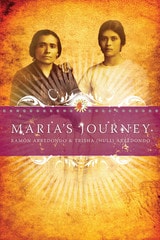
Maria's Journey
Ramon Arredondo and Trisha (Hull) Arredondo
Indiana Historical Society Press, 2010
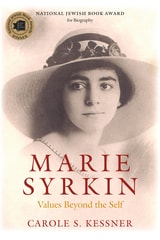
Marie Syrkin
Values Beyond the SelfCarole S. Kessner
Brandeis University Press, 2008
Marie Syrkin’s life spanned ninety years of the twentieth century, 1899–1989. As a polemical journalist, socialist Zionist, poet, educator, literary critic, translator, and idiosyncratic feminist, she was an eyewitness to and reporter on most of the major events in America, Israel, and Europe. Beautiful as well as brilliant, she had a rich personal life as a lover, wife, mother, and friend. During her lifetime Syrkin’s name was widely recognized in the world of Jewish life and letters. Yet, since Syrkin’s death, recognition of her name is no longer quite so immediate. Carole S. Kessner’s biography restores Syrkin’s fascinating life and legacy for a new generation.

Marina Tsvetaeva
The Double Beat of Heaven and HellLily Feiler
Duke University Press, 1994
Born to a family of Russian intelligentsia in 1892 and coming of age in the crucible of revolution and war, Tsvetaeva has been seen as a victim of her politicized time, her life and her work marked by exile, neglect, and persecution. This book is the first to show us the poet as she discovered her life through art, shaped as much by inner demons as by the political forces and harsh realities of her day. With remarkable psychological and literary subtlety, Lily Feiler traces these demons through the tragic drama of Tsvetaeva’s life and poetry. Hers is a story full of contradictions, resisting social and literary conventions but enmeshed in the politics and poetry of her time. Feiler depicts the poet in her complex relation to her contemporaries—Pasternak, Rilke, Mayakovsky, Mandelstam, and Akhmatova. She shows us a woman embodying the values of nineteenth-century romanticism, yet radical in her poetry, supremely independent in her art, but desperate for appreciation and love, simultaneously mother and child in her complicated sexual relationships with men and women.
From prerevolutionary Russia to Red Moscow, from pre-World War II Berlin, Prague, and Paris to the Soviet Union under Stalin, Feiler follows the tortuous drama of Tsvetaeva’s life and work to its last tragic act, exposing at each turn the passions that molded some of this century’s most powerful poetry.
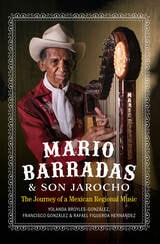
Mario Barradas and Son Jarocho
The Journey of a Mexican Regional MusicYolanda Broyles-González, Rafael Figueroa Hernández, and Francisco González
University of Texas Press, 2022
Son Jarocho was born as the regional sound of Veracruz but over time became a Mexican national genre, even transnational, genre—a touchstone of Chicano identity in the United States. Mario Barradas and Son Jarocho traces a musical journey from the Gulf Coast to interior Mexico and across the border, describing the transformations of Son Jarocho along the way.
This comprehensive cultural study pairs ethnographic and musicological insights with an oral history of the late Mario Barradas, one of Son Jarocho’s preeminent modern musicians. Chicano musician Francisco González offers an insider’s account of Barradas’s influence and Son Jarocho’s musical qualities, while Rafael Figueroa Hernández delves into Barradas’s recordings and films. Yolanda Broyles-González examines the interplay between Son Jarocho’s indigenous roots and contemporary role in Mexican and US society. The result is a nuanced portrait of a vital and evolving musical tradition.
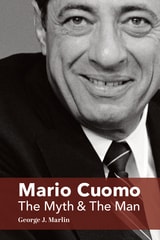
Mario Cuomo
The Myth and the ManGeorge J.
St. Augustine's Press, 2020
As governor, Mario Cuomo is remembered most for his advocacy of the “personally-opposed-but” position on abortion that led to confrontations with Catholic Church hierarchy, and for dithering about his presidential ambitions, that led the media to dub him the “Hamlet on the Hudson.” His political style reminded many of Machiavelli; Cuomo styled himself a successor to St. Thomas More.
In this political profile, George J. Marlin sets the record straight on Mario Cuomo.
Marlin traces Cuomo’s political rise and documents how and why he abandoned his public opposition to abortion to be elected New York’s chief executive.
In great detail, Marlin describes the protracted conflict between Cuomo and his church on abortion and refutes the governor’s claim that his “position on abortion is absolutely theologically sound.”
Marlin critiques Cuomo’s famous 1984 Democratic convention speech as nothing more than the usual high-toned partisan liberal bromides that offered little, if anything, that hadn’t been touted by his party for half a century.
The book also uncovers New York State’s fiscal, economic, and social decline during Cuomo’s 12 years as governor. It explains why voters repudiated Cuomo’s version of a welfare state when he sought a fourth term in 1994 and why, in the words of his son, Governor Andrew Cuomo, his father was “more accomplished as a speech-giver than as a governor.”
Marlin skillfully separates the Cuomo “Public Intellectual” myth from the political man.
Mario Cuomo, three times Governor of New York, an eloquent hard edged Catholic from Queens, dominated not only his home state but national liberal politics in the age of Reagan. Whether the subject was police or theology, Cuomo rhetorically overpowered the reporters who covered him. But he’s finally met his match in George Marlin’s Mario Cuomo The Myth and the Man. Marlin’s extraordinary equipment; a former candidate for Mayor of N.Y.C., former executive director of the New York and New Jersey Port Authority, author of books on Catholic voters and the Archbishops of New York, has made him the ideal author of what’s sure to be seen as the definitive political biography of Mario Cuomo. — Fred Siegel, Author, The Prince of the City: Giuliani, New York, and the Genius of American Life and The Future Once Happened Here: New York, D.C., L.A., and the Fate of America’s Big Cities.
“It’s easy to forget what an important and fascinating figure Mario Cuomo was during New York’s raucous political heyday of the 1970s, 80s and 90s, when the likes of Hugh Carey, Ed Koch, Al D’Amato, and Rudy Giuliani strode the political stage. Thankfully, George Marlin’s wonderful new Cuomo biography will help everyone remember both the good and bad of the remarkable man who served three terms as governor, turned down a seat on the Supreme Court and rejected the chance to run for President. Here are both Cuomo’s successes and failures — and of the latter there were many. An important work that helps restore our collective memory. — Fredric U. Dicker, the New York Post’s longtime state editor and a TV and radio commentator, covered six governors during 40 years at the state Capitol in Albany.
George Marlin is virtually peerless in blending high principle with knowledge of street-level politics and the nuts-and-bolts of otherwise mundane governance to produce readable, yet deeply insightful, social and political portraits. Mario Cuomo: The Myth and the Man, examines in fine detail one of one of New York state’s most consequential, if also deeply flawed, 20th-century gubernatorial incumbencies. Plus, readers get a bonus: Insight into what shaped the career of Mario Cuomo’s Democratic superstar son, Andrew. Marlin has been in the trenches himself and thus can separate blarney from beefsteak – which this fine volume once again demonstrates. —Bob McManus, Contributing Editor, The City Journal, was the New York Post’s Editorial Page Editor (2000-2013), and The Albany Times Union’s Executive City Editor (1975-1981).
“George Marlin not only captures the political life and journey of Mario Cuomo, but details his policy approach that led to the near demise of the Empire State. Fortunately, the Conservative Party of New York was there to carry the torch and provide the margin of victory for George Pataki ending the senior Cuomo’s reign.” —Michael Long, State Chairman, Conservative Party of New York (1988-2019)
“For both better and worse, Mario Cuomo was the quintessential American Catholic politician of an entire postwar generation: ambitious, brilliant, articulate, serious about his faith, and flexible in how and where he applied it. George Marlin is a writer of considerable skill, and he uses here it to produce a provocative, absorbing portrait of the man and his career. —Francis X. Maier, Senior Fellow in Catholic Studies at the Ethics and Public Policy Center
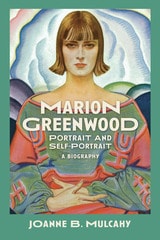
Marion Greenwood
Portrait and Self-Portrait—A BiographyJoanne B. Mulcahy
University of Alabama Press, 2025
This new biography reveals Marion Greenwood's central place in the pantheon of history’s remarkable women artists.
Marion Greenwood: Portrait and Self-Portrait—A Biography brings to life a woman who blazed through the twentieth-century art world. Born in Brooklyn in 1909, Greenwood thrived at storied institutions and arts centers such as the Art Students League, the studio of German modernist Winold Reiss, the Woodstock Colony, and Yaddo. In 1933, she catapulted to international fame as the first woman to paint a public mural in Mexico. Diego Rivera celebrated Greenwood as one of “the world’s greatest living women mural painters.” She traveled the globe to create award-winning portraits of people from diverse backgrounds, crossing racial, cultural, and class lines to reflect her vision for a more just world.
This biography, the first about Greenwood, is based on a decade of research and interviews. Author Joanne B. Mulcahy integrates the artist’s adventuresome personal life with her journey to artistic glory. Greenwood comes alive as a notable and spirited part of the heady art scenes of 1920s and 1930s Mexico, New York City, and Paris, and as one of two women artist-correspondents during World War II. After social realism and portraiture fell from favor, Greenwood doggedly stuck with what she called “the human thing” in art. Her freewheeling romantic life and independent spirit defied expectations for women, and she dismissed sexist critics who mixed acclaim for her work with commentary on her stunning beauty.
A feminist pioneer, Greenwood made a living as an artist in a time when few women could. In following Greenwood’s maverick path and artistic achievements, this book reveals her central place in the pantheon of history’s remarkable women artists.
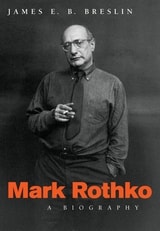
Mark Rothko
A BiographyJames E. B. Breslin
University of Chicago Press, 2012
The definitive biography of one of the most-loved artists of the twentieth century, a book the New York Times called "the best life of an American painter yet written"
A book of heroic dimensions, this is the first full-length biography of one of the greatest artists of the twentieth century—a man as fascinating, difficult, and compelling as the paintings he produced. Drawing on exclusive access to Mark Rothko's personal papers and over one hundred interviews with artists, patrons, and dealers, James Breslin tells the story of a life in art—the personal costs and professional triumphs, the convergence of genius and ego, the clash of culture and commerce. Breslin offers us not only an enticing look at Rothko as a person, but delivers a lush, in-depth portrait of the New York art scene of the 1930s, ’40s, and ’50s—the world of Abstract Expressionism, of Pollock, Rothko, de Kooning, and Klein, which would influence artists for generations to come.

Mark Twain and Orion Clemens
Brothers, Partners, StrangersPhilip Ashley Fanning
University of Alabama Press, 2003
One became America’s greatest writer. The other died in obscurity and failure. As brothers, they shaped each other's lives and work.
In a compelling way, Philip Fanning traces the fraternal relationship of Orion and Samuel Clemens from its beginning in Hannibal, Missouri, in the 1830s to Orion's death in Iowa in 1897. He demonstrates that Orion’s influence on the writer known as Mark Twain was profound, pervasive, and prolonged.
In some respects, Samuel defined himself against Orion’s formidable background. It was Orion who became the chief financial and spiritual support of the Clemens family following the father's controversial death in 1847. It was Orion who led the way for his brother into printing, journalism, and mine speculation. And it was Orion who served as Sam’s first real editor and literary mentor, recognizing and encouraging his younger brother’s talents as a writer.
The two siblings had much in common, and they often appeared to be codependent, so much so that their attitudes veered sharply from mutual admiration to mutual disdain and rivalry. Whereas Orion was self-effacing, easygoing, humble, and adventurous in his politics and progressive in his views, Twain was often ill-tempered and antagonistic toward those around him and conservative in his outlook. He frequently portrayed his older brother in autobiographical writings and letters as a buffoon and a laughingstock.
Fanning—who drew upon extensive archival sources, unpublished letters between the two brothers, and the Mark Twain Papers at the University of California, Berkeley—charts these divergences in their characters and in their fortunes. As Twain rose to become a national celebrity and a financial success, Orion's finances and self-esteem disintegrated, and Twain’s treatment of his brother became evermore harsh and mocking. Fanning’s study stands as both a biography of a fractious fraternal relationship and a work of scholarship that highlights for the first time how significantly Orion Clemens influenced Twain’s psychic and artistic economy.
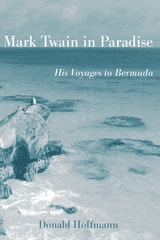
Mark Twain in Paradise
His Voyages to BermudaDonald Hoffman
University of Missouri Press, 2006
This book is the first comprehensive study of Clemens’s love affair with Bermuda, a vivid depiction of a celebrated author on recurring vacations. Donald Hoffmann has culled and clarified passages from Mark Twain’s travel pieces, letters, and unpublished autobiographical dictation—with cross-references to his fiction and infrequently cited short pieces—to create a little-known view of the author at leisure on his fantasy island.
Mark Twain in Paradise sheds light on both Clemens’s complex character and the topography and history of the islands. Hoffmann has plumbed the voluminous Mark Twain scholarship and Bermudian archives to faithfully re-create turn-of-the-century Bermuda, supplying historical and biographical background to give his narrative texture and depth. He offers insight into Bermuda’s natural environment, traditional stone houses, and romantic past, and he presents dozens of illustrations, both vintage and new, showing that much of what Mark Twain described can still be seen today.
Hoffmann also provides insight into the social circles Clemens moved in—and sometimes collected around himself. When visiting the islands, he rubbed shoulders with the likes of socialist Upton Sinclair and multimillionaire Henry H. Rogers; with Woodrow Wilson and his lover, socialite Mary Peck; as well as with the young girls to whom he enjoyed playing grandfather.
“You go to heaven if you want to,” Mark Twain wrote from Bermuda in 1910 during his long last visit. “I’d druther stay here.” And because much of what Clemens enjoyed in the islands is still available to experience today, visitors to Bermuda can now have America’s favorite author as their guide. Mark Twain in Paradise is an unexpected addition to the vast literature by and about Mark Twain and a work of travel literature unlike any other.
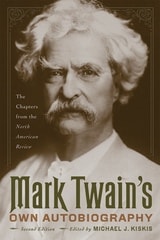
Mark Twain's Own Autobiography
The Chapters from the North American ReviewMark Twain; Edited by Michael J. Kiskis; Foreword by Sheila Leary
University of Wisconsin Press, 2010
More than the story of a literary career, this memoir is anchored in the writer’s relation to his family—what they meant to him as a husband, father, and artist. It also brims with many of Twain’s best comic anecdotes about his rambunctious boyhood in Hannibal, his misadventures in the Nevada territory, his notorious Whittier birthday speech, his travels abroad, and more.
Twain published twenty-five “Chapters from My Autobiography” in the North American Review in 1906 and 1907. “I intend that this autobiography . . . shall be read and admired a good many centuries because of its form and method—form and method whereby the past and the present are constantly brought face to face, resulting in contrasts which newly fire up the interest all along, like contact of flint with steel.”
For this second edition, Michael Kiskis’s introduction references a wealth of critical work done on Twain since 1990. He also adds a discussion of literary domesticity, locating the autobiography within the history of Twain’s literary work and within Twain’s own understanding and experience of domestic concerns.
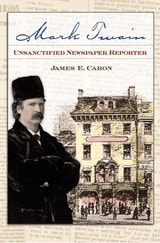
Mark Twain, Unsanctified Newspaper Reporter
James E. Caron
University of Missouri Press, 2008
Before Mark Twain became a national celebrity with his best-selling The Innocents Abroad, he was just another struggling writer perfecting his craft—but already “playin’ hell” with the world. In the first book in more than fifty years to examine the initial phase of Samuel Clemens’s writing career, James Caron draws on contemporary scholarship and his own careful readings to offer a fresh and comprehensive perspective on those early years—and to challenge many long-standing views of Mark Twain’s place in the tradition of American humor.
Tracing the arc of Clemens’s career from self-described “unsanctified newspaper reporter” to national author between 1862 and 1867, Caron reexamines the early and largely neglected writings—especially the travel letters from Hawaii and the letters chronicling Clemens’s trip from California to New York City. Caron connects those sets of letters with comic materials Clemens had already published, drawing on all known items from this first phase of his career—even the virtually forgotten pieces from the San Francisco Morning Call in 1864—to reveal how Mark Twain’s humor was shaped by the sociocultural context and how it catered to his audience’s sensibilities while unpredictably transgressing its standards.
Caron reveals how Sam Clemens’s contemporaries, notably Charles Webb, provided important comic models, and he shows how Clemens not only adjusted to but also challenged the guidelines of the newspapers and magazines for which he wrote, evolving as a comic writer who transmuted personal circumstances into literary art. Plumbing Mark Twain’s cultural significance, Caron draws on anthropological insights from Victor Turner and others to compare the performative aspects of Clemens’s early work to the role of ritual clowns in traditional societies
Brimming with fresh insights into such benchmarks as “Our Fellow Savages of the Sandwich Islands” and “Jim Smiley and His Jumping Frog,” this book is a gracefully written work that reflects both patient research and considered judgment to chart the development of an iconic American talent. Mark Twain, Unsanctified Newspaper Reporter should be required reading for all serious scholars of his work, as well as for anyone interested in the interplay between artistic creativity and the literary marketplace.
Marlborough
His Life and Times, Book OneWinston S. Churchill
University of Chicago Press, 2002
John Churchill, the Duke of Marlborough (1644-1722), was one of the greatest military commanders and statesmen in the history of England. Victorious in the Battles of Blenheim (1704), Ramillies (1706), and countless other campaigns, Marlborough, whose political intrigues were almost as legendary as his military skill, never fought a battle he didn't win. Although he helped James II crush the rebellion of the Duke of Monmouth, Marlborough later supported William of Orange against James II in the Glorious Revolution of 1688 and brilliantly managed England's diplomatic triumphs during the War of the Spanish Succession. Marlborough also bequeathed the world another great British military strategist and diplomat—his descendant, Winston S. Churchill, who wrote this book to redeem Marlborough's reputation from Macaulay's smears.
One million words long and ten years in the making, Churchill's Marlborough stands as both a literary and historical masterpiece, giving us unique insights into the Churchill of World War II, for just as Churchill's literary skill helps us understand the complexities of Marlborough's life, so too did his writing of Marlborough help Churchill master the arts of military strategy and diplomacy. This two-volume edition includes the entire text and almost all the original maps.
Marlborough
His Life and Times, Book TwoWinston S. Churchill
University of Chicago Press, 2002
John Churchill, the Duke of Marlborough (1644-1722), was one of the greatest military commanders and statesmen in the history of England. Victorious in the Battles of Blenheim (1704), Ramillies (1706), and countless other campaigns, Marlborough, whose political intrigues were almost as legendary as his military skill, never fought a battle he didn't win. Although he helped James II crush the rebellion of the Duke of Monmouth, Marlborough later supported William of Orange against James II in the Glorious Revolution of 1688 and brilliantly managed England's diplomatic triumphs during the War of the Spanish Succession. Marlborough also bequeathed the world another great British military strategist and diplomat—his descendant, Winston S. Churchill, who wrote this book to redeem Marlborough's reputation from Macaulay's smears.
One million words long and ten years in the making, Churchill's Marlborough stands as both a literary and historical masterpiece, giving us unique insights into the Churchill of World War II, for just as Churchill's literary skill helps us understand the complexities of Marlborough's life, so too did his writing of Marlborough help Churchill master the arts of military strategy and diplomacy. This two-volume edition includes the entire text and almost all the original maps.
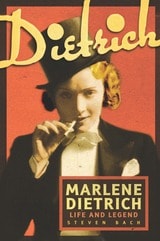
Marlene Dietrich
Life and LegendSteven Bach
University of Minnesota Press, 2011
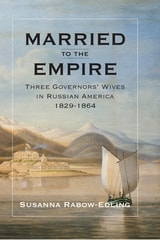
Married to the Empire
Three Governors' Wives in Russian America 1829-1864Susanna Rabow-Edling
University of Alaska Press, 2015
Elisabeth von Wrangell, Margaretha Etholén, and Anna Furuhjelm were three of eight governors' wives who took up this domestic mantle. Married to the Empire tells their stories using their own words and though extraordinary research by Susanna Rabow-Edling. All three were young and newly wed when they left Russia for the furthest outpost of the empire, and all three went through personal and cultural struggles as they worked to adjust to life in the colony. Their trials offer a little-heard female history of Russian Alaska, while illuminating the issues that arose while trying to reconcile expectations of womanhood with the realities of frontier life.

Martians And Misplaced Clues
Life Work Of Fredric BrownJack Seabrook
University of Wisconsin Press, 1993
Martin Faber
The Story of a Criminal with "Confessions of a Murder"William Gilmore Simms
University of Arkansas Press, 2006
Martin Kacur
The Biography of an IdealistIvan Cankar
Central European University Press, 2009
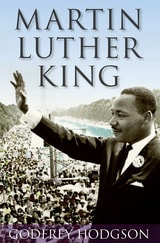
Martin Luther King
Godfrey Hodgson
University of Michigan Press, 2010
Dr. Martin Luther King Jr. is as relevant today as he was when he led civil rights campaigns in the 1950s and 1960s. He was an agent and a prophet of political change in this country, and the election of President Barack Obama is his direct legacy.
Now from one of Britain's most experienced political observers comes a new, accessible biography of the man and his works. The story of King is dramatic, and Godfrey Hodgson presents it with verve, clarity, and acute insight based in part on his own reporting on-scene at the time. He interviewed King half a dozen times or more; heard his speech at the March on Washington; was in Birmingham, Selma and Chicago; and met many of the characters in King's life story. Martin Luther King combines the best of his own reporting, plus the work of other biographers and researchers, to trace the iconic civil rights leader's career from his birth in Atlanta in 1929, through the campaigns that made possible the Civil Rights Act of 1964 and the Voting Rights Act of 1965, to his assassination in Memphis in 1968. Hodgson sheds light on every aspect of an extraordinary life: the Black Baptist culture in which King grew up, his theology and political philosophy, his physical and moral courage, his insistence on the injustice of inequality, his campaigning energy, his repeated sexual infidelities.
Hodgson describes the political minefield in which King operated; follows how he gradually persuaded President Kennedy that he could not stand by and allow the civil rights movement to be frustrated; and describes how, on the verge of success, his career was threatened by President Johnson's anger at King's principled decision to come out against the Vietnam War. He also puts King's career into the context of American history in the crisis of the 1960s. In his life, King was frustrated; but in death, he has been triumphant.
Martin Luther King allows the charisma and power of King's personality to shine through, showing in gripping narrative style exactly how one man helped America to progress toward its truest ideals. Hodgson's extensive research and detail help paint an accurate, complex portrait of one of America's most important leaders.
Godfrey Hodgson has worked in Britain and America as a newspaper and magazine journalist; as a television reporter, documentary maker and anchor; as a university teacher and lecturer; and as the author of a dozen well-received books about U.S. politics and recent history, including America in Our Time, a history of the United States in the 1960s; More Equal than Others, on politics and society in twentieth-century America; and most recently, a biography of Senator Daniel Patrick Moynihan, The Gentleman from New York. Hodgson met King on a number of occasions between 1956 and 1967. He recently retired as director of the Reuters Foundation Programme at Oxford University and is a visiting journalism professor at City University in London.
PRAISE FOR America in Our Time
"A critique so stimulating and compelling that I can only say read it."
---Richard Lingeman, The New York Times
"It simply gets right, without great fuss, the detail and proportion of things like the civil rights movement, student unrest, the stages of our Vietnam engagement."
---Garry Wills, The New York Review of Books
PRAISE FOR More Equal than Others
"The most thoughtful, thorough and sorrowful book imaginable on what has happened in these years."
---Bernard Crick, The Independent
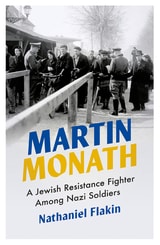
Martin Monath
A Jewish Resistance Fighter Amongst Nazi SoldiersNathaniel Flakin
Pluto Press, 2019
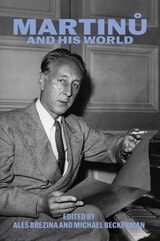
Martinu and His World
Edited by Aleš Brezina and Michael Beckerman
University of Chicago Press, 2025
Bohuslav Martinů was one of the most extraordinary and prolific composers of the twentieth century. Martinů and His World offers a portrait of the composer in all his complexity. Born in the present-day Czech Republic, Martinů was rendered stateless as a result of events around World War II and the Communist takeover of Czechoslovakia. He lived for more than a decade in the United States, where he had great success, and died in Switzerland.
Martinů composed more than four hundred works in all genres of instrumental and vocal music, and infused each with a special combination of the lyrical and the dramatic. Alongside an unerring sense of form, his works draw on a kaleidoscope of elements from such sources as Dvořák, American jazz of the 1920s, English Renaissance madrigals, the late Baroque concerto grosso, French Impressionism, Czech and Moravian folk songs, and the contemporary music of his day.
This volume pays special attention to Martinů’s little-known operatic works and presents for the first time both a recently discovered personal diary and a series of interviews with important figures who were part of his American years.
Martinů and His World reveals the composer as an essential voice of his time, an original thinker about music past and present, who lived through the political complexities of the twentieth century and stood up to them both as a human being and as an artist.
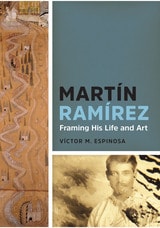
Martín Ramírez
Framing His Life and ArtBy Víctor M. Espinosa
University of Texas Press, 2015
Martín Ramírez, a Mexican migrant worker and psychiatric patient without formal artistic training, has been hailed by leading New York art critics as one of the twentieth century’s greatest artists. His work has been exhibited alongside masters such as José Clemente Orozco, Diego Rivera, Rufino Tamayo, Salvador Dalí, Marc Chagall, Paul Klee, and Joan Miró. A landmark exhibition of Ramírez’s work at the American Folk Art Museum in 2007 broke attendance records and garnered praise from major media, including the New York Times, New Yorker, and Village Voice.
Martín Ramírez offers the first sustained look at the life and critical reception of this acclaimed artist. Víctor Espinosa challenges the stereotype of outsider art as an indecipherable enigma by delving into Ramírez’s biography and showing how he transformed memories of his life in Mexico, as well as his experiences of displacement and seclusion in the United States, into powerful works of art. Espinosa then traces the reception of Ramírez’s work, from its first anonymous showings in the 1950s to contemporary exhibitions and individual works that have sold for as much as a half-million dollars. This eloquently told story reveals how Ramírez’s three-decades-long incarceration in California psychiatric institutions and his classification as “chronic paranoid schizophrenic” stigmatized yet also protected what his hands produced. Stripping off the labels “psychotic artist” and “outsider master,” Martín Ramírez demonstrates that his drawings are not passive manifestations of mental illness. Although he drew while confined as a psychiatric patient, the formal elements and content of Ramírez’s artwork are shaped by his experiences of cultural and physical displacement.
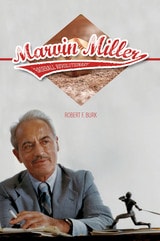
Marvin Miller, Baseball Revolutionary
Robert F. Burk
University of Illinois Press, 2015
Educating and uniting the players as a workforce, Miller embarked on a long campaign to win the concessions that defined his legacy: decent workplace conditions, a pension system, outside mediation of player grievances and salary disputes, a system of profit sharing, and the long-sought dismantling of the reserve clause that opened the door to free agency. Through it all, allies and adversaries alike praised Miller's hardnosed attitude, work ethic, and honesty.
Comprehensive and illuminating, Marvin Miller, Baseball Revolutionary tells the inside story of a time of change in sports and labor relations, and of the contentious process that gave athletes in baseball and across the sporting world a powerful voice in their own games.
Mary Austin Holley
A BiographyBy Rebecca Smith Lee
University of Texas Press, 1962
Mary Austin Holley found life challenging and made it interesting for others. As wife and widow of Horace Holley, eminent orator, clergyman, and educator, and as cousin and friend of Stephen F. Austin, founder of the first Texas colony, she formed friendships among important people. From New Haven to New Orleans and Brazoria, Texas, she was beloved.
The panorama of her life, described in vivid detail by a former head of the English Department at Texas Christian University, transports the reader to the tempestuous early years of the American Republic and, finally, to Texas during its colonization and early Republic years. Throughout this charming book Mrs. Holley's "intuition for important people" brings the reader into the company of many of America's great and accomplished: Noah Webster, John Quincy Adams, President and Mrs. Monroe, Andrew Jackson, Sam Houston, and many others.
Mary Austin
Song of a MaverickEsther F. Lanigan
University of Arizona Press, 1997
"[Lanigan] provides illuminating sociological background and lucidly marshals the existing biolgraphical data." —Choice
"Mary Hunter Austin was a well-known and respected author and activitst in her lifetime but is little known in ours. In this excellent biography...[Lanigan] chose to focus on a few central relationships in Austin's life, to explore in some depth a few central texts, and to understand the interior life of her subject. She has done a splendid job." —Ann J. Lane in the Journal of American History
Mary Chesnut's Civil War Epic
Julia A. Stern
University of Chicago Press, 2009
A genteel southern intellectual, saloniste, and wife to a prominent colonel in Jefferson Davis’s inner circle, Mary Chesnut today is remembered best for her penetrating Civil War diary. Composed between 1861 and 1865 and revised thoroughly from the late 1870s until Chesnut’s death in 1886, the diary was published first in 1905, again in 1949, and later, to great acclaim, in 1981. This complicated literary history and the questions that attend it—which edition represents the real Chesnut? To what genre does this text belong?—may explain why the document largely has, until now, been overlooked in literary studies.
Julia A. Stern’s critical analysis returns Chesnut to her rightful place among American writers. In Mary Chesnut’s Civil War Epic, Stern argues that the revised diary offers the most trenchant literary account of race and slavery until the work of Faulkner and that, along with his Yoknapatawpha novels, it constitutes one of the two great Civil War epics of the American canon. By restoring Chesnut’s 1880s revision to its complex, multidecade cultural context, Stern argues both for Chesnut’s reinsertion into the pantheon of nineteenth-century American letters and for her centrality to the literary history of women’s writing as it evolved from sentimental to tragic to realist forms.
Mary Lincoln Demystified
Frequently Asked Questions about Abraham’s WifeDonna D. McCreary
Southern Illinois University Press, 2022
Answering the most enigmatic questions about Mary Lincoln’s life
After portraying Mary Lincoln in hundreds of performances and giving lectures over a more than thirty-year career, Donna D. McCreary has fielded every imaginable inquiry about the First Lady. Gathered here, readers will find answers to the most frequently asked questions to come from live audiences. This first question-and-answer book arises directly from a public’s enduring curiosity with one the country’s most important historical figures. Decades of conversations with audiences, scholars, and relatives of the Todd family frame McCreary’s intimate and devoted research to offer a new and unique portrait of the most tragic First Lady.
Though Mary has been portrayed in books and film, McCreary’s book contains information not found elsewhere—details others have overlooked and those that would not fit well into a narrative history—such as lists of Mary’s beaus, servants, and the people the Todd family enslaved; appendixes that present mini-biographies of families and friends; and a uniquely thorough timeline. Mary Lincoln Demystified covers areas in which McCreary’s audiences have expressed the most interest: Mary’s sanity, her family relationships, her views on slavery and African Americans, her personality and habits, and what happened to her possessions and children after she died.
While sympathetic to the woman she portrayed for two decades, McCreary examines both sides of controversial issues and presents the facts with her trademark style and flair. More than a good read, McCreary’s Q&A factbook, based as it is on decades of extensive research in primary and secondary sources, will be the definitive resource for answers about Mary for years to come.
Mary Lincoln's Insanity Case
A Documentary HistoryJason Emerson
University of Illinois Press, 2012
In 1875 Mary Lincoln, the widow of a revered president, was committed to an insane asylum by her son, Robert. The trial that preceded her internment was a subject of keen national interest. The focus of public attention since Abraham Lincoln's election in 1860, Mary Lincoln had attracted plentiful criticism and visible scorn from much of the public, who perceived her as spoiled, a spendthrift, and even too much of a Southern sympathizer. Widespread scrutiny only increased following her husband's assassination in 1865 and her son Tad's death six years later, after which her overwhelming grief led to the increasingly erratic behavior that led to her being committed to a sanitarium. A second trial a year later resulted in her release, but the stigma of insanity stuck. In the years since, questions emerged with new force, as the populace and historians debated whether she had been truly insane and subsequently cured, or if she was the victim of family maneuvering.
In this volume, noted Lincoln scholar Jason Emerson provides a documentary history of Mary Lincoln's mental illness and insanity case, evenhandedly presenting every possible primary source on the subject to enable a clearer view of the facts. Beginning with documents from the immediate aftermath of her husband's assassination and ending with reminiscences by friends and family in the mid-twentieth century, Mary Lincoln's Insanity Case: A Documentary History compiles more than one hundred letters, dozens of newspaper articles, editorials, and legal documents, and the daily patient progress reports from Bellevue Place Sanitarium during Mary Lincoln's incarceration. Including many materials that have never been previously published, Emerson also collects multiple reminiscences, interviews, and diaries of people who knew Mary Lincoln or were involved in the case, including the first-hand recollection of one of the jurors in the 1875 insanity trial.
Suggesting neither accusation nor exoneration of the embattled First Lady, Mary Lincoln's Insanity Case: A Documentary History gives scholars and history enthusiasts incomparable access to the documents and information crucial to understanding this vexing chapter in American history.
Mary McLeod Bethune and Black Women's Political Activism
Joyce A. Hanson
University of Missouri Press, 2003
Mary McLeod Bethune was a significant figure in American political history. She devoted her life to advancing equal social, economic, and political rights for blacks. She distinguished herself by creating lasting institutions that trained black women for visible and expanding public leadership roles. Few have been as effective in the development of women’s leadership for group advancement. Despite her accomplishments, the means, techniques, and actions Bethune employed in fighting for equality have been widely misinterpreted.
Examining the historical evolution of African American women’s activism in the critical period between 1920 and 1950, a time previously characterized as “doldrums” for both feminist and civil rights activity, Mary McLeod Bethune and Black Women’s Political Activism is important for understanding the centrality of black women to the political fight for social, economic, and racial justice.
Mary Nohl
A Lifetime in ArtBarbara Manger
Wisconsin Historical Society Press, 2013
LOOK INSIDE THE LIFE — AND HOME — OF LEGENDARY 'OUTSIDER' ARTIST MARY NOHL
"Mary Nohl: A Lifetime in Art" by Barbara Manger and Janine Smith, tells the story of Milwaukee-born artist, Mary Nohl. A prolific and fanciful maker who worked in a variety of media, Nohl was both a mysterious figure and an iconic "outsider" artist. This new addition to the Badger Biographies series captures her life and will capture the imagination of readers, and artists, of all ages.
Nohl didn't just make art — she lived it. From the time she was young, Mary enjoyed making things, from the model airplane that won her a citywide prize to assignments in shop class, where she learned to work with tools.
Her interests in art blossomed during the years she spent training at the Art Institute of Chicago, leading to a lifetime of curiosity and ventures into new artistic media. From pottery to silver jewelry and oil painting to concrete sculpture, Mary explored new ways of making art. Many of her pieces were made from found objects that other people might think of as junk — like chicken bones, bedsprings and sand that she made into concrete.
Nohl, who made her home on the shores of Lake Michigan, decorated the interior of her cottage with bright colors and eye-catching figures in driftwood and glass. During her later years, her home became known as the "Witch's House" — a place of local legend known far beyond Fox Point. Though she died in 2001, Mary's legacy continues. Her art is held at the John Michael Kohler Arts Center in Sheboygan, and her home is listed on the National Register of Historic Places.
The popular Badger Biographies series for young readers explores the lives of famous and not-so-famous figures in Wisconsin history. The Wisconsin Historical Society Press is proud to celebrate the release of this, the 21st book in the series.
Mary Schafer, American Quilt Maker
Gwen Marston
University of Michigan Press, 2004
Extensively illustrated, with over 100 drawings and 11 unique Mary Schafer patterns, Mary Schafer, American Quilt Maker is a must-have book for anyone passionate about American quilting.
While we take that passion for granted today, author Gwen Marston shows that it wasn't always so; indeed, one woman, Mary Schafer, was largely responsible for the restoration of interest in one of our greatest folk arts -- long before the American bicentennial turned quilting into what seemed like an overnight sensation.
Marston presents Schafer as an unassuming scholar: the anonymous quilter, remaining humble and somewhat retiring. Behind the modest façade, however, Schafer displayed a remarkable devotion to research, historical accuracy, and community through her efforts to make quilting available to as many people as possible.
Nonquilters will find Mary Schafer, American Quilt Maker a welcome addition to their collection of the work of masters of American folk art, while quilting aficionados will appreciate it not only for the story it tells, but for the generous selection of patterns and illustrations it offers.
Gwen Marston is a nationally known quilt maker, teacher, and author. She is the author of over fifteen books on quilting, including Liberated String Quilts, 70 Classic Quilting Patterns, and Amish Quilting Patterns.
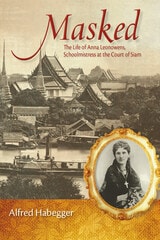
Masked
The Life of Anna Leonowens, Schoolmistress at the Court of SiamAlfred Habegger
University of Wisconsin Press, 2014
But who was Leonowens and why did her story take hold? Although it has been known for some time that she was of Anglo-Indian parentage and that her tales about the Siamese court are unreliable, not until now, with the publication of Masked, has there been a deeply researched account of her extraordinary life. Alfred Habegger, an award-winning biographer, draws on the archives of five continents and recent Thai-language scholarship to disclose the complex person behind the mask and the troubling facts behind the myth. He also ponders the curious fit between Leonowens’s compelling fabrications and the New World’s innocent dreams—in particular the dream that democracy can be spread through quick and easy interventions.
Exploring the full historic complexity of what it once meant to pass as white, Masked pays close attention to Leonowens’s midlevel origins in British India, her education at a Bombay charity school for Eurasian children, her material and social milieu in Australia and Singapore, the stresses she endured in Bangkok as a working widow, the latent melancholy that often afflicted her, the problematic aspects of her self-invention, and the welcome she found in America, where a circle of elite New England abolitionists who knew nothing about Southeast Asia gave her their uncritical support. Her embellished story would again capture America’s imagination as World War II ended and a newly interventionist United States looked toward Asia.
Best Books for General Audiences, selected by the American Association of School Librarians
Best Regional Special Interest Boosk, selected by the Public Library Reviewers

Master of the Air
William Tunner and the Success of Military AirliftRobert A. Slayton
University of Alabama Press, 2010
Into this difficult situation the US placed General William Henry Tunner. He was given a task that seemed doomed to failure—to supply a major city by air with everything it needed to survive from food to a winter’s supply of coal—and made it a brilliant success, astonishing the world in a major public relations defeat for the Soviets, and demonstrating the unexpected capacity of air fleets in a postwar world.
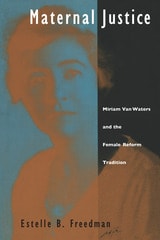
Maternal Justice
Miriam Van Waters and the Female Reform TraditionEstelle B. Freedman
University of Chicago Press, 1996
Estelle B. Freedman draws from Van Waters's diaries, letters, and personal papers to recreate her complex personal life, unveiling the disparity between Van Waters's public persona and her agonized private soul. With the power and elegance of a novel, Maternal Justice illuminates this historical context, casting light on the social welfare tradition, on women's history, on the American feminist movement, and on the history of sexuality.
"Maternal Justice is as much a work of history as it is biography, bringing to life not only a remarkable woman but also the complex political and social milieu within which she worked and lived."—Kelleher Jewett, The Nation
"This sympathetic biography reclaims Van Waters for history."—Publishers Weekly
"The Van Waters legacy, as Freedman gracefully presents, is that she cared about the lives of women behind bars. It is a strikingly unfashionable sentiment today."—Jane Meredith Adams, San Francisco Chronicle Book Review, Editor's Recommended Selection
"This finely crafted biography is both an engrossing read and a richly complicated account of a reformer whose work . . . bridged the eras of voluntarist charitable activism and professional social service."—Sherri Broder, Women's Review of Books
"This is a sympathetic, highly personal biography, revealing of both the author's responses to her subject's life and, in considerable detail, Van Waters's family traumas, illnesses, and love affairs."—Elizabeth Israels Perry, Journal of American History
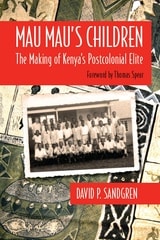
Mau Mau’s Children
The Making of Kenya’s Postcolonial EliteDavid P. Sandgren; Foreword by Thomas Spear
University of Wisconsin Press, 2012
In 1963 David P. Sandgren went to Kenya to teach in a small, rural school for boys, where he remained for the next four years. These were heady times for Kenyans, as the nation gained its independence, approved a new constitution, and held its first elections. In the school where Sandgren taught, the sons of Gikuyu farmers rose to the challenges of this post colonial era and, in time, entered Kenyan society as adults, joining Kenya’s first generation of post colonial elites.
In Mau Mau’s Children, Sandgren has reconnects with these former students. Drawing on more than one hundred interviews, he provides readers with a collective biography of the lives of Kenya’s first postcolonial elite, stretching from their 1940s childhood to the peak of their careers in the 1990s. Through these interviews, Mau Mau’s Children shows the trauma of growing up during the Mau Mau Rebellion, the nature of nationalism in Kenya, the new generational conflicts arising, and the significance of education and Gikuyu ethnicity on his students' path to success.
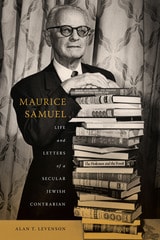
Maurice Samuel
Life and Letters of a Secular Jewish ContrarianAlan T. Levenson
University of Alabama Press, 2022
An intellectual biography that reassesses one of the premier Jewish humanists of the mid-twentieth century
In Maurice Samuel: Life and Letters of a Secular Jewish Contrarian, Alan T. Levenson captures the life, works, and milieu of the Romanian-born, English-educated, American belletrist Maurice Samuel. A diaspora intellectual—or a rooted cosmopolitan, as Levenson describes him—Samuel made an indelible mark on many features of contemporary Jewish thought and culture. A generalist in an age of experts, an independent scholar in an age of rabbis and professors, Samuel was one of the most productive and visible members of the group dubbed the “other” New York Jewish intellectuals.
His fame as a public intellectual and popular speaker were well warranted: no mere popularizer, Samuel contributed significantly to four seemingly unrelated but critical areas of modern Jewish thought. Samuel is characterized by some as principally a Zionist, by others as an accomplished translator and many Americans’ first entrée into the world of Yiddish literature, by still others as a polemicist and campaigner against anti-Semitism, and finally as a media-savvy Biblical critic, essayist, and radio personality. But he was all of these things, since Samuel succeeded in an era when it was possible to be a public intellectual without being an expert.
Drawing on Samuel’s vast literary opus, as well as previously unexplored archival material from three continents, this study writes Samuel back into the history of mid-twentieth-century American letters. Levenson argues that Samuel’s varied and substantive contributions demand reconsideration of our assumptions about the means and ends of cultural transmission, and merit him a place as one of twentieth-century American Jewry’s most significant cultural and intellectual voices.
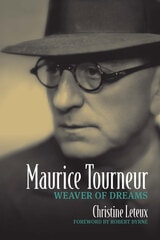
Maurice Tourneur
Weaver of DreamsChristine Leteux, Foreword by Robert Byrne
University of Wisconsin Press, 2026
In 1914, an unknown French filmmaker arrived in New York; within four years, Maurice Tourneur (1876–1961) would become one of America’s most acclaimed directors. In this masterful biography, Christine Leteux shows how intimately connected Tourneur’s life was to major events of the twentieth century as well as to the profound transformations in movie making. A master of directing silent films, he quickly managed the transition to sound. His last major work was created for Continental Films, the German-owned firm that controlled the French film industry during the Nazi Occupation. His son, Jacques, followed in his footsteps, also becoming an acclaimed director.
Drawing heavily on previously unpublished archival documents, Leteux reinvigorates film history and demonstrates that we know far less about this era of filmmaking than we often assume. She reveals not only how Tourneur jumped from France to the United States and back again but also how he shifted from one company to another, moving quickly up the ladder to bigger productions and ever larger studios. Tourneur’s drive, insight, technical proficiency, skill with actors, ability to create new forms of storytelling, and fame on both sides of the Atlantic make it all the more surprising that he is not better known today—an oversight that has now been corrected thanks to Leteux’s impressively detailed research and nuanced storytelling.
Maverick Heart
The Further Adventures Of Zane GreyStephen J. May
Ohio University Press, 2000
In 1927, at the peak of his career, Zane Grey bought a three-masted schooner, which he sailed to the Galapagos Islands, later journeying to Tahiti, New Zealand, Australia, and Fiji.
As colorful as his characters were, so too was their creator. A consummate explorer, Zane Grey toured the world, was an acclaimed expert on salt- and freshwater fishing, and incorporated the sights and sounds he witnessed into his writings.
As a companion to his biographical work of Grey’s literary life, Zane Grey: Romancing the West, author Stephen J. May now gives as a remarkable look into another aspect of Grey’s existence, the side little known but central to the measure of the man.
Maverick Heart makes use of Grey’s own memoirs and letters to give an enlightening portrait of this larger-than-life American character and a telling insight into one of the key shapers of the cultural heritage of our country.
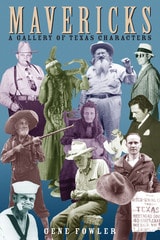
Mavericks
A Gallery of Texas CharactersBy Gene Fowler
University of Texas Press, 2008
Texas has been home to so many colorful characters, out-of-staters might wonder if any normal people live here. And it's true that the "Texian" desire to act out sometimes overcomes even the most sober citizens—which makes it a real challenge for the genuine eccentrics to distinguish themselves from the rest of us. Fortunately, though, many maverick Texans have risen to the test, and in this book, Gene Fowler introduces us to a gallery of Texas eccentrics from the worlds of oil, ranching, real estate, politics, rodeo, metaphysics, showbiz, art, and folklore.
Mavericks rounds up dozens of Fowler's favorite Texas characters, folks like the Trinity River prophet Commodore Basil Muse Hatfield; the colorful poet-politician Cyclone Davis Jr.; Big Bend tourist attraction Bobcat Carter; and the dynamic chief executive of the East Texas Oil Field Governor Willie. Fowler persuasively argues that many of these characters should be viewed as folk performance artists who created "happenings" long before the modern art world took up that practice in the 1960s. Other featured mavericks run the demographic gamut from inspirational connoisseurs of the region's native quirkiness to creative con artists and carnival oddities. But, artist or poser, all of the eccentrics in Mavericks completely embody the style and spirit that makes Texas so interesting, entertaining, and culturally unique.
Max Brand
Western Giant: The Life and Times of Frederick Schiller FaustWilliam F. Nolan
University of Wisconsin Press, 1985
Max Lerner
Pilgrim in the Promised LandSanford Lakoff
University of Chicago Press, 1998
Politically, Lerner went through a series of metamorphoses. During the 1930s, he was an anti-fascist "popular front progressive" writing for the Nation and the New Republic. From the 1940s through the 1970s, he became the country's leading liberal columnist—first with the lively but short-lived PM, then for the New York Post. In the 1980s, however, he was repelled by the New Left and the counterculture and joined the ranks of the neoconservatives, scandalizing some readers but insisting he owed it to them to tell the truth as he saw it.
This riveting biography begins with Lerner's own gripping account of the hardships his family endured in emigrating from Russia and his own boyhood triumphs and frustrations. Sanford Lakoff traces Lerner's American pilgrimage from his education at Yale, where he felt the bitter sting of anti-Semitism, through his years as a radical inspired by Thorstein Veblen, into mellower maturity as a widely read columnist, an inspiring teacher, the author of America as a Civilization, a much-loved father, and—to the end—an unapologetic romantic, who liked to say that he never learned anything worth knowing except from women.