Results by title
5448 books match the query 'History and criticism' and 307 start with m
Marianne Moore, Elizabeth Bishop, and May Swenson
The Feminist Poetics of Self-RestraintKirstin Hotelling Zona
University of Michigan Press, 2002
In recent years critical studies of Bishop and Moore have flourished, a large percentage of them devoted to explorations of sexuality and gender. A gap is growing, however, between feminist repossessions of Moore and Bishop and recent readings of their antiessentialist poetics. On the one hand, these poets are appearing more frequently in the feminist canon, but the price of this inclusion is usually the suppression of their strategies of self-restraint. While Zona questions the poetic privileging of self-expression, she establishes contiguity between feminist poetry and developments in American poetry at large. In doing so she asserts the centrality of feminist poetry within discussions of contemporary American poetry, thereby challenging the common perception of feminist poetry as an "alternative" (which often means auxiliary) genre.
Kirstin Hotelling Zona is Assistant Professor of Poetry and Poetics, Illinois State University.
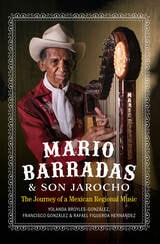
Mario Barradas and Son Jarocho
The Journey of a Mexican Regional MusicYolanda Broyles-González, Rafael Figueroa Hernández, and Francisco González
University of Texas Press, 2022
Son Jarocho was born as the regional sound of Veracruz but over time became a Mexican national genre, even transnational, genre—a touchstone of Chicano identity in the United States. Mario Barradas and Son Jarocho traces a musical journey from the Gulf Coast to interior Mexico and across the border, describing the transformations of Son Jarocho along the way.
This comprehensive cultural study pairs ethnographic and musicological insights with an oral history of the late Mario Barradas, one of Son Jarocho’s preeminent modern musicians. Chicano musician Francisco González offers an insider’s account of Barradas’s influence and Son Jarocho’s musical qualities, while Rafael Figueroa Hernández delves into Barradas’s recordings and films. Yolanda Broyles-González examines the interplay between Son Jarocho’s indigenous roots and contemporary role in Mexican and US society. The result is a nuanced portrait of a vital and evolving musical tradition.
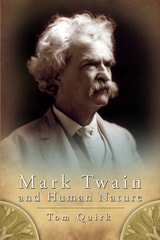
Mark Twain and Human Nature
Tom Quirk
University of Missouri Press, 2007
Mark Twain once claimed that he could read human character as well as he could read the Mississippi River, and he studied his fellow humans with the same devoted attention. In both his fiction and his nonfiction, he was disposed to dramatize how the human creature acts in a given environment—and to understand why.
Now one of America’s preeminent Twain scholars takes a closer look at this icon’s abiding interest in his fellow creatures. In seeking to account for how Twain might have reasonably believed the things he said he believed, Tom Quirk has interwoven the author’s inner life with his writings to produce a meditation on how Twain’s understanding of human nature evolved and deepened, and to show that this was one of the central preoccupations of his life.
Quirk charts the ways in which this humorist and occasional philosopher contemplated the subject of human nature from early adulthood until the end of his life, revealing how his outlook changed over the years. His travels, his readings in history and science, his political and social commitments, and his own pragmatic testing of human nature in his writing contributed to Twain’s mature view of his kind. Quirk establishes the social and scientific contexts that clarify Twain’s thinking, and he considers not only Twain’s stated intentions about his purposes in his published works but also his ad hoc remarks about the human condition.
Viewing both major and minor works through the lens of Twain’s shifting attitude, Quirk provides refreshing new perspectives on the master’s oeuvre. He offers a detailed look at the travel writings, including The Innocents Abroad and Following the Equator, and the novels, including The Adventures of Tom Sawyer, Adventures of Huckleberry Finn, and Pudd’nhead Wilson, as well as an important review of works from Twain’s last decade, including fantasies centering on man’s insignificance in Creation, works preoccupied with isolation—notably No. 44,The Mysterious Stranger and “Eve’s Diary”—and polemical writings such as What Is Man?
Comprising the well-seasoned reflections of a mature scholar, this persuasive and eminently readable study comes to terms with the life-shaping ideas and attitudes of one of America’s best-loved writers. Mark Twain and Human Nature offers readers a better understanding of Twain’s intellect as it enriches our understanding of his craft and his ineluctable humor.
Mark Twain and the American West
Joseph L. Coulombe
University of Missouri Press, 2003
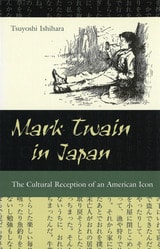
Mark Twain in Japan
The Cultural Reception of an American IconTsuyoshi, Ishihara
University of Missouri Press, 2005
Best known for his sharp wit and his portrayals of life along the banks of the Mississippi River, Mark Twain is indeed an American icon, and many scholars have examined how he and his work are perceived in the United States. In Mark Twain in Japan, however, Tsuyoshi Ishihara explores how Twain’s uniquely American work is viewed in a completely different culture.

Mark Twain on the Loose
A Comic Writer and the American SelfBruce Michelson
University of Massachusetts Press, 1995
Can we rediscover the wildness in Mark Twain’s humor? Can we understand how that wildness helped make him a national legend and a key figure in the expression of an American self? In Mark Twain on the Loose, Bruce Michelson writes about Twain as a body of literature, as a public personality, and as a myth. Michelson shows that many of Twain’s most ambitious and memorable works, from the very beginning to the end of his career, express a drive for absolute liberation from every social, psychological, and artistic limit.
The outrageous and anarchic sides of Twain play a vital role in his art. But these traits are undervalued even by his admirers, who often favor clean shapes and steady affirmations in Twain’s writing —not the dangerous comic outbreak, or the deep yearning to free the self from every definition and confinement.
Reviewing works from a wide range of Twain’s writings, Michelson brings to light those wild dimensions, their literary consequences, and their cultural importance. He reveals this great author as “the best escape artist in the American canon,” a reflexive, paradoxical, rule-shattering comic genius.
Mark Twain, Travel Books, and Tourism
The Tide of a Great Popular MovementJeffrey Alan Melton
University of Alabama Press, 2008
With the publication of The Innocents Abroad (1869), Mark Twain embarked on a long and successful career as the 19th century's best-selling travel writer. Jeffrey Melton treats Twain's travel narratives in depth, and in the context of his contemporary travel writers and a burgeoning tourism culture. As Melton shows, Twain's five major travel narratives--The Innocents Abroad, Roughing It, Life on the Mississippi, A Tramp Abroad, and Following the Equator--demonstrate Twain's mastery and reinvention of the genre.
Marketing Modernisms
Self-Promotion, Canonization, RereadingKevin J.H. Dettmar and Stephen Watt, Editors
University of Michigan Press, 1996
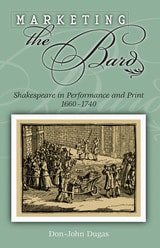
Marketing the Bard
Shakespeare in Performance and Print, 1660-1740Don-John Dugas
University of Missouri Press, 2006
To posterity, William Shakespeare may be the Bard of Avon, but to mid-seventeenth-century theatergoers he was just another dramatist. Yet barely a century later, he was England’s most popular playwright and a household name. In this intriguing study, Don-John Dugas explains how these changes came about and sealed Shakespeare’s reputation even before David Garrick performed his work on the London stage.
Martial
The World of the EpigramWilliam Fitzgerald
University of Chicago Press, 2007
In this age of the sound bite, what sort of author could be more relevant than a master of the epigram? Martial, the most influential epigrammatist of classical antiquity, was just such a virtuoso of the form, but despite his pertinence to today’s culture, his work has been largely neglected in contemporary scholarship. Arguing that Martial is a major author who deserves more sustained attention, William Fitzgerald provides an insightful tour of his works, shedding new and much-needed light on the Roman poet’s world—and how it might speak to our own.
Writing in the late first century CE—when the epigram was firmly embedded in the social life of the Roman elite—Martial published his poems in a series of books that were widely read and enjoyed. Exploring what it means to read such a collection of epigrams, Fitzgerald examines the paradoxical relationship between the self-enclosed epigram and the book of poems that is more than the sum of its parts. And he goes on to show how Martial, by imagining these books being displayed in shops and shipped across the empire to admiring readers, prophetically behaved like a modern author. Chock-full of epigrams itself—in both Latin and English versions—Fitzgerald’s study will delight classicists, literary scholars, and anyone who appreciates an ingenious witticism.
Martin Luther King Jr., Heroism, and African American Literature
Trudier Harris
University of Alabama Press, 2023
Examines how representations of Martin Luther King Jr.’s character and persona in works of African American literature have evolved and reflect the changing values and mores of African American culture
African American writers have incorporated Martin Luther King Jr. into their work since he rose to prominence in the mid-1950s. Martin Luther King Jr., Heroism, and African American Literature is a study by award-winning author Trudier Harris of King’s character and persona as captured and reflected in works of African American literature continue to evolve.
One of the most revered figures in American history, King stands above most as a hero. His heroism, argues Harris, is informed by African American folk cultural perceptions of heroes. Brer Rabbit, John the Slave, Stackolee, and Railroad Bill—folk heroes all—provide a folk lens through which to view King in contemporary literature. Ambiguities and issues of morality that surround trickster figures also surround King. Nonconformist traits that define Stackolee and Railroad Bill also inform King’s life and literary portraits. Defiance of the law, uses of indirection, moral lapses, and bad habits are as much a part of the folk-transmitted biography of King as they are a part of writers’ depictions of him in literary texts.
Harris first demonstrates that during the Black Arts Movement of the 1960s, when writers such as Nikki Giovanni, Sonia Sanchez, and LeRoi Jones (Amiri Baraka) were rising stars in African American poetry, King’s philosophy of nonviolence was out of step with prevailing notions of militancy (Black Power), and their literature reflected that division.
In the quieter times of the 1970s and 1980s and into the twenty-first century, however, treatments of King and his philosophy in African American literature changed. Writers who initially rejected him and nonviolence became ardent admirers and boosters, particularly in the years following his assassination. By the 1980s, many writers skeptical about King had reevaluated him and began to address him as a fallen hero. To the most recent generation of writers, such as Katori Hall, King is fair game for literary creation, no matter what those portrayals may reveal, to a point where King has become simply another source of reference for creativity.
Collectively these writers, among many others, illustrate that Martin Luther King Jr. provides one of the strongest influences upon the creative worlds of multiple generations of African American writers of varying political and social persuasions.
Marx for Cats
A Radical BestiaryLeigh Claire La Berge
Duke University Press, 2023
Marxist Literary Criticism Today
Barbara Foley
Pluto Press, 2019
Mary Austin's Southwest
An Anthology of Her Literary CriticismChelsea Blackbird
University of Utah Press, 2005
In Mary Austin’s Southwest, editors Blackbird and Nelson shine light on Austin’s work, revealing her to be a significant trailblazer for literary diversity. With thoughtful introductions to selected writings on Austin’s prose, drama, and poetry as well as an annotated checklist of her published Southwestern literary criticism, this collection is a celebration of a rich mixed heritage as expressed through the written word.
Mary Austin
Song of a MaverickEsther F. Lanigan
University of Arizona Press, 1997
"[Lanigan] provides illuminating sociological background and lucidly marshals the existing biolgraphical data." —Choice
"Mary Hunter Austin was a well-known and respected author and activitst in her lifetime but is little known in ours. In this excellent biography...[Lanigan] chose to focus on a few central relationships in Austin's life, to explore in some depth a few central texts, and to understand the interior life of her subject. She has done a splendid job." —Ann J. Lane in the Journal of American History
Mary Chesnut's Civil War Epic
Julia A. Stern
University of Chicago Press, 2009
A genteel southern intellectual, saloniste, and wife to a prominent colonel in Jefferson Davis’s inner circle, Mary Chesnut today is remembered best for her penetrating Civil War diary. Composed between 1861 and 1865 and revised thoroughly from the late 1870s until Chesnut’s death in 1886, the diary was published first in 1905, again in 1949, and later, to great acclaim, in 1981. This complicated literary history and the questions that attend it—which edition represents the real Chesnut? To what genre does this text belong?—may explain why the document largely has, until now, been overlooked in literary studies.
Julia A. Stern’s critical analysis returns Chesnut to her rightful place among American writers. In Mary Chesnut’s Civil War Epic, Stern argues that the revised diary offers the most trenchant literary account of race and slavery until the work of Faulkner and that, along with his Yoknapatawpha novels, it constitutes one of the two great Civil War epics of the American canon. By restoring Chesnut’s 1880s revision to its complex, multidecade cultural context, Stern argues both for Chesnut’s reinsertion into the pantheon of nineteenth-century American letters and for her centrality to the literary history of women’s writing as it evolved from sentimental to tragic to realist forms.

Mary Shelley and Frankenstein
The Fate of AndrogynyWilliam Veeder
University of Chicago Press, 1986
Masculine Singular
French New Wave CinemaGeneviève Sellier
Duke University Press, 2008
Sellier draws on sociological surveys, box office data, and popular magazines of the period, as well as analyses of specific New Wave films. She examines the development of the New Wave movement, its sociocultural and economic context, and the popular and critical reception of such well-known films as Jules et Jim and Hiroshima mon amour. In light of the filmmakers’ focus on gender relations, Sellier reflects on the careers of New Wave’s iconic female stars, including Jeanne Moreau and Brigitte Bardot. Sellier’s thorough exploration of early New Wave cinema culminates in her contention that its principal legacy—the triumph of a certain kind of cinephilic discourse and of an “auteur theory” recognizing the director as artist—came at a steep price: creativity was reduced to a formalist game, and affirmation of New Wave cinema’s modernity was accompanied by an association of creativity with masculinity.
Masculinist Impulses
Toomer, Hurston, Black Writing, and ModernityNathan Grant
University of Missouri Press, 2004
Grant’s book provides close readings of Jean Toomer (Cane and Natalie Mann) and Zora Neale Hurston (Moses, Man of the Mountain, Seraph of the Suwanee, and Their Eyes Were Watching God), for whom the American South was a crucial locus of the African American experience. Toomer and Hurston were virtually alone among the Harlem Renaissance writers of prose who returned to the South for their literary materials. That return, however, allowed their rediscovery of key black masculine values and charted the northern route of those values in the twentieth century to their compromise and destruction.
Grant then moves on to three more recent writers—John Edgar Wideman, Gloria Naylor, and Toni Morrison—who expanded upon and transformed the themes of Toomer and Hurston. Like Toomer and Hurston, these later authors recognized the need for the political union of black men and women in the effort to realize the goals of equity and justice.
Masculinist Impulses discusses nineteenth- and twentieth-century black masculinity as both a feature and a casualty of modernism. Scholars and students of African American literature will find Grant’s nuanced and creative readings of these key literary texts invaluable.
Masculinity Besieged?
Issues of Modernity and Male Subjectivity in Chinese Literature of the Late Twentieth CenturyXueping Zhong
Duke University Press, 2000
Before the 1990s onslaught of popular culture decentered the role of intellectuals within the nation, they had come to embody Chinese masculinity during the previous decade. The focus on masculinity in literature had become unprecedented in scale and the desire for “real men” began to permeate Chinese popular culture, making icons out of Rambo and Takakura Ken. Stories by Zhang Xianliang and Liu Heng portraying male anxiety about masculine sexuality are employed by Zhong to show how “marginal” males negotiate their sexual identities in relation to both women and the state. Looking at writers popular among not only the well-educated but also the working and middle classes, she discusses works by Han Shaogong, Yu Hua, and Wang Shuo and examines instances of self-loathing male voices, particularly as they are articulated in Mo Yan’s well-known work Red Sorghum. In her last chapter Zhong examines “roots literature,” which speaks of the desire to create strong men as a part of the effort to create a geopolitically strong Chinese nation. In an afterword, Zhong situates her study in the context of the 1990s.
This book will be welcomed by scholars of Chinese cultural studies, as well as in literary and gender studies.
Mashairi ya Vita vya Kuduhu
War Poetry in Kiswahili Exchanged at the Time of the Battle of KuduhuAnn Biersteker
Michigan State University Press, 1995
Mashairi Ya Vita Vya Kuduhu is a presentation and discussion of both manuscript and published versions of poems written by Lamu poets around the time of the Battle of Kuduhu. The poetic dialogue studied in this volume has played a significant role in the history of Swahili poetry, and its primary concern is to inform continued work in this area. The poems contained in this work were transmitted and preserved by speakers of Kiswahili and later collected and preserved by scholars. Chapter One contains the edited poems; Chapter Two consists of the translations. Subsequent chapters include accounts of the Battle of Kuduhu, editing and translating practices, and annotated poems and source versions. This work is presented as an example of the importance of research, fieldwork, and the consideration of available versions and alternative styles of presentation in the study of Swahili poetry.
Mashed Up
Music, Technology, and the Rise of Configurable CultureAram Sinnreich
University of Massachusetts Press, 2010
From ancient times to the present day, writers and thinkers have remarked on the unique power of music to evoke emotions, signal identity, and bond or divide entire societies, all without the benefit of literal representation. Even if we can't say precisely what our favorite melody means, we know very well what kind of effect it has on us, and on our friends and neighbors.
According to Aram Sinnreich, this power helps to explain why music has so often been regulated in societies around the globe and throughout history. Institutional authorities ranging from dynastic China's “Office to Harmonize Sounds” to today's copyright collecting societies like BMI and ASCAP leverage the rule of law and the power of the market to make sure that some musical forms and practices are allowed and others are prohibited.
Yet, despite the efforts of these powerful regulators, musical cultures consistently devise new and innovative ways to work around institutional regulations. These workarounds often generate new styles and traditions in turn, with effects far beyond the cultural sphere.
Mashed Up chronicles the rise of “configurability,” an emerging musical and cultural moment rooted in today's global, networked communications infrastructure. Based on interviews with dozens of prominent DJs, attorneys, and music industry executives, the book argues that today's battles over sampling, file sharing, and the marketability of new styles such as “mash-ups” and “techno” presage social change on a far broader scale.
Specifically, the book suggests the emergence of a new ethic of configurable collectivism; an economic reunion of labor; a renegotiation of the line between public and private; a shift from linear to recursive logic; and a new “DJ consciousness,” in which the margins are becoming the new mainstream. Whether these changes are sudden or gradual, violent or peaceful, will depend on whether we heed the lessons of configurability, or continue to police and punish the growing ranks of the mashed up.
Mask of the Parasite
A Pathology of Roman PatronageCynthia Damon
University of Michigan Press, 1997
Masked Atheism
Catholicism and the Secular Victorian HomeMaria LaMonaca
The Ohio State University Press, 2008
Why did the Victorians hate and fear Roman Catholics so much? This question has long preoccupied literary and cultural scholars alike. Masked Atheism: Catholicism and the Secular Victorian Home by Maria LaMonaca begins with the assumption that anti-Catholicism reveals far more about the Victorians than simple theological disagreements or religious prejudice. An analysis of anti-Catholicism exposes a host of anxieties, contradictions, and controversies dividing Great Britain, the world’s most powerful nation by the mid-nineteenth century.
Noting that Catholicism was frequently caricatured by the Victorians as “masked atheism”—that is, heathenism and paganism masquerading as legitimate Christianity—LaMonaca’s study suggests that much anti-Catholic rhetoric in Victorian England was fueled by fears of encroaching secularism and anxieties about the disappearance of God in the modern world. For both male and female writers, Catholicism became a synonym for larger, “ungodly” forces threatening traditional ways of life: industrialization, rising standards of living, and religious skepticism.
LaMonaca situates texts by Charlotte Brontë, George Eliot, Christina Rossetti, Elizabeth Barrett Browning, Michael Field, and others against a rich background of discourses about the growing visibility of Anglo and Roman Catholicism in Victorian England. In so doing, she demonstrates the influence of both pro- and anti-Catholic sentiment on constructs of Victorian domesticity, and explores how writers appropriated elements of Catholicism to voice anxieties about the growing secularization of the domestic sphere: a bold challenge to sentimental notions of the home as a “sacred” space. Masked Atheism will contribute a fresh perspective to an ongoing conversation about the significance of Catholicism in Victorian literature and culture.
Masterpiece Theatre
An Academic MelodramaSandra M Gilbert and Susan Gubar
Rutgers University Press, 1995
Is there a plot against the life of letters today?!!!! A mysterious assailant has tied a nameless text to a railroad track near Boondock State University. While young untenured English professor Jane Marple enlists a group of odd and oddly rivalrous academicians to help her identify and save the text, a coalition of powerful conservatives begins to suspect and rally against a left-wing conspiracy. But all are foiled when the amnesiac text is abducted on the Euro-Centric Express, where Ms. Marple encounters a number of suspiciously eccentric theorists temporarily set loose from their usual haunts in Marxist, deconstructionist, new historicist, and postcolonial circles. You'll laugh with our heroine, you'll cry with her, but you'll never guess how--using the very latest technology and in the midst of sometimes sinister stage and screen celebrities--she brings the last of three thrilling episodes in the canon wars to an end at a WOW (Writers of the World) conference set in the heart of the Big Apple.
In this hilarious romp through the culture wars, Sandra M. Gilbert and Susan Gubar send up everyone including, sometimes, themselves, while at the same time they speculate seriously on the future of literature and literacy in a society where both are increasingly endangered. The cast includes well-known critics, politicians, writers, pop stars, media personalities, and a juicy assortment of technocrats, CEOs, and other culture vultures. Any similarities you find between these characters and actual persons, living or dead, are probably glaring. So, hum the opening notes of Masterpiece Theatre as you sit back, relax, and consider (yes!) the fate of the printed word in Western civilization.
Masterpiece Theatre is the latest--and funniest--round in the culture wars. No member of Modern Language Association, lover of literature and literacy, cultural pundit, or talking head should be without a copy.
Masters of Contemporary Brazilian Song
MPB, 1965-1985By Charles A. Perrone
University of Texas Press, 1993
Masters of Contemporary Brazilian Song is a critical study of MPB (música popular brasileira), a term that refers to varieties of urban popular music of the 1960s and 1970s, incorporating samba, Bossa Nova, and new materials.
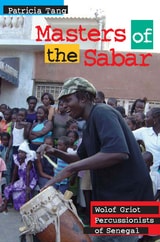
Masters of the Sabar
Wolof Griot Percussionists of SenegalPatricia Tang
Temple University Press, 2006
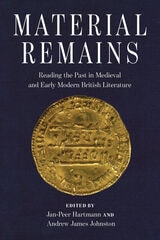
Material Remains
Reading the Past in Medieval and Early Modern British LiteratureEdited by Jan-Peer Hartmann and Andrew James Johnston
The Ohio State University Press, 2021
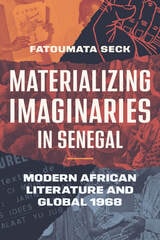
Materializing Imaginaries in Senegal
Modern African Literature and Global 1968Fatoumata Seck
Duke University Press, 2026

Maternal Body and Voice in Toni Morrison, Bobbie Ann Mason, and Lee Smith
Paula Gallant Eckard
University of Missouri Press, 2002
Maternal Fictions
Stendahl, Sand, Rachilde, and BatailleMaryline Lukacher
Duke University Press, 1994
Through readings of Armance, Le Rouge et le noir, La Vie de Henry Brulard, and Les Cenci, Lukacher exposes Stendhal's preoccupation with his dead mother, who is obsessively retrieved throughout his work. George Sand's identity is, in effect, divided between two mothers, her biological mother and her grandmother, and in Histoire de ma vie, Indiana, and Mauprat, we see the writer's efforts to break the impasse created by this divided identity. In the extraordinary but too little known work of Rachilde (Marguerite Eymery), Lukacher finds the maternal figure identified as the secret inner force of patriarchal oppression. This resistance to feminism continues in the pseudonymous work of Georges Bataille. In Ma mère, Le coupable, and L’Expérience intérieure Lukacher traces Bataille’s representation of the mother as a menacing, ever subversive figure who threatens basic social configurations.
Maternal Fictions establishes a new pseudonymous genealogy in modern French writing that will inform and advance our understanding of the act of self-creation that occurs in fiction.
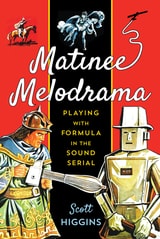
Matinee Melodrama
Playing with Formula in the Sound SerialHiggins, Scott
Rutgers University Press, 2016
Matinee Melodrama is the first book about the adventure serial as a distinct artform, one that uniquely encouraged audience participation and imaginative play. Media scholar Scott Higgins proposes that the serial’s incoherent plotting and reliance on formula, far from being faults, should be understood as some of its most appealing attributes, helping to spawn an active fan culture. Further, he suggests these serials laid the groundwork not only for modern-day cinematic blockbusters like Star Wars and Raiders of the Lost Ark, but also for all kinds of interactive media that combine spectacle, storytelling, and play.
As it identifies key elements of the serial form—from stock characters to cliffhangers—Matinee Melodrama delves deeply into questions about the nature of suspense, the aesthetics of action, and the potentials of formulaic narrative. Yet it also provides readers with a loving look at everything from Zorro’s Fighting Legion to Daredevils of the Red Circle, conveying exactly why these films continue to thrill and enthrall their fans.
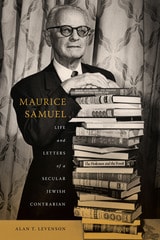
Maurice Samuel
Life and Letters of a Secular Jewish ContrarianAlan T. Levenson
University of Alabama Press, 2022
An intellectual biography that reassesses one of the premier Jewish humanists of the mid-twentieth century
In Maurice Samuel: Life and Letters of a Secular Jewish Contrarian, Alan T. Levenson captures the life, works, and milieu of the Romanian-born, English-educated, American belletrist Maurice Samuel. A diaspora intellectual—or a rooted cosmopolitan, as Levenson describes him—Samuel made an indelible mark on many features of contemporary Jewish thought and culture. A generalist in an age of experts, an independent scholar in an age of rabbis and professors, Samuel was one of the most productive and visible members of the group dubbed the “other” New York Jewish intellectuals.
His fame as a public intellectual and popular speaker were well warranted: no mere popularizer, Samuel contributed significantly to four seemingly unrelated but critical areas of modern Jewish thought. Samuel is characterized by some as principally a Zionist, by others as an accomplished translator and many Americans’ first entrée into the world of Yiddish literature, by still others as a polemicist and campaigner against anti-Semitism, and finally as a media-savvy Biblical critic, essayist, and radio personality. But he was all of these things, since Samuel succeeded in an era when it was possible to be a public intellectual without being an expert.
Drawing on Samuel’s vast literary opus, as well as previously unexplored archival material from three continents, this study writes Samuel back into the history of mid-twentieth-century American letters. Levenson argues that Samuel’s varied and substantive contributions demand reconsideration of our assumptions about the means and ends of cultural transmission, and merit him a place as one of twentieth-century American Jewry’s most significant cultural and intellectual voices.
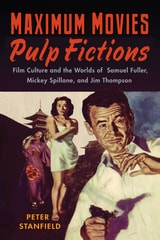
Maximum Movies—Pulp Fictions
Film Culture and the Worlds of Samuel Fuller, Mickey Spillane, and Jim ThompsonStanfield, Peter
Rutgers University Press, 2011
May All Your Fences Have Gates
Essyas on the Drama of August WilsonAlan Nadel
University of Iowa Press, 1993
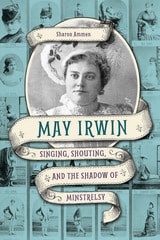
May Irwin
Singing, Shouting, and the Shadow of MinstrelsySharon Ammen
University of Illinois Press, 2017
Sharon Ammen's in-depth study traces Irwin's hurly-burly life. Irwin gained fame when, layering aspects of minstrelsy over ragtime, she popularized a racist "Negro song" genre. Ammen examines this forgotten music, the society it both reflected and entertained, and the ways white and black audiences received Irwin's performances. She also delves into Irwin's hands-on management of her image and career, revealing how Irwin carefully built a public persona as a nurturing housewife whose maternal skills and performing acumen reinforced one another. Irwin's act, soaked in racist song and humor, built a fortune she never relinquished. Yet her career's legacy led to a posthumous obscurity as the nation that once adored her evolved and changed.
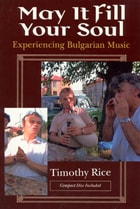
May It Fill Your Soul
Experiencing Bulgarian MusicTimothy Rice
University of Chicago Press, 1994
In the context of this history, Rice brings Bulgarian folk music to life by focusing on the biography of the Varimezov family, including the musician Kostadin and his wife Todora, a singer. Combining interviews with his own experiences of learning how to play, sing and dance Bulgarian folk music, Rice presents one of the most detailed accounts of traditional, aural learning processes in the ethnomusicological literature.
Using a combination of traditionally dichotomous musicological and ethnographic approaches, Rice tells the story of how individual musicians learned their tradition, how they lived it during the pre-Communist era of family farming, how the tradition changed with industrialization brought under Communism, and finally, how it flourished and evolved in the recent, unstable political climate.
This work—complete with a compact disc and numerous illustrations and musical examples—contributes not only to ethnomusicological theory and method, but also to our understanding of Slavic folklore, Eastern European anthropology, and cultural processes in Socialist states.
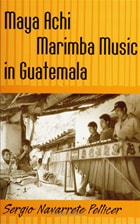
Maya Achi Marimba Music In Guatemala
Sergio Navarrete Pellicer
Temple University Press, 2005
Mayaya Rising
Black Female Icons in Latin American and Caribbean Literature and CultureDawn Duke
Bucknell University Press, 2023
Meaning and Context in the Thanksgiving Hymns
Linguistic and Rhetorical Perspectives on a CollectionTrine Bjørnung Hasselbalch
SBL Press, 2015
A new reading strategy for the Thanksgiving Hymns
Hasselbalch asserts that current theories about the social background of Thanksgiving Hymns are unable to explain its heterogeneous character. Instead the author suggests a reading strategy that leaves presumptions about the underlying social contexts aside to instead consider the collection’s hybridity as a clue to understanding the collection as a whole.
Features:
- Systemic Functional Linguistics applied to four Hodayot
- Analysis that highlights the role of a mediator in the agency of God
- An approach that highlights the unity of the collection
Measuring the Harlem Renaissance
The U.S. Census, African American Identity, and Literary FormMichael Soto
University of Massachusetts Press, 2016
In this provocative study, Michael Soto examines African American cultural forms through the lens of census history to tell the story of how U.S. officialdom—in particular the Census Bureau—placed persons of African descent within a shifting taxonomy of racial difference, and how African American writers and intellectuals described a far more complex situation of interracial social contact and intra-racial diversity. What we now call African American identity and the literature that gives it voice emerged out of social, cultural, and intellectual forces that fused in Harlem roughly one century ago.
Measuring the Harlem Renaissance sifts through a wide range of authors and ideas—from W. E. B. Du Bois, Rudolph Fisher, and Nella Larsen to Zora Neale Hurston, Langston Hughes, and Wallace Thurman, and from census history to the Great Migration—to provide a fresh take on late nineteenth—and twentieth—century literature and social thought. Soto reveals how Harlem came to be known as the “cultural capital of black America,” and how these ideas left us with unforgettable fiction and poetry.
Media Laboratories
Late Modernist Authorship in South AmericaSarah Ann Wells
Northwestern University Press, 2017
Media Laboratories explores a pivotal time for South American literature of the 1930s and ’40s. Cinema, radio, and the typewriter, once seen as promising catalysts for new kinds of writing, began to be challenged by authors, workers, and the public. What happens when media no longer seem novel and potentially democratic but rather consolidated and dominant? Moving among authors from Brazil, Argentina, and Uruguay, and among the genres of fiction, the essay, popular journalism, and experimental little magazines, Sarah Ann Wells shows how writers on the periphery of global modernity were fashioning alternative approaches to these media. Analyzing authors such as Clarice Lispector, Jorge Luis Borges, and Felisberto Hernández, along with their lesser-known contemporaries, Media Laboratories casts a wide net: from spectators of Hollywood and Soviet montage films, to inventors of imaginary media, to proletarian typists who embodied the machine-human encounters of the period. The text navigates contemporary scholarly and popular debates about the relationship of literature to technological innovation, media archaeology, sound studies, populism, and global modernisms. Ultimately, Wells underscores a question that remains relevant: what possibilities emerge when the enthusiasm for new media has been replaced by anxiety over their potentially pernicious effects in a globalizing, yet vastly unequal, world?
Media of Serial Narrative
Frank Kelleter
The Ohio State University Press, 2017
Media of Serial Narrative focuses on key sites and technologies of popular seriality since the mid-nineteenth century and up to today: newspapers, comics, cinema, television, and digital communication. Paying close attention to the affordances of individual media, as well as to their historical interactions, the fourteen chapters survey the forms, processes, and functions of popular serial storytelling. With individual chapters by Frank Kelleter, Jared Gardner, Daniel Stein, Christina Meyer, Scott Higgins, Shane Denson, Ruth Mayer, Kathleen Loock, Constantine Verevis, Jason Mittell, Sudeep Dasgupta, Sean O’Sullivan, Henry Jenkins, Christine Hämmerling, Mirjam Nast, and Andreas Sudmann, Media of Serial Narrative is an exciting and broad-ranging intervention in the fields of seriality, media, and narrative studies.
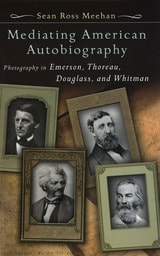
Mediating American Autobiography
Photography in Emerson, Thoreau, Douglass, and WhitmanSean Ross Meehan
University of Missouri Press, 2008
The emergence of photography in the mid-nineteenth century transformed ideas about how the self and nature could be pictured. Although the autobiographical potential of photography seems self-evident today, Sean Meehan takes us back to the birth of the medium when some of America’s preeminent authors began to think about photography’s implications for the representation of identity and the nature of autobiographical writing.
Both photography and autobiography involve a tension between disclosing and concealing their means of production: a chemical process for one, the writing process for the other. Meehan examines how four major authors—Ralph Waldo Emerson, Henry David Thoreau, Frederick Douglass, and Walt Whitman—were well aware of this tension and explored it in their work. By examining the implications of early photography in their writings, he shows how each engaged the new visual medium, how photography mediated their conceptions of self-representation, and how their appropriation of photographic thinking created a new kind of autobiography.
Examining the metonymic nature of photography, Meehan explores how the new medium influenced conceptions of visual and verbal representation. He intertwines these four writers’ reflections on photography—in Emerson’s Representative Men, Thoreau’s journals, Douglass’s narratives of slavery, and Whitman’s Specimen Days—with theories of photography as expounded by its inventors and observers, from Louis Daguerre and William Talbot in Europe to Oliver Wendell Holmes and Marcus Root in America.
As the first book to focus on the emergence of this new visual medium during the American Renaissance, Mediating American Autobiography shows us what photography means for American literature in general and for the genre most closely linked to it in particular. Because the engagement of these writers with photography has been neglected in previous scholarship, Meehan’s work provocatively bridges the study of two media and illuminates an important aspect of American thought and culture at the dawn of the technological era.
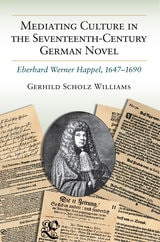
Mediating Culture in the Seventeenth-Century German Novel
Eberhard Werner Happel, 1647-1690Gerhild Scholz Williams
University of Michigan Press, 2014
Happel primarily lived and worked in the vigorous port city of Hamburg, which was a “media center” in terms of the access it offered to a wide library of books in public and private collections. Hamburg’s port status meant it buzzed with news and information, and Happel drew on this flow of data in his novels. His books deal with many topics of current interest—national identity formation, gender and sexualities, Western European encounters with neighbors to the East, confrontations with non-European and non-Western powers and cultures—and they feature multiple media, including news reports, news collections, and travel writings. As a result, Happel’s use of contemporary source material in his novels feeds our current interest in the impact of the production of knowledge on seventeenth-century narrative. Mediating Culture in the Seventeenth-Century German Novel explores the narrative wealth and multiversity of Happel’s work, examines Happel’s novels as illustrative of seventeenth-century novel writing in Germany, and investigates the synergistic relationship in Happel’s writings between the booming print media industry and the evolution of the German novel.
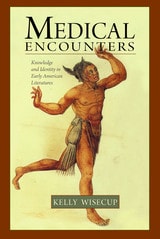
Medical Encounters
Knowledge and Identity in Early American LiteraturesKelly Wisecup
University of Massachusetts Press, 2013
Against the prevailing view that colonial texts provide insight only into their writers' perspectives, Wisecup demonstrates that Europeans, Natives, and Africans held certain medical ideas in common, including a conception of disease as both a spiritual and a physical entity, and a belief in the power of special rituals or prayers to restore health. As a consequence, medical knowledge and practices operated as a shared form of communication on which everyone drew in order to adapt to a world of devastating new maladies and unfamiliar cures.
By signaling one's relation to supernatural forces, to the natural world, and to other people, medicine became an effective means of communicating a variety of messages about power and identity as well as bodies and minds. Native Americans in Virginia and New England, for example, responded to the nearly simultaneous arrival of mysterious epidemics and peoples by incorporating colonists into explanations of disease, while British American colonists emphasized to their audiences back home the value of medical knowledge drawn from cross-cultural encounters in the New World.
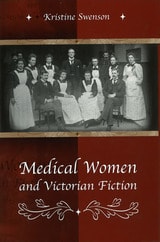
Medical Women and Victorian Fiction
Kristine Swenson
University of Missouri Press, 2005
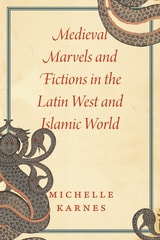
Medieval Marvels and Fictions in the Latin West and Islamic World
Michelle Karnes
University of Chicago Press, 2022
Marvels like enchanted rings and sorcerers’ stones were topics of fascination in the Middle Ages, not only in romance and travel literature but also in the period’s philosophical writing. Rather than constructions of belief accepted only by simple-minded people, Michelle Karnes shows that these spectacular wonders were near impossibilities that demanded scrutiny and investigation.
This is the first book to analyze a diverse set of writings on such wonders, comparing texts from the Latin West—including those written in English, French, Italian, and Castilian Spanish —with those written in Arabic as it works toward a unifying theory of marvels across different disciplines and cultures. Karnes tells a story about the parallels between Arabic and Latin thought, reminding us that experiences of the strange and the unfamiliar travel across a range of genres, spanning geographical and conceptual space and offering an ideal vantage point from which to understand intercultural exchange. Karnes traverses this diverse archive, showing how imagination imbues marvels with their character and power, making them at once enigmatic, creative, and resonant. Skirting the distinction between the real and unreal, these marvels challenge readers to discover the highest capabilities of both nature and the human intellect. Karnes offers a rare comparative perspective and a new methodology to study a topic long recognized as central to medieval culture.
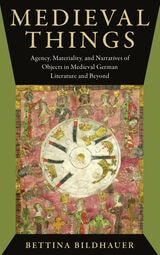
Medieval Things
Agency, Materiality, and Narratives of Objects in Medieval German Literature and BeyondBettina Bildhauer
The Ohio State University Press, 2020
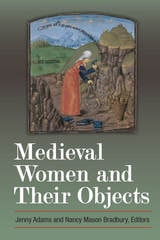
Medieval Women and Their Objects
Jenny Adams and Nancy Mason Bradbury, editors
University of Michigan Press, 2016
The opening section looks at how medieval authors imagined fictional and legendary women using particular objects in ways that reinforce or challenge gender roles. These women bring objects into the orbit of gender identity, employing and relating to them in a literal sense, while also taking advantage of their symbolic meanings. The second section focuses on the use of texts both as objects in their own right and as mechanisms by which other objects are defined. The possessors of objects in these essays lived in the world, their lives documented by historical records, yet like their fictional and legendary counterparts, they too used objects for instrumental ends and with symbolic resonances. The final section considers the objectification of medieval women’s bodies as well as its limits. While this at times seems to allow for a trade in women, authorial attempts to give definitive shapes and boundaries to women’s bodies either complicate the gender boundaries they try to contain or reduce gender to an ideological abstraction. This volume contributes to the ongoing effort to calibrate female agency in the late Middle Ages, honoring the groundbreaking work of Carolyn P. Collette.