Results by title
1917 books match the query 'Law' and 65 start with m
More or Less Afraid of Nearly Everything
Homeland Security, Borders, and Disasters in the Twenty-First CenturyBenjamin Rohrbaugh
University of Michigan Press, 2020
Throughout the twentieth century, the United States did not experience national security domestically; it defended its borders by conducting military, foreign policy, and intelligence operations internationally, and then separated these activities from domestic law enforcement with bright legal lines. In the twenty-first century, U.S. national security no longer occurs exclusively outside of the nation. The U.S. government is beginning to respond to this change, and the establishment of the Department of Homeland Security is merely the first step in an organizational and strategic realignment that will be a long, difficult, and mistake-filled process. More or Less Afraid of Nearly Everything is an accessible and engaging guide to homeland security, particularly migration and border security, that makes innovative arguments about the American government and keeping citizens safe, and provides practical solutions to real-world problems.

Mountains Without Handrails
Reflections on the National ParksJoseph L. Sax
University of Michigan Press, 1980
Focusing on the long-standing and bitter battles over recreational use of our national parklands, Joseph L. Sax proposes a novel scheme for the protection and management of America's national parks. Drawing upon the most controversial disputes of recent years---Yosemite National Park, the Colorado River in the Grand Canyon, and the Disney plan for California's Mineral King Valley---Sax boldly unites the rich and diverse tradition of nature writing into a coherent thesis that speaks directly to the dilemma of the parks.
Mountains Without Handrails
Reflections on the National ParksJoseph L. Sax
University of Michigan Press, 2018
Beloved by academic and general readers alike, Mountains Without Handrails, Joseph L. Sax’s thought-provoking treatise on America’s national parks, remains as relevant today as when first published in 1980. Focusing on the long-standing and bitter battles over recreational use of our parklands, Sax proposes a novel scheme for the protection and management of America's national parks. Drawing upon still controversial disputes—Yosemite National Park, the Colorado River in the Grand Canyon, and the Disney plan for California's Mineral King Valley—Sax boldly unites the rich and diverse tradition of nature writing into a coherent thesis that speaks directly to the dilemma of the parks.
In a new foreword, environmental law scholar Holly Doremus articulates this book’s enduring importance and reflects on what Sax, her former teacher, might have thought about the encroachment of technology into natural spaces, the impact of social media, and growing threats from climate change. At this moment of great uncertainty for the national parks, Mountains Without Handrails should be read (and re-read) by anyone with a stake in America’s natural spaces.
Movies, Censorship, and the Law
Ira H. Carmen
University of Michigan Press, 1966
Mr. Justice Black and His Critics
Tinsley E. Yarbrough
Duke University Press, 1988
Late in his career, however, Black's commitment to literalism and intent led him to assume apparently conservative positions in civil liberties cases. In an era characterized by growing acceptance of the belief that judges should adapt the Constitution to changing social and ethical perceptions, many came to regard Black's position as unrealistic and irrelevant.
Tinsley E. Yarbrough analyzes Black's judicial and constitutional philosophy, as well as his approach to specific cases, through the eyes of Black's critics (such as Justices Frankfurter and Harlan) and through an assessment of scholarly opinion of his jurisprudence. The result is a stimulating and provocative addition to the study of Justice Black and the Supreme Court.
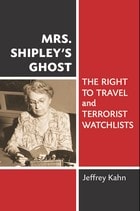
Mrs. Shipley's Ghost
The Right to Travel and Terrorist WatchlistsJeffrey Kahn
University of Michigan Press, 2014
Today, when a single person can turn an airplane into a guided missile, no one objects to rigorous security before flying. But can the state simply declare some people too dangerous to travel, ever and anywhere? Does the Constitution protect a fundamental right to travel? Should the mode of travel (car, plane, or boat) or itinerary (domestic or international) make a constitutional difference? This book explores the legal and policy questions raised by government travel restrictions, from passports and rubber stamps to computerized terrorist watchlists.
In tracing the history and scope of U.S. travel regulations, Jeffrey Kahn begins with the fascinating story of Mrs. Ruth Shipley, a federal employee who almost single-handedly controlled access to passports during the Cold War. Kahn questions how far national security policies should go and whether the government should be able to declare some individuals simply too dangerous to travel. An expert on constitutional law, Kahn argues that U.S. citizens’ freedom to leave the country and return is a fundamental right, protected by the Constitution.

Mu, 49 Marks of Abolition
Sora Y. Han
Duke University Press, 2024
Multiple InJustices
Indigenous Women, Law, and Political Struggle in Latin AmericaR. Aída Hernández Castillo
University of Arizona Press, 2016
Multiple InJustices synthesizes R. Aída Hernández Castillo’s twenty-four years of activism and research among indigenous women’s organizations in Latin America. As both feminist and critical anthropologist, Hernández Castillo analyzes the context of legal pluralism wherein the indigenous women of Mexico, Guatemala, and Colombia struggle for justice. Through ethnographical research in community, state, and international justice, she reflects on the possibilities and limitations of customary, national, and international law for indigenous women.
Colonialism, racism, and patriarchal violence have been fundamental elements for the reproduction of capitalism, Hernández Castillo asserts. Only a social policy that offers economic alternatives based on distribution of wealth and a real recognition of cultural and political rights of indigenous peoples can counter the damage of outside forces such as drug cartels on indigenous lands.
She concludes that the theories of indigenous women on culture, tradition, and gender equity—as expressed in political documents, event reports, public discourse, and their intellectual writings—are key factors in the decolonization of Latin American feminisms and social justice for all.
Murder Was Not a Crime
Homicide and Power in the Roman RepublicBy Judy E. Gaughan
University of Texas Press, 2009
Embarking on a unique study of Roman criminal law, Judy Gaughan has developed a novel understanding of the nature of social and political power dynamics in republican government. Revealing the significant relationship between political power and attitudes toward homicide in the Roman republic, Murder Was Not a Crime describes a legal system through which families (rather than the government) were given the power to mete out punishment for murder.
With implications that could modify the most fundamental beliefs about the Roman republic, Gaughan's research maintains that Roman criminal law did not contain a specific enactment against murder, although it had done so prior to the overthrow of the monarchy. While kings felt an imperative to hold monopoly over the power to kill, Gaughan argues, the republic phase ushered in a form of decentralized government that did not see itself as vulnerable to challenge by an act of murder. And the power possessed by individual families ensured that the government would not attain the responsibility for punishing homicidal violence.
Drawing on surviving Roman laws and literary sources, Murder Was Not a Crime also explores the dictator Sulla's "murder law," arguing that it lacked any government concept of murder and was instead simply a collection of earlier statutes repressing poisoning, arson, and the carrying of weapons. Reinterpreting a spectrum of scenarios, Gaughan makes new distinctions between the paternal head of household and his power over life and death, versus the power of consuls and praetors to command and kill.
Murder and Its Consequences
Essays on Capital Punishment in AmericaLeigh B Bienen
Northwestern University Press, 2010
The essays in Murder and Its Consequences span several periods in the history of capital punishment in America and the professional career of Leigh Bienen, a leading researcher on the death penalty. “A Good Murder” describes the subtle relationship between high-profile murders and the death penalty, while “The Proportionality Review of Capital Cases” places the well-known study of proportionality in New Jersey within a nationwide context.
“Anomalies” suggests that the arcane protocols written for lethal injection have little to do with insuring humane executions, but rather are concerned with protecting the sensibilities of witnesses and the liability of corrections officials. Other essays address the groundbreaking developments surrounding the death penalty in Illinois, and take a retrospective look at the evolution of her own and the country’s thinking about this complex, divisive topic.
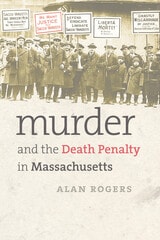
Murder and the Death Penalty in Massachusetts
Alan Rogers
University of Massachusetts Press, 2008
For more than 300 years Massachusetts executed men and women convicted of murder, but with a sharp eye on “due proceeding” and against the backdrop of popular ambivalence about the death penalty's morality, cruelty, efficacy, and constitutionality. In this authoritative book, Alan Rogers offers a comprehensive account of how the efforts of reformers and abolitionists and the Supreme Judicial Court's commitment to the rule of law ultimately converged to end the death penalty in Massachusetts.
In the seventeenth century, Governor John Winthrop and the Massachusetts General Court understood murder to be a sin and a threat to the colony's well-being, but the Puritans also drastically reduced the crimes for which death was the prescribed penalty and expanded a capital defendant's rights. Following the Revolution, Americans denounced the death penalty as “British and brutish” and the state's Supreme Judicial Court embraced its role as protector of the rights extended to all men by the Massachusetts Constitution. In the 1830s popular opposition nearly stopped the machinery of death and a vote in the Massachusetts House fell just short of abolishing capital punishment.
A post–Civil War effort extending civil rights to all men also stimulated significant changes in criminal procedure. A “monster petition” begging the governor to spare the life of a murderer convicted on slight circumstantial evidence and the grim prospect of executing nine Chinese men found guilty of murder fueled a passionate debate about the death penalty in the decade before World War I.
The trials and executions of Sacco and Vanzetti focused unwanted international and national attention on Massachusetts. This was a turning point. Sara Ehrmann took charge of the newly formed Massachusetts Council Against the Death Penalty, relentlessly lobbied the legislature, and convinced a string of governors not to sign death warrants. In the 1970s the focus shifted to the courts, and eventually, in 1980, the Supreme Judicial Court abolished the death penalty on the grounds that it violated the Massachusetts Constitution.

Murder, Courts, and the Press
Issues in Free Press/Fair TrialPeter E. Kane. Foreword by Franklyn S. Haiman
Southern Illinois University Press, 1992
When murder is the crime, the clash in the courts is likely to be between two constitutionally enshrined rights—freedom of speech and the right to a fair trial.
Peter E. Kane shows what happened in seven famous court cases when First Amendment rights (concerning freedom of speech) conflicted with Sixth Amendment rights (concerning fair trial). He reports the circumstances of each crime, the court proceedings, and the conduct of the press in the trials of Sam Sheppard, Charles Manson and his followers, John Paul Stevenson, Claus von Bülow, and Arthur Shawcross and the cases involving the Kellie family and the Wayne Clapp murders. Kane’s narrative and analytical approach illuminates legal principles and shows the roles of actual human beings underlying the abstractions of court opinions.
In this revised and expanded edition, Kane considers two new topics stemming from recent court cases: cameras in the courtroom and a code of ethics for crime reporting. Kane explores the issue of cameras through the famous Claus von Bülow retrial, which featured live television broadcasts; regarding a journalistic code, Kane examines the massive pretrial reporting of the serial murders of Arthur Shawcross. Kane notes that sensational crime stories serve the interests of many people: the public wants to read them; journalists want to write them because they can make a reporter’s fortune and reputation; and editors and publishers want to sell papers. The sensational crime story serves everyone’s purpose except that of the accused.
In addition to exploring journalistic ethics and the proper procedures for trial judges in guaranteeing a fair trial, these cases also provide an introduction to the operation of the courts in criminal justice. "The trial court is the arena in which the conflicts between a free press and a fair trial are played out," Kane writes. "This play is described here as are the subsequent evaluations of that play by the appellate courts. Thus the legal process is considered from its beginning with the original crime to the final resolution of the case in the United States Supreme Court."
Music and Cultural Rights
Edited by Andrew N. Weintraub and Bell Yung
University of Illinois Press, 2009
Contributors are Nimrod Baranovitch, Adriana Helbig, Javier F. Leon, Ana María Ochoa, Silvia Ramos, Helen Rees, Felicia Sandler, Amy Ku'uleialoha Stillman, Ricardo D. Trimillos, Andrew N. Weintraub, and Bell Yung.
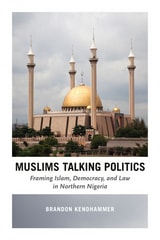
Muslims Talking Politics
Framing Islam, Democracy, and Law in Northern NigeriaBrandon Kendhammer
University of Chicago Press, 2016
Kendhammer argues that despite Nigeria’s struggles with jihadist insurgency, its recent history is really one of tenuous and fragile reconciliation between mass democratic aspirations and concerted popular efforts to preserve Islamic values in government and law. Combining an innovative analysis of Nigeria’s Islamic and political history with visits to the living rooms of working families, he sketches how this reconciliation has been constructed in the conversations, debates, and everyday experiences of Nigerian Muslims. In doing so, he uncovers valuable new lessons—ones rooted in the real politics of ordinary life—for how democracy might work alongside the legal recognition of Islamic values, a question that extends far beyond Nigeria and into the Muslim world at large.
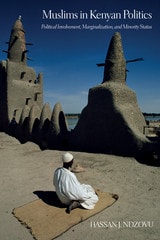
Muslims in Kenyan Politics
Political Involvement, Marginalization, and Minority StatusHassan J. Ndzovu
Northwestern University Press, 2014
Kenya’s Muslim population comprises ethnic Arabs, Indians, and black Africans, and its status has varied historically. Under British rule, an imposed racial hierarchy affected Muslims particularly, thwarting the development of a united political voice. Drawing on a broad range of interviews and historical research, Ndzovu presents a nuanced picture of political associations during the postcolonial period and explores the role of Kenyan Muslims as political actors.