Results by title
8113 books match the query 'Literary Criticism' and 516 start with m
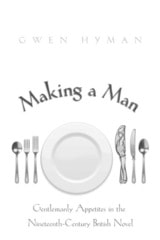
Making a Man
Gentlemanly Appetites in the Nineteenth Century British NovelGwen Hyman
Ohio University Press, 2009
The gentleman, Making a Man argues, is a dangerous alimental force. Threatened with placelessness, he seeks to locate and mark himself through his feasting and fasting. But in doing so, he inevitably threatens to starve, to subsume, to swallow the community around him. The gentleman is at once fundamental and fundamentally threatening to the health of the nation: his alimental monstrousness constitutes the nightmare of the period’s striving, anxious, alimentally fraught middle class.
Making a Man makes use of food history and theory, literary criticism, anthropology, gender theory, economics, and social criticism to read gentlemanly consumers from Mr. Woodhouse, the gruel-eater in Jane Austen’s Emma, through the vampire and the men who hunt him in Bram Stoker’s Dracula. Hyman argues that appetite is a crucial means of casting light on the elusive identity of the gentleman, a figure who is the embodiment of power and yet is hardly embodied in Victorian literature.
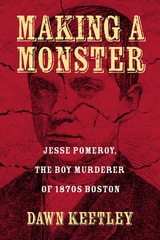
Making a Monster
Jesse Pomeroy, the Boy Murderer of 1870s BostonDawn Keetley
University of Massachusetts Press, 2017
In this book, Dawn Keetley details the story of Pomeroy's crimes and the intense public outcry. She explores the two reigning theories at the time—that he was shaped before birth when his pregnant mother visited a slaughterhouse and that he imitated brutal acts found in popular dime novels. Keetley then thoughtfully offers a new theory: that Pomeroy suffered a devastating reaction to a smallpox vaccination which altered his brain, creating a psychopath who revealed the human potential for brutality. The reaction to Pomeroy's acts, then and now, demonstrates the struggle to account for exactly those aspects of human nature that remain beyond our ability to understand.
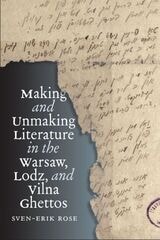
Making and Unmaking Literature in the Warsaw, Lodz, and Vilna Ghettos
Sven-Erik Rose
Brandeis University Press, 2025
A study of literature written by Jewish authors while interned in Nazi ghettos emphasizes how authors processed their horrific experiences through poetry and prose.
Published in Association with the United States Holocaust Memorial Museum
This is the first study devoted to how little known but essential authors grappled with the destitution of ghetto existence by writing within, at the limits of, and against an array of literary scenarios, tropes, plot lines, and generic conventions, including those of nature lyric, modernist interior monologue, the realist social novel, the detective story, and the gothic horror tale. Contending with starvation, disease, desperate housing conditions and the looming threat of being murdered, inhabitants of ghettos in Poland nonetheless made them sites of rich Jewish cultural production. Rose’s readings of these literary works reveal how authors asserted their humanity by insisting on writing works of literature. In such radically dehumanizing circumstances, however, their recourse to established literary genres was not naive. Rather, ghetto authors brilliantly meditated on the grotesque incongruities between established literary models and the extreme conditions of ghetto existence.

Making it Home
Place in Canadian LiteratureDeborah Keahey
University of Manitoba Press, 1998
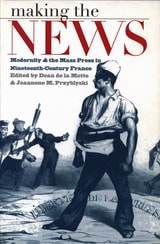
Making the News
Modernity and the Mass Press in Nineteenth-Century FranceDean de la Motte
University of Massachusetts Press, 1999
Much recent writing on print culture has focused on the social and political implications of the transition from “elite” to “mass” culture in the 1800s. The essays in this volume add significantly to our understanding of the role of the nineteenth-century French press in producing the commodities, consumers, and ideological frameworks that are the hallmarks of this shift. The book also offers an opportunity for useful comparisons with recent scholarship on the rise on the popular press in the United States, Great Britain, and Germany.
The essays address a wide range of topics, from the emergence of commercial daily newspapers during the July Monarchy to the photographic representation of women in the Paris Commune. Together they demonstrate that the French mass press was far more heterogeneous than previously supposed, tapping into an expanding readership composed of a variety of publics—from affluent bourgeois to disaffected workers to disenfranchised women. It was also relentlessly innovative, using caricature, argot, advertisements, and other attention-grabbing techniques that blurred the lines separating art, politics, and the news.
Making the Past Present
David Jones, the Middle Ages and ModernismPaul Robichaud
Catholic University of America Press, 2007
Maladies of the Will
The American Novel and the Modernity ProblemJennifer L. Fleissner
University of Chicago Press, 2022
What if the modern person were defined not by reason or sentiment, as Enlightenment thinkers hoped, but by will? Western modernity rests on the ideal of the autonomous subject, charting a path toward self-determination. Yet novelists have portrayed the will as prone to insufficiency or excess—from indecision to obsession, wild impulse to melancholic inertia. Jennifer Fleissner’s ambitious book shows how the novel’s attention to the will’s maladies enables an ongoing interrogation of modern premises from within.
Maladies of the Will reveals the nineteenth-century American novel’s relation to a wide-ranging philosophical tradition, highly relevant to our own tumultuous present. In works from Moby-Dick and The Scarlet Letter to Elizabeth Stoddard’s The Morgesons and Charles W. Chesnutt’s The Marrow of Tradition, the will’s grandeur and its perversity emerge as it alternately aligns itself with and pits itself against a bigger Will—whether of God, the state, society, history, or life itself. Today, when invocations of autonomy appear beside the medicalization of many behaviors, and democracy’s tenet of popular will has come into doubt, Maladies of the Will provides a map to how we got here, and how we might think these vital dilemmas anew.
Male Call
Becoming Jack LondonJonathan Auerbach
Duke University Press, 1996
Jonathan Auerbach shows that London’s personal identity was not a basis of his literary success, but rather a consequence of it. Unlike previous studies of London that are driven by the author’s biography, Male Call examines how London carefully invented a trademark “self” in order to gain access to a rapidly expanding popular magazine and book market that craved authenticity, celebrity, power, and personality. Auerbach demonstrates that only one fact of London’s life truly shaped his art: his passionate desire to become a successful author. Whether imagining himself in stories and novels as a white man on trail in the Yukon, a sled dog, a tramp, or a professor; or engaging questions of manhood and mastery in terms of work, race, politics, class, or sexuality, London created a public persona for the purpose of exploiting the conventions of the publishing world and marketplace.
Revising critical commonplaces about both Jack London’s work and the meaning of “nature” within literary naturalism and turn-of-the-century ideologies of masculinity, Auerbach’s analysis intriguingly complicates our view of London and sheds light on our own postmodern preoccupation with celebrity. Male Call will attract readers with an interest in American studies, American literature, gender studies, and cultural studies.
Male Delivery
Reproduction, Effeminacy, and Pregnant Men in Early Modern SpainSherry Velasco
Vanderbilt University Press, 2006
Men were increasingly taking over medical duties--especially surrounding childbirth--usually left to women and, as their medical knowledge increased, they became aware of bodies and behaviors--both male and female--that transgressed gender norms. The anxieties about men who acted in ways seen as increasingly womanly (from acting effeminately to participating in homosexual activity) played out in the character of pregnant Juan Rana.
Then, Velasco turns to Hollywood and asks if we might not use the lessons of Juan Rana to help explain why contemporary America is also fascinated by the idea of male pregnancy--think Arnold Schwarzenegger in Junior--and our increasing anxiety over the changing face of masculinity in our own culture.
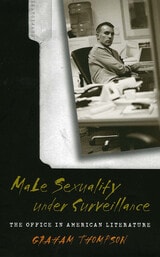
Male Sexuality under Surveillance
Office In American LiteratureGraham Thompson
University of Iowa Press, 2003
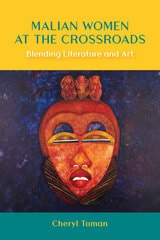
Malian Women at the Crossroads
Blending Literature and ArtCheryl Toman
Michigan State University Press, 2027
Mali’s history is defined by crossroads—geographic, cultural, and intellectual—linking to the Sahara and to long-standing trade routes. Francophone Malian women’s writing reflects this convergence, positioning literature as a site where diverse artistic and cultural traditions meet and evolve. In Malian Women at the Crossroads: Blending Literature and Art, writers such as Aoua Kéita, Aïcha Fofana, Adame Ba Konaré, Fatoumata Sidibé, Zakiyatou oualett Halatine, and Fadimata walett Oumar blur the boundaries between text and artistic practice, incorporating storytelling, visual arts, music, textile design, and other creative forms into their work. These interdisciplinary expressions both honor and reinterpret tradition, illuminating Mali’s cultural diversity while challenging divisions rooted in gender and ethnicity.
The voices of these writers denounce the conflict that has plagued Mali for over a decade and opt instead for showcasing creativity that preserves the memory of more promising times.

Malraux, the Absolute Agnostic; or, Metamorphosis as Universal Law
Claude Tannery
University of Chicago Press, 1991
Malvina, or Spoken Word in the Novel
Ewa Szary-Matywiecka
Karolinum Press, 2020
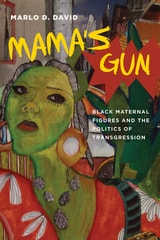
Mama's Gun
Black Maternal Figures and the Politics of TransgressionMarlo D. David
The Ohio State University Press, 2016
Taking inspiration from African American fiction, historical accounts of black life, Afrofuturism, and black popular culture in music and on screen, David turns her attention to Sapphire’s Push, Octavia Butler’s Dawn, and Suzan-Lori Parks’s Getting Mother’s Body as well as the performance art of Erykah Badu and the films of Tyler Perry. She draws out the implications of black maternal figures in these texts who balk at tradition and are far from “ideal.” David’s study shows how representations of blackness are deeply embedded in the neoliberal language of contemporary American politics and how black writers and performers resist such mainstream ideologies with their own transgressive black maternal figures.
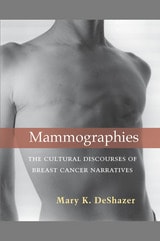
Mammographies
The Cultural Discourses of Breast Cancer NarrativesMary K. DeShazer
University of Michigan Press, 2015
While breast cancer continues to affect the lives of millions, contemporary writers and artists have responded to the ravages of the disease in creative expression. Mary K. DeShazer’s book looks specifically at breast cancer memoirs and photographic narratives, a category she refers to as mammographies, signifying both the imaging technology by which most Western women discover they have this disease and the documentary imperatives that drive their written and visual accounts of it. Mammographies argues that breast cancer narratives of the past ten years differ from their predecessors in their bold address of previously neglected topics such as the link between cancer and environmental carcinogens, the ethics and efficacy of genetic testing and prophylactic mastectomy, and the shifting politics of prosthesis and reconstruction.
Mammographies is distinctive among studies of contemporary illness narratives in its exclusive focus on breast cancer, its analysis of both memoirs and photographic texts, its attention to hybrid and collaborative narratives, and its emphasis on ecological, genetic, transnational, queer, and anti-pink discourses. DeShazer’s methodology—best characterized as literary critical, feminist, and interdisciplinary—includes detailed interpretation of the narrative strategies, thematic contours, and visual imagery of a wide range of contemporary breast cancer memoirs and photographic anthologies. The author explores the ways in which the narratives constitute a distinctive testimonial and memorial tradition, a claim supported by close readings and theoretical analysis that demonstrates how these narratives question hegemonic cultural discourses, empower reader-viewers as empathic witnesses, and provide communal sites for mourning, resisting, and remembering.
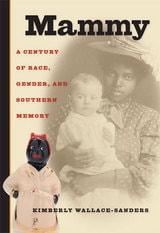
Mammy
A Century of Race, Gender, and Southern MemoryKimberly Wallace-Sanders
University of Michigan Press, 2008
---Choice
"In this insightful analysis of representations of mammy, Wallace-Sanders skillfully illustrates how this core icon of Black womanhood has figured prominently in upholding hierarchies of race, gender, and class in the United States. Far from being a timeless, natural, benign image of domesticity, the idealized mammy figure was repeatedly reworked to accommodate varying configurations of racial rule. No one reading this book will be able to see Gone with the Wind in the same way ever again."
---Patricia Hill Collins, University of Maryland
"Kimberly Wallace-Sanders' interdisciplinary approach is first-rate. This expansive and engaging book should appeal to students and scholars in American studies, African American studies, and women's studies."
---Thadious Davis, The University of Pennsylvania
Her cheerful smile and bright eyes gaze out from the covers of old cookbooks, song sheets, syrup bottles, salt and pepper shakers, and cookie jars, and she has long been a prominent figure in fiction, film, television, and folk art. She is Mammy, a figure whose provocative hold on the American psyche has persisted since before the Civil War.
But who is Mammy, and where did she come from? Her large, dark body and her round smiling face tower over our imaginations to such an extent that more accurate representations of African American women wither in her shadow. Mammy's stereotypical attributes---a sonorous and soothing voice, raucous laugh, infinite patience, self-deprecating wit, and implicit acceptance of her own inferiority and her devotion to white children---all point to a long-lasting and troubled confluence of racism, sexism, and southern nostalgia.
This groundbreaking book traces the mammy figure and what it has symbolized at various historical moments that are linked to phases in America's racial consciousness. The author shows how representations of Mammy have loomed over the American literary and cultural imagination, an influence so pervasive that only a comprehensive and integrated approach of this kind can do it justice.
The book's many illustrations trace representations of the mammy figure from the nineteenth century to the present, as she has been depicted in advertising, book illustrations, kitchen figurines, and dolls. The author also surveys the rich and previously unmined history of the responses of African American artists to the black mammy stereotype, including contemporary reframings by artists Betye Saar, Michael Ray Charles, and Joyce Scott.
Kimberly Wallace-Sanders is Associate Professor of the Graduate Institute of Liberal Arts and Women's Studies at Emory University. She is editor of Skin Deep, Spirit Strong: The Black Female Body in American Culture.
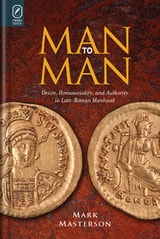
Man to Man
Desire, Homosociality, and Authority in Late-Roman ManhoodMark Masterson
The Ohio State University Press, 2014
At the same time, however, there was a marked ambivalence about same-sex desire and sexual behavior between men, and indeed same-sex sexual behavior was criminalized as it had never been before. While rejection and condemnation may seem to indicate a decisive distancing between authority and this desire and behavior, authority gained power from maintaining a relation to them. Demonstrating knowledge of the actual mechanics of sex between men suggested to a witness that there was nothing unknown to the authority making the demonstration: authority that knew of scandalous masculine sexual pleasure could project its power pretty much anywhere.
This startling dissonance between positive uses of same-sex desire between men and its criminalization in one and the same moment—a dissonance which recent discussions have been unable to address—requires further investigation, and this book supplies it.
Managing Readers
Printed Marginalia in English Renaissance BooksWilliam W. E. Slights
University of Michigan Press, 2001
The recent revolution in the protocols of reading brought on by computer technology has forced questions about the nature of book-based knowledge in our global culture. Managing Readers traces changes in the protocols of annotation and directed reading--from medieval religious manuscripts and Renaissance handbooks for explorers, rhetoricians, and politicians to the elegant clear-text editions of the Enlightenment and the hypertexts of our own time. Developing such concepts as textual authority, generic difference, and reader-response, Slights demonstrates that printed marginalia were used to confirm the authority of the text and to undermine it, to supplement "dark" passages, and to colonize strategic hermeneutic spaces. The book contains twenty-two illustrations of pages from rare-book archives that make immediately clear how distinctive the management of the reading experience was during the first century-and-a-half of printing in England.
William W. E. Slights is Professor of English, University of Saskatchewan. He is also author of Ben Jonson and the Art of Secrecy.
Mandelstam, Blok, and the Boundaries of Mythopoetic Symbolism
Stuart Goldberg
The Ohio State University Press, 2011
“Mandelstam had no teacher,” marveled Anna Akhmatova, reflecting on his early maturity and singularity. But Mandelstam himself spoke of the need and even duty to study a poet’s literary roots. So how did this consummately complex, compelling, multi-resonant poet navigate and exploit the burden of the Russian Symbolist movement from which he emerged? How did this process change and augment his poetry?
Manifestoes of Surrealism
Andre Breton
University of Michigan Press, 1969

Manly Love
Romantic Friendship in American FictionAxel Nissen
University of Chicago Press, 2009
The modern idea of Victorians is that they were emotionless prudes, imprisoned by sexual repression and suffocating social constraints; they expressed love and affection only within the bounds of matrimony—if at all. And yet, a wealth of evidence contradicting this idea has been hiding in plain sight for close to a century. In Manly Love, Axel Nissen turns to the novels and short stories of Victorian America to uncover the widely overlooked phenomenon of passionate friendships between men.
Nissen’s examination of the literature of the period brings to light a forgotten genre: the fiction of romantic friendship. Delving into works by Mark Twain, Henry James, William Dean Howells, and others, Nissen identifies the genre’s unique features and explores the connections between romantic friendships in literature and in real life. Situating love between men at the heart of Victorian culture, Nissen radically alters our understanding of the American literary canon. And with its deep insights into the emotional and intellectual life of the period, Manly Love also offers a fresh perspective on nineteenth-century America’s attitudes toward love, friendship, marriage, and sex.
Manuel Zapata Olivella and the "Darkening" of Latin American Literature
Antonio D. Tillis
University of Missouri Press, 2005
Manufacturing Modern Japanese Literature
Publishing, Prizes, and the Ascription of Literary ValueEdward Mack
Duke University Press, 2010
Many Gods and Many Voices
The Role of the Prophet in English and American ModernismLouis L. Martz
University of Missouri Press, 1998
In Many Gods and Many Voices distinguished scholar Louis L. Martz addresses works by Ezra Pound, T. S. Eliot, William Carlos Williams, H. D., and D. H. Lawrence, with brief treatment of the relation of Pound's Cantos to Joyce's Ulysses. In a graceful, lucid style, Martz argues that a prophetic tradition is represented in the Cantos, The Waste Land, Paterson, and H. D.'s Trilogy and Helen in Egypt, along with Lawrence's Plumed Serpent and the second version of Lady Chatterley's Lover. Pound's often- cited view that an epic is a poem that "includes history" does not define epic alone, for the books of biblical prophecy also contain history: the history of Israel's misdeeds and continuous redemption.
On the other hand, Martz suggests that the term prophecy should not be limited to works that foretell the future, arguing that the biblical prophet is concerned primarily with the present. The prophet is a reformer, a denouncer of evil, as well as a seer of possible redemption. He hears "voices" and transmits the message of those voices to his people, in the hope of moving them away from wickedness and toward the ways of truth. According to Martz, such was the mission that inspired Walt Whitman and that Whitman passed on to Pound, Eliot, Williams, and Lawrence. (H. D. found her own sources of inspiration in Greek and Egyptian lore.)
Martz's premise is that biblical prophecy, with its mingling of poetry and prose, its abrupt shifts from violent denunciation to exalted poetry, provides a precedent for the texture of these modernist works that will help readers to appreciate the mingling of "voices" and the complex mixture of elements. Examining their interrelationships and their common themes, Many Gods and Many Voices offers fresh insights into these modern writers.
Mapping Michel Serres
Niran Abbas, Editor
University of Michigan Press, 2005
---Robert Harrison, Stanford University [blurb from review pending permission]
The work of Michel Serres---including the books Hermes, The Parasite, The Natural Contract, Genesis, The Troubadour of Knowledge, and Conversations on Science, Culture, and Time---has stimulated readers for years, as it challenges the boundaries of science, literature, culture, language, and epistemology. The essays in Mapping Michel Serres, written by the leading interpreters of his work, offer perspectives from a range of disciplinary positions, including literature, language studies, and cultural theory. Contributors include Maria Assad, Hanjo Berressem, Stephen Clucas, Steven Connor, Andrew Gibson, René Girard, Paul Harris, Marcel Hénaff, William Johnsen, William Paulson, Marjorie Perloff, Philipp Schweighauser, Isabella Winkler, and Julian Yates.
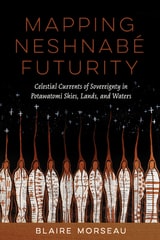
Mapping Neshnabé Futurity
Celestial Currents of Sovereignty in Potawatomi Skies, Lands, and WatersBlaire Morseau; Foreword by Grace L. Dillon
University of Arizona Press, 2025
In Mapping Neshnabé Futurity Blaire Morseau weaves together on-the-ground insights and Indigenous speculative fiction to illustrate the profound ways in which Anishinaabé/Neshnabé (Potawatomi, Odawa, and Ojibwe) communities are reclaiming their sovereignty and crafting vibrant futures. Morseau lays out how Neshnabék have marshaled dissent to hydrologic fracturing, oil pipelines, and other damaging infrastructures of capitalist settler futurity. The book positions these efforts as vital acts of nation building and visionary reclamation of space, both terrestrial and celestial.
Morseau also challenges the hegemonic narratives of settler futurism found in mainstream science fiction, which often perpetuate colonial fantasies and exclude marginalized voices. By fusing ethnography of tribal nation-building projects and analysis of Indigenous speculative fiction, Morseau provides a path to Indigenous futurisms and its role in imagining decolonization. Morseau’s analysis underscores the potency of Indigenous knowledge systems and ceremonial practices in imagining and actualizing alternative futures.
Mapping Neshnabé Futurity is an essential read for scholars and activists alike, urging a rethinking of how we conceive of futurity and sovereignty. This work shows how counter-mapping projects both on the ground and in the skies reclaim space in the Great Lakes region—Neshnabé homelands—and are part of larger constellations of Indigenous futurities and stories of survivance.
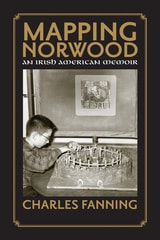
Mapping Norwood
An Irish-American MemoirCharles Fanning
University of Massachusetts Press, 2010
This memoir is an act of map making, of plotting out overlapping territories—topographical, temporal, and psychological. Centered on family life in a Massachusetts town from the 1920s to the 1960s, the author's investigation extends outward to include the Boston area from colonial times to the recent past, encounters with Boston's Museum of Fine Arts and with Harvard College, the American Civil War, and Ireland and Germany in the nineteenth century.
Charles Fanning re-creates the landscape of childhood and adolescence in a place and time both ordinary and rich with possibility. An expert on Irish immigration, he was born and raised in Norwood, Massachusetts, twelve miles outside of Boston, where Yankee and Irish cultures bumped against each other. The narrative traces his personal growth, shaped by family, school, baseball, radio drama, and art. He was the first in his family to attend college, and the book ends with his undergraduate experience at Harvard, class of 1964.
Along with this coming-of-age story, Mapping Norwood features forays back in time, including chapters on each of Fanning's parents and historical excavations and meditations on three ancestors. Guided by his own experience as a scholar, the pressure of these chapters is epistemological—the thrill of the hunt toward knowing. Fanning's great-grandfather, John Fanning, disappeared from the family in the late 1880s, and a chapter chronicles the discovery of “Walking John's” fifty years of hidden later life in East St. Louis, Illinois, where he died alone in 1946. Fanning's great-great-grandfather, Winslow Radcliffe, was a veteran of the 35th Massachusetts Infantry in the Civil War, and the author traces this regiment through the horrors of Antietam and Fredericksburg, by means of diaries and letters by four men from Winslow's company. The evidence gleaned helps explain Winslow's suicide after the war. An Irish immigrant ancestor, Phillip Fanning, came to Boston from County Monaghan just after the Great Famine of the late 1840s. Relying on historical research, Fanning imagines vividly the lives led by Phillip's family and thousands like them in the wake of Ireland's nineteenth-century catastrophe.

Mapping Post-War Italian Literature
Boom and Aftermath (1956–1979)Giulia Brecciaroli
University of London Press, 2024
In the aftermath of the Reconstruction era, immediately after the Second World War, Italy experienced an unprecedented phase of economic development, which transformed it from a traditionally agricultural and impoverished country into one of Europe’s most industrialized nations. The idea, treasured to this day by many Italians, that this period represents a golden age has been increasingly called into question by historical research that has unveiled the evident contradictions of Italian society at the time.
Mapping Post-War Italian Literature examines the “boom years” and their legacy to explore the long-lasting impact of post-war Italy’s urbanization and modernization on the imagination of Italian writers. Brecciaroli looks at how transformations affecting Italy’s leading industrial cities of the North, specifically Milan and Turin, as well as the provinces have been conceptualized in contemporary novels and travel accounts. The selected texts cross genre boundaries and reflect an array of literary perspectives, giving a compelling and multifaceted account of the post-war historical transition.
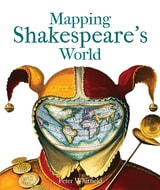
Mapping Shakespeare's World
Peter Whitfield
Bodleian Library Publishing, 2015
Mapping Shakespeare’s World explores these questions with surprising results. It has often been said that setting is irrelevant to Shakespeare’s plays—that, wherever they are set, their enduring appeal lies in their ability to speak to broad questions of human nature. Peter Whitfield shows that, on the contrary, many of Shakespeare’s locations were carefully chosen for their ability to convey subtle meanings an Elizabethan audience would have picked up on and understood. Through the use of paintings, drawings, contemporary maps and geographical texts, Whitfield suggests answers to such questions as where Illyria was located, why The Merry Wives of Windsor could only have taken place in Windsor, and how two utterly different comedies—The Comedy of Errors and Pericles, Prince of Tyre—both came to take place in ancient Ephesus.
Just when one might think there was nothing more to be said about Shakespeare, with Mapping Shakespeare’s World, Whitfield offers a fascinating new point of view.
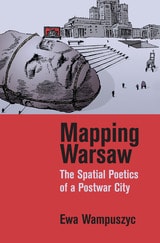
Mapping Warsaw
The Spatial Poetics of a Postwar CityEwa Wampuszyc
Northwestern University Press, 2018
Juxtaposing close readings of photo books, socialist-era newsreels called the Polska Kronika Filmowa, the comedies of Leonard Buczkowski and Jan Fethke, the writing and films of Tadeusz Konwicki, and a case study on the Palace of Culture and Science—a "gift" from none other than Stalin—this study investigates the rhetorical and visual, rather than physical, reconstruction of Warsaw in various medias and genres.
Ewa Wampuszyc roots her analysis in the historical context of the postwar decade and shows how and why Poland's capital became an essential part of a propaganda program inspired by communist ideology and the needs of a newly established socialist People's Republic. Mapping Warsaw demonstrates how physical space manifests itself in culture, and how culture, history, and politics leave an indelible mark on places. It points out ways in which we take for granted our perception of space and the meanings we assign to it.
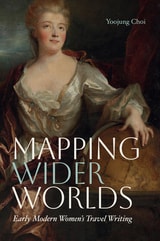
Mapping Wider Worlds
Early Modern Women's Travel WritingYoojung Choi
University of Delaware Press, 2027
Mapping Wider Worlds uncovers how early professional women writers in Britain invented a genre of women’s travel fiction in an era of increased mobility and exploration. As marketplace authorship began to take shape, writers such as Delarivier Manley, Mary Davys, Penelope Aubin, and Eliza Haywood turned to this genre to challenge the link between women’s travel and promiscuity, positioning travel instead as a site of knowledge production and self-discovery. In this book, Yoojung Choi reveals how these women authors not only reshaped cultural attitudes toward women’s mobility, but also redefined professional authorship in the late seventeenth and early eighteenth centuries, preceding and paving the way for travel literature by Lady Mary Wortley Montagu, Hester Piozzi, and Mary Wollstonecraft.
Maps and Mirrors
Topologies of Art and PoliticsSteve Martinot
Northwestern University Press, 2001
Marcus Aurelius in Love
Marcus Aurelius and Marcus Cornelius Fronto
University of Chicago Press, 2007
In 1815 a manuscript containing one of the long-lost treasures of antiquity was discovered—the letters of Marcus Cornelius Fronto, reputed to have been one of the greatest Roman orators. But this find disappointed many nineteenth-century readers, who had hoped for the letters to convey all of the political drama of Cicero’s. That the collection included passionate love letters between Fronto and the future emperor Marcus Aurelius was politely ignored—or concealed. And for almost two hundred years these letters have lain hidden in plain sight.
Marcus Aurelius in Love rescues these letters from obscurity and returns them to the public eye. The story of Marcus and Fronto began in 139 CE, when Fronto was selected to instruct Marcus in rhetoric. Marcus was eighteen then and by all appearances the pupil and teacher fell in love. Spanning the years in which the relationship flowered and died, these are the only love letters to survive from antiquity—homoerotic or otherwise. With a translation that reproduces the effusive, slangy style of the young prince and the rhetorical flourishes of his master, the letters between Marcus and Fronto will rightfully be reconsidered as key documents in the study of the history of sexuality and classics.

Margaret Atwood
Vision and FormsEdited by Kathryn Van Spanckeren and Jan Garden Castro. Foreword by Margaret Atwood
Southern Illinois University Press, 1988
A prolific writer and versatile social critic, Canadian novelist and poet Margaret Atwood has recently published Bluebeard’s Egg (short stories), Interlunar (poetry), and The Handmaid’s Tale a critically acclaimed best-selling novel.
This international collection of essays evaluates the complete body of her work—both the acclaimed fiction and the innovative poetry. The critics represented here—American, Australian, and Canadian—address Atwood’s handling of such themes as feminism, ecology, the gothic novel, and the political relationship between Canada and the United States.
The essays on Atwood’s novels introduce the general reader to her development as a writer, as she matures from a basically subjective, poetic vision, seen in Surfacing and The Edible Woman, to an increasingly engaged, political stance, exemplified by The Handmaid’s Tale. Other essays examine Atwood’s poetry, from her transformation of the Homeric model to her criticisms of the United States’ relationship with Canada. The last two critical essays offer a unique view of Atwood through an investigation of her use of the concept of shamanism and through a presentation of eight of her vivid watercolors.
The volume ends with Atwood presenting her own views in an interview with Jan Garden Castro and in a conversation between Atwood and students at the University of Tampa, Florida.
Margaret Atwood’s Textual Assassinations
Recent Poetry and FictionEdited by Sharon Rose Wilson
The Ohio State University Press, 2005

Margaret Fuller and Her Circles
Brigitte Bailey
University of New Hampshire Press, 2013
Marguerite Yourcenar
Inventing a LifeJosyane Savigneau
University of Chicago Press, 1993
Here, in its intricate and often contradictory detail, is Marguerite Yourcenar's story, one in which loss and learning intertwined almost from the first and in which love assumed a strangely paradoxical place. Drawing on letters, diaries, and interviews with Yourcenar's friends, colleagues, and lovers, Josyane Savigneau's biography paints an intimate portrait of an artist who lived according to her own, occasionally contrary, terms: a Frenchwoman ardently in love with her native tongue, yet who lived half her life in New England; an avid seductress of women, who spent nearly forty years with one woman, yet fell in love early and late in her life with two young men; a powerful female writer whose most memorable protagonists were male, from Alexis of her first novel to the later historical characters Hadrian and Zeno. Savigneau weaves these and other contraries of Yourcenar's life into a vibrant and engrossing pattern.
Editor of "Le Monde des Livres," the literary pages of France's most influential newspaper, Savigneau first met Marguerite Yourcenar on assignment in 1984. What began as a professional relationship gradually turned into a friendship. Her personal insights into that life enrich this exhaustively documented text. Following the lead set by Yourcenar in her memoir Dear Departed, the biographer found herself "searching for a truth that is multiple, unstable, evasive, sometimes saddening, and at first glance scandalous but that one cannot approach without often feeling for human beings in all their frailty a certain measure of kinship and, always, a sense of pity." Yourcenar's profound intelligence and sympathy, her foibles and obsessions, her accomplishments and trials: all are revealed here in an uncompromising portrait of an incomparable artist.
Marianne Meets the Mormons
Representations of Mormonism in Nineteenth-Century FranceHeather Belnap, Corry Cropper, and Daryl Lee
University of Illinois Press, 2022
Surprising and innovative, Marianne Meets the Mormons looks at how nineteenth-century French observers engaged with the idea of Mormonism in order to reframe their own cultural preoccupations.
Marianne Moore, Elizabeth Bishop, and May Swenson
The Feminist Poetics of Self-RestraintKirstin Hotelling Zona
University of Michigan Press, 2002
In recent years critical studies of Bishop and Moore have flourished, a large percentage of them devoted to explorations of sexuality and gender. A gap is growing, however, between feminist repossessions of Moore and Bishop and recent readings of their antiessentialist poetics. On the one hand, these poets are appearing more frequently in the feminist canon, but the price of this inclusion is usually the suppression of their strategies of self-restraint. While Zona questions the poetic privileging of self-expression, she establishes contiguity between feminist poetry and developments in American poetry at large. In doing so she asserts the centrality of feminist poetry within discussions of contemporary American poetry, thereby challenging the common perception of feminist poetry as an "alternative" (which often means auxiliary) genre.
Kirstin Hotelling Zona is Assistant Professor of Poetry and Poetics, Illinois State University.
Marianne Moore, Subversive Modernist
By Taffy Martin
University of Texas Press, 1986
Marie de France and the Poetics of Memory
Logan E. Whalen
Catholic University of America Press, 2008
Mariners, Renegades and Castaways
The Story of Herman Melville and the World We Live InC. L. R. James
Dartmouth College Press, 2001
Mariners, Renegades and Castaways
The Story of Herman Melville and the World We Live InC. L. R. James
Brandeis University Press, 2025
Political theorist and cultural critic, novelist, and cricket enthusiast, C. L. R. James (1901–89) was a brilliant polymath who was described by Edward Said as “a centrally important twentieth-century figure.” Through such landmark works as The Black Jacobins, Beyond a Boundary, and American Civilization, James’s thought continues to influence and inspire scholars in a variety of fields.
In this complete edition of his seminal work of literary and cultural criticism, Mariners, Renegades, and Castaways, James anticipated many of the concerns and ideas that have shaped the contemporary fields of American and postcolonial studies. In this provocative study of Moby Dick in which he challenged the prevailing Americanist interpretation that opposed a “totalitarian” Ahab and a “democratic, American” Ishmael, James offers instead a vision of a factory-like Pequod whose “captain of industry” leads the crew to their doom. In addition to demonstrating how such an interpretation supported the United States’ emerging national security state, he also related the narrative of Moby Dick to his own persecuted position at the height of McCarthyism. It is precisely this personal, deeply original material that was excised from the first edition of this book.
With a new foreword by Professor Chanda Prescod-Weinstein—theoretical physicist, advocate for a just science, and James’s granddaughter—and an introduction by Professor Donald E. Pease at Dartmouth College that places the work in its critical and cultural context, Mariners, Renegades, and Castaways is once again available in a new edition.
Mario Vargas Llosa
A Collection of Critical EssaysEdited by Charles Rossman and Alan Warren Friedman
University of Texas Press, 1978
The Peruvian Mario Vargas Llosa has been acclaimed throughout the literary world as one of Latin America's finest writers, yet until recently little has been written about his work in English. While his work has the subject of an increasing flow of critical commentary in Spanish and his major novels have been translated into English, this is the first full-scale critical treatment of Vargas Llosa published in the English language.
These articles by a number of established writers and critics appraise Vargas Llosa's individual novels as well as the body of his work. The Time of the Hero, The Green House, Conversation in The Cathedral, and Pantaleón y las visitadoras are examined in order of publication, A second group of more general essays ranges across Vargas Llosa's work and explores pervasive themes and concerns.
Two pieces by José Miguel Oviedo serve as a coda. In a bilingual interview, Oviedo and Vargas Llosa discuss Vargas Llosa's novel La tía Julia y el escribidor. Oviedo concludes with a critical discussion of that novel. A Vargas Llosa chronology compiled by the editors is also included.
Most of these essays originally appeared in 1977 as a special issue of Texas Studies in Literature and Language. The concluding essay by Oviedo was prepared especially for this edition.
Mario Vargas Llosa
A Life of WritingBy Raymond Leslie Williams
University of Texas Press, 2014
Awarded the Nobel Prize in 2010 at the age of seventy-four, Peruvian writer Mario Vargas Llosa has held pivotal roles in the evolution and revolutions of modern Latin American literature. Perhaps surprisingly, no complete history of Vargas Llosa’s works, placed in biographical and historical context, has been published—until now. A masterwork from one of America’s most revered scholars of Latin American fiction, Mario Vargas Llosa: A Life of Writing provides a critical overview of Vargas Llosa’s numerous novels while reinvigorating debates regarding conventional interpretations of the work.
Weaving analysis with discussions of the writer’s political commentary, Raymond Leslie Williams traces the author’s youthful identity as a leftist student of the 1960s to a repudiation of some of his earlier ideas beginning in the 1980s. Providing a unique perspective on the complexity, nuance, and scope of Vargas Llosa’s lauded early novels and on his passionate support of indigenous populations in his homeland, Williams then turns his eye to the recent works, which serve as a bridge between the legacies of the Boom and the diverse array of contemporary Latin American fiction writers at work today. In addition, Williams provides a detailed description of Vargas Llosa’s traumatic childhood and its impact on him—seen particularly in his lifelong disdain for authority figures—as well as of the authors who influenced his approach, from Faulkner to Flaubert. Culminating in reflections drawn from Williams’s formal interviews and casual conversations with the author at key phases of both men’s careers, this is a landmark publication that will spark new lines of inquiry into an intricate body of work.
Mark My Words
Native Women Mapping Our NationsMishuana Goeman
University of Minnesota Press, 2013
Dominant history would have us believe that colonialism belongs to a previous era that has long come to an end. But as Native people become mobile, reservation lands become overcrowded and the state seeks to enforce means of containment, closing its borders to incoming, often indigenous, immigrants.
In Mark My Words, Mishuana Goeman traces settler colonialism as an enduring form of gendered spatial violence, demonstrating how it persists in the contemporary context of neoliberal globalization. The book argues that it is vital to refocus the efforts of Native nations beyond replicating settler models of territory, jurisdiction, and race. Through an examination of twentieth-century Native women’s poetry and prose, Goeman illuminates how these works can serve to remap settler geographies and center Native knowledges. She positions Native women as pivotal to how our nations, both tribal and nontribal, have been imagined and mapped, and how these women play an ongoing role in decolonization.
In a strong and lucid voice, Goeman provides close readings of literary texts, including those of E. Pauline Johnson, Esther Belin, Joy Harjo, Leslie Marmon Silko, and Heid Erdrich. In addition, she places these works in the framework of U.S. and Canadian Indian law and policy. Her charting of women’s struggles to define themselves and their communities reveals the significant power in all of our stories.
Mark Twain Speaking
Paul Fatout
University of Iowa Press, 1976
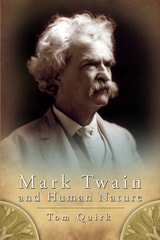
Mark Twain and Human Nature
Tom Quirk
University of Missouri Press, 2007
Mark Twain once claimed that he could read human character as well as he could read the Mississippi River, and he studied his fellow humans with the same devoted attention. In both his fiction and his nonfiction, he was disposed to dramatize how the human creature acts in a given environment—and to understand why.
Now one of America’s preeminent Twain scholars takes a closer look at this icon’s abiding interest in his fellow creatures. In seeking to account for how Twain might have reasonably believed the things he said he believed, Tom Quirk has interwoven the author’s inner life with his writings to produce a meditation on how Twain’s understanding of human nature evolved and deepened, and to show that this was one of the central preoccupations of his life.
Quirk charts the ways in which this humorist and occasional philosopher contemplated the subject of human nature from early adulthood until the end of his life, revealing how his outlook changed over the years. His travels, his readings in history and science, his political and social commitments, and his own pragmatic testing of human nature in his writing contributed to Twain’s mature view of his kind. Quirk establishes the social and scientific contexts that clarify Twain’s thinking, and he considers not only Twain’s stated intentions about his purposes in his published works but also his ad hoc remarks about the human condition.
Viewing both major and minor works through the lens of Twain’s shifting attitude, Quirk provides refreshing new perspectives on the master’s oeuvre. He offers a detailed look at the travel writings, including The Innocents Abroad and Following the Equator, and the novels, including The Adventures of Tom Sawyer, Adventures of Huckleberry Finn, and Pudd’nhead Wilson, as well as an important review of works from Twain’s last decade, including fantasies centering on man’s insignificance in Creation, works preoccupied with isolation—notably No. 44,The Mysterious Stranger and “Eve’s Diary”—and polemical writings such as What Is Man?
Comprising the well-seasoned reflections of a mature scholar, this persuasive and eminently readable study comes to terms with the life-shaping ideas and attitudes of one of America’s best-loved writers. Mark Twain and Human Nature offers readers a better understanding of Twain’s intellect as it enriches our understanding of his craft and his ineluctable humor.
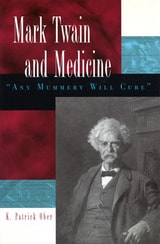
Mark Twain and Medicine
"Any Mummery Will Cure"K. Patrick Ober
University of Missouri Press, 2003
Mark Twain has always been America’s spokesman, and his comments on a wide range of topics continue to be accurate, valid, and frequently amusing. His opinions on the medical field are no exception. While Twain’s works, including his popular novels about Tom Sawyer and Huckleberry Finn, are rich in medical imagery and medical themes derived from his personal experiences, his interactions with the medical profession and his comments about health, illness, and physicians have largely been overlooked.
In Mark Twain and Medicine, K. Patrick Ober remedies this omission. The nineteenth century was a critical time in the development of American medicine, with much competition among the different systems of health care, both traditional and alternative. Not surprisingly, Mark Twain was right in the middle of it all. He experimented with many of the alternative care systems that were available in his day—in part because of his frustration with traditional medicine and in part because he hoped to find the “perfect” system that would bring health to his family.
Twain’s commentary provides a unique perspective on American medicine and the revolution in medical systems that he experienced firsthand. Ober explores Twain’s personal perspective in this area, as he expressed it in fiction, speeches, and letters. As a medical educator, Ober explains in sufficient detail and with clarity all medical and scientific terms, making this volume accessible to the general reader.
Ober demonstrates that many of Twain’s observations are still relevant to today’s health care issues, including the use of alternative or complementary medicine in dealing with illness, the utility of placebo therapies, and the role of hope in the healing process.
Twain’s evaluation of the medical practices of his era provides a fresh, humanistic, and personalized view of the dramatic changes that occurred in medicine through the nineteenth century and into the first decade of the twentieth. Twain scholars, general readers, and medical professionals will all find this unique look at his work appealing.
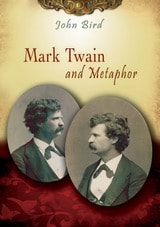
Mark Twain and Metaphor
John Bird
University of Missouri Press, 2007
Metaphor theory, observes John Bird, is like Mark Twain: both seem simple upon first introduction. Now, in the most complete study to date of Twain’s use of figurative language, a veteran Twain scholar tackles the core of his writing and explores it with theoretical approaches that have rarely been applied to Twain, providing new insights into how he imagined his world—and the singular ways in which he expressed himself.
From “The Jumping Frog” to the late dream narratives, Bird considers Twain’s metaphoric construction over his complete career and especially sheds new light on his central texts: Roughing It; The Adventures of Tom Sawyer; Adventures of Huckleberry Finn; A Connecticut Yankee in King Arthur’s Court; Pudd’nhead Wilson; and No. 44,The Mysterious Stranger. He reconsiders “Old Times on the Mississippi” as the most purely metaphorical of Twain’s writings, goes on to look at how Twain used metaphor and talked about it in a variety of works and genres, and even argues that Clemens’s pseudonym is not so much an alter ego as a metaphorized self.
By offering insight into how Twain handled figurative language during the composing process, Bird reveals not only hidden facets of his artistry but also new aspects of works that we think we know well—including some entirely new ideas regarding Huck Finn that draw on the recent discovery of the first half of the manuscript. In addition to dealing with issues currently central to Twain studies, such as race and gender, he also links metaphor to humor and dream theory to further illuminate topics central to his work.
More than a study of Twain’s language, the book delves into the psychological aspects of metaphor to reveal the writer’s attitudes and thoughts, showing how using metaphor as a guide to Twain reveals much about his composition process. Applying the insights of metaphor theorists such as Roman Jakobson and Colin M. Turbayne, Bird offers readers not only new insights into Twain but also an introduction to this interdisciplinary field.
In lively prose, Mark Twain and Metaphor provides a vital way to read Twain’s entire corpus, allowing readers to better appreciate his style, humor, and obsession with dreams. It opens new ground and makes old ground fresh again, offering ways to see and resee this essential American writer.