Results by title
4917 books match the query 'Philosophy' and 215 start with m
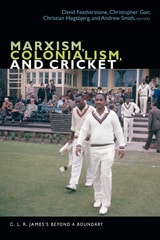
Marxism, Colonialism, and Cricket
C. L. R. James's Beyond a BoundaryDavid Featherstone, Christopher Gair, Christian Høgsbjerg and Andrew Smith, editors
Duke University Press, 2018
Contributors. Anima Adjepong, David Austin, Hilary McD. Beckles, Michael Brearley, Selwyn R. Cudjoe, David Featherstone, Christopher Gair, Paget Henry, Christian Høgsbjerg, C. L. R. James, Selma James, Roy McCree, Minkah Makalani, Clem Seecharan, Andrew Smith, Neil Washbourne, Claire Westall
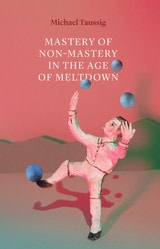
Mastery of Non-Mastery in the Age of Meltdown
Michael Taussig
University of Chicago Press, 2020
Taussig seeks to move us away from the manipulation of nature and reorient us to different metaphors and sources of inspiration to develop a new ethical stance toward the world. His ultimate goal is to undo his readers’ sense of control and engender what he calls “mastery of non-mastery.” This unique book developed out of Taussig’s work with peasant agriculture and his artistic practice, which brings performance art together with aspects of ritual. Through immersive meditations on Walter Benjamin, D. H. Lawrence, Emerson, Bataille, and Proust, Taussig grapples with the possibility of collapse and with the responsibility we bear for it.
Material Law
A Jurisprudence of What's RealJohn Brigham
Temple University Press, 2009
Law is part of the process by which people construct their views of the world. In Material Law, distinguished scholar John Brigham focuses on the places where law and material life intersect, and how law creates and alters our social reality. Brigham looks at an eclectic group of bodies and things—from maps and territories and trends in courthouse architecture to a woman's womb and a judge's body— to make connections between the material and the legal.
Theoretically sophisticated, and consistently fascinating, Material Law integrates law and society, political science, and popular culture in a truly interdisciplinary fashion. Brigham examines how the meaning of law is influenced by politics, reviewing, for example, whether the authority of global law supersedes that of national law in the context of anglo-american cultural colonialism. What emerges is a well-reasoned look at how the authority of law constitutes what we see as real in our lives.
Mathematics and Humor
John Allen Paulos
University of Chicago Press, 1982
"Jokes, paradoxes, riddles, and the art of non-sequitur are revealed with great perception and insight in this illuminating account of the relationship between humor and mathematics."—Joseph Williams, New York Times
"'Leave your mind alone,' said a Thurber cartoon, and a really complete and convincing analysis of what humour is might spoil all jokes forever. This book avoids that danger. What it does. . .is describe broadly several kinds of mathematical theory and apply them to throw sidelights on how many kinds of jokes work."—New Scientist
"Many scholars nowadays write seriously about the ludicrous. Some merely manage to be dull. A few—like Paulos—are brilliant in an odd endeavor."—Los Angeles Times Book Review
Matter and Mathematics
An Essential Account of Laws of NatureAndrew Younan
Catholic University of America Press, 2022
Matterphorics
On the Laws of TheoryDaniela Gandorfer
Duke University Press, 2026
Matters of Care
Speculative Ethics in More than Human WorldsMaría Puig de la Bellacasa
University of Minnesota Press, 2017
To care can feel good, or it can feel bad. It can do good, it can oppress. But what is care? A moral obligation? A burden? A joy? Is it only human? In Matters of Care, María Puig de la Bellacasa presents a powerful challenge to conventional notions of care, exploring its significance as an ethical and political obligation for thinking in the more than human worlds of technoscience and naturecultures.
Matters of Care contests the view that care is something only humans do, and argues for extending to non-humans the consideration of agencies and communities that make the living web of care by considering how care circulates in the natural world. The first of the book’s two parts, “Knowledge Politics,” defines the motivations for expanding the ethico-political meanings of care, focusing on discussions in science and technology that engage with sociotechnical assemblages and objects as lively, politically charged “things.” The second part, “Speculative Ethics in Antiecological Times,” considers everyday ecologies of sustaining and perpetuating life for their potential to transform our entrenched relations to natural worlds as “resources.”
From the ethics and politics of care to experiential research on care to feminist science and technology studies, Matters of Care is a singular contribution to an emerging interdisciplinary debate that expands agency beyond the human to ask how our understandings of care must shift if we broaden the world.
Meaning
Michael Polanyi and Harry Prosch
University of Chicago Press, 1977
Establishing that science is an inherently normative form of knowledge and that society gives meaning to science instead of being given the "truth" by science, Polanyi contends here that the foundation of meaning is the creative imagination. Largely through metaphorical expression in poetry, art, myth, and religion, the imagination is used to synthesize the otherwise chaotic and disparate elements of life. To Polanyi these integrations stand with those of science as equally valid modes of knowledge. He hopes this view of the foundation of meaning will restore validity to the traditional ideas that were undercut by modern science. Polanyi also outlines the general conditions of a free society that encourage varied approaches to truth, and includes an illuminating discussion of how to restore, to modern minds, the possibility for the acceptance of religion.
Meaning and Mortality in Kierkegaard and Heidegger
Origins of the Existential Philosophy of DeathAdam Buben
Northwestern University Press, 2016
Meaning and Necessity
A Study in Semantics and Modal LogicRudolf Carnap
University of Chicago Press, 1988
Meaning in History
The Theological Implications of the Philosophy of HistoryKarl Löwith
University of Chicago Press, 1957
Meaning of Modern Art
Karsten Harries
Northwestern University Press, 1979
Art expresses an ideal image of man, and an essential part of understanding the meaning of a work of art is understanding this image. When the ideal image changes, art, too, must change. It is thus possible to look at the emergence of modern art as a function of the disintegration of the Platonic-Christian conception of man. The artist no longer has an obvious, generally accepted route to follow. One sign of this is that there is no one style today comparable to Romanesque, Gothic, Renaissance, or Baroque. This lack of direction has given the artist a new freedom. Today there is a great variety of answers to the question, "What is art?" Such variety, however, betrays an uncertainty about the meaning of art. An uneasiness about the meaning of art has led modern artists to enter into dialogue with art historians, psychologists and philosophers. Perhaps this interpretation can contribute to that dialogue.
Meaning, Basic Self-Knowledge, and Mind
Essays on Tyler BurgeEdited by María Frápolli and Esther Romero
CSLI, 2003
The authors of the eleven papers here expound their versions of this position and go on to critique Burge's version. Together with Burge's replies, this volume offers a major contribution to contemporary philosophy.
Meaning, Creativity, and the Partial Inscrutability of the Human Mind
Julius M. Moravcsik
CSLI, 1998
Meaning, Creativity, and the Partial Inscrutability of the Human Mind
Second EditionJulius M. Moravcsik
CSLI, 2016
Meaning, Decision, and Norms
Themes from the Work of Allan GibbardEds. Billy Dunaway and David Plunkett
Michigan Publishing Services, 2021
This volume is not a collection of artifacts from past decades of philosophy. Instead, it is a collection of essays that each make a significant contribution to contemporary work in philosophy. This reflects the fact that Gibbard’s work has not only had a massive influence on past discussion in philosophy but also continues to influence new directions of philosophical research.
With contributions from:
Sara Aronowitz, Simon Blackburn, Paul Boghossian, David Braddon-Mitchell, Nate Charlow, Stephen Darwall, Jamie Dreier, Billy Dunaway, Melissa Fusco, Sona Ghosh, Allan Gibbard, Bill Harper, Paul Horwich, Zoë Johnson King, Tristram McPherson, Howard Nye, Lauren Olin, Caleb Perl, David Plunkett, Peter Railton, Connie Rosati, Mark Schroeder, Alex Silk, Daniel J. Singer, Brian Skyrms, and Seth Yalcin.
Meaning, Intentions, and Argumentation
Kepa Korta and Garmendia
CSLI, 2008
Means Without End
Notes on PoliticsGiorgio Agamben
University of Minnesota Press, 2000
Measuring Time, Making History
Lynn Hunt
Central European University Press, 2008

Mechanicity
The Material Force of Code in International PoliticsVic Castro
University of Michigan Press, 2027
Despite their seeming relegation to the digital world, code and software can have material, large-scale, and even violent effects. In just one example, the NotPetya ransomware paralyzed one-fifth of world maritime trade in 2017. Mechanicity is a philosophical investigation of what happens when the force of language merges with material force, and what this means for the great ideas of politics: political action, international anarchy, and the very concept of sovereign state.
In this book, Vic Castro returns to Thomas Hobbes’s idea of the mechanical as a force both determinate and unruly, just like machines and software, and examines the human body—both in Hobbes’s political philosophy and in mishaps of genetic code—as that which brings together language and materiality in political society. To develop the framework of mechanicity, Castro also revives the Copenhagen School’s poststructuralist realism, the Derridian approach to traditional International Relations, and particularly actor-network theory (ANT). Using the case studies on Apple’s 2016 encrypted iPhone and NSO Group’s Pegasus spyware, Mechanicity shows how software is not just constrained to immaterial cyberspace; it also reshapes the physical world and the politics possible therein.
Media Theory in Japan
Marc Steinberg and Alexander Zahlten, editors
Duke University Press, 2017

Media and Management
Rutvica Andrijasevic
University of Minnesota Press, 2021
An essential account of how the media devices we use today inherit the management practices governing factory labor
This book argues that management is enabled by media forms, just as media gives life to management. Media technologies central to management have included the stopwatch, the punch card, the calculator, and the camera, while management theories are taught in printed and virtual textbooks and online through TED talks. In each stage of the evolving relationship between workers and employers, management innovations are learned through media, with media formats producing fresh opportunities for management.
Drawing on rich historical and ethnographic case studies, this book approaches key instances of the industrial and service economy—the legacy of Toyotism in today’s software industry, labor mediators in electronics manufacturing in Central and Eastern Europe, and app-based food-delivery platforms in China—to push media and management studies in new directions. Media and Management offers a provocative insight on the future of labor and media that inevitably cross geographical boundaries.
Media and the Mind
Art, Science, and Notebooks as Paper Machines, 1700-1830Matthew Daniel Eddy
University of Chicago Press, 2022
We often think of reason as a fixed entity, as a definitive body of facts that do not change over time. But during the Enlightenment, reason also was seen as a process, as a set of skills enacted on a daily basis. How, why, and where were these skills learned? Concentrating on Scottish students living during the long eighteenth century, this book argues that notebooks were paper machines and that notekeeping was a capability-building exercise that enabled young notekeepers to mobilize everyday handwritten and printed forms of material and visual media in a way that empowered them to judge and enact the enlightened principles they encountered in the classroom. Covering a rich selection of material ranging from simple scribbles to intricate watercolor diagrams, the book reinterprets John Locke’s comparison of the mind to a blank piece of paper, the tabula rasa. Although one of the most recognizable metaphors of the British Enlightenment, scholars seldom consider why it was so successful for those who used it. Each chapter uses one core notekeeping skill to reveal the fascinating world of material culture that enabled students in the arts, sciences, and humanities to transform the tabula rasa metaphor into a dynamic cognitive model. Starting in the home, moving to schools, and ending with universities, the book reconstructs the relationship between media and the mind from the bottom up. It reveals that the cognitive skills required to make and use notebooks were not simply aids to reason; rather, they were part of reason itself.
Mediators
Aesthetics, Politics, and the CityReinhold Martin
University of Minnesota Press, 2014
Forerunners: Ideas First is a thought-in-process series of breakthrough digital publications. Written between fresh ideas and finished books, Forerunners draws on scholarly work initiated in notable blogs, social media, conference plenaries, journal articles, and the synergy of academic exchange. This is gray literature publishing: where intense thinking, change, and speculation take place in scholarship.
Medieval Cosmology
Theories of Infinity, Place, Time, Void, and the Plurality of WorldsPierre Duhem
University of Chicago Press, 1987
Medieval Philosophy Redefined as the Latin Age
John Deely
St. Augustine's Press, 2016
“With the sophistic modern and Enlightenment misconceptions about philosophy’s nature and history daily crashing and burning around us, Deely’s unconventional way of understanding medieval philosophy is like a breath of fresh air amid intellectual smog. This is a great book, the single most important study of medieval thought in half a century or more. It deserves an unbiased hearing by anyone today claiming to be a serious philosopher.” — Peter A. Redpath
Founding Chairman, Universities of Western Civilization Chairman of the Board, The International Etienne Gilson Society
“Drawing upon the thought of John Poinsot and Charles Pierce, John Deely has opened a distinctively postmodern path to the metaphysics of being, at once illuminating much of this ancient tradition while casting new light upon it in the context of contemporary thought. His treatment notably of St. Thomas is not merely a return to an earlier thinker, but an opening to a different path, at once in profound agreement with St. Thomas and yet heretofore unexplored. This book, thus, not only constitutes a return to a past era, but shows this era in a new light that illuminates as well the contemporary scene.” — Kenneth L. Schmitz
Professor Emeritus, University of Toronto, Canada Pontifical John Paul II Institute for Studies on Marriage and Family, Washington, D.C.
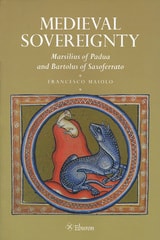
Medieval Sovereignty
Marsilius of Padua and Bartolous of SaxoferratoFrancesco Maiolo
Eburon Academic Publishers, 2007
Meeting Place
The Human Encounter and the Challenge of CoexistencePaul Carter
University of Minnesota Press, 2013
In this remarkable and often dazzling book, Paul Carter explores the conditions for sociability in a globalized future. He argues that we make many assumptions about communication but overlook barriers to understanding between strangers as well as the importance of improvisation in overcoming these obstacles to meeting. While disciplines such as sociology, legal studies, psychology, political theory, and even urban planning treat meeting as a good in its own right, they fail to provide a model of what makes meeting possible and worth pursuing: a yearning for encounter.
The volume’s central narrative—between Northern cultural philosophers and Australian societies—traverses the troubled history of misinterpretation that is characteristic of colonial cross-cultural encounter. As he brings the literature of Indigenous and non-Indigenous anthropological research into dialogue with Western approaches of conceptualizing sociability, Carter makes a startling discovery: that meeting may not be desirable and, if it is, its primary objective may be to negotiate a future of non-meeting.
To explain the phenomenon of encounter, Carter performs it in differing scales, spaces, languages, tropes, and forms of knowledge, staging in the very language of the book what he calls “passages.” In widely varying contexts, these passages posit the disjunction of Greco-Roman and Indigenous languages, codes, theatrics of power, social systems, and visions of community. In an era of new forms of technosocialization, Carter offers novel ways of presenting the philosophical dimensions of waiting, meeting, and non-meeting.
Meeting the Universe Halfway
Quantum Physics and the Entanglement of Matter and MeaningKaren Barad
Duke University Press, 2006
In an agential realist account, the world is made of entanglements of “social” and “natural” agencies, where the distinction between the two emerges out of specific intra-actions. Intra-activity is an inexhaustible dynamism that configures and reconfigures relations of space-time-matter. In explaining intra-activity, Barad reveals questions about how nature and culture interact and change over time to be fundamentally misguided. And she reframes understanding of the nature of scientific and political practices and their “interrelationship.” Thus she pays particular attention to the responsible practice of science, and she emphasizes changes in the understanding of political practices, critically reworking Judith Butler’s influential theory of performativity. Finally, Barad uses agential realism to produce a new interpretation of quantum physics, demonstrating that agential realism is more than a means of reflecting on science; it can be used to actually do science.
Melancholia's Dog
Reflections on Our Animal KinshipAlice A. Kuzniar
University of Chicago Press, 2006
An attempt to understand human attachment to the canis familiaris in terms of reciprocity and empathy, Melancholia’sDog tackles such difficult concepts as intimacy and kinship with dogs, the shame associated with identification with their suffering, and the reasons for the profound mourning over their deaths. In addition to philosophy and psychoanalysis, Alice A. Kuzniar turns to the insights and images offered by the literary and visual arts—the short stories of Ivan Turgenev and Franz Kafka, the novels of J. M. Coetzee and Rebecca Brown, the photography of Sally Mann and William Wegman, and the artwork of David Hockney and Sue Coe. Without falling into sentimentality or anthropomorphization, Kuzniar honors and learns from our canine companions, above all attending to the silences and sadness brought on by the effort to represent the dog as perfectly and faithfully as it is said to love.

Melancholy Dialectics
Walter Benjamin and the Play of MourningPensky Max
University of Massachusetts Press, 2001

Memoirs of the Blind
The Self-Portrait and Other RuinsJacques Derrida
University of Chicago Press, 1993
vision, blindness, self-representation, and their relation to
drawing, while offering detailed readings of an extraordinary
collection of images. Selected by Derrida from the prints
and drawings department of the Louvre, the works depict
blindness—fictional, historical, and biblical. From Old
and New Testament scenes to the myth of Perseus and the
Gorgon and the blinding of Polyphemus, Derrida uncovers in
these images rich, provocative layers of interpretation.
For Derrida drawing is itself blind; as an act rooted in
memory and anticipation, drawing necessarily replaces one
kind of seeing (direct) with another (mediated). Ultimately,
he explains, the very lines which compose any drawing are
themselves never fully visible to the viewer since they exist
only in a tenuous state of multiple identities: as marks on
a page, as indicators of a contour. Lacking a "pure"
identity, the lines of a drawing summon the supplement of the
word, of verbal discourse, and, in doing so, obscure the
visual experience. Consequently, Derrida demonstrates, the
very act of depicting a blind person undertakes multiple
enactments and statements of blindness and sight.
Memoirs of the Blind is both a sophisticated
philosophical argument and a series of detailed readings.
Derrida provides compelling insights into famous and lesser
known works, interweaving analyses of texts—including
Diderot's Lettres sur les aveugles, the notion of
mnemonic art in Baudelaire's The Painter of Modern
Life, and Merleau-Ponty's The Visible and the
Invisible. Along with engaging meditations on the history
and philosophy of art, Derrida reveals the ways viewers
approach philosophical ideas through art, and the ways art
enriches philosophical reflection.
An exploration of sight, representation, and art,
Memoirs of the Blind extends and deepens the
meditation on vision and painting presented in Truth and
Painting. Readers of Derrida, both new and familiar, will
profit from this powerful contribution to the study of the
visual arts.
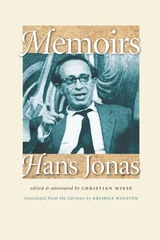
Memoirs
Hans JonasHans Jonas
Brandeis University Press, 2021
When Hans Jonas died in 1993, he was revered among American scholars specializing in European philosophy, but his thought had not yet made great inroads among a wider public. In Germany, conversely, during the 1980s, when Jonas himself was an octogenarian, he became a veritable intellectual celebrity, owing to the runaway success of his 1979 book The Imperative of Responsibility. In the 1920s, Jonas studied philosophy with Edmund Husserl and Martin Heidegger, but the Nazi regime forced him to leave Germany for London in 1933. He later emigrated to Palestine and eventually enlisted in the British Army’s Jewish Brigade to fight against Hitler. Following the Israeli War of Independence, he emigrated to the United States and took a position at the New School for Social Research in New York. He became part of a circle of friends around Hannah Arendt and Heinrich Blucher, which included Adolph Lowe and Paul Tillich.
This memoir, a diverse collection of previously unpublished materials—diaries, letters, interviews, and public statements—has been organized by Christian Wiese, whose afterword links the Jewish dimensions of Jonas’s life and philosophy. Because Jonas’s life spanned the entire twentieth century, this memoir provides nuanced pictures of German Jewry during the Weimar Republic, of German Zionism, of the Jewish emigrants in Palestine during the 1930s and 1940s, and of German Jewish émigré intellectuals in New York. Since Memoirs was first published in 2008, interest in the work of Hans Jonas has grown among American academics in recent years.
Memorializing Violence
Transnational Feminist ReflectionsAlison Crosby
Rutgers University Press, 2025
Memory against Culture
Arguments and RemindersJohannes Fabian
Duke University Press, 2007
Fabian returns to his landmark book Time and the Other to consider how the role of the other in anthropological inquiry has been transformed over the past two decades. He explores the place of linguistics in contemporary language-centered anthropology, and he ponders how studies of material culture imbue objects with “otherness.” Meditating on the place of memory and forgetting in ethnography, he draws from his own ethnographic work in the Congo to ask why Africa, the site of so much early anthropological study, continues to be forgotten in the wake of colonization. Arguing for the importance of remembering Africa, Fabian focuses on the relationship between thought and memory in the Swahili language. In so doing, he suggests new methods for investigating memory practices across cultures. Turning to the practice of ethnography, he examines the role of the Internet and the place of field notes and other memoranda in ethnographic writing. At once wide-ranging and incisive, Memory against Culture is a significant reflection on the state of the field by one of its most thoughtful and engaged practitioners.
Memory, History, Forgetting
Paul Ricoeur
University of Chicago Press, 2004
Why do major historical events such as the Holocaust occupy the forefront of the collective consciousness, while profound moments such as the Armenian genocide, the McCarthy era, and France's role in North Africa stand distantly behind? Is it possible that history "overly remembers" some events at the expense of others? A landmark work in philosophy, Paul Ricoeur's Memory, History, Forgetting examines this reciprocal relationship between remembering and forgetting, showing how it affects both the perception of historical experience and the production of historical narrative.
Memory, History, Forgetting, like its title, is divided into three major sections. Ricoeur first takes a phenomenological approach to memory and mnemonical devices. The underlying question here is how a memory of present can be of something absent, the past. The second section addresses recent work by historians by reopening the question of the nature and truth of historical knowledge. Ricoeur explores whether historians, who can write a history of memory, can truly break with all dependence on memory, including memories that resist representation. The third and final section is a profound meditation on the necessity of forgetting as a condition for the possibility of remembering, and whether there can be something like happy forgetting in parallel to happy memory. Throughout the book there are careful and close readings of the texts of Aristotle and Plato, of Descartes and Kant, and of Halbwachs and Pierre Nora.
A momentous achievement in the career of one of the most significant philosophers of our age, Memory, History, Forgetting provides the crucial link between Ricoeur's Time and Narrative and Oneself as Another and his recent reflections on ethics and the problems of responsibility and representation.

Memory, Myth, and Time in Mexico
From the Aztecs to IndependenceBy Enrique Florescano
University of Texas Press, 1994
In Memory, Myth, and Time in Mexico, noted Mexican scholar Enrique Florescano’s Memoria mexicana becomes available for the first time in English. A collection of essays tracing the many memories of the past created by different individuals and groups in Mexico, the book addresses the problem of memory and changing ideas of time in the way Mexicans conceive of their history. Original in perspective and broad in scope, ranging from the Aztec concept of the world and history to the ideas of independence, this book should appeal to a wide readership.

Men among the Mammoths
A. Bowdoin Van Riper
University of Chicago Press, 1993
Merleau-Ponty and Derrida
Intertwining Embodiment and AlterityJack Reynolds
Ohio University Press, 2005
While there have been many essays devoted to comparing the work of Maurice Merleau-Ponty with that of Jacques Derrida, there has been no sustained book-length treatment of these two French philosophers. Additionally, many of the essays presuppose an oppositional relationship between them, and between phenomenology and deconstruction more generally.
Jack Reynolds systematically explores their relationship by analyzing each philosopher in terms of two important and related issues—embodiment and alterity. Focusing on areas with which they are not commonly associated (e.g., Derrida on the body and Merleau-Ponty on alterity) makes clear that their work cannot be adequately characterized in a strictly oppositional way. Merleau-Ponty and Derrida: Intertwining Embodiment and Alterity proposes the possibility of a Merleau-Ponty-inspired philosophy that does not so avowedly seek to extricate itself from phenomenology, but that also cannot easily be dismissed as simply another instantiation of the metaphysics of presence. Reynolds argues that there are salient ethico-political reasons for choosing an alternative that accords greater attention to our embodied situation.
As the first full-length monograph comparing the philosophers, Merleau-Ponty and Derrida will interest scholars and students in European philosophy and teachers of courses dealing with deconstruction.
Merleau-Ponty's Last Vision
A Proposal for the Completion of "The Visible and the Invisible"Douglas Low
Northwestern University Press, 2000
Merleau-Ponty's Ontology
Second EditionM.C. Dillon
Northwestern University Press, 1997
Merleau-Ponty
Space, Place, ArchitecturePatricia M. Locke
Ohio University Press, 2015
Phenomenology has played a decisive role in the emergence of the discourse of place, now indispensable to many disciplines in the humanities and social sciences, and the contribution of Merleau-Ponty’s thought to architectural theory and practice is well established. Merleau-Ponty: Space, Place, Architecture is a vibrant collection of original essays by twelve eminent philosophers who mine Merleau-Ponty’s work to consider how we live and create as profoundly spatial beings. The resulting collection is essential to philosophers and creative artists as well as those concerned with the pressing ethical issues of our time.
Each contributor presents a different facet of space, place, or architecture. These essays carve paths from Merleau-Ponty to other thinkers such as Irigaray, Deleuze, Ettinger, and Piaget. As the first collection devoted specifically to developing Merleau-Ponty’s contribution to our understanding of place and architecture, this book will speak to philosophers interested in the problem of space, architectural theorists, and a wide range of others in the arts and design community.
Contributors: Nancy Barta-Smith, Edward S. Casey, Helen Fielding, Lisa Guenther, Galen A. Johnson, Randall Johnson, D. R. Koukal, Suzanne Cataldi Laba, Patricia M. Locke, Glen Mazis, Rachel McCann, David Morris, and Dorothea Olkowski.
Merleau-Ponty’s Developmental Ontology
David Morris
Northwestern University Press, 2018
Merleau-Ponty's Developmental Ontology shows how the philosophy of Maurice Merleau-Ponty, from its very beginnings, seeks to find sense or meaning within nature, and how this quest calls for and develops into a radically new ontology.
David Morris first gives an illuminating analysis of sense, showing how it requires understanding nature as engendering new norms. He then presents innovative studies of Merleau-Ponty's The Structure of Behavior and Phenomenology of Perception, revealing how these early works are oriented by the problem of sense and already lead to difficulties about nature, temporality, and ontology that preoccupy Merleau-Ponty's later work. Morris shows how resolving these difficulties requires seeking sense through its appearance in nature, prior to experience—ultimately leading to radically new concepts of nature, time, and philosophy.
Merleau-Ponty's Developmental Ontology makes key issues in Merleau-Ponty's philosophy clear and accessible to a broad audience while also advancing original philosophical conclusions.
Merleau-Ponty’s Philosophy of Nature
Ted Toadvine
Northwestern University Press, 2009
In our time, Ted Toadvine observes, the philosophical question of nature is almost entirely forgotten—obscured in part by a myopic focus on solving "environmental problems" without asking how these problems are framed. But an "environmental crisis," existing as it does in the human world of value and significance, is at heart a philosophical crisis. In this book, Toadvine demonstrates how Maurice Merleau-Ponty’s phenomenology has a special power to address such a crisis—a philosophical power far better suited to the questions than other modern approaches, with their over-reliance on assumptions drawn from the natural sciences.
The book examines key moments in the development of Merleau-Ponty’s philosophy of nature while roughly following the historical sequence of his major works. Toadvine begins by setting out an ontology of nature proposed in Merleau-Ponty’s first book, The Structure of Behavior. He takes up the theme of the expressive role of reflection in Phenomenology of Perception, as it negotiates the area between nature’s own "self-unfolding" and human subjectivity. Merleau-Ponty’s notion of "intertwining" and his account of space provide a transition to Toadvine’s study of the philosopher’s later work—in which the concept of "chiasm," the crossing or intertwining of sense and the sensible, forms the key to Merleau-Ponty’s mature ontology—and ultimately to the relationship between humans and nature.
Metabolizing Capital
Writing, Information, and the Biophysical EnvironmentChristian J. Pulver
Utah State University Press, 2020
The rise of the global cloud and the internet-of-things have ushered in a new stage of the internet that marks a transition from the celebrated user-generated content of Web 2.0 to the data-driven networks of Web 3.0. As social media networks have expanded, so has the amount of writing and communication we do online. This has created several valuable sub-layers of data and metadata about consumer-citizens that corporations and governments now routinely collect, store, and monetize. This frenzy to collect more data is contributing to several problematic social and environmental concerns as flows of information and capital dangerously accelerate how energy and matter move through ecosystems at every scale.
This book explores the planetary consequences of Web 3.0 and the vital role that writing and data production play in accelerating capital circulation, from concerns raised by the growing energy demands of the information industries, to growing streams of electronic waste, to the growing socioeconomic tensions arising as a result of information monopolies.
A posthuman, Marxist analysis of digital culture and writing, Metabolizing Capital contributes to and challenges current understandings of rhetorical agency and actor networks. Combining scholarship from writing studies, rhetoric, and composition with research in metabolic ecology, information theory, media studies, cognitive psychology, history, and new materialism, this book should be of interest to scholars in writing studies as well as others who study digital culture, ecological literacies, the history of writing and information, big data, and environmental concerns related to electronics and the information industries.
Metaculture
How Culture Moves through the WorldGreg Urban
University of Minnesota Press, 2001
It is one thing to comprehend how culture makes its way through the world in those cases where something old is reproduced in the same physical shape-where, for example, a song is sung or a story retold. It is another thing altogether, as Greg Urban demonstrates, to think about cultural motion when something new is created-a new song or a new story. And this, the creating of new culture, is the overarching value of the contemporary world, as well as the guiding principle of the capitalist entrepreneur.
From the Declaration of Independence to the movie Babe, from the Amazon River to the film studio, from microscopic studies of the words making up myths and books to the large-scale forces of conquest, conversion, and globalization that drive history, Urban follows the clues to a startling revelation: "metaculture" makes the modern, entrepreneurial form of culture possible. In Urban’s work we see how metaculture, in its relationship to newness, explains the peculiar shape of modern society and its institutions, from the prevalence of taste and choice to the processes of the public sphere, to the centrality of persuasion and hegemony within the nation.
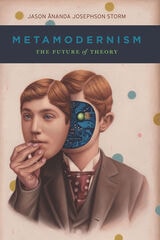
Metamodernism
The Future of TheoryJason Ananda Josephson Storm
University of Chicago Press, 2021
Metamodernism works through the postmodern critiques and uncovers the mechanisms that produce and maintain concepts and social categories. In so doing, Storm provides a new, radical account of society’s ever-changing nature—what he calls a “Process Social Ontology”—and its materialization in temporary zones of stability or “social kinds.” Storm then formulates a fresh approach to philosophy of language by looking beyond the typical theorizing that focuses solely on human language production, showing us instead how our own sign-making is actually on a continuum with animal and plant communication.
Storm also considers fundamental issues of the relationship between knowledge and value, promoting a turn toward humble, emancipatory knowledge that recognizes the existence of multiple modes of the real. Metamodernism is a revolutionary manifesto for research in the human sciences that offers a new way through postmodern skepticism to envision a more inclusive future of theory in which new forms of both progress and knowledge can be realized.

Metaphor and Musical Thought
Michael Spitzer
University of Chicago Press, 2004
The experience of music is an abstract and elusive one, enough so that we're often forced to describe it using analogies to other forms and sensations: we say that music moves or rises like a physical form; that it contains the imagery of paintings or the grammar of language. In these and countless other ways, our discussions of music take the form of metaphor, attempting to describe music's abstractions by referencing more concrete and familiar experiences.
Michael Spitzer's Metaphor and Musical Thought uses this process to create a unique and insightful history of our relationship with music—the first ever book-length study of musical metaphor in any language. Treating issues of language, aesthetics, semiotics, and cognition, Spitzer offers an evaluation, a comprehensive history, and an original theory of the ways our cultural values have informed the metaphors we use to address music. And as he brings these discussions to bear on specific works of music and follows them through current debates on how music's meaning might be considered, what emerges is a clear and engaging guide to both the philosophy of musical thought and the history of musical analysis, from the seventeenth century to the present day. Spitzer writes engagingly for students of philosophy and aesthetics, as well as for music theorists and historians.
Metaphors We Live By
George Lakoff and Mark Johnson
University of Chicago Press, 1981
In this updated edition of Lakoff and Johnson's influential book, the authors supply an afterword surveying how their theory of metaphor has developed within the cognitive sciences to become central to the contemporary understanding of how we think and how we express our thoughts in language.
Metaphysical Disputation I
On the Nature of First Philosophy or MetaphysicsFrancisco Suarez
Catholic University of America Press, 2021