Results by title
18284 books match the query 'United States' and 949 start with m
Main Street Revisited
Time, Space, and Image Building in Small-Town AmericaRichard V. Francaviglia
University of Iowa Press, 1996
As an archetype for an entire class of places, Main Street has become one of America's most popular and idealized images. In Main Street Revisited, the first book to place the design of small downtowns in spatial and chronological context, Richard Francaviglia finds the sources of romanticized images of this archetype, including Walt Disney's Main Street USA, in towns as diverse as Marceline, Missouri, and Fort Collins, Colorado.
Francaviglia interprets Main Street both as a real place and as an expression of collective assumptions, designs, and myths; his Main Streets are treasure troves of historic patterns. Using many historical and contemporary photographs and maps for his extensive fieldwork and research, he reveals a rich regional pattern of small-town development that serves as the basis for American community design. He underscores the significance of time in the development of Main Street's distinctive personality, focuses on the importance of space in the creation of place, and concentrates on popular images that have enshrined Main Street in the collective American consciousness.
Main Street and Empire
The Fictional Small Town in the Age of GlobalizationPoll, Ryan
Rutgers University Press, 2012
In Main Street and Empire, Ryan Poll addresses this need, arguing that the small town, as evoked by the image of “Main Street,” is not a relic of the past but rather a metaphorical screen upon which America’s “everyday” stories and subjects are projected on both a national and global scale.
Bringing together a broad selection of texts—from Thornton Wilder’s Our Town, Grace Metalious’s Peyton Place, and Peter Weir’s The Truman Show to the speeches of William McKinley, Ronald Reagan, Sarah Palin, and Barack Obama—Poll examines how the small town is used to imagine and reproduce the nation throughout the twentieth- and into the twenty-first century. He contends that the dominant small town, despite its innocent, nostalgic appearance, is central to the development of the U.S. empire and global capitalism.
Maine’s Lithographic Landscapes
Town and City Views, 1830-1870Earle G. Shettleworth Jr.
Brandeis University Press, 2020
During the nineteenth century, Americans celebrated their towns and cities through printed landscapes. In Maine, lithographs were commissioned from such leading artists as Fitz Henry Lane and talented, lesser known local artists, such as Esteria Butler. This book reproduces many of these works and provides insights into how these growing centers of commerce and industry viewed themselves and wished to be viewed by others.
It’s the perfect book for those who love Maine, both full-time residents and those who make it a beloved summer destination.
Published in association with the Bowdoin College Museum of Art on the occasion of the bicentennial of Maine statehood.
Mainstreaming Palestine
Cinematic Activism and Solidarity Politics in the United StatesUmayyah Cable
University of Minnesota Press, 2025
A history of cinema’s role in popularizing the politics of Palestinian liberation
For decades, Arab American activists and allies have used film, video, and multimedia to mobilize support for the Palestinian cause in the United States. In this detailed history of cinema’s role within the broader solidarity movement, Umayyah Cable analyzes the various strands of cinematic activism that have helped move Palestinian liberation politics from the periphery and into the mainstream.
Cable charts the shifting discourse around Palestine as it has been shaped by grassroots film production and alternative media distribution networks as well as more conventional outlets. Ranging from the circulation of educational filmstrips by the Association of Arab American University Graduates in the 1970s to the treatment of Palestinian solidarity at contemporary Hollywood awards ceremonies and film festivals, Mainstreaming Palestine tells the story of how cinema has promoted Palestinian liberation and solidarity politics. While highlighting various public controversies and struggles against censorship, Cable also acknowledges the drawbacks of the Palestinian cause being subsumed by the mainstream, discussing how activism risks becoming fashionable, undermining the radical potential of the very tools that helped bring it there.
Combining archival research, ethnographic observation and interviews, text analysis, and visual analysis of film, video, and multimedia, Mainstreaming Palestine encourages readers to critically assess the relationship between the politics of liberation and the all-consuming engine of contemporary capitalism. By underscoring the impact of visual media on the evolution of the Palestinian solidarity discourse, this book offers both a treatise on the practical power of cinema and a necessary historicization of an urgent issue in American politics.
Retail e-book files for this title are screen-reader friendly with images accompanied by short alt text and/or extended descriptions.
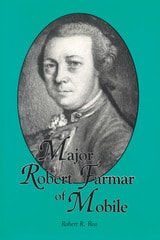
Major Robert Farmar of Mobile
Robert R. Rea
University of Alabama Press, 1990
"An engaging biography [and] a colorful tale. . . . Robert Farmar, a son of New Jersey, used his position among that colony's elite to secure a commission as a captain in the British Army during the War of Jenkins' Ear and King George's War, serving in the unsuccessful assaults at Cartegena, Cuba, and Panama and then in the disaster at Fontenoy in Flanders and in the reversals at Rocoux and Laffeldt. . . . During the Seven Years' War he participated in the capture of Havana.
Major Trade-Offs
The Surprising Truths about College Majors and Entry-Level JobsCorey Moss-Pech
University of Chicago Press, 2025
Humanities majors are used to answering the question, “So, what are you going to do with that degree?” The common misconception is that students in humanities programs don’t learn any useful skills for the real world. In Major Trade-Offs, sociologist Corey Moss-Pech argues that not only do humanities majors learn real-world skills, but they actually use them when they graduate. Despite this discrepancy, graduates with so-called practical degrees like business and engineering are much more likely to find employment, and they earn higher salaries. Why do we belittle a liberal arts education despite the valuable skills that students acquire during their studies?
Major Trade-Offs addresses this question by following students from different majors as they enter the workforce. To understand the relationship between majors and entry-level jobs, Moss-Pech conducted nearly 200 interviews with roughly ninety students from four majors at a large Midwestern university: engineering, business, English, and communications. He follows these students through their senior years, chronicling their internships and the support their universities provide in helping them pursue their career paths. He found that graduates from practical majors entered the labor market successfully, typically through structured internship programs. However, many ended up in entry-level jobs that, while well-paid, were largely clerical and didn’t necessarily require a degree to perform. On the other hand, liberal arts majors rarely accessed structured internships and were largely left to carve out their own paths, but did use their degree skills once they secured a job. These results challenge popular myths about the “marketability” of these different majors and offer a new vision for the future of higher education. Liberal arts skills are essential in the labor market, and yet educators and policymakers still push resources into the practical arts, perpetuating the myth that those majors are more valuable while depriving students of a well-rounded education and leaving them no better prepared for the workforce than liberal arts students.
Of interest to students, educators, and employers, Major Trade-Offs calls on colleges and universities to advocate for liberal arts majors, leveling the playing field for students as they plan for entry-level work.
Majoritarian Cities
Policy Making and Inequality in Urban PoliticsNeil Kraus
University of Michigan Press, 2013
Neil Kraus evaluates both the influence of public opinion on local policy-making and the extent to which public policy addresses economic and social inequalities. Drawing on several years of fieldwork and multiple sources of data, including surveys and polls; initiatives, referenda, and election results; government documents; focus groups; interviews; and a wide assortment of secondary sources, Kraus presents case studies of two Midwestern cities, Minneapolis, Minnesota, and Gary, Indiana. Specifically, he focuses on several major policy decisions in recent decades concerning education, law enforcement, and affordable housing in Minneapolis; and education and riverboat casino development in Gary.
Kraus finds that, on these issues, local officials frequently take action that reflects public opinion, yet the resulting policies often fail to meet the needs of the disadvantaged or ameliorate the effects of concentrated poverty. In light of citizens’ current attitudes, he concludes that if patterns of inequality are to be more effectively addressed, scholars and policymakers must transform the debate about the causes and effects of inequality in urban and metropolitan settings.
Majority of Scoundrels, A
An Informal History of the Rocky Mountain Fur CompanyDon Berry
Oregon State University Press, 2006
Berry’s fresh and invigorating narrative captures the peak years (1822-1834) of the fur trade in the Mountain West, the period in which the Rocky Mountain Fur Company grew to be “the greatest name in the mountains.” These were heady times in which trappers and traders explored the far corners of the western country, disputed territory with Native American tribes and the Hudson’s Bay Company, learned the lore of the land, and perfected their drinking, brawling, yarn-spinning, and boasting at the annual rendezvous.
With lively prose and an ear for a good yarn, Berry brings to life the principal trappers—colorful figures including Jim Bridger, Hugh Glass (who miraculously survived the mauling of a bear and came back from death to haunt his fellows), champion liar James P. Beckwourth, Joe Meek, Jedediah Smith, Jim Clyman, and many more. Using their journals, business records, and other sources, Berry laces his back-country narrative with an analysis of the power struggle between the St. Louis businessmen who controlled the trade and the trappers.
A new introduction by historian Stephen Dow Beckham looks beyond the romantic legends of the mountain men to set A Majority of Scoundrels in the context of recent scholarship on the American West. While Beckham demonstrates just how much our sense of history has changed in the almost fifty years since Berry’s work was first published, he also helps readers understand the continuing appeal of the mythology of the fur trade era and the lasting importance of A Majority of Scoundrels.
Make It Rain
State Control of the Atmosphere in Twentieth-Century AmericaKristine C. Harper
University of Chicago Press, 2017
In Make It Rain, Kristine C. Harper tells the long and somewhat ludicrous history of state-funded attempts to manage, manipulate, and deploy the weather in America. Harper shows that governments from the federal to the local became helplessly captivated by the idea that weather control could promote agriculture, health, industrial output, and economic growth at home, or even be used as a military weapon and diplomatic tool abroad. Clear fog for landing aircraft? There’s a project for that. Gentle rain for strawberries? Let’s do it! Enhanced snowpacks for hydroelectric utilities? Check. The heyday of these weather control programs came during the Cold War, as the atmosphere came to be seen as something to be defended, weaponized, and manipulated. Yet Harper demonstrates that today there are clear implications for our attempts to solve the problems of climate change.
Make Ours Marvel
Media Convergence and a Comics UniverseEdited by Matt Yockey
University of Texas Press, 2017
The creation of the Fantastic Four effectively launched the Marvel Comics brand in 1961. Within ten years, the introduction (or reintroduction) of characters such as Spider-Man, the Hulk, Iron Man, Captain America, and the X-Men catapulted Marvel past its primary rival, DC Comics, for domination of the comic book market. Since the 2000s, the company’s iconic characters have leaped from page to screens with the creation of the Marvel Cinematic Universe, which includes everything from live-action film franchises of Iron Man and the Avengers to television and streaming media, including the critically acclaimed Netflix series Daredevil and Jessica Jones. Marvel, now owned by Disney, has clearly found the key to transmedia success.
Make Ours Marvel traces the rise of the Marvel brand and its transformation into a transmedia empire over the past fifty years. A dozen original essays range across topics such as how Marvel expanded the notion of an all-star team book with The Avengers, which provided a roadmap for the later films, to the company’s attempts to create lasting female characters and readerships, to its regular endeavors to reinvigorate its brand while still maintaining the stability that fans crave. Demonstrating that the secret to Marvel’s success comes from adeptly crossing media boundaries while inviting its audience to participate in creating Marvel’s narrative universe, this book shows why the company and its characters will continue to influence storytelling and transmedia empire building for the foreseeable future.
Make Room for TV
Television and the Family Ideal in Postwar AmericaLynn Spigel
University of Chicago Press, 1992
In this fascinating book, Lynn Spigel chronicles the enormous impact of television in the formative years of the new medium: how, over the course of a single decade, television became an intimate part of everyday life. What did Americans expect from it? What effects did the new daily ritual of watching television have on children? Was television welcomed as an unprecedented "window on the world," or as a "one-eyed monster" that would disrupt households and corrupt children?
Drawing on an ambitious array of unconventional sources, from sitcom scripts to articles and advertisements in women's magazines, Spigel offers the fullest available account of the popular response to television in the postwar years. She chronicles the role of television as a focus for evolving debates on issues ranging from the ideal of the perfect family and changes in women's role within the household to new uses of domestic space. The arrival of television did more than turn the living room into a private theater: it offered a national stage on which to play out and resolve conflicts about the way Americans should live.
Spigel chronicles this lively and contentious debate as it took place in the popular media. Of particular interest is her treatment of the way in which the phenomenon of television itself was constantly deliberated—from how programs should be watched to where the set was placed to whether Mom, Dad, or kids should control the dial.
Make Room for TV combines a powerful analysis of the growth of electronic culture with a nuanced social history of family life in postwar America, offering a provocative glimpse of the way television became the mirror of so many of America's hopes and fears and dreams.
Make Way for Liberty
Wisconsin African Americans in the Civil WarJeff Kannel
Wisconsin Historical Society Press, 2020
Make Yourselves Gods
Mormons and the Unfinished Business of American SecularismPeter Coviello
University of Chicago Press, 2019
Over these turbulent decades, Mormons would appear by turns as heretics, sex-radicals, refugees, anti-imperialists, colonizers, and, eventually, reluctant monogamists and enfranchised citizens. Reading Mormonism through a synthesis of religious history, political theology, native studies, and queer theory, Peter Coviello deftly crafts a new framework for imagining orthodoxy, citizenship, and the fate of the flesh in nineteenth-century America. What emerges is a story about the violence, wild beauty, and extravagant imaginative power of this era of Mormonism—an impassioned book with a keen interest in the racial history of sexuality and the unfinished business of American secularism.
Make Yourselves Gods
Mormons and the Unfinished Business of American SecularismPeter Coviello
University of Chicago Press, 2019
From the perspective of Protestant America, nineteenth-century Mormons were the victims of a peculiar zealotry, a population deranged––socially, sexually, even racially––by the extravagances of belief they called “religion.” Make Yourselves Gods offers a counter-history of early Mormon theology and practice, tracking the Saints from their emergence as a dissident sect to their renunciation of polygamy at century’s end.
Over these turbulent decades, Mormons would appear by turns as heretics, sex-radicals, refugees, anti-imperialists, colonizers, and, eventually, reluctant monogamists and enfranchised citizens. Reading Mormonism through a synthesis of religious history, political theology, native studies, and queer theory, Peter Coviello deftly crafts a new framework for imagining orthodoxy, citizenship, and the fate of the flesh in nineteenth-century America. What emerges is a story about the violence, wild beauty, and extravagant imaginative power of this era of Mormonism—an impassioned book with a keen interest in the racial history of sexuality and the unfinished business of American secularism.
Makeover TV
Selfhood, Citizenship, and CelebrityBrenda R. Weber
Duke University Press, 2009
Based on her analysis of more than 2,500 hours of makeover TV, Weber argues that the much-desired After-body speaks to and makes legible broader cultural narratives about selfhood, citizenship, celebrity, and Americanness. Although makeovers are directed at both male and female viewers, their gendered logic requires that feminized subjects submit to the controlling expertise wielded by authorities. The genre does not tolerate ambiguity. Conventional (middle-class, white, ethnically anonymous, heterosexual) femininity is the goal of makeovers for women. When subjects are male, makeovers often compensate for perceived challenges to masculine independence by offering men narrative options for resistance or control. Foregoing a binary model of power and subjugation, Weber provides an account of makeover television that is as appreciative as it is critical. She reveals the makeover show as a rich and complicated text that expresses cultural desires and fears through narratives of selfhood.
Maker Literacies for Academic Libraries
Integration into CurriculumEdited by Katie Musick Peery
American Library Association, 2020
Melding universities’ strategic goals with libraries’ teaching and learning mission, the academic library makerspace can be a powerful catalyst for information literacy, offering faculty partners a place for interdisciplinary, experiential learning. If you’re pondering what it takes to get your makerspace into the curriculum, this volume’s relatable, first-hand accounts from librarians, makerspace staff, and faculty partners will give you the confidence to make the leap. Contributors, drawn from the IMLS-funded Maker Literacies project, describe pilots and assessment for a variety of demographics, course subjects, and makerspace equipment. Guided by their experiences, you’ll be ready to fully partner with faculty through the course integration and assessment process. Inside, you’ll learn
- why academic librarians are uniquely situated to be leaders in the realm of makerspaces and makerspace literacy;
- how the ACRL Framework informs maker competencies;
- methods for using competencies and assessment in designing course assignments;
- 5 steps for guiding faculty in creating assignments for makerspaces;
- advice on developing a new staffing and service model to handle course-wide use of the makerspace;
- steps for taking students through concept, design, prototype, and final product in a project management course;
- how an ethical perspective engaged a women’s history course toward the “In Her Shoes” project;
- pedagogical strategies for integrating the makerspace into fine arts classes; and
- ways to showcase makerspace outputs to generate excitement around campus.

Makerspaces
Caitlin A. Bagley
American Library Association, 2014
Makeshift Chicago Stages
A Century of Theater and PerformanceEdited by Megan E. Geigner, Stuart J. Hecht, and Jasmine Jamillah Mahmoud
Northwestern University Press, 2021
This book examines the rise and proliferation of Chicago’s performance spaces, which have rooted the city’s dynamic, thriving theater community. Chapters cover well‑known, groundbreaking, and understudied theatrical sites, ensembles, and artists, including the 1893 Columbian Exposition Midway Plaisance, the 57th Street Artist Colony, the Fine Arts Building, the Goodman Theatre, the Federal Theatre Project, the Kingston Mines and Body Politic Theaters, ImprovOlympics (later iO), Teatro Vista, Theaster Gates, and the Chicago Home Theater Festival. By putting space at the center of the city’s theater history, the authors in Makeshift Chicago Stages spotlight the roles of neighborhoods, racial dynamics, atypical venues, and borders as integral to understanding the work and aesthetics of Chicago’s artists, ensembles, and repertoires, which have influenced theater practices worldwide. Featuring rich archival work and oral histories, this anthology will prove a valuable resource for theater historians, as well as anyone interested in Chicago’s cultural heritage.
Making America Corporate, 1870-1920
Olivier Zunz
University of Chicago Press, 1992
Making American Boys
Boyology and the Feral TaleKenneth B. Kidd
University of Minnesota Press, 2005
Making Americans Healthier
Social and Economic Policy as Health PolicyRobert F. Schoeni
Russell Sage Foundation, 2008
Making Americans
Children's Literature from 1930 to 1960Gary D. Schmidt
University of Iowa Press, 2013
Although some later critics have argued that the books published in this era offered a vision of a safe, secure, simple world without injustice or unhappy endings, Gary D. Schmidt shows that the progressive political agenda shared by many Americans who wrote, illustrated, published, and taught children’s books had a powerful effect. Authors like James Daugherty, Laura Ingalls Wilder, Lois Lenski, Ingri and Edgar Parin D’Aulaire, Virginia Lee Burton, Robert McCloskey, and many others addressed directly and indirectly the major social issues of a turbulent time: racism, immigration and assimilation, sexism, poverty, the Great Depression, World War II, the atomic bomb, and the threat of a global cold war.
The central concern that many children’s book authors and illustrators wrestled with was the meaning of America and democracy itself, especially the tension between individual freedoms and community ties. That process produced a flood of books focused on the American experience and intent on defining it in terms of progress toward inclusivity and social justice. Again and again, children’s books addressed racial discrimination and segregation, gender roles, class differences, the fate of Native Americans, immigration and assimilation, war, and the role of the United States in the world. Fiction and nonfiction for children urged them to see these issues as theirs to understand, and in some ways, theirs to resolve. Making Americans is a study of a time when the authors and illustrators of children’s books consciously set their eyes on national and international sights, with the hope of bringing the next generation into a sense of full citizenship.
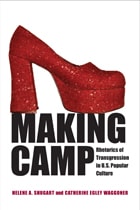
Making Camp
Rhetorics of Transgression in U.S. Popular CultureHelene A. Shugart and Catherine Egley Waggoner
University of Alabama Press, 2008
Making Camp examines the rhetoric and conventions of “camp” in contemporary popular culture and the ways it both subverts and is co-opted by mainstream ideology and discourse, especially as it pertains to issues of gender and sexuality.
Making Care Count
A Century of Gender, Race, and Paid Care WorkMignon Duffy
Rutgers University Press, 2011
There are fundamental tasks common to every society: children have to be raised, homes need to be cleaned, meals need to be prepared, and people who are elderly, ill, or disabled need care. Day in, day out, these responsibilities can involve both monotonous drudgery and untold rewards for those performing them, whether they are family members, friends, or paid workers. These are jobs that cannot be outsourced, because they involve the most intimate spaces of our everyday lives--our homes, our bodies, and our families.
Mignon Duffy uses a historical and comparative approach to examine and critique the entire twentieth-century history of paid care work--including health care, education and child care, and social services--drawing on an in-depth analysis of U.S. Census data as well as a range of occupational histories. Making Care Count focuses on change and continuity in the social organization along with cultural construction of the labor of care and its relationship to gender, racial-ethnic, and class inequalities. Debunking popular understandings of how we came to be in a "care crisis," this book stands apart as an historical quantitative study in a literature crowded with contemporary, qualitative studies, proposing well-developed policy approaches that grow out of the theoretical and empirical arguments.
Making Care Work
Employed Mothers in the New Childcare MarketUttal, Lynet
Rutgers University Press, 2002
As ever more women work outside the home, ever more families employ childcare workers. In the absence of government regulations or social models that clearly define the childcare provider’s role, mothers worry about the quality of care their children are getting. By connecting the personal level of mothers’ daily experiences to the larger political, economic, and ideological context of childcare, Lynet Uttal describes and explains how mothers rely on their relationship with the providers to monitor and influence the quality of care their children receive. Whereas other studies have emphasized how mothers undervalue and exploit providers, this book paints a more nuanced picture, arguing that the ties between adults who share in the care of children creates neither heroes nor victims. This ethnography reveals that mothers are often reluctant to discuss their concerns with their childcare providers. Uttal shows how mothers walk a fine line between wanting to believe in the quality of care they have chosen, and the fact that they might have made a mistake. Catalyzed by their worries about the quality of care, mothers develop complex relationships with the women—and most are women—who look after their children.
Making Choices, Making Do
Survival Strategies of Black and White Working-Class Women during the Great DepressionLois Rita Helmbold
Rutgers University Press, 2023
Making Easy Listening
Material Culture and Postwar American RecordingTim Anderson
University of Minnesota Press, 2006
Making Easy Listening presents a social and cultural history of the contentious, diverse, and experimental culture of musical production and enjoyment that aims to understand how recording technologies fit into and influence musicians’, as well as listeners’, lives. With attention to the details of what it means to play a particular record in a distinct cultural context, Anderson connects neglected genres of the musical canon—classical and easy listening music, Broadway musicals, and sound effects records—with the development of sound aesthetics and technical music practices that leave an indelible imprint on individuals. Tracing the countless impacts that this period of innovation exacted on the mass media, Anderson reveals how an examination of this historical era—and recorded music as an object—furthers a deeper understanding of the present-day American music industry.
Tim J. Anderson is assistant professor of communication at Denison University.

Making Endless War
The Vietnam and Arab-Israeli Conflicts in the History of International LawBrian Cuddy and Victor Kattan, Editors
University of Michigan Press, 2023
Making Endless War is built on the premise that any attempt to understand how the content and function of the laws of war changed in the second half of the twentieth century should consider two major armed conflicts, fought on opposite edges of Asia, and the legal pathways that link them together across time and space. The Vietnam and Arab-Israeli conflicts have been particularly significant in the shaping and attempted remaking of international law from 1945 right through to the present day. This carefully curated collection of essays by lawyers, historians, philosophers, sociologists, and political geographers of war explores the significance of these two conflicts, including their impact on the politics and culture of the world’s most powerful nation, the United States of America. The volume foregrounds attempts to develop legal rationales for the continued waging of war after 1945 by moving beyond explaining the end of war as a legal institution, and toward understanding the attempted institutionalization of endless war.
Making Ends Meet
How Single Mothers Survive Welfare and Low-Wage WorkKathryn Edin
Russell Sage Foundation, 1997
Making Failure Pay
For-Profit Tutoring, High-Stakes Testing, and Public SchoolsJill P. Koyama
University of Chicago Press, 2010
A little-discussed aspect of the No Child Left Behind Act (NCLB) is a mandate that requires failing schools to hire after-school tutoring companies—the largest of which are private, for-profit corporations—and to pay them with federal funds. Making Failure Pay takes a hard look at the implications of this new blurring of the boundaries between government, schools, and commerce in New York City, the country’s largest school district.
As Jill P. Koyama explains in this revelatory book, NCLB—a federally legislated, state-regulated, district-administered, and school-applied policy—explicitly legitimizes giving private organizations significant roles in public education. Based on her three years of ethnographic fieldwork, Koyama finds that the results are political, problematic, and highly profitable. Bringing to light these unproven, unregulated private companies’ almost invisible partnership with the government, Making Failure Pay lays bare the unintended consequences of federal efforts to eliminate school failure—not the least of which is more failure.
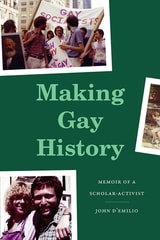
Making Gay History
Memoir of a Scholar-ActivistJohn D'Emilio
Duke University Press, 2026
Making Gay History continues John D’Emilio’s story, following his memoir of his early years, Memories of a Gay Catholic Boyhood. Here, D’Emilio recounts his career as a public historian, activist, and academic, relating his own queer history alongside the development of the LGBTQ movement in the United States. D’Emilio was part of the first burgeoning period of LGBTQ studies while still a graduate student in New York City. From there, he takes readers through his experiences as an out professor at UNC Greensboro, his activism in Washington, DC, and finally, his employment at the University of Illinois as an LGBTQ historian, a position that was unimaginable at the start of his career. At the same time, he narrates his own coming out, his successes and struggles with LGBTQ advocacy, and the loves and losses faced throughout his adult life, telling an intertwined personal and national history of queer hearts and minds.
Making Gray Gold
Narratives of Nursing Home CareTimothy Diamond
University of Chicago Press, 1992
In a society in which some two million people live in 16,000 nursing homes, with their numbers escalating daily, this thought-provoking work demands immediate and widespread attention.
"[An] unnerving portrait of what it's like to work and live in a nursing home. . . . By giving voice to so many unheard residents and workers Diamond has performed an important service for us all."—Diane Cole, New York Newsday
"With Making Gray Gold, Timothy Diamond describes the commodification of long-term care in the most vivid representation in a decade of round-the-clock institutional life. . . . A personal addition to the troublingly impersonal national debate over healthcare reform."—Madonna Harrington Meyer, Contemporary Sociology
Making Hispanics
How Activists, Bureaucrats, and Media Constructed a New AmericanG. Cristina Mora
University of Chicago Press, 2014
Some argue that these cultures are fundamentally similar and that the Spanish language is a natural basis for a unified Hispanic identity. But Mora shows very clearly that the idea of ethnic grouping was historically constructed and institutionalized in the United States. During the 1960 census, reports classified Latin American immigrants as “white,” grouping them with European Americans. Not only was this decision controversial, but also Latino activists claimed that this classification hindered their ability to portray their constituents as underrepresented minorities. Therefore, they called for a separate classification: Hispanic. Once these populations could be quantified, businesses saw opportunities and the media responded. Spanish-language television began to expand its reach to serve the now large, and newly unified, Hispanic community with news and entertainment programming. Through archival research, oral histories, and interviews, Mora reveals the broad, national-level process that led to the emergence of Hispanicity in America.
Making History / Making Blintzes
How Two Red Diaper Babies Found Each Other and Discovered AmericaFlacks, Mickey
Rutgers University Press, 2018
Throughout this memoir, the couple demonstrates that their lifelong commitment to making history through social activism cannot be understood without returning to the deeply personal context of their family history—of growing up “Red Diaper babies” in 1950s New York City, using folk music as self-expression as adolescents in the 1960s, and of making blintzes for their own family through the 1970s and 1980s. As the children of immigrants and first generation Jews, Dick and Mickey crafted their own religious identity as secular Jews, created a critical space for American progressive activism through SDS, and ultimately, found themselves raising an “American” family.
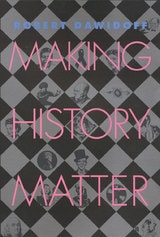
Making History Matter
Robert Dawidoff
Temple University Press, 2000
As a scholar of intellectual and cultural history, Dawidoff takes the stance that historians ought to take an active role in our democratic culture, informing and participating in public discourse. He argues for a broad reach when it comes to cultural expression, resisting the polarization of formal intellectual history and folk or commercial popular culture. In his view, Ralph Waldo Emerson and Katherine Hepburn are equally worthy topics for a historian's consideration, provided that they are treated with equal seriousness of purpose and analytic rigor. In "The Gay Nineties" section that closes the book, he traces key events in the continual struggle for gay and lesbian civil rights and takes on such unresolved issues as safer sex, needle exchange programs to control HIV transmission, and the public controversy around the portrayal of gay and lesbian television characters.
Divided into sections that deal with the patriarchs of American political and intellectual culture, expressive culture, and a historian's public voice, this book is a model of engaged and engaging writing. Accessible and witty, Making History Matter will appeal to general and academic readers interested in American history as well as gay and lesbian political and cultural issues.
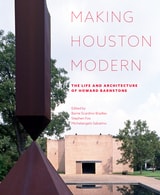
Making Houston Modern
The Life and Architecture of Howard BarnstoneBy Barrie Scardino Bradley, Stephen Fox, and Michelangelo Sabatino
University of Texas Press, 2020
Complex, controversial, and prolific, Howard Barnstone was a central figure in the world of twentieth-century modern architecture. Recognized as Houston’s foremost modern architect in the 1950s, Barnstone came to prominence for his designs with partner Preston M. Bolton, which transposed the rigorous and austere architectural practices of Ludwig Mies van der Rohe to the hot, steamy coastal plain of Texas. Barnstone was a man of contradictions—charming and witty but also self-centered, caustic, and abusive—who shaped new settings that were imbued, at once, with spatial calm and emotional intensity.
Making Houston Modern explores the provocative architect’s life and work, not only through the lens of his architectural practice but also by delving into his personal life, class identity, and connections to the artists, critics, collectors, and museum directors who forged Houston’s distinctive culture in the postwar era. Edited by three renowned voices in the architecture world, this volume situates Barnstone within the contexts of American architecture, modernism, and Jewish culture to unravel the legacy of a charismatic personality whose imaginative work as an architect, author, teacher, and civic commentator helped redefine architecture in Texas.
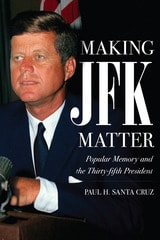
Making JFK Matter
Popular Memory and the Thirty-fifth PresidentPaul H. Santa Cruz
University of North Texas Press, 2015

Making Jet Engines in World War II
Britain, Germany, and the United StatesHermione Giffard
University of Chicago Press, 2016
Giffard compares the approaches of Britain, Germany, and the United States. Each approached jet engines in different ways because of its own war aims and industrial expertise. Germany, which produced more jet engines than the others, did so largely as replacements for more expensive piston engines. Britain, on the other hand, produced relatively few engines—but, by shifting emphasis to design rather than production, found itself at war's end holding an unrivaled range of designs. The US emphasis on development, meanwhile, built an institutional basis for postwar production. Taken together, Giffard's work makes a powerful case for a more nuanced understanding of technological innovation, one that takes into account the influence of the many organizational factors that play a part in the journey from idea to finished product.
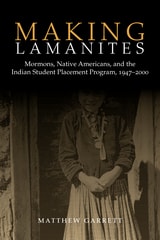
Making Lamanites
Mormons, Native Americans, and the Indian Student Placement Program, 1947-2000Matthew Garrett
University of Utah Press, 2016
Winner of the Juanita Brooks Prize in Mormon Studies
From 1947 to 2000, some 50,000 Native American children left the reservations to live with Mormon foster families. While some dropped out of the Indian Student Placement Program (ISPP), for others the months spent living with LDS families often proved more penetrating than expected.
The ISPP emerged in the mid-twentieth century, championed by Apostle Spencer W. Kimball, aligned with the then national preferences to terminate tribal entities and assimilate indigenous people. But as the paradigm shifted to self-determination, critics labeled the program as crudely assimilationist. Some ISPP students like Navajo George P. Lee fiercely defended the LDS Church before native peers and Congress, contending that it empowered Native people and instilled the true Indian identity; meanwhile Red Power activists organized protests in Salt Lake City, denouncing LDS colonization. As a new generation of church leaders quietly undercut the Indian programs, many of its former participants felt a sense of confusion and abandonment as Mormon distinctions for Native people faded in the late twentieth century.
Making Lamanites traces this student experience within contested cultural and institutional landscapes to reveal how and why many of these Native youth adopted a new notion of Indianness.
Winner of the Francis Armstrong Madsen Best Book Award from the Utah Division of State History.
Making Lemonade out of Lemons
Mexican American Labor and Leisure in a California Town 1880-1960José M. Alamillo
University of Illinois Press, 2006
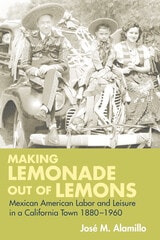
Out of the “lemons” handed to Mexican American workers in Corona, California--low pay, segregated schooling, inadequate housing, and racial discrimination--Mexican men and women made “lemonade” by transforming leisure spaces such as baseball games, parades, festivals, and churches into politicized spaces where workers voiced their grievances, debated strategies for advancement, and built solidarity. Using oral history interviews, extensive citrus company records, and his own experiences in Corona, José Alamillo argues that Mexican Americans helped lay the groundwork for civil rights struggles and electoral campaigns in the post-World War II era.
Making Local News
Phyllis Kaniss
University of Chicago Press, 1991
"Making Local News by Phyllis Kaniss . . . is significant. . . . If we can continue to get smarter about that which journalism leaves out or distorts in its coverage of politics, we may eventually get smarter about politics itself."—Mitchell Stephens, The Philadelphia Inquirer View
"A convincing analysis of the factors and forces which color how and why local issues do, or do not, become newsworthy." —Michael H. Ebner, Journal of Interdisciplinary History
"This work serves as a reminder of the importance of a medium that is often overlooked until economic realities threaten its very existence." —Choice
"Kaniss is truly a pioneer in the study of local news."—Susan Herbst, Contemporary Sociology
Making Maine
Statehood and the War of 1812Joshua M. Smith
University of Massachusetts Press, 2022
Honorable mention for U.S. Maritime History, John Lyman Book Awards
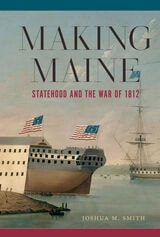
After the Revolutionary War ended, the new American nation grappled with a question about its identity: Were the states sovereign entities or subordinates to a powerful federal government? The War of 1812 brought this vexing issue into sharp relief, as a national government intent on waging an unpopular war confronted a populace in Massachusetts that was vigorously opposed to it. Maine, which at the time was part of Massachusetts, served as the battleground in this political struggle.
Joshua M. Smith recounts an innovative history of the war, focusing on how it specifically affected what was then called the District of Maine. Drawing on archival materials from the United States, Britain, and Canada, Smith exposes the bitter experience of Maine’s citizens during that conflict as they endured multiple hardships, including starvation, burdensome taxation, smuggling, treason, and enemy occupation. War’s inherent miseries, along with a changing relationship between regional and national identities, gave rise to a statehood movement that rejected a Boston-centric worldview in favor of a broadly American identity.
Making March Madness
The Early Years of the NCAA, NIT, and College Basketball Championships, 1922-1951Chad Carlson
University of Arkansas Press, 2017
Throughout the NCAA Tournament’s history, underdogs, Cinderella stories, and upsets have captured the attention and imagination of fans. Making March Madness is the story of this premiere tournament, from its early days in Kansas City, to its move to Madison Square Garden, to its surviving a point-shaving scandal in New York and taking its games to different sites across the country.Chad Carlson’s analysis places college basketball in historical context and connects it to larger issues in sport and American society, providing fresh insights on a host of topics that readers will find interesting, illuminating, and thought provoking.
Making Mark Twain Work in the Classroom
James S. Leonard, ed.
Duke University Press, 1999
The essays in Making Mark Twain Work in the Classroom reaffirm the importance of Twain in the American literature curriculum from high school through graduate study. Addressing slavery and race, gender, class, religion, language and ebonics, Americanism, and textual issues of interest to instructors and their students, the contributors offer guidance derived from their own demographically diverse classroom experiences. Although some essays focus on such works as A Connecticut Yankee in King Arthur’s Court and The Innocents Abroad, most discuss the hotly debated Adventures of Huckleberry Finn, viewed alternately in this volume as a comic masterpiece or as evidence of Twain’s growing pessimism—but always as an effective teaching tool.
By placing Twain’s work within the context of nineteenth-century American literature and culture, Making Mark Twain Work in the Classroom will interest all instructors of American literature. It will also provoke debate among Americanists and those concerned with issues of race, class, and gender as they are represented in literature.
Contributors. Joseph A. Alvarez, Lawrence I. Berkove, Anthony J. Berret, S.J., Wesley Britton, Louis J. Budd, James E. Caron, Everett Carter, Jocelyn Chadwick-Joshua, Pascal Covici Jr., Beverly R. David, Victor Doyno, Dennis W. Eddings, Shelley Fisher Fishkin, S. D. Kapoor, Michael J. Kiskis, James S. Leonard, Victoria Thorpe Miller, Stan Poole, Tom Reigstad, David E. E. Sloane, David Tomlinson
Making Meaning
"Printers of the Mind" and Other EssaysD. F. McKenzie
University of Massachusetts Press, 2002
The greatest bibliographer of our time, was how historian Robert Darnton described D. F. McKenzie. Yet until now many of McKenzie's major essays, scattered in specialist journals and inaccessible publications, have circulated mainly in tattered photocopies. This volume, edited by two of McKenzie's former students, brings together for the first time a wide range of his writings on bibliography, the book trade, and the “sociology of texts.” Selected by the author himself before his sudden death in 1999, the essays range from the material transmission of Shakespeare's plays in the seventeenth century to the connections among oral, manuscript, and print cultures.
Making Meaning reflects McKenzie's virtuosity as a traditional bibliographer and reveals how his thought-provoking scholarship made him a driving force in the genesis and development of the new interdisciplinary field of book history. His refusal to recognize the traditional boundary between bibliography and literary history re-energized the study of the social, political, economic, and cultural aspects of book production and reception.
The editors' introduction and headnotes situate McKenzie's innovative and controversial thinking in the debates of his time.
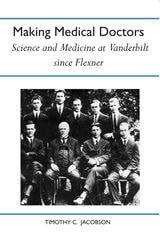
Making Medical Doctors
Science and Medicine at Vanderbilt since FlexnerTimothy C. Jacobson
University of Alabama Press, 1987
Making Medical Doctors is not a conventional institutional history, but rather a study of the union of science and medicine in a particularly illustrative institutional setting. Its general subject is the institution where science and medicine most dramatically came together: the modern medical school and medical center. Its particular subject is the medical school and center of Vanderbilt University, which was rebuilt in the 1920s as a model for medical education and research. Making Medical Doctors also explores the intellectual and financial sources of institutional development: the worlds of Abraham Flexner, Frederick T. Gates, and Henry S. Pritchett, three foundation masters of the early 20th century. It examines closely the vanished medical world of that generation of doctors who reached the height of their influence in the period between the two world wars and describes how they actually did medicine, surgery, and science.
The convergence of science and medicine in the 19th and 20th centuries produced what we know today as modern medicine. The balance of power and interdependence between science and medicine have changed vastly from the 1920s and 1930s, as Vanderbilt’s story clearly illustrates.
Making Men, Making Class
The YMCA and Workingmen, 1877-1920Thomas Winter
University of Chicago Press, 2002
Starting in the 1870s, the leaders ("secretaries") of the YMCA sought to reduce political radicalism and labor unrest by instilling new ideals of manliness among workers. By involving workingmen in a range of activities on the job and off, the YMCA hoped to foster team spirit, moral conduct, and new standards of manhood that would avoid conflict and instead encourage cooperation along the lines of a Christian, pious manliness. In their efforts to make better men, the secretaries of the YMCA also crafted new ideals of middle-class manliness for themselves that involved a sense of mission and social purpose. In doing so, they ended up "making" class, too, as they began to speak a language of manhood structured by class differences.
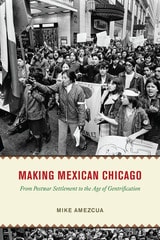
Making Mexican Chicago
From Postwar Settlement to the Age of GentrificationMike Amezcua
University of Chicago Press, 2022
Though Chicago is often popularly defined by its Polish, Black, and Irish populations, Cook County is home to the third-largest Mexican-American population in the United States. The story of Mexican immigration and integration into the city is one of complex political struggles, deeply entwined with issues of housing and neighborhood control. In Making Mexican Chicago, Mike Amezcua explores how the Windy City became a Latinx metropolis in the second half of the twentieth century.
In the decades after World War II, working-class Chicago neighborhoods like Pilsen and Little Village became sites of upheaval and renewal as Mexican Americans attempted to build new communities in the face of white resistance that cast them as perpetual aliens. Amezcua charts the diverse strategies used by Mexican Chicagoans to fight the forces of segregation, economic predation, and gentrification, focusing on how unlikely combinations of social conservatism and real estate market savvy paved new paths for Latinx assimilation. Making Mexican Chicago offers a powerful multiracial history of Chicago that sheds new light on the origins and endurance of urban inequality.
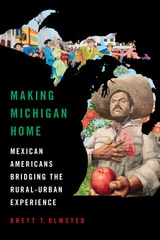
Making Michigan Home
Mexican Americans Bridging the Rural-Urban ExperienceBrett T. Olmsted
University of Illinois Press, 2025
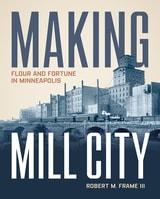
Making Mill City
Flour and Fortune in MinneapolisRobert M. Frame III
University of Minnesota Press, 2026
A richly illustrated history of the flour factories that transformed the milling industry worldwide—and forever changed the culture and architecture of Minneapolis
Among the most consequential advances of the Industrial Revolution was the invention of the modern roller mill, which sent the traditional millstone into obsolescence and fundamentally changed the production of a key ingredient to feeding the world. The culture and landscape of its hometown, Minneapolis, Minnesota, was altered as well, and Making Mill City tells the story of how revolutionary technologies originating at St. Anthony Falls on the Mississippi River put Minneapolis on the map and cemented its global status as “Mill City.”
With deep historical detail and abundant illustrations, Robert M. Frame III charts the dramatic transformation of Minneapolis milling—and urban life—between the early 1870s and 1920s. Two machines propelled this change: the middlings purifier and the modern roller mill. Enabling millers to grind hard Upper Midwestern spring wheat, these innovations gave rise to the “mammoth mills” and ever-expanding flour factories that would soon dominate the Minneapolis riverfront. Prominent entrepreneurs like those who gave their names to the Washburn and Pillsbury A Mills were significant, but Frame foregrounds the crucial roles of the millers, millwrights, and engineers who designed and equipped the massive new factories, as well as the editor of the legendary weekly trade publication Northwestern Miller, to paint a picture of the vibrant and diverse culture that grew around this industrial phenomenon.
A rich narrative describing how Minneapolis became the largest producer and exporter of wheat flour for more than fifty years, Making Mill City captures a critical chapter in the history of the city. Art and architecture inspired by mills and millers stand today as National Historic Landmarks, and the development and success of the current thriving metropolis have strong foundations in its milling history.