Results by title
28167 books match the query 'History' and 1583 start with m
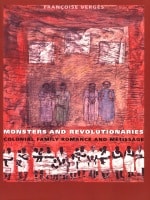
Monsters and Revolutionaries
Colonial Family Romance and MetissageFrançoise Vergès
Duke University Press, 1999
Originally settled by sugar plantation owners and their Indian and African slaves following a seventeenth-century French colonial decree, Réunion abolished slavery in 1848. Because plantation owners continued to import workers from India, Africa, Asia, and Madagascar, the island was defined as a place based on mixed heritages, or métissage. Vergès reads the relationship between France and the residents of Réunion as a family romance: France is the seemingly protective mother, La Mère-Patrie, while the people of Réunion are seen and see themselves as France’s children. Arguing that the central dynamic in the colonial family romance is that of debt and dependence, Verges explains how the republican ideals of the French Revolution and the Enlightenment are seen as gifts to Réunion that can never be repaid. This dynamic is complicated by the presence of métissage, a source of anxiety to the colonizer in its refutation of the “purity” of racial bloodlines. For Vergès, the island’s history of slavery is the key to understanding métissage, the politics of assimilation, constructions of masculinity, and emancipatory discourses on Réunion.
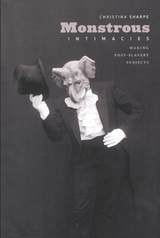
Monstrous Intimacies
Making Post-Slavery SubjectsChristina Sharpe
Duke University Press, 2010
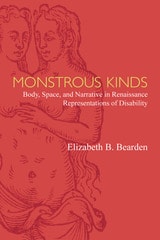
Monstrous Kinds
Body, Space, and Narrative in Renaissance Representations of DisabilityElizabeth B. Bearden
University of Michigan Press, 2019
Monstrous Politics
Geography, Rights, and the Urban Revolution in Mexico CityBen Gerlofs
Vanderbilt University Press, 2022
Transdisciplinary by design, Monstrous Politics first moves historically through Mexico City’s turbulent twentieth century, driven centrally by the contentious imbrication of the Institutional Revolutionary Party (PRI) and its capital city. Participant observation, expert interviews, and archival materials demonstrate the shifting strategies and alliances of recent decades, provide the reader with a sense of the texture of contemporary political life in the city during a time of unprecedented change, and locate these dynamics within the history and geography of twentieth-century urbanization and political revolution. Substantive ethnographic chapters trace the emergence and decline of the political language of “the right to the city,” the establishment and contestation of a “postpolitical” governance regime, and the culmination of a century of urban politics in the processes of “political reform” by which Mexico City finally wrested back significant political autonomy and local democracy from the federal state.
A four-fold transection of the revolutionary structure of feeling that pervades the city in this historic moment illustrates the complex and contradictory sentiments, appraisals, and motivations through which contemporary politics are understood and enacted. Drawing on theories of social revolution that embrace complexity, and espousing a methodology that foregrounds the everyday nature of politics, Monstrous Politics develops an understanding of revolutionary urban politics at once contextually nuanced and conceptually expansive, and thus better able to address the realities of politics in the “urban age” even beyond Mexico City.
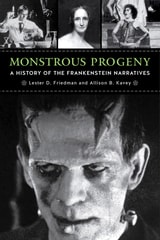
Monstrous Progeny
A History of the Frankenstein NarrativesFriedman, Lester D
Rutgers University Press, 2016

Montana Ghost Dance
Essays on Land and LifeBy John B. Wright
University of Texas Press, 1998
Montana has been the "last best place" for so many people. A century ago, Native Americans gathered here to perform the Ghost Dance—a last, doomed attempt to make white settlers vanish and bring back the old ways of life. Today, people are still pouring into Montana, looking for the pristine wilderness they saw in A River Runs through It.
The reality of Montana—indeed, of all the West—has never matched the myths, but this book eloquently explores how the search for a perfect place is driving growth, development, and resource exploitation in Big Sky country. In ten personal essays, John Wright looks at such things as Montana myths; old-timers; immigrants; elk; ways of seeing the landscape; land conservation and land trusts; the fate of the Blackfoot, Bitterroot, and Paradise valleys; and some means of preserving the last, best places.
These reflections offer a way of understanding Montana that goes far beyond the headlines about militia groups and celebrities' ranches. Montana never was or will be a pristine wilderness, but Wright believes that much can be saved if natives and newcomers alike see what stands to be lost. His book is a wake-up call, not a ghost dance.
Montana Pay Dirt
Guide To Mining Camps Of Treasure StateMuriel Sibell Wolle
Ohio University Press, 1963
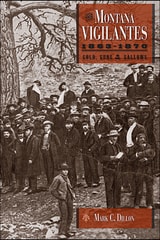
Montana Vigilantes 1863–1870
Gold,Guns and GallowsMark C. Dillon
Utah State University Press, 2016
Using newspaper articles, diaries, letters, biographies, invoices, and books that speak to the compelling history of Montana’s vigilantism in the 1860s, Dillon examines the conduct of the vigilantes in the context of the due process norms of the time. He implicates the influence of lawyers and judges who, like their non-lawyer counterparts, shaped history during the rush to earn fortunes in gold.
Dillon’s perspective as a state Supreme Court justice and legal historian uniquely illuminates the intersection of territorial politics, constitutional issues, corrupt law enforcement, and the basic need of citizenry for social order. This readable and well-directed analysis of the social and legal context that contributed to the rise of Montana vigilante groups will be of interest to scholars and general readers interested in Western history, law, and criminal justice for years to come.
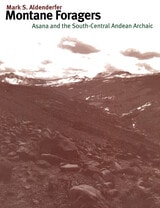
Montane Foragers
Asana and the South-Central Andean ArchaicMark S. Aldenderfer
University of Iowa Press, 1998
Aldenderfer's investigation forms a methodological and theoretical tour de force that elucidates elevational stress—what it takes for humans to adjust and survive at high altitudes. In a masterful integration of mountain biology and ecology, he emphasizes the nature of hunter-gatherer adaptations to high-mountain environments. He carefully documents the cultural history of Asana, the first stratified, open-air site discovered in the highlands of the south-central Andes. He establishes a number of major occurrences at this revolutionary site, including the origins of plant and animal domestication and transitions to food production, the growth and packing of forager populations, and the advent of some form of complexity and social hierarchy.
The rich and diversified archaeological record recovered at Asana—which spans from 10,000 to 3,500 years ago—includes the earliest houses as well as public and ceremonial buildings in the central cordillera. Built, used, and abandoned over many millennia, the Asana structures completely transform our understanding of the antiquity and development of native American architecture. Aldenderfer's detailed archaeological case study of high-elevation foraging adaptation, his description of this extreme environment as a viable human habitat, and his theoretical model of montane foraging create a new understanding of the lifeways of foraging peoples worldwide.
Monte Alban's Hinterland, Part I
The Prehispanic Settlement Patterns of the Central and Southern Parts of the Valley of Oaxaca, MexicoRichard E. Blanton, Stephen Kowalewski, Gary Feinman, and Jill Appel
University of Michigan Press, 1982
Monte Albán's Hinterland, Part II
Prehispanic Settlement Patterns in Tlacolula, Etla, and Ocotlan, the Valley of Oaxaca, Mexico, Vols. 1 and 2Stephen Kowalewski, Gary Feinman, Laura Finsten, Richard Blanton, and Linda Nicholas
University of Michigan Press, 1989
Montgomery C. Meigs and the Building of the Nation’s Capital
William C. Dickinson
Ohio University Press, 2001
At the age of thirty-six, in 1852, Lt. Montgomery Cunningham Meigs of the Army Corps of Engineers reported to Washington, D.C., for duty as a special assistant to the chief army engineer, Gen. Joseph G. Totten. It was a fateful assignment, both for the nation’s capital and for the bright, ambitious, and politically connected West Point graduate.
Meigs's forty-year tenure in the nation's capital was by any account spectacularly successful. He surveyed, designed, and built the Washington water supply system, oversaw the extension of the U.S. Capitol and the erection of its massive iron dome, and designed and supervised construction of the Pension Building, now the home of the National Building Museum. The skills he exhibited in supervising engineering projects were carefully noted by political leaders, including president-elect Abraham Lincoln, who named Meigs quartermaster general of the Union Army, the most important position he held during his long and active military career.
Meigs believed Washington, D.C., should be the reincarnation of Rome, the ancient capital of the Roman Empire. He endeavored to memorialize the story of the American nation in all the structures he built, expressing these ideas in murals, sculpture, and monumental design.
Historians have long known Meigs for the organizational genius with which he fulfilled his duty as quartermaster general during the Civil War and for his unwavering loyalty to Lincoln and Secretary of War Edwin Stanton. This volume establishes his claim as one of the major nineteenth-century contributors to the built environment of the nation's capital.
Montgomery in the Good War
Portrait of a Southern City, 1939-1946Wesley Phillips Newton
University of Alabama Press, 2000
One city. One war. A story of transformation at home and abroad.
Using newspaper accounts, interviews, letters, journals, and his own memory of the time, Wesley Newton reconstructs wartime-era Montgomery, Alabama--a sleepy southern capital that was transformed irreversibly during World War II.
The war affected every segment of Montgomery society: black and white, rich and poor, male and female, those who fought in Europe and the Pacific and those who stayed on the home front. Newton follows Montgomerians chronologically through the war from Pearl Harbor to Hiroshima as they experience patriotism, draft and enlistment, rationing, scarcity drives, and the deaths of loved ones. His use of small vignettes based on personal recollections adds drama and poignancy to the story.
Montgomery in the Good War is an important reminder that wars are waged at home as well as abroad and that their impact reverberates well beyond those who fight on the front lines. Those who came of age during the war will recognize themselves in this moving volume. It will also be enlightening to those who have lived in times of relative peace.
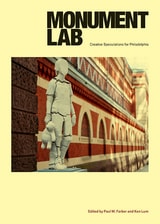
Monument Lab
Creative Speculations for PhiladelphiaPaul M. Farber
Temple University Press, 2020
What is an appropriate monument for the current city of Philadelphia? That was the question posed by the curators, artists, scholars, and students who comprise the Philadelphia-based public art and history studio Monument Lab. And in 2017, along with Mural Arts Philadelphia, they produced and organized a groundbreaking, city-wide exhibition of temporary, site-specific works that engaged directly with the community. The installations, by a cohort of diverse artists considering issues of identity, appeared in iconic public squares and neighborhood parks with research and learning labs and prototype monuments.
Monument Lab is a fabulous compendium of the exhibition and a critical reflection of the proceedings, including contributions from interlocutors and collaborators. The exhibition and this handbook were designed to generate new ways of thinking about monuments and public art as well as to find new, critical perspectives to reflect on the monuments we have inherited and to imagine those we have yet to build. Monument Lab energizes acivic dialogue about place and history as forces for a deeper questioning of what it means to be Philadelphian in a time of renewal and continuing struggle.
Contributors: Alexander Alberro, Alliyah Allen, Laurie Allen, Andrew Friedman, Justin Geller, Kristen Giannantonio, Jane Golden, Aviva Kapust, Fariah Khan, Homay King, Stephanie Mach, Trapeta B. Mayson, Nathaniel Popkin, Ursula Rucker, Jodi Throckmorton, Salamishah Tillet, Jennifer Harford Vargas, Naomi Waltham-Smith, Bethany Wiggin, Mariam I. Williams, Leslie Willis-Lowry, and the editors.
Artists: Tania Bruguera, Mel Chin, Kara Crombie, Tyree Guyton, Hans Haacke, David Hartt, Sharon Hayes, King Britt and Joshua Mays, Klip Collective, Duane Linklater, Emeka Ogboh, Karyn Olivier, Michelle Angela Ortiz, Kaitlin Pomerantz, RAIR, Alexander Rosenberg, Jamel Shabazz, Hank Willis Thomas, Shira Walinsky and Southeast by Southeast, and Marisa Williamson.
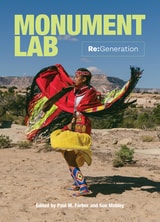
Monument Lab
Re:GenerationEdited by Paul M. Farber and Sue Mobley
Temple University Press, 2026
Monument Lab: Re:Generation presents case studies that travel across America, highlighting local commemorative campaigns dedicated to advancing public memory. Featuring articles and artwork from the country’s leading monument makers, each project includes a framing essay that provides insights into the varied contexts of location, culture, form, and subject matter.
Monument Lab: Re:Generation provides innovative, healing, and practical approaches to the United States’ unreconciled past and divided present facing our nation. In doing so, it invites readers to engage with a broader discourse of monuments and public memory.
Contributors: Thomas J. Adams, Kareal Amenumey, Sháńdíín Brown, Jonathan Jae-an Crisman, Kristen Dorsey, Aruna D'Souza, Mariluz Franco Ortiz, Jacqui Germain, Grace Sanders Johnson, Dani R. Merriman, Deirdre Cooper Owens, Naima Murphy Salcido, Kirk Savage, Clint Smith, Tsione Wolde-Michael, Eric Zimmer, and the editors
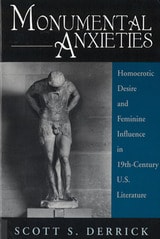
Monumental Anxieties
Homoerotic Desire and Feminine Influence in 19-th Century U.S. LiteratureDerrick, Scott S
Rutgers University Press, 1997
Scott Derrick has written an original book that contributes significantly to current revisions of the nineteenth-century American literary tradition's representation of gender and sexuality. His interpretation of feminist, lesbian-feminist, and gay issues in nineteenth-century American literature as complementary enlarges our historical understanding and helps build the coalition politics needed in these areas."-John Carlos Rowe, University of California, Irvine
Recent gender-based scholarship on nineteenth-century American literature has established male authors' crucial awareness of the competition from popular women writers. And critical work in gay studies and queer theory has stressed the importance in canonical American literature of homoerotic relations between men, even before "homosexuality" became codified at the end of the century. Scott Derrick draws on these insights to explore the ways in which male authors struggle to refigure literature-historically devalued as feminine-as a masculine and heterosexual enterprise. Derrick focuses on scenes of compositional crisis that reveal how male identity itself is at risk in the perils and possibilities of being a male author in a feminized literary marketplace.
He suggests that traditionally valued texts by Hawthorne, Poe, James, Sinclair, and Crane have at their core combustible four-sided conflicts between feminine identifications and masculine distancings, homoerotic longings and homophobic dreads, conflicts which are largely determined by domestic ideals of male and female roles within the nineteenth-century family. The negotiation of such conflicts is controlled by the nature of fiction writing, which both frees the imagination to explore forbidden fantasies and harnesses the imagination to public understandings of the proper form and content of fiction. Thus Monumental Anxieties also contributes to recent debates about the social shaping of contemporary homosexuality and to the history of American masculinity.
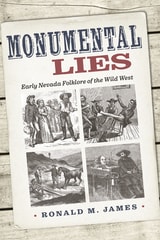
Monumental Lies
Early Nevada Folklore of the Wild WestRonald M. James
University of Nevada Press, 2023
Monumental Lies: Early Nevada Folklore of the Wild West opens the door to understanding how legends and traditions emerged during the first decades following the “Rush to Washoe,” which transformed the region beginning in 1859. During this Wild West period, there was widespread celebration of deceit, manifesting in tall tales, burlesque lies, practical jokes, and journalistic hoaxes. Humor was central to these endeavors and practitioners easily found themselves scorned if they failed to be adequately funny. This ethos became central to the way folklore emerged during the formative years of the Nevada territory and state.
The tens of thousands of people who came to the West, attracted by gold and silver mining, brought distinct cultural legacies. The interaction of diverse perspectives, even while new stories and traditions coalesced or simply appeared, was a complex process. Author Ronald M. James addresses how the fluidity of the region affected new expressions of folklore as they took root.
Mark Twain, often a go-to source for collections of early tall tales of this region, cannot be overlooked, but his interaction with local traditions was specific and narrow. More importantly, William Wright—publishing as Dan De Quille—arose as a key collector of legends, a counterpart of early European folklorists. With a bedrock understanding of what unfolded in the nineteenth century, it is possible to consider
Monumental Matters
The Power, Subjectivity, and Space of India's Mughal ArchitectureSanthi Kavuri-Bauer
Duke University Press, 2011
She examines the representation and eventual preservation of the monuments, from their disrepair in the colonial past to their present status as protected heritage sites. Drawing on theories of power, subjectivity, and space, Kavuri-Bauer’s interdisciplinary analysis encompasses Urdu poetry, British landscape painting, imperial archaeological surveys, Indian Muslim identity, and British tourism, as well as postcolonial nation building, World Heritage designations, and conservation mandates. Since Independence, the state has attempted to construct a narrative of Mughal monuments as symbols of a unified, secular nation. Yet modern-day sectarian violence at these sites continues to suggest that India’s Mughal monuments remain the transformative spaces—of social ordering, identity formation, and national reinvention—that they have been for centuries.
Monumentality
Geographies, Histories, IdeologiesElizabeth Kassler-Taub
J. Paul Getty Trust, The, 0
An exploration of how monuments—both physical and conceptual—shape memory, identity, and public debate across cultures and time.
This compelling volume invites readers to reimagine how monuments shape history, identity, and public space. Monumentality is explored as a dynamic and contested idea—one that moves beyond grand buildings and enduring structures to understand how societies remember the past and envision the future.
Engaging scholarly essays, accompanied by focused reflections on objects held in Getty collections, analyze the emotional, ideological, and technological dimensions of monuments by tracing their changing meanings across cultures and historical periods. Spanning themes of destruction, circulation, territorialization, and empire, the book investigates topics such as the ruin aesthetic of the Paris Commune, the material remnants of Buddhism in India, the construction of Cold War dams, and the influence of Almohad minaret architecture. Throughout, readers will encounter the enduring effects of colonialism, modernization, and settlements on societies around the world—from nineteenth-century West Africa to postwar Japan and Guam to present-day Israel and Ukraine.
Together, these studies integrate histories of art, architecture, and urban landscapes to examine the role of monuments in contemporary life. Monumentality offers fresh perspectives on what we choose to honor, why the past is preserved (or forgotten), and how the complex narratives embedded in memorials or public art condition our experience of the present.
Monuments Askew
An Elliptical History of the Factory of the Eccentric ActorMaria Corrigan
Rutgers University Press, 2025
Monuments and Territory
War Memorials in Russian-Occupied UkraineMischa Gabowitsch
Central European University Press, 2025
From the very first weeks of Russia’s large-scale attack on Ukraine in February 2022, Russian soldiers, politicians, and proxy administrators expended considerable effort interacting with monuments on newly occupied territory. Why did the invaders care enough about war memorials to divert scarce resources to destroying, maintaining, or building them amid a massive war? Why did they remove some memorials and spare others? What was the point of commemorating past victories and defeats while bombing Ukrainian cities, and how did commemorative ceremonies in the occupied territories
change over the first year of the war? What was the broader impact of monument-related practices beyond the local settings in which they occurred? And what does the Ukrainian case teach us more generally about how memorials to past wars can be used to justify new conquests? These are some of the questions this book explores, based on fieldwork in occupied Ukraine and online research.

Monuments of Romanesque Art
The Art of the Church Treasures in Northwestern EuropeHanns Swarzenski
University of Chicago Press, 1974

Moorings and Metaphors
Figures of Culture and Gender in Black Women's LiteratureKarla F. Holloway
Rutgers University Press, 1991
Proceeding from a consideration of the imaginative textual languages of contemporary African-American and West African writers, Holloway asserts the intertextuality of black women's literature across two continents. She argues the subtext of culture as the source of metaphor and language, analyzes narrative structures and linguistic processes, and develops a combined theoretical/critical apparatus and vocabulary for interpreting these writers' works. The cultural sources and spiritual considerations that inhere in these textual languages are discussed within the framework Holloway employs of patterns of revision, (re)membrance, and recursion--all of which are vehicles for expressive modes inscribed at the narrative level. Her critical reading of contemporary black women's writing in the United States and West Africa is unique, radical, and sure to be controversial.
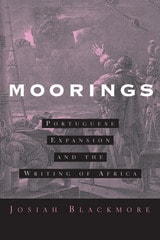
Moorings
Portuguese Expansion and the Writing of AfricaJosiah Blackmore
University of Minnesota Press, 2008
How Africa was perceived in the early modern imaginary
In this first book to study Portuguese texts about Africa, Moorings brings an important but little-known body of European writings to bear on contemporary colonial thought. Images of Africa as monstrous, dangerous, and lush were created in early Portuguese imperial writings and dominated its representation in European literature. Moorings establishes these key works in their proper place: foundational to Western imperial discourse.
Attentive to history as well as the nuances of language, Josiah Blackmore leads readers from the formation of the “Moor” in medieval Iberia to the construction of a full colonial imaginary, as found in the works of two writers: the royal chronicler Gomes Eanes de Zurara and the epic poet Luís de Camões. Blackmore’s original work helps to explain how concepts and myths—such as the “otherness” of Africa and Africans—originated, functioned, and were perpetuated.Delving into the Portuguese imperial experience, Moorings enriches our understanding of historical and literary imagination during a significant period of Western expansion.
Moquis and Kastiilam
Hopis, Spaniards, and the Trauma of History, Volume I, 1540–1679Edited by Thomas E. Sheridan, Stewart B. Koyiyumptewa, Anton Daughters, Dale S. Brenneman, T. J. Ferguson, Leigh Kuwanwisiwma, and Lee Wayne Lomayestewa
University of Arizona Press, 2015
The editors argue that the Spanish record is incomplete, and only the Hopi perspective can balance the story. The Spanish documentary record (and by extension the documentary record of any European or Euro-American colonial power) is biased and distorted, according to the editors, who assert there are enormous silences about Hopi responses to Spanish missionization and colonization. The only hope of correcting those weaknesses is to record and analyze Hopi oral traditions, which have been passed down from generation to generation, and give voice to Hopi values and Hopi social memories of what was a traumatic period in their past.
Spanish abuses during missionization—which the editors address specifically and directly as the sexual exploitation of Hopi women, suppression of Hopi ceremonies, and forced labor of Hopis—drove Hopis to the breaking point, inspiring a Hopi revitalization that led them to participate in the Pueblo Revolt. Those abuses, the revolt, and the resistance that followed remain as open wounds in Hopi society today.
Moquis and Kastiilam
Hopis, Spaniards, and the Trauma of History, Volume II, 1680–1781Edited by Thomas E. Sheridan, Stewart B. Koyiyumptewa, Anton Daughters, Dale S. Brenneman, T. J. Ferguson, Leigh Kuwanwisiwma, and Lee Wayne Lomayestewa
University of Arizona Press, 2020
The second in a two-volume series, Moquis and Kastiilam, Volume II, 1680–1781 continues the story of the encounter between the Hopis, who the Spaniards called Moquis, and the Spaniards, who the Hopis called Kastiilam, from the Pueblo Revolt in 1680 through the Spanish expeditions in search of a land route to Alta California until about 1781. By comparing and contrasting Spanish documents with Hopi oral traditions, the editors present a balanced presentation of a shared past. Translations of sixteenth-, seventeenth-, and eighteenth-century documents written by Spanish explorers, colonial officials, and Franciscan missionaries tell the perspectives of the European visitors, and oral traditions recounted by Hopi elders reveal the Indigenous experience.
The editors argue that only the Hopi perspective can balance the story recounted in the Spanish documentary record, which is biased, distorted, and incomplete (as is the documentary record of any European or Euro-American colonial power). The only hope of correcting those weaknesses and the enormous silences about the Hopi responses to Spanish missionization and colonization is to record and analyze Hopi oral traditions, which have been passed down from generation to generation since 1540, and to give voice to Hopi values and social memories of what was a traumatic period in their past.
Volume I documented Spanish abuses during missionization, which the editors address specifically and directly as the sexual exploitation of Hopi women, suppression of Hopi ceremonies, and forced labor of Hopi men and women. These abuses drove Hopis to the breaking point, inspiring a Hopi revitalization that led them to participate in the Pueblo Revolt and to rebuff all subsequent efforts to reestablish Franciscan missions and Spanish control. Volume II portrays the Hopi struggle to remain independent at its most effective—a mixture of diplomacy, negotiation, evasion, and armed resistance. Nonetheless, the abuses of Franciscan missionaries, the bloodshed of the Pueblo Revolt, and the subsequent destruction of the Hopi community of Awat’ovi on Antelope Mesa remain historical traumas that still wound Hopi society today.
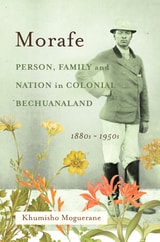
Morafe
Person, Family, and Nation in Colonial Bechuanaland, 1880s–1950sKhumisho Moguerane
Ohio University Press, 2024
In Morafe, Khumisho Moguerane has written a luminous exploration of two generations of the prominent Molema family. They were “border people” who straddled what would become present-day South Africa and Botswana. The book begins in the 1880s at the frontier of the new British territories of Bechuanaland (North West and Northern Cape provinces) and the Bechuanaland Protectorate (Botswana), where the political boundary between these two territories was negligible and where skin color did not yet necessarily connect with a particular social or political status or affect economic opportunity.
Morafe ends in the 1950s, when the political boundary mattered profoundly, dividing two very different colonial dispensations of racial ordering and classification, and two separate traditions of nationalist politics. With this landmark publication, Moguerane reveals that “the nation” is less “out there,” in public institutions and political struggles, and more “in here,” in the everyday drama of personal and ordinary lives.
Moral Economies of Corruption
State Formation and Political Culture in NigeriaSteven Pierce
Duke University Press, 2016
Moral Entanglements
Conserving Birds in Britain and GermanyStefan Bargheer
University of Chicago Press, 2018
Moral Enterprise
Literature and Education in Antebellum AmericaDerek Pacheco
The Ohio State University Press, 2013

Moral Philosophy and Development
The Human Condition in AfricaTedros Kiros
Ohio University Press, 1992
Moral Politics in the Philippines
Inequality, Democracy and the Urban PoorWataru Kusaka
National University of Singapore Press, 2017

Moralia et Ascetica Armeniaca
The Oft-Repeated DiscoursesAbraham Terian
Catholic University of America Press, 2022
Morality and the Mail in Nineteenth-Century America
Wayne E. Fuller
University of Illinois Press, 2003
Drawing on House and Senate documents, postmasters general reports, and the Congressional Record, as well as sermons, speeches, and articles from numerous religious and secular periodicals, Fuller illuminates the problems the changed postal system posed for evangelicals, from Sunday mail delivery and Sunday newspapers to an avalanche of unseemly material brought into American homes via improved mail service and reduced postage prices. Along the way, Fuller offers new perspectives on the church and state controversy in the United States as well as on publishing, politics, birth control, the lottery, censorship, Congress’s postal power, and the waning of evangelical Protestant influence.
Morals Of History
Tzvetan Todorov
University of Minnesota Press, 1995
Morbid Cravings
Appetite and Addiction in the Nineteenth CenturyHannah Markley
The Ohio State University Press, 2027
Morbid Cravings is the first book toexamine how eating disorders and drug addiction developed in the nineteenth century as entwined psychosocial responses to imperial-driven cultural demands that Britons regulate their appetites. Through close readings of Jane Austen, Thomas De Quincey, Sydney Whiting, and Arthur Conan Doyle, Hannah Markley explores the comorbidity of these disorders in relation to imperial trade and colonial conquest, applying a postcolonial lens to show us how emerging, separate diagnostic categories were in fact structured by the same social and economic systems.
During the seventeenth and eighteenth centuries, the influx of sugar, tea, coffee, opium, chocolate, and tobacco began to transform British diets and nervous systems, creating dependence on not only these substances but on the colonial systems that delivered them. In turn, medicine attempted to curtail these appetites by promoting restrictive dietary practices. By focusing on how anorexia nervosa, opium-eating, dyspepsia, and compulsive injection emerged in relation to attempts to regulate British appetites for colonial substances, Markley argues that the medico-ideological imperative to restrict appetites produced interrelated representations of eating disorders and addictions that ultimately enacted the voracious logic of British racial capitalism.
More Adventures with Britannia
Personalities, Politics and Culture in BritainEdited by Wm. Roger Louis
University of Texas Press, 1998
Collecting the interpretations of outstanding writers on the literature and history of modern Britain, this book deals with a rich variety of themes, some familiar, many unexpected, taking the reader on a highly engaging excursion through British life and intellectual biography. The scope includes not only the personalities, politics, and culture of England, Wales, Scotland, and Ireland, but also the interaction of British and other societies throughout the world.
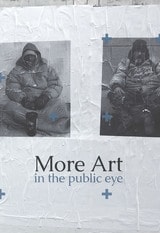
More Art in the Public Eye
Micaela Martegani, Jeff Kaspar, and Emma Drew, editors
Duke University Press, 2019
Contributors. Rebecca Amato, Michael Birchall, Ofri Cnaani, Michelle Coffey, Jennifer Dalton, Emma Drew, Pablo Helguera, Mary Jane Jacob, Jessica Lynne, Jeff Kasper, Kimsooja, Micaela Martegani, Andrea Mastrovito, Tony Oursler, William Powhida, Ernesto Pujol, Michael Rakowitz, Kirk Savage, Dread Scott, Andres Serrano, Gregory Sholette, Xaviera Simmons, Krzysztof Wodiczko
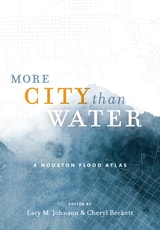
More City than Water
A Houston Flood AtlasEdited by Lacy M. Johnson and Cheryl Beckett
University of Texas Press, 2022
2022 Art in Service to the Environment Award, Sierra Club Lone Star Chapter
Honorable Mention, 2022 Nonfiction Prize, Writers' League of Texas
Writers explore a city’s relationship with chronic catastrophic flooding.
Shortly after Hurricane Harvey dumped a record 61 inches of rain on Houston in 2017, celebrated writer and Bayou City resident Lacy M. Johnson began collecting flood stories. Although these stories attested to the infinite variety of experience in America’s most diverse city, they also pointed to a consistent question: What does catastrophic flooding reveal about this city, and what does it obscure?
More City than Water brings together essays, conversations, and personal narratives from climate scientists, marine ecologists, housing activists, urban planners, artists, poets, and historians as they reflect on the human geography of a region increasingly defined by flooding. Both a literary and a cartographic anthology, More City than Water features striking maps of Houston’s floodplains, waterways, drainage systems, reservoirs, and inundated neighborhoods. Designed by University of Houston seniors from the Graphic Design program, each map, imaginative and precise, shifts our understanding of the flooding, the public’s relationship to it, and the fraught reality of rebuilding. Evocative and unique, this is an atlas that uncovers the changing nature of living where the waters rise.
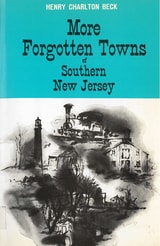
More Forgotten Towns of Southern New Jersey
Henry Beck
Rutgers University Press, 1963
Henry Charlton Black, raised in Haddonfield for years, shared his endless delight in the land and the lore of South Jersey. He, like a few other devoted Jerseyans, began to hunt out in the 1930s the old sites and to record the stories handed down from generation to generation, clear back to early settlers. In this sequel to Forgotten Towns of Southern New Jersey, his visits to the state's early heritage - churches, villages, and roads - are continued. He explores the routes of old railroads and the tangled wilderness of the Forked River Mountains, and he tells the lost stories of forgotten glass and iron and shipbuilding villages.
More Important Than the Music
A History of Jazz DiscographyBruce D. Epperson
University of Chicago Press, 2013
More Nights than Days
A Survey of Writings of Child Genocide SurvivorsYudit Kiss
Central European University Press, 2023
More Nights Than Days is a unique exploration of the experience of children who survived the Holocaust—including Roma and Sinti victims—and the genocides in Cambodia, Rwanda, and Bosnia. Children are among the principal victims of armed conflicts and slaughters; nonetheless, they perceive events through the prism of their unique perspective and have a range of coping techniques adults don't possess.
This overview of writings of ninety-one child survivors bears evidence from a wide range of human ruthlessness. The author presents little-known texts along with famous memoirs and autobiographical fiction, with abundant quotations. Many of these are not only compelling as historical testimony, but poetic and stirringly expressive. Yudit Kiss has not written a historical study or literary criticism of the children’s books. She explores, instead, what the authors went through and what they felt and understood about their experience. An accessible and captivating reading, this volume presents a close-up, human size dimension of the destruction. The books written by child survivors also describe the resources and means that helped them to remain human even in the deepest well of inhumanity, offering precious lessons about resistance and resilience.M
More Peoples of Las Vegas
One City, Many FacesJerry L Simich
University of Nevada Press, 2010
The remarkable economic growth of Las Vegas between 1980 and 2007 created a population boom and a major increase in the ethnic and religious diversity of the city. Today, over 21 percent of the city’s population is foreign born, and over 30 percent speak a language other than English at home. The local court system offers interpreters in 82 languages, and in 2005/2006, for example, more than 11,000 people, originating from 138 countries, were naturalized there as American citizens.More Peoples of Las Vegas extends the survey of this city’s cosmopolitan population begun in The Peoples of Las Vegas (University of Nevada Press, 2005). As in the previous book, this volume includes well-established groups like the Irish and Germans, and recently arrived groups like the Ethiopians and Guatemalans. Essays describe the history of each group in Las Vegas and the roles they play in the life and economy of the city. The essays also explore the influence of modern telecommunications and accessible air travel, showing how these factors allow newcomers to create transnational identities and maintain ties with families and culture back home. They also examine the role of local institutions—including clubs, religious organizations, shops, restaurants, and newspapers and other media—in helping immigrants maintain their ethnic and religious identities and in disseminating national and even regional cultures of origin.More Peoples of Las Vegas adds to our awareness of the rich and varied ethnic and religious character of Las Vegans. In a broader context, it offers thoughtful perspectives on the impact of globalization on a major American city and on the realities of immigrant life in the twenty-first century.
More Philadelphia Murals and the Stories They Tell
Jane Golden
Temple University Press, 2006
More Real Courage
Transforming Honor at the Early Naval AcademySamuel Limneos
University of Alabama Press, 2026
How discipline and conscience displaced anger and reputation in the early US Navy’s crucible of leadership
More Real Courage: Transforming Honor at the Early Naval Academy is a work of narrative history that traces a hard-fought moral transformation within the United States Navy’s officer corps. Samuel J. Limneos reveals an institutional struggle between competing ideals of courage, as traditional notions of offense, reputation, and aggression collided with emerging values of restraint, loyalty, and duty. Through intensely human stories of conflict, discipline, and conscience, the book shows how honor was contested, defended, and ultimately reshaped into a standard grounded in moral courage and professional responsibility.
Set across three pivotal decades at the Naval Academy, the study examines how midshipmen learned to navigate a culture inherited from European martial traditions while serving a rapidly changing republic. Limneos illuminates the professionalization of naval officers during the mid-nineteenth century, demonstrating how commitment, longsuffering, and performance of duty gradually displaced volatile codes of personal honor. Bridging social, cultural, and institutional history, More Real Courage fills a significant gap in naval historiography and speaks directly to enduring debates over character, leadership, and education in the armed forces. The book offers enduring moral lessons for naval historians, military professionals, and readers seeking to understand how national character is forged amid conflict, reform, and cultural change.
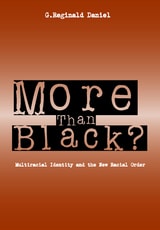
More Than Black
Multiracial Identity & New Racial OrderG. Reginald Daniel
Temple University Press, 2001
Tracing the centuries-long evolution of Eurocentrism, a concept geared to protecting white racial purity and social privilege, Daniel shows how race has been constructed and regulated in the United States. The so-called one-drop rule (i.e., hypodescent) obligated individuals to identify as black or white, in effect erasing mixed-race individuals from the social landscape. For most of our history, many mixed-race individuals of African American descent have attempted to acquire the socioeconomic benefits of being white by forming separate enclaves or "passing." By the 1990s, however, interracial marriages became increasingly common, and multiracial individuals became increasingly political, demanding institutional changes that would recognize the reality of multiple racial backgrounds and challenging white racial privilege.
More Than Black? regards the crumbling of the old racial order as an opportunity for substantially more than an improvement in U.S. race relations; it offers no less than a radical transformation of the nation's racial consciousness and the practice of democracy.
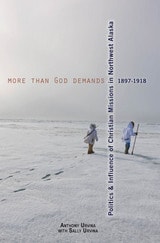
More Than God Demands
Politics and Influence of Christian Missions in Northwest Alaska, 1897-1918Anthony Urvina with Sally Urvina
University of Alaska Press, 2016
Anthony Urvina, whose mother was an orphan raised at one of the missions established as part of this program, draws on details from her life in order to present the first full history of this missionary effort. Smoothly combining personal and regional history, he tells the story of his mother’s experience amid a fascinating account of Alaska Native life and of the men and women who came to Alaska to spread the word of Christ, confident in their belief and unable to see the power of the ancient traditions they aimed to supplant.

More Than Science and Sputnik
The National Defense Education Act of 1958Wayne J. Urban
University of Alabama Press, 2010
Sparked by dramatic Soviet achievements, particularly in nuclear technology and the development of the Sputnik space orbiter, the United States responded in the late 1950s with an extraordinary federal investment in education. Designed to overcome a perceived national failure to produce enough qualified scientists, engineers, and mathematicians to compete with the Communist bloc, the effort resulted in the National Defense Education Act of 1958 (NDEA). Representative Carl Elliott and Senator Lister Hill both from Alabama, and then Assistant Secretary of Health, Education, and Welfare, Elliot Richardson were the prime movers in shaping of this landmark legislation.
More than Science and Sputnik analyzes primary documents of the three leaders to describe the political process that established the NDEA. The book illustrates what the assumptions of the key players were, and why they believed the act was needed.
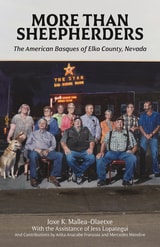
More Than Sheepherders
The American Basques of Elko County, NevadaJoxe K. Mallea-Olaetxe
University of Nevada Press, 2025
Joxe K. Mallea-Olaetxe presents a modern study focused on the post-1970s, when the retired Basque sheepherders and their families became the dominant Americanized minority in the area. During this time, the Fourth of July National Basque Festival began to attract thousands of visitors from as far away as Europe to the small Nevada community and brought to light the vibrant customs of these Nevadans.
This book explores the American Basques’ present-day place in the West, bolstered by the collaborative efforts of four contributors, including two women—all who have been residents of Elko. The writers offer firsthand knowledge of their heritage through numerous vignettes, and these deeply personal perspectives will entice readers into Mallea-Olaetxe’s singular and entertaining historical account.

More Than Words
A Memoir of a Writing LifeJerry Apps
Wisconsin Historical Society Press, 2022