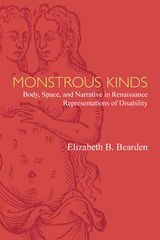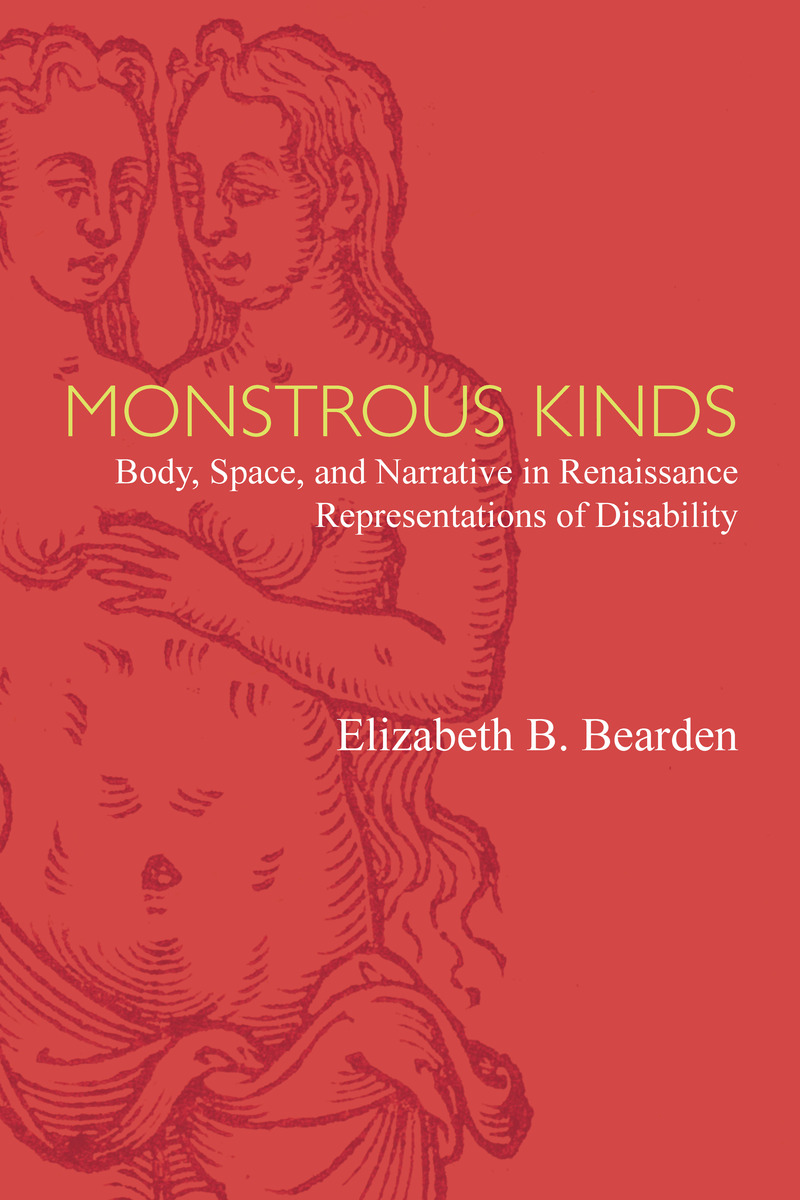
Monstrous Kinds: Body, Space, and Narrative in Renaissance Representations of Disability
University of Michigan Press, 2019
Cloth: 978-0-472-13112-9 | eISBN: 978-0-472-12458-9
Library of Congress Classification PN56.D553B43 2019
Dewey Decimal Classification 809.935610903
Cloth: 978-0-472-13112-9 | eISBN: 978-0-472-12458-9
Library of Congress Classification PN56.D553B43 2019
Dewey Decimal Classification 809.935610903
ABOUT THIS BOOK | AUTHOR BIOGRAPHY | REVIEWS | TOC | REQUEST ACCESSIBLE FILE
ABOUT THIS BOOK
Monstrous Kinds is the first book to explore textual representations of disability in the global Renaissance. Elizabeth B. Bearden contends that monstrosity, as a precursor to modern concepts of disability, has much to teach about our tendency to inscribe disability with meaning. Understanding how early modern writers approached disability not only provides more accurate genealogies of disability, but also helps nuance current aesthetic and theoretical disability formulations.
The book analyzes the cultural valences of early modern disability across a broad national and chronological span, attending to the specific bodily, spatial, and aesthetic systems that contributed to early modern literary representations of disability. The cross section of texts (including conduct books and treatises, travel writing and wonder books) is comparative, putting canonical European authors such as Castiglione into dialogue with transatlantic and Anglo-Ottoman literary exchange. Bearden questions grand narratives that convey a progression of disability from supernatural marvel to medical specimen, suggesting that, instead, these categories coexist and intersect.
The book analyzes the cultural valences of early modern disability across a broad national and chronological span, attending to the specific bodily, spatial, and aesthetic systems that contributed to early modern literary representations of disability. The cross section of texts (including conduct books and treatises, travel writing and wonder books) is comparative, putting canonical European authors such as Castiglione into dialogue with transatlantic and Anglo-Ottoman literary exchange. Bearden questions grand narratives that convey a progression of disability from supernatural marvel to medical specimen, suggesting that, instead, these categories coexist and intersect.
See other books on: Body | Disability | European literature | Narrative | Space
See other titles from University of Michigan Press