Results by title
5550 books match the query 'Biography & Autobiography' and 333 start with m
Memoirs of a Revolutionary
Victor Serge
University of Iowa Press, 2002

Memoirs of an Early Arab Feminist
The Life and Activism of Anbara Salam KhalidiAnbara Salam Khalidi
Pluto Press, 2013
Memoirs of an Early Arab Feminist is the first English translation of the memoirs of Anbara Salam Khalidi, the iconic Arab feminist. At a time when women are playing a leading role in the Arab Spring, this book brings to life an earlier period of social turmoil and women's activism through one remarkable life.
Anbara Salam was born in 1897 to a notable Sunni Muslim family of Beirut. She grew up in 'Greater Syria', in which unhindered travel between Beirut, Jerusalem and Damascus was possible, and wrote a series of newspaper articles calling on women to fight for their rights within the Ottoman Empire. In 1927 she caused a public scandal by removing her veil during a lecture at the American University of Beirut.
Later she translated Homer and Virgil into Arabic and fled from Jerusalem to Beirut following the establishment of Israel in 1948. She died in Beirut in 1986. These memoirs have long been acclaimed by Middle East historians as an essential resource for the social history of Beirut and the larger Arab world in the 19th and 20th centuries.

Memoirs of an Indo Woman
Twentieth Century Life in the East Indies and AbroadMarguérite Schenkhuizen
Ohio University Press, 1993
The memoirs of Marguérite Schenkhuizen provide an overview of practically the whole of the twentieth century as experienced by persons of mixed Dutch and Indonesian ancestry who lived in the former Dutch East Indies. The memoirs provide vignettes of Indonesian life, both rural and urban, as seen through the eyes of the author first as a girl, then as a wife separated from her husband during the Japanese occupation, finally as an immigrant to the United States after World War II.
This self-portrait gives glimpses of the life of Indos from inside their society, glimpses that are valuable for their descendents as well as for outsiders. Written with humor and a positive town, Schenkhuizen’s story sets aside the myth that Indos were denied access to the upper layers of Dutch colonial society or were otherwise disadvantaged. Instead, her life story provides an authentic view of a vital Indo culture and experience that has been unavailable to the general reader of English.
Memoirs of the Civil War
Between the Northern and Southern Sections of the United States of America 1861 to 1865William W. Chamberlaine
University of Alabama Press, 2011
Memoirs of the Civil War, though relatively little known because of its rarity in the original edition, contains much valuable information and engaging narrative passages. A Virginian whose Confederate career included service in an infantry regiment early in the war, Chamberlaine’s most important military service was as a staff officer attached to Brigadier General Reuben Lindsay Walker, who commanded the Third Corps artillery in the Army of Northern Virginia.
Includes excellent material on the duties of staff officers, operation of Confederate conscription, and the role of artillery in Lee’s campaigns. He is especially eloquent and revealing about a number of famous battles: the Seven Days; Antietam, where Chamberlaine distinguished himself and was wounded; and the Wilderness, where he had a memorable encounter with Lee.
Memoirs of the Life, Religious Experience, Ministerial Travels, and Labours of Mrs. Elaw
Zilpha Elaw
West Virginia University Press, 2021
As a young Black orphan indentured to a Quaker family in Bristol, Pennsylvania, Zilpha Elaw (c. 1793–1873) decided to join the upstart Methodists in 1808. She preached her first sermon a decade later, ignoring her husband and the many church leaders, clergy, and laity who tried to silence her. Elaw’s memoir chronicles the first twenty years of her forty-year itinerant ministry during massive Protestant revivalism in the United States and England.
Elaw preached from Maine to Virginia, attracting multiracial and multidenominational audiences that included powerful men, wealthy White women, poor families, and enslaved communities. She moved from Bristol to Burlington, New Jersey, then to Nantucket, Massachusetts, and finally, in 1840, to London’s East End. In England, Elaw’s celebrity expanded, and at least twice she drew crowds so large they caused human stampedes and multiple injuries.
Blockett’s introduction and extensive annotations draw on newly unearthed information about the entirety of Elaw’s evangelism to provide context for this remarkable story of an antebellum Black woman’s personal and professional mobility.
Memoirs of the Life, Religious Experience, Ministerial Travels, and Labours of Mrs. Elaw
Kimberly D. Blockett
University of Delaware Press, 0
Elaw preached from Maine to Virginia, attracting multiracial and multidenominational audiences that included powerful men, wealthy White women, poor families, and enslaved communities. She moved from Bristol to Burlington, New Jersey, then to Nantucket, Massachusetts, and finally, in 1840, to London’s East End. In England, Elaw’s celebrity expanded, and at least twice she drew crowds so large they caused human stampedes and multiple injuries.
Kimberly D. Blockett’s introduction and extensive annotations draw on newly unearthed information about the entirety of Elaw’s evangelism to provide context for this remarkable story of an antebellum Black woman’s personal and professional mobility.
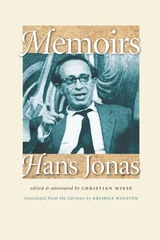
Memoirs
Hans JonasHans Jonas
Brandeis University Press, 2021
When Hans Jonas died in 1993, he was revered among American scholars specializing in European philosophy, but his thought had not yet made great inroads among a wider public. In Germany, conversely, during the 1980s, when Jonas himself was an octogenarian, he became a veritable intellectual celebrity, owing to the runaway success of his 1979 book The Imperative of Responsibility. In the 1920s, Jonas studied philosophy with Edmund Husserl and Martin Heidegger, but the Nazi regime forced him to leave Germany for London in 1933. He later emigrated to Palestine and eventually enlisted in the British Army’s Jewish Brigade to fight against Hitler. Following the Israeli War of Independence, he emigrated to the United States and took a position at the New School for Social Research in New York. He became part of a circle of friends around Hannah Arendt and Heinrich Blucher, which included Adolph Lowe and Paul Tillich.
This memoir, a diverse collection of previously unpublished materials—diaries, letters, interviews, and public statements—has been organized by Christian Wiese, whose afterword links the Jewish dimensions of Jonas’s life and philosophy. Because Jonas’s life spanned the entire twentieth century, this memoir provides nuanced pictures of German Jewry during the Weimar Republic, of German Zionism, of the Jewish emigrants in Palestine during the 1930s and 1940s, and of German Jewish émigré intellectuals in New York. Since Memoirs was first published in 2008, interest in the work of Hans Jonas has grown among American academics in recent years.
Memorializing Motherhood
Anna Jarvis and the Struggle for Control of Mother's DayKatharine Lane Antolini
West Virginia University Press, 2017
Few know the name Anna Jarvis, yet on the second Sunday in May, we mail the card, buy the flowers, place the phone call, or make the brunch reservation to honor our mothers, all because of her.
Anna Jarvis organized the first official Mother’s Day celebration in Grafton, West Virginia in 1908 and then spent decades promoting the holiday and defending it from commercialization. She designed her Mother’s Day celebration around a sentimental view of motherhood and domesticity, envisioning a day venerating the daily services and sacrifices of mothers within the home.
After Mother’s Day became a national holiday in 1914, many organizations sought to align the holiday’s meaning with changing perceptions of modern motherhood in the twentieth century. Instead of restricting a mother’s service and influence solely to the domestic sphere, they emphasized the power of mothers both within their homes and throughout their communities.
Jarvis refused to accept this changing interpretation, claiming both intellectual and legal ownership of Mother’s Day. Her obsession with protecting the purity of her vision sustained a war of verbal and legal assaults against rival holiday promoters, patriotic women’s organizations, charitable foundations, public health reformers, and the Franklin D. Roosevelt administration. The struggle for control of Mother’s Day ultimately threatened her livelihood, physical health, and emotional stability.
Memorializing Motherhood explores the complicated history of Anna Jarvis’s movement to establish and control Mother’s Day, as well as the powerful conceptualization of this day as both a holiday and a cultural representation of motherhood.
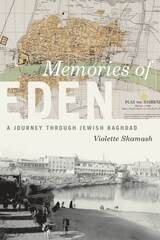
Memories of Eden
A Journey Through Jewish BaghdadViolette Shamash
Northwestern University Press, 2010
According to legend, the Garden of Eden was located in Iraq, and for millennia, Jews resided peacefully in metropolitan Baghdad. Memories of Eden: A Journey Through Jewish Baghdad reconstructs the last years of the oldest Jewish Diaspora community in the world through the recollections of Violette Shamash, a Jewish woman who was born in Baghdad in 1912, sent to her daughter Mira Rocca and son-in-law, the British journalist Tony Rocca. The result is a deeply textured memoir—an intimate portrait of an individual life, yet revealing of the complex dynamics of the Middle East in the twentieth century.
Toward the end of her long life, Violette Shamash began writing letters, notes, and essays and sending them to the Roccas. The resulting book begins near the end of Ottoman rule and runs through the British Mandate, the emergence of an independent Iraq, and the start of dictatorial government. Shamash clearly loved the world in which she grew up but is altogether honest in her depiction of the transformation of attitudes toward Baghdad’s Jewish population. Shamash’s world is finally shattered by the Farhud, the name given to the massacre of hundreds of Iraqi Jews over three days in 1941. An event that has received very slight historical coverage, the Farhud is further described and placed in context in a concluding essay by Tony Rocca.
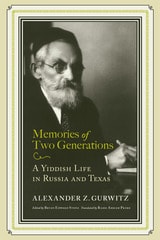
Memories of Two Generations
A Yiddish Life in Russia and TexasAlexander Z. Gurwitz, Edited and Introduced by Bryan Edward Stone
University of Alabama Press, 2022
The 1935 autobiography of Alexander Ziskind Gurwitz, an Orthodox Jew whose lively recounting of his life in Tsarist Russia and his immigration to San Antonio, Texas, in 1910 captures turbulent changes in early twentieth-century Jewish history
In 1910, at the age of fifty-one, Alexander Ziskind Gurwitz made the bold decision to emigrate with his wife and four children from southeastern Ukraine in Tsarist Russia to begin a new life in Texas. In 1935, in his seventies, Gurwitz composed a retrospective autobiography, Memories of Two Generations, that recounts his personal story both of the rich history of the lost Jewish world of Eastern Europe and of the rambunctious development of frontier Jewish communities in the United States.
In both Europe and America, Gurwitz inhabited an almost exclusively Jewish world. As a boy, he studied in traditional yeshivas and earned a living as a Hebrew language teacher and kosher butcher. Widely travelled, Gurwitz recalls with wit and insight daily life in European shtetls, providing perceptive and informative comments about Jewish religion, history, politics, and social customs. Among the book’s most notable features is his first-hand, insider’s account of the yearly Jewish holiday cycle as it was observed in the nineteenth century, described as he experienced it as a child.
Gurwitz’s account of his arrival in Texas forms a cornerstone record of the Galveston Immigration Movement; this memoir represents the only complete narrative of that migration from an immigrant’s point of view. Gurwitz’s descriptions about the development of a thriving Orthodox community in San Antonio provide an important and unique primary source about a facet of American Jewish life that is not widely known.
Gurwitz wrote his memoir in his preferred Yiddish, and this translation into English by Rabbi Amram Prero captures the lyrical style of the original. Scholar and author Bryan Edward Stone’s special introduction and illuminating footnotes round out a superb edition that offers much to experts and general readers alike.
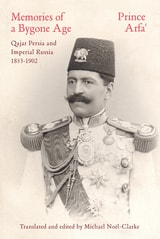
Memories of a Bygone Age
Qajar Persia and Imperial Russia 1853-1902Prince Arfa
Gingko, 2016
Prince Arfa writes with arresting wit about the deadly intrigues of the Qajar court. Lamentingly, but resolutely, he chronicles the decline of Iran from a once great empire to an almost bankrupt, lawless state, in which social unrest is channelled and exploited by the clergy. He describes the complex interactions between Iran and Europe, including an account of Naser-od-Din Shah’s profligate visits to Britain and France; the splendor and eccentricities of the doomed Tsar Nicholas II’s court; the Tsar’s omen-laden coronation; and his own favor with the Tsarina, who would grant him concessions on matters of vital importance to his country. The result is a memoir of extraordinary political intrigue.

Memories of a Gay Catholic Boyhood
Coming of Age in the SixtiesJohn D'Emilio
Duke University Press, 2022
Memories of a Gay Catholic Boyhood is D’Emilio’s coming-of-age story in which he takes readers from his working-class Bronx neighborhood to an elite Jesuit high school in Manhattan to Columbia University and the political and social upheavals of the late 1960s. He shares his personal experiences of growing up in a conservative, tight-knit, multigenerational family, how he went from considering entering the priesthood to losing his faith and coming to terms with his same-sex desires. Throughout, D’Emilio outlines his complicated relationship with his family while showing how his passion for activism influenced his decision to use research, writing, and teaching to build a strong LGBTQ movement.
This is not just John D’Emilio’s personal story; it opens a window into how the conformist baby boom decade of the 1950s transformed into the tumultuous years of radical social movements and widespread protest during the 1960s. It is the story of what happens when different cultures and values collide and the tensions and possibilities for personal discovery and growth that emerge. Intimate and honest, D’Emilio’s story will resonate with anyone who has had to chart their own path in a world they did not expect to find.
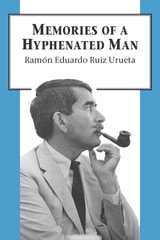
Memories of a Hyphenated Man
Ramón Eduardo Ruiz Urueta
University of Arizona Press, 2003
Historian, author, and intellectual, Ruiz has established himself through such books as Triumphs and Tragedy: A History of the Mexican People and Cuba: The Making of a Revolution, and in 1998 he was awarded the National Humanities Medal by President Clinton. Now he turns his pen on his own life to offer a personal look at what it really means to be American by birth but Mexican by culture.
Little has been written by or about persons of Mexican origin who have achieved the academic stature of Ruiz, and his memoir provides insights not found in the more common biographies of labor leaders and civil rights activists. His early life straddled the social worlds of his parent's Mexico and semi-rural America, where his father's success as an entrepreneur and property owner set his family's experiences apart from those of most other Mexican Americans at the time. His parents reinforced in their children an identity as mexicanos, and that connection with his ancestral roots was for Ruiz a lifejacket in the days of acute bigotry in America.
In making an early, self-conscious commitment to a life of the mind, Ruiz became aware of his unique nature, and while not immune to prejudice he was able to make a name for himself in several endeavors. As a student, he attended college when few Mexican Americans were given that opportunity, and he was one of the first of his generation to earn a Ph.D. As an Army Air Force officer during World War II, he served as a pilot in the Pacific theatre. And as an intellectual, he navigated the currents of the historical profession and charted new directions in Latin American research through his prolific writing.
Ruiz's career teaching took him to Mexico, Massachusetts, Texas, Oregon—often as the lone "Mexican professor," and ultimately back to his native California. While teaching at Smith, he exulted in being "free to interpret Spanish American life and culture to my heart's content," and at the University of California, San Diego, he saw the era of campus racial barrier give way to the birth of affirmative action. While at UCSD, he taught hundreds of Chicanos and trained one of the largest groups of Chicano Ph.D's.
Memories of a Hyphenated Man is the story of a unique individual who, while shaped by his upbringing and drawing on deep cultural roots, steadfastly followed his own compass in life. It tells of a singular man who beat the odds as it poignantly addresses the ambiguities associated with race, class, citizenship, and nationality for Mexicans and Mexican Americans.

Memory Care
Essays on ForgettingJennifer C. Nash
Duke University Press, 2027
Memory Fever
Ray Gonzalez
University of Arizona Press, 1999
Through 29 storylike essays, Gonzalez takes readers into the heart of the desert and the soul of a developing poet. He introduces us to the people who shaped his life. We learn of his father's difficulties with running a pool hall and of his grandmother's steadfast religious faith. We meet sinister Texas Rangers, hallucinatory poets, illegal aliens, and racist high school jocks. His vivid recollections embrace lizard hunts and rattlesnake dreams, rock music and menudo making—all in stories that convey the pains and joys of growing up on the border. As Gonzalez leads us through his desert of hope and vision, we come to recognize the humor and sadness that permeate this special place.
Memory of Trees
A Daughter’s Story of a Family FarmGayla Marty
University of Minnesota Press, 2013
Memory of Trees is a multigenerational story of Gayla Marty’s family farm near Rush City, Minnesota. Cleared from woodlands by her great-grandfather Jacob in the 1880s, the farm passed to her father, Gordon, and his brother, Gaylon. Hewing to a conservative Swedish Baptist faith, the two brothers worked the farm, raising their families in side-by-side houses.
As the years go by, the families grow—and slowly grow apart. Uncle Gaylon, more doctrinaire in his faith, rails against the permissiveness of Gayla’s parents. Financial tensions arise as well when the farm economy weakens and none of the children is willing or able to take over. Gayla is encouraged to leave for college, international travel, and city life, but the farm remains essential to her sense of self, even after the family decides to sell the land.
When Gaylon has an accident on a tractor, Gayla becomes driven to reconnect with him and to find out why she and her uncle—once so close but now estranged—were the only two members of the family who had resisted selling the land. Guided by vivid images of the farm’s many beautiful trees, she pores over sacred and classical works as well as layers of her own memory to understand the forces that have transformed the American landscape and culture in the last half of the twentieth century. Beneath the belief in land as a giver of life and blessing, she discovers a powerful anxiety born of human uprootedness and loss. Movingly written, Memory of Trees will resonate for many with attachments to small towns or farms, whether they continue to work the land or, like so many, have left for a different life.
Memory
A Fourth MemoirWallace Fowlie
Duke University Press, 1990
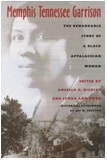
Memphis Tennessee Garrison
The Remarkable Story of a Black Appalachian WomanAncella R. Bickley
Ohio University Press, 2001
As a black Appalachian woman, Memphis Tennessee Garrison belonged to a demographic category triply ignored by historians.
The daughter of former slaves, she moved to McDowell County, West Virginia, at an early age and died at ninety-eight in Huntington. The coalfields of McDowell County were among the richest seams in the nation. As Garrison makes clear, the backbone of the early mining work force—those who laid the railroad tracks, manned the coke ovens, and dug the coal—were black miners. These miners and their families created communities that became the centers of the struggle for unions, better education, and expanded civil rights. Memphis Tennessee Garrison, an innovative teacher, administrative worker at U.S. Steel, and vice president of the National Board of the NAACP at the height of the civil rights struggle (1963-66), was involved with all of these struggles.
In many ways, this oral history, based on interview transcripts, is the untold and multidimensional story of African American life in West Virginia, as seen through the eyes of a remarkable woman. She portrays a courageous people who organize to improve their working conditions, send their children to school and then to college, own land, and support a wide range of cultural and political activities.
Men I Hate
A Memoir in EssaysLynette D'Amico
The Ohio State University Press, 2026
Can a lesbian who loves a trans man still call herself a lesbian? Against the backdrop of a traditional Sicilian American upbringing, Lynette D’Amico identified as a lesbian despite the expectation that her future hinged on the man she married. As a teenager, she fled her St. Louis home in the dark of night to escape her fate. No boys allowed, until one day D’Amico’s life was completely upended when her lover and spouse of twenty years—P. Carl, the acclaimed author of Becoming a Man: The Story of a Transition—told her he was a man.
Seemingly overnight, D’Amico no longer recognized her spouse in photos of past vacations or of the couple celebrating their legal gay marriage. In Men I Hate, she asks: What happens when the people we are closest to change? As D’Amico tries to engage more deeply with the man she is married to, she looks at all the men—historical figures, politicians, men in her family—in search of clear dividing lines between good men and bad, between the men she loves and the men she hates. These lines dissolve as she writes her way toward an understanding of the words marriage,husband, and home—and how we reconcile who we are with who we become.
Men I've Never Been
Michael Sadowski
University of Wisconsin Press, 2021
Through wrenching tragedy and tense, life-threatening challenges, Sadowski learns to find love, purpose, and healthy self-regard. In coming to understand his identity and his place within his family, he meditates on the power of real human connection and comes to grasp the damage of his troubled upbringing and the traumas caused by toxic masculinity. By turns comic and tragic, this nuanced memoir uncovers the false selves we create to get along in the world and the price we pay to maintain them.
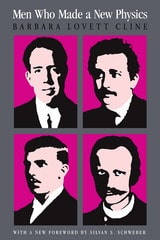
Men Who Made a New Physics
Physicists and the Quantum TheoryBarbara Lovett Cline
University of Chicago Press, 1987
Mendings
Megan Sweeney
Duke University Press, 2023
Mental Traveler
A Father, a Son, and a Journey through SchizophreniaW. J. T. Mitchell
University of Chicago Press, 2020
Gabriel Mitchell was diagnosed with schizophrenia at age twenty-one and died by suicide eighteen years later. He left behind a remarkable archive of creative work and a father determined to honor his son’s attempts to conquer his own illness. Before his death, Gabe had been working on a film that would show madness from inside and out, as media stereotype and spectacle, symptom and stigma, malady and minority status, disability and gateway to insight. He was convinced that madness is an extreme form of subjective experience that we all endure at some point in our lives, whether in moments of ecstasy or melancholy, or in the enduring trauma of a broken heart. Gabe’s declared ambition was to transform schizophrenia from a death sentence to a learning experience, and madness from a curse to a critical perspective.
Shot through with love and pain, Mental Traveler shows how Gabe drew his father into his quest for enlightenment within madness. It is a book that will touch anyone struggling to cope with mental illness, and especially for parents and caregivers of those caught in its grasp.
Merchant Saint
The Church, the Market, and the First Lay Canonizationprudlo
St. Augustine's Press, 2024
Voss and Prudlo provide a rich resource for readers concerned with the proper aims and boundaries of a life in the world of commerce, the nature of work, the ethics of profit, the problem of money-lending, the virtues needed for moral capitalism, and the tension between otium and negotium. Voss and Prudlo have accumulated a veritable trove of primary text materials relating to the life of Omobono, and provide translations and commentary to complete their analysis. This fascinating account crosses the threshold of pure history and stimulates inquiry in the fields of philosophy, economics, and theology.
Meredith Nicholson
A Writing LifeRalph D. Gray
Indiana Historical Society Press, 2007
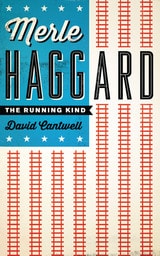
Merle Haggard
The Running KindBy David Cantwell
University of Texas Press, 2013
Merle Haggard has enjoyed artistic and professional triumphs few can match. He’s charted more than a hundred country hits, including thirty-eight number ones. He’s released dozens of studio albums and another half dozen or more live ones, performed upwards of ten thousand concerts, been inducted into the Country Music Hall of Fame, and seen his songs performed by artists as diverse as Lynryd Skynyrd, Elvis Costello, Tammy Wynette, Willie Nelson, the Grateful Dead, and Bob Dylan. In 2011 he was feted as a Kennedy Center Honoree. But until now, no one has taken an in-depth look at his career and body of work.
In Merle Haggard: The Running Kind, David Cantwell takes us on a revelatory journey through Haggard’s music and the life and times out of which it came. Covering the entire breadth of his career, Cantwell focuses especially on the 1960s and 1970s, when Haggard created some of his best-known and most influential music, which helped invent the America we live in today. Listening closely to a masterpiece-crowded catalogue (including songs such as “Okie from Muskogee,” “Sing Me Back Home,” “Mama Tried,” “Working Man Blues,” “Kern River,” “White Line Fever,” “Today I Started Loving You Again,” and “If We Make It through December,” among many more), Cantwell explores the fascinating contradictions—most of all, the desire for freedom in the face of limits set by the world or self-imposed—that define not only Haggard’s music and public persona but the very heart of American culture.
Messiah of the New Technique
John Howard Lawson, Communism, and American Theatre, 1923-1937Jonathan L. Chambers
Southern Illinois University Press, 2006
Messiah of the New Technique: John Howard Lawson, Communism, and American Theatre, 1923–1937 is a critical and political biography and a cultural and social history that focuses on Lawson’s career in the theatre. Using a materialist methodology, Jonathan L. Chambers emphasizes the evolution and interplay of the playwright’s artistic vision and political ideology, considering his art as both a documentation of this evolution and a product of the socio-political and cultural matrix in which he was immersed.
Spanning the playwright’s career, the volume details Lawson’s early indoctrination in and commitment to the avant-garde, his use and development of various nonrealistic playwriting techniques, his subtle though unfocused attacks on bourgeois society, and the varied critical responses he received. Chambers addresses Lawson’s involvement with the New Playwrights’ Theatre and his participation in the protests surrounding the case of Nicola Sacco and Bartolomeo Vanzetti, which stimulated his growing commitment to left-wing politics and radical causes.
Chambers also analyzes the social and cultural factors that shaped Lawson’s growing interest in revolutionary politics, his tutelage in Marxism under Edmund Wilson, and his tenure as president of the Screen Writers Guild. He also covers the final phase of Lawson’s playwriting career, which reveals the playwright’s internal struggle. That struggle, suggests Chambers, pitted Lawson’s view of aesthetics against his political ideology and is reflected in his scripts and theoretical writings.
Messiah of the New Technique provides a wealth of new material about both the playwright and the period, offering a critical synopsis of the artist’s career, addressing his often vehement rebuttals to his critics, and summarizing both his political activism and his creative and critical endeavors in the last forty years of his life.
Metamorphoses
Memoirs of a Life in MedicineWilliam G. Anlyan, M. D.
Duke University Press, 2004
Born in Alexandria, Egypt, in 1925, and schooled in the British tradition, Anlyan attended Yale University as an undergraduate and medical student before coming to the relatively unknown medical school at Duke University in 1949 for an internship in general and thoracic surgery. He stayed on, first as a resident, then as a staff surgeon. By 1961, he was a full professor of surgery. In 1964, Anlyan was named dean of the medical school, the first in a series of administrative posts at the medical school and hospital. Anlyan’s role in the transformation of the Duke University Medical Center into an internationally renowned health system is manifest: he restructured the medical school and hospital and supervised the addition of almost four million square feet of new or renovated space. He hired outstanding administrators and directed a staff that instituted innovative programs and groundbreaking research centers, such as the Cancer Center and the Physician’s Assistant Program.
Anlyan describes a series of metamorphoses in his own life, in the world of medicine, in Durham, and at Duke. At the time of his prep school upbringing in Egypt, medicine was a matter of controlling infectious diseases like tuberculosis and polio. As he became an immigrant medical student and then a young surgeon, he observed vast advances in medical practice and changes in the financing of medical care. During his tenure at Duke, Durham was transformed from a sleepy mill and tobacco town into the “City of Medicine,” a place where patients routinely travel for open-heart surgery and cutting-edge treatments for cancer and other diseases.
Anyone interested in health care, medical education, and the history of Duke University will find Anlyan’s memoir of interest.
Metamorphosis
Who We Become after Facial ParalysisFaye Linda Wachs
Rutgers University Press, 2023
Method Acting and Its Discontents
On American Psycho-DramaShonni Enelow
Northwestern University Press, 2015
Method Acting and Its Discontents: On American Psycho-Drama provides a new understanding of a crucial chapter in American theater history. Enelow’s consideration of the broader cultural climate of the late 1950s and early 1960s, specifically the debates within psychology and psychoanalysis, the period’s racial and sexual politics, and the rise of mass media, gives us a nuanced, complex picture of Lee Strasberg and the Actors Studio and contemporaneous works of drama. Combining cultural analysis, dramaturgical criticism, and performance theory, Enelow shows how Method acting’s contradictions reveal powerful tensions inside mid-century notions of individual and collective identity.
Mettlework
A Mining Daughter on Making HomeJessica E. Johnson
Acre Books, 2024
In the weeks after her first child is born, Jessica E. Johnson receives an email from her mother that contains artifacts of the author’s early childhood: scans of Polaroids and letters her mother wrote in mountain west mining camps and ghost towns—places without running water, companions, or help. Awash in love and restlessness, Johnson begins to see how the bedrock images of her isolated upbringing have stayed with her, even when she believed she was removing herself from their logic.
As she copes with the swirling pressures of parenting, teaching at an urban community college, and a partnership shaped by chronic illness, Johnson starts digging through her mother’s keepsakes and the histories of the places her family passed through, uncovering the linked misogyny and disconnection that characterized her childhood world—a world with uncomfortable echoes in the present and even in the act of writing itself. The resulting journey encompasses Johnson’s early memories, the story of the earth told in the language of geology, bits of vivid correspondence, a mothering manual from the early twentieth century, and the daily challenges of personal and collective care in a lonesome-crowded Pacific wonderland. Mettlework traces intergenerational failures of homemaking, traveling toward presence and relationship amid the remains of extractive industry and unsustainable notions of family.
Mexican Political Biographies, 1884–1934
By Roderic Ai Camp
University of Texas Press, 1991
Here is an authoritative reference work that makes biographies of prominent Mexican national politicians from the period 1884–1934 available in English. Like the author's biographical directory for the years 1935–2009, it draws on many years of research in Mexico and the United States and seeks not only to provide accurate biographical information about each entry but also, where possible and appropriate, to connect these politicians to more recent leadership generations. Thus, Mexican Political Biographies, 1884-1934 not only is a useful historical source but also provides additional information on the family backgrounds of many contemporary figures.
The work includes those figures who have held specific posts at the national level or who have served as state governors. Each biographical entry contains the following information: date of birth, birthplace, education, elective political office, political party positions, appointive governmental posts at all levels, group activities, nongovernmental positions and professions, relatives, mentors and important friends, military experience, unusual career activities, and published biographical sources.
Another unique feature of the directory is appendixes with complete lists of the names and dates of cabinet members, supreme court justices, senators, deputies, selected ambassadors, and party leaders.
Mexican Political Biographies, 1935-2009
Fourth EditionBy Roderic Ai Camp
University of Texas Press, 2011
This fourth edition of Roderic Camp's highly respected Mexican Political Biographies is an updated comprehensive biographical directory of leading state and national politicians in Mexico, covering the years 1935–2009. The original edition, published in 1976, was the first and only comprehensive biographical work on contemporary political figures in any language and served as the prototype for the Mexican government's brief foray into its own official biographical directory. The Mexican Supreme Court has cited every biography of justices in the third edition as the basis of its biographies in the late 1980s.
With updates of the existing biographies and appendices, plus almost 1,000 additional biographies, this fourth edition now features close to 3,000 entries and serves as a unique resource list of the chronological occupants of all leading national political posts. The need for such information has become even more pronounced since Mexico's political transformation from a semi-authoritarian to a democratic model.
This latest edition allows readers access to information about Mexican politicians into the new century, and like its earlier versions, will be a valuable tool for government officials, journalists, historians, social scientists, the business community, and students.
Finally, it includes a detailed bibliographic essay that identifies and explains the significance of biographical sources and has been enhanced by numerous up-to-date Internet sources. An added convenience is an accompanying CD that allows readers to search the biographies and appendices, enhancing the longevity, usefulness, and uniqueness of this edition.
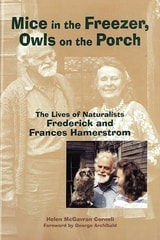
Mice in the Freezer, Owls on the Porch
The Lives of Naturalists Frederick and Francis HamerstromHelen M. Corneli
University of Wisconsin Press, 2006
Mice in the Freezer, Owls on the Porch is in many ways a love story—about a quiet scientist and his flamboyant wife, but also about their passions for hunting, for wild lands, and for the grouse and raptor species that they were instrumental in saving from destruction.
From the papers and letters of Frederick and Frances Hamerstrom, the reminiscences of contemporaries, and her own long friendship with this extraordinary couple who were her neighbors, Helen Corneli draws an intimate picture of Fran and "Hammy" from childhood through the genesis and maturation of a romantic, creative, and scientific relationship. Following the Hamerstroms as they give up a life of sophisticated convention and comfort for the more "civilized" (as Aldo Leopold would have it) pleasures of living and conducting on-the-spot research into diminishing species, Corneli captures the spirit of the Hamerstroms, their profession, and the natural and human environments in which they worked. A nuanced account of the labors, adventures, and achievements that distinguished the Hamerstroms over the years—and that inspired a generation of naturalists—this book also provides a dramatic account of conservation history over the course of the twentieth century, particularly in Wisconsin during the eventful years from the 1920s through the 1970s.
Michael Moore and the Rhetoric of Documentary
Edited by Thomas W. Benson and Brian J. Snee
Southern Illinois University Press, 2015
Not afraid to tackle provocative topics in American culture, from gun violence and labor policies to terrorism and health care, Michael Moore has earned both applause and invective in his career as a documentarian. In such polarizing films as Bowling for Columbine, Fahrenheit 9/11, and Sicko, Moore has established a unique voice of radical nostalgia for progressivism, and in doing so has become one of the most recognized documentary filmmakers of all time.
In the first in-depth study of Moore’s feature-length documentary films, editors Thomas W. Benson and Brian J. Snee have gathered leading rhetoric scholars to examine the production, rhetorical appeals, and audience reception of these films. Contributors critique the films primarily as modes of public argument and political art. Each essay is devoted to one of Moore’s films and traces in detail how each film invites specific audience responses.
Michael Moore and the Rhetoric of Documentary reveals not only the art, the argument, and the emotional appeals of Moore’s documentaries but also how these films have revolutionized the genre of documentary filmmaking.
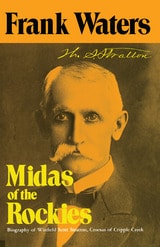
Midas of the Rockies
Biography of Winfield Scott Stratton, Croesus of Cripple CreekFrank Waters
Ohio University Press, 1972
This reprint makes available again Frank Waters’ dramatic and colorful 1937 biography of Winfield Scott Stratton, the man who struck it rich at the foot of Pike’s Peak and turned Cripple Creek into the greatest gold camp on earth. More than regional history, Midas of the Rockies is a story so fabulously impossible and yet so painfully true that it commends itself to the whole of America, the only earth, the only people who could have created it.
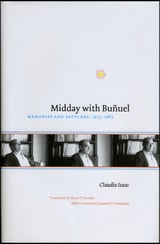
Midday with Buñuel
Memories and Sketches, 1973-1983Claudio Isaac
Swan Isle Press, 2007
The text includes sketches, vignettes, and anecdotes from Isaac’s notebooks, revealing his perspective first as a precocious boy and then as a young man. Isaac reflects on Buñuel’s presence among a community of exiles, artists, actors, writers, and intellectuals in Mexico City. These are at once touching, perceptive, and critical glimpses into Buñuel’s roles as husband and father, friend and colleague, surrealist, philosopher, and iconoclast during his last years. Throughout, Isaac’s words reveal his deep admiration and affection for an older friend full of contradictions. Intimate photographs from the Isaac family archive complement the writing, and Bryan Thomas Scoular’s careful translation makes this text available for the first time in English.
Part biography, part memoir, Midday with Buñuel brings to life the creative milieu of Mexico City and gives readers a privileged view of the relationship between these two filmmakers.

Midnight at the Barrelhouse
The Johnny Otis StoryGeorge Lipsitz
University of Minnesota Press, 2010
Mies van der Rohe
A Critical Biography, New and Revised EditionFranz Schulze and Edward Windhorst
University of Chicago Press, 2012
Miguel Mármol
Roque Dalton
Northwestern University Press, 1995
Mike Leigh
Sean O'Sullivan
University of Illinois Press, 2011
O'Sullivan challenges the prevailing characterizations of Leigh's cinema by detailing the complicated constructions of his realism, positing his films not as transparent records of life but as aesthetic transformations of it. Concentrating on the most recent two decades of Leigh's career, the study examines how Naked, Secrets and Lies, Topsy-Turvy, Vera Drake, and other films engage narrative convergence and narrative diffusion, the tension between character and plot, the interplay of coincidence and design, cinema's relationship to other systems of representation, and the filmic rendering of the human figure. The book also spotlights such earlier, less-discussed works as Four Days in July and The Short and Curlies, illustrating the recurring visual and storytelling concerns of Leigh's cinema. With a detailed filmography, this volume also includes key selections from O'Sullivan's several interviews with Leigh.
Mikhail Bakhtin
The Duvakin Interviews, 1973Slav N Gratchev
Bucknell University Press, 2019
Published by Bucknell University Press. Distributed worldwide by Rutgers University Press.
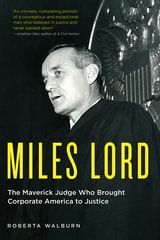
Miles Lord
The Maverick Judge Who Brought Corporate America to JusticeRoberta Walburn
University of Minnesota Press, 2017
The life of a crusading federal judge who stood up and fought for “the little guy”
This is the story of Miles Lord (1919–2016), who rose from humble beginnings on Minnesota’s Iron Range to become one of the most colorful and powerful judges in the country, described as “an unabashed Prairie populist” and “a live-wire slayer of corporate behemoths.” He cut a wide swath through history on his path to the bench: coming of age alongside a cadre of young Midwestern social-gospel progressives, including Hubert H. Humphrey, Eugene McCarthy, and Walter Mondale, in the days before they reached national fame; teaming with Bobby Kennedy as a hotshot prosecutor in pursuit of Jimmy Hoffa; and serving as the secret envoy between his friends Hubert and Eugene in their battle for the soul of the Democratic party in the historic 1968 presidential campaign. Later, after donning his black robe, he reshaped jurisprudence with precedent-breaking rulings—on issues ranging from women’s rights to consumer protection to education reform—and breaking trail when he ordered the shutdown of the Reserve Mining Company in northern Minnesota, which was spewing its waste into Lake Superior, in the most sensational trial of the early environmental era.
One of Judge Lord’s landmark cases—and interlaced as a centerpiece narrative of this book—involved the Dalkon Shield intrauterine device, which caused horrific infections in thousands of women, resulting in infertility and sometimes death. Author Roberta Walburn served as the judge’s law clerk during that litigation in 1983–84, and she provides a page-turning account (both an insider’s view and an in-depth chronicle) of what was called “one of the most disastrous episodes of American corporate misconduct.” In the end, more than 200,000 women received nearly $3 billion in compensation, and the Fortune 500 defendant was left in ruins. But Judge Lord was hauled up on judicial misconduct charges for his no-holds-barred actions that were certainly provocative but also stand as a timely reminder, even (or especially) today, of the challenges in balancing the scales of justice for a legal system that too often skews to the rich and powerful.
The author deftly weaves the Dalkon Shield drama into the larger story of the life of a one-of-a-kind man, crafting a sweeping and spirited true-life tale with not only her first-hand experiences as the judge’s law clerk but also with unrestricted access to the judge’s personal files. This is a rare and compelling portrait of a remarkable man and his place in both Minnesota and U.S. history.
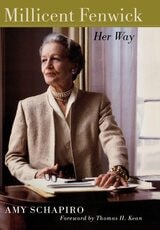
Millicent Fenwick
Her WaySchapiro, Amy
Rutgers University Press, 2003
Amy Schapiro has written the first biography of Millicent Fenwick, the popular and colorful New Jersey congresswoman. Affectionately remembered as the pipe-smoking grandmother who served as the model for Garry Trudeau’s Doonesbury character Lacey Davenport, Fenwick defied such simplistic expectations to become, in the words of Walter Cronkite, “the conscience of Congress.”
Born in 1910 into comfortable circumstances, Fenwick faced tragedy at an early age when her mother was lost in the sinking of the Lusitania. Following an upper-class childhood and a failed marriage, she began a fourteen-year career at Vogue magazine.
In the 1960s, Fenwick became involved in the civil rights movement and took part in local and state politics in New Jersey. Blessed with striking good looks and a sharp wit, she cut a glamorous figure, rising quickly through the ranks of the state Republican Party at a time when most of her peers were retiring. When this colorful, outspoken figure—one of only five New Jersey women ever elected to Congress— went to Washington in 1974 at age sixty-four, her victory was portrayed by the media as a “geriatric triumph.”
Schapiro’s extensive interviews with Fenwick’s son, Hugh, who granted her exclusive rights to Fenwick’s personal papers, oral histories, letters, and photographs, provide rare insight into the life and career of one of America’s most memorable politicians.
Milton Friedman and Economic Debate in the United States, 1932–1972, Volume 1
Edward Nelson
University of Chicago Press, 2020
This two-volume account provides a foundational introduction to Friedman’s role in several major economic debates that took place in the United States between 1932 and 1972. The first volume, which takes the story through 1960, covers the period in which Friedman began and developed his research on monetary policy. It traces Friedman’s thinking from his professional beginnings in the 1930s as a combative young microeconomist, to his wartime years on the staff of the US Treasury, and his emergence in the postwar period as a leading proponent of monetary policy. The second volume covers the years between 1960 and 1972— years that saw the publication of Friedman and Anna Schwartz’s Monetary History of the United States. The book also covers Friedman’s involvement in a number of debates in the 1960s and 1970s, on topics such as unemployment, inflation, consumer protection, and the environment.
As a fellow monetary economist, Nelson writes from a unique vantage point, drawing on both his own expertise in monetary analysis and his deep familiarity with Friedman’s writings. Using extensive documentation, the book weaves together Friedman’s research contributions and his engagement in public debate, providing an unparalleled analysis of Friedman’s views on the economic developments of his day.
Milton Friedman and Economic Debate in the United States, 1932–1972, Volume 2
Edward Nelson
University of Chicago Press, 2020
This two-volume account provides a foundational introduction to Friedman’s role in several major economic debates that took place in the United States between 1932 and 1972. The first volume, which takes the story through 1960, covers the period in which Friedman began and developed his research on monetary policy. It traces Friedman’s thinking from his professional beginnings in the 1930s as a combative young microeconomist, to his wartime years on the staff of the US Treasury, and his emergence in the postwar period as a leading proponent of monetary policy. The second volume covers the years between 1960 and 1972— years that saw the publication of Friedman and Anna Schwartz’s Monetary History of the United States. The book also covers Friedman’s involvement in a number of debates in the 1960s and 1970s, on topics such as unemployment, inflation, consumer protection, and the environment.
As a fellow monetary economist, Nelson writes from a unique vantage point, drawing on both his own expertise in monetary analysis and his deep familiarity with Friedman’s writings. Using extensive documentation, the book weaves together Friedman’s research contributions and his engagement in public debate, providing an unparalleled analysis of Friedman’s views on the economic developments of his day.
Mind The Gap
The Education Of A Nature WriterJohn Hay
University of Nevada Press, 2006
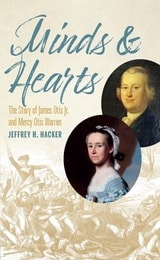
Minds and Hearts
The Story of James Otis Jr. and Mercy Otis WarrenJeffrey H. Hacker
University of Massachusetts Press, 2021
Minds and Hearts is the dual biography of these remarkable siblings, placing James and Mercy in the spotlight together for the first time, amid the rush of events, competing ideologies, and changing social conditions of eighteenth-century America. Jeffrey H. Hacker crafts a compelling narrative that focuses on the Otises' unique and dramatic relationship and traces their impact on the Revolutionary movement in Massachusetts. If the real American Revolution took place "in the minds and hearts of the people," as John Adams claimed, then the Otises were among the nation's true patriots.
Minerva and the Muse
A Life of Margaret FullerDoe Coover Agency
University of Massachusetts Press, 1996

Minnesota's Geologist
The Life of Newton Horace WinchellSue Leaf
University of Minnesota Press, 2026
Winner of the 2021 Minnesota Book Award for Minnesota Nonfiction
The story of the scientist who first mapped Minnesota’s geology, set against the backdrop of early scientific inquiry in the state
At twenty, Newton Horace Winchell declared, “I know nothing about rocks.” At twenty-five, he decided to make them his life’s work. As a young geologist tasked with heading the Minnesota Geological and Natural History Survey, Winchell (1839–1914) charted the prehistory of the region, its era of inland seas, its volcanic activity, and its several ice ages—laying the foundation for the monumental five-volume Geology of Minnesota. Tracing Winchell’s remarkable path from impoverished fifteen-year-old schoolteacher to a leading light of an emerging scientific field, Minnesota’s Geologist also recreates the heady early days of scientific inquiry in Minnesota, a time when one man’s determination and passion for learning could unlock the secrets of the state’s distant past and present landscape.
Traveling by horse and cart, by sailboat and birchbark canoe, Winchell and his group surveyed rock outcrops, river valleys, basalt formations on Lake Superior, and the vast Red River Valley. He studied petrology at the Sorbonne in Paris, bringing cutting-edge knowledge to bear on the volcanic rocks of the Arrowhead region. As a founder of the American Geological Society and founding editor of American Geologist, the first journal for professional geologists, Winchell was the driving force behind scientific endeavor in early state history, serving as mentor to many young scientists and presiding over a household—the Winchell House, located on the University of Minnesota’s present-day mall—that was a nexus of intellectual ferment. His life story, told here for the first time, draws an intimate picture of this influential scientist, set against a backdrop of Minnesota’s geological complexity and splendor.