Results by title
4917 books match the query 'Philosophy' and 215 start with m
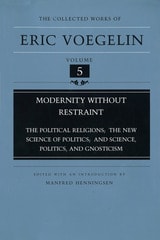
Modernity without Restraint (CW5)
Political Religions; The New Science of Politics; and Science, Politics and GnosticismEric Voegelin, Edited & Intro by Manfred Henningsen
University of Missouri Press, 2000
Published together for the first time in one volume are Eric Voegelin's Political Religions, The New Science of Politics, and Science, Politics, and Gnosticism.Political Religions was first published in 1938 in Vienna, the year of Voegelin's forced emigration from Austria to the United States. The New Science of Politics was written in 1952 and established Voegelin's reputation as a political philosopher in America. Science, Politics, and Gnosticism was Voegelin's Inaugural Lecture at the University of Munich in 1958 and introduced him to the West German intellectual public.
Although these books were written during remarkably different historical circumstances of Voegelin's life, all three present an analysis of modern Western civilization that has lost its spiritual foundations and is challenged by various ideological persuasions. Voegelin critiques in these texts a "modernity without restraint." It is a modernity with Hegelian, Marxian, Nietzschean, Heideggerian, positivist, Fascist, and other predominantly German characteristics. The author confronts this modernity with Western meaning as it emerged in ancient Greece, Rome, Israel, and Christianity and became transformed in the European Middle Ages, the Italian Renaissance, and the Anglo- American political formation.
This three-in-one volume delves into the intellectual and spiritual complications of modernity, tracing its evolution from the ancient civilizations to the twentieth century. In his substantial new introduction, Manfred Henningsen explores the experiential background that motivated Voegelin's theoretical analyses and the new relevance that his work has gained in recent years with the unexpected collapse of state socialism in East Germany, Eastern Europe, and the Soviet Union. Modernity without Restraint will be a valuable addition to intellectual history and Voegelin studies.
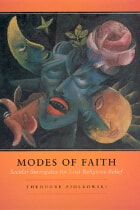
Modes of Faith
Secular Surrogates for Lost Religious BeliefTheodore Ziolkowski
University of Chicago Press, 2007
In the decades surrounding World War I, religious belief receded in the face of radical new ideas such as Marxism, modern science, Nietzschean philosophy, and critical theology. Modes of Faith addresses both this decline of religious belief and the new modes of secular faith that took religion’s place in the minds of many writers and poets.
Theodore Ziolkowski here examines the motives for this embrace of the secular, locating new modes of faith in art, escapist travel, socialism, politicized myth, and utopian visions. James Joyce, he reveals, turned to art as an escape while Hermann Hesse made a pilgrimage to India in search of enlightenment. Other writers, such as Roger Martin du Gard and Thomas Mann, sought temporary solace in communism or myth. And H. G. Wells, Ziolkowski argues, took refuge in utopian dreams projected in another dimension altogether.
Rooted in innovative and careful comparative reading of the work of writers from France, England, Germany, Italy, and Russia, Modes of Faith is a critical masterpiece by a distinguished literary scholar that offers an abundance of insight to anyone interested in the human compulsion to believe in forces that transcend the individual.
Monad and Thou
Phenomenological Ontology Of Human BeingHiroshi Kojima
Ohio University Press, 2000
The genesis for this volume was in the bombing of Japan during World War II, where the author, as a young boy, watched the bombers overhead, speculating about the lives of the pilots and their relationship with those huddled on the ground.
From this disturbing diorama, Professor Hiroshi Kojima, the translator of Martin Buber into Japanese, unfolds a new approach to Buber’s “I-Thou” relation, drawing upon insights from Husserl, Heidegger, and others in the tradition of continental philosophy to extend and deepen Buber’s thought.
In chapters that reflect upon a wide range of phenomena—from religion, science, and technology, to imagination, embodiment, and power—Professor Kojima articulates a conception of what it means to be a human being that stands as an alternative to atomism and alienation of the modern world. Analyses of haiku and other aspects of Japanese culture demonstrate how Kojima’s theory can illuminate the spiritual traditions of both East and West.
Original in its thought and revealing in its insight into Japanese thought and culture, Monad and Thou represents the life’s work of one of Japan’s great thinkers.
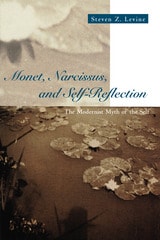
Monet, Narcissus, and Self-Reflection
The Modernist Myth of the SelfSteven Z. Levine
University of Chicago Press, 1994
Money For Change
Social Movement Philanthropy at the Haymarket People's FundSusan A. Ostrander
Temple University Press, 1997
Within this fascinating behind-the-scenes account, Ostrander argues that the "social relations of philanthropy" are more important and more varied than previously understood. Written at a time when Haymarket was dealing with crisis, this book tells a story of organizational change as the Fund moved from an informal collective to a more formal structure; it is also the story of a struggle to build a multi-race, multi-class, gender-equal organization. Ostrander details these ongoing struggles and addresses the larger issue of how fundraising can itself be a kind of social movement organizing among the progressive people with wealth who continue to be Haymarket's main donors.
Moneybags Must Be So Lucky
On the Literary Structure of CapitalRobert P. Wolff
University of Massachusetts Press, 1988
Monks and Magic
Revisiting a Classic Study of Religious Ceremonies in ThailandBarend Jan Terwiel
National University of Singapore Press, 2012
Monotheistic Kingship
The Medieval VariantsAziz Al-Azmeh
Central European University Press, 2004
This volume of essays intends to present diverse aspects of monotheistic kingship during the Middle Ages in two general-theoretical articles and a series of “case studies” on the relationship of religion and rulership. The authors discuss examples of the role of religion—based on both textual and iconic evidence—in Carolingian, Ottonian and late medieval western Europe; in Byzantium and Armenia; Georgia; Hungary; the Khazar Khanate; Poland, and Rus’. Two studies explore the issue in medieval Jewish and Islamic political thought. The editors hope that these special inquiries will engender more comparative studies on the subject.
Montaigne and the Origins of Modern Philosophy
Ann Hartle
Northwestern University Press, 2013
Montaigne’s Essays are rightfully studied as giving birth to the literary form of that name. Ann Hartle’s Montaigne and the Origins of Modern Philosophy argues that the essay is actually the perfect expression of Montaigne as what he called "a new figure: an unpremeditated and accidental philosopher." Unpremeditated philosophy is philosophy made sociable—brought down from the heavens to the street, where it might be engaged in by a wider audience. In the same philosophical act, Montaigne both transforms philosophy and invents "society," a distinctly modern form of association. Through this transformation, a new, modern character emerges: the individual, who is neither master nor slave and who possesses the new virtues of integrity and generosity. In Montaigne’s radically new philosophical project, Hartle finds intimations of both modern epistemology and modern political philosophy.
Montesquieu and the Despotic Ideas of Europe
An Interpretation of "The Spirit of the Laws"Vickie B. Sullivan
University of Chicago Press, 2017
Nowhere is Montesquieu’s critique of the despotic ideas of Europe more powerful than in his enormously influential The Spirit of the Laws, and Vickie B. Sullivan guides readers through Montesquieu’s sometimes veiled, yet sharply critical accounts of Machiavelli, Hobbes, Aristotle, and Plato, as well as various Christian thinkers. He finds deleterious consequences, for example, in brutal Machiavellianism, in Hobbes’s justifications for the rule of one, in Plato’s reasoning that denied slaves the right of natural defense, and in the Christian teachings that equated heresy with treason and informed the Inquisition.
In this new reading of Montesquieu’s masterwork, Sullivan corrects the misconception that it offers simple, objective observations, showing it instead to be a powerful critique of European politics that would become remarkably and regrettably prescient after Montesquieu’s death when despotism wound its way through Europe.
Montesquieu's Philosophy of Liberalism
A Commentary on The Spirit of the LawsThomas L. Pangle
University of Chicago Press, 1973
Mood and Trope
The Rhetoric and Poetics of AffectJohn Brenkman
University of Chicago Press, 2020
Engaging a quartet of modern philosophers—Kant, Nietzsche, Heidegger, and Deleuze—Brenkman explores how they all approach the question of affect primarily through literature and art. He draws on the differences and dialogues among them, arguing that the vocation of criticism is incapable of systematicity and instead must be attuned to the singularity and plurality of literary and artistic creations. In addition, he confronts these four philosophers and their essential concepts with a wide array of authors and artists, including Pinter and Poe, Baudelaire, Jorie Graham and Li-Young Lee, Shakespeare, Tino Sehgal, and Francis Bacon. Filled with surprising insights, Mood and Trope provides a rich archive for rethinking the nature of affect and its aesthetic and rhetorical stakes.
Moral Action
A Phenomenological StudyRobert Sokolowski
Catholic University of America Press, 2017
Moral Conscience through the Ages
Fifth Century BCE to the PresentRichard Sorabji
University of Chicago Press, 2014
Sorabji examines an impressive breadth of topics: the longing for different kinds of freedom of conscience, the proper limits of freedom itself, protests at conscience’s being ‘terrorized,’ dilemmas of conscience, the value of conscience to human beings, its secularization, its reliability, and ways to improve it. These historical issues are alive today, with fresh concerns about topics such as conscientious objection, the force of conscience, or the balance between freedoms of conscience, religion, and speech. The result is a stunningly comprehensive look at a central component of our moral understanding.
Moral Emotions
Reclaiming the Evidence of the HeartAnthony J. Steinbock
Northwestern University Press, 2014
Moral Emotions builds upon the philosophical theory of persons begun in Phenomenology and Mysticism and marks a new stage of phenomenology. Author Anthony J. Steinbock finds personhood analyzing key emotions, called moral emotions. Moral Emotions offers a systematic account of the moral emotions, described here as pride, shame, and guilt as emotions of self-givenness; repentance, hope, and despair as emotions of possibility; and trusting, loving, and humility as emotions of otherness.
Moral Imagination
Implications of Cognitive Science for EthicsMark Johnson
University of Chicago Press, 1993
Expanding his innovative studies of human reason in Metaphors We Live By and The Body in the Mind, Johnson provides the tools for more practical, realistic, and constructive moral reflection.

Moral Philosophy Of Moore
Robert Peter Sylvester, edited by Ray Perkins, Jr. and R. W. Sleeper, foreword by Tom Regan
Temple University Press, 1990
This study of G. E. Moore’s work in moral philosophy draws upon a close examination of the early essays that preceded the writing of Principia Ethica in order to ground the author’s view that Moore’s famous "naturalistic fallacy argument" of Principia has been widely misunderstood. At the time of his death in 1986, Robert Peter Sylvester was in the process of preparing this book for publication. That process has been brought to completion by Ray Perkins, Jr., and R. W. Sleeper. Sylvester’s reappraisal of the moral philosophy of G. E. Moore argues that criticism of the work of this major twentieth-century British philosopher has been based on misinterpretation of his unified position. He treats Moore’s ideas about "What is Good?", "What things are Good?" and "What ought we to do?" as forming a coherent system.
To bring this work up to date since the author’s death, the editors have provided a bibliographic essay following each chapter in which recent scholarship is discussed.

Moral Philosophy and Development
The Human Condition in AfricaTedros Kiros
Ohio University Press, 1992
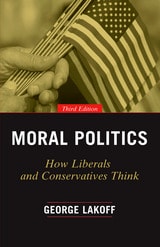
Moral Politics
How Liberals and Conservatives Think, Third EditionGeorge Lakoff
University of Chicago Press, 2016
Lakoff reveals radically different but remarkably consistent conceptions of morality on both the left and right. Moral worldviews, like most deep ways of understanding the world, are unconscious—part of our “hard-wired” brain circuitry. When confronted with facts that don’t fit our moral worldview, our brains work automatically and unconsciously to ignore or reject these facts, and it takes extraordinary openness and awareness of this phenomenon to pay critical attention to the vast number of facts we are presented with each day. For this new edition, Lakoff has added a new preface and afterword, extending his observations to major ideological conflicts since the book's original publication, from the Affordable Care Act to the wars in Iraq and Afghanistan, the recent financial crisis, and the effects of global warming. One might have hoped such massive changes would bring people together, but the reverse has actually happened; the divide between liberals and conservatives has become stronger and more virulent.
To have any hope of bringing mutual respect to the current social and political divide, we need to clearly understand the problem and make it part of our contemporary public discourse. Moral Politics offers a much-needed wake-up call to both the left and the right.
Moral Politics
What Conservatives Know That Liberals Don'tGeorge Lakoff
University of Chicago Press, 1996

Moral Principles
John Dewey. Preface by Sidney Hook
Southern Illinois University Press, 1975
Moral Problems in Higher Education
Steven Cahn
Temple University Press, 2011
Moral Problems in Higher Education brings together key essays that explore ethical issues in academia. The editor and contributors-all noted philosophers and educators-consider such topics as academic freedom and tenure, free speech on campus, sexual harassment, preferential student admissions, affirmative action in faculty appointments, and the ideal of a politically neutral university. Chapters address possible restrictions on research because of moral concerns, the structure of peer review, telling the truth to colleagues and students, and concerns raised by intercollegiate athletics.
Cahn selects two key readings in each area to offer a readable introductory guide to these critical subjects for students studying academic ethics and higher education policy. In addition to the selections and a general introduction, Cahn provides study questions for use in the classroom.
Contributors include Scott F. Aikin, Derek Bok, William G. Bowen, Myles Brand, Richard T. DeGeorge, Paul D. Eisenberg, Leslie Pickering Francis, Martin P. Golding, Philip Kitcher, Charles R. Lawrence III, David Lewis, Paul J. Olscamp, Nancy Tuana, David Shatz, George Sher, Robert L. Simon, Robert B. Talisse, Stephan Thernstrom, Abigail Thernstrom, Laurence Thomas, Robert Paul Wolff, and the editor.
Moral Responsibility and Persons
Eugene Schlossberger
Temple University Press, 1992
Challenging traditional philosophical views of moral responsibility, Eugene Schlossberger argues that we are responsible not so much for what we do as for who we are. He explores what it means to be a person, concluding that personhood is the sum of beliefs and values—which are by no means entirely within our control. Consequently, the voluntariness of our acts—or even whether we act at all—is irrelevant to the moral evaluation of us as persons. Schlossberger contends that we are to be judged morally on the basis of what we are, our "world-view," rather than what we do.
In Moral Responsibility and Persons Schlossberger disputes various received philosophical positions. His challenging and entertaining account also examines psychology and its view of the nature of personhood, as well as insanity and the "personality" of animals, children, and computers. He explores the validity of emotions we may feel in response to others—especially gratitude and resentment. And finally, Schlossberger tackles the inevitable implications of his position in the area of crime and punishment.
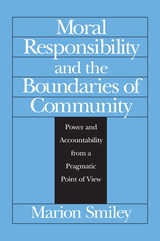
Moral Responsibility and the Boundaries of Community
Power and Accountability from a Pragmatic Point of ViewMarion Smiley
University of Chicago Press, 1992
In an argument both compelling and provocative, Marion Smiley demonstrates how attributions of blame—far from being based on an objective process of factual discovery—are instead judgments that we ourselves make on the basis of our own political and social points of view. She argues that our conception of responsibility is a singularly modern one that locates the source of blameworthiness in an individual's free will. After exploring the flaws inherent in this conception, she shows how our judgments of blame evolve out of our configuration of social roles, our conception of communal boundaries, and the distribution of power upon which both are based.
The great strength of Smiley's study lies in the way in which it brings together both rigorous philosophical analysis and an appreciation of the dynamics of social and political practice. By developing a pragmatic conception of moral responsibility, this work illustrates both how moral philosophy can enhance our understanding of social and political practices and why reflection on these practices is necessary to the reconstruction of our moral concepts.
Moral Spaces
Rethinking Ethics And World PoliticsDavid Campbell
University of Minnesota Press, 1999
Moral Vision and Tradition
Antonio S. Cua
Catholic University of America Press, 2018
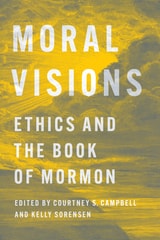
Moral Visions
Ethics and the Book of MormonEdited by Courtney S. Campbell and Kelly Sorensen
University of Illinois Press, 2025
Contributors in the first section discuss foundational issues such as the Book of Mormon’s moral psychology, its minimalist and covenantal moralities, the nature of the good and how the good is known, the question of whether value depends on a certain kind of future, the Book of Mormon's strategy for moral persuasion, and God’s participation in human choices. In the second section, the essayists turn to everyday ethical questions concerning resistance to forced cultural assimilation, clothing and dress, authority, and memory. The final chapter further explores practical moral visions.
A rich and thought-provoking analysis, Moral Visions examines the Book of Mormon through a variety of methods while aiming to deepen understanding of both the text’s messages and its potential place in future discussions of ethics. Contributors: Daniel Becerra, Courtney S. Campbell, Ryan Davis, Michael D. K. Ing, Ariel Bybee Laughton, Kimberly Matheson, Rachel Esplin Odell, Kelly Sorensen, Joseph M. Spencer
Morality & Imagination
Yi-Fu Tuan
University of Wisconsin Press, 1989

Morality by Design
Technology's Challenge to Human ValuesWade Rowland
Intellect Books, 2019
In guiding the reader through Enlightenment-era rationalist thought as it pertained to human nature and the foundations of morality, Rowland provides a coherent, intellectually sound, and intuitively appealing alternative to the nihilistic views popularized by contemporary radical relativism. Morality by Design ultimately seeks to convince readers that there is such a thing as moral fact, and that they do indeed have what it takes to make robust and durable moral judgments.
Morality for Humans
Ethical Understanding from the Perspective of Cognitive ScienceMark Johnson
University of Chicago Press, 2014
Ethical naturalism is not just a revamped form of relativism. Indeed, Johnson attempts to overcome the absolutist-versus-relativist impasse that has been one of the most intractable problems in the history of philosophy. He does so through a careful and inclusive look at the many ways we reason about right and wrong. Much of our moral thought, he shows, is automatic and intuitive, gut feelings that we follow up and attempt to justify with rational analysis and argument. However, good moral deliberation is not limited merely to intuitive judgments supported after the fact by reasoning. Johnson points out a crucial third element: we imagine how our decisions will play out, how we or the world would change with each action we might take. Plumbing this imaginative dimension of moral reasoning, he provides a psychologically sophisticated view of moral problem solving, one perfectly suited for the embodied, culturally embedded, and ever-developing human creatures that we are.
Morality within the Limits of Reason
Russell Hardin
University of Chicago Press, 1988
Morality, Responsibility, and the University
Studies in Academic Ethicsedited by Steven M. Cahn
Temple University Press, 1992
Moralizing Technology
Understanding and Designing the Morality of ThingsPeter-Paul Verbeek
University of Chicago Press, 2011
Morals Of History
Tzvetan Todorov
University of Minnesota Press, 1995
Morals, Reason, and Animals
S. Sapontzis
Temple University Press, 1992
More Than Life
Georg Simmel and Walter Benjamin on ArtStéphane Symons
Northwestern University Press, 2017
Reading Simmel’s work, particularly his essays on Michelangelo, Rembrandt, and Rodin, alongside Benjamin’s concept of Unscheinbarkeit (inconspicuousness) and his writings on Charlie Chaplin, More Than Life demonstrates that both Simmel and Benjamin conceive of art as the creation of something entirely new rather than as a mimetic reproduction of a given. The two thinkers diverge in that Simmel emphasizes the presence of a continuous movement of life, whereas Benjamin highlights the priority of discontinuous, interruptive moments.
With the aim of further elucidating Simmel and Benjamin’s ideas on art, Stéphane Symons presents a number of in-depth analyses of specific artworks that were not discussed by these authors. Through an insightful examination of both the conceptual affinities and the philosophical differences between Simmel and Benjamin , Symons reconstructs a crucial episode in twentieth-century debates on art and aesthetics.
More than Cool Reason
A Field Guide to Poetic MetaphorGeorge Lakoff and Mark Turner
University of Chicago Press, 1989
We usually think of the language of poetry, the metaphors that poets use to express their intentions, as far removed from ordinary life. But in More than Cool Reason, George Lakoff and Mark Turner show how understanding how metaphor works in poetry, the tasks it takes on and the ways it shapes our patterns of thought, can be hugely helpful to seeing and understanding how we think in all manner of other fields and areas of life. Metaphor, they show, is a tool so familiar, so everyday, that we fail to notice it. Lakoff and Turner correct that failure here, helping us see how richly metaphorical our language and thought are, and what that means for not only reading and enjoying poetry and literature, but also for linguistics, philosophy, psychology, anthropology, cognitive science, and more.
Mortal Imitations of Divine Life
The Nature of the Soul in Aristotle's De AnimaEli Diamond
Northwestern University Press, 2015
In Mortal Imitations of Divine Life, Diamond offers an interpretation of De Anima, which explains how and why Aristotle places souls in a hierarchy of value. Aristotle’s central intention in De Anima is to discover the nature and essence of soul—the principle of living beings. He does so by identifying the common structures underlying every living activity, whether it be eating, perceiving, thinking, or moving through space. As Diamond demonstrates through close readings of De Anima, the nature of the soul is most clearly seen in its divine life, while the embodied soul’s other activities are progressively clear approximations of this principle. This interpretation shows how Aristotle’s psychology and biology cannot be properly understood apart from his theological conception of God as life, and offers a new explanation of De Anima’s unity of purpose and structure.

Mortality and Morality
A Search for Good After AuschwitzHans Jonas
Northwestern University Press, 1996
Moses Maimonides and His Time
Eric L. Ormsby
Catholic University of America Press, 2018
Moses Mendelssohn
Writings on Judaism, Christianity, and the BibleEdited by Michah Gottlieb
Brandeis University Press, 2011
Motivation and the Primacy of Perception
Merleau-Ponty's Phenomenology of KnowledgePeter Antich
Ohio University Press, 2021
Motive and Intention
An Essay in the Appreciation of ActionRoy Lawrence
Northwestern University Press, 1972
Movement and the Ordering of Freedom
On Liberal Governances of MobilityHagar Kotef
Duke University Press, 2015
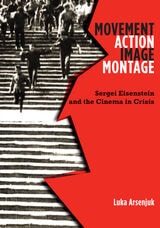
Movement, Action, Image, Montage
Sergei Eisenstein and the Cinema in CrisisLuka Arsenjuk
University of Minnesota Press, 2018
A major new study of Sergei Eisenstein delivers fresh, in-depth analyses of the iconic filmmaker’s body of work
What can we still learn from Sergei Eisenstein? Long valorized as the essential filmmaker of the Russian Revolution and celebrated for his indispensable contributions to cinematic technique, Eisenstein’s relevance to contemporary culture is far from exhausted. In Movement, Action, Image, Montage, Luka Arsenjuk considers the auteur as a filmmaker and a theorist, drawing on philosophers such as Georg Wilhelm Friedrich Hegel and Gilles Deleuze—as well as Eisenstein’s own untranslated texts—to reframe the way we think about the great director and his legacy.
Focusing on Eisenstein’s unique treatment of the foundational concepts of cinema—movement, action, image, and montage—Arsenjuk invests each aspect of the auteur’s art with new significance for the twenty-first century. Eisenstein’s work and thought, he argues, belong as much to the future as the past, and both can offer novel contributions to long-standing cinematic questions and debates.
Movement, Action, Image, Montage brings new elements of Eisenstein’s output into academic consideration, by means ranging from sustained and comprehensive theorization of Eisenstein’s practice as a graphic artist to purposeful engagement with his recently published, unfinished book Method, still unavailable in English translation. This tour de force offers new and significant insights on Eisenstein’s oeuvre—the films, the art, and the theory—and is a landmark work on an essential filmmaker.
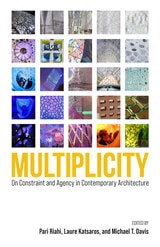
Multiplicity
On Constraint and Agency in Contemporary ArchitectureEdited by Pari Riahi, Laure Katsaros, and Michael T. Davis
University of Massachusetts Press, 2024
Today, the field of architecture faces a reckoning. While there is no longer consensus on what defines an architectural work, theorists, historians, and practitioners are grappling with urgent issues—among them the impact of climate change, the dynamics of power and race in relation with the built environment, and the technological, practical, and ethical dimensions of architecture. As established practices, academic objectives, and professional expectations come under scrutiny, architecture is in search of new definitions, identities, and voices.
Inspired by Italo Calvino’s memos about literature in the twenty-first century, this volume—the second in a series— situates architecture within a broad framework, exploring its complex interactions with environmental, cultural, political, social, artistic, and technological forces. The editors’ objective is to spur conversation across the boundaries that divide architecture’s theorists and historians from practitioners. In addition to the editors, the contributors include Sanford Kwinter, Aleksandra Jaeschke, Jennifer Mack, Rahul Mehrotra, Charles Waldheim, Kristi Cheramie, Jesse Reiser, Julian Harake, Jenny E. Sabin, Charles Davis, Esra Akcan, and David Karmon.

Mundus Imaginalis
World Literatures After Phantom EmpiresHamid Dabashi
Duke University Press, 2027
Museum Culture
Histories, Discourses, SpectaclesDaniel Sherman
University of Minnesota Press, 1994
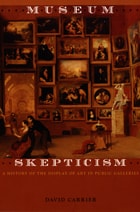
Museum Skepticism
A History of the Display of Art in Public GalleriesDavid Carrier
Duke University Press, 2006
Carrier illuminates the public role of art museums by describing the ways they influence how art is seen: through their architecture, their collections, the narratives they offer museum visitors. He insists that an understanding of the art museum must take into account the roles of collectors, curators, and museum architects. Toward that end, he offers a series of case studies, showing how particular museums and their collections evolved. Among those who figure prominently are Baron Dominique Vivant Denon, the first director of the Louvre; Bernard Berenson, whose connoisseurship helped Isabella Stewart Gardner found her museum in Boston; Ernest Fenollosa, who assembled much of the Asian art collection now in the Museum of Fine Arts, Boston; Albert Barnes, the distinguished collector of modernist painting; and Richard Meier, architect of the J. Paul Getty Center in Los Angeles. Carrier’s learned consideration of what the art museum is and has been provides the basis for understanding the radical transformation of its public role now under way.
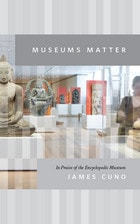
Museums Matter
In Praise of the Encyclopedic MuseumJames Cuno
University of Chicago Press, 2011
The concept of an encyclopedic museum was born of the Enlightenment, a manifestation of society’s growing belief that the spread of knowledge and the promotion of intellectual inquiry were crucial to human development and the future of a rational society. But in recent years, museums have been under attack, with critics arguing that they are little more than relics and promoters of imperialism. Could it be that the encyclopedic museum has outlived its usefulness?
With Museums Matter, James Cuno, president and director of the Art Institute of Chicago, replies with a resounding “No!” He takes us on a brief tour of the modern museum, from the creation of the British Museum—the archetypal encyclopedic collection—to the present, when major museums host millions of visitors annually and play a major role in the cultural lives of their cities. Along the way, Cuno acknowledges the legitimate questions about the role of museums in nation-building and imperialism, but he argues strenuously that even a truly national museum like the Louvre can’t help but open visitors’ eyes and minds to the wide diversity of world cultures and the stunning art that is our common heritage. Engaging with thinkers such as Edward Said and Martha Nussbaum, and drawing on examples from the politics of India to the destruction of the Bramiyan Buddhas to the history of trade and travel, Cuno makes a case for the encyclopedic museum as a truly cosmopolitan institution, promoting tolerance, understanding, and a shared sense of history—values that are essential in our ever more globalized age.
Powerful, passionate, and to the point, Museums Matter is the product of a lifetime of working in and thinking about museums; no museumgoer should miss it.