Results by title
935 books match the query 'Ancient' and 33 start with n
Near Eastern Archaeology, volume 84 number 3 (September 2021)
The University of Chicago Press
University of Chicago Press Journals, 2021
Near Eastern Archaeology, volume 84 number 4 (December 2021)
The University of Chicago Press
University of Chicago Press Journals, 2021
Near Eastern Archaeology, volume 85 number 1 (March 2022)
The University of Chicago Press
University of Chicago Press Journals, 2022
Near Eastern Archaeology, volume 85 number 2 (June 2022)
The University of Chicago Press
University of Chicago Press Journals, 2022
Near Eastern Archaeology, volume 85 number 3 (September 2022)
The University of Chicago Press
University of Chicago Press Journals, 2022
Near Eastern Archaeology, volume 85 number 4 (December 2022)
The University of Chicago Press
University of Chicago Press Journals, 2022
Near Eastern Archaeology, volume 86 number 1 (March 2023)
The University of Chicago Press
University of Chicago Press Journals, 2023
Near Eastern Archaeology, volume 86 number 2 (June 2023)
The University of Chicago Press
University of Chicago Press Journals, 2023
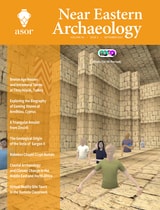
Near Eastern Archaeology, volume 86 number 3 (September 2023)
The University of Chicago Press
University of Chicago Press Journals, 2023
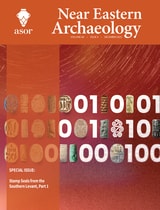
Near Eastern Archaeology, volume 86 number 4 (December 2023)
The University of Chicago Press
University of Chicago Press Journals, 2023
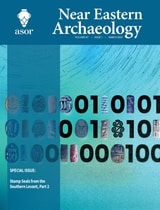
Near Eastern Archaeology, volume 87 number 1 (March 2024)
The University of Chicago Press
University of Chicago Press Journals, 2024
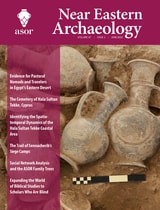
Near Eastern Archaeology, volume 87 number 2 (June 2024)
The University of Chicago Press
University of Chicago Press Journals, 2024
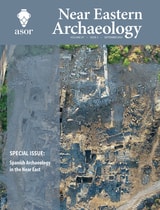
Near Eastern Archaeology, volume 87 number 3 (September 2024)
The University of Chicago Press
University of Chicago Press Journals, 2024
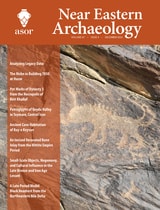
Near Eastern Archaeology, volume 87 number 4 (December 2024)
The University of Chicago Press
University of Chicago Press Journals, 2024
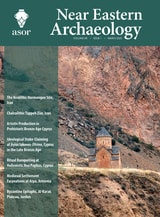
Near Eastern Archaeology, volume 88 number 1 (March 2025)
The University of Chicago Press
University of Chicago Press Journals, 2025
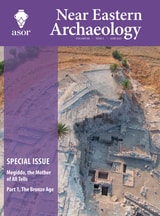
Near Eastern Archaeology, volume 88 number 2 (June 2025)
The University of Chicago Press
University of Chicago Press Journals, 2025
Near Eastern Archaeology, volume 88 number 3 (September 2025)
The University of Chicago Press
University of Chicago Press Journals, 2025
Near Eastern Archaeology, volume 88 number 4 (December 2025)
The University of Chicago Press
University of Chicago Press Journals, 2025
Near Eastern Archaeology, volume 89 number 1 (March 2026)
The University of Chicago Press
University of Chicago Press Journals, 2026
Near Eastern Archaeology, volume 89 number 2 (June 2026)
The University of Chicago Press
University of Chicago Press Journals, 2026

Nefertiti
The Making of a Global IconSebastian Conrad
University of Chicago Press, 2026
Charts the global resonance of the image of Nefertiti over the past century.
From the moment that the bust of Nefertiti was uncovered after over three thousand years and shown at its first exhibition in Berlin in 1924, it rapidly became an iconic image. Today, the silhouette alone of this powerful ancient Egyptian queen is recognized and admired around the world.
In Nefertiti: The Making of a Global Icon, historian Sebastian Conrad tracks the full story of the world’s embrace and appropriation of this famous visage. Starting with the discovery of the bust and Germany’s claims to its possession, Conrad shows how it became a contested object, tracing Egypt’s efforts to call for its restitution from 1924 to the present. He also canvasses the uses to which Nefertiti’s image has been put and the causes with which it has been associated: for cosmetic ads and beauty clinics; by advocates for European unity; by drag queens and the queer community; by National Socialists; by nationalists in Egypt and Bengal; by Afro-Brazilian communities; and by important Black figures from Elijah Muhammad to Beyoncé. Against a global backdrop, Conrad showcases the stunning object’s fame and the often-controversial issues and debates in which it has been embroiled. He also argues that the story of Nefertiti’s trajectory offers insights into the changing shape of globalization from the era of imperialism to the present.
This accessible, deeply researched book reveals both how much is at stake in the life of objects and how Nefertiti’s arresting likeness continues to challenge us today.
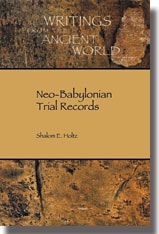
Neo-Babylonian Trial Records
Shalom E. Holtz
SBL Press, 2014
New translations of fifty transliterated texts for research and classroom use
This collection of sixth-century B.C.E. Mesopotamian texts provides a close-up, often dramatic, view of ancient courtroom encounters shedding light on Neo-Babylonian legal culture and daily life. In addition to the legal texts, Holtz provides an introduction to Neo-Babylonian social history, archival records, and legal materials. This is an essential resource for scholars interested in the history of law.
Features
- Fifty new English translations
- Transliterations for use in advanced Akkadian courses
- Background essays perfect for courses dealing with ancient Near Eastern history and law
- Explanatory essays preceding each text and its translation
New Documents Illustrating Early Christianity 11A
Texts from EphesusJames R. Harrison
SBL Press, 2024
New Documents Illustrating Early Christianity 11B
Essays on EphesusJames R. Harrison
SBL Press, 2025
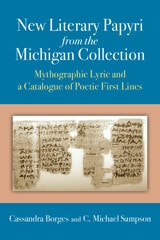
New Literary Papyri from the Michigan Collection
Mythographic Lyric and a Catalogue of Poetic First LinesCassandra Borges and C. Michael Sampson
University of Michigan Press, 2012
New texts from Greek antiquity continue to emerge on scraps of papyrus from the sands of Egypt, not only adding to the surviving corpus of classical and Hellenistic literature, but also occasionally offering a glimpse into how these poems were studied in antiquity. New Literary Papyri from the Michigan Collection: Mythographic Lyric and a Catalogue of Poetic First Lines presents three such new texts: an innovative lyric poem on the Trojan cycle, a scholarly anthology of lyric verses, and a brief but enigmatic third text. Cassandra Borges and C. Michael Sampson offer the original Greek text of these pieces, along with their scholarly commentary, analyzing their features in a variety of contexts—historical, cultural, poetic, mythological, religious, and scholarly.
The fragments collected here are of considerable antiquity (late third to second century BCE) a fact that is significant inasmuch as it places them among the oldest Greek papyri, but all the more so because in this period, a scholarly community was thriving in Ptolemaic Alexandria, the political and cultural capital of Hellenistic Egypt. The fragments bear witness to that scholarly activity: not only is their anthology of poetic verses consistent with other scholarly selections, but the very survival of these texts may well be at least partially indebted to the work of the Alexandrians in studying and propagating Greek literature in Egypt.
This edition supplements the 1970s work of Reinhold Merkelbach and Denys Page. Recent digitizing for the APIS project revealed a previously unsuspected join with other material, however, which alone warrants a new, comprehensive edition and analysis.
New Perspectives on Etruria and Early Rome
Sinclair Bell
University of Wisconsin Press, 2009
Paying tribute to Richard Daniel De Puma, a scholar who has made significant and influential contributions to Etruscan and Roman studies, the contributors to this collection echo the ambition and creativity of his work while offering an up-to-date survey of contemporary Etruscan scholarship. In surveying new developments in both fields, the work collected here represent the diverse, interdisciplinary interests of De Puma as well as areas of recent groundbreaking research.
News and Frontier Consciousness in the Late Roman Empire
Mark W. Graham
University of Michigan Press, 2006
Approaching Roman frontiers with the aid of media studies as well as anthropological and sociological methodologies, Mark W. Graham chronicles and documents this significant transition in ancient thought, which coincided with, but was not necessarily dependent on, the Christianization of the Roman world.
Mark W. Graham is Assistant Professor of History at Grove City College.
Nomodeiktes
Greek Studies in Honor of Martin OstwaldRalph M. Rosen and Joseph Farrell, Editors
University of Michigan Press, 1994
Nomodeiktes: Greek Studies in Honor of Martin Ostwald offers fascinating discussions of many of these areas, and it helps illuminate ways in which modern perceptions of this complex period are right and are wrong. Important observations are made on Greek historians and historiography, on politics and society, and on Greek philosophy and literature. The analyses of these major areas of investigation will be very useful for all interested in this centrally important period and for those who know the lure of that vivid and compelling city, Athens.
Non-Lyric and Lyric in Horace's Odes
The Poetics of Disguise and InfiltrationKenneth Draper
University of Michigan Press, 2026
Kenneth Draper’s new volume investigates genre, gender, and self-presentation in Horace’s first collection of Odes. It examines how Horace uses non-lyric genres—elegy, epic, invective, and philosophical discourse—to define his lyric project, responding to the rhetorical challenge of writing in the wake of civil war. It shows how Horace employs a “poetics of disguise and infiltration” in his engagement with these other genres. At times, he assimilates his lyric persona to an elegiac one, claiming to share elegy’s effeminacy and disinterest in politics. Similarly, he draws on philosophical discourse to present himself as too modest for heavy political themes. In both cases, he turns to clothing metaphors to identify the slight persona as a disguise that he may assume or discard as needed. Through this disingenuous self-presentation, he disavows interest in the masculine modes of epic and invective. Read as reflections on Horace’s own infiltration of epic territory, the examined scenes give clues about his motivations: focusing on the characters’ self-preservation amid dangers, he reminds readers of the risks and audacity of his project.
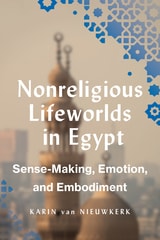
Nonreligious Lifeworlds in Egypt
Sense-Making, Emotion, and EmbodimentKarin van Nieuwkerk
University of Texas Press, 2026
An analysis of the growing visibility of nonreligion in Egypt.
Egypt's 2011 Uprising, while often perceived as a failed revolution, nonetheless nonetheless had durable social effects. Among these has been a rise in expressing atheism and agnosticism, especially among educated and affluent youth—the country’s future leaders.
An intimate ethnography, Nonreligious Lifeworlds in Egypt explores the intellectual and emotional transformations of atheists and agnostics inspired by the aspirational freedom-seeking of the Arab Spring. Rejecting both of Egypt’s dominant religious traditions, Islam and Coptic Christianity, nonreligious people are widely viewed as agents of moral outrage. Amid media-driven panics, their sanity is often questioned by their own families as they experiment with new ways of living and relating. Drawing from in-depth fieldwork, interviews, and social media analysis, Karin van Nieuwkerk reveals her interlocutors’ changing perspectives on sex and gender, eating and drinking, and life and death. Above all, she emphasizes the affective experiences of renouncing religion, marked by anxiety and regret—but also liberation and relief. With rigor and compassion, Van Nieuwkerk opens our minds to the arduous process of exchanging established norms for self-determination.
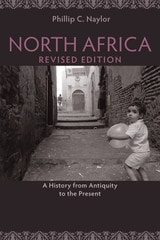
North Africa, Revised Edition
A History from Antiquity to the PresentBy Phillip C. Naylor
University of Texas Press, 2014
North Africa has been a vital crossroads throughout history, serving as a connection between Africa, Asia, and Europe. Paradoxically, however, the region's historical significance has been chronically underestimated. In a book that may lead scholars to reimagine the concept of Western civilization, incorporating the role North African peoples played in shaping "the West," Phillip Naylor describes a locale whose transcultural heritage serves as a crucial hinge, politically, economically, and socially.
Ideal for novices and specialists alike, North Africa begins with an acknowledgment that defining this area has presented challenges throughout history. Naylor's survey encompasses the Paleolithic period and early Egyptian cultures, leading readers through the pharonic dynasties, the conflicts with Rome and Carthage, the rise of Islam, the growth of the Ottoman Empire, European incursions, and the postcolonial prospects for Egypt, Libya, Tunisia, Algeria, Morocco, and Western Sahara.
Emphasizing the importance of encounters and interactions among civilizations, North Africa maps a prominent future for scholarship about this pivotal region.
Now with a new afterword that surveys the “North African Spring” uprisings that roiled the region from 2011 to 2013, this is the most comprehensive history of North Africa to date, with accessible, in-depth chapters covering the pre-Islamic period through colonization and independence.
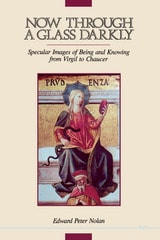
Now through a Glass Darkly
Specular Images of Being and Knowing from Virgil to ChaucerEdward Peter Nolan
University of Michigan Press, 1991
Now through a Glass Darkly brings both traditional medievalist and postmodernist approaches to bear in its attempt to understand both the powers and the limits of verbal art. Nolan explores the ways medieval writers and their Roman predecessors used formal and thematic mirrors to examine the implications of alterity in the face of similarity, arguing that these preoccupations were as central to the medieval sensibility as they are to our own. Now through a Glass Darkly frames several of the key issues in the current debate over the continued viability (or not) of the inherited canon of Western culture, such as the question whether there is any meaning at all to be rescued from such notions as “coherence” or “tradition” in Western literature.
Now through a Glass Darkly will appeal to the educated generalist interested in the relationships between literature and its surrounding intellectual and cultural contexts as well as to those more specifically interested in medieval poetry and poetics. For medievalists and those who work at the intersection of critical theory and medieval literature, Now through a Glass Darkly will be of critical importance.
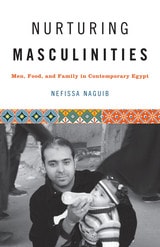
Nurturing Masculinities
Men, Food, and Family in Contemporary EgyptBy Nefissa Naguib
University of Texas Press, 2015
Two structuring concepts have predominated in discussions concerning how Middle Eastern men enact their identity culturally: domination and patriarchy. Nurturing Masculinities dispels the illusion that Arab men can be adequately represented when we speak of them only in these terms. By bringing male perspectives into food studies, which typically focus on the roles of women in the production and distribution of food, Nefissa Naguib demonstrates how men interact with food, in both political and domestic spheres, and how these interactions reflect important notions of masculinity in modern Egypt.
In this classic ethnography, narratives about men from a broad range of educational backgrounds, age groups, and social classes capture a holistic representation of masculine identity and food in modern Egypt on familial, local, and national levels. These narratives encompass a broad range of issues and experiences, including explorations of traditions surrounding food culture; displays of caregiving and love when men recollect the taste, feel, and fragrance of food as they discuss their desires to feed their families well and often; and the role that men, working to ensure the equitable distribution of food, played during the Islamist movement of the Muslim Brotherhood in 2011. At the core of Nurturing Masculinities is the idea that food is a powerful marker of manhood, fatherhood, and family structure in contemporary Egypt, and by better understanding these foodways, we can better understand contemporary Egyptian society as a whole.