3071 books match the query 'Business & Economics' and 89 start with n
cover of NAFTA and Labor in North America

NAFTA and Labor in North America

Norman Caulfield

University of Illinois Press, 2010
As companies increasingly look to the global market for capital, cheaper commodities and labor, and lower production costs, the impact on Mexican and American workers and labor unions is significant. National boundaries and the laws of governments that regulate social relations between laborers and management are less relevant in the era of globalization, rendering ineffective the traditional union strategies of pressuring the state for reform. Focusing especially on the effects of the North American Free Trade Agreement and the North American Agreement on Labor Cooperation (the first international labor agreement linked to an international trade agreement), Norman Caulfield notes the waning political influence of trade unions and their disunity and divergence on crucial issues such as labor migration and workers' rights. Comparing the labor movement's fortunes in the 1970s with its current weakened condition, Caulfield notes the parallel decline in the United States' hegemonic influence in an increasingly globalized economy. As a result, organized labor has been transformed from organizations that once pressured management and the state for worker concessions to organizations that now request that workers concede wages, pensions, and health benefits to remain competitive in the global marketplace.
[more]
cover of NBER International Seminar on Macroeconomics 2009, Volume 6

NBER International Seminar on Macroeconomics 2009, Volume 6

Edited by Lucrezia Reichlin and Kenneth West

University of Chicago Press, 2010
The distinguished International Seminar on Macroeconomics (ISoM) has met annually in Europe for thirty years. The papers included in this volume discuss openness and the fall and rise of stock market correlations between 1890 and 2001; defaults, underwriters and sovereign bond markets between 1815 and 2007; systemic risk taking and the U.S. financial crisis; the Feldstein-Horioka fact, nontradable goods' real exchange rate puzzle; and assessing external equilibrium in low income countries.
[more]
cover of NBER Macroeconomics Annual 2007: Volume 22

NBER Macroeconomics Annual 2007

Volume 22

Edited by Daron Acemoglu, Kenneth Rogoff, and Michael Woodford

University of Chicago Press Journals, 2008

The NBER Macroeconomics Annual provides a forum for important debates in contemporary macroeconomics and major developments in the theory of macroeconomic analysis and policy that include leading economists from a variety of fields. The papers and accompanying discussions in NBER Macroeconomics Annual 2007 address exchange-rate models; implications of credit market frictions; cyclical budgetary policy and economic growth; the impacts of shocks to government spending on consumption, real wages, and employment; dynamic macroeconomic models; and the role of cyclical entry of new firms and products on the nature of business-cycle fluctuations and on the effects of monetary policy.
[more]
cover of NBER Macroeconomics Annual 2008: Volume 23

NBER Macroeconomics Annual 2008

Volume 23

Edited by Daron Acemoglu, Kenneth Rogoff, and Michael Woodford

University of Chicago Press Journals, 2009

The NBER Macroeconomics Annual provides a forum for important debates in contemporary macroeconomics and major developments in the theory of macroeconomic analysis and policy. . The papers and accompanying discussions in NBER Macroeconomics Annual 2008, which
include contributions from leading economists from a variety of fields, address the timing of labor market expansions, macroeconomic dynamics in the Euro area, public health and the GDP, the role of technological progress on the formation of households, carry trades and currency crises, and new approaches to analyzing monetary policy.
[more]
cover of NBER Macroeconomics Annual 2009: Volume 24

NBER Macroeconomics Annual 2009

Volume 24

Edited by Daron Acemoglu and Michael Woodford

University of Chicago Press Journals, 2010
The NBER Macroeconomics Annual provides a forum for important debates in contemporary macroeconomics and major developments in the theory of macroeconomic analysis and policy that include leading economists from a variety of fields. The papers and accompanying discussions in NBER Macroeconomics Annual 2009 address how heterogeneous beliefs interact with equilibrium leverage and potentially lead to leverage cycles, the validity of alternative hypotheses about the reason for the recent increase in foreclosures on residential mortgages, the credit rating crisis, quantitative implications for the evolution of the U.S. wage distribution, and noisy business cycles.
[more]
cover of NBER Macroeconomics Annual 2010: Volume 25

NBER Macroeconomics Annual 2010

Volume 25

Edited by Daron Acemoglu and Michael Woodford

University of Chicago Press Journals, 2011
[more]
cover of NBER Macroeconomics Annual 2012: Volume 27

NBER Macroeconomics Annual 2012

Volume 27

Edited by Daron Acemoglu, Jonathan Parker, and Michael Woodford

University of Chicago Press Journals, 2013
The twenty-seventh edition of the NBER Macroeconomics Annual continues a tradition of featuring theoretical and empirical contributions that shed light on central issues in contemporary macroeconomics, pushing the frontiers of macroeconomic research on topics related to both the business cycle and economic growth and addressing important policy-relevant questions. This year’s volume features two papers that illuminate two causes of the recent financial crisis: how firms accessed credit during the financial crisis and how the risk in mortgage lending was measured in the UK in the decades before the crisis. Other papers in this volume include a study of individual prices over time that draws out the implications of observed price adjustment for macroeconomic models of price stickiness, a focus on the implications of microeconomic estimates of labor supply for the determination of employment rates, a study of the empirical validity of the Keynesian explanation for employment declines during recessions, and an innovative paper that measures the efficacy of fiscal stimulus by looking at the economic impact of changes in federal highway spending across US states.
[more]
cover of NBER Macroeconomics Annual 2013: Volume 28

NBER Macroeconomics Annual 2013

Volume 28

Edited by Jonathan Parker and Michael Woodford

University of Chicago Press Journals, 2014
The twenty-eighth edition of the NBER Macroeconomics Annual continues its tradition of featuring theoretical and empirical research on central issues in contemporary macroeconomics. As in previous years, this volume not only addresses recent developments in macroeconomics, but also takes up important policy-relevant questions and opens new debates that will continue for years to come. The first two papers in this year’s issue tackle fiscal and monetary policy, asking how interest rates and inflation can remain low despite fiscal policy behavior that appears inconsistent with a monetary policy regime focused only on inflation and output and not on fiscal balances as recently observed in the U.S. The third examines the implications of reference-dependent preferences and moral hazard in employment fluctuations in the labor market. The fourth paper addresses money and inflation, analyzing the long run inflation rate, the coexistence of money with pledgeable and money-like assets, and why inflation did not increase in response to business-cycle fluctuations in productivity. And the fifth looks at the stock market and how it relates to the real economy. The final chapter discusses the large and public shift towards more expansionary monetary policy that has recently occurred in Japan.
[more]
cover of NBER Macroeconomics Annual 2014: Volume 29

NBER Macroeconomics Annual 2014

Volume 29

Edited by Jonathan Parker and Michael Woodford

University of Chicago Press Journals, 2015
The twenty-ninth edition of the NBER Macroeconomics Annual continues its tradition of featuring theoretical and empirical research on central issues in contemporary macroeconomics. Two papers in this year’s issue deal with recent economic performance: one analyzes the evolution of aggregate productivity before, during, and after the Great Recession, and the other characterizes the factors that have contributed to slow economic growth following the Great Recession. Another pair of papers tackles the role of information in business cycles. Other contributions address how assumptions about sluggish nominal price adjustment affect the consequences of different monetary policy rules and the role of business cycles in the long-run decline in the share of employment in middle-wage jobs. The final chapter discusses the advantages and disadvantages of the elimination of physical currency.
[more]
cover of NBER Macroeconomics Annual 2015: Volume 30

NBER Macroeconomics Annual 2015

Volume 30

Edited by Martin Eichenbaum and Jonathan Parker

University of Chicago Press Journals, 2016
This year, the NBER Macroeconomics Annual celebrates its thirtieth volume. The first two papers examine China’s macroeconomic development. “Trends and Cycles in China's Macroeconomy” by Chun Chang, Kaiji Chen, Daniel F. Waggoner, and Tao Zha outlines the key characteristics of growth and business cycles in China. “Demystifying the Chinese Housing Boom” by Hanming Fang, Quanlin Gu, Wei Xiong, and Li-An Zhou constructs a new house price index, showing that Chinese house prices have grown by ten percent per year over the past decade.  The third paper, “External and Public Debt Crises” by Cristina Arellano, Andrew Atkeson, and Mark Wright, asks why there appear to be large differences across countries and subnational jurisdictions in the effect of rising public debts on economic outcomes.  The fourth, “Networks and the Macroeconomy: An Empirical Exploration” by Daron Acemoglu, Ufuk Akcigit, and William Kerr, explains how the network structure of the US economy propagates the effect of gross output productivity shocks across upstream and downstream sectors. The fifth and sixth papers investigate the usefulness of surveys of household’s beliefs for understanding economic phenomena. “Expectations and Investment,” by Nicola Gennaioli, Yueran Ma, and Andrei Shleifer, demonstrates that a chief financial officer's expectations of a firm's future earnings growth is related to both the planned and actual future investment of that firm. “Declining Desire to Work and Downward Trends in Unemployment and Participation” by Regis Barnichon and Andrew Figura shows that an increasing number of prime-age Americans who are not in the labor force report no desire to work and that this decline accelerated during the second half of the 1990s.
[more]
cover of NBER Macroeconomics Annual 2016

NBER Macroeconomics Annual 2016

Edited by Martin Eichenbaum and Jonathan Parker

University of Chicago Press Journals, 2017
The thirty-first edition of the NBER Macroeconomics Annual features theoretical and empirical research on central issues in contemporary macroeconomics. The first two papers are rigorous and data-driven analyses of the European financial crisis. The third paper introduces a new set of facts about economic growth and financial ratios as well as a new macrofinancial database for the study of historical financial booms and busts. The fourth paper studies the historical effects of Federal Reserve efforts to provide guidance about the future path of the funds rate. The fifth paper explores the distinctions between models of price setting and associated nominal frictions using data on price setting behavior. The sixth paper considers the possibility that the economy displays nonlinear dynamics that lead to cycles rather than long-term convergence to a steady state.  The volume also includes a short paper on the decline in the rate of global economic growth.
 
[more]
cover of NBER Macroeconomics Annual 2017: Volume 32

NBER Macroeconomics Annual 2017

Volume 32

Edited by Jonathan A. Parker and Martin Eichenbaum

University of Chicago Press Journals, 2018
Volume 32 of the NBER Macroeconomics Annual features six theoretical and empirical studies of important issues in contemporary macroeconomics, and a keynote address by former IMF chief economist Olivier Blanchard. In one study, SeHyoun Ahn, Greg Kaplan, Benjamin Moll, Thomas Winberry, and Christian Wolf examine the dynamics of consumption expenditures in non-representative-agent macroeconomic models. In another, John Cochrane asks which macro models most naturally explain the post-financial-crisis macroeconomic environment, which is characterized by the co-existence of low and nonvolatile inflation rates, near-zero short-term interest rates, and an explosion in monetary aggregates. Manuel Adelino, Antoinette Schoar, and Felipe Severino examine the causes of the lending boom that precipitated the recent U.S. financial crisis and Great Recession. Steven Durlauf and Ananth Seshadri investigate whether increases in income inequality cause lower levels of economic mobility and opportunity. Charles Manski explores the formation of expectations, considering the efficacy of directly measuring beliefs through surveys as an alternative to making the assumption of rational expectations. In the final research paper, Efraim Benmelech and Nittai Bergman analyze the sharp declines in debt issuance and the evaporation of market liquidity that coincide with most financial crises. Blanchard’s keynote address discusses which distortions are central to understanding short-run macroeconomic fluctuations.
[more]
cover of NBER Macroeconomics Annual 2018: Volume 33

NBER Macroeconomics Annual 2018

Volume 33

Edited by Martin Eichenbaum and Jonathan A. Parker

University of Chicago Press Journals, 2019
This volume contains six studies on current topics in macroeconomics. The first shows that while assuming rational expectations is unrealistic, a finite-horizon forward planning model can yield results similar to those of a rational expectations equilibrium. The second explores the aggregate risk of the U.S. financial sector, and in particular whether it is safer now than before the 2008 financial crisis. The third analyzes “factorless income,” output that is not measured as capital or labor income. Next, a study argues that the financial crisis increased the perceived risk of a very bad economic and financial outcome, and explores the propagation of large, rare shocks. The next paper documents the substantial recent changes in the manufacturing sector and the decline in employment among prime-aged Americans since 2000. The last paper analyzes the dynamic macroeconomic effects of border adjustment taxes.
[more]
cover of NBER Macroeconomics Annual 2019: Volume 34

NBER Macroeconomics Annual 2019

Volume 34

Edited by Martin Eichenbaum, Erik Hurst, and Jonathan A. Parker

University of Chicago Press Journals, 2020
The thirty-fourth volume of the NBER Macroeconomics Annual features theoretical and empirical studies of issues in contemporary macroeconomics and a keynote address by James Stock, a member of President Obama’s Council of Economic Advisers from 2013 to 2014. Chong-en Bai, Chang-Tai Hsieh, and Zheng Song examine the “special deals” provided by Chinese local governments to favored private firms and their effects on economic growth. Matias Covarrubias, Germán Gutiérrez, and Thomas Philippon study the evolution of profits, investment, and market shares in US industries over the past forty years and find evidence of inefficient concentration and barriers to entry since 2000. David Debortoli, Jordi Galí, and Luca Gambetti assess whether recent economic performance was affected by a binding zero lower bound constraint on the interest rate. Michael McLeay and Silvana Tenreyro explain why it is difficult to empirically identify the Phillips curve (a key element of the policy framework used by central banks) using aggregate data. The authors suggest using regional variation in unemployment and inflation to estimate the relationship between these variables. Margherita Borella, Mariacristina De Nardi, and Fang Yang examine the effects of shorter life expectancies, higher medical expenses, and lower wages for white, non-college-educated Americans born in the 1960s on labor supply and retirement savings. Nir Jaimovich, Sergio Rebelo, Arlene Wong, and Miao Ben Zhang investigate the role that increases in the quality of the goods consumed (“trading up”) played in the rise of the skill premium that occurred in the last four decades.
[more]
cover of NBER Macroeconomics Annual 2020: Volume 35

NBER Macroeconomics Annual 2020

Volume 35

Edited by Martin Eichenbaum and Erik Hurst

University of Chicago Press Journals, 2021
NBER Macroeconomics Annual 2020 presents research by leading scholars on central issues in contemporary macroeconomics. George-Marios Angeletos, Zhen Huo, and Karthik Sastry ask how to model expectations without rational expectations. They find that in response to business cycle shocks, expectations underreact initially but eventually overshoot, which in their view favors models with dispersed, noisy information and overextrapolation of expectations. Next, Esteban Rossi-Hansberg, Pierre-Daniel Sarte, and Nicholas Trachter contrast the patterns of rising aggregate firm market concentration with falling market concentration over time at the local level. Some associate rising concentration with less competition and more market power, but because most product markets are local, studying changes in local competition, as opposed to trends in aggregate competition, provides important insights. Adam Guren, Alisdair McKay, Emi Nakamura, and Jón Steinsson develop a novel econometric procedure to recover structural parameters using cross-region variation, for example, to estimate direct effects of housing wealth changes on individual household consumption. To avoid confounding direct and indirect effects, the authors isolate the direct effect of house price changes on consumption by using other estimates of demand multipliers from the local government spending literature to deflate estimates of the total effect of local consumption on local house prices. Peter Klenow and Huiyu Li examine the sources of reduced productivity growth by quantifying the contribution of innovation to economic growth. They find that young firms generate roughly half the productivity growth, most of the changes in productivity during the mid-1990s are accounted for by older firms, and most growth results from quality improvements on incumbents’ own products. In the fifth chapter, Fatih Guvenen, Greg Kaplan, and Jae Song use detailed micro panel data from the Social Security Administration to assess the progress women have made into the top 1% and top 0.1% of the income distribution over time. Finally, Joachim Hubmer, Per Krusell, and Anthony Smith Jr. explore the reasons for growing wealth inequality across the developed world. They argue that the significant drop in tax progressivity starting in the late 1970s was the most important source of growing wealth inequality in the United States. The sharp observed increases in earnings inequality and the falling labor share cannot account for the bulk of the increase in wealth inequality.
 
[more]
cover of NBER Macroeconomics Annual 2021: Volume 36

NBER Macroeconomics Annual 2021

Volume 36

Edited by Martin Eichenbaum and Erik Hurst

University of Chicago Press Journals, 2022
The NBER Macroeconomics Annual 2021 presents research-central issues in contemporary macroeconomics. Robert Hall and Marianna Kudlyak examine unemployment dynamics during economic recoveries. They present new empirical findings and explore models in which the labor market gradually draws down the stock of unemployed workers in the aftermath of a downturn. Titan Alon, Sena Coskun, Matthias Doepke, David Koll, and Michèle Tertilt analyze the relative decline in employment of women during the COVID-19 pandemic and the associated global recession. They show that increased childcare needs, which fell more heavily on women, and differences in occupations both contributed. In the case of the US, however, each of these factors account for less than 20% of the gender gap in hours worked during the pandemic. Richard Rogerson and Johanna Wallenius study the employment rates of older workers in OECD countries over the last forty years. An expansion of institutions incentivizing retirement, concurrent with negative aggregate shocks between 1970 and 1995, led to falling employment rates. This trend started to reverse in the mid-1990s when many of these institutions, such as public pension programs, were cut back. Michael Barnett, William Brock, and Lars Peter Hansen explore the consequences of risk, ambiguity, and model misspecification in climate policy design. They consider carbon emissions pricing and the effects of different sources of uncertainty—such as future information about environmental damage, uncertainties in carbon and temperature dynamics and damage functions, and the role of future green technologies—on policy design. Michael Kremer, Jack Willis, and Yang You present new evidence suggesting a steady trend toward income convergence across countries since the late 1980s. They find convergence in various determinants of economic growth across countries and a flattening of the relationship between growth and these determinants. The paper challenges theories of growth arising after earlier rejections of the neoclassical growth model.
[more]
cover of NBER Macroeconomics Annual, 2022: Volume 37

NBER Macroeconomics Annual, 2022

Volume 37

Edited by Martin Eichenbaum, Erik Hurst, and Valerie Ramey

University of Chicago Press Journals, 2023

Authoritative takes on the most current and pressing issues in macroeconomics today.

The NBER Macroeconomics Annual provides a forum for leading economists to participate in important debates in macroeconomics and to report on major developments in macroeconomic analysis and policy.

The NBER Macroeconomics Annual brings together leading scholars to discuss five research papers on central issues in contemporary macroeconomics. First, Andrea Eisfeldt, Antonio Falato, and Mindy Xiaolan document the rise of a new class of worker that receives part of its labor income as equity-based compensation, its role in the recent decline in the labor share of income, and implications for the returns to skilled labor and the implied capital-skill complementarity. Next, Michael Bauer and Eric Swanson focus on monetary policy shocks and argue the correlation between estimated monetary surprises and previously available information can be explained by uncertainty about the parameters of the monetary policy rule. Using new data and methods they find effects of monetary policy on macroeconomic variables that are much larger than previously estimated. Job Boerma and Loukas Karabarbounis provide a framework for quantitatively exploring the gap in wealth between White and Black Americans over the past 150 years and examine the effectiveness of reparations as a tool for closing this gap. Guido Menzio considers workers who do not have rational expectations, and whose “stubborn” beliefs change the response of wages to technology shocks, resulting in sticky wages. He finds that the larger the fraction of workers with stubborn beliefs, the more volatile unemployment is. Finally, Rishabh Aggarwal, Adrien Auclert, Matthew Rognlie, and Ludwig Straub investigate the growth—particularly in the United States—of private savings, current account deficits, and fiscal deficits after 2020. They argue that fiscal deficits lead to large and persistent increases in private savings and current account deficits.
 
[more]
cover of NBER Macroeconomics Annual, 2024: Volume 39

NBER Macroeconomics Annual, 2024

Volume 39

Edited by Martin Eichenbaum, John Leahy, and Valerie Ramey

University of Chicago Press Journals, 2025

Provides a forum for leading economists to participate in important debates in macroeconomics and to report on major developments in macroeconomic analysis and policy.

The NBER Macroeconomics Annual presents research on central issues in contemporary macroeconomics. Martin Kornejew, Chen Lian, Yueran Ma, Pablo Ottonello, and Diego Perez investigate the role of bankruptcy institutions in mitigating the economic fallout of credit crunches following booms and find that efficient institutions reduce the adverse effect of credit tightening on GDP. Santiago Camara, Lawrence Christiano, and Hüsnü Dalgic analyze the global effects of US monetary policy shocks, with particular attention to trade channels and financial frictions, and find that tighter US monetary policy leads to more pronounced contractions in emerging markets than in advanced economies. David Altig, Alan Auerbach, Erin Eidschun, Laurence Kotlikoff, and Victor Yifan Ye assess the welfare costs of inflation through interactions with tax and benefit programs and show that imperfect indexation leads to welfare losses for some households and gains for others. Paul Beaudry, Chenyu Hou, and Franck Portier examine inflation dynamics and find that supply shocks and inflation expectations are pivotal for explaining them. Finally, Davide Debortoli and Jordi Galí develop a simplified two-agent new Keynesian (TANK) model to emulate more complex heterogeneous agent new Keynesian (HANK) models, and use it to examine the many channels through which heterogeneity influences aggregate fluctuations.
[more]
cover of NBER Macroeconomics Annual, 2025: Volume 40

NBER Macroeconomics Annual, 2025

Volume 40

Edited by John Leahy and Valerie Ramey

University of Chicago Press Journals, 2026

Provides a forum for leading economists to participate in important debates in macroeconomics and to report on major developments in macroeconomic analysis and policy.

This fortieth volume of the NBER Macroeconomics Annual includes four new papers on contemporary macroeconomic challenges and methodologies. Christopher Clayton, Matteo Maggiori, and Jesse Schreger examine how hegemonic powers use economic policies as tools of influence on target countries and show how the effectiveness of these policies depends on the target’s available alternatives and whether it can take advantage of those alternatives. José Luis Montiel Olea, Mikkel Plagborg-Møller, Eric Qian, and Christian Wolf provide essential guidance for practitioners choosing between vector autoregressions and local projections for estimating impulse response functions. Kristin Forbes, Jongrim Ha, and M. Ayhan Kose analyze inflation-output tradeoffs across rate cycles from the 1970s to the post-pandemic period using a new cross-country database that reveals how delayed but aggressive monetary responses can generate low-cost disinflation. Satyajit Chatterjee, Dean Corbae, Kyle Dempsey, and José-Victor Ríos-Rull explore the bidirectional relationship between credit scores and inequality over the life cycle, demonstrating through a dynamic general equilibrium model how full information credit scoring systems can improve welfare outcomes. In a keynote address commemorating the conference anniversary, Olivier Blanchard assesses the evolution of macroeconomic research over four decades, and finds substantial methodological convergence.

[more]
cover of NGOs and Transnational Networks: Wild Cards in World Politics

NGOs and Transnational Networks

Wild Cards in World Politics

William E. DeMars

Pluto Press, 2005

[more]
cover of Narrating the Organization: Dramas of Institutional Identity

Narrating the Organization

Dramas of Institutional Identity

Barbara Czarniawska

University of Chicago Press, 1997

The most common social phenomenon of Western societies is the organization, yet those
involved in real-world managing are not always willing to reveal the intricacies of their
everyday muddles. Barbara Czarniawska argues that in order to understand these uncharted
territories, we need to gather local and concrete stories about organizational life and subject
them to abstract and metaphorical interpretation.

Using a narrative approach unique to organizational studies, Czarniawska employs literary
devices to uncover the hidden workings of organizations. She applies cultural metaphors to
public administration in Sweden to demonstrate, for example, how the dynamics of a
screenplay can illuminate the budget disputes of an organization. She shows how the
interpretive description of organizational worlds works as a distinct genre of social analysis,
and her investigations ultimately disclose the paradoxical nature of organizational life: we follow
routines in order to change, and decentralize in order to control. By confronting such
paradoxes, we bring crisis to existing institutions and enable them to change.

[more]
cover of National Accounts and Environmentally Sustainable National Income

National Accounts and Environmentally Sustainable National Income

Roefie Hueting and Bart de Boer

Eburon Academic Publishers, 2019

Our planet is threatened by a mistaken confidence in erroneously calculated growth. The term “economic growth” can only mean an increase in human welfare, but it is often wrongly identified with production growth that may in fact be destructive to the environment. Thus, while the measures of standard National Income (NI) or Gross Domestic Product (GDP) are useful for many purposes, they are inadequate in guiding environmental policy making. This book develops the corrective concept of an environmentally Sustainable National Income (eSNI). eSNI is defined as the maximally attainable level of production, using the technology of the year under review, whereby the vital environmental functions (possible uses) of the not-human-made physical surroundings remain available for future generations. In order to accurately judge environmental sustainability, the authors show, NI and eSNI must be addressed jointly. Drawing on data from the Netherlands from 1990 to 2015, the authors demonstrate the effectiveness of eSNI and argue that national statistical bureaus around the world should provide this measure to their own policymakers, so that policymaking across the globe might be informed by sound information about both national economies and the global environment.
[more]
cover of National Duties: Custom Houses and the Making of the American State

National Duties

Custom Houses and the Making of the American State

Gautham Rao

University of Chicago Press, 2016

A historical account of the relationship between the federal government and merchant capital in the formative years of the American Republic.

In the wake of the American Revolution, if you had asked a citizen whether his fledgling state would survive more than two centuries, the answer would have been far from confident. The problem, as is so often the case, was money. Left millions of dollars of debt by the war, the nascent federal government created a system of taxes on imported goods and installed custom houses at the nation’s ports, which were charged with collecting these fees. Gradually, the houses amassed enough revenue from import merchants to stabilize the new government. But, as the fragile United States was dependent on this same revenue, the merchants at the same time gained outsized influence over the daily affairs of customs houses. As the United States tried to police this commerce in the early nineteenth century, the merchants’ stranglehold on custom house governance proved to be formidable.

In National Duties, Gautham Rao makes the case that the origins of the federal government and the modern American state lie in these conflicts at government custom houses between the American Revolution and the presidency of Andrew Jackson. He argues that the contours of the government emerged from the push-and-pull between these groups, with commercial interests gradually losing power to the administrative state, which only continued to grow and lives on today.
[more]
cover of National Growth and Economic Change in the Upper Midwest

National Growth and Economic Change in the Upper Midwest

James M. Henderson

University of Minnesota Press, 1965

This volume constitutes the final, general report of the comprehensive research conducted by the Upper Midwest Economic Study, a joint undertaking of the Upper Midwest Research and Development Council and the University of Minnesota. The authors present a detailed analysis of the economy of the Upper Midwest, the region coincident with the Ninth Federal Reserve District, which includes Montana, North Dakota, South Dakota, Minnesota, twenty-six counties in northwestern Wisconsin, and Michigan’s Upper Peninsula. 

The present study analyzes the region’s past economic growth, its current structure, and possible future development. The region’s initial economic growth was based upon its natural resources—land, forest, and minerals. Today productivity growth is increasing more rapidly than demand in most of these sectors. Hence, total employment opportunities in resource-based industries are declining. Future employment growth generally must be based on the region’s advantage in human resources. This is the challenge for economic growth in the Upper Midwest. The same challenge exists on a nation-wide basis, but the severity of transition away from natural resources industries is greater in the Upper Midwest because of its above-average reliance on such industries. 

The authors analyze economic change in the region from 1950 to 1960 and possible future development through 1975, with projections of employment, income, population, and migration for 1975. The projections, based on an assumption of no new action to facilitate economic growth in the region, serve mainly as a departure point for the analysis of regional policy and action.

[more]
cover of National Health Care: Lessons for the United States and Canada

National Health Care

Lessons for the United States and Canada

Jonathan Lemco, Editor

University of Michigan Press, 1994
The American health care system is at the center of current policy debates. There is widespread dissatisfaction with the existing system as costs escalate and more Americans join the ranks of the uninsured and underinsured. This volume brings together scholars who consider the extent to which Canada's national health care system can or cannot provide lessons for the United States.  National Health Care attempts to provide a balanced, policy-focused discussion on many of the most prominent health care reform strategies. The contributors clearly demonstrate that no one health care system is perfect but that meaningful reforms are possible. Since the issues associated with health care reform will affect all of us in North America, it is incumbent on our policymakers to pay particular attention to the most pragmatic and effective policy prescriptions. The evidence suggests that voters in Canada, and even more voters in the United. States, will reward candidates who meet their health care expectations.Contributors are Morris L. Barer. Luciano Bozzini, David W. Conklin, Raisa B. Deber, Robert G. Evans, David U. Himmelstein, Jonathan Lemeo, Theodore R. Marmor, Jerry L. Mashaw, Edward Neuschler, Frank W. Puffer, Barry Seidman, Lee Soderstrom. Paul W. Sperduto, Malcolm Taylor, and Steffie Woolhandler.
[more]
cover of National Saving and Economic Performance

National Saving and Economic Performance

Edited by B. Douglas Bernheim and John B. Shoven

University of Chicago Press, 1991

The past decade has witnessed a decline in saving throughout the developed world—the United States has the dubious distinction of leading the way. The consequences can be serious. For individuals, their own economic security and that of their families is jeopardized. For society, inadequate rates of saving have been blamed for a variety of ills—decreasing the competitive abilities of American industry, slowing capital accumulation, increasing our trade deficit, and forcing the sale of capital stock to foreign investors at bargain prices. Restoring acceptable rates of saving in the United States poses a major challenge to those who formulate national economic policy, especially since economists and policymakers alike still understand little about what motivates people to save.

In National Saving and Economic Performance, edited by B. Douglas Bernheim and John B. Shoven, that task is addressed by offering the results of new research, with recommendations for policies aimed to improve saving. Leading experts in diverse fields of economics debate the need for more accurate measurement of official saving data; examine how corporate decisions to retain or distribute earnings affect household-level consumption and saving; and investigate the effects of taxation on saving behavior, correlations between national saving and international investment over time, and the influence of economic growth on saving.

Presenting the most comprehensive and up-to-date research on saving, this volume will benefit both academic and government economists.
[more]
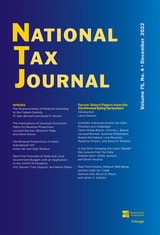
cover of National Tax Journal, volume 75 number 4 (December 2022)

National Tax Journal, volume 75 number 4 (December 2022)

The University of Chicago Press

University of Chicago Press Journals, 2022
This is volume 75 issue 4 of National Tax Journal. The goal of the National Tax Journal (NTJ) is to encourage and disseminate high quality original research on governmental tax and expenditure policies. The journal publishes peer reviewed articles that include economic, theoretical, and empirical analyses of tax and expenditure issues with an emphasis on policy implications. Each issue includes a Forum, which consists of invited papers by leading scholars that examine in depth a single current tax or expenditure policy issue. The NTJ has been published quarterly since 1948 under the auspices of the National Tax Association (NTA).
[more]
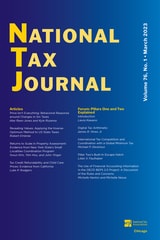
cover of National Tax Journal, volume 76 number 1 (March 2023)

National Tax Journal, volume 76 number 1 (March 2023)

The University of Chicago Press

University of Chicago Press Journals, 2023
This is volume 76 issue 1 of National Tax Journal. The goal of the National Tax Journal (NTJ) is to encourage and disseminate high quality original research on governmental tax and expenditure policies. The journal publishes peer reviewed articles that include economic, theoretical, and empirical analyses of tax and expenditure issues with an emphasis on policy implications. Each issue includes a Forum, which consists of invited papers by leading scholars that examine in depth a single current tax or expenditure policy issue. The NTJ has been published quarterly since 1948 under the auspices of the National Tax Association (NTA).
[more]
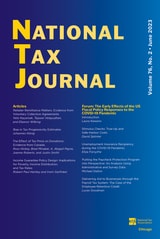
cover of National Tax Journal, volume 76 number 2 (June 2023)

National Tax Journal, volume 76 number 2 (June 2023)

The University of Chicago Press

University of Chicago Press Journals, 2023
This is volume 76 issue 2 of National Tax Journal. The goal of the National Tax Journal (NTJ) is to encourage and disseminate high quality original research on governmental tax and expenditure policies. The journal publishes peer reviewed articles that include economic, theoretical, and empirical analyses of tax and expenditure issues with an emphasis on policy implications. Each issue includes a Forum, which consists of invited papers by leading scholars that examine in depth a single current tax or expenditure policy issue. The NTJ has been published quarterly since 1948 under the auspices of the National Tax Association (NTA).
[more]
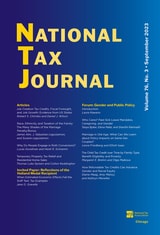
cover of National Tax Journal, volume 76 number 3 (September 2023)

National Tax Journal, volume 76 number 3 (September 2023)

The University of Chicago Press

University of Chicago Press Journals, 2023
This is volume 76 issue 3 of National Tax Journal. The goal of the National Tax Journal (NTJ) is to encourage and disseminate high quality original research on governmental tax and expenditure policies. The journal publishes peer reviewed articles that include economic, theoretical, and empirical analyses of tax and expenditure issues with an emphasis on policy implications. Each issue includes a Forum, which consists of invited papers by leading scholars that examine in depth a single current tax or expenditure policy issue. The NTJ has been published quarterly since 1948 under the auspices of the National Tax Association (NTA).
[more]
cover of National Tax Journal, volume 76 number 4 (December 2023)

National Tax Journal, volume 76 number 4 (December 2023)

The University of Chicago Press

University of Chicago Press Journals, 2023
This is volume 76 issue 4 of National Tax Journal. The goal of the National Tax Journal (NTJ) is to encourage and disseminate high quality original research on governmental tax and expenditure policies. The journal publishes peer reviewed articles that include economic, theoretical, and empirical analyses of tax and expenditure issues with an emphasis on policy implications. Each issue includes a Forum, which consists of invited papers by leading scholars that examine in depth a single current tax or expenditure policy issue. The NTJ has been published quarterly since 1948 under the auspices of the National Tax Association (NTA).
[more]
cover of National Tax Journal, volume 77 number 1 (March 2024)

National Tax Journal, volume 77 number 1 (March 2024)

The University of Chicago Press

University of Chicago Press Journals, 2024
This is volume 77 issue 1 of National Tax Journal. The goal of the National Tax Journal (NTJ) is to encourage and disseminate high quality original research on governmental tax and expenditure policies. The journal publishes peer reviewed articles that include economic, theoretical, and empirical analyses of tax and expenditure issues with an emphasis on policy implications. Each issue includes a Forum, which consists of invited papers by leading scholars that examine in depth a single current tax or expenditure policy issue. The NTJ has been published quarterly since 1948 under the auspices of the National Tax Association (NTA).
[more]
cover of National Tax Journal, volume 77 number 2 (June 2024)

National Tax Journal, volume 77 number 2 (June 2024)

The University of Chicago Press

University of Chicago Press Journals, 2024
This is volume 77 issue 2 of National Tax Journal. The goal of the National Tax Journal (NTJ) is to encourage and disseminate high quality original research on governmental tax and expenditure policies. The journal publishes peer reviewed articles that include economic, theoretical, and empirical analyses of tax and expenditure issues with an emphasis on policy implications. Each issue includes a Forum, which consists of invited papers by leading scholars that examine in depth a single current tax or expenditure policy issue. The NTJ has been published quarterly since 1948 under the auspices of the National Tax Association (NTA).
[more]
cover of National Tax Journal, volume 77 number 3 (September 2024)

National Tax Journal, volume 77 number 3 (September 2024)

The University of Chicago Press

University of Chicago Press Journals, 2024
This is volume 77 issue 3 of National Tax Journal. The goal of the National Tax Journal (NTJ) is to encourage and disseminate high quality original research on governmental tax and expenditure policies. The journal publishes peer reviewed articles that include economic, theoretical, and empirical analyses of tax and expenditure issues with an emphasis on policy implications. Each issue includes a Forum, which consists of invited papers by leading scholars that examine in depth a single current tax or expenditure policy issue. The NTJ has been published quarterly since 1948 under the auspices of the National Tax Association (NTA).
[more]
cover of National Tax Journal, volume 77 number 4 (December 2024)

National Tax Journal, volume 77 number 4 (December 2024)

The University of Chicago Press

University of Chicago Press Journals, 2024
This is volume 77 issue 4 of National Tax Journal. The goal of the National Tax Journal (NTJ) is to encourage and disseminate high quality original research on governmental tax and expenditure policies. The journal publishes peer reviewed articles that include economic, theoretical, and empirical analyses of tax and expenditure issues with an emphasis on policy implications. Each issue includes a Forum, which consists of invited papers by leading scholars that examine in depth a single current tax or expenditure policy issue. The NTJ has been published quarterly since 1948 under the auspices of the National Tax Association (NTA).
[more]
cover of National Tax Journal, volume 78 number 1 (March 2025)

National Tax Journal, volume 78 number 1 (March 2025)

The University of Chicago Press

University of Chicago Press Journals, 2025
This is volume 78 issue 1 of National Tax Journal. The goal of the National Tax Journal (NTJ) is to encourage and disseminate high quality original research on governmental tax and expenditure policies. The journal publishes peer reviewed articles that include economic, theoretical, and empirical analyses of tax and expenditure issues with an emphasis on policy implications. Each issue includes a Forum, which consists of invited papers by leading scholars that examine in depth a single current tax or expenditure policy issue. The NTJ has been published quarterly since 1948 under the auspices of the National Tax Association (NTA).
[more]
cover of National Tax Journal, volume 78 number 2 (June 2025)

National Tax Journal, volume 78 number 2 (June 2025)

The University of Chicago Press

University of Chicago Press Journals, 2025
This is volume 78 issue 2 of National Tax Journal. The goal of the National Tax Journal (NTJ) is to encourage and disseminate high quality original research on governmental tax and expenditure policies. The journal publishes peer reviewed articles that include economic, theoretical, and empirical analyses of tax and expenditure issues with an emphasis on policy implications. Each issue includes a Forum, which consists of invited papers by leading scholars that examine in depth a single current tax or expenditure policy issue. The NTJ has been published quarterly since 1948 under the auspices of the National Tax Association (NTA).
[more]
cover of National Tax Journal, volume 78 number 3 (September 2025)

National Tax Journal, volume 78 number 3 (September 2025)

The University of Chicago Press

University of Chicago Press Journals, 2025
This is volume 78 issue 3 of National Tax Journal. The goal of the National Tax Journal (NTJ) is to encourage and disseminate high quality original research on governmental tax and expenditure policies. The journal publishes peer reviewed articles that include economic, theoretical, and empirical analyses of tax and expenditure issues with an emphasis on policy implications. Each issue includes a Forum, which consists of invited papers by leading scholars that examine in depth a single current tax or expenditure policy issue. The NTJ has been published quarterly since 1948 under the auspices of the National Tax Association (NTA).
[more]
cover of National Tax Journal, volume 78 number 4 (December 2025)

National Tax Journal, volume 78 number 4 (December 2025)

The University of Chicago Press

University of Chicago Press Journals, 2025
This is volume 78 issue 4 of National Tax Journal. The goal of the National Tax Journal (NTJ) is to encourage and disseminate high quality original research on governmental tax and expenditure policies. The journal publishes peer reviewed articles that include economic, theoretical, and empirical analyses of tax and expenditure issues with an emphasis on policy implications. Each issue includes a Forum, which consists of invited papers by leading scholars that examine in depth a single current tax or expenditure policy issue. The NTJ has been published quarterly since 1948 under the auspices of the National Tax Association (NTA).
[more]
cover of National Tax Journal, volume 79 number 1 (March 2026)

National Tax Journal, volume 79 number 1 (March 2026)

The University of Chicago Press

University of Chicago Press Journals, 2026
This is volume 79 issue 1 of National Tax Journal. The goal of the National Tax Journal (NTJ) is to encourage and disseminate high quality original research on governmental tax and expenditure policies. The journal publishes peer reviewed articles that include economic, theoretical, and empirical analyses of tax and expenditure issues with an emphasis on policy implications. Each issue includes a Forum, which consists of invited papers by leading scholars that examine in depth a single current tax or expenditure policy issue. The NTJ has been published quarterly since 1948 under the auspices of the National Tax Association (NTA).
[more]
cover of National Tax Journal, volume 79 number 2 (June 2026)

National Tax Journal, volume 79 number 2 (June 2026)

The University of Chicago Press

University of Chicago Press Journals, 2026
This is volume 79 issue 2 of National Tax Journal. The goal of the National Tax Journal (NTJ) is to encourage and disseminate high quality original research on governmental tax and expenditure policies. The journal publishes peer reviewed articles that include economic, theoretical, and empirical analyses of tax and expenditure issues with an emphasis on policy implications. Each issue includes a Forum, which consists of invited papers by leading scholars that examine in depth a single current tax or expenditure policy issue. The NTJ has been published quarterly since 1948 under the auspices of the National Tax Association (NTA).
[more]
cover of National Tax Journal, volume 79 number 3 (September 2026)

National Tax Journal, volume 79 number 3 (September 2026)

The University of Chicago Press

University of Chicago Press Journals, 2026

This is volume 79 issue 3 of National Tax Journal. The goal of the National Tax Journal (NTJ) is to encourage and disseminate high quality original research on governmental tax and expenditure policies. The journal publishes peer reviewed articles that include economic, theoretical, and empirical analyses of tax and expenditure issues with an emphasis on policy implications. Each issue includes a Forum, which consists of invited papers by leading scholars that examine in depth a single current tax or expenditure policy issue. The NTJ has been published quarterly since 1948 under the auspices of the National Tax Association (NTA).
[more]
cover of Nationalism and the Economy: Explorations into a Neglected Relationship

Nationalism and the Economy

Explorations into a Neglected Relationship

Stefan Berger

Central European University Press, 2019
This book is the first attempt to bridge the current divide between studies addressing "economic nationalism" as a deliberate ideology and movement of economic 'nation-building', and the literature concerned with more diffuse expressions of economic "nationness"—from national economic symbols and memories, to the "banal" world of product communication. The editors seeks to highlight the importance of economic issues for the study of nations and nationalism, and its findings point to the need to give economic phenomena a more prominent place in the field of nationalism studies. The authors of the essays come from disciplines as diverse as economic and cultural history, political science, business studies, as well as sociology and anthropology. Their chapters address the nationalism-economy nexus in a variety of realms, including trade, foreign investment, and national control over resources, as well as consumption, migration, and welfare state policies. Some of the case studies have a historical focus on nation-building in the nineteenth and early twentieth centuries, while others are concerned with contemporary developments. Several contributions provide in-depth analyses of single cases while others employ a comparative method. The geographical focus of the contributions vary widely, although, on balance, the majority of our authors deal with European countries.
[more]
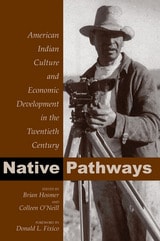
cover of Native Pathways: American Indian Culture and Economic Development in the Twentieth Century

Native Pathways

American Indian Culture and Economic Development in the Twentieth Century

Brian Hosmer

University Press of Colorado, 2004

How has American Indians' participation in the broader market - as managers of casinos, negotiators of oil leases, or commercial fishermen - challenged the U.S. paradigm of economic development? Have American Indians paid a cultural price for the chance at a paycheck? How have gender and race shaped their experiences in the marketplace? Contributors to Native Pathways ponder these and other questions, highlighting how indigenous peoples have simultaneously adopted capitalist strategies and altered them to suit their own distinct cultural beliefs and practices. Including contributions from historians, anthropologists, and sociologists, Native Pathways offers fresh viewpoints on economic change and cultural identity in twentieth-century Native American communities. Foreword by Donald L. Fixico.
[more]
cover of Natural Resource Development and Human Rights in Latin America: State and non-state actors in the promotion of and opposition to extractivism

Natural Resource Development and Human Rights in Latin America

State and non-state actors in the promotion of and opposition to extractivism

Edited by Malayna Raftopoulos and Radoslaw Poweska

University of London Press, 2017

Contemporary development debates in Latin America are marked by the pursuit of economic growth, technological improvement and poverty reduction, and are overshadowed by growing concerns about the preservation of the environment and human rights. This collection’s multidisciplinary perspective links local, national, regional and transnational levels of inquiry into the interaction of state and non-state actors involved in promoting or opposing natural resource development. Taking this approach allows the book to contemplate the complex panorama of competing visions, concepts and interests grounded in the mutual influences and interdependencies which shape the contemporary arena of social-environmental conflicts in the region.
[more]
cover of Natural Resources and the New Frontier: Constructing Modern China's Borderlands

Natural Resources and the New Frontier

Constructing Modern China's Borderlands

Judd C. Kinzley

University of Chicago Press, 2018

China’s westernmost province of Xinjiang has experienced escalating cycles of violence, interethnic strife, and state repression since the 1990s. In their search for the roots of these growing tensions, scholars have tended to focus on ethnic clashes and political disputes. In Natural Resources and the New Frontier, historian Judd C. Kinzley takes a different approach—one that works from the ground up to explore the infrastructural and material foundation of state power in the region.
 
As Kinzley argues, Xinjiang’s role in producing various natural resources for regional powers has been an important but largely overlooked factor in fueling unrest. He carefully traces the buildup to this unstable situation over the course of the twentieth century by focusing on the shifting priorities of Chinese, Soviet, and provincial officials regarding the production of various resources, including gold, furs, and oil among others. Through his archival work, Kinzley offers a new way of viewing Xinjiang that will shape the conversation about this important region and offer a model for understanding the development of other frontier zones in China as well as across the global south.

[more]
cover of Nature in the Global South: Environmental Projects in South and Southeast Asia

Nature in the Global South

Environmental Projects in South and Southeast Asia

Paul Greenough and Anna Lowenhaupt Tsing, eds.

Duke University Press, 2003

A nuanced look at how nature has been culturally constructed in South and Southeast Asia, Nature in the Global South is a major contribution to understandings of the politics and ideologies of environmentalism and development in a postcolonial epoch. Among the many significant paradigms for understanding both the preservation and use of nature in these regions are biological classification, state forest management, tropical ecology, imperial water control, public health, and community-based conservation. Focusing on these and other ways that nature has been shaped and defined, this pathbreaking collection of essays describes projects of exploitation, administration, science, and community protest.

With contributors based in anthropology, ecology, sociology, history, and environmental and policy studies, Nature in the Global South features some of the most innovative and influential work being done in the social studies of nature. While some of the essays look at how social and natural landscapes are created, maintained, and transformed by scientists, officials, monks, and farmers, others analyze specific campaigns to eradicate smallpox and save forests, waterways, and animal habitats. In case studies centered in the Philippines, India, Pakistan, Thailand, Indonesia, and South and Southeast Asia as a whole, contributors examine how the tropics, the jungle, tribes, and peasants are understood and transformed; how shifts in colonial ideas about the landscape led to extremely deleterious changes in rural well-being; and how uneasy environmental compromises are forged in the present among rural, urban, and global allies.

Contributors:
Warwick Anderson
Amita Baviskar
Peter Brosius
Susan Darlington
Michael R. Dove
Ann Grodzins Gold
Paul Greenough
Roger Jeffery
Nancy Peluso
K. Sivaramakrishnan
Nandini Sundar
Anna Lowenhaupt Tsing
Charles Zerner

[more]
cover of Naval Leadership in the Atlantic World: The Age of Reform and Revolution, 1700–1850

Naval Leadership in the Atlantic World

The Age of Reform and Revolution, 1700–1850

Richard Harding and Agustín Guimerá

University of Westminster Press, 2017

[more]
cover of Navigating White News: Asian American Journalists at Work

Navigating White News

Asian American Journalists at Work

David C Oh

Rutgers University Press, 2023

NCA Asian Pacific American Caucus & Communication Studies Division Outstanding Book Award 

Combining critical race studies with cultural production studies, Navigating White News: Asian American Journalists at Work is the only academic book to examine the ways that racial identification and activation matters in their understanding of news. This adds to the existing literature on race and the sociology of news by examining intra-racial differences in the ways they navigate and understand White newsrooms. Employing in-depth interviews with twenty Asian American journalists who are actively working in large and small newsrooms across the United States, Navigating White News: Asian American Journalists at Work argues that Asian American reporters for whom racial identities are important questioned what counted as news, questioned the implicitly White perspective of objectivity, and actively worked toward providing more complex, substantive coverage of Asian American communities. For Asian American reporters for whom racial identity was not meaningful, they were more invested in existing professional norms. Regardless, all journalists understood that news is a predominantly and culturally White institution.

 
[more]
cover of Navigating the Cultures of Health Care and Health Insurance: Highly Skilled Migrants in the U.S.

Navigating the Cultures of Health Care and Health Insurance

Highly Skilled Migrants in the U.S.

Nina Zeldes

University College London, 2023

A qualitative and quantitative approach to the study of foreign patients’ utilization and assessment of health care in the United States.

What are the barriers preventing migrants from accessing and successfully using health care in their new home country? Do these barriers vary based on the migrants’ country of origin? And are they a problem for highly skilled migrants, who often have well-paid jobs and health insurance provided by their employers? Based on field research conducted in the Washington DC area, Navigating the Cultures of Health Care and Health Insurance brings together mixed methods, qualitative, and quantitative approaches to the study of foreign patients’ utilization and assessment of health care in the United States. Through interviews with both health care providers and patients, attitudes toward health insurance and medical treatment are compared for migrants from three countries with very different cultural backgrounds and health insurance systems: Germany, India, and Japan. 
[more]