Results by title
434 books match the query 'Ethics & Moral Philosophy' and 15 start with n

NEWER IDEALS OF PEACE
Jane Addams
University of Illinois Press, 2006
In this her second book, Jane Addams moves beyond humanitarian appeals to sensibility and prudence, advancing a more aggressive, positive idea of peace as a dynamic social process emerging out of the poorer quarters of cosmopolitan cities. Her deep analysis of relations among diverse groups in U.S. society, exemplified by inter-ethnic and labor relations in Chicago, draws widely useful lessons for both domestic and global peace, in an early formulation of today’s "globalization from below."
In an unprecedented, revolutionary critique of the pervasive militarization of society, Addams applies her scathing pen to traditional advocates and philosophers of “negative” peace, founders of the U.S. constitution, militarists, bigots, imperialists, and theories of “democratic peace” and liberal capitalism. Instead she sees a slow, powerful emergence of forces from below--the poor, the despised, workers, women, ethnic and racial communities, oppressed groups at home and abroad--that would invent moral substitutes for war and gradually shape a just, peaceful, and varied social order. An extensive, in-depth introduction by Berenice Carroll and Clinton Fink provides historical context, analysis, and a reassessment of the theoretical and practical significance of Newer Ideals of Peace today.

Nationalism and Beyond
Introducing Moral Debate about ValuesNenad Mišcevic
Central European University Press, 2001
A very readable introduction to the concepts and principles shaping the philosophical debate around nationalism. The book provides portraits of two kinds of nationalists: the tougher type, more common in everyday life, and the ultra-moderate "liberal nationalist" encountered in academia. The author introduces a debate with a "thoughtful nationalist," one who defends the view that states should be organized around national culture and that individuals have basic obligations to their nation. The author attempts to answer his opponent's standard arguments and presents a fully documented critique of his views.
A passion born from Miscevic's encounter with nationalism in the former Yugoslavia glows from every line of the argument. Questions raised and discussed include: Why is radicalism typical of nationalism? How successful is the nation-state? Does nationalism support liberal-democratic values? Is membership in a nation necessary for human fulfillment and for understanding values? Why might nationalism be immoral?
The book is unique not only because it explains a contemporary moral debate, in terms clear to the non-philosopher reader, but also because it has been written from the perspective of Central and Eastern Europe based on the author's personal experience.

Natural Moral Law in Contemporary Society
Holger Zaborowski
Catholic University of America Press, 2010

Nature as Guide
Wittgenstein and the Renewal of Moral TheologyDavid Goodill, OP
Catholic University of America Press, 2022
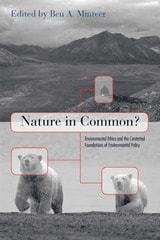
Nature in Common?
Environmental Ethics and the Contested Foundations of Environmental PolicyBen A. Minteer
Temple University Press, 2009
This important book brings together leading environmental thinkers to debate a central conflict within environmental philosophy: Should we appreciate nature mainly for its ability to advance our interests or should we respect it as having a good of its own, apart from any contribution to human well being? Specifically, the fourteen essays collected here discuss the "convergence hypothesis" put forth by Bryan Norton—a controversial thesis in environmental ethics about the policy implications of moral arguments for environmental protection. Historically influential essays are joined with newly commissioned essays to provide the first sustained attempt to reconcile two long-opposed positions. Norton himself offers the book's closing essay.
This seminal volume contains contributions from some of the most respected scholars in the field, including Donald Brown, J. Baird Callicott, Andrew Light, Holmes Rolston III, Laura Westra, and many others. Although Nature in Common? will be especially useful for students and professionals studying environmental ethics and philosophy, it will engage any reader who is concerned about the philosophies underlying contemporary environmental policies.

Nature's Keeper
Peter S. Wenz
Temple University Press, 1996
In the West, humans tend to separate themselves from nature, valuing nature only as a means of meeting their own needs and happiness. This domination of nature often fosters human oppression instead of freedom and progress, as those who ignore abuses of nature tend to disregard human injustice as well. Peter S. Wenz argues that this oppression involves such destructive forces as sexism, ethnic strife, and political repression, including repression of the nuclear power industry's victims. Catastrophes like the Holocaust and the Gulf War are the result.
In contrast to the destructive "separate from nature" attitude, Wenz looks to various indigenous peoples as an example of societies where human beings revere nature for itself--societies where human beings flourish as individuals, in families, and in communities. Unlike societies dependent on commerce and industry, many indigenous peoples consider themselves part of a circle of life, reaping benefits far greater than the technological advances of the West. Wenz considers how to adopt the perspective of some indigenous cultures and how to make it work in our fast-food world. Additionally, he uses a trip to the World Uranium Hearings in Salzburg as a vehicle for understanding complex philosophical issues from consumerism to anthropocentrism.
In the series Ethics and Action, edited by Tom Regan.

Nature's Virtue
James F. Pontuso
St. Augustine's Press, 2016
Yet virtue seems to be a part of everyday life. What accounts for the kindly relationships between people? Why are most people peaceful, law abiding, and decent? If, as some insist, there is no foundation for virtue, or people act only out of self-interest, how can we explain why so many people are good to each other?
Prestigious scholars, such as Alasdair MacIntyre, After Virtue, James Q. Wilson, The Moral Sense, Steven Pinker, The Better Angels of Our Nature, and Philippa Foot, Natural Goodness, have attempted to answer this question. While these authors make great strides in explaining the character of goodness, their works do not face the problem raised by “anti-foundationalist.” Anti-foundationalist such as Richard Rorty, Friedrich Nietzsche, Martin Heidegger, and the libertarian school of economics maintain that humans lack a capacity for comprehending what is good or bad. For anti-foundationalists there are no higher metaphysical principles that guide behavior. Prescriptive judgments are little more than long-held cultural prejudices fortified by habit so as to seem natural. Therefore, philosophic claims about virtue are little more than guesses about proper conduct.
Nature’s Virtue squarely faces the challenge of anti-foundationalists. The book points out the defects of these ideas. It does so by presenting a contemporary restatement of the case for grounding virtue in Platonic forms or ideas.

New Directions in Private Law Theory
Edited by Fabiana Bettini, Martin Fischer, Charles Mitchell, and Prince Saprai
University College London, 2023
New Directions in Private Law Theory brings together some of the best new work on private law theory, reflecting the breadth of this increasingly important field. The authors adopt a variety of different approaches and contribute to ongoing and important debates about the moral foundations of private law, the individuation of areas of private law, and the connections between private law and everyday moral experience. Questions addressed include: does the diversity identified among claims in unjust enrichment mean that the category is incoherent? Are claims in tort law always about compensating for wrongs? How should we understand the parties’ agreement in a contract? The contributions shed new light on these and other topics and the ways in which they intersect and open up new lines of scholarly inquiry.
This book will be of interest to researchers working in private law and legal theory, but it will also appeal to those outside of law, most notably researchers with an interest in moral and political philosophy, economics, and history.

Nietzsche Pursued
Toward a Philosophy for the FutureRichard Schacht
University of Chicago Press, 2024
Nietzsche advocated for a post-theistic “philosophy of the future”—a new approach to human reality that would bend Western thought away from nihilism in a life-affirming, value-creative direction. His early demise left this endeavor only just begun. In Nietzsche Pursued, Richard Schacht examines Nietzsche’s revisionist approach to familiar philosophical topics, exploring how some may be further pursued in Nietzschean ways.
Each chapter focuses on one topic that is central to Nietzsche's vision of what philosophy can and should be and do. Among them: his kind of naturalism, humanity, perspectivism, morality, and music. Building on his analysis in Nietzsche’s Kind of Philosophy, Schacht invites readers to see with new appreciation the ongoing significance of Nietzsche’s thought for philosophy’s future.
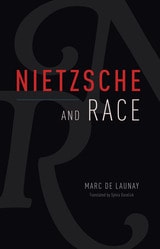
Nietzsche and Race
Marc de Launay
University of Chicago Press, 2023
The caricature of Friedrich Nietzsche as a proto-Nazi is still with us, having originated with his own Nazi sister, Elisabeth Förster, who curated Nietzsche’s disparate texts to suit her own purposes. In Nietzsche and Race, Marc de Launay deftly counters this persistent narrative in a series of concise and highly accessible reflections on the concept of race in Nietzsche’s publications, notebooks, and correspondence. Through a fresh reading of Nietzsche’s core philosophical project, de Launay articulates a new understanding of race in Nietzsche’s body of work free from the misunderstanding of his detractors.

Nietzsche and the Shadow of God
Didier Franck; Translated from the French by Bettina Bergo and Philippe Farah
Northwestern University Press, 2011
Bergo and Farah’s clear translation introduces this work to an English-speaking audience for the first time.

No Longer Patient
Feminist Ethics and Health CareSusan Sherwin
Temple University Press, 1992

No Smoking
The Ethical IssuesRobert E. Goodin
University of Chicago Press, 1990

Noble Purpose
Joy Of Living A Meaningful LifeWilliam Bill Damon
Templeton Press, 2003
This book describes the personal and spiritual benefits of living life in a way that matters, with an awareness that one's life can reflect a sense of higher purpose no matter what the circumstances. The book draws upon religious, philosophical, and literary writings to show how humans in many cultures and historical epochs have pursued noble purposes by answering God's call as each hears it.
Noble purpose can be pursued both in heroic acts and in everyday behavior. The book shows how ordinary people—teachers, business professionals, parents, citizens—can ennoble what they do by being mindful of its deepest meaning. It also points out that humility is a necessary virtue for those who pursue a noble purpose. Great heroes are bold, courageous, and sometimes audacious in their determination to succeed; but they are also humble in their awareness of their own limitations. Moreover, a person must never violate basic moral laws while pursuing a noble purpose—the means must be as moral as the ends.
Purpose brings coherence and satisfaction to people's lives, producing joy in good times and resilience in hard times. It also presents a paradox: hard work in service of noble purpose that transcends personal gain is a surer path to happiness than the self-indulgent pursuit of happiness for its own sake. The closer we come to God's purpose for us, the more satisfied our lives become.
From the inspiration and examples conveyed in this book, we learn that all individuals have the capacity to discover their own God-given abilities, to learn the world's need for the services they can provide, and to experience joy in serving society and God in their special ways. As theologian Frederick Buechner writes, "The place God calls you to is the place where your deep gladness and the world's deep hunger meet."

Notebooks for an Ethics
Jean-Paul Sartre
University of Chicago Press, 1992
In the famous conclusion to Being and Nothingness, Sartre announced that he would devote his next philosophical work to moral problems. Although he worked on this project in the late 1940s, Sartre never completed it to his satisfaction, and it remained unpublished until after his death in 1980. Presented here for the first time in English, the Notebooks reveal Sartre at his most productive, crafting a masterpiece of philosophical reflection that can easily stand alongside his other great works.
Sartre grapples anew here with such central issues as "authenticity" and the relation of alienation and freedom to moral values. Exploring fundamental modes of relating to the Other—among them violence, entreaty, demand, appeal, refusal, and revolt—he articulates the necessary transition from individualism to historical consciousness. This work thus forms an important bridge between the early existentialist Sartre and the later Marxist social thinker of the Critique of Dialectical Reason. The Notebooks themselves are complemented here by two additional essays, one on "the good and subjectivity," the other on the oppression of blacks in the United States.
With publication of David Pellauer's lucid translation, English-speaking readers will be able to appreciate this important contribution to moral philosophy and the history of ethics.
Jean-Paul Sartre (1906-1980) was offered, but declined, the Nobel Prize for literature in 1964. His many works of fiction, drama, and philosophy include the monumental study of Flaubert, The Family Idiot, and The Freud Scenario, both published in translation by the University of Chicago Press.