Results by title
522 books match the query 'Gender' and 17 start with n

Native Men Remade
Gender and Nation in Contemporary Hawai'iTy P. Kawika Tengan
Duke University Press, 2008
The sharing of personal stories is an integral part of Hale Mua fellowship, and Tengan’s account is filled with members’ first-person narratives. At the same time, Tengan explains how Hale Mua rituals and practices connect to broader projects of cultural revitalization and Hawaiian nationalism. He brings to light the tensions that mark the group’s efforts to reclaim indigenous masculinity as they arise in debates over nineteenth-century historical source materials and during political and cultural gatherings held in spaces designated as tourist sites. He explores class status anxieties expressed through the sharing of individual life stories, critiques of the Hale Mua registered by Hawaiian women, and challenges the group received in dialogues with other indigenous Polynesians. Native Men Remade is the fascinating story of how gender, culture, class, and personality intersect as a group of indigenous Hawaiian men work to overcome the dislocations of colonial history.
Natives Making Nation
Gender, Indigeneity, and the State in the AndesAndrew Canessa
University of Arizona Press, 2005
This volume looks at how metropolitan ideas of nation employed by politicians, the media and education are produced, reproduced, and contested by people of the rural Andes—people who have long been regarded as ethnically and racially distinct from more culturally European urban citizens. Yet these peripheral “natives” are shown to be actively engaged with the idea of the nation in their own communities, forcing us to re-think the ways in which indigeneity is defined by its marginality.
The contributors examine the ways in which numerous identities—racial, generational, ethnic, regional, national, gender, and sexual—are both mutually informing and contradictory among subaltern Andean people who are more likely now to claim an allegiance to a nation than ever before. Although indians are less often confronted with crude assimilationist policies, they continue to face racism and discrimination as they struggle to assert an identity that is more than a mere refraction of the dominant culture. Yet despite the language of multiculturalism employed even in constitutional reform, any assertion of indian identity is likely to be resisted. By exploring topics as varied as nation-building in the 1930s or the chuqila dance, these authors expose a paradox in the relation between indians and the nation: that the nation can be claimed as a source of power and distinct identity while simultaneously making some types of national imaginings unattainable.
Whether dancing together or simply talking to one another, the people described in these essays are shown creating identity through processes that are inherently social and interactive. To sing, to eat, to weave . . . In the performance of these simple acts, bodies move in particular spaces and contexts and do so within certain understandings of gender, race and nation. Through its presentation of this rich variety of ethnographic and historical contexts, Natives Making Nation provides a finely nuanced view of contemporary Andean life.

Natural Acts
Gender, Race, and Rusticity in Country MusicPamela Fox
University of Michigan Press, 2009

Nature's Body
Gender in the Making of Modern ScienceSchiebinger, Londa
Rutgers University Press, 2004
Eighteenth-century natural historians created a peculiar, and peculiarly durable, vision of nature—one that embodied the sexual and racial tensions of that era. When plants were found to reproduce sexually, eighteenth-century botanists ascribed to them passionate relations, polyandrous marriages, and suicidal incest, and accounts of steamy plant sex began to infiltrate the botanical literature of the day. Naturalists also turned their attention to the great apes just becoming known to eighteenth-century Europeans, clothing the females in silk vestments and training them to sip tea with the modest demeanor of English matrons, while imagining the males of the species fully capable of ravishing women.
Written with humor and meticulous detail, Nature’s Body draws on these and other examples to uncover the ways in which assumptions about gender, sex, and race have shaped scientific explanations of nature. Schiebinger offers a rich cultural history of science and a timely and passionate argument that science must be restructured in order to get it right.
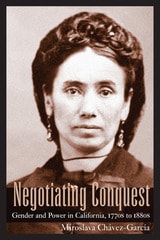
Negotiating Conquest
Gender and Power in California, 1770s to 1880sMiroslava Chávez-García
University of Arizona Press, 2004
Negotiating Conquest begins with an examination of how gender and ethnicity shaped the policies and practices of the Spanish conquest, showing that Hispanic women, marriage, and the family played a central role in producing a stable society on Mexico’s northernmost frontier. It then examines how gender, law, property, and ethnicity shaped social and class relations among Mexicans and native peoples, focusing particularly on how women dealt with the gender-, class-, and ethnic-based hierarchies that gave Mexican men patriarchal authority. With the American takeover in 1846, the text’s focus shifts to how the imposition of foreign legal, economic, linguistic, and cultural norms affected the status of Mexican women, male-female relations, and the family. Addressing such issues as divorce, legitimacy, and inheritance, it describes the manner in which the conquest weakened the economic position of both Mexican women and men while at the same time increasing the leverage of Mexican women in their personal and social relationships with men.
Drawing on archival materials—including dozens of legal cases—that have been largely ignored by other scholars, Chávez-García examines federal, state, and municipal laws across many periods in order to reveal how women used changing laws, institutions, and norms governing property, marriage and sexuality, and family relations to assert and protect their rights. By showing that mexicanas contested the limits of male rule and insisted that patriarchal relationships be based on reciprocity, Negotiating Conquest expands our knowledge of how patriarchy functioned and evolved as it reveals the ways in which conquest can transform social relationships in both family and community.

Negotiating Difference
Race, Gender, and the Politics of PositionalityMichael Awkward
University of Chicago Press, 1995
From Spike Lee's She's Gotta Have It to Michael Jackson's physical transmutations, from Toni Morrison's Song of Solomon to August Wilson's Fences, from male scholars' investments in feminism to white scholars' in black texts—Awkward explores cultural moments that challenge the exclusive critical authority of race and gender. In each instance he confronts the question: What do artists, scholars, and others concerned with representations of Afro-American life make of the view that gender, race, and sexuality circumscribe their own and others' lives and narratives? Throughout he demonstrates the perils and merits of the sort of "boundary crossing" this book ultimately makes: a black male feminism.
In pursuing a black male feminist criticism, Awkward's study acknowledges the complexities of interpretation in an age when a variety of powerful discourses have proliferated on the subject of racial, gendered, and sexual difference; at the same time, it identifies this proliferation as an opportunity to negotiate seemingly fixed cultural and critical positions.

Negotiating Performance
Gender, Sexuality, and Theatricality in Latin/o AmericaDiana Taylor and Juan Villegas, ed.
Duke University Press, 1994
The Latin/o America examined here stretches from Patagonia to New York City, bridging the political and geographical divides between U.S. Latinos and Latin Americans. Moving from Nuyorican casitas in the South Bronx, to subversive street performances in Buenos Aires, to border art from San Diego/Tijuana, this volume negotiates the borders that bring Americans together and keep them apart, while at the same time debating the use of the contested term "Latino/a." In the emerging dialogue, contributors reenvision an inclusive "América," a Latin/o America that does not pit nationality against ethnicity—in other words, a shared space, and a home to all Latin/o Americans.
Negotiating Performance opens up the field of Latin/o American theater and performance criticism by looking at performance work by Mayans, women, gays, lesbians, and other marginalized groups. In so doing, this volume will interest a wide audience of students and scholars in feminist and gender studies, theater and performance studies, and Latin American and Latino cultural studies.
Contributors. Judith Bettelheim, Sue-Ellen Case, Juan Flores, Jean Franco, Donald H. Frischmann, Guillermo Gómez-Peña, Jorge Huerta, Tiffany Ana López, Jacqueline Lazú, María Teresa Marrero, Cherríe Moraga, Kirsten F. Nigro, Patrick O’Connor, Jorge Salessi, Alberto Sandoval, Cynthia Steele, Diana Taylor, Juan Villegas, Marguerite Waller
New Perspectives on Environmental Justice
Gender, Sexuality, and ActivismStein, Rachel
Rutgers University Press, 2004
Women make up the vast majority of activists and organizers of grassroots movements fighting against environmental ills that threaten poor and people of color communities. New Perspectives on Environmental Justice is the first collection of essays that pays tribute to the enormous contributions women have made in these endeavors.
The writers offer varied examples of environmental justice issues such as children's environmental health campaigns, cancer research, AIDS/HIV activism, the Environmental Genome Project, and popular culture, among many others. Each one focuses on gender and sexuality as crucial factors in women's or gay men's activism and applies environmental justice principles to related struggles for sexual justice. The contributors represent a wide variety of activist and scholarly perspectives including law, environmental studies, sociology, political science, history, medical anthropology, American studies, English, African and African American studies, women's studies, and gay and lesbian studies, offering multiple vantage points on gender, sexuality, and activism.
Feminist/womanist impulses shape and sustain environmental justice movements around the world, making an understanding of gender roles and differences crucial for the success of these efforts.
Next to the Color Line
Gender, Sexuality, and W. E. B. Du BoisSusan Gillman
University of Minnesota Press, 2007

No Bond but the Law
Punishment, Race, and Gender in Jamaican State Formation, 1780–1870Diana Paton
Duke University Press, 2004
No Bond but the Law reveals the longstanding and intimate relationship between state formation and private punishment. The construction of a dense, state-organized system of prisons began not with emancipation but at the peak of slave-based wealth in Jamaica, in the 1780s. Jamaica provided the paradigmatic case for British observers imagining and evaluating the emancipation process. Paton’s analysis moves between imperial processes on the one hand and Jamaican specificities on the other, within a framework comparing developments regarding punishment in Jamaica with those in the U.S. South and elsewhere. Emphasizing the gendered nature of penal policy and practice throughout the emancipation period, Paton is attentive to the ways in which the actions of ordinary Jamaicans and, in particular, of women prisoners, shaped state decisions.

No More Invisible Man
Race and Gender in Men's WorkAdia Harvey Wingfield
Temple University Press, 2012
The “invisible men” of sociologist Adia Harvey Wingfield’s urgent and timely No More Invisible Man are African American professionals who fall between extremely high status, high-profile black men and the urban underclass. Her compelling interview study considers middle-class, professional black men and the challenges, obstacles, and opportunities they encounter in white male–dominated occupations.
No More Invisible Man chronicles these men’s experiences as a tokenized minority in the workplace to show how issues of power and inequality exist—especially as they relate to promotion, mobility, and developing occupational networks. Wingfield’s intersectional analysis deftly charts the ways that gender, race, and class collectively shape black professional men’s work experiences.
In its examination of men’s interactions with women and other men, as well as men’s performances of masculinity and their emotional demeanors in these jobs, No More Invisible Man extends our understanding of racial- and gender-based dynamics in professional work.

No One Really Knows Me
Helping Young Men Find Connection, Love, and PurposeMichael C. Reichert and Gary Barker
University of Chicago Press, 2027
Counters common and harmful myths about manhood today and offers recommendations for what young men really need as they mature.
From the “manosphere” and LooksMaxxers to Proud Boys, it increasingly feels these days like the kids—particularly the boys—are not all right. Social expectations around what masculinity means are in flux, while algorithms push out misogynist content with no regard for its radicalizing effects. In 2023 and again in 2025, a representative survey of 2,000 American men aged 18-23 found that over two-thirds agreed with the statement: “No one really knows me.” This dramatic finding revealed the failure of American boyhood to account for young men’s full humanity and equip them with the skills, relationships, and support needed for success in these modern times.
In No One Really Knows Me, psychologists Michael C. Reichert and Gary Barker seek to uncover the root causes of and solutions to our contemporary crisis of masculinity. Based on single and group interviews and a wealth of survey data, including their own national survey of 2,000 men ages 18 to 45 from a broad range of economic, racial, and social backgrounds, their findings were clear: across the board, men are struggling to build the social networks they desperately need for health and success. Underlying this failure is a set of historic, pernicious myths that continue to dominate boyhood and shape the imaginations of boys in families, schools, and relationships. Reichert and Barker use each chapter to highlight one myth of masculinity, offer data from their own research and practice to debunk it, and then present life-changing, evidence-based alternatives.
Young men today are in quite a different position than they were a generation ago. As he emerges from boyhood on his way to manhood, each young man needs to be grounded in emotionally open connections, deep relationships with people who have his back, and opportunities to engage with purpose. This book shows us how we can provide young men with surer footing for their passage to adulthood.

No Slam Dunk
Gender, Sport and the Unevenness of Social ChangeCooky, Cheryl
Rutgers University Press, 2018
The chapters in No Slam Dunk show that is this not simply a story of an “unfinished revolution.” Rather, they contend, it is simplistic optimism to assume that we are currently nearing the conclusion of a story of linear progress that ends with a certain future of equality and justice. This book provides important theoretical and empirical insights into the contemporary world of sports to help explain the unevenness of social change and how, despite significant progress, gender equality in sports has been “No Slam Dunk.”
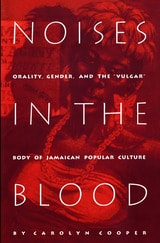
Noises in the Blood
Orality, Gender, and the"Vulgar" Body of Jamaican Popular CultureCarolyn Cooper
Duke University Press, 1995
Cooper’s exploration of Jamaican popular culture covers a wide range of topics, including Bob Marley’s lyrics, the performance poetry of Louise Bennett, Mikey Smith, and Jean Binta Breeze, Michael Thelwell’s novelization of The Harder They Come, the Sistren Theater Collective’s Lionheart Gal, and the vitality of the Jamaican DJ culture. Her analysis of this cultural "noise" conveys the powerful and evocative content of these writers and performers and emphasizes their contribution to an undervalued Caribbean identity. Making the connection between this orality, the feminized Jamaican "mother tongue," and the characterization of this culture as low or coarse or vulgar, she incorporates issues of gender into her postcolonial perspective. Cooper powerfully argues that these contemporary vernacular forms must be recognized as genuine expressions of Jamaican culture and as expressions of resistance to marginalization, racism, and sexism.
With its focus on the continuum of oral/textual performance in Jamaican culture, Noises in the Blood, vividly and stylishly written, offers a distinctive approach to Caribbean cultural studies.

Not June Cleaver
Women and Gender in Postwar America, 1945-1960June Meyerowitz
Temple University Press, 1994
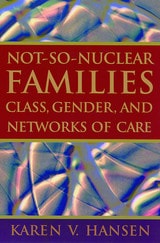
Not-So-Nuclear Families
Class, Gender, and Networks of CareHansen, Karen V
Rutgers University Press, 2004
In recent years U.S. public policy has focused on strengthening the nuclear family as a primary strategy for improving the lives of America's youth. It is often assumed that this normative type of family is an independent, self-sufficient unit adequate for raising children. But half of all households in the United States with young children have two employed parents. How do working parents provide care and mobilize the help that they need?
In Not-So-Nuclear Families: Class, Gender, and Networks of Care, Karen V. Hansen investigates the lives of working parents and the informal networks they construct to help care for their children. She chronicles the conflicts, hardships, and triumphs of four families of various social classes. Each must navigate the ideology that mandates that parents, mothers in particular, rear their own children, in the face of an economic reality that requires that parents rely on the help of others. In vivid family stories, parents detail how they and their networks of friends, paid caregivers, and extended kin collectively close the "care gap" for their school-aged children.
Hansen not only debunks the myth that families in the United States are independent, isolated, and self-reliant units, she breaks new theoretical ground by asserting that informal networks of care can potentially provide unique and valuable bonds that nuclear families cannot.

Nursing Civil Rights
Gender and Race in the Army Nurse CorpsCharissa J. Threat
University of Illinois Press, 2015
As Threat reveals, both groups viewed their circumstances with the Army Nurse Corps as a civil rights matter. Each conducted separate integration campaigns to end the discrimination they suffered. Yet their stories defy the narrative that civil rights struggles inevitably arced toward social justice. Threat tells how progressive elements in the campaigns did indeed break down barriers in both military and civilian nursing. At the same time, she follows conservative threads to portray how some of the women who succeeded as agents of change became defenders of exclusionary practices when men sought military nursing careers. The ironic result was a struggle that simultaneously confronted and reaffirmed the social hierarchies that nurtured discrimination.