60 books match the query 'Ghana' and 4 start with n
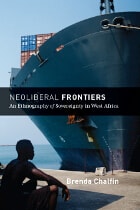
cover of Neoliberal Frontiers: An Ethnography of Sovereignty in West Africa

Neoliberal Frontiers

An Ethnography of Sovereignty in West Africa

Brenda Chalfin

University of Chicago Press, 2010
In Neoliberal Frontiers, Brenda Chalfin presents an ethnographic examination of the day-to-day practices of the officials of Ghana’s Customs Service, exploring the impact of neoliberal restructuring and integration into the global economy on Ghanaian sovereignty. From the revealing vantage point of the Customs office, Chalfin discovers a fascinating inversion of our assumptions about neoliberal transformation: bureaucrats and local functionaries, government offices, checkpoints, and registries are typically held to be the targets of reform, but Chalfin finds that these figures and sites of authority act as the engine for changes in state sovereignty. Ghana has served as a model of reform for the neoliberal establishment, making it an ideal site for Chalfin to explore why the restructuring of a state on the global periphery portends shifts that occur in all corners of the world. At once a foray into international political economy, politics, and political anthropology, Neoliberal Frontiers is an innovative interdisciplinary leap forward for ethnographic writing, as well as an eloquent addition to the literature on postcolonial Africa.
[more]
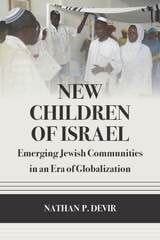
cover of New Children of Israel: Emerging Jewish Communities in an Era of Globalization

New Children of Israel

Emerging Jewish Communities in an Era of Globalization

Nathan P. Devir

University of Utah Press, 2017

In the last century, the tragic events of the Holocaust and the subsequent founding of the state of Israel brought about tremendous changes for Jewish communities all over the world. This book explores what may be the next watershed moment for the Jews: the inclusion of millions of people from developing nations who self-define as Jewish but who have no historical ties with established centers of Jewish life. These emerging groups are expanding notions of what it means to be Jewish.

This comparative ethnographic study, the first of its kind, presents in-depth analyses of the backgrounds, motivations, and sociohistorical contexts of emerging Jewish communities in Cameroon, Ghana, India, and other postcolonial locales. It investigates the ramifications of these new movements for the larger Judeo-Christian world, particularly with regard to issues of multiculturalism, immigration, race relations, and messianic expectations concerning the prophecy of Isaiah 11:12, according to which God will “assemble the dispersed of Israel, and gather together the scattered of Judah from the four corners of the earth.” 
[more]
cover of Nkrumah & the Chiefs: The Politics of Chieftaincy in Ghana, 1951–1960

Nkrumah & the Chiefs

The Politics of Chieftaincy in Ghana, 1951–1960

Richard Rathbone

Ohio University Press, 1999

Kwame Nkrumah, who won independence for Ghana in 1957, was the first African statesman to achieve world recognition. Nkrumah and his movement also brought about the end of independent chieftaincy—one of the most fundamental changes in the history of Ghana.

Kwame Nkrumah’s Convention Peoples’ Party was committed not only to the rapid termination of British colonial rule but also to the elimination of chiefly power. This book is an account of Kwame Nkrumah and his government’s long struggle to wrest administrative control of the Ghanaian countryside from the chiefs. Based largely upon previously unstudied documentation in Ghana, this study charts the government’s frustrated attempts to democratize local government and the long and bitter campaigns mounted by many southern chiefs to resist their political marginalization.

Between 1951 and the creation of the First Republic in 1960, Ghanaian governments sought to discard the chiefly principle in local government, then to weaken chieftaincy by attrition and eventually, by altering the legal basis of chieftaincy, to incorporate and control a considerably altered chieftaincy. The book demonstrates that chieftaincy was consciously and systematically reconstructed in the decade of the 1950s with implications which can still be felt in modern Ghana.
[more]
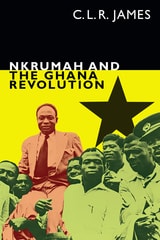
cover of Nkrumah and the Ghana Revolution

Nkrumah and the Ghana Revolution

C. L. R. James

Duke University Press, 2022

In this new edition of Nkrumah and the Ghana Revolution, C. L. R. James tells the history of the socialist revolution led by Kwame Nkrumah, the first president and prime minister of Ghana. Although James wrote it in the immediate post-independence period around 1958, he did not publish it until nearly twenty years later, when he added a series of his own letters, speeches, and articles from the 1960s. Although Nkrumah led the revolution, James emphasizes that it was a popular mass movement fundamentally realized by the actions of everyday Ghanaians. Moreover, James shows that Ghana’s independence movement was an exceptional moment in global revolutionary history: it moved revolutionary activity to the African continent and employed new tactics not seen in previous revolutions. Featuring a new introduction by Leslie James, an unpublished draft of C. L. R. James's introduction to the 1977 edition, and correspondence, this definitive edition of Nkrumah and the Ghana Revolution offers a revised understanding of Africa’s shaping of freedom movements and insight into the possibilities for decolonial futures.
[more]