Results by title
50 books match the query 'Justice, Administration of' and 2 start with n
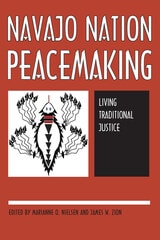
Navajo Nation Peacemaking
Living Traditional JusticeEdited by Marianne O. Nielsen and James W. Zion
University of Arizona Press, 2005
Navajo peacemaking is one of the most renowned restorative justice programs in the world. Neither mediation nor alternative dispute resolution, it has been called a “horizontal system of justice” because all participants are treated as equals with the purpose of preserving ongoing relationships and restoring harmony among involved parties. In peacemaking there is no coercion, and there are no “sides.” No one is labeled the offender or the victim, the plaintiff or the defendant. This is a book about peacemaking as it exists in the Navajo Nation today, describing its origins, history, context, and contributions with an eye toward sharing knowledge between Navajo and European-based criminal justice systems. It provides practitioners with information about important aspects of peacemaking—such as structure, procedures, and outcomes—that will be useful for them as they work with the Navajo courts and the peacemakers. It also offers outsiders the first one-volume overview of this traditional form of justice. The collection comprises insights of individuals who have served within the Navajo Judicial Branch, voices that authoritatively reflect peacemaking from an insider’s point of view. It also features an article by Justice Sandra Day O’Connor and includes contributions from other scholars who, with the cooperation of the Navajo Nation, have worked to bring a comparative perspective to peacemaking research. In addition, some chapters describe the personal journey through which peacemaking takes the parties in a dispute, demonstrating that its purpose is not to fulfill some abstract notion of Justice but to restore harmony so that the participants are returned to good relations. Navajo Nation Peacemaking seeks to promote both peacemaking and Navajo common law development. By establishing the foundations of the Navajo way of natural justice and offering a vision for its future, it shows that there are many lessons offered by Navajo peacemaking for those who want to approach old problems in sensible new ways.
[more]
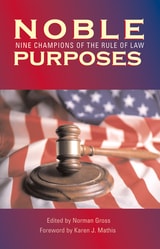
Noble Purposes
Nine Champions of the Rule of LawNorman Gross
Ohio University Press, 2007
Throughout the history of the United States, the acts of a few have proved to be turning points in the way our legal system has treated the least of us. The nine individuals whose deeds are recounted here have compelling stories, and though they remain unknown to the general public, their commitment to the rule of law has had a lasting impact on our nation. Noble Purposes brings their stories to life. It describes the contributions of such individuals as James Alexander, the guiding and central force in the colonial-era trial of John Peter Zenger, which sowed the seeds for the American Revolution and the constitutional guarantee of a free press. In the 1870s, Hugh Lennox Bond stared down threats as judge in the trials of the South Carolina Ku Klux Klan, while Clara Shortridge Foltz overcame tremendous resistance during her fifty-year law practice, which included advocacy of public defender offices. Early last century, Louis Marshall paved the way for the rights of minorities in America and abroad, while Francis Biddle, FDR’s attorney general, sought to maintain civil liberties during World War II, arguing against the internment of Japanese Americans and later serving as the American judge in the Nuremberg trials. Edited by legal scholar Norman Gross and written by leading legal historians from around the country, the profiles presented in Noble Purposes tell the stories of these and other individuals who stood firmly in support of the rule of law, often against great odds.
[more]