Results by title
1917 books match the query 'Law' and 31 start with n

Narrative, Violence, and the Law
The Essays of Robert CoverMartha Minow, Michael Ryan, and Austin Sarat, Editors
University of Michigan Press, 1993
"Bob Cover was and remains the dominant voice of his generation among legal scholars. These essays, each one magnificent in itself, are, when taken together, even more important. The wisdom they impart is forever." --Guido Calabresi, Dean and Sterling Professor of Law, Yale University "Robert Cover drew his sources for the authority of law--for its violence, but also for its paideic potential--from the structuring stories that spark our communal imaginations. Literally until the day of his untimely death, his irreplaceably restless spirit was binding itself with the pages of the Midrash, of The Brothers Karamazov, of Billy Budd, Sailor. It is for us now to work also with these--Bob Cover's stories."--Richard Weisberg, Benjamin N. Cardozo Law School, Yeshiva University "The writings of Robert Cover were usually provocative, sometimes exasperating, but always relevant. In his last years, he concentrated on Jewish sources as well as mystical and Messianic thought. This collection of his articles is a thesaurus of some of his finest writings."--Robert F. Drinan, S.J., Georgetown University Law Center. The late Robert Cover was Professor of Law, Yale Law School.
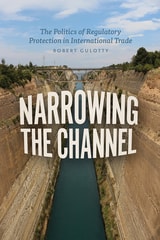
Narrowing the Channel
The Politics of Regulatory Protection in International TradeRobert Gulotty
University of Chicago Press, 2020
Narrowing the Channel demonstrates that globalization and globalized firms can paradoxically hinder rather than foster economic cooperation as larger firms seek to protect their markets through often unnecessarily strict product regulations. To illustrate the problem of regulatory protectionism, Robert Gulotty offers an in-depth analysis of contemporary rulemaking in the United States and the European Union in the areas of health, safety, and environmental standards. He shows how large firms seek regulatory schemes that disproportionately disadvantage small firms. When multinationals are embedded in the local economy, governments too have an incentive to use these regulations to shift profits back home. Today, the key challenge to governing global trade is not how much trade occurs but who is allowed to participate, and this book shows that new rules will be needed to allow governments to widen the benefits of global commerce and avoid further inequality and market concentration.
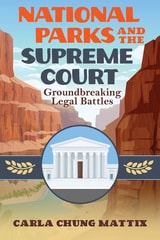
National Parks and the Supreme Court
Groundbreaking Legal BattlesCarla Chung Mattix
University of Nevada Press, 2026
This book examines five landmark Supreme Court cases involving national parks—Gettysburg, Yellowstone, Grand Canyon, Death Valley, and the National Mall. Each chapter blends legal analysis with historical context, tracing the origins of the parks and the disputes that brought them before the nation’s highest court. Spanning nearly a century, these cases reveal how the Court has shaped park policy, land use, Native American rights, water law, and free speech.
Through these pivotal decisions, National Parks and the Supreme Court offers a new lens on the contested terrain of the national parks, where legal, environmental, and cultural values collide. By exploring the courts’ influence on public lands, it deepens our understanding of the complexities of managing America’s most cherished landscapes.

Native Acts
Law, Recognition, and Cultural AuthenticityJoanne Barker
Duke University Press, 2011
Natural Law and Thomistic Juridical Realism
Prospects for a Dialogue with Contemporary Legal TheoryPetar Popovic
Catholic University of America Press, 2022

Natural Law
Reflections On Theory & PracticeJacques Maritain
St. Augustine's Press, 2001
Can there be universal moral principles in a culturally and religiously diverse world? Are such principles provided by a theory of natural law? Jacques' response to both questions is "yes".
These essays, selected from the writings of one of the most influential philosophers of the past hundred years, provide a clear statement of Maritain's theory of natural law and natural rights. Maritain's ethics and political philosophy occupies a middle ground between the extremes of individualism and collectivism. Written during a period when cultural diversity and pluralism were beginning to have an impact on ethics and politics, these essays provide a defense of natural law and natural right that continues to be timely.
The first essay introduces Maritain's theory of connatural knowledge -- knowledge by inclination -- that lies at the basis of his distinctive views on moral philosophy, aesthetics, and mystical belief. The second essay gives Maritain's principal metaphysical arguments for natural law as well as his account of how that law can be naturally known and universally held.
The third essay in this collection explains the roots of the natural law and shows how it provides a rational foundation for other kinds of law and for human rights. In the fourth essay, reflecting his personalism and integral humanism, Maritain indicates how he extends his understanding of human rights to include the rights of the civic and of the social or working person.
Nature of the Law and Related Legal Writings (CW27)
Eric Voegelin, Edited by Robert Anthony Pascal, James Lee Babin, & John WilliamCorrington
University of Missouri Press, 0

Nature's Wild
Love, Sex, and Law in the CaribbeanAndil Gosine
Duke University Press, 2021
Duke University Press Scholars of Color First Book Award recipient
Navajo Courts and Navajo Common Law
A Tradition of Tribal Self-GovernanceRaymond D. Austin
University of Minnesota Press, 2009
The Navajo Nation court system is the largest and most established tribal legal system in the world. Since the landmark 1959 U.S. Supreme Court decision in Williams v. Lee that affirmed tribal court authority over reservation-based claims, the Navajo Nation has been at the vanguard of a far-reaching, transformative jurisprudential movement among Indian tribes in North America and indigenous peoples around the world to retrieve and use traditional values to address contemporary legal issues.
A justice on the Navajo Nation Supreme Court for sixteen years, Justice Raymond D. Austin has been deeply involved in the movement to develop tribal courts and tribal law as effective means of modern self-government. He has written foundational opinions that have established Navajo common law and, throughout his legal career, has recognized the benefit of tribal customs and traditions as tools of restorative justice.
In Navajo Courts and Navajo Common Law, Justice Austin considers the history and implications of how the Navajo Nation courts apply foundational Navajo doctrines to modern legal issues. He explains key Navajo foundational concepts like Hózhó (harmony), K'é (peacefulness and solidarity), and K'éí (kinship) both within the Navajo cultural context and, using the case method of legal analysis, as they are adapted and applied by Navajo judges in virtually every important area of legal life in the tribe.
In addition to detailed case studies, Justice Austin provides a broad view of tribal law, documenting the development of tribal courts as important institutions of indigenous self-governance and outlining how other indigenous peoples, both in North America and elsewhere around the world, can draw on traditional precepts to achieve self-determination and self-government, solve community problems, and control their own futures.
Neglected Policies
Constitutional Law and Legal Commentary as Civic EducationIra L. Strauber
Duke University Press, 2002
Strauber situates agnostic skepticism within contemporary legal thought, explaining how it draws upon sociological jurisprudence, legal realism, and critical legal studies. Through studies of cases involving pornography, adoption custody battles, flag burning, federalism, and environmental politics, he demonstrates how agnostic skepticism applies to constitutional issues. Strauber contends that training in skeptical critique will enable a new kind of civic education and culture—one in which citizens are increasingly tolerant of the ambiguities and contradictions inherent in the law and politics of a pluralistic society.
Using insights from the social sciences to examine the ways constitutional cases are studied and taught, Neglected Policies will interest scholars of jurisprudence, political science, and the sociology of law.
Negotiating Culture
Heritage, Ownership, and Intellectual PropertyLaetitia La Follette
University of Massachusetts Press, 2013
This provocative collection of essays—a series of case studies in cultural ownership by scholars from a range of fields—explores issues of cultural heritage and intellectual property in a variety of contexts, from contests over tangible artifacts as well as more abstract forms of culture such as language and oral traditions to current studies of DNA and genes that combine nature and culture, and even new, nonproprietary models for the sharing of digital technologies. Each chapter sets the debate in its historical and disciplinary context and suggests how the approaches to these issues are changing or should change.
One of the most innovative aspects of the volume is the way each author recognizes the social dimensions of group ownership and demonstrates the need for negotiation and new models. The collection as a whole thus challenges the reader to reevaluate traditional ways of thinking about cultural ownership and to examine the broader social contexts within which negotiation over the ownership of culture is taking place.
In addition to Laetitia La Follette, contributors include David Bollier, Stephen Clingman, Susan DiGiacomo, Oriol Pi-Sunyer, Margaret Speas, Banu Subramaniam, Joe Watkins, and H. Martin Wobst.
Negotiating in Civil Conflict
Constitutional Construction and Imperfect Bargaining in IraqHaider Ala Hamoudi
University of Chicago Press, 2013

Net Neutrality and the Battle for the Open Internet
Danny Kimball
University of Michigan Press, 2022

New Directions in Private Law Theory
Edited by Fabiana Bettini, Martin Fischer, Charles Mitchell, and Prince Saprai
University College London, 2023
New Directions in Private Law Theory brings together some of the best new work on private law theory, reflecting the breadth of this increasingly important field. The authors adopt a variety of different approaches and contribute to ongoing and important debates about the moral foundations of private law, the individuation of areas of private law, and the connections between private law and everyday moral experience. Questions addressed include: does the diversity identified among claims in unjust enrichment mean that the category is incoherent? Are claims in tort law always about compensating for wrongs? How should we understand the parties’ agreement in a contract? The contributions shed new light on these and other topics and the ways in which they intersect and open up new lines of scholarly inquiry.
This book will be of interest to researchers working in private law and legal theory, but it will also appeal to those outside of law, most notably researchers with an interest in moral and political philosophy, economics, and history.
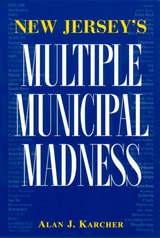
New Jersey's Multiple Municipal Madness
Karcher, Alan
Rutgers University Press, 1998
Alan Karcher looks at the history and high cost of New Jersey's multiple municipalities. He investigates the economic considerations, political pressures, and personal agendas that created the bizarre configurations dividing the Garden State, while analyzing the public policies that allowed and even encouraged the formation of new municipalities. Karcher also examines the political dynamics that thwarted every effort of New Jersey metropolises to join the front ranks of major American cities.
Karcher identifies the major motivations behind the unparalleled experience of New Jersey's municipal multiplication. He delves deeply into the primary causes of new lines being drawn, such as road appropriations, the location of a railroad station, control of a local school district, the regulation of alcohol sales, and the preservation of exclusivity prior to the acceptance of zoning. He also assesses the present situation and what has happened in the past 60 years since the municipal multiplication madness ceased, calling on elected officials to confront reality and correct yesterday's excesses.
The genesis of the present political map of the state is a story that while interesting is not always charming, while fascinating is far from edifying. Little in the history can be called quaint. Rather it is a story of separation and exclusion, of division and greed, of preservation of prerogatives and prejudices. It is a story that supports the conclusion that these lines are rarely the product of chance, rather they were drawn by politicians with very human foibles and frailties, and with very narrow agendas-agendas that have proven to be egregiously expensive for today's taxpayers.
Alan Karcher, the former Speaker of the New Jersey Assembly during the activist 1980s, currently practices municipal law in Middlesex County. He represents the third generation of his family to serve as a member of the New Jersey State Legislature.
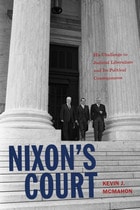
Nixon's Court
His Challenge to Judicial Liberalism and Its Political ConsequencesKevin J. McMahon
University of Chicago Press, 2011
Most analysts have deemed Richard Nixon’s challenge to the judicial liberalism of the Warren Supreme Court a failure—“a counterrevolution that wasn’t.” Nixon’s Court offers an alternative assessment. Kevin J. McMahon reveals a Nixon whose public rhetoric was more conservative than his administration’s actions and whose policy towards the Court was more subtle than previously recognized. Viewing Nixon’s judicial strategy as part political and part legal, McMahon argues that Nixon succeeded substantially on both counts.
Many of the issues dear to social conservatives, such as abortion and school prayer, were not nearly as important to Nixon. Consequently, his nominations for the Supreme Court were chosen primarily to advance his “law and order” and school desegregation agendas—agendas the Court eventually endorsed. But there were also political motivations to Nixon’s approach: he wanted his judicial policy to be conservative enough to attract white southerners and northern white ethnics disgruntled with the Democratic party but not so conservative as to drive away moderates in his own party. In essence, then, he used his criticisms of the Court to speak to members of his “Silent Majority” in hopes of disrupting the long-dominant New Deal Democratic coalition.
For McMahon, Nixon’s judicial strategy succeeded not only in shaping the course of constitutional law in the areas he most desired but also in laying the foundation of an electoral alliance that would dominate presidential politics for a generation.

No Bond but the Law
Punishment, Race, and Gender in Jamaican State Formation, 1780–1870Diana Paton
Duke University Press, 2004
No Bond but the Law reveals the longstanding and intimate relationship between state formation and private punishment. The construction of a dense, state-organized system of prisons began not with emancipation but at the peak of slave-based wealth in Jamaica, in the 1780s. Jamaica provided the paradigmatic case for British observers imagining and evaluating the emancipation process. Paton’s analysis moves between imperial processes on the one hand and Jamaican specificities on the other, within a framework comparing developments regarding punishment in Jamaica with those in the U.S. South and elsewhere. Emphasizing the gendered nature of penal policy and practice throughout the emancipation period, Paton is attentive to the ways in which the actions of ordinary Jamaicans and, in particular, of women prisoners, shaped state decisions.

No Boundaries
Transnational Latino Gangs and American Law EnforcementTom Diaz
University of Michigan Press, 2011
"Tom Diaz has worn out some shoe leather, much like a good detective, in gathering facts, not myths or urban legends. As a result he has produced an accurate and comprehensive look at a grave and present danger to our society."
---From the foreword by Chris Swecker, former Assistant Director of the FBI and former head of the FBI's Criminal Investigative Division
No Boundaries is a disturbing account of what many consider the "next Mafia"---Latino crime gangs. Like the Mafia, these gangs operate an international network, consider violence a routine matter, and defy U.S. law enforcement at every level. Also, the gangs spawn kingpins such as the notorious Nelson Martinez Varela Comandari, who nearly became the first "Latin godfather" in the United States.
Focusing on the Los Angeles–based Mara Salvatrucha (MS-13) and the 18th Street Gang, and the Chicago-based Latin Kings, Tom Diaz describes how neighborhood gangs evolved into extremely brutal, sophisticated criminal enterprises and how local and federal authorities have struggled to suppress them. As he makes clear, the problem of transnational Latino gangs involves complex national and international issues, such as racial tensions, immigration policy, conflict in Latin America, and world economic pressures.
Tom Diaz is a lawyer, author, and public speaker who conducts research on gun policy and violence for the Violence Policy Center, a Washington, D.C.–based think tank. He has covered national security affairs for the Washington Times and served as counsel to the U.S. House Subcommittee on Crime and Criminal Justice from 1993 to 1997.
Cover photograph: Tegucigalpa, Honduras: A policeman passes by a graffiti of the Mara Salvatrucha "MS-13" (juvenile gang) at the entrance of the unit where members of the gang are kept imprisoned in the National Penitentiary in Tamara, 30 km north of Tegucigalpa, February 1, 2006. © Elmer Martinez/AFP/Getty Images

No State Shall Abridge
The Fourteenth Amendment and the Bill of RightsMichael Kent Curtis
Duke University Press, 1990
“Curtis effectively settles a serious legal debate: whether the framers of the 14th Amendment intended to incorporate the Bill of Rights guarantees and thereby inhibit state action. Taking on a formidable array of constitutional scholars, . . . he rebuts their argument with vigor and effectiveness, conclusively demonstrating the legitimacy of the incorporation thesis. . . . A bold, forcefully argued, important study.”—Library Journal

No Winners Here Tonight
Race, Politics, and Geography in One of the Country’s Busiest Death Penalty StatesAndrew Welsh-Huggins
Ohio University Press, 2009
Few subjects are as intensely debated in the United States as the death penalty. Some form of capital punishment has existed in America for hundreds of years, yet the justification for carrying out the ultimate sentence is a continuing source of controversy. No Winners Here Tonight explores the history of the death penalty and the question of its fairness through the experience of a single state, Ohio, which, despite its moderate midwestern values, has long had one of the country’s most active death chambers.
In 1958, just four states accounted for half of the forty-eight executions carried out nationwide, each with six: California, Georgia, Ohio, and Texas. By the first decade of the new century, Ohio was second only to Texas in the number of people put to death each year. No Winners Here Tonight looks at this trend and determines that capital punishment has been carried out in an uneven fashion from its earliest days, with outcomes based not on blind justice but on the color of a person’s skin, the whim of a local prosecutor, or the biases of the jury pool in the county in which a crime was committed.
Andrew Welsh-Huggins’s work is the only comprehensive study of the history of the death penalty in Ohio. His analysis concludes that the current law, crafted by lawmakers to punish the worst of the state’s killers, doesn’t come close to its intended purpose and instead varies widely in its implementation. Welsh-Huggins takes on this controversial topic evenhandedly and with respect for the humanity of the accused and the victim alike. This exploration of the law of capital punishment and its application will appeal to students of criminal justice as well as those with an interest in law and public policy.
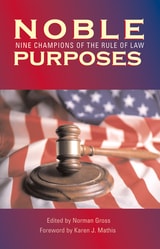
Noble Purposes
Nine Champions of the Rule of LawNorman Gross
Ohio University Press, 2007

Nobody's Boy and His Pals
The Story of Jack Robbins and the Boys’ Brotherhood RepublicHendrik Hartog
University of Chicago Press, 2024
In 1914, social reformer Jack Robbins and a group of adolescent boys in Chicago founded the Boys’ Brotherhood Republic, an unconventional and unusual institution. During a moral panic about delinquent boys, Robbins did not seek to rehabilitate and/or punish wayward youths. Instead, the boys governed themselves, democratically and with compassion for one another, and lived by their mantra “So long as there are boys in trouble, we too are in trouble.” For nearly thirty years, Robbins was their “supervisor,” and the will he drafted in the late 1950s suggests that he continued to care about forgotten boys, even as the political and legal contexts that shaped children’s lives changed dramatically.
Nobody’s Boy and His Pals is a lively investigation that challenges our ideas about the history of American childhood and the law. Scouring the archives for traces of the elusive Jack Robbins, Hendrik Hartog examines the legal histories of Progressive reform, childhood, criminality, repression, and free speech. The curiosity of Robbins’s story is compounded by the legal challenges to his will, which wound up establishing the extent to which last wishes must conform to dominant social values. Filled with persistent mysteries and surprising connections, Nobody’s Boy and His Pals illuminates themes of childhood and adolescence, race and ethnicity, sexuality, wealth and poverty, and civil liberties, across the American Century.

None of Your Damn Business
Privacy in the United States from the Gilded Age to the Digital AgeLawrence Cappello
University of Chicago Press, 2019
Every day, Americans surrender their private information to entities claiming to have their best interests in mind. This trade-off has long been taken for granted, but the extent of its nefariousness has recently become much clearer. As None of Your Damn Business reveals, the problem is not so much that data will be used in ways we don’t want, but rather how willing we have been to have our information used, abused, and sold right back to us. In this startling book, Lawrence Cappello targets moments from the past 130 years of US history when privacy was central to battles over journalistic freedom, national security, surveillance, big data, and reproductive rights. As he makes dismayingly clear, Americans have had numerous opportunities to protect the public good while simultaneously safeguarding our information, and we’ve squandered them every time. None of Your Damn Business is a rich and provocative survey of an alarming topic that grows only more relevant with each fresh outrage of trust betrayed.
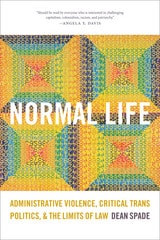
Normal Life
Administrative Violence, Critical Trans Politics, and the Limits of LawDean Spade
Duke University Press, 2015
Wait—what's wrong with rights? It is usually assumed that trans and gender nonconforming people should follow the civil rights and "equality" strategies of lesbian and gay rights organizations by agitating for legal reforms that would ostensibly guarantee nondiscrimination and equal protection under the law. This approach assumes that the best way to address the poverty and criminalization that plague trans populations is to gain legal recognition and inclusion in the state's institutions. But is this strategy effective?
In Normal Life Dean Spade presents revelatory critiques of the legal equality framework for social change, and points to examples of transformative grassroots trans activism that is raising demands that go beyond traditional civil rights reforms. Spade explodes assumptions about what legal rights can do for marginalized populations, and describes transformative resistance processes and formations that address the root causes of harm and violence.
In the new afterword to this revised and expanded edition, Spade notes the rapid mainstreaming of trans politics and finds that his predictions that gaining legal recognition will fail to benefit trans populations are coming to fruition. Spade examines recent efforts by the Obama administration and trans equality advocates to "pinkwash" state violence by articulating the US military and prison systems as sites for trans inclusion reforms. In the context of recent increased mainstream visibility of trans people and trans politics, Spade continues to advocate for the dismantling of systems of state violence that shorten the lives of trans people. Now more than ever, Normal Life is an urgent call for justice and trans liberation, and the radical transformations it will require.

Normal Life
Administrative Violence, Critical Trans Politics, and the Limits of LawDean Spade
Duke University Press, 2011
Wait—what's wrong with rights? It is usually assumed that trans and gender nonconforming people should follow the civil rights and “equality” strategies of lesbian and gay rights organizations by agitating for legal reforms that would ostensibly guarantee equal access, nondiscrimination, and equal protection under the law. This approach assumes that the best way to address the poverty and criminalization that plague trans populations is to get recognized by law and included in the state's institutions. But does changing what the law says about a targeted and marginalized population bring material relief? And what if many of the problems that shorten trans people's lives stem from the ordinary, banal ways that gender norm categories are administered by virtually every state and private institution?
In Normal Life Dean Spade presents revelatory critiques of the legal equality framework for social change and points to examples of transformative grassroots trans activism that is raising demands that go beyond traditional civil rights reforms. Spade explodes the assumptions about what legal rights can do for marginalized populations and describes transformative resistance processes and formations that address the root causes of harm and violence. Setting forth a politic that goes beyond the quest for mere legal inclusion, Normal Life is an urgent call for justice and trans liberation, and the radical transformations it will require.

Northern Ireland and the UK Constitution
Lisa Claire Whitten
Haus Publishing, 2024
Since the United Kingdom’s withdrawal from the European Union, the constitutional position of Northern Ireland within the Union has endured an unusual level of attention. Northern Ireland and the UK Constitution leads us through its pivotal moments: the 1920–72 Unionist-led governments, the following thirty years of bitter conflicts, the 1998 Belfast/Good Friday Agreement, and the 2016 referendum on the United Kingdom’s membership in the European Union. Considering each of the moments in the broader setting of UK constitutional norms and narratives, she addresses the exceptional constitutional characteristics of Northern Ireland and the ways in which these have often resulted in “blindspot” analyses of the Union. This short book also considers the implications of Brexit and the constitutional impacts and shifts it has brought to Northern Ireland and discusses the possible constitutional repercussions.

Northern Lights
Essays in Private Law in Memory of Professor David Carey MillerDouglas Bain, Roderick R.M. Paisley, Andrew R. Simpson and Nikola J.M. Tait
Aberdeen University Press, 2018

Not in Front of the Children
'Indecency,' Censorship, and the Innocence of YouthHeins, Marjorie
Rutgers University Press, 2007
From Huckleberry Finn to Harry Potter, from Internet filters to the v-chip, censorship exercised on behalf of children and adolescents is often based on the assumption that they must be protected from “indecent” information that might harm their development—whether in art, in literature, or on a Web site. But where does this assumption come from, and is it true?
In Not in Front of the Children, Marjorie Heins explores the fascinating history of “indecency” laws and other restrictions aimed at protecting youth. From Plato’s argument for rigid censorship, through Victorian laws aimed at repressing libidinous thoughts, to contemporary battles over sex education in public schools and violence in the media, Heins guides us through what became, and remains, an ideological minefield. With fascinating examples drawn from around the globe, she suggests that the “harm to minors” argument rests on shaky foundations.
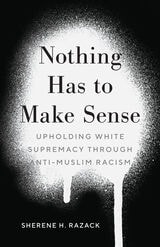
Nothing Has to Make Sense
Upholding White Supremacy through Anti-Muslim RacismSherene H. Razack
University of Minnesota Press, 2022
How Western nations have consolidated their whiteness through the figure of the Muslim in the post-9/11 world
While much has been written about post-9/11 anti-Muslim racism (often termed Islamophobia), insufficient attention has been given to how anti-Muslim racism operates through law and is a vital part of law’s protection of whiteness. This book fills this gap while also providing a unique new global perspective on white supremacy. Sherene H. Razack, a leading critical race and feminist scholar, takes an innovative approach by situating law within media discourses and historical and contemporary realities. We may think of law as logical, but, argues Razack, its logic breaks down when the subject is Muslim.
Tracing how white subjects and majority-white nations in the post-9/11 era have consolidated their whiteness through the figure of the Muslim, Razack examines four sites of anti-Muslim racism: efforts by American evangelical Christians to ban Islam in the school curriculum; Canadian and European bans on Muslim women’s clothing; racial science and the sentencing of Muslims as terrorists; and American national memory of the torture of Muslims during wars and occupations. Arguing that nothing has to make sense when the subject is Muslim, she maintains that these legal and cultural sites reveal the dread, phobia, hysteria, and desire that mark the encounter between Muslims and the West.
Through the prism of racism, Nothing Has to Make Sense argues that the figure of the Muslim reveals a world divided between the deserving and the disposable, where people of European origin are the former and all others are confined in various ways to regimes of disposability. Emerging from critical race theory, and bridging with Islamophobia/critical religious studies, it demonstrates that anti-Muslim racism is a revelatory window into the operation of white supremacy as a global force.
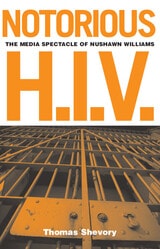
Notorious H.I.V.
The Media Spectacle Of Nushawn WilliamsThomas Shevory
University of Minnesota Press, 2004
The real story behind the Nushawn Williams case: media distortions, judicial contortions, ruined lives
In the fall of 1997, public authorities in Chautauqua County, New York, were granted an exception to the state’s HIV confidentiality law—and released Nushawn Williams’s name and picture to the press, deeming him a “public health threat,” the source of a “near epidemic” of HIV transmission. Williams, who is HIV-positive, had unprotected sex with many young women and girls and infected at least nine of them.
In Notorious H.I.V. Thomas Shevory sorts through the ensuing media panic and legal imbroglio to tell the story behind the Nushawn Williams case. Through media reports, legal documents, and interviews with many of the participants—including Williams, who eventually pled guilty to reckless endangerment and statutory rape charges and is currently serving time in a maximum security prison in New York—Shevory exposes the significant exaggerations, misunderstandings, and distortions that riddled the Williams case from the start. He contends that Williams’s portrayal as an “AIDS monster” served political purposes; specifically, representations of Williams helped to foster the passage of HIV-transmission statutes, resulting in criminalizing a public health problem in a virtually unprecedented fashion.Notorious H.I.V. also traces the impact of such high-profile cases on communities. Shevory provides a nuanced portrait of the hard economic and cultural realities of Jamestown, New York, and, drawing on Williams’s narratives, of the life of a lower-level drug dealer in a small upstate city. His work shows how media coverage robs individuals like Williams of their humanity, creating a pervasive atmosphere of threat that warps the integrity and fairness of the criminal justice and penal system.
Nullius
The Anthropology of Ownership, Sovereignty, and the Law in IndiaKriti Kapila
HAU, 2022
Nullius is an award-winning anthropological account of the troubled status of ownership in India and its consequences for our understanding of sovereignty and social relations. Though property rights and ownership are said to be a cornerstone of modern law, in the Indian case they are often a spectral presence. Kapila offers a detailed study of paradigms where proprietary relations have been erased, denied, misappropriated.
The book examines three forms of negation, where the Indian state de facto adopted doctrines of terra nullius (in the erasure of indigenous title), res nullius (in acquiring museum objects), and, controversially, corpus nullius (in denying citizens ownership of their bodies under biometrics). The result is a pathbreaking reconnection of questions of property, exchange, dispossession, law, and sovereignty.
Nullius is the winner of the 2024 Bernard S. Cohn Prize, Association of Asian Studies.