Results by title
534 books match the query 'Making' and 10 start with n

NOVEL PROFESSIONS
INTERESTED DISINTEREST AND THE MAKING OF THE VICTORIAN NOVELJennifer Ruth
The Ohio State University Press, 2006
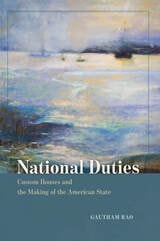
National Duties
Custom Houses and the Making of the American StateGautham Rao
University of Chicago Press, 2016
In the wake of the American Revolution, if you had asked a citizen whether his fledgling state would survive more than two centuries, the answer would have been far from confident. The problem, as is so often the case, was money. Left millions of dollars of debt by the war, the nascent federal government created a system of taxes on imported goods and installed custom houses at the nation’s ports, which were charged with collecting these fees. Gradually, the houses amassed enough revenue from import merchants to stabilize the new government. But, as the fragile United States was dependent on this same revenue, the merchants at the same time gained outsized influence over the daily affairs of customs houses. As the United States tried to police this commerce in the early nineteenth century, the merchants’ stranglehold on custom house governance proved to be formidable.
In National Duties, Gautham Rao makes the case that the origins of the federal government and the modern American state lie in these conflicts at government custom houses between the American Revolution and the presidency of Andrew Jackson. He argues that the contours of the government emerged from the push-and-pull between these groups, with commercial interests gradually losing power to the administrative state, which only continued to grow and lives on today.
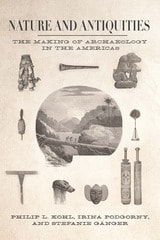
Nature and Antiquities
The Making of Archaeology in the AmericasEdited by Philip L. Kohl, Irina Podgorny, and Stefanie Gänger
University of Arizona Press, 2014
The volume breaks new ground by entreating archaeologists to acknowledge the importance of ways of knowing that resulted from the study of nature in the history of archaeology. Some of the contributions to this volume trace the part conventions, practices, and concepts from natural history and the natural sciences played in the history and making of the discipline. Others set out to uncover, reassemble, or adjust our vision of collections that research historians of archaeology have disregarded or misrepresented—because their nineteenth-century makers would refuse to comply with today’s disciplinary borders and study natural specimens and antiquities in conjunction, under the rubric of the territorial, the curious or the universal. Other contributions trace the sociopolitical implications of studying nature in conjunction with “indigenous peoples” in the Americas—inquiring into what it meant and entailed to comprehend the inhabitants of the American continent in and through a state of nature.
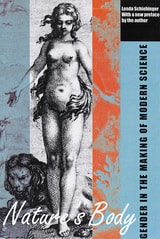
Nature's Body
Gender in the Making of Modern ScienceSchiebinger, Londa
Rutgers University Press, 2004
Eighteenth-century natural historians created a peculiar, and peculiarly durable, vision of nature—one that embodied the sexual and racial tensions of that era. When plants were found to reproduce sexually, eighteenth-century botanists ascribed to them passionate relations, polyandrous marriages, and suicidal incest, and accounts of steamy plant sex began to infiltrate the botanical literature of the day. Naturalists also turned their attention to the great apes just becoming known to eighteenth-century Europeans, clothing the females in silk vestments and training them to sip tea with the modest demeanor of English matrons, while imagining the males of the species fully capable of ravishing women.
Written with humor and meticulous detail, Nature’s Body draws on these and other examples to uncover the ways in which assumptions about gender, sex, and race have shaped scientific explanations of nature. Schiebinger offers a rich cultural history of science and a timely and passionate argument that science must be restructured in order to get it right.

Nefertiti
The Making of a Global IconSebastian Conrad
University of Chicago Press, 2026
Charts the global resonance of the image of Nefertiti over the past century.
From the moment that the bust of Nefertiti was uncovered after over three thousand years and shown at its first exhibition in Berlin in 1924, it rapidly became an iconic image. Today, the silhouette alone of this powerful ancient Egyptian queen is recognized and admired around the world.
In Nefertiti: The Making of a Global Icon, historian Sebastian Conrad tracks the full story of the world’s embrace and appropriation of this famous visage. Starting with the discovery of the bust and Germany’s claims to its possession, Conrad shows how it became a contested object, tracing Egypt’s efforts to call for its restitution from 1924 to the present. He also canvasses the uses to which Nefertiti’s image has been put and the causes with which it has been associated: for cosmetic ads and beauty clinics; by advocates for European unity; by drag queens and the queer community; by National Socialists; by nationalists in Egypt and Bengal; by Afro-Brazilian communities; and by important Black figures from Elijah Muhammad to Beyoncé. Against a global backdrop, Conrad showcases the stunning object’s fame and the often-controversial issues and debates in which it has been embroiled. He also argues that the story of Nefertiti’s trajectory offers insights into the changing shape of globalization from the era of imperialism to the present.
This accessible, deeply researched book reveals both how much is at stake in the life of objects and how Nefertiti’s arresting likeness continues to challenge us today.

New Bodleian
Making the Weston LibraryEdited by the Bodleian Library
Bodleian Library Publishing, 2015
New Bodleian: The Making of the Weston Library tells the story of how the plans for the new Weston Library—as the New Bodleian is now known—were realized, describing in detail the architectural, academic, curatorial, and heritage considerations addressed, as well as the successful collaborations between clients and consultants. Among the updates introduced were enhanced public access, including new entrance spaces; redesigned reading rooms for the study of special collections; new teaching facilities; and state-of-the-art storage space for the library’s many treasures. With over one hundred color illustrations, the book sheds light on the challenges of meeting the needs of an internationally renowned, four-hundred-year-old institution in the twenty-first century.
New Earth Histories
Geo-Cosmologies and the Making of the Modern WorldEdited by Alison Bashford, Emily M. Kern, and Adam Bobbette
University of Chicago Press, 2023
This book brings the history of the geosciences and world cosmologies together, exploring many traditions, including Chinese, Pacific, Islamic, South and Southeast Asian conceptions of the earth’s origin and makeup. Together the chapters ask: How have different ideas about the sacred, animate, and earthly changed modern environmental sciences? How have different world traditions understood human and geological origins? How does the inclusion of multiple cosmologies change the meaning of the Anthropocene and the global climate crisis? By carefully examining these questions, New Earth Histories sets an ambitious agenda for how we think about the earth.
The chapters consider debates about the age and structure of the earth, how humans and earth systems interact, and how empire has been conceived in multiple traditions. The methods the authors deploy are diverse—from cultural history and visual and material studies to ethnography, geography, and Indigenous studies—and the effect is to highlight how earth knowledge emerged from historically specific situations. New Earth Histories provides both a framework for studying science at a global scale and fascinating examples to educate as well as inspire future work. Essential reading for students and scholars of earth science history, environmental humanities, history of science and religion, and science and empire.
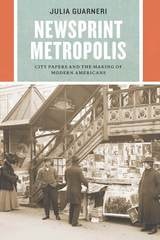
Newsprint Metropolis
City Papers and the Making of Modern AmericansJulia Guarneri
University of Chicago Press, 2017
At the turn of the twentieth century, ambitious publishers like Joseph Pulitzer, William Randolph Hearst, and Robert McCormick produced the most spectacular newspapers Americans had ever read. Alongside current events and classified ads, publishers began running comic strips, sports sections, women’s pages, and Sunday magazines. Newspapers’ lavish illustrations, colorful dialogue, and sensational stories seemed to reproduce city life on the page.
Yet as Julia Guarneri reveals, newspapers did not simply report on cities; they also helped to build them. Metropolitan sections and civic campaigns crafted cohesive identities for sprawling metropolises. Real estate sections boosted the suburbs, expanding metropolitan areas while maintaining cities’ roles as economic and information hubs. Advice columns and advertisements helped assimilate migrants and immigrants to a class-conscious, consumerist, and cosmopolitan urban culture.
Newsprint Metropolis offers a tour of American newspapers in their most creative and vital decades. It traces newspapers’ evolution into highly commercial, mass-produced media, and assesses what was gained and lost as national syndicates began providing more of Americans’ news. Case studies of Philadelphia, New York, Chicago, and Milwaukee illuminate the intertwined histories of newspapers and the cities they served. In an era when the American press is under attack, Newsprint Metropolis reminds us how papers once hosted public conversations and nurtured collective identities in cities across America.
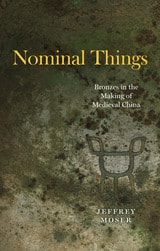
Nominal Things
Bronzes in the Making of Medieval ChinaJeffrey Moser
University of Chicago Press, 2023
This book opens in eleventh-century China, where scholars were the first in world history to systematically illustrate and document ancient artifacts. As Jeffrey Moser argues, the visual, technical, and conceptual mechanisms they developed to record these objects laid the foundations for methods of visualizing knowledge that scholars throughout early modern East Asia would use to make sense of the world around them.
Of the artifacts these scholars studied, the most celebrated were bronze ritual vessels that had been cast nearly two thousand years earlier. While working to make sense of the relationship between the bronzes’ complex shapes and their inscribed glyphs, they came to realize that the objects were “nominal things”—objects inscribed with names that identified their own categories and uses. Eleventh-century scholars knew the meaning of these glyphs from hallowed Confucian writings that had been passed down through centuries, but they found shocking disconnects between the names and the bronzes on which they were inscribed. Nominal Things traces the process by which a distinctive system of empiricism was nurtured by discrepancies between the complex materiality of the bronzes and their inscriptions. By revealing the connections between the new empiricism and older ways of knowing, the book explains how scholars refashioned the words of the Confucian classics into material reality.

Not the Triumph But the Struggle
The 1968 Olympics and the Making of the Black AthleteAmy Bass
University of Minnesota Press, 2004
A sweeping look at black athletes through the lens of the black power protests at the Mexico City Olympics—now in paperback!
Jesse Owens. Muhammad Ali. Michael Jordan. Tiger Woods. All are iconic black athletes, as are Tommie Smith and John Carlos, the African American track and field medalists who raised black-gloved fists on the victory dais at the Mexico City Olympics and brought the roiling American racial politics of the late 1960s to a worldwide television audience. But few of those viewers fully realized what had led to this demonstration—events that included the assassination of Dr. Martin Luther King Jr., uprisings in American cities, student protests around the world, the rise of the Black Power movement, and decolonization and apartheid in Africa.
In this far-reaching account, Amy Bass offers nothing less than a history of the black athlete. Beginning with the racial eugenics discussions of the early twentieth century and their continuing reverberations in popular perceptions of black physical abilities, Bass explores ongoing African American attempts to challenge these stereotypes. Although Tommie Smith and John Carlos were reviled by Olympic officials for their demonstration, Bass traces how their protest has come to be the defining image of the 1968 Games, with lingering effects in the sports world and on American popular culture generally.