Results by title
209 books match the query 'Mathematics' and 11 start with n

Narrative Threads
Accounting and Recounting in Andean KhipuEdited by Jeffrey Quilter and Gary Urton
University of Texas Press, 2002
The Inka Empire stretched over much of the length and breadth of the South American Andes, encompassed elaborately planned cities linked by a complex network of roads and messengers, and created astonishing works of architecture and artistry and a compelling mythology—all without the aid of a graphic writing system. Instead, the Inkas' records consisted of devices made of knotted and dyed strings—called khipu—on which they recorded information pertaining to the organization and history of their empire. Despite more than a century of research on these remarkable devices, the khipu remain largely undeciphered.
In this benchmark book, twelve international scholars tackle the most vexed question in khipu studies: how did the Inkas record and transmit narrative records by means of knotted strings? The authors approach the problem from a variety of angles. Several essays mine Spanish colonial sources for details about the kinds of narrative encoded in the khipu. Others look at the uses to which khipu were put before and after the Conquest, as well as their current use in some contemporary Andean communities. Still others analyze the formal characteristics of khipu and seek to explain how they encode various kinds of numerical and narrative data.
Native American Mathematics
By Michael P. Closs
University of Texas Press, 1996
There is no question that native cultures in the New World exhibit many forms of mathematical development. This Native American mathematics can best be described by considering the nature of the concepts found in a variety of individual New World cultures. Unlike modern mathematics in which numbers and concepts are expressed in a universal mathematical notation, the numbers and concepts found in native cultures occur and are expressed in many distinctive ways. Native American Mathematics, edited by Michael P. Closs, is the first book to focus on mathematical development indigenous to the New World.
Spanning time from the prehistoric to the present, the thirteen essays in this volume attest to the variety of mathematical development present in the Americas. The data are drawn from cultures as diverse as the Ojibway, the Inuit (Eskimo), and the Nootka in the north; the Chumash of Southern California; the Aztec and the Maya in Mesoamerica; and the Inca and Jibaro of South America. Among the strengths of this collection are this diversity and the multidisciplinary approaches employed to extract different kinds of information. The distinguished contributors include mathematicians, linguists, psychologists, anthropologists, and archaeologists.
Navier-Stokes Equations
Peter Constantin and Ciprian Foias
University of Chicago Press, 1988
Neighborhood Technologies
Media and Mathematics of Dynamic NetworksEdited by Tobias Harks and Sebastian Vehlken
Diaphanes, 2015
To answer these and related questions, this volume introduces the concept of “neighborhood technologies” as a model for intermediate, or meso-level, research into the links between local agents and neighborhood relations. Bridging the gap between the sciences and humanities, Tobias Harks and Sebastian Vehlken have assembled a group of contributors who are either natural scientists with an interest in interdisciplinary research or technology-savvy humanists. With insights into computer science, mathematics, sociology, media and cultural studies, theater studies, and architecture, the book will inform new research.
New Infinitary Mathematics
Petr Vopenka
Karolinum Press, 2023
The dominant current of twentieth-century mathematics relies on Georg Cantor’s classical theory of infinite sets, which in turn relies on the assumption of the existence of the set of all natural numbers, the only justification for which—a theological justification—is usually concealed and pushed into the background.
This book surveys the theological background, emergence, and development of classical set theory, warning us about the dangers implicit in the construction of set theory, and presents an argument about the absurdity of the assumption of the existence of the set of all natural numbers. It instead proposes and develops a new infinitary mathematics driven by a cautious effort to transcend the horizon bounding the ancient geometric world and mathematics prior to set theory, while allowing mathematics to correspond more closely to the real world surrounding us. Finally, it discusses real numbers and demonstrates how, within a new infinitary mathematics, calculus can be rehabilitated in its original form employing infinitesimals.
Non-Well-Founded Sets
Peter Aczel
CSLI, 1988
Nonmonotonic Reasoning
An OverviewGerhard Brewka, Jürgen Dix, and Kurt Konolige
CSLI, 1997
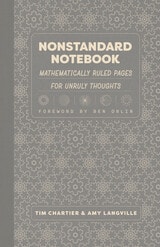
Nonstandard Notebook
Mathematically Ruled Pages for Unruly ThoughtsTim Chartier and Amy Langville
University of Chicago Press, 2024
A standard notebook displays page after page of horizontal lines. But what if we break the pattern? What if the ruled pages grew unruly? In this Nonstandard Notebook, lines twist, fragment, curve, and crisscross in beautiful formations. Each sheet is a distinctive work of imagination, asking us to draw, doodle, and journal in the same spirit.
Page after page, as we journey from lines to parabolas to waves, deep questions arise—about form, art, and mathematics. How do we harness the infinite? Why do patterns permeate nature? What are the limitations and possibilities of human vision? Nonstandard Notebook explores these questions and more through its provocative and inspirational images, each displayed with the mathematics that generated it. We see how straight lines can form fractal crenellations, how circles can disrupt and unify, and how waves and scaling can form complex landscapes (or even famous faces). Created by mathematicians, educators, and math popularizers Tim Chartier and Amy Langville, and with a foreword from Ben Orlin (bestselling author of Math with Bad Drawings), Nonstandard Notebook shows that rules—both the rules of mathematics and the rules of a notebook—do not mark the end of creativity, but the beginning.
Notes in Banach Spaces
Edited by H. Elton Lacey
University of Texas Press, 1980
Notes on the Witt Classification of Hermitian Innerproduct Spaces over a Ring of Algebraic Integers
By P. E. Conner, Jr.
University of Texas Press, 1979
Number and Time
Reflections Leading Toward a Unification of Depth Psychology and PhysicsMarie-Louise von Franz
Northwestern University Press, 1986
A classic on mind, matter, and the unified world model
C. G. Jung's work in his later years suggested that the seemingly divergent sciences of psychology and modern physics might, in fact, be approaching a unified world model in which the dualism of matter and psyche would be resolved into “one world” or Unus Mundus. Jung believed that the natural integers are the archetypal patterns that regulate the unitary realm of psyche and matter, and that number serves as a special instrument for man's becoming conscious of this unity.
Written in a clear style and replete with illustrations which help make the mathematical ideas visible, Number and Time is a piece of original scholarship which introduces a view of how "mind" connects with "matter" at the most fundamental level.