Results by title
1947 books match the query 'Music' and 31 start with n
Nabucodonosor
Dramma lirico in Four Parts by Temistocle SoleraGiuseppe Verdi
University of Chicago Press, 1988
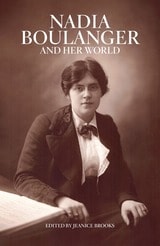
Nadia Boulanger and Her World
Edited by Jeanice Brooks
University of Chicago Press, 2020
Composer, performer, conductor, impresario, and charismatic and inspirational teacher, Boulanger engaged in a vast array of activities in a variety of media, from private composition lessons and lecture-recitals to radio broadcasts, recordings, and public performances. But how to define and account for Boulanger’s impact on the music world is still unclear. Nadia Boulanger and Her World takes us from a time in the late nineteenth century, when many careers in music were almost entirely closed to women, to the moment in the late twentieth century when those careers were becoming a reality. Contributors consider Boulanger’s work in the worlds of composition, musical analysis, and pedagogy and explore the geographies of transatlantic and international exchange and disruption within which her career unfolded. Ultimately, this volume takes its title as a topic for exploration—asking what worlds Boulanger belonged to, and in what sense we can consider any of them to be “hers.”
Nationalists, Cosmopolitans, and Popular Music in Zimbabwe
Thomas Turino
University of Chicago Press, 2000
Natural Acts
Gender, Race, and Rusticity in Country MusicPamela Fox
University of Michigan Press, 2009
Ne me quitte pas
A Song by Jacques Brel and Interpreted by Nina Simone and OthersMaya Angela Smith
Duke University Press, 2025
Negotiated Moments
Improvisation, Sound, and SubjectivityGillian Siddall and Ellen Waterman, editors
Duke University Press, 2016
Contributors. George Blake, David Borgo, Judith Butler, Rebecca Caines, Louise Campbell, Illa Carrillo Rodríguez, Berenice Corti, Andrew Raffo Dewar, Nina Eidsheim, Tomie Hahn, Jaclyn Heyen, Christine Sun Kim, Catherine Lee, Andra McCartney, Tracy McMullen, Kevin McNeilly, Leaf Miller, Jovana Milovic, François Mouillot, Pauline Oliveros, Jason Robinson, Neil Rolnick, Simon Rose, Gillian Siddall, Julie Dawn Smith, Jesse Stewart, Clara Tomaz, Sherrie Tucker, Lindsay Vogt, Zachary Wallmark, Ellen Waterman, David Whalen, Pete Williams, Deborah Wong, Mandy-Suzanne Wong
Negro Soy Yo
Hip Hop and Raced Citizenship in Neoliberal CubaMarc D. Perry
Duke University Press, 2016
Nettl's Elephant
Bruno Nettle
University of Illinois Press, 2010
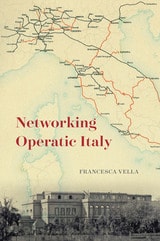
Networking Operatic Italy
Francesca Vella
University of Chicago Press, 2022
Opera’s role in shaping Italian identity has long fascinated both critics and scholars. Whereas the romance of the Risorgimento once spurred analyses of how individual works and styles grew out of and fostered specifically “Italian” sensibilities and modes of address, more recently scholars have discovered the ways in which opera has animated Italians’ social and cultural life in myriad different local contexts.
In Networking Operatic Italy, Francesca Vella reexamines this much-debated topic by exploring how, where, and why opera traveled on the mid-nineteenth-century peninsula, and what this mobility meant for opera, Italian cities, and Italy alike. Focusing on the 1850s to the 1870s, Vella attends to opera’s encounters with new technologies of transportation and communication, as well as its continued dissemination through newspapers, wind bands, and singing human bodies. Ultimately, this book sheds light on the vibrancy and complexity of nineteenth-century Italian operatic cultures, challenging many of our assumptions about an often exoticized country.
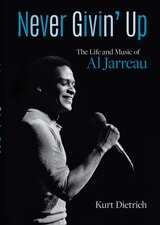
Never Givin' Up
The Life and Music of Al JarreauKurt Dietrich
Wisconsin Historical Society Press, 2023
This is the first biography to chronicle the life and career of one of the most distinguished and beloved musical artists to come out of Wisconsin: Al Jarreau. From his earliest days singing in the 1940s until his death in 2017, Jarreau defied categorization. While his biggest hit, “We’re In This Love Together,” is pure pop, he smashed music industry stereotypes as the first artist to win Grammy Awards in three genres: jazz, pop, and R&B.
Never Givin’ Up traces Jarreau’s singing career from humble beginnings in his hometown of Milwaukee to international fame. The narrative includes his formative student days at Ripon College and the University of Iowa, as well as the years spent honing his craft at nightspots in Milwaukee, San Francisco, and the Twin Cities. After he was signed by Warner Bros. Records in 1975 at the age of 35, Jarreau achieved stardom with his innovative vocal stylings and electric live performances.
This book includes more than 20 sidebars with bonus information about every Jarreau album and behind-the-scenes stories about the making of the records. Author Kurt Dietrich conducted interviews with dozens of Al's friends, fellow musicians, professional associates, and family members—most notably Al’s sister, Rose Marie Freeman, who was a major contributor to the project. Featuring 54 images spanning Jarreau’s life, from never-before-seen family snapshots to stills from his legendary stage performances, Never Givin’ Up celebrates a Milwaukee hometown hero and global sensation.
Silver Medal Winner for the 2023 Foreword INDIES Book of the Year Award for Performing Arts and Music
Finalist for the Association for Recorded Sound Collections’ Award for Best Historical Research in Recorded Jazz
“Kurt Dietrich has created a masterful book, revealing and depicting a detailed version of my brother, Al Jarreau, through his music and career. In these pages, I see Al’s determination and his admirable goal of ‘Never Givin’ Up’ on his joy of singing. It was my distinct pleasure to work with Kurt Dietrich in the process, establishing what has become a bond of family-like friendship that will endure for a lifetime and beyond.”
—Rose Marie (Jarreau) Freeman
“Dietrich captures Jarreau’s simultaneously gregarious and shy charm while revealing his own affection for this gifted and gracious performer. It’s his love letter to a Milwaukee legend.”
—Bill Milkowski, author of Jaco: The Extraordinary and Tragic Life of Jaco Pastorius and Ode to a Tenor Titan: The Life and Times and Music of Michael Brecker
"Written in an approachable style and carefully documented, this book will be valuable for fans and researchers of Jarreau’s music. Summing Up: Highly recommended."
—Choice Reviews
Never Givin' Up
The Life and Music of Al JarreauKurt Dietrich
Wisconsin Historical Society Press, 2025
This is the first biography to chronicle the life and career of one of the most distinguished and beloved musical artists to come out of Wisconsin: Al Jarreau. From his earliest days singing in the 1940s until his death in 2017, Jarreau defied categorization. While his biggest hit, “We’re In This Love Together,” is pure pop, he smashed music industry stereotypes as the first artist to win Grammy Awards in three genres: jazz, pop, and R&B.
Never Givin’ Up traces Jarreau’s singing career from humble beginnings in his hometown of Milwaukee to international fame. The narrative includes his formative student days at Ripon College and the University of Iowa, as well as the years spent honing his craft at nightspots in Milwaukee, San Francisco, and the Twin Cities. After he was signed by Warner Bros. Records in 1975 at the age of 35, Jarreau achieved stardom with his innovative vocal stylings and electric live performances.
This book includes more than 20 sidebars with bonus information about every Jarreau album and behind-the-scenes stories about the making of the records. Author Kurt Dietrich conducted interviews with dozens of Al's friends, fellow musicians, professional associates, and family members—most notably Al’s sister, Rose Marie Freeman, who was a major contributor to the project. Never Givin’ Up celebrates a Milwaukee hometown hero and global sensation.
Silver Medal Winner for the 2023 Foreword INDIES Book of the Year Award for Performing Arts and Music
Finalist for the Association for Recorded Sound Collections’ Award for Best Historical Research in Recorded Jazz
“Kurt Dietrich has created a masterful book, revealing and depicting a detailed version of my brother, Al Jarreau, through his music and career. In these pages, I see Al’s determination and his admirable goal of ‘Never Givin’ Up’ on his joy of singing. It was my distinct pleasure to work with Kurt Dietrich in the process, establishing what has become a bond of family-like friendship that will endure for a lifetime and beyond.”
—Rose Marie (Jarreau) Freeman
“Dietrich captures Jarreau’s simultaneously gregarious and shy charm while revealing his own affection for this gifted and gracious performer. It’s his love letter to a Milwaukee legend.”
—Bill Milkowski, author of Jaco: The Extraordinary and Tragic Life of Jaco Pastorius and Ode to a Tenor Titan: The Life and Times and Music of Michael Brecker
"Written in an approachable style and carefully documented, this book will be valuable for fans and researchers of Jarreau’s music. Summing Up: Highly recommended."
—Choice Reviews

Never without a Song
The Years and Songs of Jennie Devlin, 1865-1952Katharine D. Newman
University of Illinois Press, 1995
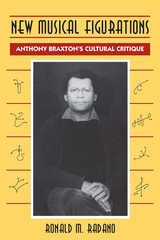
New Musical Figurations
Anthony Braxton's Cultural CritiqueRonald M. Radano
University of Chicago Press, 1993
Born in 1945, Braxton is not only a virtuoso jazz saxophonist but an innovative theoretician and composer of experimental art music. His refusal to conform to the conventions of official musical culture has helped unhinge the very ideologies on which definitions of "jazz," "black music," "popular music," and "art music" are founded.
New Musical Figurations gives the richest view available of this many-sided artist. Radano examines Braxton's early years on the South Side of Chicago, whose vibrant black musical legacy inspired him to explore new avenues of expression. Here is the first detailed history of Braxton's central role in the Association for the Advancement of Creative Musicians, the principal musician-run institution of free jazz in the United States. After leaving Chicago, Braxton was active in Paris and New York, collaborating with Philip Glass, Steve Reich, Frederic Rzewski, and other composers affiliated with the experimental-music movement. From 1974 to 1981, he gained renown as a popular jazz performer and recording artist. Since then he has taught at Mills College and Wesleyan University, given lectures on his theoretical musical system, and written works for chamber groups as well as large, opera-scale pieces.
The neglect of radical, challenging figures like Braxton in standard histories of jazz, Radano argues, mutes the innovative voice of the African-American musical tradition. Refreshingly free of technical jargon, New Musical Figurations is more than just another variation on the same jazz theme. Rather, it is an exploratory work as rich in theoretical vision as it is in historical detail.
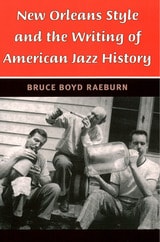
New Orleans Style and the Writing of American Jazz History
Bruce Boyd Raeburn
University of Michigan Press, 2009
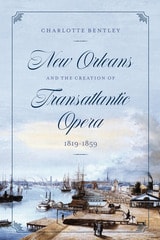
New Orleans and the Creation of Transatlantic Opera, 1819–1859
Charlotte Bentley
University of Chicago Press, 2022
New Orleans and the Creation of Transatlantic Opera, 1819–1859 explores the thriving operatic life of New Orleans in the first half of the nineteenth century, drawing out the transatlantic connections that animated it. By focusing on a variety of individuals, their extended webs of human contacts, and the materials that they moved along with them, this book pieces together what it took to bring opera to New Orleans and the ways in which the city’s operatic life shaped contemporary perceptions of global interconnection. The early chapters explore the process of bringing opera to the stage, taking a detailed look at the management of New Orleans’s Francophone theater, the Théâtre d’Orléans, as well as the performers who came to the city and the reception they received. But opera’s significance was not confined to the theater, and later chapters of the book examine how opera permeated everyday life in New Orleans, through popular sheet music, novels, magazines and visual culture, and dancing in its many ballrooms. Just as New Orleans helped to create transatlantic opera, opera in turn helped to create the city of New Orleans.

Nick Drake
Dreaming EnglandNathan Wiseman-Trowse
Reaktion Books, 2013
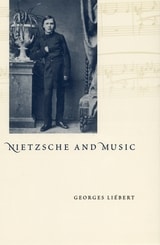
Nietzsche and Music
Georges Liébert
University of Chicago Press, 2003
In his youth, Friedrich Nietzsche yearned to become a great composer and wrote many pieces of music. He later claimed to be "the most musical of all philosophers." Yet most books on Nietzsche fail to explore the importance of music for his thought.
Nietzsche and Music provides the first in-depth examination of the fundamental significance of music for Nietzsche's life and work. Nietzsche's views on music are essential for understanding his philosophy as a whole. Part biography and part critical examination, Georges Liébert brilliantly demonstrates that despite failed attempts at a professional career as composer, Nietzsche never fully removed himself from the world of music, but instead, became a composer of philosophy, utilizing the musical form as a template for his own writings and creative thought. Liébert's study surveys Nietzsche's opinions about particular composers and compositions, as well as his more theoretical writings on music and its relation to the other arts. He also explores Nietzsche's listening habits, his playing and style of composition, and his many contacts in the musical world, including his controversial and contentious relationship with Richard Wagner. For Nietzsche, music gave access to a realm of wisdom that transcended thought. Music was Nietzsche's great solace; in his last years, it was his refuge from madness.
A virtuoso exploration of this little-known but crucial aspect of Nietzsche's life and work, this volume will be of enormous value to scholars of philosophy, music, aesthetics, and literature.
Night Moves
By Jessica Hopper
University of Texas Press, 2018
Written in taut, mesmerizing, often hilarious scenes, Night Moves captures the fierce friendships and small moments that form us all. Drawing on her personal journals from the aughts, Jessica Hopper chronicles her time as a DJ, living in decrepit punk houses, biking to bad loft parties with her friends, exploring Chicago deep into the night. And, along the way, she creates an homage to vibrant corners of the city that have been muted by sleek development. A book birthed in the amber glow of Chicago streetlamps, Night Moves is about a transformative moment of cultural history—and how a raw, rebellious writer found her voice.
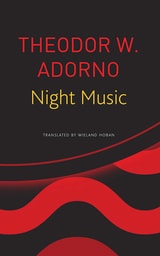
Night Music
Essays on Music 1928-1962Theodor W. Adorno
Seagull Books, 2009
Although Theodor W. Adorno is best known for his association with the Frankfurt School of Critical Theory, he began his career as a composer and successful music critic. Night Music presents the first complete English translations of two collections of texts compiled by German philosopher and musicologist Adorno—Moments musicaux, containing essays written between 1928 and 1962, and Theory of New Music, a group of texts written between 1929 and 1955.
In Moments musicaux, Adorno echoes Schubert’s eponymous cycle, with its emphasis on aphorism, and offers lyrical reflections on music of the past and his own time. The essays include extended aesthetic analyses that demonstrate Adorno’s aim to apply high philosophical standards to the study of music. Theory of New Music, as its title indicates, presents Adorno’s thoughts and theories on the composition, reception, and analysis of the music that was being written around him. His extensive philosophical writing ultimately prevented him from pursuing the compositional career he had once envisaged, but his view of the modern music of the time is not simply that of a theorist, but clearly also that of a composer. Though his advocacy of the Second Viennese School, comprising composer Arnold Schoenberg and his pupils, is well known, many of his writings in this field have remained obscure. Collected in their entirety for the first time in English, the insightful texts in Night Music show the breadth of Adorno’s musical understanding and reveal an overlooked side to this significant thinker.
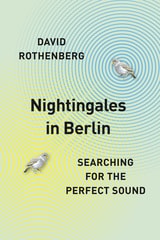
Nightingales in Berlin
Searching for the Perfect SoundDavid Rothenberg
University of Chicago Press, 2019
But have you ever listened closely to a nightingale’s song? It’s a strange and unsettling sort of composition—an eclectic assortment of chirps, whirs, trills, clicks, whistles, twitters, and gurgles. At times it is mellifluous, at others downright guttural. It is a rhythmic assault, always eluding capture. What happens if you decide to join in?
As philosopher and musician David Rothenberg shows in this searching and personal new book, the nightingale’s song is so peculiar in part because it reflects our own cacophony back at us. As vocal learners, nightingales acquire their music through the world around them, singing amidst the sounds of humanity in all its contradictions of noise and beauty, hard machinery and soft melody. Rather than try to capture a sound not made for us to understand, Rothenberg seeks these musical creatures out, clarinet in tow, and makes a new sound with them. He takes us to the urban landscape of Berlin—longtime home to nightingale colonies where the birds sing ever louder in order to be heard—and invites us to listen in on their remarkable collaboration as birds and instruments riff off of each other’s sounds. Through dialogue, travel records, sonograms, tours of Berlin’s city parks, and musings on the place animal music occupies in our collective imagination, Rothenberg takes us on a quest for a new sonic alchemy, a music impossible for any one species to make alone. In the tradition of The Hidden Life of Trees and The Invention of Nature, Rothenberg has written a provocative and accessible book to attune us ever closer to the natural environment around us.
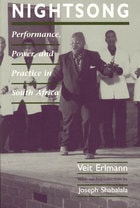
Nightsong
Performance, Power, and Practice in South AfricaVeit Erlmann
University of Chicago Press, 1996
Veit Erlmann provides the first comprehensive interpretation of isicathamiya performance practice and its relation to the culture and consciousness of the Zulu migrant laborers who largely compose its choirs. In songs and dances, the performers oppose the class and racial oppression that reduces them to "labor units." At the same time, Erlmann argues, the performers rework dominant images to symbolically reconstruct their "home," an imagined world of Zulu rural tradition and identity.
By contrasting the live performance of isicathamiya to its reproduction in mass media, recordings, and international concerts, Erlmann addresses important issues in performance studies and anthropology, and looks to the future of isicathamiya live performance in the new South Africa. Featuring an Introduction by Joseph Shabalala, the lead singer and founder of Ladysmith Black Mambazo, this book will be essential reading for anyone interested in the study of music, performance, popular culture, or South Africa.

Nine Choices
Johnny Cash and American CultureJonathan Silverman
University of Massachusetts Press, 2010
For much of his career, Johnny Cash opened his shows with the tagline, “Hello, I'm Johnny Cash.” This introduction seemed unnecessary, since everyone in the audience knew who he was—the famous musical artist whose career spanned almost five decades, whose troubled life on and off the stage received wide publicity, and whose cragged face seemed to express a depth and intensity not found in any other artist, living or dead.
For Cash, as for many celebrities, renown was the product of both hard work and luck. Often a visionary and always a tireless performer, he was subject to a whirlwind of social, economic, and cultural countercurrents. Nine Choices explores the tension between Cash's desire for mainstream success, his personal struggles with alcohol and drugs, and an ever-changing cultural landscape that often circumscribed his options.
Drawing on interviews, archival research, and textual analysis, Jonathan Silverman focuses on Cash's personal and artistic choices as a way of understanding his life, his impact on American culture, and the ways in which that culture in turn shaped him. Cash made decisions about where he would live, what he would play, who would produce his albums, whether he would support the Vietnam War, and even if he would flip his famous “bird”—the iconic image of Cash giving the finger which is now plastered on posters and T-shirts everywhere—in the context of cultural forces both visible and opaque. He made other decisions in consultation with a variety of people, many of whom were chiefly concerned with the reaction of his audiences.
Less a conventional biography than a study of the making of an identity, Nine Choices explores how Johnny Cash sought to define who he was, how he was perceived, and what he signified through a series of self-conscious actions. The result, Silverman shows, was a life that was often tumultuous but never uninteresting.
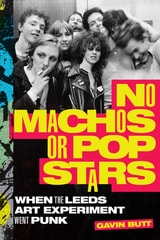
No Machos or Pop Stars
When the Leeds Art Experiment Went PunkGavin Butt
Duke University Press, 2022
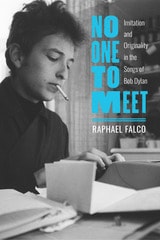
No One to Meet
Imitation and Originality in the Songs of Bob DylanRaphael Falco
University of Alabama Press, 2022
WINNER OF THE ELIZABETH AGEE PRIZE IN AMERICAN LITERATURE
A groundbreaking appreciation of Dylan as a literary practitioner.
The literary establishment tends to regard Bob Dylan as an intriguing, if baffling, outsider. That changed overnight when Dylan was awarded the 2016 Nobel Prize in Literature, challenging us to think of him as an integral part of our national and international literary heritage. No One to Meet: Imitation and Originality in the Songs of Bob Dylan places Dylan the artist within a long tradition of literary production and offers an innovative way to understand his unique and often controversial methods of composition.
Dylan expert Raphael Falco traces the similarities between the way Dylan borrows, digests, and transforms traditional songs and what Renaissance writers called imitatio. Although Dylan’s lyrical postures may suggest an avant-garde consciousness, No One to Meet shows that Dylan’s creative process creatively expands methods used by classical and Renaissance authors.
Drawing on numerous examples, including Dylan’s previously unseen manuscript excerpts and archival materials, Raphael Falco illuminates how the ancient process of poetic imitation, handed down from Greco-Roman antiquity, allows us to make sense of Dylan’s musical and lyrical technique. By placing Dylan firmly in the context of an age-old poetic practice, No One to Meet deepens our appreciation of Dylan’s songs and allows us to celebrate him as what he truly is: a great writer.
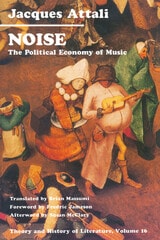
Noise
The Political Economy of MusicJacques Attali
University of Minnesota Press, 1985

Norwegian Emigrant Songs and Ballads
Theodore Blegen
University of Minnesota Press, 1936

Nostalgia and Videogame Music
A Primer of Case Studies, Theories and Analyses for the Player-AcademicEdited by Vincent E. Rone, Can Aksoy, and Sarah Pozderac-Chenevey
Intellect Books, 2022
This book allows readers to understand the relationships and memories they often form around games, and music is central to this process. The quest into the past begins with this book, a map that leads to the intersection between nostalgia and videogame music. Informed by research on musicology, memory, and practices of gaming culture, this edited volume discusses different forms of nostalgia, considers how videogames display their relation to those forms, and explores the ways theoretically self-conscious positions can be found in games. An important scholarly addition to the burgeoning field of ludomusicology, this book will appeal to researchers, educators, practitioners, undergraduate and graduate students, and videogame fans and players alike.
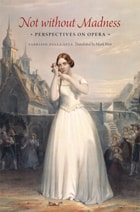
Not without Madness
Perspectives on OperaFabrizio Della Seta
University of Chicago Press, 2012
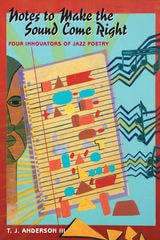
Notes to Make the Sound Come Right
Four Innovators of Jazz PoetryT.J. Anderson III
University of Arkansas Press, 2004
Now that the audience is assembled
David Grubbs
Duke University Press, 2018
Nuns Behaving Badly
Tales of Music, Magic, Art, and Arson in the Convents of ItalyCraig A. Monson
University of Chicago Press, 2010
Witchcraft. Arson. Going AWOL. Some nuns in sixteenth- and seventeenth-century Italy strayed far from the paradigms of monastic life. Cloistered in convents, subjected to stifling hierarchy, repressed, and occasionally persecuted by their male superiors, these women circumvented authority in sometimes extraordinary ways. But tales of their transgressions have long been buried in the Vatican Secret Archive. That is, until now.
In Nuns Behaving Badly, Craig A. Monson resurrects forgotten tales and restores to life the long-silent voices of these cloistered heroines. Here we meet nuns who dared speak out about physical assault and sexual impropriety (some real, some imagined). Others were only guilty of misjudgment or defacing valuable artwork that offended their sensibilities. But what unites the women and their stories is the challenges they faced: these were women trying to find their way within the Catholicism of their day and through the strict limits it imposed on them. Monson introduces us to women who were occasionally desperate to flee cloistered life, as when an entire community conspired to torch their convent and be set free. But more often, he shows us nuns just trying to live their lives. When they were crossed—by powerful priests who claimed to know what was best for them—bad behavior could escalate from mere troublemaking to open confrontation.
In resurrecting these long-forgotten tales and trials, Monson also draws attention to the predicament of modern religious women, whose “misbehavior”—seeking ordination as priests or refusing to give up their endowments to pay for priestly wrongdoing in their own archdioceses—continues even today. The nuns of early modern Italy, Monson shows, set the standard for religious transgression in their own age—and beyond.