Results by title
754 books match the query 'Native American Studies' and 46 start with n
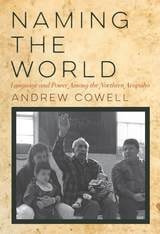
Naming the World
Language and Power Among the Northern ArapahoAndrew Cowell
University of Arizona Press, 2018
As the Arapaho people resist Euro-American assimilation or domination, the Arapaho language and the idea that the language is sacred are key rallying points—but also key points of contestation. Cowell finds that while many at Wind River see the language as crucial for maintaining access to more-than-human power, others primarily view the language in terms of peer-oriented identities as Arapaho, Indian, or non-White. These different views lead to quite different language usage and attitudes in relation to place naming, personal naming, cultural metaphors, new word formation, and the understudied practice of folk etymology.
Cowell presents data from conversations and other natural discourse to show the diversity of everyday speech and attitudes, and he links these data to broader debates at Wind River and globally about the future organization of indigenous societies and the nature of Arapaho and indigenous identity.
Nation Within
The History of the American Occupation of Hawai'iTom Coffman
Duke University Press, 2009

National Monuments
Heid E. Erdrich
Michigan State University Press, 2008
Many of the poems in National Monuments explore bodies, particularly the bodies of indigenous women worldwide, as monuments—in life, in photos, in graves, in traveling exhibitions, and in plastic representations at the airport. Erdrich sometimes imagines what ancient bones would say if they could speak. Her poems remind us that we make monuments out of what remains—monuments are actually our own imaginings of the meaning or significance of things that are, in themselves, silent.
As Erdrich moves from the expectedly "poetic" to the voice of a newspaper headline or popular culture, we are jarred into wondering how we make our own meanings when the present is so immediately confronted by the past (or vice versa). The language of the scientists that Erdrich sometimes quotes in epigraphs seems reductive in comparison to the richness of tone and meaning that these poems—filled with puns, allusions, and wordplay—provide.
Erdrich's poetry is literary in the best sense of the word, infused with an awareness of the poetic canon. Her revisions of and replies to poems by William Carlos Williams, Robert Frost, and others offer an indigenous perspective quite different from the monuments of American literature they address.
Native Acts
Law, Recognition, and Cultural AuthenticityJoanne Barker
Duke University Press, 2011
Native Agency
Indians in the Bureau of Indian AffairsValerie Lambert
University of Minnesota Press, 2022
What happens when American Indians take over an institution designed to eliminate them?
The Bureau of Indian Affairs was hatched in the U.S. Department of War to subjugate and eliminate American Indians. Yet beginning in the 1970s, American Indians and Alaska Natives took over and now run the agency. Choctaw anthropologist Valerie Lambert argues that, instead of fulfilling settler-colonial goals, the Indians in the BIA have been leveraging federal power to fight settler colonialism, battle white supremacy, and serve the interests of their people.
Although the missteps and occasional blunders of the Indians in the BIA have at times damaged the federal–Indian relationship and fueled the ire of their people, and although the BIA is massively underfunded, Indians began crafting the BIA into a Native agency by reformulating the meanings of concepts that lay at its heart—concepts such as tribal sovereignty, treaties, the trust responsibility, and Indian land. At the same time, they pursued actions to strengthen and bolster tribes, to foster healing, to fight the many injustices Indians face, and to restore the Indian land base.
This work provides an essential national-level look at an intriguing and impactful form of Indigenous resistance. It describes, in great detail, the continuing assaults made on Native peoples and tribal sovereignty in the United States during the twenty-first century, and it sketches the visions of the future that Indians at the BIA and in Indian Country have been crafting for themselves.
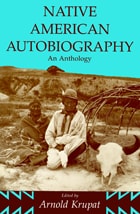
Native American Autobiography
An AnthologyArnold Krupat
University of Wisconsin Press, 1994
Native American Autobiography is the first collection to bring together the major autobiographical narratives by Native American people from the earliest documents that exist to the present. The thirty narratives included here cover a range of tribes and cultural areas, over a span of more than 200 years.
From the earliest known written memoir—a 1768 narrative by the Reverend Samson Occom, a Mohegan, reproduced as a chapter here—to recent reminiscences by such prominent writers as N. Scott Momaday and Gerald Vizenor, the book covers a broad range of Native American experience. The sections include “Traditional Lives;” “The Christian Indians, from the Eighteenth Century to Indian Removal, 1830;” “The Resisting Indians, from Indian Removal to Wounded Knee, 1830-90;” “The Closed Frontier, 1890-;” “The Anthropologists' Indians, 1900-;” “‘Native American Renaissance,’ 1968-;” and “Traditional Lives Today.” Editor Arnold Krupat provides a general introduction, a historical introduction to each of the seven sections, extensive headnotes for each selection, and suggestions for further reading, making this an ideal resource for courses in American literature, history, anthropology, and Native American studies. General readers, too, will find a wealth of fascinating material in the life stories of these Native American men and women.
"This is the first comprehensive anthology of American Indian autobiography ever published. It will be of interest to virtually anyone teaching or studying the literatures of the native peoples of North America, as well as to a general audience, because of the informative, literate introductions and the absorbing narratives themselves."—William L. Andrews, series editor
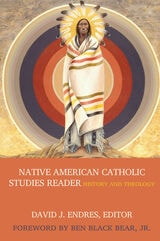
Native American Catholic Studies Reader
History and TheologyDavid J. Endres
Catholic University of America Press, 2022
Native American DNA
Tribal Belonging and the False Promise of Genetic ScienceKim TallBear
University of Minnesota Press, 2013
Who is a Native American? And who gets to decide? From genealogists searching online for their ancestors to fortune hunters hoping for a slice of casino profits from wealthy tribes, the answers to these seemingly straightforward questions have profound ramifications. The rise of DNA testing has further complicated the issues and raised the stakes.
In Native American DNA, Kim TallBear shows how DNA testing is a powerful—and problematic—scientific process that is useful in determining close biological relatives. But tribal membership is a legal category that has developed in dependence on certain social understandings and historical contexts, a set of concepts that entangles genetic information in a web of family relations, reservation histories, tribal rules, and government regulations. At a larger level, TallBear asserts, the “markers” that are identified and applied to specific groups such as Native American tribes bear the imprints of the cultural, racial, ethnic, national, and even tribal misinterpretations of the humans who study them.
TallBear notes that ideas about racial science, which informed white definitions of tribes in the nineteenth century, are unfortunately being revived in twenty-first-century laboratories. Because today’s science seems so compelling, increasing numbers of Native Americans have begun to believe their own metaphors: “in our blood” is giving way to “in our DNA.” This rhetorical drift, she argues, has significant consequences, and ultimately she shows how Native American claims to land, resources, and sovereignty that have taken generations to ratify may be seriously—and permanently—undermined.

Native American Folklore in Nineteenth-Century Periodicals
William M. Clements
Ohio University Press, 1986
Though study of American Indian cultures had been fostered for several centuries by missionaries and explorers, it was not until he nineteenth century that a disciplined and systematic approach to the study of New World cultures began to emerge. With Schoolcraft, Powell, Boas, and others, an adventurers’ avocation first became a profession, and it is to these early scholars that we owe the major theoretical perspectives and insights which provided a grounding for American anthropology and folklore studies.
In these twenty-one essays, many of which originally appeared in such now obscure periodicals as Southern Literary Messenger, American Whig Review, and DeLestry’s Western Magazine, Clements presents representative works by most of the major early figures in the field. The collection includes early statements and applications of most of the theoretical approaches to folklore employed in the nineteenth century, and it encompasses each of the major folklore genres studied by nineteenth-century researchers.
Extensive headnotes to each essay provide information about the author, discussion of the theoretical context of each essay, and direction to more contemporary treatments of the theories and materials involved, and the problems addressed. These together with a brief introduction tracing the genesis of American folklore studies, and chronological arrangement of the articles themselves, make Native American Folklore a convenient introduction to and survey of the major ideas and figures of American folklore studies in its formative period.
Native American Language Ideologies
Beliefs, Practices, and Struggles in Indian CountryEdited by Paul V. Kroskrity and Margaret C. Field
University of Arizona Press, 2009
These studies take up such active issues as "insiderness" in Cherokee language ideologies, contradictions of space-time for the Northern Arapaho, language socialization and Paiute identity, and orthography choices and language renewal among the Kiowa. The authors--including members of indigenous speech communities who participate in language renewal efforts--discuss not only Native Americans' conscious language ideologies but also the often-revealing relationship between these beliefs and other more implicit realizations of language use as embedded in community practice.
The chapters discuss the impact of contemporary language issues related to grammar, language use, the relation between language and social identity, and emergent language ideologies themselves in Native American speech communities. And although they portray obvious variation in attitudes toward language across communities, they also reveal commonalities--notably the emergent ideological process of iconization between a language and various national, ethnic, and tribal identities.
As fewer Native Americans continue to speak their own language, this timely volume provides valuable grounded studies of language ideologies in action--those indigenous to Native communities as well as those imposed by outside institutions or language researchers. It considers the emergent interaction of indigenous and imported ideologies and the resulting effect on language beliefs, practices, and struggles in today's Indian Country as it demonstrates the practical implications of recognizing a multiplicity of indigenous language ideologies and their impact on heritage language maintenance and renewal.
Native American Legends of the Southeast
Tales from the Natchez, Caddo, Biloxi, Chickasaw, and Other NationsGeorge E. Lankford
University of Alabama Press, 2011
Native American Performance and Representation
Edited by S. E. Wilmer
University of Arizona Press, 2009
This volume examines Native performance using a variety of lenses, such as feminism, literary and film theory, and postcolonial discourse. Through the many unique voices of the contributors, major themes are explored, such as indigenous self-representations in performance, representations by nonindigenous people, cultural authenticity in performance and representation, and cross-fertilization between cultures. Authors introduce important, though sometimes controversial, issues as they consider the effects of miscegenation on traditional customs, racial discrimination, Native women’s position in a multicultural society, and the relationship between authenticity and hybridity in Native performance.
An important addition to the new and growing field of Native performance, Wilmer’s book cuts across disciplines and areas of study in a way no other book in the field does. It will appeal not only to those interested in Native American studies but also to those concerned with women’s and gender studies, literary and film studies, and cultural studies.
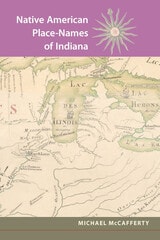
Native American Place Names of Indiana
Michael McCafferty
University of Illinois Press, 2007
A linguistic history of Native American place-names in Indiana
In tracing the roots of Indiana place names, Michael McCafferty focuses on those created and used by local Native Americans. Drawing from exciting new sources that include three Illinois dictionaries from the eighteenth century, the author documents the language used to describe landmarks essential to fur traders in Les Pays d’en Haut and settlers of the Old Northwest territory. Impeccably researched, this study details who created each name, as well as when, where, how and why they were used. The result is a detailed linguistic history of lakes, streams, cities, counties, and other Indiana names. Each entry includes native language forms, translations, and pronunciation guides, offering fresh historical insight into the state of Indiana.

Native American Slavery in the Seventeenth Century
Arne Bialuschewski, special issue editor
Duke University Press, 2017
Contributors. Carolyn Arena, Arne Bialuschewski, Linford D. Fisher, George Edward Milne, Andrés Reséndez
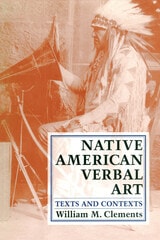
Native American Verbal Art
Texts and ContextsWilliam M. Clements
University of Arizona Press, 1996
He examines in depth Henry Timberlake’s 1765 translation of a Cherokee war song that was probably the first printed English rendering of a Native American "poem." He discusses early-nineteenth-century textualizers and translators who saw in Native American verbal art a literature manqué that they could transform into a fully realized literature, with particular attention to the work of Henry Rowe Schoolcraft, an Indian agent and pioneer field collector who developed this approach to its fullest. He discusses the "scientific" textualizers of the late nineteenth century who viewed Native American discourse as a data source for historical, ethnographic, and linguistic information, and he examines the work of Natalie Curtis, whose field research among the Hopis helped to launch a wave of interest in Native Americans and their verbal art that continues to the present.
In addition, Clements addresses theoretical issues in the textualization, translation, and anthologizing of American Indian oral expression. In many cases the past records of Native American expression represent all we have left of an entire verbal heritage; in most cases they are all that we have of a particular heritage at a particular point in history. Covering a broad range of materials and their historical contexts, Native American Verbal Art identifies the agendas that have informed these records and helps the reader to determine what remains useful in them. It will be a welcome addition to the fields of Native American studies and folklore.
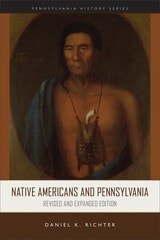
Native Americans and Pennsylvania
Daniel K. Richter
Temple University Press, 2026
Engagingly written, deeply researched, and thoroughly revised to reflect the most recent interdisciplinary scholarship, this new edition of Native Americans and Pennsylvania focuses on Indigenous actors, voices, and landscapes, while tracing interconnections among local, continental, and global trends.
The story begins thousands of years before there was such a thing as “Pennsylvania.” William Penn did not paint his colony on a blank canvas. Colonists adapted ancient patterns of trade and cultural interaction created by the ancestors of Lenape, Conestoga, and Haudenosaunee peoples and convinced themselves they had made them their own. In the process, Pennsylvanians developed moral justifications for the expropriation of Indigenous land, pernicious doctrines about racial superiority, and brutal mechanisms of vigilante violence that profoundly influenced later United States government policies.
Those policies kept Pennsylvania in the foreground of national Native American issues long after the Commonwealth expelled the majority of its Indigenous population to far-flung diasporic homes: forced cultural assimilation at off-reservation boarding schools in the nineteenth century, cultural revitalization and political activism in the twentieth, and struggles with cultural institutions over the repatriation of human remains and controversies over who has the right to claim Indigenous identity in the twenty-first.
In the series Pennsylvania History
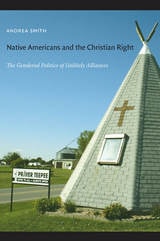
Native Americans and the Christian Right
The Gendered Politics of Unlikely AlliancesAndrea Smith
Duke University Press, 2008
Smith draws on archival research, interviews, and her own participation in Native struggles and Christian Right conferences and events. She considers American Indian activism within the Promise Keepers and new Charismatic movements. She also explores specific opportunities for building unlikely alliances. For instance, while evangelicals’ understanding of the relationship between the Bible and the state may lead to reactionary positions on issues including homosexuality, civil rights, and abortion, it also supports a relatively progressive position on prison reform. In terms of evangelical and Native American feminisms, she reveals antiviolence organizing to be a galvanizing force within both communities, discusses theories of coalition politics among both evangelical and indigenous women, and considers Native women’s visions of sovereignty and nationhood. Smith concludes with a reflection on the implications of her research for the field of Native American studies.
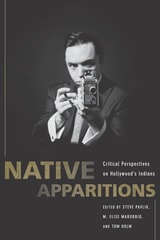
Native Apparitions
Critical Perspectives on Hollywood’s IndiansEdited by Steve Pavlik, M. Elise Marubbio, and Tom Holm
University of Arizona Press, 2017
Native Apparitions offers a critical intervention and response to Hollywood’s representations of Native peoples in film, from historical works by director John Ford to more contemporary works, such as Apocalypto and Avatar. But more than a critique of stereotypes, this book is a timely call for scholarly activism engaged in Indigenous media sovereignty. The collection clusters around three approaches: retrospective analysis, individual film analysis, and Native- and industry-centered testimonials and interviews, which highlight indigenous knowledge and cultural context, thus offering a complex and multilayered dialogic and polyphonic response to Hollywood’s representations.
Using an American Indian studies framework, Native Apparitions deftly illustrates the connection between Hollywood’s representations of Native peoples and broader sociopolitical and historical contexts connected to colonialism, racism, and the Western worldview. Most importantly, it shows the impact of racializing stereotypes on Native peoples, and the resilience of Native peoples in resisting, transcending, and reframing Hollywood’s Indian tropes.
CONTRIBUTORS
Chadwick Allen
Richard Allen
Joanna Hearne
Tom Holm
Jan-Christopher Horak
Jacqueline Land
Andrew Okpeaha MacLean
M. Elise Marubbio
Steve Pavlik
Rose Roberts
Myrton Running Wolf
Richard M. Wheelock
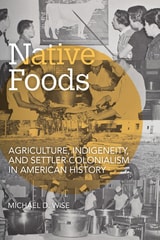
Native Foods
Agriculture, Indigeneity, and Settler Colonialism in American HistoryMichael D. Wise
University of Arkansas Press, 2023
Combining original historical research with interdisciplinary perspectives and informed by the work of Indigenous food sovereignty advocates and activists, this study sheds new light on the historical roles of Native American cuisine in American history and the significance of ongoing colonial processes in present-day discussions about the place of Native foods and Native history in our evolving worlds of taste, justice, and politics.
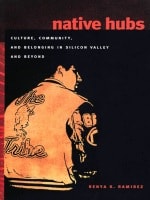
Native Hubs
Culture, Community, and Belonging in Silicon Valley and BeyondRenya K. Ramirez
Duke University Press, 2007
Ramirez’s ethnography revolves around the Paiute American activist Laverne Roberts’s notion of the “hub,” a space that allows for the creation of a sense of belonging away from a geographic center. Ramirez describes “hub-making” activities in Silicon Valley, including sweat lodge ceremonies, powwows, and American Indian Alliance meetings, gatherings at which urban Indians reinforce bonds of social belonging and forge intertribal alliances. She examines the struggle of the Muwekma Ohlone, a tribe aboriginal to the San Francisco Bay area, to maintain a sense of community without a land base and to be recognized as a tribe by the federal government. She considers the crucial role of Native women within urban indigenous communities; a 2004 meeting in which Native Americans from Mexico and the United States discussed cross-border indigenous rights activism; and the ways that young Native Americans in Silicon Valley experience race and ethnicity, especially in relation to the area’s large Chicano community. A unique and important exploration of diaspora, transnationalism, identity, belonging, and community, Native Hubs is intended for scholars and activists alike.
Native Land Talk
Indigenous and Arrivant Rights TheoriesYael Ben-zvi
Dartmouth College Press, 2018
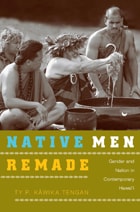
Native Men Remade
Gender and Nation in Contemporary Hawai'iTy P. Kawika Tengan
Duke University Press, 2008
The sharing of personal stories is an integral part of Hale Mua fellowship, and Tengan’s account is filled with members’ first-person narratives. At the same time, Tengan explains how Hale Mua rituals and practices connect to broader projects of cultural revitalization and Hawaiian nationalism. He brings to light the tensions that mark the group’s efforts to reclaim indigenous masculinity as they arise in debates over nineteenth-century historical source materials and during political and cultural gatherings held in spaces designated as tourist sites. He explores class status anxieties expressed through the sharing of individual life stories, critiques of the Hale Mua registered by Hawaiian women, and challenges the group received in dialogues with other indigenous Polynesians. Native Men Remade is the fascinating story of how gender, culture, class, and personality intersect as a group of indigenous Hawaiian men work to overcome the dislocations of colonial history.
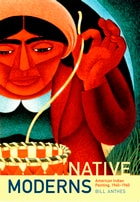
Native Moderns
American Indian Painting, 1940-1960Bill Anthes
Duke University Press, 2006
In the mid-twentieth century, Native artists began to produce work that reflected the accelerating integration of Indian communities into the national mainstream as well as, in many instances, their own experiences beyond Indian reservations as soldiers or students. During this period, a dynamic exchange among Native and non-Native collectors, artists, and writers emerged. Anthes describes the roles of several anthropologists in promoting modern Native art, the treatment of Native American “Primitivism” in the writing of the Jewish American critic and painter Barnett Newman, and the painter Yeffe Kimball’s brazen appropriation of a Native identity. While much attention has been paid to the inspiration Native American culture provided to non-Native modern artists, Anthes reveals a mutual cross-cultural exchange that enriched and transformed the art of both Natives and non-Natives.
Native North American Armor, Shields, and Fortifications
By David E. Jones
University of Texas Press, 2004
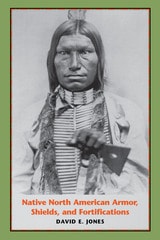
From the Chickasaw fighting the Choctaw in the Southeast to the Sioux battling the Cheyenne on the Great Plains, warfare was endemic among the North American Indians when Europeans first arrived on this continent. An impressive array of offensive weaponry and battle tactics gave rise to an equally impressive range of defensive technology. Native Americans constructed very effective armor and shields using wood, bone, and leather. Their fortifications ranged from simple refuges to walled and moated stockades to multiple stockades linked in strategic defensive networks.
In this book, David E. Jones offers the first systematic comparative study of the defensive armor and fortifications of aboriginal Native Americans. Drawing data from ethnohistorical accounts and archaeological evidence, he surveys the use of armor, shields, and fortifications both before European contact and during the historic period by American Indians from the Southeast to the Northwest Coast, from the Northeast Woodlands to the desert Southwest, and from the Sub-Arctic to the Great Plains. Jones also demonstrates the sociocultural factors that affected warfare and shaped the development of different types of armor and fortifications. Extensive eyewitness descriptions of warfare, armor, and fortifications, as well as photos and sketches of Indian armor from museum collections, add a visual dimension to the text.
Native Pathways
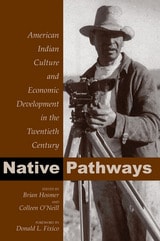
American Indian Culture and Economic Development in the Twentieth CenturyBrian Hosmer
University Press of Colorado, 2004
Native People of Wisconsin, TG
Bobbie Malone and Kori Oberle
Wisconsin Historical Society Press, 2003
The revised and updated Teacher's Guide for Native People of Wisconsin is available Winter 2015, ISBN 9780870207495.This teacher's guide helps students grasp fully the rich content of Native People of Wisconsin. The guide offers more structured activities that reengage students in the text itself in a manner that diverges from teacher's guides to our earlier publications. Activities for each chapter focus on interdisciplinary standards-related reading strategies, journaling, and other multidimensional skills that both reinforce and complement the content of the text. Included with the teacher's guide is an accompanying CD-ROM, produced specifically for Native People of Wisconsin of segments from several of the video series on Wisconsin Studies produced by the Wisconsin Educational Communications Board. Such interactive learning integrates reasoning and reading skills (and state standards) beyond the social studies and promise to make Native People of Wisconsin an essential part of the classroom curriculum.
Native Studies Keywords
Edited by Stephanie Nohelani Teves, Andrea Smith, and Michelle Raheja
University of Arizona Press, 2015
Take sovereignty, for example. The word has served as the battle cry for social justice in Indian Country. But what is the meaning of sovereignty? Native peoples with diverse political beliefs all might say they support sovereignty—without understanding fully the meaning and implications packed in the word.
The field of Native studies is filled with many such words whose meanings are presumed, rather than articulated or debated. Consequently, the foundational terms within Native studies always have multiple and conflicting meanings. These terms carry the colonial baggage that has accrued from centuries of contested words.
Native Studies Keywords is a genealogical project that looks at the history of words that claim to have no history. It is the first book to examine the foundational concepts of Native American studies, offering multiple perspectives and opening a critical new conversation.
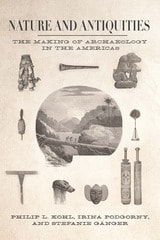
Nature and Antiquities
The Making of Archaeology in the AmericasEdited by Philip L. Kohl, Irina Podgorny, and Stefanie Gänger
University of Arizona Press, 2014
The volume breaks new ground by entreating archaeologists to acknowledge the importance of ways of knowing that resulted from the study of nature in the history of archaeology. Some of the contributions to this volume trace the part conventions, practices, and concepts from natural history and the natural sciences played in the history and making of the discipline. Others set out to uncover, reassemble, or adjust our vision of collections that research historians of archaeology have disregarded or misrepresented—because their nineteenth-century makers would refuse to comply with today’s disciplinary borders and study natural specimens and antiquities in conjunction, under the rubric of the territorial, the curious or the universal. Other contributions trace the sociopolitical implications of studying nature in conjunction with “indigenous peoples” in the Americas—inquiring into what it meant and entailed to comprehend the inhabitants of the American continent in and through a state of nature.
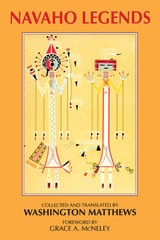
Navaho Legends
Washington Matthews
University of Utah Press, 1994
Navaho Legends is one of the earliest collections of Navajo oral traditions in English, and still the best. Originally published in 1897, Washington Matthews’s sensitive translation contains extensive versions of the Original Legend and two other tales. These richly detailed legends remain among the most complete sources of Navajo cultural, ritual, and ceremonial information.
This edition is fully faithful to the original, containing Matthews’s introduction, extensive notes, interlinear prayer translations, musical notations, and index, plus a new note on orthography by Robert Young.
Navajo Architecture
Forms, History, DistributionsStephen C. Jett and Virginia E. Spencer
University of Arizona Press, 1981
Stephen C. Jett and Virginia E. Spencer have devoted years of fieldwork to studying the origin, evolution, and construction of Navajo buildings: not only hogans, houses, and summer dwellings, but also numerous other structures related to activities such as food preparation, hunting, sweat-bathing, and funerary observation. In addition, they have defined the geographic distribution of dwelling forms to reveal both utilization of local resources and local differences in degree of acculturation.
Navajo Courts and Navajo Common Law
A Tradition of Tribal Self-GovernanceRaymond D. Austin
University of Minnesota Press, 2009
The Navajo Nation court system is the largest and most established tribal legal system in the world. Since the landmark 1959 U.S. Supreme Court decision in Williams v. Lee that affirmed tribal court authority over reservation-based claims, the Navajo Nation has been at the vanguard of a far-reaching, transformative jurisprudential movement among Indian tribes in North America and indigenous peoples around the world to retrieve and use traditional values to address contemporary legal issues.
A justice on the Navajo Nation Supreme Court for sixteen years, Justice Raymond D. Austin has been deeply involved in the movement to develop tribal courts and tribal law as effective means of modern self-government. He has written foundational opinions that have established Navajo common law and, throughout his legal career, has recognized the benefit of tribal customs and traditions as tools of restorative justice.
In Navajo Courts and Navajo Common Law, Justice Austin considers the history and implications of how the Navajo Nation courts apply foundational Navajo doctrines to modern legal issues. He explains key Navajo foundational concepts like Hózhó (harmony), K'é (peacefulness and solidarity), and K'éí (kinship) both within the Navajo cultural context and, using the case method of legal analysis, as they are adapted and applied by Navajo judges in virtually every important area of legal life in the tribe.
In addition to detailed case studies, Justice Austin provides a broad view of tribal law, documenting the development of tribal courts as important institutions of indigenous self-governance and outlining how other indigenous peoples, both in North America and elsewhere around the world, can draw on traditional precepts to achieve self-determination and self-government, solve community problems, and control their own futures.

Navajo Kinship and Marriage
Gary Witherspoon
University of Chicago Press, 1996
"Witherspoon . . . clarifies problems pertaining to Navajo kinship and marriage through his skillful use of the concepts of cultural and social systems. He adds to the body of knowledge on the Navajo by his own fieldwork and unique life experiences." —R. S. Freed, Sociology
"Not only can Witherspoon's book on Navajo kinship help unravel the web for the Anglo willing to concentrate, it can also bring to Navajo readers an understanding of why Anglos don't understand Navajo family relationships." —Joanne Reuter, Navajo Times
"This is an important work on Navajo kinship and marriage." —David F. Aberle, American Anthropology
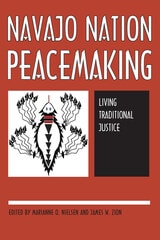
Navajo Nation Peacemaking
Living Traditional JusticeEdited by Marianne O. Nielsen and James W. Zion
University of Arizona Press, 2005
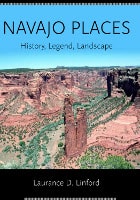
Navajo Places
Laurance D. Linford
University of Utah Press, 2000
Navajoland is the heart and soul of the American Southwest. While the Navajo Reservation incorporates portions of Arizona, New Mexico, and Utah, this is only about half the traditional homeland of 220,000 Diné, the People. In one way or another, nearly all of it, including the original homeland, is sacred to them. Before Spaniards and Americans affixed their own names to the land, every topographic feature had at least one Navajo name. Many of these made their way onto maps—in various forms—or are still in use among Navajo speakers.
Navajo Places is the most ambitious attempt yet to preserve this rich legacy. Through years of research, interviews, and consultation with Navajo authorities, Laurance Linford has compiled a place-name guide that goes beyond reservation boundaries to include the entirety of the traditional Navajo homeland. The volume contains over 1,200 entries, plus a pronunciation guide and sections on Navajo history and the relation of ritual and sacred legend to landscape.
An invaluable resource for anyone interested in the Four Corners region.
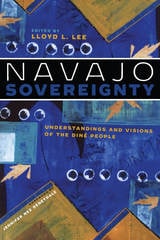
Navajo Sovereignty
Understandings and Visions of the Diné PeopleEdited by Lloyd L. Lee; Foreword by Jennifer Nez Denetdale
University of Arizona Press, 2017
The last few decades have given rise to an electrifying movement of Native American activism, scholarship, and creative work challenging five hundred years of U.S. colonization of Native lands. Indigenous communities are envisioning and building their nations and are making decolonial strides toward regaining power from colonial forces.
The Navajo Nation is among the many Native nations in the United States pushing back. In this new book, Diné author Lloyd L. Lee asks fellow Navajo scholars, writers, and community members to envision sovereignty for the Navajo Nation. He asks, (1) what is Navajo sovereignty, (2) how do various Navajo institutions exercise sovereignty, (3) what challenges does Navajo sovereignty face in the coming generations, and (4) how did individual Diné envision sovereignty?
Contributors expand from the questions Lee lays before them to touch on how Navajo sovereignty is understood in Western law, how various institutions of the Navajo Nation exercise sovereignty, what challenges it faces in coming generations, and how individual Diné envision power, authority, and autonomy for the people.
A companion to Diné Perspectives: Revitalizing and Reclaiming Navajo Thought, each chapter offers the contributors’ individual perspectives. The book, which is organized into four parts, discusses Western law’s view of Diné sovereignty, research, activism, creativity, and community, and Navajo sovereignty in traditional education. Above all, Lee and the contributing scholars and community members call for the rethinking of Navajo sovereignty in a way more rooted in Navajo beliefs, culture, and values.
Contributors:
Raymond D. Austin
Bidtah N. Becker
Manley A. Begay, Jr.
Avery Denny
Larry W. Emerson
Colleen Gorman
Michelle L. Hale
Michael Lerma
Leola Tsinnajinnie
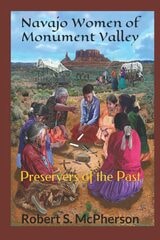
Navajo Women of Monument Valley
Preservers of the PastRobert S. McPherson
University Press of Colorado, 2021
"McPherson, through this oral history of Navajo Women living in Monument Valley, provides a unique story of cultural understanding specific to the area. From personal experience and a shared heritage, these women explain their early struggles in life, religious beliefs and sacred teachings, daily activities of a traditional family, and later, battling against cultural loss. Today's rapidly changing world challenges these elders while enticing the young to forget what it means to be Diné. Here, these women share what they want the youth to know. I highly recommend this book to those who wish to learn about the past, understand the present, and consider the future."
—Ronald P. Maldonado, Navajo Nation Cultural Resource Supervisor
"The teachings and stories presented here are fascinating and important. When reading them, I heard my granmother's and aunt's voices, connecting me to the past while strengthening my understanding of Navajo culture. It is the women who are the heard and soul of preserving this information as they guide youth into the future. Here that wisdom becomes real. Those interested in a balanced presentation of the difficult, yet rewarding live of Navajo elders will be highly rewarded by learning from this book"
—Charlotte Nez Lacy, Heritage Language Educator/Translator
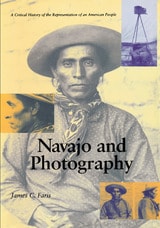
Navajo and Photography
James C Faris
University of Utah Press, 2003
"Our God Tscorenci was our Father and created the sun, which is like a mirror. He sees us from up on high and makes photographs of our reflection. When we die the photograph disappears. Many have been lost."
—Kenchori, an Asháninka from Peruvian Amazonia, when asked to tell a story concerning cameras (From W. Baker, Backward: An Essay on Indians, Time, and Photography).
Historically photographs say less about the Navajo than about photographers of Navajos. In Navajo and Photography James Faris calls attention to the inability of photographs of Navajo by non-Navajo to communicate either the lived experiences of native people or their history. Beginning with the earliest photographs of Navajos in captivity at Bosque Redondo and including the most recent glossy picture books and calendars, Faris’s survey points out assumptions that have always governed photographic representation of the Navajo people. Full of the work of photographers such as Edward S. Curtis and Laura Gilpin, as well as photographs by many less-well known figures, readers will find Navajo and Photography an enlightening juxtaposition of cultures.
Negotiating Tribal Water Rights
Fulfilling Promises in the Arid WestBonnie G. Colby, John E. Thorson, and Sarah Britton; Foreword by David H. Getches
University of Arizona Press, 2005
Much has been written about Indian water rights; for the many tribal and non-Indian stakeholders who rely upon western water, this book now offers practical guidance on how to negotiate them. By providing a comprehensive synthesis of western water issues, tribal water disputes, and alternative approaches to dispute resolution, it offers a valuable sourcebook for all—tribal councils, legislators, water professionals, attorneys—who need a basic understanding of the complexities of the situation.
The book reviews the history, current status, and case law related to western water while revealing strategies for addressing water conflicts among tribes, cities, farms, environmentalists, and public agencies. Drawing insights from the process, structure, and implementation of water rights settlements currently under negotiation or already agreed to, it presents a detailed analysis of how these cases evolve over time. It also provides a wide range of contextual materials, from the nuts and bolts of a Freedom of Information Act request to the hydrology of irrigation. It also includes contributed essays by expert authors on special topics, as well as interviews with key individuals active in water management and tribal water cases.
As stakeholders continue to battle over rights to water, this book clearly addresses the place of Native rights in the conflict. Negotiating Tribal Water Rights offers an unsurpassed introduction to the ongoing challenges these claims present to western water management while demonstrating the innovative approaches that states, tribes, and the federal government have taken to fulfill them while mitigating harm to both non-Indians and the environment.
New Deal Archaeology in Tennessee
Intellectual, Methodological, and Theoretical ContributionsEdited by David H. Dye
University of Alabama Press, 2016
Exploring how New Deal innovation transformed archaeology in the American South.
New Deal Archaeology in Tennessee tells the engrossing story of Southeastern archaeology in the 1930s. The Tennessee Valley Authority Act of May 1933 initiated an ambitious program of flood control and power generation by way of a chain of hydroelectric dams on the Tennessee River. The construction of these dams flooded hundreds of thousands of square miles of river bottoms, campsites, villages, and towns that had been homes to Native Americans for centuries. This triggered an urgent need to undertake extensive archaeological fieldwork throughout the region. Those studies continue to influence contemporary archaeology.
The state of Tennessee and the Tennessee Valley were especially well suited research targets thanks to their mild climate and long field seasons. A third benefit in the 1930s was the abundance of labor supplied by Tennesseans unemployed during the Great Depression. Within months of the passage of the Tennessee Valley Authority Act, teams of archaeologists fanned out across the state and region under the farsighted direction of Smithsonian Institution curators Neil M. Judd, Frank H. H. Roberts, and Frank M. Setzler. The early months of 1934 would become the busiest period of archaeological fieldwork in US history.
The twelve insightful essays in New Deal Archaeology in Tennessee document and explore this unique peak in archaeological study. Chapters highlight then-new techniques such as mound “peeling” and stratigraphic excavation adapted from the University of Chicago; the four specific New Deal sites of Watts Bar Reservoir, Mound Bottom, Pack, and Chickamauga Basin; bioarchaeology in the New Deal; and the enduring impact of the New Deal on contemporary fieldwork.
The challenges of the 1930s in recruiting skilled labor, training unskilled ancillary labor, developing and improvising new field methods, and many aspects of archaeological policies, procedures, and best-practices laid much of the foundation of contemporary archaeological practice. New Deal Archaeology in Tennessee offers an invaluable record of that pivotal time for professional, student, and amateur archaeologists.
New Indians, Old Wars
Elizabeth Cook-Lynn
University of Illinois Press, 2006
Addressing Native American Studies' past, present, and future, the essays in New Indians, Old Wars tackle the discipline head-on, presenting a radical revision of the popular view of the American West in the process. Instead of luxuriating in its past glories or accepting the widespread historians' view of the West as a shared place, Elizabeth Cook-Lynn argues that it should be fundamentally understood as stolen.
Firmly grounded in the reality of a painful past, Cook-Lynn understands the story of the American West as teaching the political language of land theft and tyranny. She argues that to remedy this situation, Native American studies must be considered and pursued as its own discipline, rather than as a subset of history or anthropology. She makes an impassioned claim that such a shift, not merely an institutional or theoretical change, could allow Native American studies to play an important role in defending the sovereignty of indigenous nations today.
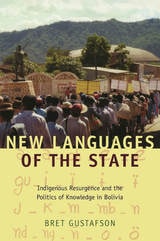
New Languages of the State
Indigenous Resurgence and the Politics of Knowledge in BoliviaBret Gustafson
Duke University Press, 2009
Gustafson shows that bilingual education is an issue that extends far beyond the classroom. Public schools are at the center of a broader battle over territory, power, and knowledge as indigenous movements across Latin America actively defend their languages and knowledge systems. In attempting to decolonize nation-states, the indigenous movements are challenging deep-rooted colonial racism and neoliberal reforms intended to mold public education to serve the market. Meanwhile, market reformers nominally embrace cultural pluralism while implementing political and economic policies that exacerbate inequality. Juxtaposing Guarani life, language, and activism with intimate portraits of reform politics among academics, bureaucrats, and others in and beyond La Paz, Gustafson illuminates the issues, strategic dilemmas, and imperfect alliances behind bilingual intercultural education.
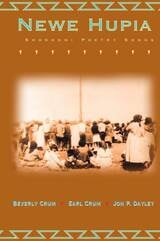
Newe Hupia
Shoshoni Poetry SongsBeverly Crum, Earl Crum, and Jon P. Dayley
Utah State University Press, 2002
Nihikéyah
Navajo HomelandEdited by Lloyd L. Lee
University of Arizona Press, 2023
While various books have investigated Native American reservations and homelands, this book is from Diné individuals’ experiences, observations, and examinations. Poets, writers, and scholars frame their thoughts on four key questions: What are the thoughts/perspectives on nihikéyah/Navajo homeland? What challenges does nihikéyah face in the coming generations, and what should all peoples know about nihikéyah? And how can nihikéyah build a strong and positive Navajo Nation for the rest of this century and beyond?
The authors come from a variety of backgrounds and use multiple approaches to discuss Diné history in the U.S. Southwest, as well as forward-looking examinations of the Navajo Nation.
Together, the essays shed new light on Diné homeland and the challenges to the Navajo homeland and its peoples.
Contributors
Mario Atencio
Shawn Attakai
Wendy Shelly Greyeyes
Rex Lee Jim
Manny Loley
Jonathan Perry
Jake Skeets
Jennifer Jackson Wheeler
North American Indigenous Warfare and Ritual Violence
Edited by Richard J. Chacon and Rubén G. Mendoza
University of Arizona Press, 2007
The editors argue that a failure to acknowledge the roles of warfare and violence in the lives of indigenous North Americans is itself a vestige of colonial repression—depriving native warriors of their history of armed resistance. These essays document specific acts of Native American violence across the North American continent. Including contributions from anthropologists, archaeologists, historians, and ethnographers, they argue not only that violence existed but also that it was an important and frequently celebrated component of Amerindian life.
CONTENTS
Acknowledgments
Introduction
Richard J. Chacon and Rubén G. Mendoza
1. Traditional Native Warfare in Western Alaska
Ernest S. Burch Jr.
2. Barbarism and Ardour of War from the Tenderest Years”: Cree-Inuit Warfare in the Hudson Bay Region
Charles A. Bishop and Victor P. Lytwyn
3. Aboriginal Warfare on the Northwest Coast: Did the Potlatch Replace Warfare?
Joan A. Lovisek
4. Ethnohistoric Descriptions of Chumash Warfare
John R. Johnson
5. Documenting Conflict in the Prehistoric Pueblo Southwest
Polly Schaafsma
6. Cahokia and the Evidence for Late Pre-Columbian War in the North American Midcontinent
Thomas E. Emerson
7. Iroquois-Huron Warfare
Dean R. Snow
8. Desecrating the Sacred Ancestor Temples: Chiefly Conflict and Violence in the American Southeast
David H. Dye and Adam King
9. Warfare, Population, and Food Production in Prehistoric Eastern North America
George R. Milner
10. The Osteological Evidence for Indigenous Warfare in North America
Patricia M. Lambert
11. Ethical Considerations and Conclusions Regarding Indigenous Warfare and Violence in North America
Richard J. Chacon and Rubén G. Mendoza
References
About the Contributors
Index
North Country Captives
Selected Narratives of Indian Captivity from Vermont and New HampshireEdited by Colin G. Calloway
University Press of New England, 1992
Nuclear Decolonization
Indigenous Resistance to High-Level Nuclear Waste SitingDanielle Endres
The Ohio State University Press, 2023
Honorable Mention, 2024 NCA Public Address Division’s Marie Hochmuth Nichols Award
Honorable Mention, 2025 Association for the Rhetoric of Science, Technology, and Medicine Book Award
While research demonstrates how Indigenous populations have been disproportionately affected by the global nuclear production complex, less attention has been given to tactics that have successfully resisted such projects. Danielle Endres’s Nuclear Decolonization shifts the conversation around nuclear colonialism in important ways, offering an account of how the Western Shoshone, Southern Paiute, and Skull Valley Goshute peoples and nations prevented two high-level nuclear waste sites from being built on their lands.
Using a decolonial approach, Endres highlights two sets of rhetorical tactics—Indigenous Lands rhetorics and national interest rhetorics—used to fight nuclear colonialism. The book reframes nuclear decolonization as fundamentally a struggle for the return of Indigenous lands while also revealing how Native activists selectively move between Indigenous nationhood and US citizenship in order to resist settler decision-making. Working at the intersection of Indigenous antinuclear advocacy, Indigenized environmental justice, and decolonization, Nuclear Decolonization centers Native activism and voices while amplifying the power and resilience of Indigenous peoples and nations.