230 books match the query 'Physics' and 8 start with n
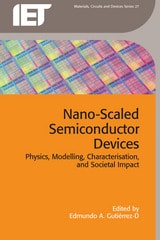
cover of Nano-Scaled Semiconductor Devices: Physics, modelling, characterisation, and societal impact

Nano-Scaled Semiconductor Devices

Physics, modelling, characterisation, and societal impact

Edmundo A. Gutiérrez-D

The Institution of Engineering and Technology, 2016

The rapid evolution of integrated circuit technology has brought with it many new materials and processing steps at the nano-scale which boost the electrical performance of devices, resulting in faster and more functionally-complex electronics. However, working at this reduced scale can bring second order effects that degrade efficiency and reliability.
[more]
cover of Nanoantennas and Plasmonics: Modelling, design and fabrication

Nanoantennas and Plasmonics

Modelling, design and fabrication

Douglas H. Werner

The Institution of Engineering and Technology, 2020

This book presents cutting-edge research advances in the rapidly growing areas of nanoantennas and plasmonics as well as their related enabling technologies and applications. It provides a comprehensive treatment of the field on subjects ranging from fundamental theoretical principles and new technological developments, to state-of-the-art device design, as well as examples encompassing a wide range of related sub-areas. The content of the book also covers highly-directive nanoantennas, all-dielectric and tuneable/reconfigurable devices, metasurface optical components, and other related topics.
[more]
cover of Nature and Nature's God: A Philosophical and Scientific Defense of Aquinas' Unmoved Mover Argument

Nature and Nature's God

A Philosophical and Scientific Defense of Aquinas' Unmoved Mover Argument

Daniel Shields

Catholic University of America Press, 2023
Aquinas’ first proof for God’s existence is usually interpreted as a metaphysical argument immune to any objections coming from empirical science. Connections to Aquinas’ own historical understanding of physics and cosmology are ignored or downplayed. Nature and Nature's God proposes a natural philosophical interpretation of Aquinas’ argument more sensitive to the broader context of Aquinas’ work and yielding a more historically accurate account of the argument. Paradoxically, the book also shows that, on such an interpretation, Aquinas’ argument is not only consistent with modern science, but actually confirmed by the history of science, from classical mechanics through 19th century thermodynamics to contemporary cosmology. The first part of the book considers Aquinas’ argument in its historical context, exploring the key principles that everything in motion is moved by something else and that an infinite regress of causes is impossible. The structure of the First Way is analyzed and the argument is connected both with Aquinas’ Third Way—a new interpretation of which is also proposed—and Aquinas’ second proof from motion in the Summa contra Gentiles. To complete the account of what natural philosophy—prior to metaphysics—can demonstrate about God, a chapter on Aquinas’ teleological argument (the Fifth Way) is also included. The second part of the book tracks the history of modern science from Copernicus to today, showing how Aquinas’ argument fared at each major turn. The first chapter shows how Newton’s understanding of inertia and conservation of momentum supports the idea that motion cannot continue forever without God’s causality, and integrates a modern understanding of inertia and gravity with the principles of Thomistic natural philosophy. The second chapter considers the first and second laws of thermodynamics, showing how they too support Aquinas’ contention that motion cannot continue forever without God’s causality. This chapter also discusses statistical mechanics and contemporary cosmology, demonstrating that science continues to support Aquinas’ unmoved mover argument. The final chapter turns to modern biology as well as cosmological fine-tuning to show that modern science also continues to support Aquinas’ teleological argument. The result is not only a satisfying defense of Aquinas’ natural philosophical proofs for God’s existence, but a primer on the broader project of integrating Thomistic natural philosophy with modern science.
[more]
cover of New Waves in Electromagnetic Technology

New Waves in Electromagnetic Technology

Andrew Michael Chugg

The Institution of Engineering and Technology, 2025
The concept for this book emerged from a webinar on Electromagnetic Waves: Successfully Surfing the Subject that the editor gave on behalf of the IET in June 2020. The concept was that experts in specialist areas of electromagnetics would write each chapter; providing insightful summaries of current developments within their specialisms, and then extrapolating these existing trends in a logical and reasoned fashion to forecast the future technological developments in their fields. The challenge was for them to look ahead by anything up to a century or more.
[more]
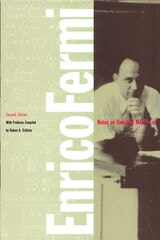
cover of Notes on Quantum Mechanics

Notes on Quantum Mechanics

Enrico Fermi

University of Chicago Press, 1995

The lecture notes presented here in facsimile were prepared by Enrico Fermi for students taking his course at the University of Chicago in 1954. They are vivid examples of his unique ability to lecture simply and clearly on the most essential aspects of quantum mechanics.

At the close of each lecture, Fermi created a single problem for his students. These challenging exercises were not included in Fermi's notes but were preserved in the notes of his students. This second edition includes a set of these assigned problems as compiled by one of his former students, Robert A. Schluter.

Enrico Fermi was awarded the Nobel Prize for Physics in 1938.
[more]
cover of Nuclear Physics: A Course Given by Enrico Fermi at the University of Chicago

Nuclear Physics

A Course Given by Enrico Fermi at the University of Chicago

Enrico Fermi

University of Chicago Press, 1974

This volume presents, with some amplification, the notes on the lectures on nuclear physics given by Enrico Fermi at the University of Chicago in 1949.

"The compilers of this publication may be warmly congratulated. . . . The scope of this course is amazing: within 240 pages it ranges from the general properties of atomic nuclei and nuclear forces to mesons and cosmic rays, and includes an account of fission and elementary pile theory. . . . The course addresses itself to experimenters rather than to specialists in nuclear theory, although the latter will also greatly profit from its study on account of the sound emphasis laid everywhere on the experimental approach to problems. . . . There is a copious supply of problems."—Proceedings of the Physical Society

"Only a relatively few students are privileged to attend Professor Fermi's brilliant lectures at the University of Chicago; it is therefore a distinct contribution to the followers of nuclear science that his lecture material has been systematically organized in a publication and made available to a much wider audience."—Nucelonics
[more]
cover of Nuclear Weapons, Policy, and Strategy: The Uses of Atomic Energy in an Increasingly Complex World

Nuclear Weapons, Policy, and Strategy

The Uses of Atomic Energy in an Increasingly Complex World

Peter J. Pella

Parkhurst Brothers, Inc., 2010

In this comprehensive introduction to nuclear physics, related national and international policy  issues from Dr. Pete Pella, Gettysburg College nuclear physicist, educators will find a definitive   textbook on the peaceful and military uses of nuclear energy. Pella traces both the scientific evolution and political history of nuclear power and arms, bringing us to current events including  nuclear plant development, status of treaties, U.S.-Russia disarmament efforts, and policing of  rogue nations. Must reading for the world’s citizens concerned about these vital issues.
[more]
cover of Nucleus and Nation: Scientists, International Networks, and Power in India

Nucleus and Nation

Scientists, International Networks, and Power in India

Robert S. Anderson

University of Chicago Press, 2010

In 1974 India joined the elite roster of nuclear world powers when it exploded its first nuclear bomb. But the technological progress that facilitated that feat was set in motion many decades before, as India sought both independence from the British and respect from the larger world. Over the course of the twentieth century, India metamorphosed from a marginal place to a serious hub of technological and scientific innovation. It is this tale of transformation that Robert S. Anderson recounts in Nucleus and Nation.

Tracing the long institutional and individual preparations for India’s first nuclear test and its consequences, Anderson begins with the careers of India’s renowned scientists—Meghnad Saha, Shanti Bhatnagar, Homi Bhabha, and their patron Jawaharlal Nehru—in the first half of the twentieth century before focusing on the evolution of the large and complex scientific community—especially Vikram Sarabhi—in the later part of the era. By contextualizing Indian debates over nuclear power within the larger conversation about modernization and industrialization, Anderson hones in on the thorny issue of the integration of science into the framework and self-reliant ideals of Indian nationalism. In this way, Nucleus and Nation is more than a history of nuclear science and engineering and the Indian Atomic Energy Commission; it is a unique perspective on the history of Indian nationhood and the politics of its scientific community.

[more]