Results by title
3785 books match the query 'Poetry' and 86 start with n
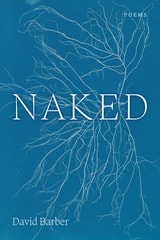
NAKED
PoemsDavid Barber
Northwestern University Press, 2027
A moving and sonically stunning exploration into the body and soul
David Barber’s masterful new book, NAKED, is powered by prolific feats of verbal prowess. With formal dexterity, nerve, and ingenious wordplay, these poems grapple with the serious business of soulmaking. In a spacious collection that enacts changes on the touch-and-go of innocence and experience, these poems are rife with inklings and reckonings in the name of muscle memory and mortal longing. Here, Hollywood meets Babylon in the Garden of Earthly Delights; Odysseus opts for a username; the naked eye goes toe-to-toe with the naked truth; American sonnets & ampersands run wild. NAKED is an all-out lovers’ quarrel over the give-and-take of the spirit and flesh—and Barber is all in.
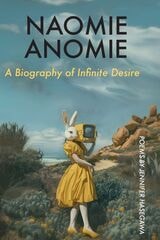
NAOMIE ANOMIE
A Biography of Infinite DesireJennifer Hasegawa
Omnidawn, 2025
Jennifer Hasegawa’s NAOMIE ANOMIE: A Biography of Infinite Desire, is an experimental poetic take on biography, growing increasingly surreal as it follows the truths behind its unreliable narrator through paradoxes rendered in luxurious detail. This book is a portrait of a flawed life, a call for attention to the looming ecological crisis, and a lyrical experiment in truth-telling.
Feeling ever-increasing existential strain leading up to the COVID-19 pandemic and culminating in her decision to no longer venture outside of her apartment, Naomie is not surprised to find her name is an anagram for anomie, a term for the breakdown of social norms. In these pages is a meticulous account of everything that went wrong in Naomie’s five decades of life. We find retellings of a life’s most significant moments—not because they are sources of pride, but because they stand as the only decipherable moments of humanity amid a world of static. This story in verse acts as a survival guide, romance novel, liberation handbook, pulp thriller, and jokebook for those who will live through ongoing plagues, environmental change, total AI integration, water wars, and cyberattacks and who will come out the other side ready to restart.
Naked Wanting
Margo Tamez
University of Arizona Press, 2003
Margo Tamez’s voice is that of the cicada and the cricket, the raven and the crane. In this volume of poetry, she shows us that the earth is an erotic current linking all beings, a vibrant network of birth, death, and rebirth. A sacred intertwining from which we as humans have become disconnected. Tamez shares the perspective of other creatures in images that remind us of Nature's beauty and fragility. An invocation of birds: “Sudden hum / wings touching / wings in swift turn / hush / a fast red out of the flux.” An appreciation for the delicacy of insects, for spiderwebs “like a hundred needle-thin tubes of blown glass.”
Here too are reflections on childbirth and children—and on miscarriage, when damage inflicted on the environment by herbicides comes back to haunt all of us in our skin and bones, our very wombs. Warning of “the chemical cocktail seeping into the air ducts,” she brings the voice of someone who has experienced firsthand what happens when our land and water are compromised. For Tamez, earth, food, and family are the essentials of life, and we ignore them at our own peril. “If a person / does not admit the peril . . . that becomes a dangerous / form of existence.”
Written with the wisdom of one who knows and loves the land, her lyrical meditations speak to the naked wanting in us all.
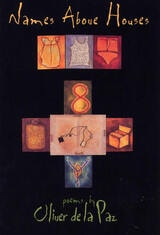
Names Above Houses
Oliver de la Paz
Southern Illinois University Press, 2001
In Names above Houses, Oliver de la Pazuses both prose and verse poems to create the magical realm of Fidelito Recto—a boy who wants to fly—and his family of Filipino immigrants. Fidelito’s mother, Maria Elena, tries to keep her son grounded while struggling with her own moorings. Meanwhile, Domingo, Fidelito's fisherman father, is always at sea, even when among them. From the archipelago of the Philippines to San Francisco, horizontal and vertical movements shape moments of displacement and belonging for this marginalized family. Fidelito approaches life with a sense of wonder, finding magic in the mundane and becoming increasingly uncertain whether he is in the sky or whether his feet are planted firmly on the ground.

Naming the Wind
Steven Rood
Omnidawn, 2022
Wind moves through this collection, opening the poems to the dying beauty of the natural world, to the weathers inside the psyche and without, and to the connections between a family and between the speaker his mentor, the great poet Jack Gilbert. The collection navigates the intimacies of human relationships with others, the challenges of working as a lawyer trying to maintain integrity as others fall prey to corporate greed, and the complexity of holding a Jewish identity while being awake to tradition’s hold on the mind and its cost. Steven Rood offers a powerful account of how to be a human in dynamic relationships while also holding respect for the non-human beings that comprise most of the life on our planet.
Rood employs structures and forms that directly relate to the content of the poems themselves. Spontaneous breaks and starts reflect the writer’s turns of mind, offering readers insight into the meaning and measure of the work.
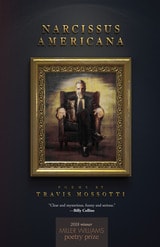
Narcissus Americana
PoemsTravis Mossotti
University of Arkansas Press, 2018
Winner, 2018 Miller Williams Poetry Prize
Narcissus Americana sings and scraps and wrestles its way across various landscapes—abandoned quarries, art museums, lavish homes, and tar pits—in a quest to attain a more complex vision of what it means to be upwardly mobile.
These poems question the usefulness of wealth and ownership as markers of success. Taking wine fridges and fake flowers as emblems of capitalism’s failure to assuage human loneliness, the speakers in these poems find joy in shared meals and glasses of wine, and use moments of mutual attention to challenge notions of class in America. Intimacy is on display in “Cruising Altitude,” where the speaker finds a sublime communion between two disparate worldviews during an in-flight conversation with his father:
I ask if his certainty about humanity’s course gives
his life some kind of purpose. He doesn’t sleep well.
I know this. I quote Yeats. He quotes scripture.
Light balances on the wing and casts its yellow spell. . . .
Sharply written, and with an eye for form, these poems engage with heavy inquiry but also know better than to take themselves too seriously, making it possible for, say, dungeons to share space with donuts, as in the poem “Rancho La Brea.”
Mossotti’s timely book invites the reader to traverse America, and see the nation anew, on a journey marked simultaneously by critical scrutiny and deep affection.
Natal Command
Peter Sacks
University of Chicago Press, 1997
National Monuments
Heid E. Erdrich
Michigan State University Press, 2008
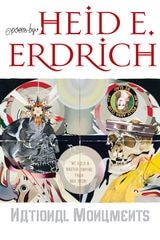
Many of the poems in National Monuments explore bodies, particularly the bodies of indigenous women worldwide, as monuments—in life, in photos, in graves, in traveling exhibitions, and in plastic representations at the airport. Erdrich sometimes imagines what ancient bones would say if they could speak. Her poems remind us that we make monuments out of what remains—monuments are actually our own imaginings of the meaning or significance of things that are, in themselves, silent.
As Erdrich moves from the expectedly "poetic" to the voice of a newspaper headline or popular culture, we are jarred into wondering how we make our own meanings when the present is so immediately confronted by the past (or vice versa). The language of the scientists that Erdrich sometimes quotes in epigraphs seems reductive in comparison to the richness of tone and meaning that these poems—filled with puns, allusions, and wordplay—provide.
Erdrich's poetry is literary in the best sense of the word, infused with an awareness of the poetic canon. Her revisions of and replies to poems by William Carlos Williams, Robert Frost, and others offer an indigenous perspective quite different from the monuments of American literature they address.
Native Species
Todd Davis
Michigan State University Press, 2019

Native Voices
Indigenous American Poetry, Craft, and ConversationsEdited by CMarie Fuhrman and Dean Rader
Tupelo Press, 2019
In this groundbreaking anthology of Indigenous poetry and prose, Native poems, stories, and essays are informed with a knowledge of both what has been lost and what is being restored. It offers a diverse collection of stories told by Indigenous writers about themselves, their histories, and their present. It is a celebration of culture and the possibilities of language.
Featuring forty-four poets, including Ishmael Hope, Bojan Louis, Ruby Murray, Simon Ortiz, Leslie Marmon Silko, Luci Tapahonso, Joy Harjo, dg okpik, Sherwin Bitsui, Heid E. Erdrich, Layli Long Soldier, and Orlando White.
Original influence essays by Diane Glancy on Lorca, Chrystos on Audre Lorde, Louise Erdrich on Elizabeth Bishop, LeAnne Howe on W. D. Snodgrass, Allison Hedge Coke on Delmore Schwartz, Suzanne Rancourt on Ai, and M. L. Smoker on Richard Hugo, among others.
And, a selection of resonant work chosen from previous generations of Native artists.
“There really is no better anthology out there that collects indigenous poets publishing from 1960 to the present.” — Dean Rader, co-editor
Natural Selections
Joseph Campana
University of Iowa Press, 2012
Natural Takeover of Small Things
Tim Z. Hernandez
University of Arizona Press, 2013
The book opens with an image of Fresno as “the inexhaustible nerve/in the twitching leg of a dog/three hours after being smashed/beneath the retread wheel/of a tomato truck en route to/a packing house that was raided/by the feds just days before the harvest.” It ends with “Adios, Fresno,” an astringent farewell to the city: “You can keep your fields,/the sun will follow me./I won’t reconsider./I’ve overstayed my welcome/by three generations.” By then, we have toured the breadth of the San Joaquin Valley, have tasted Fuyu persimmons and lengua, have witnessed a home crumbling to foreclosure, and listened to the last words of a dying campesino. We’re made aware that this is an atmosphere scented by an entirely organic stew—a melding of culture, objects, and forms. This is a place where rubble mirrors the refuse of lives. But garbage is also compost. And if we squint, we can see through the wreckage a few small patches where love could be taking root and hope might actually be sprouting.
Navigating CHamoru Poetry
Indigeneity, Aesthetics, and DecolonizationCraig Santos Perez
University of Arizona Press, 2021
This book shows that CHamoru poetry has been an inspiring and empowering act of protest, resistance, and testimony in the decolonization, demilitarization, and environmental justice movements of Guåhan. Perez roots his intersectional cultural and literary analyses within the fields of CHamoru studies, Pacific Islands studies, Native American studies, and decolonial studies, using his research to assert that new CHamoru literature has been—and continues to be—a crucial vessel for expressing the continuities and resilience of CHamoru identities. This book is a vital contribution that introduces local, national, and international readers and scholars to contemporary CHamoru poetry and poetics.
Near/Miss
Charles Bernstein
University of Chicago Press, 2018
This collection’s title highlights poetry’s ability to graze reality without killing it, and at the same time implies that the poems themselves are wounded by the grief of loss. The book opens with a rollicking satire of difficult poetry—proudly declaring itself “a totally inaccessible poem”—and moves on to the stuff of contrarian pop culture and political cynicism—full of malaprops, mondegreens, nonsequiturs, translations of translations, sardonically vandalized signs, and a hilarious yet sinister feed of blog comments. At the same time, political protest also rubs up against epic collage, through poems exploring the unexpected intimacies and continuities of “our united fates.” These poems engage with works by contemporary painters—including Amy Sillman, Rackstraw Downes, and Etel Adnan—and echo translations of poets ranging from Catullus and Virgil to Goethe, Cruz e Souza, and Kandinsky.
Grounded in a politics of multiplicity and dissent, and replete with both sharp edges and subtle intimacies, Near/Miss is full of close encounters of every kind.
Near/Miss
Charles Bernstein
University of Chicago Press, 2018
This collection’s title highlights poetry’s ability to graze reality without killing it, and at the same time implies that the poems themselves are wounded by the grief of loss. The book opens with a rollicking satire of difficult poetry—proudly declaring itself “a totally inaccessible poem”—and moves on to the stuff of contrarian pop culture and political cynicism—full of malaprops, mondegreens, nonsequiturs, translations of translations, sardonically vandalized signs, and a hilarious yet sinister feed of blog comments. At the same time, political protest also rubs up against epic collage, through poems exploring the unexpected intimacies and continuities of “our united fates.” These poems engage with works by contemporary painters—including Amy Sillman, Rackstraw Downes, and Etel Adnan—and echo translations of poets ranging from Catullus and Virgil to Goethe, Cruz e Souza, and Kandinsky.
Grounded in a politics of multiplicity and dissent, and replete with both sharp edges and subtle intimacies, Near/Miss is full of close encounters of every kind.
Nebulous Vertigo
Belle Ling
Tupelo Press, 2025
The realm that belongs to Nebulous Vertigo is both visceral and vibrant, and it is mysteriously familiar. If you come close to it, you will hear how rains eat, how a silken tofu revolts, how the Chinese word for “beans” turns into a speaking persona, and how a telephone bridges the surviving and the afterlife. In Nebulous Vertigo, everyday life is inevitably lost to the inevitable fate. And yet, with unexpected quivers, our fate and life keep surprising us.
Traveling through the cha chaan teng in Hong Kong, you can hear how Mrs. Suen, Mr. Yuen, and Waiter Kuen carry out intriguing conversations; astounded by the night sky in Paris, you will see how constellations narrate the lovers’ quirky destiny; and all the way through the Sayama Hills in Tokorozawa, you will be surprised by the turnings and upturnings of the myths told by a Japanese Uncle. Nebulous Vertigo, as its title beckons, “sighs an unreal cloud / for the fated sun to rise.” If fate can never be changed, how can we embrace its weaving? Every attempt, as the poems suggest, can be calmingly adventurous, unobvious yet magnanimous.
Necessary Light
Patricia Fargnoli
Utah State University Press, 1999
Neck of the World
F. Daniel Rzicznek
Utah State University Press, 2007
Negative Capability
Contemporary American PoetryLinda Gregerson
University of Michigan Press, 2001
In a wide-ranging and fiercely intelligent series of readings, Linda Gregerson presents an eloquent overview of the contemporary American lyric. This lyric is distinguished, she argues, not only by its unprecedented variety and abundance, but by its persistent and supple engagement with form. In detailed examinations of work by John Ashbery, Mark Strand, Louis Gluck, James Schuyler, Muriel Rukeyser, C. K. Williams, Rita Dove, Philip Levine, Heather McHugh, William Meredith, John Hollander, and a host of other recent and contemporary poets, Gregerson documents the depth and richness of American lyric production at the turn of the twenty-first century. In its scruples and reservations as in its discriminating explanations, Negative Capability unearths the contours of a distinctive American poetic tradition. This book is a rich symbiosis of critical and poetic intelligence. It is also a work of passionate advocacy. The book will appeal to those interested in the current state of American poetry: practicing poets, readers and students of literature and literary criticism, and professional critics.

Negative Poetics
Edward Jayne
University of Iowa Press, 1992
Negro Mountain
C. S. Giscombe
University of Chicago Press, 2023
In the final section of Negro Mountain, C. S. Giscombe writes, “Negro Mountain—the summit of which is the highest point in Pennsylvania—is a default, a way among others to think about the Commonwealth.” Named for an “incident” in which a Black man was killed while fighting on the side of white enslavers against Indigenous peoples in the eighteenth century, this mountain has a shadow presence throughout this collection; it appears, often indirectly, in accounts of visions, reimaginings of geography, testimonies about the “natural” world, and speculations and observations about race, sexuality, and monstrosity. These poems address location, but Giscombe—who worked for ten years in central Pennsylvania—understands location to be a practice, the continual “action of situating.”
The book weaves through the ranges of thinking that poetic voice itself might trouble. Addressing a gallery of figures, Giscombe probes their impurities and ambivalences as a way of examining what languages “count” or “don’t count” as poetry. Here, he finds that the idea of poetry is visionary, but also investigatory and exploratory.
Networked Poetics
The Digital Turn in Southern African PoetrySusanna L. Sacks
University of Massachusetts Press, 2024
Winner of the 2025 MLA Scaglione Prize for African Studies
Simultaneously transnational and local, poetry in the twenty-first century is produced across digital networks, shaped through local communities, and evaluated on a global scale. It might start on social media, where a video of a poet circulates and goes viral, gaining international attention without ever going through traditional modes of publication. In Networked Poetics, Susanna L. Sacks introduces readers to the southern African poetry scene in Malawi, Zimbabwe, and South Africa, illustrating how contemporary poetry is shaped, from inception to canonization, by the influence of digital media publication.
Interweaving ethnographic observation and extensive literary analysis, Sacks demonstrates that, as more artists in Africa reach wider audiences through online publication, poetic form has shifted to reflect social media’s aesthetic norms of urgency, immediacy, and populism. These changes have, in turn, challenged elite processes of valuation, forcing literary institutions like prizes, festivals, and curricula to accommodate the digital turn.
Never the Whole Story
Anita Skeen
Michigan State University Press, 2011
Epiphanic and rich with striking imagery, Anita Skeen’s new collection of poetry documents the fragmentary nature of life and celebrates the desire to make a meaningful narrative from momentary experience. In Never the Whole Story, the past is never past, and the present comes filled with the miracle of small gestures—singular moments that have the power to transport the mind from one geographic place to the next, one emotional world to another. Memory is incomplete, events unfold from multiple perspectives, and secrets unspool from the ordinary. Following in the tradition of James Wright, Maxine Kumin, Mary Oliver, Jane Kenyon, Robert Hass, and other writers whose work is grounded in the detail of ordinary life, Never the Whole Story will be a welcome addition to the libraries of those who turn to literature to find deeper connections between their own lives and the natural world.
New Cathay
Contemporary Chinese PoetryEdited by Ming Di
Tupelo Press, 2013
New Jersey
Betsy Andrews
University of Wisconsin Press, 2007
New Letters to a Young Poet
Joan Margarit
Swan Isle Press, 2010
In these intimate pages, award-winning Catalan poet Joan Margarit offers a passionate defense of poetry and of the intelligible poem—the well-made text that can provide refuge, wisdom, and consolation. Inspired by Rilke's classic Letters to a Young Poet, this slender volume explores poetry as vocation, obsession, and partnership between writer and reader, a "road toward inner growth." For Margarit, poetry promises "a clarity that allows us mysteriously to live without the need to forget." This is essential reading for poets young and old, writers, and readers seeking insights into the creative process and "the way both poet and reader can find their own way to face solitude."
New Mexico Poetry Anthology 2023
Levi Romero
Museum of New Mexico Press, 2023
Best Poetry Books of 2023, Book Riot
“Poetry of Place: A selection of poems from the New Mexico Poetry Anthology 2023 defines the essence of the Land of Enchantment.” —New Mexico Magazine
“Many of the selections are published bilingually in Spanish-English translation and other languages including indigenous tongues and Yiddish are to be found in these pages. It’s all here: Farolitos. Sephardic Jewish rituals. Family traditions. Grief. Recovery. Resilience. Adobes. Santa Fe. Albuquerque. Taos. Los Lunas. Espanola. Mesilla. Cities, villages, ranches, farms. The homeless. Asylum-seekers. Outlaws. Dancers. Matanzas. Basketball. Mountains. Llanos. Guns. Syringes. Rattlesnakes. Scorpions. Roadrunners. Sandhill cranes. Coyotes. Cattle. Horses. Babies. Abuelitos. Ghosts. Elders. Gringas. Sunsets …. This grand book could come from nowhere else BUT New Mexico, and, arguably only from the present time, the third decade of this 21st century Southwestern/Norteño soul. It’s that special.”— Bill Nevins, Enchanted Circle
“The poems…can be enjoyed in brief, bite-sized readings or in longer sittings. Read them silently or aloud.”— David Steinberg, Albuquerque Journal
New Perspectives on the Life and Art of Richard Crashaw
Edited by John R. Roberts
University of Missouri Press, 1990
Richard Crashaw (1612/13-1649) has been one of the most neglected, misunderstood, misread, and unappreciated of the so-called major metaphysical poets. Critics have long labeled Crashaw’s poetry “foreign,” “grotesque,: “deficient in judgment and taste,” and even “sexually perverse.” In recent years, however, Crashaw’s role in providing an understanding and appreciation of seventeenth century poetic theory and aesthetics has become increasingly more evident to literary scholars and critics. They now generally agree that his poetry occupies a permanent and significant position in the intellectual, religious, and literary history of his time.
This collection of ten original critical and historical essays on the life and art of Crashaw will serve as a further impetus to the renewed interest in Crashaw. In the introduction, John R. Roberts and Lorraine M. Roberts survey past Crashavian criticism, giving the reader an overall view of the critical response to Crashaw and his work. The introduction also signals new directions for future scholarship. Scholars, critics, and students of metaphysical, baroque, and religious poetry will find these essays engaging and insightful.
New Poems
A Bilingual EditionRainer Maria Rilke
Northwestern University Press, 1998
New Songs of Innocence
S. J. Hodson
St. Augustine's Press, 2025
But poetry isn't just play, however clever. Language is a serious matter. It's not working unless it opens us up to our world. Beauty is at once at odds with and requires truth. In this ancient quarrel between poetry and philosophy, S.J. Hodson comes down squarely on both sides. At its best poetry teaches without preaching. If Blake's Songs of Innocence calls established religion into question to recover wonder at the religious spirit that gives birth to it, Hodson's New Songs of Innocence means to call into question science, the established religion of our time, to wonder again at what gives birth to it, the scientific spirit. […]
[Hodson] writes not so much to please his audience as to tease and teach his audience-and what a pleasure it is to be taught this way. Making poetry is for him serious-a way to think, a way to wonder. But he is also masterful at playfully seducing others to wonder. If 'philosophy begins in wonder,' these poems are invitations to philosophize. S.J. Hodson is one of the most interesting and talented poets of his generation, and yet he remains known to only a very few. In New Songs of Innocence, we are graced with his first published book of poetry. We should be thankful and hope it will not be his last." Taken from the Introduction by Michael Davis
New Vrindaban
Jacob Strautmann
Four Way Books, 2024
New Vrindaban lives in the disputed territory between the past and present, between the idealistic hopes and complicated reality of creating a better world. An electrifying collision of uniquely Appalachian cultural forces, the formal division of poems into “Side One” and “Side Two” pay homage to the concept albums of 1970s garage rock, while the book’s title alludes to the intentional Hare Krishna community in West Virginia founded in the same era.
Jacob Strautmann’s latest collection builds an extraordinary temple on the compromised ground — it houses the compressed narratives of varied characters, monumentalizes the beautiful illusions of failed ideas, and remembers the irretrievable innocent love of youth. The music of New Vrindaban is both a ballad of survivor’s guilt and the raucous soundtrack of a record party among friends. It is the “black swift-moving waters,” “the bright clouds unmoored in the wind.”
New World Maker
Radical Poetics, Black Internationalism, and the Translations of Langston HughesRyan James Kernan, foreword by Robin D. G. Kelley
Northwestern University Press, 2022
Through original research and close readings alert to the foreign prosody underlying Hughes’s work, New World Maker recuperates his political writing, which had been widely maligned by Cold War detractors and adherents of New Criticism, and affirms his place as a progenitor of African diasporic literature and within the pantheon of US modernists. Demonstrating the integral part translation played in Hughes’s creative process, this book challenges a number of common assumptions about this canonical thinker and offers important insights for scholars of African diasporic literature, comparative literature, and American, Caribbean, and translation studies.
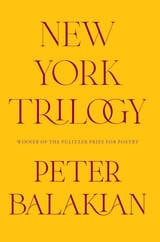
New York Trilogy
Peter Balakian
University of Chicago Press, 2025
In an inventive, elliptical language, New York Trilogy explores one man’s journey from the late 1960s to the twenty-first century, as he moves through a series of experiences centered in New York City and the surrounding New Jersey Palisades. Throughout this long poem in three parts, the protagonist’s life is impacted by historical events including the Armenian Genocide, the bombing of Hiroshima, the Vietnam War, the AIDS epidemic, the attacks of September 11th, the US war in Iraq, and the climate crisis.
Comprised of three multi-sequence poems originally included in Peter Balakian’s collections No Sign, Ozone Journal, and Ziggurat, the sections of New York Trilogy come together to form a poetry that embraces interior and aesthetic experiences, celebrates human intimacy, and bears witness to history. The historical power and psychological depth of Balakian’s work expands on the tradition of the American long poem with a lyrical narrative that weaves intimate personal moments into the vastness of shared history.
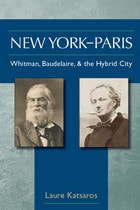
New York-Paris
Whitman, Baudelaire, and the Hybrid CityLaure Katsaros
University of Michigan Press, 2012
As New York and Paris began to modernize, new modes of entertainment, such as panoramas, dioramas, and photography, seemed poised to take the place of the more complex forms of literary expression. Dioramas and photography were invented in Paris but soon spread to America, forming part of an increasingly universal idiom of the spectacle. This brave new world of technologically advanced but crudely mimetic spectacles haunts both Whitman's vision of New York and Baudelaire's view of Paris. In New York-Paris, Katsaros explores the images of the mid-nineteenth-century city in the poetry of both Whitman and Baudelaire and seeks to demonstrate that, by projecting an image of the other's city onto his own, each poet tried to resist the apparently irresistible forward momentum of modernity rather than create a paradigmatically happy mixture of "high" and "low" culture.
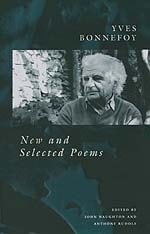
New and Selected Poems
Yves Bonnefoy
University of Chicago Press, 1995
Spanning four decades and drawing on all of Bonnefoy's major collections, this selection provides a comprehensive overview of and an ideal introduction to his work. The elegant translations, many of them new, are presented in this dual-language edition alongside the original French. Several significant works appear here in English for the first time, among them, in its entirety, Bonnefoy's 1991 book of verse, The Beginning and the End of the Snow, the 1988 prose poem Where the Arrow Falls, and an important long poem from 1993, "Wind and Smoke." Together with poems from such classic volumes as "In the Lure of the Threshold", these new works shed light on the growth as well as the continuity of Bonnefoy's work.
John Naughton's detailed introduction looks at the evolution of Bonnefoy's poetry from the 1953 publication of "On the Motion and Immobility of Douve", which immediately established his reputation as one of France's leading poets, through the 1993 publication of The Wandering Life and its centerpiece "Wind and Smoke."
"This is a comprehensive selection that contains examples of work spanning [Bonnefoy's] full career of forty years, from the ground-breaking "Du Mouvement et de l'Immobilité de Douve" through the celebratory "Pierre Ecrite" to the magical winter landscapes of America's East Coast and an unsettling reworking of myth in the recent "La Vie Errante" . . . The translations, which are the work of a variety of hands, including Galway Kinnell, Emily Grosholz and Anthony Rudolf, nevertheless fit well together and all are sensitive to the register and subtleties of both languages, while the introductory essay by John Naughton expertly explains Bonnefoy's importance as a poet and the influences which have shaped him. This is definitely a volume worth having, for layman and French specialist alike."—Hilary Davies, Times Literary Supplement
"Anyone not familiar with Bonnefoy's work will benefit from the background information and explanations given by John Naughton in his excellent introduction . . . . The book as a whole provides an excellent introduction to Bonnefoy's poetry and to his concerns of a lifetime."—Don Rodgers, Poetry Wales
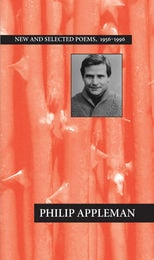
New and Selected Poems
1956-1996Philip Appleman
University of Arkansas Press, 1996
With an astonishing command of nature imagery, from sparrows to mastodons, Philip Appleman can deftly weave into a single poem an intricate pattern of ideas drawn from evolution, humanism, anthropology, religious skepticism, and everyday experience. Appealing to reason as well as to emotion and imagination, he writes poems of lyrical intensity and remarkable narrative depth. He creates characters—Eve or Darwin or a failed priest—with such wit, compassion, and subtle humor that they live on the page and surprise us with new insights into joy and sorrow, life and death. Set on the beach at Malibu, in the port of Trieste, or in a Manhattan subway, his poems evoke genuine feeling with out sentimentality and transform the personal into the universal.
Drawn from six previous books of poetry written over four decades, and with fourteen new poems, this collection shows the power and complexity of Appleman’s wide-ranging talent.
News from Where I Live
PoemsMartin Lammon
University of Arkansas Press, 1998
Winner of the eighth annual Arkansas Poetry Award, Martin Lammon writes poems that deal fearlessly and directly with their subjects. Tenderness, complexity, compassion, reverence, and condemnation are all within his range.
Writing of love, he can speak broadly and universally of the heart, yet in the same poem, he can intricately describe a woman’s hand, a fire on a beach, or the hollows around a lover’s eye. Even when he works in the voice of a suicide, his precision can be devastating, as in these lines: “When you lie beside me under stars, each needlepoint / of light pricks my bare arms.”
With equal ease, Lammon travels across miles, cultures, and time, writing of kilns and potters in Japan, long-dead Eskimos in Alaska, or Blue Hole Cave in Pennsylvania.
Full of grace and candor, these poems pursue the stories that shimmer behind the day’s headlines, seeking the spirit at stake in the “lives beside [our] own whose secrets are worth loving.”
Newspaper Verse
The Dark Matter of Eighteenth-Century English PoetryJohn O'Brien
University of Chicago Press, 0
A study of the popular but forgotten poetry published in eighteenth-century English newspapers and their overlooked influence on the canonical work from the period.
The first book-length study of its kind, Newspaper Verse focuses on poetry published in English-language newspapers during the long eighteenth century, including odes, couplets, news poems, ballads, and elegies by such famous poets as Jonathan Swift, Samuel Taylor Coleridge, Alexander Pope, Elizabeth Carter, and Thomas Gray and also verse by lesser-known or anonymous writers. For John O’Brien, these texts constitute something like the dark matter of eighteenth-century letters: the most widely read poetry in the period and yet unincorporated into existing narratives of eighteenth-century English literature. By engaging with these forgotten poems, O’Brien demonstrates how popular media enabled poetry to thrive and recovers their rich influence on the shape of English literary history.
Night Burial
Kate Bolton Bonnici
University Press of Colorado, 2020
Night Logic
Matthew Gellman
Tupelo Press, 2023
Night Radio
Kim Young
University of Utah Press, 2012
Winner of the Agha Shahid Ali Poetry Prize
Set against the sprawling backdrop of Los Angeles, Night Radio excavates the kidnapping and sexual assault of a young girl and the resulting layers of trauma exacted upon her and her family. Working within the paradox of the insufficiency of language and the necessity of expression, these poems elevate overwhelming experiences into near-mythic narrative. Night Radio’s attempt through art to “make sense” of a seemingly senseless world raises troubling and timeless questions about the value, necessity, and futility of the aesthetic act. At the heart of the book is a journey toward reconciliation—wherein one discovers an abiding though hard-won faith within a complex, overwhelming, and, at times, frightening universe.
Finalist for the Kate Tufts Discovery Award.
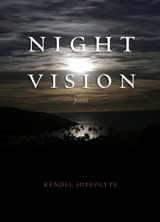
Night Vision
PoemsKendel Hippolyte
Northwestern University Press, 2006
it is difficult to see through it. And yet we must
or we become it, become nothing else but history.
It is this challenge, laid down in the powerful title poem of this collection, which Kendel Hippolyte takes up in Night Vision. And the history that Hippolyte penetrates is a history of the change overtaking the island of St. Lucia. As town becomes city and city spreads like a cancer, the poet's searching verse finds among the waste of humanity, nature, and culture a microcosm of the transforming Caribbean-from tradition, community, rooted identity, to social fragmentation, isolation, uncertainty. And yet, in the personal, away from the daytime public glare, Night Vision also finds the possibility of renewal. Engaging society and self, the poet's dialogue is conducted in a range of poetic voices and styles-the traditional forms of sonnet, villanelle, triolet, echo poem, as well as dramatic monologues in Caribbean English idioms and rhythms of speech; poems written to the metrics of blues and rap alongside free verse poems that expand in long-breath incantatory lines and contract in miniaturist forms as concise as graffiti. The joyful linguistic energy of the poems is perhaps what makes them, and us, look beyond the glaring reality they contemplate to a more hopeful, if nighttime, vision.
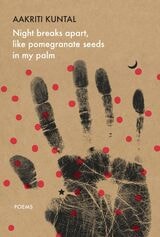
Night breaks apart, like pomegranate seeds in my palm
PoemsAakriti Kuntal
Seagull Books, 2025
What does it mean to exist within language—to shape it, and in turn, to be shaped by it? In Night breaks apart, like pomegranate seeds in my palm, Aakriti Kuntal crafts poems that unravel at the edges of self and myth, where language is neither home nor escape, but a threshold to something more elemental. Her verses move like water rolling and sifting through sediment, shifting between dream and flesh. Through intimate confessions and stark observations, she confronts the absurdity of suffering, the weight of the body, and the vast, unknowable machinery of the universe. Each poem resists easy meaning, instead offering raw honesty: language as both wound and salve.
For readers drawn to the introspective and the experimental, Kuntal’s poetry echoes the emotional depth of Ocean Vuong and the intellectual play of Anne Carson. This collection is for those who seek poetry not as answers, but as an experience—visceral, and unafraid to press against the limits of being.
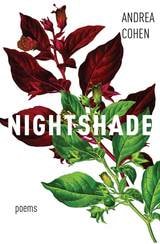
Nightshade
Andrea Cohen
Four Way Books, 2019
Nimble Believing
Dickinson and the UnknownJames McIntosh
University of Michigan Press, 2004
--Harold Bloom, Genius
" . . . a truly literary study in the largest, most humane, sense. Instead of subjecting poems to the distortions of theory, it brings biography, theology, psychology, and cultural history to bear on the intricacies of language, where all the issues of the poet's life and work converge, contend, and seek resolution."
--Albert Gelpi, American Literature
" . . . insightful readings of many of Dickinson's difficult poems and . . . a significant contribution to Dickinson studies."
---Choice
"McIntosh shows the power of Dickinson's religious quest in word, in verse, and in truth. He shows that she was much more than an ever-adolescent angry rebel trying to subvert the religious oppression of benighted Amherst neighbors."
---Emily Dickinson Journal

Nine Skies
POEMSA. V. Christie
University of Illinois Press, 1997
for the 1996 National Poetry Series
The late poet James V. Dickey
was judge of the Yale Prize poetry competition when he wrote to A. V.
Christie, one of the finalists, "I have become very fond of your
poems, especially the elegiac ones. . . . Your work is heartfelt; one
believes every word of it. . . . You have given me much in-depth pleasure;
have moved me strongly."
The work in Nine Skies
is as Dickey described it--heartfelt, moving. Here is what others
say about it:
"Beautifully crafted
and sustained, with six or seven poems as fine as anything being written
today. This remarkable book is a rite of passage for the poet and speaks
of even better things to come." -- Elizabeth Spires
"Only the best poetry
is written this well, with this much craft and conviction. Of course the
poems are meditative and elegiac, brilliant and finely detailed, but they
are also thought through and wholly felt, so that even in their small
moments they celebrate."
-- Stanley Plumly
"A. V. Christie writes
with a Romantic's eye and a Realist's heart, so there is no sentimentality,
that sickness afflicting our age. The voice on these pages is hard-bitten,
luxuriant, and true." -- Henri Cole
"Nine Skies is
a graceful realization in each detail of elegy or celebration." --
Sandra McPherson
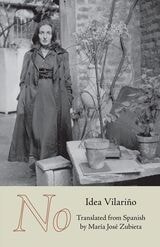
No
Idea Vilariño
Carnegie Mellon University Press, 2025
In No, Idea Vilariño strips poetry to its essence—distilling love, loss, and the inexorable passage of time into spare yet searing verses. Renowned as a leading voice of Uruguay’s “Generation of 45,” Vilariño’s final collection is at once a defiant refusal and an unrelenting assertion of existence. From its stark nihilism emerges a poetic voice that insists on being heard, even as it denies life’s joys.
Now available in English for the first time, No has been masterfully translated by María José Zubieta, in collaboration with poet and musicologist J. Martin Daughtry. This bilingual edition preserves Vilariño’s rhythmic precision and existential intensity, giving readers a rare glimpse into a body of work that continues to resonate far beyond its origins. No is a testament to the power of poetry to confront the void, and to carve meaning from silence.
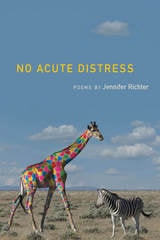
No Acute Distress
Jennifer Richter
Southern Illinois University Press, 2016
Richter seasons her work with irony from the start, titling the book’s opening poem, “Pleasant, healthy-appearing adult white female in no acute distress.” As the collection progresses, the speaker’s growing children bring new, wider perspective to the poems; the heart of the book opens up to embrace the adolescents’ increasing self-sufficiency and the body’s vibrant re-emergence into health.
No Acute Distress offers readers fresh language grounded in a masterful use of form, speaking with an urgency that acknowledges chronic pain’s cumulative damage to the body and spirit, and with an openness that allows for hope and the inexplicable on the path to victorious recovery.
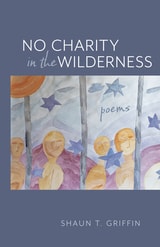
No Charity in the Wilderness
PoemsShaun T. Griffin
University of Nevada Press, 2024
Griffin has spent many decades in the high desert trying to find the way forward—when what he knows has been challenged and still there is breath on the horizon. One day an ancient Chinese poet comes to visit: "Snow deepens/ to quiet what I once believed, and Wang Wei stoops from the spine:/ this is how you become silence." Even if you doubt the old poet's counsel, like Griffin, you want to journey with him into the wilderness.
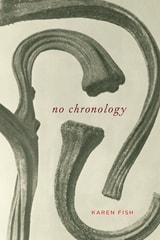
No Chronology
Karen Fish
University of Chicago Press, 2021
Imagine, staring into the sun, then,
how the clouds spread out and open like wallets
over a few corrugated roofs.