Results by title
857 books match the query 'Schools' and 8 start with n

Navigating Conflict
How Youth Handle Trouble in a High-Poverty SchoolCalvin Morrill and Michael Musheno
University of Chicago Press, 2018
Urban schools are often associated with violence, chaos, and youth aggression. But is this reputation really the whole picture? In Navigating Conflict, Calvin Morrill and Michael Musheno challenge the violence-centered conventional wisdom of urban youth studies, revealing instead the social ingenuity with which teens informally and peacefully navigate strife-ridden peer trouble. Taking as their focus a multi-ethnic, high-poverty school in the American southwest, the authors complicate our vision of urban youth, along the way revealing the resilience of students in the face of carceral disciplinary tactics.
Grounded in sixteen years of ethnographic fieldwork, Navigating Conflict draws on archival and institutional evidence to locate urban schools in more than a century of local, state, and national change. Morrill and Musheno make the case for schools that work, where negative externalities are buffered and policies are adapted to ever-evolving student populations. They argue that these kinds of schools require meaningful, inclusive student organizations for sustaining social trust and collective peer dignity alongside responsive administrative leadership. Further, students must be given the freedom to associate and move among their peers, all while in the vicinity of watchful, but not intrusive adults. Morrill and Musheno make a compelling case for these foundational conditions, arguing that only through them can schools enable a rich climate for learning, achievement, and social advancement.
Grounded in sixteen years of ethnographic fieldwork, Navigating Conflict draws on archival and institutional evidence to locate urban schools in more than a century of local, state, and national change. Morrill and Musheno make the case for schools that work, where negative externalities are buffered and policies are adapted to ever-evolving student populations. They argue that these kinds of schools require meaningful, inclusive student organizations for sustaining social trust and collective peer dignity alongside responsive administrative leadership. Further, students must be given the freedom to associate and move among their peers, all while in the vicinity of watchful, but not intrusive adults. Morrill and Musheno make a compelling case for these foundational conditions, arguing that only through them can schools enable a rich climate for learning, achievement, and social advancement.
[more]
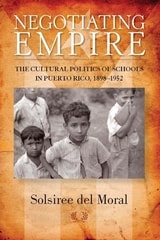
Negotiating Empire
The Cultural Politics of Schools in Puerto Rico, 1898–1952Solsiree del Moral
University of Wisconsin Press, 2013
After the United States invaded Puerto Rico in 1898, the new unincorporated territory sought to define its future. Seeking to shape the next generation and generate popular support for colonial rule, U.S. officials looked to education as a key venue for promoting the benefits of Americanization. At the same time, public schools became a site where Puerto Rican teachers, parents, and students could formulate and advance their own projects for building citizenship. In Negotiating Empire, Solsiree del Moral demonstrates how these colonial intermediaries aimed for regeneration and progress through education.
Rather than seeing U.S. empire in Puerto Rico during this period as a contest between two sharply polarized groups, del Moral views their interaction as a process of negotiation. Although educators and families rejected some tenets of Americanization, such as English-language instruction, they also redefined and appropriated others to their benefit to increase literacy and skills required for better occupations and social mobility. Pushing their citizenship-building vision through the schools, Puerto Ricans negotiated a different school project—one that was reformist yet radical, modern yet traditional, colonial yet nationalist.
Rather than seeing U.S. empire in Puerto Rico during this period as a contest between two sharply polarized groups, del Moral views their interaction as a process of negotiation. Although educators and families rejected some tenets of Americanization, such as English-language instruction, they also redefined and appropriated others to their benefit to increase literacy and skills required for better occupations and social mobility. Pushing their citizenship-building vision through the schools, Puerto Ricans negotiated a different school project—one that was reformist yet radical, modern yet traditional, colonial yet nationalist.
[more]
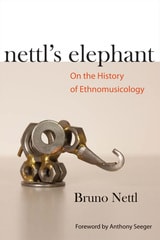
Nettl's Elephant
Bruno Nettle
University of Illinois Press, 2010
From one of the most lauded scholars in ethnomusicology comes this enlightening and highly personal narrative on the evolution and current state of the field of ethnomusicology. Surveying the field he helped establish, Bruno Nettl investigates how concepts such as evolution, geography, and history serve as catalysts for advancing ethnomusicological methods and perspectives. This entertaining collection covers Nettl's scholarly interests ranging from Native American to Mediterranean to Middle Eastern contexts while laying out the pivotal moments of the field and conversations with the giants of its past. Nettl moves from reflections on the history of ethnomusicology to evaluations of the principal organizations in the field, interspersing those broader discussions with shorter essays focusing on neglected literature and personal experiences.
[more]
Networks of Trust
The Social Costs of College and What We Can Do about ThemAnthony Simon Laden
University of Chicago Press, 2024
An eye-opening look at how parents’ mistrust of colleges has less to do with what their kids are learning than with whom they come to trust.
Higher education is a familiar battlefield in today’s culture wars. The right accuses colleges and universities of indoctrinating conservative students with liberal values; the left, with failing to be sufficiently inclusive. The anxieties expressed on both sides of the political spectrum have much in common, however, and they are triggered not by colleges’ failures but by their successes.
So argues philosopher Anthony Simon Laden in Networks of Trust. He highlights how a college education shapes students’ informational trust networks: the complex set of people and institutions they rely on for the information they use to think about and understand the world. While the networks that colleges build for students have great value, learning to inhabit them pulls some students away from their families and communities. If many people distrust institutions of higher education, this is one reason why. Networks of Trust offers a path forward, one that preserves the value while reducing the harms of a college education. It includes concrete suggestions for how colleges and universities can educate students in a manner that inspires and deserves trust: one that bridges rather than deepens our social divides.
[more]
Networks of Trust
The Social Costs of College and What We Can Do about ThemAnthony Simon Laden
University of Chicago Press, 2024
This is an auto-narrated audiobook version of this book.
An eye-opening look at how parents’ mistrust of colleges has less to do with what their kids are learning than with whom they come to trust.
Higher education is a familiar battlefield in today’s culture wars. The right accuses colleges and universities of indoctrinating conservative students with liberal values; the left, with failing to be sufficiently inclusive. The anxieties expressed on both sides of the political spectrum have much in common, however, and they are triggered not by colleges’ failures but by their successes.
So argues philosopher Anthony Simon Laden in Networks of Trust. He highlights how a college education shapes students’ informational trust networks: the complex set of people and institutions they rely on for the information they use to think about and understand the world. While the networks that colleges build for students have great value, learning to inhabit them pulls some students away from their families and communities. If many people distrust institutions of higher education, this is one reason why. Networks of Trust offers a path forward, one that preserves the value while reducing the harms of a college education. It includes concrete suggestions for how colleges and universities can educate students in a manner that inspires and deserves trust: one that bridges rather than deepens our social divides.
[more]
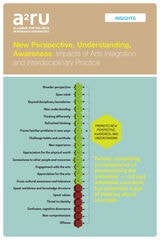
New Perspective, Understanding, Awareness
Impacts of Arts Integration and Interdisciplinary PracticeGabriel Harp
A2RU Intervals, 2019
The Alliance for the Arts in Research Universities (A2RU) fosters and champions the role of the arts and design in research universities. Underpinned by research and synthesis, our mission is connected knowledge and empowered leadership — to uphold and advance the arts and design in research, teaching, scholarship, and creative practice.
Learn more online at a2ru.org about A2RU programs, alliance partners, and how to become an A2RU partner. Discover insights and tools to support the arts and design in research universities. You can also search and browse A2RU conference abstracts, working session captures, and a wide array of supporting materials from A2RU and its alliance partnerships.
Learn more online at a2ru.org about A2RU programs, alliance partners, and how to become an A2RU partner. Discover insights and tools to support the arts and design in research universities. You can also search and browse A2RU conference abstracts, working session captures, and a wide array of supporting materials from A2RU and its alliance partnerships.
[more]
New Work of Writing Across the Curriculum
Diversity and Inclusion, Collaborative Partnerships, and Faculty DevelopmentStaci M. Perryman-Clark
Utah State University Press, 2023
The New Work of Writing Across the Curriculum is a descriptive analysis of how institutions can work to foster stronger intellectual activities around writing as connected to campus-wide diversity and inclusion initiatives. Author Staci M. Perryman-Clark blends theory and practice, grounds disciplinary conversations with practical examples of campus work, and provides realistic expectations for operations with budgetary constraints while enhancing diversity, equity, and inclusion work in higher education.
Many of these initiatives are created in isolation, reinforcing institutional silos that are not used strategically to gain the attention of senior administrators, particularly those working at state-supported public institutions who must manage shrinking institutional budgets. Yet teaching and learning centers and WAC programs gain tremendously from one another by building explicit partnerships on campus-wide diversity initiatives that emphasize cultural competence. In addition, both cultural competence and written proficiency enhance the transferable skills necessary for completing undergraduate education requirements, and this work can be leveraged to draw the attention of senior administrative leadership.
Faculty development and WAC need to make diversity and inclusion initiatives a priority for professional development. The New Work of Writing Across the Curriculum reviews initiatives that point to increased understanding of diversity and inclusion that will be of significance to administrators, WAC specialists, faculty developers, and diversity officers across the spectrum of institutions of higher learning.
[more]
Now Don't Try to Reason with Me
Essays and Ironies for a Credulous AgeWayne C. Booth
University of Chicago Press, 1970
In this entertaining collection of essays, Wayne Booth looks for the much-maligned “middle ground” for reason—a rhetoric that can unite truths of the heart with truths of the head and allow us all to discover shared convictions in mutual inquiry. First delivered as lectures in the 1960s, when Booth was a professor at Earlham College and the University of Chicago, Now Don’t Try to Reason with Me still resounds with anyone struggling for consensus in a world of us versus them.
“Professor Booth’s earnestness is graced by wit, irony, and generous humor.”—Louis Coxe, New Republic
“Professor Booth’s earnestness is graced by wit, irony, and generous humor.”—Louis Coxe, New Republic
[more]