Results by title
476 books match the query 'World War, 1939-1945' and 19 start with n

Nahum Goldman
His Missions to the GentileRaphael Patai
University of Alabama Press, 1980
Nahum Goldmann (1895-1982) was a major Zionist figure for the last half-century and the chief architect of the pact pledging West Germany to pay reparations to Israel and to individual Jews for acts committed during the Nazi regime. He was co-founder of the Eschkol Publishing House in Berlin and was co-publisher of the Encyclopedia Judaica, the only major Jewish encyclopedia published in Germany.
Patai’s study is the first to explore this brilliant, often irritating, and enormously successful Jewish politician and diplomat. Goldmann represented no government, yet he effected important international change. The book discusses Goldmann’s involvement with the partition controversy which led to the establishment of Israel, West German reparation payments amounting to over $36 billion, and a series of attempts to meet with Egyptian President Nasser in hopes of bringing peace to the Middle East.
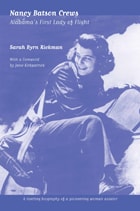
Nancy Batson Crews
Alabama's First Lady of FlightSarah Byrn Rickman
University of Alabama Press, 2009
This is the story of an uncommon woman--high school cheerleader, campus queen, airplane pilot, wife, mother, politician, business-woman--who epitomizes the struggles and freedoms of women in 20th-century America, as they first began to believe they could live full lives and demanded to do so. World War II offered women the opportunity to contribute to the work of the country, and Nancy Batson Crews was one woman who made the most of her privileged beginnings and youthful talents and opportunities.
In love with flying from the time she first saw Charles Lindbergh in Birmingham, (October 1927), Crews began her aviation career in 1939 as one of only five young women chosen for Civilian Pilot Training at the University of Alabama. Later, Crews became the 20th woman of 28 to qualify as an "Original" Women's Auxiliary Ferrying Squadron (WAFS) pilot, employed during World War II shuttling P-38, P-47, and P-51 high-performance aircrafts from factory to staging areas and to and from maintenance and training sites. Before the war was over, 1,102 American women would qualify to fly Army airplanes. Many of these female pilots were forced out of aviation after the war as males returning from combat theater assignments took over their roles. But Crews continued to fly, from gliders to turbojets to J-3 Cubs, in a postwar career that began in California and then resumed in Alabama.
The author was a freelance journalist looking to write about the WASP (Women Airforce Service Pilots) when she met an elderly, but still vital, Nancy Batson Crews. The former aviatrix held a reunion of the surviving nine WAFS for an interview with them and Crews, recording hours of her own testimony and remembrance before Crews's death from cancer in 2001. After helping lead the fight in the '70s for WASP to win veteran status, it was fitting that Nancy Batson Crews was buried with full military honors.

Nancy Love and the WASP Ferry Pilots of World War II
Sarah Byrn Rickman
University of North Texas Press, 2008

Narratives of Exile and Identity
Soviet Deportation Memoirs from the Baltic StatesTomas Balkelis
Central European University Press, 2018

National Socialism and Gypsies in Austria
Erika Thurner
University of Alabama Press, 1998
In this first English translation of Erika Thurner's National Socialism and Gypsies in Austria, Gilya Gerda Schmidt makes available Thurner’s investigation of Camps Salzburg and Lackenbach, the two central areas of Gypsy persecution in Austria. Two factors made Thurner’s research especially difficult: the Roma and Sinti have more an oral tradition than a written one, and scholarship on the plight of the Gypsies is sparse. Through painstaking research, Thurner has been able to piece together fragments from Nazi documents, recollections of victims, accounts of bystanders and other eyewitnesses, and formal records to present her account. The result is a volume that truly enhances our understanding of the Gypsies’ experiences during this period.
The volume also focuses on broader aspects of the Gypsies’ ordeals: the ideological foundations and legal ordinances regarding Gypsies, the discrimination and persecution in Burgenland as a whole, the transports from Austria to Lodz and Chelmo, and the medical experimentation. The book has also been expanded, with a new study of Camp Salzburg, an updated bibliography, and numerous photographs, which were not included in the German edition.
The recent upsurge of anti-Gypsy violence in Austria illustrates both the horror of the treatment of Gypsy tribes and the timeliness of the subject of this volume.

Nationalism and Terror
Ante Pavelic and Ustasha Terrorism from Fascism to the Cold WarGiorgio Cingolani
Central European University Press, 2018
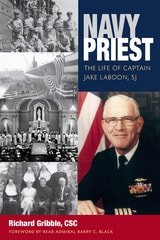
Navy Priest
Richard Gribble
Catholic University of America Press, 2015

Nazi-Looted Jewish Archives in Moscow
A Guide to Jewish Historical and Cultural Collections in the Russian State Military ArchiveEdited by David E. Fishman, Mark Kupovetsky, and Vladimir Kuzelenkov
University of Scranton Press, 2010

New Deal Photographs of West Virginia, 1934-1943
Betty Rivard
West Virginia University Press, 2012

Nightmare in the Pacific
The World War II Saga of Artie Shaw and His Navy BandMichael Doyle
University of North Texas Press, 2025
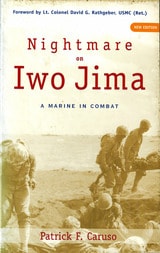
Nightmare on Iwo Jima
A Marine in CombatPatrick F. Caruso, with a foreword by David G. Rathgeber
University of Alabama Press, 2007
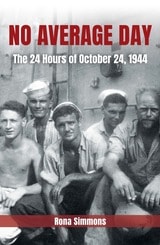
No Average Day
The 24 Hours of October 24, 1944Rona Simmons
University of Missouri Press, 2024
On Tuesday, October 24, 1944, nearly three years after the United States entered World War II, over 2,600 Americans perished—more than on any other single day of the conflict—yet the day remains overshadowed by more widely remembered dates in WWII history. Drawing from the accounts of men from diverse backgrounds who served in the U.S. Army, Navy, Marines, and Air Corps, Rona Simmons offers a gripping retelling of the fateful day, hour by hour and incident by incident. The book begins with Army Private First Class Paul Miller’s demise in a prisoner of war camp and ends with the death of Navy Seaman Second Class Wanza E. Matthews after the Japanese submarine I-56 attacked his ship off New Guinea. The sinking of the Japanese “hellship” Arisan Maru—a lesser-known tragedy of the war—looms large, deftly interwoven through each part of the narrative.
Perhaps the most compelling aspect of No Average Day is its attention to the human side of conflict, telling the stories of ordinary individuals—clerks, radio operators, cooks, sailors, machinist mates, riflemen, and pilots and their air crews—as they grapple with the horrors of the war. Despite its narrow focus, or perhaps because of it, No Average Day reveals the vastness of World War II through a consideration of the largely overlooked events that unfolded on what, for members of the US Armed Forces, was its deadliest day.
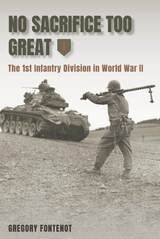
No Sacrifice Too Great
The 1st Infantry Division in World War IIGregory Fontenot
University of Missouri Press, 2027
The U.S. 1st Infantry Division (1st ID), familiarly known as the Big Red One, adapted to dynamic battlefield conditions throughout the course of its deployment during World War II by innovating and altering behavior, including tactics, techniques, and procedures. Both the Division’s leaders and soldiers accomplished this by thinking critically about their experiences in combat and wasting little time in putting lessons learned to good use. Simply put, they learned on the job—in battle and after battle—and did so quickly.
In telling the Division’s WWII story, which includes an extensive photographic essay featuring many previously unpublished images, Gregory Fontenot includes the stories of individual members of the Big Red One, from high-ranking officers to enlisted men fresh off the streets of Brooklyn, both during and after the conflict. Colonel Fontenot’s rare ability to combine expert analysis with compelling narrative history makes No Sacrifice Too Great an absorbing read for anyone interested in the military history of the United States.
No Sword To Bury
Japanese Americans In HawaiiFranklin S. Odo
Temple University Press, 2004

Normandy to the Bulge
An American GI in Europe During World War IIRichard Courtney
Southern Illinois University Press, 1997
Basing this compelling war memoir on his original World War II diary, Pfc. Richard D. Courtney tells what it was like to be a combat infantryman in the greatest and most destructive war in history.
Not Without Honor
The Nazi POW Journal of Steve Carano; With Accounts by John C. Bitzer and Bill BlackmonKay Sloan
University of Arkansas Press, 2008

Not the Germans Alone
A Son's Search for the Truth of VichyIsaac Levendel
Northwestern University Press, 2000
On the eve of D-Day, Isaac Levendel's mother left her hiding place on a farm in southern France and never returned. After 40 years of silence and torment, he returned to France in 1990 determined to find out what had happened. This is the story of how, with perseverance, luck, and official help, he gained access to secret wartime documents laying bare the details of French collaboration-and the truth about his mother's fate.

Nothing in Sight
Jens Rehn
University of Chicago Press, 2005
In a terse, almost clinically exact style, Nothing in Sight distills the brutal essence of what it is to die alone. Much more than a story of war, this short novel presents the memories, dreams, and hallucinations of two soldiers as they drift toward death. With nothing in sight on the horizon, Jens Rehn directs our view inward, into the minds of both men as they question the meaning of life, the existence of God, and the possibility of enduring human relationships. As the drama unfolds, each man recalls fragments of his past through the delirium of thirst and pain. The American soldier, his arm severed, dies first of gangrene. The German dies in agony a week later. Their life raft sinks into the vastness of the ocean.
Reissued two years ago in Germany, Nothing in Sight was hailed by critics there as a singular achievement. The work is presented here in a crystalline English translation for the first time, given new life for generations of readers to come.
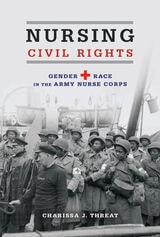
Nursing Civil Rights
Gender and Race in the Army Nurse CorpsCharissa J. Threat
University of Illinois Press, 2015
As Threat reveals, both groups viewed their circumstances with the Army Nurse Corps as a civil rights matter. Each conducted separate integration campaigns to end the discrimination they suffered. Yet their stories defy the narrative that civil rights struggles inevitably arced toward social justice. Threat tells how progressive elements in the campaigns did indeed break down barriers in both military and civilian nursing. At the same time, she follows conservative threads to portray how some of the women who succeeded as agents of change became defenders of exclusionary practices when men sought military nursing careers. The ironic result was a struggle that simultaneously confronted and reaffirmed the social hierarchies that nurtured discrimination.