Results by title
28164 books match the query 'History' and 647 start with n
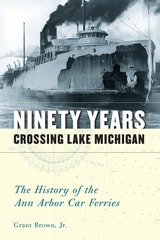
Ninety Years Crossing Lake Michigan
The History of the Ann Arbor Car FerriesGrant Brown, Jr.
University of Michigan Press, 2008
"A must buy for anyone interested in the Great Lakes."
---Frederick Stonehouse, maritime historian
In 1892, the Ann Arbor Car Ferries shook the transportation world by doing what was then deemed impossible---carrying loaded railroad cars by ship across the sixty-two miles of open water between Frankfort, Michigan and Kewaunee, Wisconsin. With passion, acuity, and remarkable detail, Grant Brown describes the nearly 100-year crossings---from their beginnings with James Ashley's bold new idea of car ferrying down to the last fight for survival until the Michigan Interstate Rail Company finally closed in 1982.
Crossing the lake with loaded freight cars was a treacherous task that presented daily obstacles. Knowledgeable people believed it was impossible to secure rail cars from tipping over and sinking the ship. Weather and ice presented two near-insurmountable hurdles, making car ferrying doubly difficult in the winter when nearly all shipping on the Great Lakes shut down. This vivid history gives voice to the ships and their crews as they battled the storms without modern navigational aids or adequate power.
This spirited account of the Ann Arbor car ferries draws on ships' logs from various museums, over 2,000 newspaper articles, annual reports from 1889 through 1976, and interviews with former employees. The result is a living history of the ships, the crews, and their adventures; of the men who built and ran the business; and of the enormous influence the vessels had on the communities they served.
Grant Brown, Jr., worked for S.D. Warren Company, a paper manufacturer, for 37 years. He raced sailboats on Crystal Lake in northern Michigan for ten years while growing up, continued in Boston and St. Louis, and has since returned to living and racing in Frankfort, Michigan. He spent eight years in the U.S. Coast Guard Reserve, where he learned navigation and shipboard procedure.

Ninety Years Crossing Lake Michigan
The History of the Ann Arbor Car FerriesGrant Brown, Jr.
University of Michigan Press, 2008
"A must buy for anyone interested in the Great Lakes."
---Frederick Stonehouse, maritime historian
In 1892, the Ann Arbor Car Ferries shook the transportation world by doing what was then deemed impossible---carrying loaded railroad cars by ship across the sixty-two miles of open water between Frankfort, Michigan and Kewaunee, Wisconsin. With passion, acuity, and remarkable detail, Grant Brown describes the nearly 100-year crossings---from their beginnings with James Ashley's bold new idea of car ferrying down to the last fight for survival until the Michigan Interstate Rail Company finally closed in 1982.
Crossing the lake with loaded freight cars was a treacherous task that presented daily obstacles. Knowledgeable people believed it was impossible to secure rail cars from tipping over and sinking the ship. Weather and ice presented two near-insurmountable hurdles, making car ferrying doubly difficult in the winter when nearly all shipping on the Great Lakes shut down. This vivid history gives voice to the ships and their crews as they battled the storms without modern navigational aids or adequate power.
This spirited account of the Ann Arbor car ferries draws on ships' logs from various museums, over 2,000 newspaper articles, annual reports from 1889 through 1976, and interviews with former employees. The result is a living history of the ships, the crews, and their adventures; of the men who built and ran the business; and of the enormous influence the vessels had on the communities they served.
Grant Brown, Jr., worked for S.D. Warren Company, a paper manufacturer, for 37 years. He raced sailboats on Crystal Lake in northern Michigan for ten years while growing up, continued in Boston and St. Louis, and has since returned to living and racing in Frankfort, Michigan. He spent eight years in the U.S. Coast Guard Reserve, where he learned navigation and shipboard procedure.
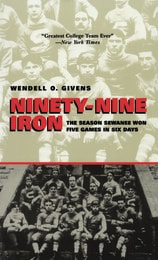
Ninety-Nine Iron
The Season Sewanee Won Five Games in Six DaysWendell Givens
University of Alabama Press, 2003
The fascinating story of the 1899 Sewanee football team’s remarkable, unassailable winning streak.
Ninety-Nine Iron is the story of the 1899 Sewanee football team. The University of the South, as it is formally called, is a small Episcopal college on Mounteagle Mountain in southeastern Tennessee. It is a respected academic institution not known for its athletic programs. But in that final year of the 19th century the Sewanee football team, led by captain “Diddy” Seibels, produced a record that is legendary.
In six days, on a grueling 2,500-mile train trip, the team defeated Texas, Texas A&M, Tulane, Louisiana State University, and Ole Miss—all much larger schools than Sewanee. In addition to this marathon of victory, the 21 members of the Sewanee Iron Men won all 12 of their regular games, and of their 12 opponents, only Auburn managed to score at all against them. Ten of these 12 victories were against Southern Intercollegiate Athletic Association opponents, which put Sewanee in the record books for most conference games played and most won in a season.
In Ninety-Nine Iron, Wendell Givens provides a play-by-play account of that remarkable season. He includes an overview of campus life at Sewanee and profiles of the players, the team’s coach (Billy Suter), the manager (Luke Lea), and the trainer (Cal Burrows). In the five years he researched the work, Givens conducted interviews with Seibels and visited the five cities in which the Iron Men had played—Austin, Houston, New Orleans, Baton Rouge, and Memphis. Givens has written a vivid account of a sports achievement not likely to be seen again.
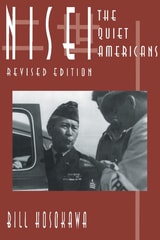
Nisei
The Quiet Americans, Revised EditionBill Hosokawa
University Press of Colorado, 2002
As Hosokawa additionally demonstrates, since World War II, Japanese Americans have achieved exceptional social, economic, and political progress. Their efforts led to apologies by four U.S. presidents for wartime injustices and redress through the landmark Civil Liberties Act of 1988. Brought up-to-date in this newly revised edition, Nisei details the transformation of these "quiet Americans" from despised security risks to respected citizens.

Nitinikiau Innusi
I Keep the Land AliveTshaukuesh Elizabeth Penashue
University of Manitoba Press, 2019

Nixon and the Silver Screen
Mark Feeney
University of Chicago Press, 2004
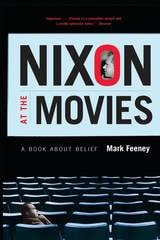
Nixon at the Movies
A Book about BeliefMark Feeney
University of Chicago Press, 2004
Nixon at the Movies takes a new and often revelatory approach to looking at Nixon's career—and Hollywood's. From the obvious (All the President's Men) to the less so (Elvis Presley movies and Nixon's relationship to '60s youth culture) to several onscreen "alternate" Nixons (Fred MacMurray in Double Indemnity, Tony Curtis in The Sweet Smell of Success, Gene Hackman in The Conversation), Feeney sees aspects of Nixon's character, and the nation's, refracted and reimagined in film. Conversely, Feeney argues that Nixon can help us see the movies in a new light, making a strong case for Nixon as the movies' tutelary deity during the early '70s, playing a role in Hollywood's Silver Age comparable to FDR's during its Golden Age.
Stylishly written and bracingly eclectic, Nixon at the Movies draws on biography, politics, cultural history, and film criticism to show just how deeply in the twentieth-century American grain lies the pair of seemingly incongruous nouns in its title. As Nixon once remarked to Garry Wills: "Isn't that a hell of a thing, that the fate of a great country can depend on camera angles?"

Nixon's Court
His Challenge to Judicial Liberalism and Its Political ConsequencesKevin J. McMahon
University of Chicago Press, 2011
Most analysts have deemed Richard Nixon’s challenge to the judicial liberalism of the Warren Supreme Court a failure—“a counterrevolution that wasn’t.” Nixon’s Court offers an alternative assessment. Kevin J. McMahon reveals a Nixon whose public rhetoric was more conservative than his administration’s actions and whose policy towards the Court was more subtle than previously recognized. Viewing Nixon’s judicial strategy as part political and part legal, McMahon argues that Nixon succeeded substantially on both counts.
Many of the issues dear to social conservatives, such as abortion and school prayer, were not nearly as important to Nixon. Consequently, his nominations for the Supreme Court were chosen primarily to advance his “law and order” and school desegregation agendas—agendas the Court eventually endorsed. But there were also political motivations to Nixon’s approach: he wanted his judicial policy to be conservative enough to attract white southerners and northern white ethnics disgruntled with the Democratic party but not so conservative as to drive away moderates in his own party. In essence, then, he used his criticisms of the Court to speak to members of his “Silent Majority” in hopes of disrupting the long-dominant New Deal Democratic coalition.
For McMahon, Nixon’s judicial strategy succeeded not only in shaping the course of constitutional law in the areas he most desired but also in laying the foundation of an electoral alliance that would dominate presidential politics for a generation.

Nkrumah & the Chiefs
The Politics of Chieftaincy in Ghana, 1951–1960Richard Rathbone
Ohio University Press, 1999
Kwame Nkrumah, who won independence for Ghana in 1957, was the first African statesman to achieve world recognition. Nkrumah and his movement also brought about the end of independent chieftaincy—one of the most fundamental changes in the history of Ghana.
Kwame Nkrumah’s Convention Peoples’ Party was committed not only to the rapid termination of British colonial rule but also to the elimination of chiefly power. This book is an account of Kwame Nkrumah and his government’s long struggle to wrest administrative control of the Ghanaian countryside from the chiefs. Based largely upon previously unstudied documentation in Ghana, this study charts the government’s frustrated attempts to democratize local government and the long and bitter campaigns mounted by many southern chiefs to resist their political marginalization.
Between 1951 and the creation of the First Republic in 1960, Ghanaian governments sought to discard the chiefly principle in local government, then to weaken chieftaincy by attrition and eventually, by altering the legal basis of chieftaincy, to incorporate and control a considerably altered chieftaincy. The book demonstrates that chieftaincy was consciously and systematically reconstructed in the decade of the 1950s with implications which can still be felt in modern Ghana.
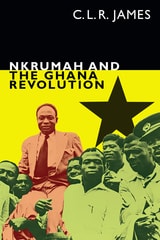
Nkrumah and the Ghana Revolution
C. L. R. James
Duke University Press, 2022
No Apocalypse, No Integration
Modernism and Postmodernism in Latin AmericaMartín Hopenhayn
Duke University Press, 2001
What form does the crisis of modernity take in Latin America when societies are politically demobilized and there is no revolutionary agenda in sight? How does postmodern criticism reflect on enlightenment and utopia in a region marked by incomplete modernization, new waves of privatization, great masses of excluded peoples, and profound sociocultural heterogeneity? In No Apocalypse, No Integration Martín Hopenhayn examines the social and philosophical implications of the triumph of neoliberalism and the collapse of leftist and state-sponsored social planning in Latin America.
With the failure of utopian movements that promised social change, the rupture of the link between the production of knowledge and practical intervention, and the defeat of modernization and development policy established after World War II, Latin American intellectuals and militants have been left at an impasse without a vital program of action. Hopenhayn analyzes these crises from a theoretical perspective and calls upon Latin American intellectuals to reevaluate their objects of study, their political reality, and their society’s cultural production, as well as to seek within their own history the elements for a new collective discourse. Challenging the notion that strict adherence to a single paradigm of action can rescue intellectual and cultural movements, Hopenhayn advocates a course of epistemological pluralism, arguing that such an approach values respect for difference and for cultural and theoretical diversity and heterodoxy.
This essay collection will appeal to readers of sociology, public policy, philosophy, cultural theory, and Latin American history and culture, as well as to those with an interest in Latin America’s current transition.
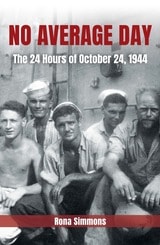
No Average Day
The 24 Hours of October 24, 1944Rona Simmons
University of Missouri Press, 2024
On Tuesday, October 24, 1944, nearly three years after the United States entered World War II, over 2,600 Americans perished—more than on any other single day of the conflict—yet the day remains overshadowed by more widely remembered dates in WWII history. Drawing from the accounts of men from diverse backgrounds who served in the U.S. Army, Navy, Marines, and Air Corps, Rona Simmons offers a gripping retelling of the fateful day, hour by hour and incident by incident. The book begins with Army Private First Class Paul Miller’s demise in a prisoner of war camp and ends with the death of Navy Seaman Second Class Wanza E. Matthews after the Japanese submarine I-56 attacked his ship off New Guinea. The sinking of the Japanese “hellship” Arisan Maru—a lesser-known tragedy of the war—looms large, deftly interwoven through each part of the narrative.
Perhaps the most compelling aspect of No Average Day is its attention to the human side of conflict, telling the stories of ordinary individuals—clerks, radio operators, cooks, sailors, machinist mates, riflemen, and pilots and their air crews—as they grapple with the horrors of the war. Despite its narrow focus, or perhaps because of it, No Average Day reveals the vastness of World War II through a consideration of the largely overlooked events that unfolded on what, for members of the US Armed Forces, was its deadliest day.
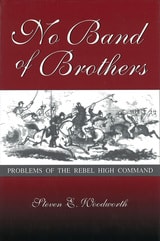
No Band of Brothers
Problems of the Rebel High CommandSteven E. Woodworth
University of Missouri Press, 1999
The Civil War was barely over before Southerners and other students of the war began to examine the Confederate high command in search of an explanation for the South's failure. Although years of research failed to show that the South's defeat was due to a single, overriding cause, the actions of the Southern leaders during the war were certainly among the reasons the South lost the war.
In No Band of Brothers, Steven Woodworth explores, through a series of essays, various facets of the way the Confederacy waged its unsuccessful war for secession. He examines Jefferson Davis and some of his more important generals, including Pierre G. T. Beauregard, Leonidas Polk, Joseph E. Johnston, Robert E. Lee, James Longstreet, and Thomas J. "Stonewall" Jackson; the Confederacy's strategic plans; and the South's success in making competent officers out of men with very little military preparation.
Woodworth particularly looks at the personalities and personal relationships that affected the course and outcome of the war. What made a good general? What could make an otherwise able man a failure as a general? What role did personal friendships or animosities play in the Confederacy's top command assignments and decisions? How successful was the Confederacy in making competent generals out of its civilian leaders? In what ways did Jefferson Davis succeed or fail in maximizing the chances for the success of his cause?
In analyzing the Confederate leadership, Woodworth reveals some weaknesses, many strengths, and much new information. No Band of Brothers will be an important addition to Civil War scholarship and will be welcomed by professional historians, amateur historians, students, and the general reader alike.
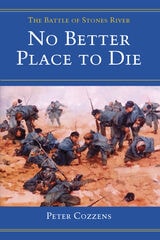
No Better Place to Die
THE BATTLE OF STONES RIVERPeter Cozzens
University of Illinois Press, 1990
It was here that both the Union and Confederate armies lost over one-quarter of their forces in battle casualties. The Confederacy's defeat at Stones River unleashed a wave of dissension that crippled the army's high command and ultimately closed Tennessee to the South for two years. The loss deterred the British and French from coming to the aid of the South in the Civil War, with tragic effects for the Southern cause.
In the 126 years since the guns fell silent at Stones River, few books have examined the bloody clash and its impact on the war's subsequent outcome. No Better Place to Die recounts the events and strategies that brought the two armies to the banks of this central Tennessee river on December 31, 1862. Cozzens re-creates the battle itself, following the movements and performance of individual regiments. A series of maps clarifies the combat activity.
Cozzens frequently lets the men who fought the battle speak for themselves, through letters, diaries, memoirs, and battlefield communications. Here we learn about such critical moments as General Philip Sheridan's gallant defense along the Wilkinson Pike, one of the war's most tenacious stands against overwhelming odds, and the bravery in battle exemplified by Brekenridge's attack on the Union left, a doomed assault with the poignancy of Pickett's charge.
Over twenty thousand Union and Confederate soldiers were killed, wounded, or captured in the bloody New Year's battle of Stone's River. The impact of their struggle extended far beyond the thousands of shattered human lives, ultimately imperiling the fortunes of the Confederacy. No Better Place to Die pays tribute to the heroes, the scoundrels, the mistakes, the bravery, and the grief at Stone's River.
No Bond but the Law
Punishment, Race, and Gender in Jamaican State Formation, 1780–1870Diana Paton
Duke University Press, 2004
No Bond but the Law reveals the longstanding and intimate relationship between state formation and private punishment. The construction of a dense, state-organized system of prisons began not with emancipation but at the peak of slave-based wealth in Jamaica, in the 1780s. Jamaica provided the paradigmatic case for British observers imagining and evaluating the emancipation process. Paton’s analysis moves between imperial processes on the one hand and Jamaican specificities on the other, within a framework comparing developments regarding punishment in Jamaica with those in the U.S. South and elsewhere. Emphasizing the gendered nature of penal policy and practice throughout the emancipation period, Paton is attentive to the ways in which the actions of ordinary Jamaicans and, in particular, of women prisoners, shaped state decisions.
No Boundaries
Transnational Latino Gangs and American Law EnforcementTom Diaz
University of Michigan Press, 2011
"Tom Diaz has worn out some shoe leather, much like a good detective, in gathering facts, not myths or urban legends. As a result he has produced an accurate and comprehensive look at a grave and present danger to our society."
---From the foreword by Chris Swecker, former Assistant Director of the FBI and former head of the FBI's Criminal Investigative Division
No Boundaries is a disturbing account of what many consider the "next Mafia"---Latino crime gangs. Like the Mafia, these gangs operate an international network, consider violence a routine matter, and defy U.S. law enforcement at every level. Also, the gangs spawn kingpins such as the notorious Nelson Martinez Varela Comandari, who nearly became the first "Latin godfather" in the United States.
Focusing on the Los Angeles–based Mara Salvatrucha (MS-13) and the 18th Street Gang, and the Chicago-based Latin Kings, Tom Diaz describes how neighborhood gangs evolved into extremely brutal, sophisticated criminal enterprises and how local and federal authorities have struggled to suppress them. As he makes clear, the problem of transnational Latino gangs involves complex national and international issues, such as racial tensions, immigration policy, conflict in Latin America, and world economic pressures.
Tom Diaz is a lawyer, author, and public speaker who conducts research on gun policy and violence for the Violence Policy Center, a Washington, D.C.–based think tank. He has covered national security affairs for the Washington Times and served as counsel to the U.S. House Subcommittee on Crime and Criminal Justice from 1993 to 1997.
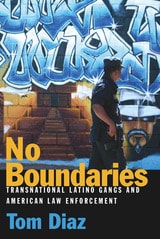
Cover photograph: Tegucigalpa, Honduras: A policeman passes by a graffiti of the Mara Salvatrucha "MS-13" (juvenile gang) at the entrance of the unit where members of the gang are kept imprisoned in the National Penitentiary in Tamara, 30 km north of Tegucigalpa, February 1, 2006. © Elmer Martinez/AFP/Getty Images
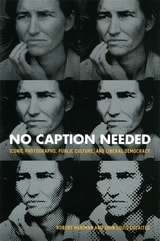
No Caption Needed
Iconic Photographs, Public Culture, and Liberal DemocracyRobert Hariman and John Louis Lucaites
University of Chicago Press, 2007
In No Caption Needed, Robert Hariman and John Louis Lucaites provide the definitive study of the iconic photograph as a dynamic form of public art. Their critical analyses of nine individual icons explore the photographs themselves and their subsequent circulation through an astonishing array of media, including stamps, posters, billboards, editorial cartoons, TV shows, Web pages, tattoos, and more. Iconic images are revealed as models of visual eloquence, signposts for collective memory, means of persuasion across the political spectrum, and a crucial resource for critical reflection.
Arguing against the conventional belief that visual images short-circuit rational deliberation and radical critique, Hariman and Lucaites make a bold case for the value of visual imagery in a liberal-democratic society. No Caption Needed is a compelling demonstration of photojournalism’s vital contribution to public life.
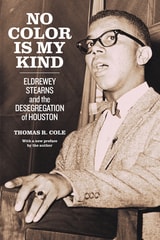
No Color Is My Kind
Eldrewey Stearns and the Desegregation of HoustonThomas R. Cole
University of Texas Press, 2021
In 1959, a Black man named Eldrewey Stearns was beaten by Houston police after being stopped for a traffic violation. He was not the first to suffer such brutality, but the incident sparked Stearns’s conscience and six months later he was leading the first sit-in west of the Mississippi River. No Color Is My Kind, first published in 1997, introduced readers to Stearns, including his work as a civil rights leader and lawyer in Houston’s desegregation movement between 1959 and 1963. This remarkable and important history, however, was nearly lost to bipolar affective disorder. Stearns was a fifty-two-year-old patient in a Galveston psychiatric hospital when Thomas Cole first met him in 1984. Over the course of a decade, Cole and Stearns slowly recovered the details of Stearns’s life before his slide into mental illness, writing a story that is more relevant today than ever.
In this new edition, Cole fills in the gaps between the late 1990s and now, providing an update on the progress of civil rights in Houston and Stearns himself. He also reflects on his tumultuous and often painful collaboration with Stearns, challenging readers to be part of his journey to understand the struggles of a Black man’s complex life. At once poignant, tragic, and emotionally charged, No Color Is My Kind is essential reading as the current movement for racial reconciliation gathers momentum.
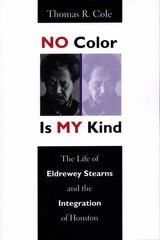
No Color Is My Kind
The Life of Eldrewey Stearns and the Integration of HoustonBy Thomas R. Cole
University of Texas Press, 1997
No Condition Is Permanent
The Social Dynamics of Agrarian Change in Sub-Saharan AfricaSara S. Berry
University of Wisconsin Press, 1993
“No condition is permanent,” a popular West African slogan, expresses Sara S. Berry’s theme: the obstacles to African agrarian development never stay the same. Her book explores the complex way African economy and society are tied to issues of land and labor, offering a comparative study of agrarian change in four rural economies in sub-Saharan Africa, including two that experienced long periods of expanding peasant production for export (southern Ghana and southwestern Nigeria), a settler economy (central Kenya), and a rural labor reserve (northeastern Zambia).
The resources available to African farmers have changed dramatically over the course of the twentieth century. Berry asserts that the ways resources are acquired and used are shaped not only by the incorporation of a rural area into colonial (later national) and global political economies, but also by conflicts over culture, power, and property within and beyond rural communities. By tracing the various debates over rights to resources and their effects on agricultural production and farmers’ uses of income, Berry presents agrarian change as a series of on-going processes rather than a set of discrete “successes” and “failures.”
No Condition Is Permanent enriches the discussion of agrarian development by showing how multidisciplinary studies of local agrarian history can constructively contribute to development policy. The book is a contribution both to African agrarian history and to debates over the role of agriculture in Africa’s recent economic crises.

No Country for Travellers?
British Visitors to Spain and Portugal, 1760–1820Rosemary Sweet and Richard Ansell
University College London, 2025
Using extensive archival and printed sources left by contemporary travelers, No Country for Travellers? explores the rise and nature of British travel to Spain and Portugal in the late eighteenth and early nineteenth centuries. Not only is it the first book to address the trend of travelers to the Iberian Peninsula during this time, revealing the extent of British interest in Islamic Spain before the Romantic era, but it also brings to light the role of non-combatant travelers to Iberia during the Peninsular War. Beyond uncovering a previously overlooked dimension of the Peninsular War, this history contends with stereotypes of Iberia that were embedded in early modern confessional and civilizational hierarchies.
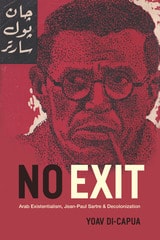
No Exit
Arab Existentialism, Jean-Paul Sartre, and DecolonizationYoav Di-Capua
University of Chicago Press, 2018
By closely following the remarkable career of Arab existentialism, Yoav Di-Capua reconstructs the cosmopolitan milieu of the generation that tried to articulate a political and philosophical vision for an egalitarian postcolonial world. He tells this story by touring a fascinating selection of Arabic and Hebrew archives, including unpublished diaries and interviews. Tragically, the warm and hopeful relationships forged between Arab intellectuals, Sartre, Simone de Beauvoir, and others ended when, on the eve of the 1967 war, Sartre failed to embrace the Palestinian cause. Today, when the prospect of global ethical engagement seems to be slipping ever farther out of reach, No Exit provides a timely, humanistic account of the intellectual hopes, struggles, and victories that shaped the Arab experience of decolonization and a delightfully wide-ranging excavation of existentialism’s non-Western history.

No Gifts from Chance
A Biography of Edith WhartonBy Shari Benstock
University of Texas Press, 2004
The first new biography of America's foremost woman of letters in twenty years, No Gifts from Chance presents an Edith Wharton for our times. Far from the emotionally withdrawn and neurasthenic victim of earlier portraits, she is revealed here as an ambitious, disciplined, and self-determined woman who fashioned life to her own desires. Drawing on government records, legal and medical documents, and recently opened collections of Wharton's letters, Shari Benstock's biography offers new information on what have been called the key mysteries of her life: the question of her paternity, her troubled relations with her mother and older brothers, her marriage to manic-depressive Teddy Wharton, and her extramarital affair with Morton Fullerton.

No Hand Held Mine
Stories — "Granny Wild Goose" and "The Root's Tale"Kim Soom
Rutgers University Press, 2026
An elderly Korean woman talking about being forced into sexual slavery during World War II. A modern Korean woman extricating herself from a failing relationship with an artist. Award-winning South Korean writer Kim Soom presents us with portraits of two women who couldn’t be more different but who both show resilience and compassion. No Hand Held Mine: Stories, containing one non-fiction piece and one short story, demonstrates the power and breadth of Kim’s writing. “Granny Wild Goose” uses former Comfort Woman Gil Won-Ok’s own words, recorded during conversations with Kim, to tell her life story of brutality, betrayal, and survival. In “The Root’s Tale,” the female protagonist comes to understand the strength of solitary women. Both devastating and reaffirming, No Hand Held Mine shows why Kim Soom has received every major literary award in Korea. Joon-Li Kim and Doo-Sun Ryu’s sensitive translation maintains Kim’s lyricism and exquisite imagery.
This book is published with the support of The Daesan Foundation.

No Hope for Heaven, No Fear of Hell
The Stafford-Townsend Feud of Colorado County, Texas 1871-1911James Kearney
University of North Texas Press, 2016

No Innocent Bystanders
Performance Art and AudienceFrazer Ward
Dartmouth College Press, 2012

No Limits to Their Sway
Cartagena's Privateers and the Masterless Caribbean in the Age of RevolutionsEdgardo Pérez Morales
Vanderbilt University Press, 2018
Most of Cartagena's privateers were people of color and descendants of slaves who benefited from the relative freedom and flexibility of life at sea, but also faced kidnapping, enslavement, and brutality. Many came from Haiti and Guadeloupe; some had been directly involved in the Haitian Revolution. While their manpower proved crucial in the early Anti-Spanish struggles, Afro-Caribbean privateers were also perceived as a threat, suspected of holding questionable loyalties, disorderly tendencies, and too strong a commitment to political and social privileges for people of color. Based on handwritten and printed sources in Spanish, English, and French, this book tells the story of Cartagena's multinational and multicultural seafarers, revealing the Trans-Atlantic and maritime dimensions of South American independence.

No Limits to Their Sway
Cartagena's Privateers and the Masterless Caribbean in the Age of RevolutionsEdgardo Pérez Morales
Vanderbilt University Press, 2022
Most of Cartagena's privateers were people of color and descendants of slaves who benefited from the relative freedom and flexibility of life at sea, but also faced kidnapping, enslavement, and brutality. Many came from Haiti and Guadeloupe; some had been directly involved in the Haitian Revolution. While their manpower proved crucial in the early Anti-Spanish struggles, Afro-Caribbean privateers were also perceived as a threat, suspected of holding questionable loyalties, disorderly tendencies, and too strong a commitment to political and social privileges for people of color. Based on handwritten and printed sources in Spanish, English, and French, this book tells the story of Cartagena's multinational and multicultural seafarers, revealing the Trans-Atlantic and maritime dimensions of South American independence.
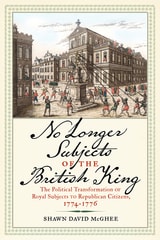
No Longer Subjects of the British King
The Political Transformation of Royal Subjects to Republican Citizens, 1774–1776Shawn David McGhee
Westholme Publishing, 2024
Historian Shawn McGhee offers a fresh perspective on the origins of American political identity. No Longer Subjects of the British King: The Political Transformation of Royal Subjects to Republican Citizens, 1774-1776reveals the crucial process by which the Continental Association organized American towns and counties into a protonational community of suffering to protect political identities they felt under threat. This work further demonstrates how those sacrificing for the common cause severed their bonds of allegiance to the British king and separated from the broader imperial nation. In this crucible of austerity, they formed an American political community, completing the political transformation from subject to citizen.

No Machos or Pop Stars
When the Leeds Art Experiment Went PunkGavin Butt
Duke University Press, 2022

No Man Is An Island
Community and Commemoration on Norway's UtøyaJørgen Watne Frydnes, translated by Wendy H. Gabrielsen
University of Massachusetts Press, 2025
On July 22, 2011, a white supremacist killed eight people at Oslo’s Government Center in Norway and then terrorized the idyllic island of Utøya, where he executed sixty-nine more people, mostly teenagers. The country had never suffered such a massacre, and in the aftermath, the entire population was reeling.
Utøya, the Norwegian Labor Party’s summer camp for youth, a beloved place where many Norwegians learned about democratic values and processes, made lifelong friendships, and developed a vision for a just society, became mired in grief and discord. When Jørgen Watne Frydnes took on the daunting task of rebuilding the island and charting its future, he had to figure out a compassionate and just way forward. He made a radical decision: he set out to talk with each family of a murdered person, seeking to understand their needs and their hopes so that the future of the island could include their wishes and concerns. This emotionally grueling work, which was never considered in the scholarly literature on commemoration, led to a true renewal of Utøya, resulting in a meaningful memorial to those who were lost as well as beautiful surroundings for campers who come there to study democracy and peace.
Frydnes’s narrative, originally published in Norwegian, is structured around the seasons of the year and the landscape of the island, and tracks one person’s account of learning how to remember, commemorate, and honor the dead, and acknowledge a mass tragedy, and yet also create a nurturing, aspirational space for hope.

No Mexicans, Women, or Dogs Allowed
The Rise of the Mexican American Civil Rights MovementBy Cynthia E. Orozco
University of Texas Press, 2009
Founded by Mexican American men in 1929, the League of United Latin-American Citizens (LULAC) has usually been judged according to Chicano nationalist standards of the late 1960s and 1970s. Drawing on extensive archival research, including the personal papers of Alonso S. Perales and Adela Sloss-Vento, No Mexicans, Women, or Dogs Allowed presents the history of LULAC in a new light, restoring its early twentieth-century context.
Cynthia Orozco also provides evidence that perceptions of LULAC as a petite bourgeoisie, assimilationist, conservative, anti-Mexican, anti-working class organization belie the realities of the group's early activism. Supplemented by oral history, this sweeping study probes LULAC's predecessors, such as the Order Sons of America, blending historiography and cultural studies. Against a backdrop of the Mexican Revolution, World War I, gender discrimination, and racial segregation, No Mexicans, Women, or Dogs Allowed recasts LULAC at the forefront of civil rights movements in America.
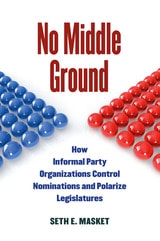
No Middle Ground
How Informal Party Organizations Control Nominations and Polarize LegislaturesSeth E. Masket
University of Michigan Press, 2011
"This is a fascinating book. It is one of the best studies of the ways that parties and politics get conducted in any American state. Masket shows that legislators can be perfectly content without parties that control agendas and does a terrific job of explaining the transition from free-wheeling legislators to rigidly partisan voting blocs."
---Sam Popkin, University of California at San Diego
"No Middle Ground makes a significant contribution to the study of American parties and legislative politics."
---Matthew Green, Catholic University of America
Despite concerns about the debilitating effects of partisanship on democratic government, in recent years political parties have gained strength in state governments as well as in Washington. Whereas political machines of the past manipulated votes, today's machines determine which candidates can credibly compete in a primary.
Focusing on the history and politics of California, Seth E. Masket reveals how these machines evolved and how they stay in power by directing money, endorsements, and expertise to favored candidates, who often tend toward the ideological extreme. Masket argues that politicians are not inherently partisan. Instead, partisanship is thrust upon them by actors outside the government with the power to manipulate primary elections.
Seth E. Masket is Associate Professor of Political Science at the University of Denver.
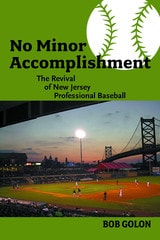
No Minor Accomplishment
The Revival of New Jersey Professional BaseballGolon, Bob
Rutgers University Press, 2008
In No Minor Accomplishment, sports historian and New Jersey native Bob Golon tells the story of the state's baseball scene since the Trenton Thunder arrived in 1994. Drawing on interviews with team owners and employees, industry executives and fans, Golon goes behind the scenes to show how maintaining a minor league ball club can be a risky business venture. Stadiums cost millions to build, and a team full of talented players does not immediately guarantee success. Instead, each of the eight minor league and independent professional teams in the state must tailor themselves to the communities in which they are situated. Shrewd marketing is necessary to attract fans, but Golon also explains how, unlike Major League Baseball, the business aspect of the minor and independent leagues is not something the average spectator notices. For the fans, baseball in New Jersey is wholesome, exciting family entertainment.

No Money, No Beer, No Pennants
The Cleveland Indians and Baseball in the Great DepressionScott H. Longert
Ohio University Press, 2016
The Cleveland Indians of 1928 were a far cry from the championship team of 1920. They had begun the decade as the best team in all of baseball, but over the following eight years, their owner died, the great Tris Speaker retired in the face of a looming scandal, and the franchise was in terrible shape. Seeing opportunity in the upheaval, Cleveland real estate mogul Alva Bradley purchased the ball club in 1927, infused it with cash, and filled its roster with star players such as Bob Feller, Earl Averill, and Hal Trosky. He aligned himself with civic leaders to push for a gigantic new stadium that—along with the team that played in it—would be the talk of the baseball world.
Then came the stock market crash of 1929. Municipal Stadium was built, despite the collapse of the industrial economy in Rust Belt cities, but the crowds did not follow. Always the shrewd businessman, Bradley had engineered a lease agreement with the city of Cleveland that included an out clause, and he exercised that option after the 1934 season, leaving the 80,000-seat, multimillion-dollar stadium without a tenant.
In No Money, No Beer, No Pennants, Scott H. Longert gives us a lively history of the ups and downs of a legendary team and its iconic players as they persevered through internal unrest and the turmoil of the Great Depression, pursuing a pennant that didn’t come until 1948. Illustrated with period photographs and filled with anecdotes of the great players, this book will delight fans of baseball and fans of Cleveland.

No More Dual City
The Fate of Atlantic CityChristina Jackson
Rutgers University Press, 2027
No More Dual City: The Fate of Atlantic City examines Atlantic City as a vivid case study of how Black communities endure and resist the forces of economic redevelopment, racialized planning, and environmental vulnerability. Drawing on five years of ethnographic research, Jackson reveals how the city’s famed tourism and casino economy depends upon, yet marginalizes, the historically Black Northside neighborhood. Through the concept of dualness, Jackson explores how racial capitalism produces both material and emotional divides, between growth and decay, visibility and exclusion, and belonging and dispossession. Combining first-person narrative, theory, and community storytelling, the book illuminates the “slow violence” of urban inequality and the creativity of residents who build rooted futures amid instability. No More Dual City reframes Atlantic City not as an anomaly but as a microcosm of racialized urban America, offering a compelling new way to think about sustainability, justice, and the right to stay in place.

No More Separate Spheres!
A Next Wave American Studies ReaderCathy N. Davidson and Jessamyn Hatcher, eds.
Duke University Press, 2002
Using American literary studies as a way to talk about changing categories of analysis, these essays discuss the work of such major authors as Catharine Sedgwick, Herman Melville, Pauline E. Hopkins, Frederick Douglass, Catharine Beecher, Ralph Waldo Emerson, W. E. B. Du Bois, Sarah Orne Jewett, Nathaniel Hawthorne, María Ampara Ruiz de Burton, Ann Petry, Gwendolyn Brooks, Cynthia Kadohata, Chang Rae-Lee, and Samuel Delany. No More Separate Spheres! shows scholars and students different ways that gender can be approached and incorporated into literary interpretations. Feisty and provocative, it provides a forceful analysis of the limitations of any theory of gender that applies only to women, and urges suspicion of any argument that posits “woman” as a universal or uniform category.
By bringing together essays from the influential special issue of American Literature of the same name, a number of classic essays, and several new pieces commissioned for this volume, No More Separate Spheres! will be an ideal teaching tool, providing a key supplementary text in the American literature classroom.
Contributors. José F. Aranda, Lauren Berlant, Cathy N. Davidson, Judith Fetterley, Jessamyn Hatcher, Amy Kaplan, Dana D. Nelson, Christopher Newfield, You-me Park, Marjorie Pryse, Elizabeth Renker, Ryan Schneider, Melissa Solomon, Siobhan Somerville, Gayle Wald , Maurice Wallace
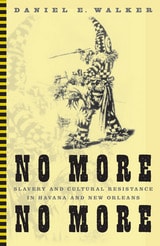
No More, No More
Slavery And Cultural Resistance In Havana And New OrleansDaniel E. Walker
University of Minnesota Press, 2004
An illuminating look at the festival performances of slaves in Havana and New Orleans
However urban slave societies might have differed from their rural counterparts, they still relied on a concerted assault on the psychological, social, and cultural identity of their African-descended inhabitants to maintain power and control. This ambitious book looks at how people of African descent in two such societies—Havana and New Orleans in the nineteenth century—created and maintained their own forms of cultural resistance to the slave regime’s assault and, in the process, put forth autonomous views of self and the social landscape.
In Havana’s annual Día de Reyes festival and in the weekly activities that took place at New Orleans’s Congo Square, author Daniel Walker identifies specific cultural beliefs and activities that Africans brought to the New World and modified in order to withstand and contest the dehumanizing effects of oppression. No More, No More crosses disciplinary boundaries as well, elucidating the economic, social, cultural, and demographic operations at work in two cities and the wide-scale efforts at cultural resistance embodied in public performances.
No One Ailing Except a Physician
Medicine in the Mining West, 1848-1919Duane A. Smith
University Press of Colorado, 2001
From burying scurvy victims up to their necks in the earth to drinking kerosene mixed with sugar to treat influenza, mid-nineteenth century medicine in the mining communities of the West usually consisted of home remedies that were often remarkable for their inventiveness but tragically random in their effectiveness. Only as a desperate last resort would people turn to the medical community, which had developed a deplorable reputation for quackery and charlatanism because of its lack of licensing regulations and uniform educational standards. No One Ailing Except a Physician takes readers back to those free-wheeling days in the mining towns and the dark recesses of the mines themselves, a time when illness or injury was usually survived more due to sheer luck than the interventions of medicine.
In this important new contribution to both mining and medical history, historians Duane A. Smith and Ronald C. Brown present a detailed analysis of the ailments that confronted the miners and the methods with which they and their doctors attempted to "cure" them. The occupational hazards of mining, with its strenuous labor and exposure to the elements, contributed to the miners' vulnerability to disease and injury, which was further worsened by the typical miner's refusal to heed prevailing medical wisdom and common sense, often leading to easily preventable diseases such as scurvy. And because medical science of the era had not progressed much beyond that of the ancient Greeks, such debilitating diseases such as cholera, influenza, dysentery, and malaria proved to be virtual death sentences, to say nothing of occupational accidents with fires and explosions, mine collapses, and safety cage mishaps.
No One Ever Asked
The Untold Story of a Civil Rights WorkerArnold Rochvarg
University of Missouri Press, 2025
Rochvarg, the cousin of the woman around whom the narrative revolves, had for over fifty years been intrigued by the mystery surrounding the seven-year disappearance of his cousin Iris during the 1960s. Once he finally approached her about her rumored involvement in the civil rights movement, she generously shared her experiences with him and arranged for him to meet others with whom she had worked. His book corroborates and enhances the stories he was told through traditional research based on primary and secondary sources.
More than a review of significant events of the mid-1960s, No One Ever Asked is also the story of the challenges and sacrifices of young civil rights workers both Black and white, young persons who not only faced violence and personal harm, but in many cases became estranged from their families because of their involvement in the movement. Rochvarg approaches history from the “bottom-up,” focusing on persons whose stories have never been told but have something to add to an understanding of the history of the movement. Many of them, even sixty years later, have never shared their stories because, as in the case of the central character of this book, no one ever asked them.

No One Knows Their Names
Screenwriters in HollywoodJorja Prover
University of Wisconsin Press, 1994
No One Was Killed
The Democratic National Convention, August 1968John Schultz
University of Chicago Press, 2009
While other writers contemplated the events of the 1968 Chicago riots from the safety of their hotel rooms, John Schultz was in the city streets, being threatened by police, choking on tear gas, and listening to all the rage, fear, and confusion around him. The result, No One Was Killed, is his account of the contradictions and chaos of convention week, the adrenalin, the sense of drama and history, and how the mainstream press was getting it all wrong.
"A more valuable factual record of events than the city’s white paper, the Walker Report, and Theodore B. White’s Making of a President combined."—Book Week
"As a reporter making distinctions between Yippie, hippie, New Leftist, McCarthyite, police, and National Guard, Schultz is perceptive; he excels in describing such diverse personalities as Julian Bond and Eugene McCarthy."—Library Journal
"High on my short list of true, lasting, inspired evocations of those whacked-out days when the country was fighting a phantasmagorical war (with real corpses), and police under orders were beating up demonstrators who looked at them funny."—Todd Gitlin, from the foreword
No Ordinary Letter
A Gendered History of Rural Violence and Shame in Apartheid South AfricaJill E. Kelly
Ohio University Press, 0
No Ordinary Letter reconstructs the intellectual world of rural South African women who, in 1959, mounted determined campaigns across Natal to resist the expanding policies of apartheid. Challenging Bantu Authorities, detrimental agricultural schemes, restrictions on movement, and the extension of pass laws to women, these organizers drew on knowledge rooted in the lived experience of farmwork, household management, and community governance. The book shows how women assessed their political circumstances and crafted strategies—some peaceful, some destructive—to make themselves heard in a system structured to ignore them.
Foregrounding women as thinkers as well as activists, No Ordinary Letter reveals how rural organizers theorized their positions under apartheid law and within patriarchal households and communities. Their repertoire of political understanding encompassed the daily violence of apartheid, local cultures of honor that enabled them to shame others into action, and finely honed skills for navigating the authority of elders, in-laws, and traditional leaders. When the Camperdown Native Commissioner asked why a group had destroyed government property, they replied, “We were really writing a letter to the authorities which they could read. If we had written an ordinary letter, you would not have replied.” Their explanation captures how an underlying logic of violence became a vehicle for extraordinary political communication.
At the same time, the book underscores the profound constraints shaping women’s choices: poverty, state repression, and the multiple patriarchies embedded within both the apartheid state and African communities. These overlapping systems meant that the immediate enforcers of apartheid policy were often African men with their own stakes in patriarchal arrangements. No Ordinary Letter offers a groundbreaking account of how rural women understood, navigated, and contested these entangled structures of power, providing a fresh view on political thought and resistance in apartheid South Africa.
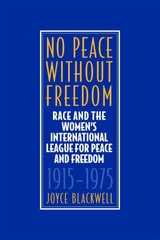
No Peace Without Freedom
Race and The Women's International League For Peace and Freedom 1915-1975Joyce Blackwell
Southern Illinois University Press, 2004
Just as women changed the direction and agenda of the peace movement when they became progressively more involved in an all-male club, black women altered a cause that had previously lacked racial diversity when they were first granted admission to the Women’s International League for Peace and Freedom in 1915. As Joyce Blackwell illustrates in this first study of collective black peace activism, the increased presence of black women in the WILPF over the next sixty years brought to the movement historical experiences shaped by societal racism.
No Peace Without Freedom: Race and the Women’s International League for Peace and Freedom, 1915–1975 explores how black women, fueled by the desire to eradicate racial injustice, compelled the white leadership of the WILPF to revisit its own conceptions of peace and freedom. Blackwell offers a renewed examination of peace movements in American history, one that points out the implications of black women’s participation for the study of social activism, African American history, and women’s history. This new perspective on interracial and black female global activism helps redefine the often-covert systemic violence necessary to maintain systems of social and economic hierarchy, moving peace and war discourse away from its narrow focus on European and European-American issues.
Blackwell looks closely at the reasons why white women organized their own peace group at the start of World War I and assesses several bold steps taken by these groups in their first ten years. Addressing white peace activists’ continuous search for the “perfect” African American woman, Blackwell considers when and why black women joined the WILPF, why so few of them were interested in the organization, and what the small number who did join had in common with their white counterparts. She also shows how the WILPF, frustrated at its inability to successfully appeal to black women, established a controversial interracial committee to deal with the dilemma of recruiting black women while attempting to maintain all of its white members.
Tracing the black activists’ peace reform activities on an international level from World War I to the end of the Vietnam War, No Peace Without Freedom examines the links black activists established within the African American community as well as the connections they made with peoples of the black Diaspora and later with colonized people irrespective of race. The volume is complemented by eighteen illustrations.

No Peace, No War
An Anthropology of Contemporary Armed ConflictsPaul Richards
Ohio University Press, 2004
A rash of small wars erupted after the Cold War ended in Africa, the Balkans, and other parts of the former communist world. The wars were in “inter-zones,” the spaces left where weak states had withdrawn or collapsed. Consequently the debate over what constitutes war has returned to basics. No Peace, No War departs from the usual analysis that considers the new wars mindless mass actions to offer the paradoxical idea that to understand war one must deny war special status. Rather than leave war to the security specialists, these writers attempt to grasp its character as one among many aspects of social reality.
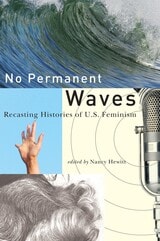
No Permanent Waves
Recasting Histories of U.S. FeminismHewitt, Nancy A
Rutgers University Press, 2010
A respected group of contributors from diverse generations and backgrounds argue for new chronologies, more inclusive conceptualizations of feminist agendas and participants, and fuller engagements with contestations around particular issues and practices. Race, class, and sexuality are explored within histories of women's rights and feminism as well as the cultural and intellectual currents and social and political priorities that marked movements for women's advancement and liberation. These essays question whether the concept of waves surging and receding can fully capture the complexities of U.S. feminisms and suggest models for reimagining these histories from radio waves to hip-hop.
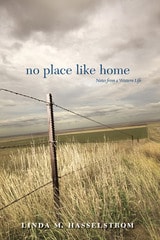
No Place Like Home
Notes from a Western LifeLinda M. Hasselstrom
University of Nevada Press, 2010
In No Place Like Home, Linda Hasselstrom ponders the changing nature of community in the modern West, where old family ranches are being turned into subdivisions and historic towns are evolving into mean, congested cities. Her scrutiny, like her life, moves back and forth between her ranch on the South Dakota prairie and her house in an old neighborhood at the edge of downtown Cheyenne, Wyoming. The vignettes that form the foundation of her consideration are drawn from the communities she has known during her life in the West, reflecting on how they have grown, thrived, failed, and changed, and highlighting the people and decisions that shaped them. Hasselstrom’s ruminations are both intensely personal and universal. She laments the disappearance of the old prairie ranches and the rural sense of community and mutual responsibility that sustained them, but she also discovers that a spirit of community can be found in unlikely places and among unlikely people. The book defines her idea of how a true community should work, and the kind of place she wants to live in. Her voice is unique and honest, both compassionate and cranky, full of love for the harsh, hauntingly beautiful short-grass prairie that is her home, and rich in understanding of the intricacies of the natural world around her and the infinite potentials of human commitment, hope, and greed. For anyone curious about the state of the contemporary West, Hasselstrom offers a report from the front, where nature and human aspirations are often at odds, and where the concepts of community and mutual responsibility are being redefined.

No Place To Call Home
The 1807-1857 Life Writings of Caroline Barnes Crosby, Chronicler of Outlying Mormon CommunitiesEdward Leo Lyman, Susan Ward Payne, and S. George Ellsworth
Utah State University Press, 2020
Caroline Crosby's life took a wandering course between her 1834 marriage to Jonathan Crosby and conversion to the infant Mormon Church and her departure for her final home, Utah, on New Year's Day, 1858. In the intervening years, she lived in many places but never long enough to set firm roots. Her adherence to a frontier religion on the move kept her moving, even after the church began to settle down in Utah. Despite the impermanence of her situation—perhaps even because of it—Caroline Crosby left a remarkably rich record of her life and travels, thereby telling us not only much about herself and her family but also about times and places of which her documentary record provides a virtually unparalleled view. A notable aspect of her memoirs and journals is what they convey of the character of their author, who, despite the many challenges of transience and poverty she faced, appears to have remained curious, dedicated, observant, and optimistic.
From Caroline's home in Canada, she and Jonathan Crosby first went to the headquarters of Joseph Smith's new church in Kirtland, Ohio. She recounts, in a memoir, the early struggles of his followers there. As the church moved west, the Crosbys did as well, but, as became characteristic, they did not move immediately with the main body to the center of the religion. For a while they settled in Indiana, finally reaching the new Mormon center of Nauvoo in 1842. Fleeing Nauvoo with the last of the Mormons in 1846, they spent two years in Iowa and set out for Utah in 1848, the account of which is the first of Caroline Crosby's vivid trail journals. The Crosbys were able to rest in Salt Lake City for less than two years before Brigham Young sent them on a church mission to the Society and Austral Islands in the South Pacific. She recorded, in detail, their overland travel to San Francisco and then by sea to French Polynesia and their service on the islands. In late 1852 the Crosbys returned to California, beginning what is probably the most historically significant time recorded in her writings, her diaries of life. First, in immediately post-Gold-Rush San Francisco and, second, in the new Mormon village of San Bernardino in southern California. There is no comparable record by a woman of 1850s life in these growing communities. The Crosbys responded in 1857 to Brigham Young's call for church members to gather in Utah and again abandoned a new home—the nicest one they had built and one of the finest houses in San Bernardino—again displaying their unquestioning loyalty to the Mormon church.

No Place of Grace
Antimodernism and the Transformation of American Culture, 1880-1920T. J. Jackson Lears
University of Chicago Press, 2021
First published in 1981, T. J. Jackson Lears’s No Place of Grace is a landmark book in American studies and American history, acclaimed for both its rigorous research and the deft fluidity of its prose. A study of responses to the emergent culture of corporate capitalism at the turn of the twentieth century, No Place of Grace charts the development of contemporary consumer society through the embrace of antimodernism—the effort among middle- and upper-class Americans to recapture feelings of authentic experience. Rather than offer true resistance to the increasingly corporatized bureaucracy of the time, however, antimodernism helped accommodate Americans to the new order—it was therapeutic rather than oppositional, a striking forerunner to today’s self-help culture. And yet antimodernism contributed a new dynamic as well, “an eloquent edge of protest,” as Lears puts it, which is evident even today in anticonsumerism, sustainable living, and other practices. This new edition, with a lively and discerning foreword by Jennifer Ratner-Rosenhagen, celebrates the fortieth anniversary of this singular work of history.
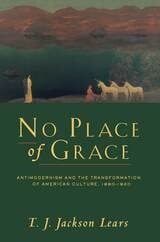
No Place of Grace
Antimodernism and the Transformation of American Culture, 1880–1920T. J. Jackson Lears
University of Chicago Press, 1994
"It's an understatement to call No Place of Grace a brilliant book. . . . It's the first clear sign I've seen that my generation, after marching through the '60s and jogging through the '70s might be pausing to examine what we've learned, and to teach it."—Walter Kendrick, Village Voice
"One can justly make the claim that No Place of Grace restores and reinterprets a crucial part of American history. Lears's method is impeccable."—Ann Douglas, The Nation