Results by title
1116 books match the query 'Africa' and 16 start with o
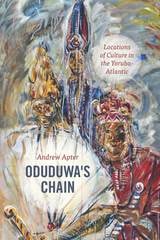
Oduduwa's Chain
Locations of Culture in the Yoruba-AtlanticAndrew Apter
University of Chicago Press, 2017
Focusing on Yoruba history and culture in Nigeria, Apter applies a generative model of cultural revision that allows him to identify formative Yoruba influences without resorting to the idea that culture and tradition are fixed. For example, Apter shows how the association of African gods with Catholic saints can be seen as a strategy of empowerment, explores historical locations of Yoruba gender ideologies and their variations in the Atlantic world, and much more. He concludes with a rousing call for a return to Africa in studies of the Black Atlantic, resurrecting a critical notion of culture that allows us to transcend Western inventions of African while taking them into account.
Of Revelation and Revolution, Volume 1
Christianity, Colonialism, and Consciousness in South AfricaJean Comaroff and John L. Comaroff
University of Chicago Press, 1991
Of Revelation and Revolution, Volume 2
The Dialectics of Modernity on a South African FrontierJohn L. Comaroff and Jean Comaroff
University of Chicago Press, 1997
The Comaroffs trace many of the major themes of twentieth-century South African history back to these formative encounters. The relationship between the British evangelists and the Southern Tswana engendered complex exchanges of goods, signs, and cultural markers that shaped not only African existence but also bourgeois modernity "back home" in England. We see, in this volume, how the colonial attempt to "civilize" Africa set in motion a dialectical process that refashioned the everyday lives of all those drawn into its purview, creating hybrid cultural forms and potent global forces which persist in the postcolonial age.
This fascinating study shows how the initiatives of the colonial missions collided with local traditions, giving rise to new cultural practices, new patterns of production and consumption, new senses of style and beauty, and new forms of class distinction and ethnicity. As noted by reviewers of the first volume, the Comaroffs have succeeded in providing a model for the study of colonial encounters. By insisting on its dialectical nature, they demonstrate that colonialism can no longer be seen as a one-sided relationship between the conquering and the conquered. It is, rather, a complex system of reciprocal determinations, one whose legacy is very much with us today.
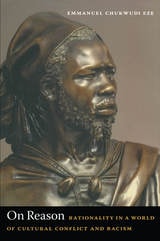
On Reason
Rationality in a World of Cultural Conflict and RacismEmmanuel Chukwudi Eze
Duke University Press, 2008
Eze draws on an extraordinary command of Western philosophical thought and a deep knowledge of African philosophy and cultural traditions. He explores models of rationality in the thought of philosophers from Aristotle, René Descartes, Francis Bacon, and Thomas Hobbes to Noam Chomsky, Richard Rorty, Hilary Putnam, and Jacques Derrida, and he considers portrayals of reason in the work of the African thinkers and novelists Chinua Achebe, Ngugi wa Thiong’o, and Wole Soyinka. Eze reflects on contemporary thought about genetics, race, and postcolonial historiography as well as on the interplay between reason and unreason in the hearings of South Africa’s Truth and Reconciliation Commission. He contends that while rationality may have a foundational formality, any understanding of its foundation and form is dynamic, always based in historical and cultural circumstances.

On the Fringes of History
A MemoirPhilip D. Curtin
Ohio University Press, 2005
In the 1950s, professional historians claiming to specialize in tropical Africa were no more than a handful. The teaching of world history was confined to high school courses, and even those were focused on European history, with a chapter added to account for the history of East and South Asia. The change over the ensuing decades was revolutionary.
Philip D. Curtin was a leader among a new generation of historians that emerged after the Second World War. Written with characteristic economy and telling detail, On the Fringes of History: A Memoir follows Curtin from his beginnings in central West Virginia in the 1920s, through a distinguished academic career in which Curtin founded African studies at the University of Wisconsin. He began the programs in comparative world history at Wisconsin and Johns Hopkins, producing many of the most influential historians and Africanists from the 1950s to today.
Always an independent thinker and controversial figure, Curtin revived the study of the Atlantic slave trade. His career stands as an example of the kind of dissatisfaction and struggles that brought about a sea change in higher education. On the Fringes of History traces the movement of African history and world history from the fringes of the history profession into the mainstream. This stunningly illustrated memoir illuminates both the career of a leading historian and the history of twentieth-century academia.
One Way
BERNARD DADIE OBSERVES AMERICABernard Binlin Dadié
University of Illinois Press, 1994
Oral Tradition as History
Jan M. Vansina
University of Wisconsin Press, 1985
Jan Vansina’s 1961 book, Oral Tradition, was hailed internationally as a pioneering work in the field of ethno-history. Originally published in French, it was translated into English, Spanish, Italian, Arabic, and Hungarian. Reviewers were unanimous in their praise of Vansina’s success in subjecting oral traditions to intense functional analysis.
Now, Vansina—with the benefit of two decades of additional thought and research—has revised his original work substantially, completely rewriting some sections and adding much new material. The result is an essentially new work, indispensable to all students and scholars of history, anthropology, folklore, and ethno-history who are concerned with the transmission and potential uses of oral material.
“Those embarking on the challenging adventure of historical fieldwork with an oral community will find the book a valuable companion, filled with good practical advice. Those who already have collected bodies of oral material, or who strive to interpret and analyze that collected by others, will be forced to subject their own methodological approaches to a critical reexamination in the light of Vansina’s thoughtful and provocative insights. . . . For the second time in a quarter of a century, we are profoundly in the debt of Jan Vansina.”—Research in African Literatures
“Oral Traditions as History is an essential addition to the basic literature of African history.”—American Historical Review
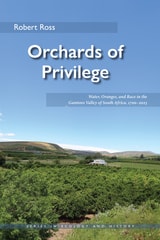
Orchards of Privilege
Water, Oranges, and Race in the Gamtoos Valley of South Africa, 1700–2023Robert Ross
Ohio University Press, 2025
This study of the Gamtoos River floodplain in South Africa’s Eastern Cape Province traces its transformation from an eighteenth-century natural landscape of thick bush into an agricultural zone now threatened by climate change. The first half of the book explains how missionaries from the London Missionary Society and residents of the Hankey Mission Station introduced irrigation, turning the area into a community of small-scale farmers. Despite early failures, by 1849 they had constructed South Africa’s first major irrigation tunnel and aqueduct. However, conflicts between the missionaries and residents led to the loss of communal lands to privatization, which ultimately impoverished the local farmers. The second half explores efforts to develop the valley for large-scale agriculture, addressing challenges like drought, flash floods, and saline water. By the mid-twentieth century, Afrikaners dominated the area, benefiting from the construction in 1970 of the Kouga Dam, which provided fresh water for the floodplain. This led to the rise of a wealthy white farming community, sustained by apartheid policies and labor from the “Coloured” and African populations. In the early twenty-first century, however, this prosperity has become threatened by severe droughts linked to global climate change. In view of these historical transformations, the Gamtoos River floodplain exemplifies the complex interplay between human ambition, environmental challenges, and sociopolitical forces.
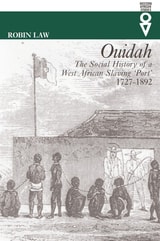
Ouidah
The Social History of a West African Slaving Port, 1727–1892Robin Law
Ohio University Press, 2004
Ouidah, an African town in the Republic of Benin, was the principal precolonial commercial center of its region and the second-most-important town of the Dahomey kingdom. It served as a major outlet for the transatlantic slave trade. Between the seventeenth and the nineteenth centuries, Ouidah was the most important embarkation point for slaves in the region of West Africa known to outsiders as the Slave Coast. This is the first detailed study of the town’s history and of its role in the Atlantic slave trade.
Ouidah is a well-documented case study of precolonial urbanism, of the evolution of a merchant community, and in particular of the growth of a group of private traders whose relations with the Dahomian monarchy grew increasingly problematic over time.
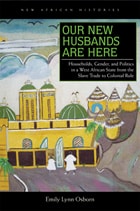
Our New Husbands Are Here
Households, Gender, and Politics in a West African State from the Slave Trade to Colonial RuleEmily Lynn Osborn
Ohio University Press, 2011
In Our New Husbands Are Here, Emily Lynn Osborn investigates a central puzzle of power and politics in West African history: Why do women figure frequently in the political narratives of the precolonial period, and then vanish altogether with colonization? Osborn addresses this question by exploring the relationship of the household to the state. By analyzing the history of statecraft in the interior savannas of West Africa (in present-day Guinea-Conakry), Osborn shows that the household, and women within it, played a critical role in the pacifist Islamic state of Kankan-Baté, enabling it to endure the predations of the transatlantic slave trade and become a major trading center in the nineteenth century. But French colonization introduced a radical new method of statecraft to the region, one that separated the household from the state and depoliticized women’s domestic roles. This book will be of interest to scholars of politics, gender, the household, slavery, and Islam in African history.
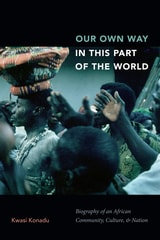
Our Own Way in This Part of the World
Biography of an African Community, Culture, and NationKwasi Konadu
Duke University Press, 2019
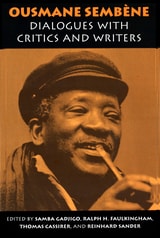
Ousmane Sembene
Dialogues with Critics and WritersThomas Cassirer
University of Massachusetts Press, 1993
This volume celebrates the work of Ousmane Sembène, the brilliant African filmmaker and writer. Since the 1950s, working in his native Senegal, Sembène has produced a series of films and novels that incisively depict the realities of contemporary African experience, particularly that of urban and industrial Africa. The book begins with critical essays on Sembène’s oeuvre by Frederick Ivor Case, Françoise Pfaff, Mbye Cham, and Claire Andrade-Warkins. There follows a series of presentations by distinguished black writers who discuss their craft and the ways in which language can function as a political act of cultural legitimation. These writers include Toni Cade Bambara, Earl Lovelace, Ngũgĩ wa Thiong’o, John Edgar Wideman, and Sembène.
The next section reproduces Sembène’s remarks on his film Camp de Thiaroye and an extended interview he recorded in Toronto in 1992. His comments are presented in both French and English. The volume concludes with annotated bibliographies of Sembène’s novels and of the films he has written and directed.
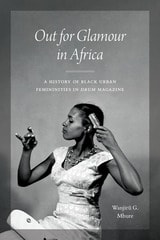
Out for Glamour in Africa
A History of Black Urban Femininities in Drum MagazineWanjiru G. Mbure
University of Michigan Press, 2026
Out for Glamour in Africa critically reflects on how Black women utilized Drum magazine, a leading publication in Africa during the era of independence, for political empowerment and constructing notions of Black femininity. Wanjirũ G. Mbure terms the concept of femme urbAfricana, a model of Black femininity depicted as urban, political, fashionable, paradoxically Afrocentric, heteronormative, and transnational. Foregrounding stories of the women who embodied these traits and the social, political, and economic forces that shaped their presence in Drum, Mbure argues that these representations of Black women from Africa, the Caribbean, Europe, and the United States produced a novel form of Black urban femininity. Utilizing a breadth of archival materials from cover girl photographs, advertisements, and columns, to readers’ comments, Mbure reveals the complex relationship between the Black urban woman and the era’s contested ideals within a transnational matrix.
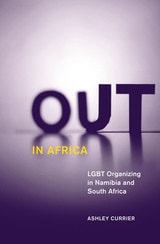
Out in Africa
LGBT Organizing in Namibia and South AfricaAshley Currier
University of Minnesota Press, 2012
Visibility matters to activists—to their social and political relevance, their credibility, their influence. But invisibility matters, too, in times of political hostility or internal crisis. Out in Africa is the first to present an intimate look at how Namibian and South African lesbian, gay, bisexual, and transgender (LGBT) organizations have cultivated visibility and invisibility as strategies over time. As such, it reveals the complexities of the LGBT movements in both countries as these organizations make use of Western terminology and notions of identity to gain funding even as they work to counter the perception that they are “un-African.”
Different sociopolitical conditions in Namibia and South Africa affected how activists in each country campaigned for LGBT rights between 1995 and 2006. Focusing on this period, Ashley Currier shows how, in Namibia, LGBT activists struggled against ruling party leaders’ homophobic rhetoric and how, at the same time, black LGBT citizens of South Africa, though enjoying constitutional protections, greater visibility, and heightened activism, nonetheless confronted homophobic violence because of their gender and sexual nonconformity.
As it tells the story of the evolving political landscape in postapartheid Namibia and South Africa, Out in Africa situates these countries’ movements in relation to developments in pan-African LGBT organizing and offers broader insights into visibility as a social movement strategy rather than simply as a static accomplishment or outcome of political organizing.

Out of One, Many Africas
Reconstructing the Study and Meaning of AfricaEdited by William G. Martin and Michael O. West
University of Illinois Press, 1999
By surveying the present predicament and the current grassroots impulse toward reconsidering the meaning of the continent, Out of One, Many Africas gives shape and momentum to a crucial dialogue aimed at transforming the study of Africa
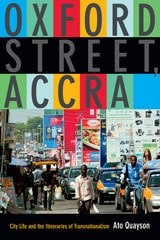
Oxford Street, Accra
City Life and the Itineraries of TransnationalismAto Quayson
Duke University Press, 2014