Results by title
664 books match the query 'Ancient & Classical' and 21 start with o
Objects as Actors
Props and the Poetics of Performance in Greek TragedyMelissa Mueller
University of Chicago Press, 2015
As Mueller shows, props such as weapons, textiles, and even letters were often fully integrated into a play’s action. They could provoke surprising plot turns, elicit bold viewer reactions, and provide some of tragedy’s most thrilling moments. Whether the sword of Sophocles’s Ajax, the tapestry in Aeschylus’s Agamemnon, or the tablet of Euripides’s Hippolytus, props demanded attention as a means of uniting—or disrupting—time, space, and genre.
Insightful and original, Objects as Actors offers a fresh perspective on the central tragic texts—and encourages us to rethink ancient theater as a whole.
Odes
Horace, Translated with commentary by David R. Slavitt
University of Wisconsin Press, 2014
This edition is also notable for Slavitt’s extensive notes and commentary about the art of translation. He presents the problems he encountered in making the translation, discussing possible solutions and the choices he made among them. The effect of the notes is to bring the reader even closer to the original Latin and to understand better how to gauge the distance between the two languages.
Odes and Epodes
Horace
University of Chicago Press, 1960
In 23 B.C., when he published the first three books of his lyrics, Horace was 42 years old, secure in the favor of the emperor Augustus, and living in ease and comfort as a country gentleman on his Sabine farm. Serenity is reflected in these lyrics, certainly, but so are other experiences, for Horace had lived through three major political crises in a society that was the center of the world, that was sophisticated, refined—and beginning to decay. A worldly, high-spirited, cultivated man, Horace responds in his poetry to the myriad elements of Roman life he knew so well.
The Odes and Epodes of Horace collects the entirety of his lyric poetry, comprising all 103 odes, the Carmen Saeculare ("Festival Hymn"), and the earlier epodes. Joseph P. Clancy has achieved a mirroring of the originals that is worthy in its own right as English verse, and his introductions to each book of lyrics are both lively and informed.

Odyssean Identities in Modern Cultures
The Journey HomeHunter Gardner
The Ohio State University Press, 2014
These retellings raise fresh questions about the relationship between home and the identities we expect to find rooted there and stress the elusiveness of a satisfying homecoming. They remind us that the Odyssey’s happy ending is itself qualified by the hero’s unsettled future, the violence of his return, and the independent desires of his friends and family members. At the same time, they highlight new obstacles to homecoming posed by the modern world with its political and economic upheavals, newly configured family relations and gender roles, and diminished confidence in the stability of identity. The authors discussed include Charlotte Yonge, James Joyce, Virginia Woolf, Rebecca West, George Seferis, Yannis Ritsos, Gwendolyn Brooks, Charles Frazier, W. B. Sebald, Marilynne Robinson, and Zachary Mason.
Oedipus Rex
David Sophocles
University of Wisconsin Press, 2011
Oedipus Rex is the greatest of the Greek tragedies, a profound meditation on the human condition. The story of the mythological king, who is doomed to kill his father and marry his mother, has resonated in world culture for almost 2,500 years. But Sophocles’ drama as originally performed was much more than a great story—it was a superb poetic script and exciting theatrical experience. The actors spoke in pulsing rhythms with hypnotic forward momentum, making it hard for audiences to look away. Interspersed among the verbal rants and duels were energetic songs performed by the chorus.
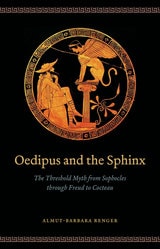
Oedipus and the Sphinx
The Threshold Myth from Sophocles through Freud to CocteauAlmut-Barbara Renger
University of Chicago Press, 2013
Oedipus at Colonus
Sophocles, A verse translation by David Mulroy, with introduction and notes
University of Wisconsin Press, 2014
As in his previous translations of Oedipus Rex and Antigone, Mulroy combines scrupulous scholarship and textual accuracy with a fresh poetic style. He uses iambic pentameter for spoken passages and short rhymed stanzas for choral songs, resulting in a text that is accessible and fun to read and perform.
Oedipus the King
Sophocles
University of Chicago Press, 2010
Available for the first time as an independent work, David Grene’s legendary translation of Oedipus the King renders Sophocles’ Greek into cogent, vivid, and poetic English for a new generation to savor. Over the years, Grene and Lattimore’s Complete Greek Tragedies have been the preferred choice of millions of readers—for personal libraries, individual study, and classroom use. This new, stand-alone edition of Sophocles’ searing tale of jealousy, rage, and revenge will continue the tradition of the University of Chicago Press’s classic series.
Praise for David Grene and Richmond Lattimore’s Complete Greek Tragedies
“This is it. No qualifications. Go out and buy it everybody.”—Kenneth Rexroth, Nation
“The translations deliberately avoid the highly wrought and affectedly poetic; their idiom is contemporary. . . . They have life and speed and suppleness of phrase.”—Times Education Supplement
Oedipus the King, Second Edition
Sophocles
University of Chicago Press, 2013
Over the years, David Grene and Richmond Lattimore’s Complete Greek Tragedies have been the preferred translations of millions of readers—for personal libraries, individual study, and classroom use. Drawn from the authoritative third edition of the University of Chicago Press’s classic series, this updated stand-alone edition of Grene’s Oedipus the King renders the original Greek in clear, vivid, and poetic English for a new generation to savor.
Mark Griffith and Glenn W. Most’s introduction to Sophocles’s searing tale of jealousy, rage, and revenge provides essential information about the play’s first production, plot, and reception in antiquity and beyond.
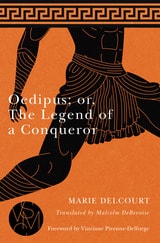
Oedipus; or, The Legend of a Conqueror
Marie Delcourt
Michigan State University Press, 2020
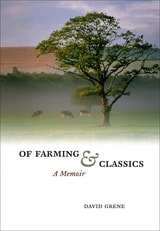
Of Farming and Classics
A MemoirDavid Grene
University of Chicago Press, 2006
A fiercely independent thinker, colorful storyteller, and spirited teacher, David Grene devoted his life to two things: farming, which he began as a boy in Ireland and continued into old age; and classics, which he taught for several decades that culminated in his translating and editing, with Richmond Lattimore, of The Complete Greek Tragedies.
In this charming memoir, which he wrote during the years leading up to his death in 2002 at the age of eighty-nine, Grene weaves together these interests to tell a quirky and absorbing story of the sometimes turbulent and always interesting life he split between the University of Chicago—where he helped found the Committee on Social Thought—and the farm he kept back in Ireland.
Charting the path that took him from Europe to Chicago in 1937, and encompassing his sixty-five-year career at the university, Grene’s book draws readers into the heady and invigorating climate of his time there. And it is elegantly balanced with reflections stemming from his work on the farm where he hunted, plowed and regularly traveled on horseback to bring his cows home for milking. Grene’s form and humor are quite his own, and his brilliant storytelling will enthrall anyone interested in the classics, rural Ireland, or twentieth-century intellectual history, especially as it pertains to the University of Chicago.
Oikonomia
Ancient Greek Philosophers on the Meaning of Economic LifeÉtienne Helmer
University of Chicago Press, 2024
In this book, Étienne Helmer offers a comprehensive analysis of oikonomia in ancient Greek philosophy. Despite its similarity to the word “economy,” for the ancients, oikonomia named a branch of knowledge—the science of management—that was aimed at studying the practices we engage in to satisfy our needs. This began with the domestic sphere, but it radiated outward from the oikos (house) to encompass broader issues in the polis (city) as well. Helmer explores topics such as gender roles and marriage, property and the household, the acquisition and preservation of material goods, and how Greek philosophers addressed the issue of slavery in the ancient world. Even if we are not likely to share many of ancient thinkers’ beliefs today, Helmer shows that there was once a way of thinking of “economic life” that went beyond the mere accumulation of wealth, representing a key point of departure for understanding how to inhabit the world with others.
On Benefits
Lucius Annaeus Seneca
University of Chicago Press, 2011
Lucius Annaeus Seneca (4 BCE–65 CE) was a Roman Stoic philosopher, dramatist, statesman, and advisor to the emperor Nero, all during the Silver Age of Latin literature. The Complete Works of Lucius Annaeus Seneca is a fresh and compelling series of new English-language translations of his works in seven accessible volumes. Edited by world-renowned classicists Elizabeth Asmis, Shadi Bartsch, and Martha C. Nussbaum, this engaging collection restores Seneca—whose works have been highly praised by modern authors from Desiderius Erasmus to Ralph Waldo Emerson—to his rightful place among the classical writers most widely studied in the humanities.
On Benefits, written between 56 and 64 CE, is a treatise addressed to Seneca’s close friend Aebutius Liberalis. The longest of Seneca’s works dealing with a single subject—how to give and receive benefits and how to express gratitude appropriately—On Benefits is the only complete work on what we now call “gift exchange” to survive from antiquity. Benefits were of great personal significance to Seneca, who remarked in one of his later letters that philosophy teaches, above all else, to owe and repay benefits well.
On Reason
Rationality in a World of Cultural Conflict and RacismEmmanuel Chukwudi Eze
Duke University Press, 2008
Eze draws on an extraordinary command of Western philosophical thought and a deep knowledge of African philosophy and cultural traditions. He explores models of rationality in the thought of philosophers from Aristotle, René Descartes, Francis Bacon, and Thomas Hobbes to Noam Chomsky, Richard Rorty, Hilary Putnam, and Jacques Derrida, and he considers portrayals of reason in the work of the African thinkers and novelists Chinua Achebe, Ngugi wa Thiong’o, and Wole Soyinka. Eze reflects on contemporary thought about genetics, race, and postcolonial historiography as well as on the interplay between reason and unreason in the hearings of South Africa’s Truth and Reconciliation Commission. He contends that while rationality may have a foundational formality, any understanding of its foundation and form is dynamic, always based in historical and cultural circumstances.
Once Out of Nature
Augustine on Time and the BodyAndrea Nightingale
University of Chicago Press, 2011
Order and History, Volume 3 (CW16)
Plato and AristotleEric Voegelin. Edited & Intro by Dante Germino
University of Missouri Press, 2000
This third volume of Order and History completes Voegelin's study of Greek culture from its earliest pre- Hellenic origins to its full maturity with the dominance of Athens. As the title suggests, Plato and Aristotle is principally devoted to the work of the two great thinkers who represent the high point of philosophic inquiry among the Greeks.
Through an absorbing analysis of the Platonic and Aristotelian vision of soul, polis, and cosmos, Voegelin demonstrates how the symbolic framework of the older myth was superseded by the more precisely differentiated symbols of philosophy. Although this outmoding and rejection of past symbols of truth might seem to lead to a chaotic and despairing relativism, Voegelin makes it the basis of a profound conception of the historical process: "the attempts to find the symbolic forms that will adequately express the meaning [of a society], while imperfect, do not form a senseless series of failures. For the great societies have created a sequence of orders, intelligibly connected with one another as advances toward, or recessions from, an adequate symbolization of the truth concerning the order of being of which the order of society is a part."
In this view, history has no obvious "meaning," yet each society makes a similar venture after truth. Although every society works out its destiny under different conditions, each nonetheless creates symbols"in its deeds and institutions"which bear the meaning of its own existence. History, then, acquires a unity in the common endeavor toward meaning and order. The rationality and nobility of this view of history has much to say to the present age.
Dante Germino's powerful introduction to this edition of Plato and Aristotle eloquently directs the reader into Voegelin's search through the thought of Plato foremost and Aristotle secondarily and toward a full understanding of their relevance to the "modern" world. This masterpiece, Germino argues, provides a welcome antidote to the spirit of an era Voegelin once called the Gnostic age.
Orphism and Tragedy
Myth TransfiguredGianni Carchia
Seagull Books, 2026
A reimagining of the ancient Greek mystical movement Orphism.
What does it mean to step outside the civic order through poetry? Ever since it first emerged in Greece around the sixth century BC, Orphic doctrine has marked a powerful rupture with the ancient world. Its salvific practices, closely tied to a belief in the soul’s immortality, its resolute rejection of sacrificial ritual and embrace of vegetarianism, and its distinctive conception of time and memory all defined a way of life, the bios orphikos, that was at once poetic and political.
In this brief yet densely layered text, Gianni Carchia returns to Orphism in all its implications. It becomes clear that, for Carchia, Orphism is not merely a historiographical concern, but an aesthetic and political one. If tragedy constitutes one of the central pillars around which the polis was formed, Orphism represents a radically different path—an alternative to the polis itself—by placing the poetic word, in all its autonomous power, at its core. And if the relationship between philosophy and tragedy has long been a central theme in the history of Western thought, Carchia’s reflections here ask a different question: Is the Orphic path still accessible to us today?
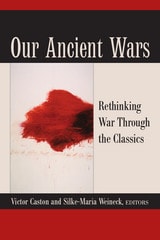
Our Ancient Wars
Rethinking War through the ClassicsVictor Caston and Silke-Maria Weineck, editors
University of Michigan Press, 2016
Our Ancient Wars features essays by top scholars from across academic disciplines—classicists and historians, philosophers and political theorists, literary scholars, some with firsthand experience of war and some without—engaging with classical texts to understand how differently they were read in other times and places. Contributors articulate difficult but necessary questions about contemporary conceptions of war and conflict.
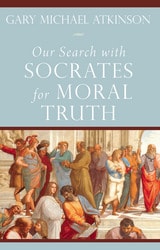
Our Search with Socrates for Moral Truth
Gary Michael Atkinson
Catholic University of America Press, 2015
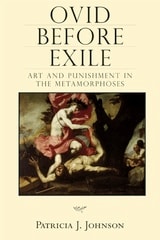
Ovid before Exile
Art and Punishment in the MetamorphosesPatricia J. Johnson
University of Wisconsin Press, 2007
Patricia J. Johnson demonstrates how the production of art—specifically poetry—changed dramatically during the reign of Augustus. By Ovid’s final decade in Rome, the atmosphere for artistic work had transformed, leading to a drop in poetic production of quality. Johnson shows how Ovid, in the episodes of artistic creation that anchor his Metamorphoses, responded to his audience and commented on artistic circumstances in Rome.
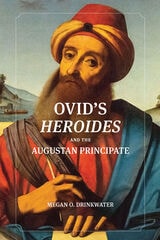
Ovid's "Heroides" and the Augustan Principate
Megan O. Drinkwater
University of Wisconsin Press, 2023
It was in this era of turmoil and transformation that Ovid, the Roman poet best known for Metamorphoses, was born. The Heroides, one of his earliest and most elusive works, is not written from the first-person perspective that so often characterizes the elegiac poetry of that time but from the personae of tragic heroines of classical mythology.
Megan O. Drinkwater illustrates how Ovid used innovations of literary form to articulate an expression of the crisis of civic identity in Rome at a time of extreme and permanent political change. The letters are not divorced from the context of their composition but instead elucidate that context for their readers and expose how Ovid engaged in politics throughout his entire career. Their importance is as much historical as literary. Drinkwater makes a compelling case for understanding the Heroides as a testament from one of Rome’s most eloquent writers to the impact that the dramatic shift from republic to empire had on its intellectual elites.