Results by title
5159 books match the query 'Biography' and 127 start with o

O Little Town
Remembering Life in a Prairie VillageHarlo L. Jones
University of Manitoba Press, 1995
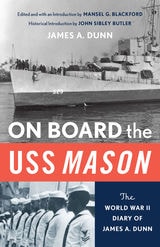
ON BOARD THE USS MASON
THE WORLD WAR II DIARY OF JAMES A. DUNNMANSEL G. BLACKFORD
The Ohio State University Press, 2016
Dunn kept a day-to-day diary during his spare time on board the Mason. Such diaries are a rarity, for the navy (and other armed services) forbade the keeping of diaries, fearful lest secret information fall into enemy hands. The diary chronicles the Mason’s wartime activities, from the first convoy to the final return to the United States. It captures the feeling and meaning of life on board with an immediacy not fully found in retrospective accounts. The diary accurately records the mortal danger Dunn and his shipmates were in while attacking enemy submarines or dealing with extreme weather conditions in the North Atlantic. It conveys the boredom the men encountered while confined on long, tedious convoys and the joy of shore leaves. Here is the daily life aboard ship—the duties and the pastimes that made shipboard life endurable.
Equally interesting, the diary reveals what it meant to be an African American in a white navy within a segregated American society, the shipboard tensions, and the shipboard cooperation and sense of unity. It also portrays the life of an African American onshore in the United States, Great Britain, and North Africa and the love story that unfolded between James and his wife, Jane.
Supplemented by additional sources, including interviews with Dunn, this diary is a personal view into an important part of American history. Like the Tuskegee airmen, the men of the USS Mason paved the way for desegregation in America’s armed forces, contributing to a civil rights movement that changed the face of a nation.
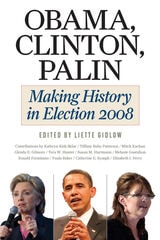
Obama, Clinton, Palin
Making History in Elections 2008Edited by Liette Gidlow
University of Illinois Press, 2011
Election 2008 made American history, but it was also the product of American history. Barack Obama, Hillary Clinton, and Sarah Palin smashed through some of the most enduring barriers to high political office, but their exceptional candidacies did not come out of nowhere. In these timely and accessible essays, a distinguished group of historians explores how the candidates both challenged and reinforced historic stereotypes of race and sex while echoing familiar themes in American politics and exploiting new digital technologies.
Contributors include Kathryn Kish Sklar on Clinton’s gender masquerade; Tiffany Ruby Patterson on the politics of black anger; Mitch Kachun on Michelle Obama and stereotypes about black women’s bodies; Glenda E. Gilmore on black women’s century of effort to expand political opportunities for African Americans; Tera W. Hunter on the lost legacy of Shirley Chisholm; Susan M. Hartmann on why the U.S. has not yet followed western democracies in electing a female head of state; Melanie Gustafson on Palin and the political traditions of the American West; Ronald Formisano on the populist resurgence in 2008; Paula Baker on how digital technologies threaten the secret ballot; Catherine E. Rymph on Palin’s distinctive brand of political feminism; and Elisabeth I. Perry on the new look of American leadership.
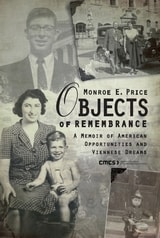
Objects of Remembrance
A Memoir of American Opportunities and Viennese DreamsMonroe E. Price
Central European University Press, 2009
This is a memoir about the power of American assimilation and opportunity in the face of persisting refugee realities. Like Isaac Bashevis Singer, Monroe Price recounts the continuing impact of European identities as families, cast from their homes by the rise of Hitler and the Third Reich, struggle to find their way in a new and challenging environment.
In a series of reflections, Price, who was born to a Jewish family in Vienna in 1938 and left when he was seven months old, seeks to create the Vienna of his infancy, including Jewish life, anti-Semitism, the Anschluss, and Kristallnacht (during which his father was arrested). He shifts to scenes of American socialization in the places he moved with his parents:: Macon, Georgia, Cincinnati, Ohio, and the experience of New York City. Through these reflections, Price illuminates ideas about family, religion, friends and schooling as well as deeply personal issues such as home, food and intimacy.
Price’s memoir weaves complicated strands—his Viennese origins, campaigns to distribute Jewish refugees away from New York City, the special qualities of Midwestern Ohio life in the 1950s—and the contrasting patterns of adjustment by different generations in his family in the American landscape. As he traces the particular path of his own life, Price reveals a more universal story of adjustment, and the relationship between a marginal community and the drama of American citizenship.

Obliged to Help
Adolphine Fletcher Terry and the Progressive SouthStephanie Bayless
Butler Center for Arkansas Studies, 2011
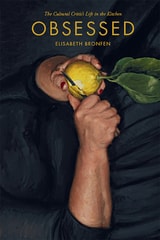
Obsessed
The Cultural Critic’s Life in the KitchenElisabeth Bronfen
Rutgers University Press, 2019
Even the most brilliant minds have to eat. And for some scholars, food preparation is more than just a chore; it’s a passion. In this unique culinary memoir and cookbook, renowned cultural critic Elisabeth Bronfen tells of her lifelong love affair with cooking and demonstrates what she has learned about creating delicious home meals. She recounts her cherished food memories, from meals eaten at the family table in postwar Germany to dinner parties with friends. Yet, in a thoughtful reflection on the pleasures of cooking for one, she also reveals that some of her favorite meals have been consumed alone.
Though it contains more than 250 mouth-watering recipes, Obsessed is anything but a conventional cookbook. As she shares a lifetime of knowledge acquired in the kitchen, Bronfen hopes to empower both novice and experienced home chefs to improvise, giving them hints on how to tweak her recipes to their own tastes. And unlike cookbooks that assume readers have access to an unlimited pantry, this book is grounded in reality, offering practical advice about food storage and reusing leftovers. As Bronfen serves up her personal stories and her culinary wisdom, reading Obsessed is like sitting down to a home-cooked meal with a clever friend.

Octavia E. Butler
Gerry Canavan
University of Illinois Press, 2016
Gerry Canavan offers a critical and holistic consideration of Butler's career. Drawing on Butler's personal papers, Canavan tracks the false starts, abandoned drafts, tireless rewrites, and real-life obstacles that fed Butler's frustrations and launched her triumphs. Canavan departs from other studies to approach Butler first and foremost as a science fiction writer working within, responding to, and reacting against the genre's particular canon. The result is an illuminating study of how an essential SF figure shaped themes, unconventional ideas, and an unflagging creative urge into brilliant works of fiction.
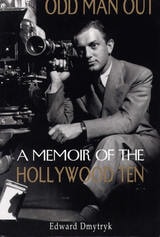
Odd Man Out
A Memoir of the Holllywood TenEdward Dmytryk
Southern Illinois University Press, 1996
In 1947, the House Un-American Activities Committee rudely interrupted the successful career and life of Edward Dmytryk, citing him with contempt of Congress. As a result, Dmytryk was fired by RKO and spent three years in England before returning to the United States to serve a six-month jail sentence and undergo a second round of hearings, during which he recanted and provided evidence against several of his former colleagues.
In this personal and perceptive book, Dmytryk sharply chronicles the history of a particularly turbulent era in American political life while examining his own life before and after the events universally called the witch hunts. He details his brief membership in the Communist Party of America, explaining his initial commitment to what he perceived as communist ideals of civil liberties, economic justice, and antifacism, followed by his eventual disillusionment with the party as itbetrayed those ideals. He goes on to provide a fair assessment of what then happened to him and the effect it had on the rest of his life.
Dmytryk describes the activities, prejudices, and personal behaviors of all the parties enmeshed in the congressional hearings on communism in Hollywood. His reactions to other members of the Hollywood Ten and his recollection of conversations with them lend his book an immediacy that is not only informative but also absorbing. Most importantly, he does not uphold an ideology but rather presents the events as he perceived them, understood them, and responded to them. Dmytryk’s account is characterized by an openness born of a mature awareness of personal trial as history.
Odd Wisconsin
Amusing, Perplexing, and Unlikely Stories from Wisconsin's PastErika Janik
Wisconsin Historical Society Press, 2007
While Bob La Follette's exploits as leader of progressive politics are legendary, his early morning exertions to save valuable government documents and executive department paintings during the disastrous 1904 capitol fire are largely unknown - until now. Odd Wisconsin captures the Wisconsin people, places, and events that didn't make it into conventional state histories, lowering a bucket into the depths of Wisconsin history and bringing to light curious fragments of forgotten lives.
This unique book unearths the stories that got lost to history even though they may have made local headlines at the time. No mythical hodags or eight-legged horses here! Odd Wisconsin features strange but true stories from Wisconsin's past, every one of which was documented (albeit by the standards of the day). These brief glimpses into Wisconsin's past will surprise, perplex, astonish, and otherwise connect readers with the state's fascinating history. From "the voyageur with a hole in his side" to "pigs beneath the legislature," Odd Wisconsin gathers 300 years of curiosities, all under the radar of traditional stories.
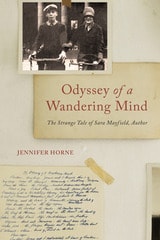
Odyssey of a Wandering Mind
The Strange Tale of Sara Mayfield, AuthorJennifer Horne
University of Alabama Press, 2024
A carefully rendered portrait of a brilliant but troubled daughter of the Old South who struggled against the conventions of gender, class, family, and ultimately of sanity, yet survived to define a creative life of her own
Sara Mayfield was born into Alabama’s governing elite in 1905 and grew up in a social circle that included Zelda Sayre, Sara Haardt, and Tallulah and Eugenia Bankhead. After winning a Goucher College short story contest judged by H. L. Mencken, Mayfield became friends with Mencken and his circle, then visited with Scott and Zelda Fitzgerald and hobnobbed with the literati while traveling in Europe after a failed marriage. Returning to Alabama during the Depression, she briefly managed the family landholdings before departing for New York City where she became involved in the theater. Inventing a plastic compound while working on theatrical sets, she applied for a patent and set her sights on a livelihood as an inventor and businesswoman. With the advent of World War II, Mayfield returned to her family home in Tuscaloosa where she expanded her experiments, freelanced as a journalist, and doggedly pursued a bizarre series of military and intelligence schemes, prompting temporary hospitalization. In 1945, she mingled with a host of cultural figures, including Frida Kahlo, Diego Rivera, Orson Welles, Rita Hayworth, and even a young John F. Kennedy, while reporting on the creation of the United Nations from Mexico and California. Back in Tuscaloosa after the war, however, she struggled to find her way with both work and family, becoming increasingly paranoid about perceived conspiracies arrayed against her. Finally, her mother and brother committed her to Bryce Hospital for the Insane, where she remained for the next seventeen years.
Throughout her life, Mayfield kept journals, wrote fiction, and produced thousands of letters while nursing the ambition that had driven her since childhood: to write and publish books. During her confinement, Mayfield assiduously recorded her experiences and her determined efforts—sometimes delusional, always savvy—to overturn her diagnosis and return to the world as a sane, independent adult. At 59, she was released from Bryce and later obtained a decree of “having been restored to sanity,” enabling her to manage her own financial affairs and to live how and where she pleased. She went on to publish noteworthy literary biographies of the Menckens and the Fitzgeralds plus a novel based on the life of Mona Lisa, finally achieving her quest to become the author of books and her own life. In Odyssey of a Wandering Mind, noted writer Jennifer Horne draws on years of research and an intimate understanding of the vast archive Sara Mayfield left behind to sensitively render Mayfield’s struggle to move through the world as the person she was—and her ultimate success in surviving to define the terms of her story.
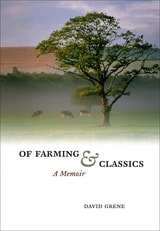
Of Farming and Classics
A MemoirDavid Grene
University of Chicago Press, 2006
A fiercely independent thinker, colorful storyteller, and spirited teacher, David Grene devoted his life to two things: farming, which he began as a boy in Ireland and continued into old age; and classics, which he taught for several decades that culminated in his translating and editing, with Richmond Lattimore, of The Complete Greek Tragedies.
In this charming memoir, which he wrote during the years leading up to his death in 2002 at the age of eighty-nine, Grene weaves together these interests to tell a quirky and absorbing story of the sometimes turbulent and always interesting life he split between the University of Chicago—where he helped found the Committee on Social Thought—and the farm he kept back in Ireland.
Charting the path that took him from Europe to Chicago in 1937, and encompassing his sixty-five-year career at the university, Grene’s book draws readers into the heady and invigorating climate of his time there. And it is elegantly balanced with reflections stemming from his work on the farm where he hunted, plowed and regularly traveled on horseback to bring his cows home for milking. Grene’s form and humor are quite his own, and his brilliant storytelling will enthrall anyone interested in the classics, rural Ireland, or twentieth-century intellectual history, especially as it pertains to the University of Chicago.
Of G-Men and Eggheads
The FBI and the New York IntellectualsJohn Rodden
University of Illinois Press, 2017
John Rodden cuts this tall tale down to its authentic pint size, refusing to indulge the public relations myth promoted by J. Edgar Hoover's FBI. In Of G-Men and Eggheads, Rodden portrays federal agents’ hilarious obsession with monitoring that ever-present threat to national security, the American literary intellectual. Drawing on government dossiers and archives, Rodden focuses on the onetime members of a radical political sect of ex-Trotskyists (barely numbering a thousand at its height), the so-called New York intellectuals. He describes the nonsensical decades-long pursuit of this group of intellectuals, especially Lionel Trilling, Dwight Macdonald, and Irving Howe. The Keystone Cops style of numerous FBI agents is documented carefully in Rodden's meticulous case studies of how Hoover's men recruited informants to snoop on the "Commies," opened their personal mail, tracked their movements, and reported on their wives and friends.

Of Morsels and Marvels
Maryse Condé
Seagull Books, 2019
In Of Morsels and Marvels, Condé takes us on a literary journey around places she has travelled to in India, Indonesia, and South Africa. She highlights the tastes and culinary traditions that are fascinating examples of a living museum. Such places, Condé explains, provide important insights into lesser-known aspects of contemporary life. One anecdote illustrates what becomes of the standard Antillean dishes of fish stew and goat curry by two Antilleans who own a restaurant in Sydney, Australia. Cuisine changes not only according to the individual cook but also adapts to foreign skies under which it is created. The author also recounts personal memories of her lifelong relationship with cooking, such as when Adélia, her family’s servant, wrongly blames little Maryse for mixing raisins with fish and using her imagination in the kitchen.
Blending travel with gastronomy, this enchanting volume from the winner of the 2018 Alternative Nobel Prize will delight all who marvel at the wonders of the kitchen or seek to taste the world.
Of Mules and Mud
The Story of Alabama Folk Potter Jerry BrownJerry Brown, edited and with an introduction by Joey Brackner
University of Alabama Press, 2022
The life and times of Alabama folk potter Jerry Brown, as told in his own words
Born in 1942, Jerry Brown helped out in his father’s pottery shop as a young boy. There he learned the methods and techniques for making pottery in a family tradition dating back to the 1830s. His responsibilities included tending the mule that drove the mill that was used to mix clay (called “mud” by traditional potters). Business suffered as demand for stoneware churns, jugs, and chamber pots waned in the postwar years, and manufacture ceased following the deaths of Brown’s father and brother in the mid-1960s. Brown turned to logging for his livelihood, his skill with mules proving useful in working difficult and otherwise inaccessible terrain. In the early 1980s, he returned to the family trade and opened a new shop that relied on the same methods of production with which he had grown up, including a mule-powered mill for mixing clay and the use of a wood-fired rather than gas-fueled kiln.
Folklorist Joey Brackner met Brown in 1983, and the two quickly became close friends who collaborated together on a variety of documentary and educational projects in succeeding years—efforts that led to greater exposure, commercial success, and Brown’s recognition as a National Heritage Fellow by the National Endowment for the Arts. For years, Brown spoke of the urge to write his life story, but he never set pen to paper. In 2015, Brackner took the initiative and interviewed Brown, recording his life story over the course of a weekend at Brown’s home. Of Mules and Mud is the result of that marathon interview session, conducted one year before Brown passed away.
Brackner has captured Jerry Brown’s life in his own words as recounted that weekend, lightly edited and elaborated. Of Mules and Mud is illustrated with photos from all phases of Brown’s life, including a color gallery of 28 photos of vessel forms made by Brown throughout his career that collectors of folk pottery will find invaluable.
Of Spies and Spokesmen
My Life as a Cold War CorrespondentNicholas Daniloff
University of Missouri Press, 2008
An American reporter of Russian heritage assigned to Soviet-era Moscow might seem to have an edge on his colleagues, but when he’s falsely accused of spying, any advantage quickly evaporates. . . . .
As a young UPI correspondent in Moscow during the early 1960s, Nicholas Daniloff hoped to jump-start his career in his father’s homeland, but he soon learned that the Cold War had its own rules of engagement. In this riveting memoir, he describes the reality of journalism behind the Iron Curtain: how Western reporters banded together to thwart Soviet propagandists, how their “official sources” were almost always controlled by the KGB—and how those sources would sometimes try to turn newsmen into collaborators.
Leaving Moscow for Washington in 1965, Daniloff honed his skills at the State Department, then returned to Moscow in 1981 to find a more open society. But when the FBI nabbed a Soviet agent in 1986, Daniloff was arrested in retaliation and thrown into prison as a spy—an incident that threatened to undo the Reykjavik summit until top aides to Reagan and Gorbachev worked out a solution.
In addition to recounting a career in the thick of international intrigue, Of Spies and Spokesmen is brimming with inside information about historic events. Daniloff tells how the news media played a crucial role in resolving the Cuban Missile Crisis, recalls the emotional impact of the JFK assassination on Soviet leadership, and describes the behind-the-scenes struggles that catapulted Mikhail Gorbachev to power. He even shares facts not told to the public: how the SAC would warn Moscow that its submarines were too close to American shores, why the Soviets shot down the KAL airliner without visual identification, and how American reporters in Moscow sometimes did dangerous favors for our government that could easily have been mistaken for espionage.
Daniloff sheds light not only on prominent figures such as Nikita Khrushchev and Henry Kissinger but also on suspected spies Frederick Barghoorn, John Downey, and ABC correspondent Sam Jaffe—unfairly branded a Soviet agent by the FBI. In addition, he assesses the performance of Henry Shapiro, dean of American journalists in Moscow, whose forty years in the adversary’s capital often provoke questions about his role and reputation.
In describing how the Western press functioned in the old Soviet Union—and how it still functions in Washington today—Daniloff shows that the Soviet Russia he came to know was far more complex than the “evil empire” painted by Ronald Reagan: a web of propaganda and manipulation, to be sure, but also a place of hospitality and friendship. And with Russia still finding its way toward a new social and political order, he reminds us that seventy years of Communist rule left a deep impression on its national psyche. As readable as it is eye-opening, Of Spies and Spokesmenprovides a new look at that country’s heritage—and at the practice of journalism in times of crisis.
Off the Record
The Private Papers of Harry S. TrumanEdited by Robert H. Ferrell
University of Missouri Press, 1997
Gathered for the first time, Truman's private papers--diaries, letters, and memoranda--cover the period from his occupancy of the White House in 1945 to shortly before his death in 1972. Students and scholars will find valuable material on major events of the Truman years, from the Potsdam Conference to the Korean War.
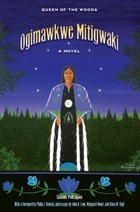
Ogimawkwe Mitigwaki (Queen of the Woods)
Simon Pokagon
Michigan State University Press, 2010
Simon Pokagon, the son of tribal patriarch Leopold Pokagon, was a talented writer, advocate for the Pokagon Potawatomi community, and tireless self-promoter.
In 1899, shorty after his death, Pokagon's novel Ogimawkwe Mitigwaki (Queen of the Woods)—only the second ever published by an American Indian—appeared. It was intended to be a testimonial to the traditions, stability, and continuity of the Potawatomi in a rapidly changing world. Read today, Queen of the Woods is evidence of the author's desire to mark the cultural, political, and social landscapes with a memorial to the past and a monument to a future that included the Pokagon Potawatomi as distinct and honored people.
This new edition offers a reprint of the original 1899 novel with the author's introduction to the language and culture of his people. In addition, new accompanying materials add context through a cultural biography, literary historical analysis, and linguistic considerations of the unusual text.
Oglethorpe in Perspective
Georgia's Founder after Two Hundred YearsEdited by Phinizy Spalding and Harvey H. Jackson, III
University of Alabama Press, 1989
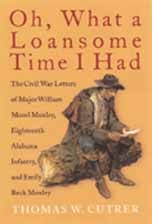
Oh, What a Loansome Time I Had
The Civil War Letters of Major William Morel Moxley, Eighteenth Alabama Infantry, and Emily Beck MoxleyEmily Beck Moxley
University of Alabama Press, 2002
Most surviving correspondence of the Civil War period was written by members of a literate, elite class; few collections exist in which the woman's letters to her soldier husband have been preserved. Here, in the exchange between William and Emily Moxley, a working-class farm couple from Coffee County, Alabama, we see vividly an often-neglected aspect of the Civil War experience: the hardships of civilian life on the home front.
Emily's moving letters to her husband, startling in their immediacy and detail, chronicle such difficulties as a desperate lack of food and clothing for her family, the frustration of depending on others in the community, and her growing terror at facing childbirth without her husband, at the mercy of a doctor with questionable skills. Major Moxley's letters to his wife reveal a decidedly unromantic side of the war, describing his frequent encounters with starvation, disease, and bloody slaughter.
Ohio Farm
Wheeler McMillen
The Ohio State University Press, 1997
Uncomplicated when compared with the task of managing today's highly mechanized agricultural complexes, life on the early twentieth-century small farm entailed hard work and afforded simple pleasures that brought satisfaction and enjoyment to the farm and family. Farming on that scale and in the same manner has now become almost completely infeasible, yet in those times a good farmer could prosper and become independent. Wheeler McMillen’s father, Lewis, did both.
Relying frequently on his father’s account books and concise diaries, for this is primarily his father’s story, McMillen recounts the immense labor that farming demanded before the advent of the tractor and the combine harvester. He evokes the special excitements of having company for Sunday dinner, attending the annual oyster supper at the Grange Hall, and gathering on the Fourth of July with the interminable wait for darkness to fall. McMillen also portrays the quiet peace and ineffable joy of private moments, such as resting the horses during spring plowing to watch bronzed grackles search for food in the freshly turned furrows.
Wheeler McMillen’s slice of history will speak to those interested in what rural life was once like in the Midwest and to Ohioans who would like to learn more about their state’s recent past.
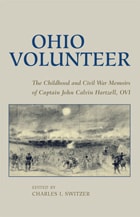
Ohio Volunteer
The Childhood and Civil War Memoirs of Captain John Calvin Hartzell, OVICharles I. Switzer
Ohio University Press, 2005
Edited and introduced by Charles Switzer, Ohio Volunteer: The Childhood and Civil War Memoirs of Captain John Calvin Hartzell, OVI documents military strategy, the life of the common soldier, the intense excitement and terror of battle, and the wretchedness of the wounded.
Hartzell’s family implored him to set down his life story, including his experiences in the Civil War from 1862 to 1866. Hartzell did so diligently, taking more than two years to complete his manuscript. The memoir reveals a remarkable memory for vivid details, the ability to see larger and more philosophical perspectives, and a humorous outlook that helped him bear the unbearable.
He also depicted the changing rural economy, the assimilation of the Pennsylvania Dutch, and the transformations wrought by coal mining and the iron industry. Hartzell felt individualism was threatened by the Industrial Revolution and the cruelties of the war. He found his faith in humanity affirmed—and the dramatic tension in his memoir resolved—when 136,000 Union soldiers reenlisted and assured victory for the North. The common soldier, he wrote, was “loyal to the core.”
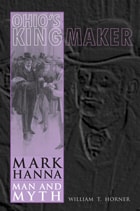
Ohio’s Kingmaker
Mark Hanna, Man and MythWilliam T. Horner
Ohio University Press, 2010
For a decade straddling the turn of the twentieth century, Mark Hanna was one of the most famous men in America. Portrayed as the puppet master controlling the weak-willed William McKinley, Hanna was loved by most Republicans and reviled by Democrats, in large part because of the way he was portrayed by the media of the day. Newspapers and other media outlets that supported McKinley reported positively about Hanna, but those sympathetic to William Jennings Bryan, the Democrats’ presidential nominee in 1896 and 1900, attacked Hanna far more aggressively than they attacked McKinley himself. Their portrayal of Hanna was wrong, but powerful, and this negative image of him survives to this day.
In this study of Mark Hanna’s career in presidential politics, William T. Horner demonstrates the flaws inherent in the ways the news media cover politics. He deconstructs the myths that surround Hanna and demonstrates the dangerous and long-lasting effect that inaccurate reporting can have on our understanding of politics. When Karl Rove emerged as the political adviser to George W. Bush’s presidential campaigns, the reporters quickly began to compare Rove to Hanna even a century after Hanna’s death. The two men played vastly different roles for the presidents they served, but modern reporters consistently described Rove as the second coming of Mark Hanna, another political Svengali.
Ohio’s Kingmaker is the story of a fascinating character in American politics and serves to remind us of the power of (mis)perceptions.
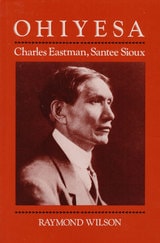
Ohiyesa
Charles Eastman, Santee SiouxRaymond Wilson
University of Illinois Press, 1983
Charles Eastman, called Ohiyesa in Santee, came of age amidst increasing tensions and violence between Native and European colonizers. Though raised to be a hunter-warrior, Eastman was persuaded by his Christian father to enter white society. Eastman graduated from Dartmouth and the Boston University School of Medicine. His career included service as the government physician at the Pine Ridge Agency, where he tended casualties at Wounded Knee; as an Inspector for the Bureau of Indian Affairs; as Indian secretary for the YMCA; and as one of the cofounders of the Boy Scouts of America.
Raymond Wilson examines these accomplishments while also delving into the writings that expressed Eastman’s determination to hold onto his Santee roots. Popular works like Indian Boyhood, The Soul of the Indian, and Indian Heroes and Chieftains reconfirmed his heritage and aimed at making white society aware of Indigenous peoples’ contribution to American civilization.

Oil and Urbanization on the Pacific Coast
Ralph Bramel Lloyd and the Shaping of the Urban WestMichael R. Adamson
West Virginia University Press, 2018
Oil and Urbanization on the Pacific Coast tells the story of oilman Ralph Bramel Lloyd, a small business owner who drove the development of one of America’s largest oil fields. Lloyd invested his petroleum earnings in commercial real estate—much of it centered around automobiles and the fuel they require—in several western cities, notably Portland, Oregon. Putting the history of extractive industry in dialogue with the history of urban development, Michael R. Adamson shows how energy is woven into the fabric of modern life, and how the “energy capital” of Los Angeles exerted far-flung influence in the US West.
A contribution to the relatively understudied history of small businesses in the United States, Oil and Urbanization on the Pacific Coast explores issues of interest to multiple audiences, such as the competition for influence over urban development waged among local growth machines and outside corporate interests; the urban rivalries of a region; the importance of public capital in mobilizing the commercial real estate sector during the Great Depression and World War II; and the relationships among owners, architects, and contractors in the execution of commercial building projects.
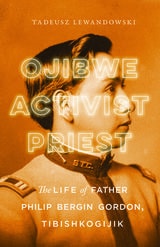
Ojibwe, Activist, Priest
The Life of Father Philip Bergin Gordon, TibishkogijikTadeusz Lewandowski
University of Wisconsin Press, 2019
Drawing on previously unexplored materials, Tadeusz Lewandowski paints a portrait of a contentious life. Ojibwe, Activist, Priest examines Gordon's efforts to abolish the Bureau of Indian Affairs, his membership in the Society of American Indians, and his dismissal from his Ojibwe parish and exile to a tiny community where he'd be less likely to stir up controversy. Lewandowski illuminates a significant chapter in the struggle for Native American rights through the views and experiences of a key Native progressive.
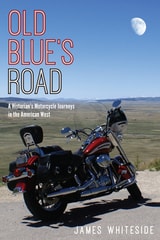
Old Blue's Road
A Historian's Motorcycle Journeys in the American WestJames Whiteside
University Press of Colorado, 2014
In 2005, Whiteside bought a Harley Davidson Heritage Softail, christened it “Old Blue,” and set off on a series of far-reaching motorcycle adventures. Over six years he traveled more than 15,000 miles. Part travelogue and part historical tour, this book takes the reader along for the ride. Whiteside’s travels to the Pacific Northwest, Yellowstone, Dodge City, Santa Fe, Wounded Knee, and many other locales prompt consideration of myriad topics—the ongoing struggle between Indian and mainstream American culture, the meaning of community, the sustainability of the West's hydraulic society, the creation of the national parks system, the Mormon experience in Utah, the internment of Japanese Americans during World War II, and more.
Delightfully funny and insightful, Old Blue’s Road links the colorful history and vibrant present from Whiteside’s unique vantage point, recognizing and reflecting on the processes of change that made the West what it is today. The book will interest the general reader and western historian alike, leading to new appreciation for the complex ways in which the American West's past and present come together.
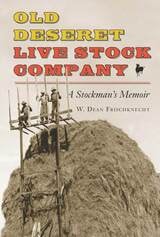
Old Deseret Live Stock Company
A Stockman's MemoirW. Dean Frischknecht
Utah State University Press, 2008
In the high country of the northern Wasatch Mountains, lies what is left of one of the West’s largest ranches. Deseret Live Stock Company was reputed at various times to be the largest private landholder in Utah and the single biggest producer of wool in the world. The ranch began as a sheep operation, but as it found success, it also ran cattle. Incorporated in the 1890s by a number of northern Utah ranchers who pooled their resources, the company was at the height of successful operations in the mid-twentieth century when a young Dean Frischknecht, bearing a recent degree in animal science, landed the job of sheep foreman. In his memoir he recounts in detail how Deseret managed huge herds of livestock, vast lands, and rich wildlife and recalls through lively anecdotes how stockmen and their families lived and worked in the Wasatch Mountains and Skull Valley’s desert wintering grounds.
Old Farm
A HistoryJerry Apps
Wisconsin Historical Society Press, 2013
Old Orchard Farm
The Story of an Iowa BoyhoodHugh Orchard
University of Iowa Press, 2010
Old Riot, New Ranger
Captain Jack Dean, Texas Ranger and U.S. MarshalBob Alexander
University of North Texas Press, 2018
Old Times on the Upper Mississippi
Recollections of a Steamboat Pilot from 1854 to 1863George Byron Merrick
University of Minnesota Press, 2001
A long-awaited new edition of the steamboating classic.
George Byron Merrick chronicles the entire panorama of steamboat life he experienced in the mid-1800s, where he started as a cabin boy and worked up to cub pilot on the mighty Mississippi. Originally published in 1909, Merrick’s narrative matches lively stories about gamblers, shipwrecks, and steamboat races with rich descriptions of river life and steamboat operations.
Fesler-Lampert Minnesota Heritage Series
Ole Evinrude and His Outboard Motor
Bob Jacobson
Wisconsin Historical Society Press, 2009
Wisconsin entrepreneur Ole Evinrude will inspire children in this addition to the Badger Biographies series for young readers, where the story of Ole's invention, from drawing board to factory floor, is told in a reader-friendly format that includes historic images, a glossary of terms, and sidebars explaining how an outboard motor works.
Ole Evinrude was born in Norway in 1877 and immigrated to the United States when he was five years old. The Evinrude family settled in Wisconsin and began farming, but it was clear from a very young age that Ole would not follow the family tradition. Ole Evinrude was meant to work with boats.
Building an outboard motor was not easy, though - Ole suffered numerous mechanical and financial setbacks along the way. After years of hard work and persistence, the Evinrude motor company was founded and Ole's outboard motors were an instant hit around the world. Ole continued to improve the design of his motor and attracted other entrepreneurs to the area, making Wisconsin the center of the outboard motor industry for decades.

Ole Hendricks and His Tunebook
Folk Music and Community on the FrontierAmy M. Shaw
University of Wisconsin Press, 2020
Such tunebooks, popular during the nineteenth century, rarely survive and are often overlooked by folk scholars in favor of commercially produced recordings, published sheet music, or oral tradition. Based on extensive historical and genealogical research, Amy Shaw presents a grounded picture of a musician, his family, and his community in the Upper Midwest, revealing much about music and dance in the area. This notable contribution to regional music and folklore includes more than one hundred of Ole's dance tunes, transcribed into modern musical notation for the first time. Ole Hendricks and His Tunebook will be valuable to readers and scholars interested in ethnomusicology and the Norwegian American immigrant experience.

Oliver Heaviside
Maverick Mastermind of ElectricityBasil Mahon
The Institution of Engineering and Technology, 2009
Olivier
Francis Beckett
Haus Publishing, 2006
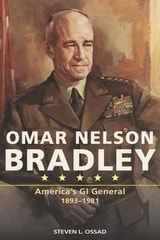
Omar Nelson Bradley
America's GI General, 1893-1981Steven L. Ossad
University of Missouri Press, 2017
Omar Nelson Bradley was the youngest and last of nine men to earn five-star rank and the only army officer so honored after World War II. This new biography by Steven L. Ossad gives an account of Bradley’s formative years, his decorated career, and his postwar life.
Bradley’s decisions shaped the five Northwest European Campaigns from the D-Day landings to VE Day. As the man who successfully led more Americans in battle than any other in our history, his long-term importance would seem assured. Yet his name is not discussed often in the classrooms of either civilian or military academies, either as a fount of tactical or operational lessons learned, or a source of inspiration for leadership exercised at Corps, Army, Group, Army Chief, or Joint Chiefs of Staff levels.
The Bradley image was tailor-made for the quintessential homespun American heroic ideal and was considered by many to be a simple, humble country boy who rose to the pinnacle of power through honesty, hard work, loyalty and virtuous behavior. Even though his classmates in both high school and at West Point made remarks about his looks, and Bradley was always self-conscious about smiling because of an accident involving his teeth, he went on to command 12 Army Group, the largest body of American fighting men under a single general.
Bradley’s postwar career as administrator of the original GI Bill and first Chairman of the Joint Chiefs of Staff during the Korean War ensures his legacy. These latter contributions, as much as Bradley’s demonstrable World War II leadership, shaped U.S. history and culture in decisive, dramatic, and previously unexamined ways.
Drawing on primary sources such as those at West Point, Army War College and Imperial War Museum, this book focuses on key decisions, often through the eyes of eyewitness and diarist, British liaison officer Major Thomas Bigland. The challenges our nation faces sound familiar to his problems: fighting ideologically-driven enemies across the globe, coordinating global strategy with allies, and providing care and benefits for our veterans.
On Any Given Sunday
A Life of Bert BellRobert S. Lyons, Foreword by Don Shula
Temple University Press, 2009
Bell, who arguably saved the league from bankruptcy by conceiving the idea for the annual player draft, later made the historic decision to introduce “sudden death” overtime—a move that propelled professional football into the national consciousness. He coined the phrase “on any given sunday” and negotiated the league’s first national TV contract. Lyons also describes in fascinating detail Bell’s relationships with leading figures ranging from such Philadelphia icons as Walter Annenberg and John B. Kelly to national celebrities and U.S. Presidents. He also provides insight into Bell’s colorful personal life—including his hell-raising early years and his secret marriage to Frances Upton, a golden name in show business.
On Any Given Sunday is being published on the 50th anniversary of Bell’s death.
On Colfax Avenue
A Victorian ChildhoodElizabeth Young
University Press of Colorado, 2004

On Dickinson
The Best from American LiteratureEdwin H. Cady
Duke University Press, 1990
On Robert Antelme's The Human Race
Essays and CommentaryRobert Antelme
Northwestern University Press, 2003
In this volume, the extraordinary nature and extent of Robert Antelme's accomplishment, and of the reverberations he set in motion in French life and literature, finds eloquent expression. The pieces Antelme wrote for journals—including essays on "principles put to the test," man as the "basis of right," and the question of revenge—appear here alongside appreciations of The Human Race by authors from Perec to Maurice Blanchot to Sarah Kofman. Also included are Antelme's personal recollections and interviews with, among others, Dionys Mascolo (who brought Antelme back from Dachau), Marguerite Duras (Antelme's wife, who tells of his return from Germany), and Mitterand.
Also available: Antelme's The Human Race
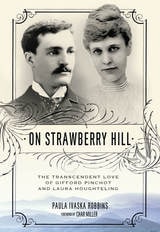
On Strawberry Hill
The Transcendent Love of Gifford Pinchot and Laura HoughtelingPaula Ivaska Robbins
University of Alabama Press, 2017
At its core, Paula Ivaska Robbins’s On Strawberry Hill: The Transcendent Love of Gifford Pinchot and Laura Houghteling is a human interest story that cuts a neat slice across nineteenth-century America by bringing into juxtaposition a wide array of topics germane to the period—the national fascination with spiritualism, the death scourge that was tuberculosis, the rise of sanitariums and tourism in the southern highlands, the expansion of railroad travel, the rage for public parklands and playgrounds, and the development of professional forestry and green preservation―all through the very personal love story of two young blue bloods.
Born into a wealthy New York family, Gifford Pinchot (1865–1946) served two terms as Pennsylvania’s governor and was the first chief of the US Forest Service, which today manages 192 million acres across the country. Pinchot also created the Society of American Foresters, the organization that oversees his chosen profession, and the Yale School of Forestry and Environmental Studies, the oldest forestry school in America. Ultimately, he and his friend President Theodore Roosevelt made forestry the focus of a national land conservation movement.
But before these accomplishments, Gifford Pinchot fell in love with Laura Houghteling, daughter of the head of the Chicago Board of Trade, while she recuperated from “consumption” at Strawberry Hill, the family retreat in Asheville, North Carolina. In his twenties at the time and still a budding forester, Pinchot was working just across the French Broad River at George Vanderbilt’s great undertaking, the Biltmore Estate, when the young couple’s relationship blossomed. Although Laura would eventually succumb to the disease, their brief romance left an indelible mark on Gifford, who recorded his ongoing relationship, and mental conversations, with Laura in his daily diary entries long after her death. He steadfastly remained a bachelor for twenty years while accomplishing the major highlights of his career.
This poignant book focuses on that phenomenon of devotion and inspiration, providing a unique window into the private practice of spiritualism in the context of Victorian mores, while offering new perspectives on Pinchot and early American forestry. In addition, preeminent Pinchot biographer Char Miller contributes an excellent foreword.

On Time Delivery
The Dog Team Mail CarriersWilliam S. Schneider
University of Alaska Press, 2012
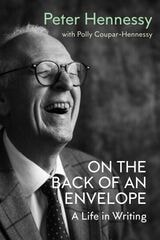
On the Back of an Envelope
A Life in WritingPeter Hennessy
Haus Publishing, 2025
As one of Britain’s foremost constitutional experts and contemporary historians, Peter Hennessy has spent his professional life unpicking the arcane world of Whitehall and Westminster. He began his career as a journalist for the Times, the Economist, and the Financial Times, developing a network of insider contacts who helped him shine a light on some of the dustiest corners of the British establishment. As a journalist, prize-winning contemporary historian, and political commentator, he has chronicled the workings of the British state with wit, affection, and a healthy sense of the absurd over a five-decade career. Now a crossbench peer, he has, in his own words, “moved in with his exhibits.” Hennessy is also a stalwart of BBC election night coverage and a regular commentator on BBC Radio 4, bringing a historical and constitutional perspective on current events.
In this new volume, he brings together selected journalism, unpublished lectures, and new writing alongside personal recollections and reflections on his time observing postwar Britain, how it is governed, and those who do the governing. He reflects on the making and unmaking of prime ministers from Attlee to Truss, life in the House of Lords, and the changing constitutional landscape in the wake of Brexit and amid uncertainty about the future of the Union. Interspersed with lectures, journalism, and new pieces, Hennessy also looks back at a fascinating career, reflecting on his own experiences as a young green graduate navigating the hard-nosed world of Fleet Street in the 1970s, bringing to life a cast of characters from a world now largely gone. He revisits his time as a public historian, academic, and crossbench peer with a levity reflected in his belief that history is “gossip with footnotes.”
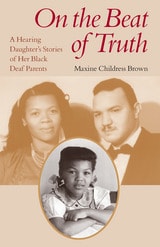
On the Beat of Truth
A Hearing Daughter’s Stories of Her Black Deaf ParentsMaxine Childress Brown
Gallaudet University Press, 2013
As an African American woman born in 1943, Maxine Childress Brown possessed a unique vantage point to witness the transformative events in her parents’ lives. Both came from the South -- her father, Herbert Childress, from Nashville, TN, and her mother, Thomasina Brown, from Concord, NC. The oldest of three daughters, Maxine was fascinated by her parents’ stories. She marveled at how they raised a well-respected, middle-class family in the midst of segregation with the added challenge of being deaf.
Her parents met in Washington, DC, where they married and settled down. Her father worked as a shoe repairman for $65 per week for more than 15 years. A gifted seamstress, her mother gave up sewing to clean houses. Because of their modest means, Maxine and her sisters lived more than modest lives. When Maxine’s tonsils became infected, her parents could not afford the operation to have them removed. For her high school prom, her mother bought her a dress on credit because she had no time to sew. Herbert Childress showed great love for his young daughters, but events turned him to bitterness and to drink. Throughout all, Thomasina encouraged her girls, always urging them to excel. She demanded their honest best with her signature phrase, her flat hand raised from her mouth straight up in the air, “on the beat of truth.”
On the Bus with Bill Monroe
My Five-Year Ride with the Father of Blue GrassMark Hembree
University of Illinois Press, 2022
The amusing story of a Yankee fish out of water, On the Bus with Bill Monroe mixes memoir with storytelling to recount the adventures of a Northerner learning new ways and the Old South.
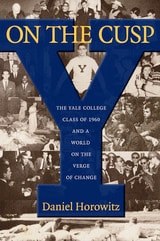
On the Cusp
The Yale College Class of 1960 and a World on the Verge of ChangeDaniel Horowitz
University of Massachusetts Press, 2015
How did the 1950s become “The Sixties”? This is the question at the heart of Daniel Horowitz's On the Cusp. Part personal memoir, part collective biography, and part cultural history, the book illuminates the dynamics of social and political change through the experiences of a small, and admittedly privileged, generational cohort.
A Jewish “townie” from New Haven when he entered Yale College in fall 1956, Horowitz reconstructs the undergraduate career of the class of 1960 and follows its story into the next decade. He begins by looking at curricular and extracurricular life on the all-male campus, then ranges beyond the confines of Yale to larger contexts, including the local drama of urban renewal, the lingering shadow of McCarthyism, and decolonization movements around the world. He ponders the role of the university in protecting the prerogatives of class while fostering social mobility, and examines the growing significance of race and gender in American politics and culture, spurred by a convergence of the personal and the political. Along the way he traces the political evolution of his classmates, left and right, as Cold War imperatives lose force and public attention shifts to the civil rights movement and the war in Vietnam.
Throughout Horowitz draws on a broad range of sources, including personal interviews, writings by classmates, reunion books, issues of the Yale Daily News, and other undergraduate publications, as well as his own letters and college papers. The end product is a work consistent with much of Horowitz's previously published scholarship on postwar America, further exposing the undercurrent of discontent and dissent that ran just beneath the surface of the so-called Cold War consensus.
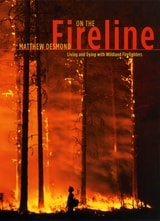
On the Fireline
Living and Dying with Wildland FirefightersMatthew Desmond
University of Chicago Press, 2007
A classic early work by the author of Evicted, a close-up look at the lives of wildland firefighters
In this rugged account of a rugged profession, Matthew Desmond explores the heart and soul of the wildland firefighter. Having joined a firecrew in Northern Arizona as a young man, Desmond relates his experiences with intimate knowledge and native ease, adroitly balancing emotion with analysis and action with insight. On the Fireline shows that these firefighters aren’t the adrenaline junkies or romantic heroes as they’re so often portrayed.
An immersion into a dangerous world, On the Fireline is also a sophisticated analysis of a high-risk profession—and a captivating read.
On the Fringes of History
A MemoirPhilip D. Curtin
Ohio University Press, 2005
In the 1950s, professional historians claiming to specialize in tropical Africa were no more than a handful. The teaching of world history was confined to high school courses, and even those were focused on European history, with a chapter added to account for the history of East and South Asia. The change over the ensuing decades was revolutionary.
Philip D. Curtin was a leader among a new generation of historians that emerged after the Second World War. Written with characteristic economy and telling detail, On the Fringes of History: A Memoir follows Curtin from his beginnings in central West Virginia in the 1920s, through a distinguished academic career in which Curtin founded African studies at the University of Wisconsin. He began the programs in comparative world history at Wisconsin and Johns Hopkins, producing many of the most influential historians and Africanists from the 1950s to today.
Always an independent thinker and controversial figure, Curtin revived the study of the Atlantic slave trade. His career stands as an example of the kind of dissatisfaction and struggles that brought about a sea change in higher education. On the Fringes of History traces the movement of African history and world history from the fringes of the history profession into the mainstream. This stunningly illustrated memoir illuminates both the career of a leading historian and the history of twentieth-century academia.
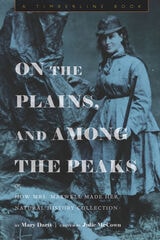
On the Plains, and Among the Peaks
or, How Mrs. Maxwell Made Her Natural History Collection: by Mary DarttJulie McCown
University Press of Colorado, 2021
Dartt’s book tells the story of Maxwell’s lifelong passion and dedication to work and education that made her a pioneer in more ways than one. It catalogs her important scientific contributions and development of museum habitat groupings and lifelike taxidermy mounts, showcases engaging accounts of wilderness excursions on the frontier of the Western United States in the 1860s and 1870s, and testifies to her resolve to show that women were capable of succeeding in traditionally male-dominated fields.
This scholarly edition of On the Plains, and Among the Peaks will spark renewed interest in Maxwell and Dartt as neglected figures in nineteenth-century US history and literature, opening a conversation that other literary scholars and historians will join to further situate their work within the numerous disciplines to which it speaks, including nineteenth-century American literature; women’s, western, environmental, and natural history; and gender, museum, and animal studies.

On the Run in Siberia
Rane Willerslev
University of Minnesota Press, 2012
If I had let myself be ruled by reason alone, I would surely be lying dead somewhere or another in the Siberian frost.
The Siberian taiga: a massive forest region of roughly 4.5 million square miles, stretching from the Ural Mountains to the Bering Sea, breathtakingly beautiful and the coldest inhabited region in the world. Winter temperatures plummet to a bitter 97 degrees below zero, and beneath the permafrost lie the fossilized remains of mammoths, woolly rhinoceroses, and other ice age giants. For the Yukaghir, an indigenous people of the taiga, hunting sable is both an economic necessity and a spiritual experience—where trusting dreams and omens is as necessary as following animal tracks. Since the fall of Communism, a corrupt regional corporation has monopolized the fur trade, forcing the Yukaghir hunters into impoverished servitude.
Enter Rane Willerslev, a young Danish anthropologist who ventures into this frozen land on an idealistic mission to organize a fair-trade fur cooperative with the hunters. From the outset, things go terribly wrong. The regional fur company, with ties to corrupt public officials, proves it will stop at nothing to maintain its monopoly: one of Willerslev’s Yukaghir business partners is arrested on spurious charges of poaching and illegal trading; another drowns mysteriously. When police are sent to arrest him, Willerslev fears for his life, and he and a local hunter flee to a remote hunting lodge even deeper in the icy wilderness. Their situation turns even more desperate right away: they manage to kill a moose but lose the meat to predators and begin to starve, frostbitten and isolated in the frozen taiga.
Thus begins Willerslev’s extraordinary, chilling tale of one year living in exile among Yukaghir hunters in the stark Siberian taiga region. At turns shocking and quietly moving, On the Run in Siberia is a pulse-pounding tale of idealism, political corruption, starvation, and survival (with a timely assist from Vladimir Putin) as well as a striking portrait of the Yukaghirs’ shamanistic tradition and their threatened way of life, a drama unfolding daily in one of the world’s coldest, most enthralling landscapes.