Results by title
5550 books match the query 'Biography & Autobiography' and 118 start with o
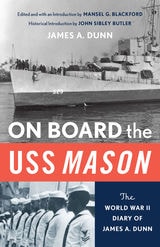
ON BOARD THE USS MASON
THE WORLD WAR II DIARY OF JAMES A. DUNNMANSEL G. BLACKFORD
The Ohio State University Press, 2016
Dunn kept a day-to-day diary during his spare time on board the Mason. Such diaries are a rarity, for the navy (and other armed services) forbade the keeping of diaries, fearful lest secret information fall into enemy hands. The diary chronicles the Mason’s wartime activities, from the first convoy to the final return to the United States. It captures the feeling and meaning of life on board with an immediacy not fully found in retrospective accounts. The diary accurately records the mortal danger Dunn and his shipmates were in while attacking enemy submarines or dealing with extreme weather conditions in the North Atlantic. It conveys the boredom the men encountered while confined on long, tedious convoys and the joy of shore leaves. Here is the daily life aboard ship—the duties and the pastimes that made shipboard life endurable.
Equally interesting, the diary reveals what it meant to be an African American in a white navy within a segregated American society, the shipboard tensions, and the shipboard cooperation and sense of unity. It also portrays the life of an African American onshore in the United States, Great Britain, and North Africa and the love story that unfolded between James and his wife, Jane.
Supplemented by additional sources, including interviews with Dunn, this diary is a personal view into an important part of American history. Like the Tuskegee airmen, the men of the USS Mason paved the way for desegregation in America’s armed forces, contributing to a civil rights movement that changed the face of a nation.
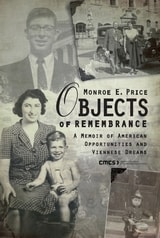
Objects of Remembrance
A Memoir of American Opportunities and Viennese DreamsMonroe E. Price
Central European University Press, 2009
This is a memoir about the power of American assimilation and opportunity in the face of persisting refugee realities. Like Isaac Bashevis Singer, Monroe Price recounts the continuing impact of European identities as families, cast from their homes by the rise of Hitler and the Third Reich, struggle to find their way in a new and challenging environment.
In a series of reflections, Price, who was born to a Jewish family in Vienna in 1938 and left when he was seven months old, seeks to create the Vienna of his infancy, including Jewish life, anti-Semitism, the Anschluss, and Kristallnacht (during which his father was arrested). He shifts to scenes of American socialization in the places he moved with his parents:: Macon, Georgia, Cincinnati, Ohio, and the experience of New York City. Through these reflections, Price illuminates ideas about family, religion, friends and schooling as well as deeply personal issues such as home, food and intimacy.
Price’s memoir weaves complicated strands—his Viennese origins, campaigns to distribute Jewish refugees away from New York City, the special qualities of Midwestern Ohio life in the 1950s—and the contrasting patterns of adjustment by different generations in his family in the American landscape. As he traces the particular path of his own life, Price reveals a more universal story of adjustment, and the relationship between a marginal community and the drama of American citizenship.
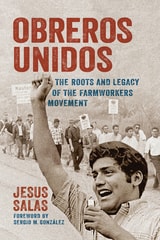
Obreros Unidos
The Roots and Legacy of the Farmworkers MovementJesus Salas
Wisconsin Historical Society Press, 2023
Taking inspiration from César Chávez, as a young man Salas and others led a historic march from Wautoma to Madison to demand that lawmakers address rampant violations of Wisconsin’s minimum wage laws and housing codes. These young labor leaders founded Obreros Unidos—Workers United—to continue the fight for fairness and respect, as well as to provide much-needed services to migrant families. This memoir of a movement details how their work went beyond the fields to have lasting impacts on representation in community organizations and access to education, empowering later generations to demand better.
Winner of the 2024 Benjamin Franklin Award for Multicultural Books
Winner of the 2024 Hamlin Garland Prize in Popular History from the Midwest History Association
“In recounting the story of Tejano settlement and struggle in Wisconsin, Salas unsettles this story line and, in the process, demonstrates the power of personal narrative and the lasting political implications of retrieving and restoring Latino history.”
—Sergio M. González, author of Mexicans in Wisconsin
“Salas’s story is an essential chapter in the history of Wisconsin and Milwaukee and mirrors the growth, progress and dreams of the Latinx community. His reflections speak to not only the importance of the Latinx community, but the need to build alliances across lines of race and gender and fulfill the promise of a multiracial democracy.”
—Barbara Miner, Milwaukee Magazine
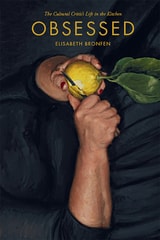
Obsessed
The Cultural Critic’s Life in the KitchenElisabeth Bronfen
Rutgers University Press, 2019
Even the most brilliant minds have to eat. And for some scholars, food preparation is more than just a chore; it’s a passion. In this unique culinary memoir and cookbook, renowned cultural critic Elisabeth Bronfen tells of her lifelong love affair with cooking and demonstrates what she has learned about creating delicious home meals. She recounts her cherished food memories, from meals eaten at the family table in postwar Germany to dinner parties with friends. Yet, in a thoughtful reflection on the pleasures of cooking for one, she also reveals that some of her favorite meals have been consumed alone.
Though it contains more than 250 mouth-watering recipes, Obsessed is anything but a conventional cookbook. As she shares a lifetime of knowledge acquired in the kitchen, Bronfen hopes to empower both novice and experienced home chefs to improvise, giving them hints on how to tweak her recipes to their own tastes. And unlike cookbooks that assume readers have access to an unlimited pantry, this book is grounded in reality, offering practical advice about food storage and reusing leftovers. As Bronfen serves up her personal stories and her culinary wisdom, reading Obsessed is like sitting down to a home-cooked meal with a clever friend.
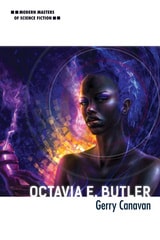
Octavia E. Butler
Gerry Canavan
University of Illinois Press, 2016
Gerry Canavan offers a critical and holistic consideration of Butler's career. Drawing on Butler's personal papers, Canavan tracks the false starts, abandoned drafts, tireless rewrites, and real-life obstacles that fed Butler's frustrations and launched her triumphs. Canavan departs from other studies to approach Butler first and foremost as a science fiction writer working within, responding to, and reacting against the genre's particular canon. The result is an illuminating study of how an essential SF figure shaped themes, unconventional ideas, and an unflagging creative urge into brilliant works of fiction.
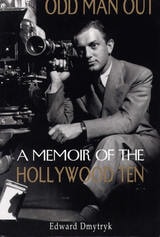
Odd Man Out
A Memoir of the Holllywood TenEdward Dmytryk
Southern Illinois University Press, 1996
In 1947, the House Un-American Activities Committee rudely interrupted the successful career and life of Edward Dmytryk, citing him with contempt of Congress. As a result, Dmytryk was fired by RKO and spent three years in England before returning to the United States to serve a six-month jail sentence and undergo a second round of hearings, during which he recanted and provided evidence against several of his former colleagues.
In this personal and perceptive book, Dmytryk sharply chronicles the history of a particularly turbulent era in American political life while examining his own life before and after the events universally called the witch hunts. He details his brief membership in the Communist Party of America, explaining his initial commitment to what he perceived as communist ideals of civil liberties, economic justice, and antifacism, followed by his eventual disillusionment with the party as itbetrayed those ideals. He goes on to provide a fair assessment of what then happened to him and the effect it had on the rest of his life.
Dmytryk describes the activities, prejudices, and personal behaviors of all the parties enmeshed in the congressional hearings on communism in Hollywood. His reactions to other members of the Hollywood Ten and his recollection of conversations with them lend his book an immediacy that is not only informative but also absorbing. Most importantly, he does not uphold an ideology but rather presents the events as he perceived them, understood them, and responded to them. Dmytryk’s account is characterized by an openness born of a mature awareness of personal trial as history.
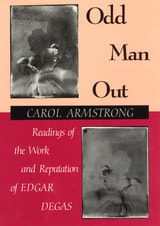
Odd Man Out
Readings of the Work and Reputation of Edgar DegasCarol M. Armstrong
University of Chicago Press, 1991
By reading several groups of the artist's images through the lens of a sequence of critical texts, Armstrong shows how our critical and popular expectations of Degas are overturned and subverted. Each of these groups of images is matched to different interpretive moves, each highlighting distinct themes: economics and vocation; narrative and semiotics; gender and corporeality; and the author and self. Armstrong's provocative analysis celebrates the tantalizing qualities of the artist's elusive career: the pluralism of his work, its conflation of positivistic and negational tactics, the modern and the traditional, the abstract and the representational.
"A lucid and searching study. . . . Armstrong has produced one of the most elegant and persuasive examples of the historian's use of 19th-century art criticism. In the process, she has achieved a reading of the artist which makes a difference to the way we understand the difference of Degas himself."—Neil McWilliam, Times Higher Education Supplement
"This is a brilliant, original, and beautifully articulated study. Carol Armstrong's scholarship is impressive in its richness, ambition, and sophistication: Degas's works have rarely been given such detailed, penetrating, and suggestive readings as those offered in this book."—Linda Nochlin, Yale University
"With brilliant insight and incisive analytical intelligence, Carol Armstrong introduces new ways to conceptualize the structural ambiguities of Degas's work. Her subtle and probing readings clarify the fundamental contrariness of Degas's images—their disturbing negativity, their anti-modern modernism. Odd Man Out catapults the criticism of Degas from the hinterlands of traditional art history to the foreground of contemporary critical theory in both literature and the visual arts."—Charles Bernheimer, University of Pennsylvania
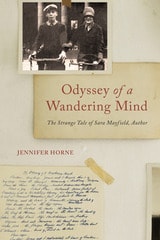
Odyssey of a Wandering Mind
The Strange Tale of Sara Mayfield, AuthorJennifer Horne
University of Alabama Press, 2024
A carefully rendered portrait of a brilliant but troubled daughter of the Old South who struggled against the conventions of gender, class, family, and ultimately of sanity, yet survived to define a creative life of her own
Sara Mayfield was born into Alabama’s governing elite in 1905 and grew up in a social circle that included Zelda Sayre, Sara Haardt, and Tallulah and Eugenia Bankhead. After winning a Goucher College short story contest judged by H. L. Mencken, Mayfield became friends with Mencken and his circle, then visited with Scott and Zelda Fitzgerald and hobnobbed with the literati while traveling in Europe after a failed marriage. Returning to Alabama during the Depression, she briefly managed the family landholdings before departing for New York City where she became involved in the theater. Inventing a plastic compound while working on theatrical sets, she applied for a patent and set her sights on a livelihood as an inventor and businesswoman. With the advent of World War II, Mayfield returned to her family home in Tuscaloosa where she expanded her experiments, freelanced as a journalist, and doggedly pursued a bizarre series of military and intelligence schemes, prompting temporary hospitalization. In 1945, she mingled with a host of cultural figures, including Frida Kahlo, Diego Rivera, Orson Welles, Rita Hayworth, and even a young John F. Kennedy, while reporting on the creation of the United Nations from Mexico and California. Back in Tuscaloosa after the war, however, she struggled to find her way with both work and family, becoming increasingly paranoid about perceived conspiracies arrayed against her. Finally, her mother and brother committed her to Bryce Hospital for the Insane, where she remained for the next seventeen years.
Throughout her life, Mayfield kept journals, wrote fiction, and produced thousands of letters while nursing the ambition that had driven her since childhood: to write and publish books. During her confinement, Mayfield assiduously recorded her experiences and her determined efforts—sometimes delusional, always savvy—to overturn her diagnosis and return to the world as a sane, independent adult. At 59, she was released from Bryce and later obtained a decree of “having been restored to sanity,” enabling her to manage her own financial affairs and to live how and where she pleased. She went on to publish noteworthy literary biographies of the Menckens and the Fitzgeralds plus a novel based on the life of Mona Lisa, finally achieving her quest to become the author of books and her own life. In Odyssey of a Wandering Mind, noted writer Jennifer Horne draws on years of research and an intimate understanding of the vast archive Sara Mayfield left behind to sensitively render Mayfield’s struggle to move through the world as the person she was—and her ultimate success in surviving to define the terms of her story.
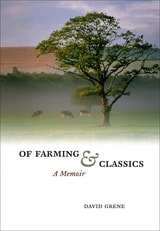
Of Farming and Classics
A MemoirDavid Grene
University of Chicago Press, 2006
A fiercely independent thinker, colorful storyteller, and spirited teacher, David Grene devoted his life to two things: farming, which he began as a boy in Ireland and continued into old age; and classics, which he taught for several decades that culminated in his translating and editing, with Richmond Lattimore, of The Complete Greek Tragedies.
In this charming memoir, which he wrote during the years leading up to his death in 2002 at the age of eighty-nine, Grene weaves together these interests to tell a quirky and absorbing story of the sometimes turbulent and always interesting life he split between the University of Chicago—where he helped found the Committee on Social Thought—and the farm he kept back in Ireland.
Charting the path that took him from Europe to Chicago in 1937, and encompassing his sixty-five-year career at the university, Grene’s book draws readers into the heady and invigorating climate of his time there. And it is elegantly balanced with reflections stemming from his work on the farm where he hunted, plowed and regularly traveled on horseback to bring his cows home for milking. Grene’s form and humor are quite his own, and his brilliant storytelling will enthrall anyone interested in the classics, rural Ireland, or twentieth-century intellectual history, especially as it pertains to the University of Chicago.

Of Morsels and Marvels
Maryse Condé
Seagull Books, 2019
In Of Morsels and Marvels, Condé takes us on a literary journey around places she has travelled to in India, Indonesia, and South Africa. She highlights the tastes and culinary traditions that are fascinating examples of a living museum. Such places, Condé explains, provide important insights into lesser-known aspects of contemporary life. One anecdote illustrates what becomes of the standard Antillean dishes of fish stew and goat curry by two Antilleans who own a restaurant in Sydney, Australia. Cuisine changes not only according to the individual cook but also adapts to foreign skies under which it is created. The author also recounts personal memories of her lifelong relationship with cooking, such as when Adélia, her family’s servant, wrongly blames little Maryse for mixing raisins with fish and using her imagination in the kitchen.
Blending travel with gastronomy, this enchanting volume from the winner of the 2018 Alternative Nobel Prize will delight all who marvel at the wonders of the kitchen or seek to taste the world.
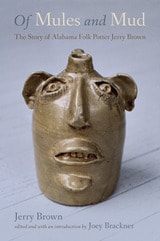
Of Mules and Mud
The Story of Alabama Folk Potter Jerry BrownJerry Brown, edited and with an introduction by Joey Brackner
University of Alabama Press, 2022
The life and times of Alabama folk potter Jerry Brown, as told in his own words
Born in 1942, Jerry Brown helped out in his father’s pottery shop as a young boy. There he learned the methods and techniques for making pottery in a family tradition dating back to the 1830s. His responsibilities included tending the mule that drove the mill that was used to mix clay (called “mud” by traditional potters). Business suffered as demand for stoneware churns, jugs, and chamber pots waned in the postwar years, and manufacture ceased following the deaths of Brown’s father and brother in the mid-1960s. Brown turned to logging for his livelihood, his skill with mules proving useful in working difficult and otherwise inaccessible terrain. In the early 1980s, he returned to the family trade and opened a new shop that relied on the same methods of production with which he had grown up, including a mule-powered mill for mixing clay and the use of a wood-fired rather than gas-fueled kiln.
Folklorist Joey Brackner met Brown in 1983, and the two quickly became close friends who collaborated together on a variety of documentary and educational projects in succeeding years—efforts that led to greater exposure, commercial success, and Brown’s recognition as a National Heritage Fellow by the National Endowment for the Arts. For years, Brown spoke of the urge to write his life story, but he never set pen to paper. In 2015, Brackner took the initiative and interviewed Brown, recording his life story over the course of a weekend at Brown’s home. Of Mules and Mud is the result of that marathon interview session, conducted one year before Brown passed away.
Brackner has captured Jerry Brown’s life in his own words as recounted that weekend, lightly edited and elaborated. Of Mules and Mud is illustrated with photos from all phases of Brown’s life, including a color gallery of 28 photos of vessel forms made by Brown throughout his career that collectors of folk pottery will find invaluable.
Of Walking in Ice
Munich-Paris, 23 November–14 December 1974Werner Herzog
University of Minnesota Press, 2015
In late November 1974, filmmaker Werner Herzog received a phone call from Paris delivering some terrible news. German film historian, mentor, and close friend Lotte Eisner was seriously ill and dying. Herzog was determined to prevent this and believed that an act of walking would keep Eisner from death. He took a jacket, a compass, and a duffel bag of the barest essentials, and wearing a pair of new boots, set off on a three-week pilgrimage from Munich to Paris through the deep chill and snowstorms of winter.
Of Walking in Ice is Herzog’s beautifully written, much-admired, yet often-overlooked diary account of that journey. Herzog documents everything he saw and felt on his quest to his friend’s bedside, from poetic descriptions of the frozen landscape and harsh weather conditions to the necessity of finding shelter in vacant or abandoned houses and the intense loneliness of his solo excursion.
Includes, for the first time, Werner Herzog’s 1982 “Tribute to Lotte Eisner” upon her receipt of the Helmut Käutner Prize
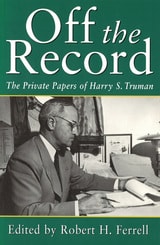
Off the Record
The Private Papers of Harry S. TrumanEdited by Robert H. Ferrell
University of Missouri Press, 1997
Gathered for the first time, Truman's private papers--diaries, letters, and memoranda--cover the period from his occupancy of the White House in 1945 to shortly before his death in 1972. Students and scholars will find valuable material on major events of the Truman years, from the Potsdam Conference to the Korean War.
Off the Rim
Basketball and Other Religions in a Carolina ChildhoodFred Hobson
University of Missouri Press, 2006
Oglethorpe in Perspective
Georgia's Founder after Two Hundred YearsEdited by Phinizy Spalding and Harvey H. Jackson, III
University of Alabama Press, 1989
Ohio Farm
Wheeler McMillen
The Ohio State University Press, 1997
Uncomplicated when compared with the task of managing today's highly mechanized agricultural complexes, life on the early twentieth-century small farm entailed hard work and afforded simple pleasures that brought satisfaction and enjoyment to the farm and family. Farming on that scale and in the same manner has now become almost completely infeasible, yet in those times a good farmer could prosper and become independent. Wheeler McMillen’s father, Lewis, did both.
Relying frequently on his father’s account books and concise diaries, for this is primarily his father’s story, McMillen recounts the immense labor that farming demanded before the advent of the tractor and the combine harvester. He evokes the special excitements of having company for Sunday dinner, attending the annual oyster supper at the Grange Hall, and gathering on the Fourth of July with the interminable wait for darkness to fall. McMillen also portrays the quiet peace and ineffable joy of private moments, such as resting the horses during spring plowing to watch bronzed grackles search for food in the freshly turned furrows.
Wheeler McMillen’s slice of history will speak to those interested in what rural life was once like in the Midwest and to Ohioans who would like to learn more about their state’s recent past.
Ohio Volunteer
The Childhood and Civil War Memoirs of Captain John Calvin Hartzell, OVICharles I. Switzer
Ohio University Press, 2005
Edited and introduced by Charles Switzer, Ohio Volunteer: The Childhood and Civil War Memoirs of Captain John Calvin Hartzell, OVI documents military strategy, the life of the common soldier, the intense excitement and terror of battle, and the wretchedness of the wounded.
Hartzell’s family implored him to set down his life story, including his experiences in the Civil War from 1862 to 1866. Hartzell did so diligently, taking more than two years to complete his manuscript. The memoir reveals a remarkable memory for vivid details, the ability to see larger and more philosophical perspectives, and a humorous outlook that helped him bear the unbearable.
He also depicted the changing rural economy, the assimilation of the Pennsylvania Dutch, and the transformations wrought by coal mining and the iron industry. Hartzell felt individualism was threatened by the Industrial Revolution and the cruelties of the war. He found his faith in humanity affirmed—and the dramatic tension in his memoir resolved—when 136,000 Union soldiers reenlisted and assured victory for the North. The common soldier, he wrote, was “loyal to the core.”
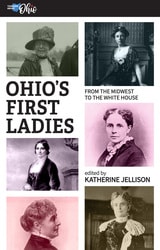
Ohio's First Ladies
From the Midwest to the White HouseKatherine Jellison
Ohio University Press, 0
This engaging collection of essays explores the lives and legacies of six Ohio-born First Ladies: Lucy Webb Hayes, Lucretia Rudolph Garfield, Caroline Scott Harrison, Ida Saxton McKinley, Helen Herron Taft, and Florence Kling Harding. With contributions by leading scholars, the volume moves beyond traditional biography to examine how each woman’s Ohio roots shaped her public role and influenced her husband’s political career at both state and national levels. Connecting Ohio history to the broader narrative of nineteenth- and early twentieth-century US history, these essays draw on rich primary and secondary sources to illuminate the intersection of regional identity and national politics. Accessible and insightful, Ohio’s First Ladies invites readers of all backgrounds—from high school students to lifelong learners—to discover how the Midwest helped mold women who would leave their mark on the White House. Contributors Benjamin T. Arrington Jennifer Capps Annette B. Dunlap Kara M. French Michelle Gullion Katherine Jellison Katherine A. S. Sibley
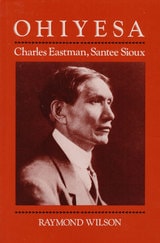
Ohiyesa
Charles Eastman, Santee SiouxRaymond Wilson
University of Illinois Press, 1983
Charles Eastman, called Ohiyesa in Santee, came of age amidst increasing tensions and violence between Native and European colonizers. Though raised to be a hunter-warrior, Eastman was persuaded by his Christian father to enter white society. Eastman graduated from Dartmouth and the Boston University School of Medicine. His career included service as the government physician at the Pine Ridge Agency, where he tended casualties at Wounded Knee; as an Inspector for the Bureau of Indian Affairs; as Indian secretary for the YMCA; and as one of the cofounders of the Boy Scouts of America.
Raymond Wilson examines these accomplishments while also delving into the writings that expressed Eastman’s determination to hold onto his Santee roots. Popular works like Indian Boyhood, The Soul of the Indian, and Indian Heroes and Chieftains reconfirmed his heritage and aimed at making white society aware of Indigenous peoples’ contribution to American civilization.
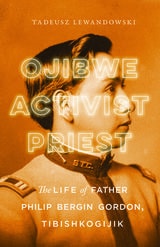
Ojibwe, Activist, Priest
The Life of Father Philip Bergin Gordon, TibishkogijikTadeusz Lewandowski
University of Wisconsin Press, 2019
Drawing on previously unexplored materials, Tadeusz Lewandowski paints a portrait of a contentious life. Ojibwe, Activist, Priest examines Gordon's efforts to abolish the Bureau of Indian Affairs, his membership in the Society of American Indians, and his dismissal from his Ojibwe parish and exile to a tiny community where he'd be less likely to stir up controversy. Lewandowski illuminates a significant chapter in the struggle for Native American rights through the views and experiences of a key Native progressive.

Old Brick
Charles Chauncy of Boston, 1705-1787Edward M. Griffin
University of Minnesota Press, 1980
Old Brick was first published in 1980. Minnesota Archive Editions uses digital technology to make long-unavailable books once again accessible, and are published unaltered from the original University of Minnesota Press editions.
Charles Chauncy was a powerful and influential figure in his own time, but in historical accounts he has always been overshadowed by his contemporaries Benjamin Franklin and Jonathan Edwards. When he is remembered today, it is usually as Edwards's chief antagonist during the Great Awakening of the 1740s. Yet Chauncy's fellow New Englanders knew that there was more to the man than that.
In the course of his 60-year tenure as a pastor of Boston's First Church (the "Old Brick"), Chauncy involved himself in most of the important intellectual, religious, and political issues of the century. Not only did he aggressively oppose the emotional revivalism of the Great Awakening, but he was also a bold pamphleteer and preacher in support of the American Revolution. In theology Chauncy became, as an old man, the leading advocate probably having scandalized his own forebears, but he insisted that he was true to his Protestant tradition and never abandoned his reliance on Scripture and Puritan discipline in favor of rationalist secularism.
Old Brick,the first full-scale biography of Charles Chauncy, attempts to recover not only Chauncy the spokesman for the ideas of a great many colonial Americans, but also the complex man who struggled with himself and with the events of his time to arrive at those positions. The portrait of Chauncy that emerges is fuller, more comprehensive, and more balanced than the stereotypes and partial portraits that have thus far represented him in history. This biography now makes it possible to consider Chauncy a figure worthy of study in his own right and to take a fresh look at eighteenth-century New England in light of the tradition Chauncy represents.
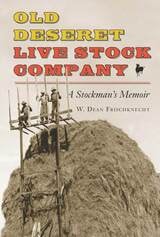
Old Deseret Live Stock Company
A Stockman's MemoirW. Dean Frischknecht
Utah State University Press, 2008
In the high country of the northern Wasatch Mountains, lies what is left of one of the West’s largest ranches. Deseret Live Stock Company was reputed at various times to be the largest private landholder in Utah and the single biggest producer of wool in the world. The ranch began as a sheep operation, but as it found success, it also ran cattle. Incorporated in the 1890s by a number of northern Utah ranchers who pooled their resources, the company was at the height of successful operations in the mid-twentieth century when a young Dean Frischknecht, bearing a recent degree in animal science, landed the job of sheep foreman. In his memoir he recounts in detail how Deseret managed huge herds of livestock, vast lands, and rich wildlife and recalls through lively anecdotes how stockmen and their families lived and worked in the Wasatch Mountains and Skull Valley’s desert wintering grounds.

Old Farm Country Christmas
Favorite Recipes, Homespun Crafts, and Merry MemoriesJerry Apps
Wisconsin Historical Society Press, 2026
A festive and nostalgic celebration of family Christmas recipes and traditions.
From the beloved father–daughter team behind the bestseller Old Farm Country Cookbook comes a heartwarming celebration of Christmases past—when the first snowfall signaled the start of the season, neighbors gathered close, and simple joys lit up the long Midwestern winter.
In Old Farm Country Christmas, Jerry Apps and Susan Apps-Bodilly invite readers inside the farmhouse kitchens, one-room schoolhouses, rural churches, and snow-packed fields of Wisconsin, sharing Christmas stories from the Great Depression and World War II through the 1960s. Drawing on vivid family memories, interviews, and historical research, the authors recreate a time when holiday magic was handmade, heartfelt, and shared generously.
Readers will savor more than 80 cherished Apps family recipes, from First Snow Peppermint Butter Cookies and Lucia Buns to Spiced Cider, Krumkake, Seven Layer Bars, Cheesy Potatoes and Ham, and other festive favorites for every gathering. Paired with these culinary classics are twelve simple, old-fashioned craft projects—think paper chains, evergreen garlands, applesauce ornaments, and cozy sock snow people—along with seven timeless activities perfect for wintry afternoons with friends and family.
With 50 vintage photographs and illustrations, this heartfelt collection captures the laughter of school Christmas programs, the excitement of long-hoped-for gifts, the aroma of butter and spices drifting from the oven, and the deep meaning of the traditions that knit rural communities together.
More than a book, Old Farm Country Christmas is an invitation to slow down and rediscover the warmth, wonder, and shared traditions that make the season shine.

Old Farm Country Cookbook
Recipes, Menus, and MemoriesJerry Apps
Wisconsin Historical Society Press, 2017
Inspired by the dishes made by his mother, Eleanor, and featuring recipes found in her well-worn recipe box, Jerry and his daughter, Susan, take us on a culinary tour of life on the farm during the Depression and World War II. Seasoned with personal stories, menus, and family photos, Old Farm Country Cookbook recalls a time when electricity had not yet found its way to the farm, when making sauerkraut was a family endeavor, and when homemade ice cream tasted better than anything you could buy at the store.
Old Orchard Farm
The Story of an Iowa BoyhoodHugh Orchard
University of Iowa Press, 2010

Ole Evinrude and His Outboard Motor
Bob Jacobson
Wisconsin Historical Society Press, 2009
Wisconsin entrepreneur Ole Evinrude will inspire children in this addition to the Badger Biographies series for young readers, where the story of Ole's invention, from drawing board to factory floor, is told in a reader-friendly format that includes historic images, a glossary of terms, and sidebars explaining how an outboard motor works.
Ole Evinrude was born in Norway in 1877 and immigrated to the United States when he was five years old. The Evinrude family settled in Wisconsin and began farming, but it was clear from a very young age that Ole would not follow the family tradition. Ole Evinrude was meant to work with boats.
Building an outboard motor was not easy, though - Ole suffered numerous mechanical and financial setbacks along the way. After years of hard work and persistence, the Evinrude motor company was founded and Ole's outboard motors were an instant hit around the world. Ole continued to improve the design of his motor and attracted other entrepreneurs to the area, making Wisconsin the center of the outboard motor industry for decades.
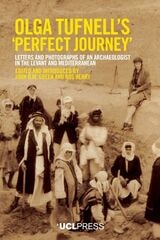
Olga Tufnell's “Perfect Journey”
Letters and Photographs of an Archaeologist in the Levant and MediterraneanEdited by John D.M. Green and Henry Ros
University College London, 2021
Olga Tufnell was a British archaeologist working in Egypt, Cyprus, and Palestine in the 1920s and 1930s—a period often described as a golden age of archaeological discovery. For the first time, this book presents Tufnell’s account of her experiences in her own words. Based largely on letters, the text is accompanied by dozens of photographs that shed light on her personal experiences of travel and dig life at this extraordinary time. Introductory material by John D.M. Green and Ros Henry provides the social, historical, biographical, and archaeological context, as the letters offer new insights into the social and professional networks and history of archaeological research in Palestine under the British Mandate. They provide insights into the role of foreign archaeologists, relationships with local workers and inhabitants, and the colonial framework within which they operated during turbulent times. This book will be an important resource for those studying the history of archaeology in the Eastern Mediterranean, particularly for the sites of Qau el-Kebir, Tell Fara, Tell el-‘Ajjul and Tell ed-Duweir (ancient Lachish). Moreover, Tufnell’s lively style makes this a fascinating personal account of archaeology and travel in the interwar era.
Olivier
Francis Beckett
Haus Publishing, 2006
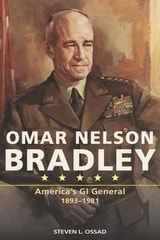
Omar Nelson Bradley
America's GI General, 1893-1981Steven L. Ossad
University of Missouri Press, 2017
Omar Nelson Bradley was the youngest and last of nine men to earn five-star rank and the only army officer so honored after World War II. This new biography by Steven L. Ossad gives an account of Bradley’s formative years, his decorated career, and his postwar life.
Bradley’s decisions shaped the five Northwest European Campaigns from the D-Day landings to VE Day. As the man who successfully led more Americans in battle than any other in our history, his long-term importance would seem assured. Yet his name is not discussed often in the classrooms of either civilian or military academies, either as a fount of tactical or operational lessons learned, or a source of inspiration for leadership exercised at Corps, Army, Group, Army Chief, or Joint Chiefs of Staff levels.
The Bradley image was tailor-made for the quintessential homespun American heroic ideal and was considered by many to be a simple, humble country boy who rose to the pinnacle of power through honesty, hard work, loyalty and virtuous behavior. Even though his classmates in both high school and at West Point made remarks about his looks, and Bradley was always self-conscious about smiling because of an accident involving his teeth, he went on to command 12 Army Group, the largest body of American fighting men under a single general.
Bradley’s postwar career as administrator of the original GI Bill and first Chairman of the Joint Chiefs of Staff during the Korean War ensures his legacy. These latter contributions, as much as Bradley’s demonstrable World War II leadership, shaped U.S. history and culture in decisive, dramatic, and previously unexamined ways.
Drawing on primary sources such as those at West Point, Army War College and Imperial War Museum, this book focuses on key decisions, often through the eyes of eyewitness and diarist, British liaison officer Major Thomas Bigland. The challenges our nation faces sound familiar to his problems: fighting ideologically-driven enemies across the globe, coordinating global strategy with allies, and providing care and benefits for our veterans.
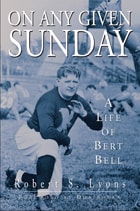
On Any Given Sunday
A Life of Bert BellRobert S. Lyons, Foreword by Don Shula
Temple University Press, 2009
Bell, who arguably saved the league from bankruptcy by conceiving the idea for the annual player draft, later made the historic decision to introduce “sudden death” overtime—a move that propelled professional football into the national consciousness. He coined the phrase “on any given sunday” and negotiated the league’s first national TV contract. Lyons also describes in fascinating detail Bell’s relationships with leading figures ranging from such Philadelphia icons as Walter Annenberg and John B. Kelly to national celebrities and U.S. Presidents. He also provides insight into Bell’s colorful personal life—including his hell-raising early years and his secret marriage to Frances Upton, a golden name in show business.
On Any Given Sunday is being published on the 50th anniversary of Bell’s death.
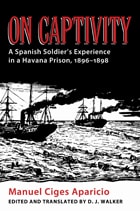
On Captivity
A Spanish Soldier's Experience in a Havana Prison, 1896-1898Manuel Ciges Aparicio
University of Alabama Press, 2012
A rare and unfiltered witness to Spain’s colonial collapse—Ciges Aparicio’s prison memoir exposes the political, human, and moral stakes of the Cuban War of Independence.
Ciges enlisted in the Spanish army in 1893 at the age of twenty. He served in Africa and then in Cuba, where he opposed Spanish General Valeriano Weyler’s policies in Cuba as well as the war itself. Ciges soon found himself imprisoned and facing execution for treason as punishment for an article critical of Weyler’s conducting of the war that was intercepted by Spanish authorities before it could be published in the pro-Cuban Parisian paper L’Intransigeant.
First published in book form in 1903, Ciges’s account includes detailed observations concerning prison organization, perceptions of political events and personalities of the time, as well as graphic descriptions of the daily life of the men confined in the infamous prison. Ciges is the only one of the so-called Generation of 1898—writers considered to have been deeply marked by el desastre (the loss of the colonies)—who was in Cuba during the war years. His witness to events there, colored by his stance as a freethinker and political skeptic, constitutes a significant historical document. Following his release from prison, Ciges returned to Spain where he resumed his career as an activist journalist and also earned acclaim as a translator and novelist. In time, his political allegiances shifted from socialism to liberal republicanism. He was acting as provincial governor of Avila when he was killed by unidentified assassins on August 4, 1936—eighteen days after the Falangist uprising against the Second Republic.
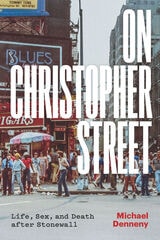
On Christopher Street
Life, Sex, and Death after StonewallMichael Denneny
University of Chicago Press, 2023
The Stonewall Riots of 1969 and the AIDS crisis of the 1980s have been captured in minute detail, and rightly memorialized in books, on tv, and in film as pivotal and powerful moments in queer history. Yet what about the moments in between—the tumultuous decade post-Stonewall when the queer community’s vitality and creativity exploded across the country, even as the AIDS crisis emerged?
Michael Denneny was there for it all. As a founder and editor of the wildly influential magazine Christopher Street and later as the first openly gay editor at a major publishing house, Denneny critically shaped publishing around gay subjects in the 1970s and beyond. At St. Martin’s Press, he acquired a slew of landmark titles by gay authors—many for his groundbreaking Stonewall Inn Editions—propelling queer voices into the mainstream cultural conversation. On Christopher Street is Denneny’s time machine, going back to that heady period to lay out the unfolding geographies and storylines of gay lives and capturing the raw immediacy of his and his contemporaries’ daily lives as gay people in America. Through forty-one micro-chapters, he uses his journal writings, articles, interviews, and more from the 1970s and ‘80s to illuminate the twists and turns of a period of incomparable cultural ferment.
One of the few surviving voices of his generation, Denneny transports us back in time to share those vibrant in-between moments in gay lives—the joy, sorrow, ecstasy, and energy—across three decades of queer history.
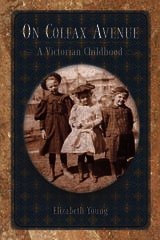
On Colfax Avenue
A Victorian ChildhoodElizabeth Young
University Press of Colorado, 2004
On Good Ground
The Story of the Sisters of Saint Joseph in St. PaulSister Helen Angela Hurley
University of Minnesota Press, 1951
On Good Ground was first published in 1951. Minnesota Archive Editions uses digital technology to make long-unavailable books once again accessible, and are published unaltered from the original University of Minnesota Press editions.
Besides providing a vivid yet scholarly account of a religious order, this book reflects much of the regional history of the area where the nuns have done their work. The order maintains the College of St. Catherine and numerous other institutions in Minnesota and North Dakota.
On Homesickness
A PleaJesse Donaldson
West Virginia University Press, 2017
One day, Jesse Donaldson wakes up in Portland, Oregon, and asks his wife to uproot their life together and move to his native Kentucky. As he searches for the reason behind this sudden urge, Donaldson examines both the place where he was born and the life he’s building.
The result is a hybrid—part memoir, part meditation on nostalgia, part catalog of Kentucky history and myth. Organized according to Kentucky geography, with one passage for each of the commonwealth’s 120 counties, On Homesickness examines whether we can ever return to the places we’ve called home.
On James Baldwin
Colm Tóibín
Brandeis University Press, 2024
Acclaimed Irish novelist Colm Tóibín first read James Baldwin just after turning eighteen. He had completed his first year at an Irish university and was struggling to free himself from a religious upbringing. He had even considered entering a seminary and was searching for literature that would offer illumination and insight. Inspired by the novel Go Tell It on the Mountain, Tóibín found a writer who would be a lifelong companion and exemplar.
From On James Baldwin
Baldwin was interested in the hidden and dramatic areas in his own being, and was prepared as a writer to explore difficult truths about his own private life. In his fiction, he had to battle for the right of his protagonists to choose or influence their destinies. He knew about guilt and rage and bitter privacies in a way that few of his White novelist contemporaries did. And this was not simply because he was Black and homosexual; the difference arose from the very nature of his talent, from the texture of his sensibility. “All art,” he wrote, “is a kind of confession, more or less oblique. All artists, if they are to survive, are forced, at last, to tell the whole story, to vomit the anguish up.”
On James Baldwin is a magnificent contemporary author’s tribute to one of his most consequential literary progenitors.
On Not Knowing
How to Love and Other EssaysEmily Ogden
University of Chicago Press, 2022
Moments of clarity are rare and fleeting; how can we become comfortable outside of them, in the more general condition of uncertainty within which we make our lives? Written by English professor Emily Ogden while her children were small, On Not Knowing forays into this rich, ambivalent space. Each of her sharply observed essays invites the reader to think with her about questions she can’t set aside: not knowing how to give birth, to listen, to hold it together, to love.
Unapologetically capacious in her range of reference and idiosyncratic in the canon she draws on, Ogden moves nimbly among the registers of experience, from the operation of a breast pump to the art of herding cattle; from one-night stands to the stories of Edgar Allan Poe; from kayaking near a whale to a psychoanalytic meditation on drowning. Committed to the accumulation of knowledge, Ogden nonetheless finds that knowingness for her can be a way of getting stuck, a way of not really living. Rather than the defensiveness of willful ignorance, On Not Knowing celebrates the defenselessness of not knowing yet—possibly of not knowing ever. Ultimately, this book shows how resisting the temptation of knowingness and embracing the position of not knowing becomes a form of love.
On Our Own Ground
The Complete Writings of William Apess, a PequotWilliam Apess
University of Massachusetts Press, 1992
William Apess was the first Native American to fully, and publicly, speak out regarding the racism and unfair treatment that he and others endured. The author's writing is eloquently delivered, instilling the reader with a realistic framework of a political, historical, and personal mindset.
On Our Way Home from the Revolution
Reflections on UkraineSonya Bilocerkowycz
The Ohio State University Press, 2019
In 2014 Sonya Bilocerkowycz is a tourist at a deadly revolution. At first she is enamored with the Ukrainians’ idealism, which reminds her of her own patriotic family. But when the romantic revolution melts into a war with Russia, she becomes disillusioned, prompting a return home to the US and the diaspora community that raised her. As the daughter of a man who studies Ukrainian dissidents for a living, the granddaughter of war refugees, and the great-granddaughter of a gulag victim, Bilocerkowycz has inherited a legacy of political oppression. But what does it mean when she discovers a missing page from her family’s survival story—one that raises questions about her own guilt?
In these linked essays, Bilocerkowycz invites readers to meet a swirling cast of post-Soviet characters, including a Russian intelligence officer who finds Osama bin Laden a few weeks after 9/11; a Ukrainian poet whose nose gets broken by Russian separatists; and a long-lost relative who drives a bus into the heart of Chernobyl. On Our Way Home from the Revolution muddles our easy distinctions between innocence and culpability, agency and fate.
On Second Thought
Learned Women Reflect on Profession, Community, and PurposeLuisa Del Giudice
University of Utah Press, 2017
In these dynamic essays, thirteen wise women review their lives for meaning and purpose, striving to integrate both head and heart. They consider how their spiritual paradigms have shaped their vocations as teachers, scholars, guides, mentors, and advocates and how these roles have been integral to their life’s work, not merely to their work life. With courageous and insightful testimonies they narrate the intersecting relationships of work, family, students, patients, and colleagues, weaving them together rather than compartmentalizing them. Challenges inside and outside the academy and other professional settings are revealed, to tell of suffering and transformation, to tally hard-earned life lessons and to share wisdom achieved.
Lives and words are gathered and generously shared, allowing these women to make sense of their own lives while mentoring a wider circle of younger and older readers alike. These “travel tales” of journeys through knowledge and self-knowledge will inform, challenge, surprise, entertain, and inspire.
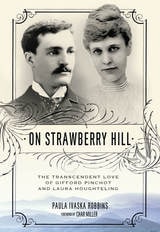
On Strawberry Hill
The Transcendent Love of Gifford Pinchot and Laura HoughtelingPaula Ivaska Robbins
University of Alabama Press, 2017
At its core, Paula Ivaska Robbins’s On Strawberry Hill: The Transcendent Love of Gifford Pinchot and Laura Houghteling is a human interest story that cuts a neat slice across nineteenth-century America by bringing into juxtaposition a wide array of topics germane to the period—the national fascination with spiritualism, the death scourge that was tuberculosis, the rise of sanitariums and tourism in the southern highlands, the expansion of railroad travel, the rage for public parklands and playgrounds, and the development of professional forestry and green preservation―all through the very personal love story of two young blue bloods.
Born into a wealthy New York family, Gifford Pinchot (1865–1946) served two terms as Pennsylvania’s governor and was the first chief of the US Forest Service, which today manages 192 million acres across the country. Pinchot also created the Society of American Foresters, the organization that oversees his chosen profession, and the Yale School of Forestry and Environmental Studies, the oldest forestry school in America. Ultimately, he and his friend President Theodore Roosevelt made forestry the focus of a national land conservation movement.
But before these accomplishments, Gifford Pinchot fell in love with Laura Houghteling, daughter of the head of the Chicago Board of Trade, while she recuperated from “consumption” at Strawberry Hill, the family retreat in Asheville, North Carolina. In his twenties at the time and still a budding forester, Pinchot was working just across the French Broad River at George Vanderbilt’s great undertaking, the Biltmore Estate, when the young couple’s relationship blossomed. Although Laura would eventually succumb to the disease, their brief romance left an indelible mark on Gifford, who recorded his ongoing relationship, and mental conversations, with Laura in his daily diary entries long after her death. He steadfastly remained a bachelor for twenty years while accomplishing the major highlights of his career.
This poignant book focuses on that phenomenon of devotion and inspiration, providing a unique window into the private practice of spiritualism in the context of Victorian mores, while offering new perspectives on Pinchot and early American forestry. In addition, preeminent Pinchot biographer Char Miller contributes an excellent foreword.
On Wisconsin Women
Working for Their Rights from Settlement to SuffrageGenevieve C. McBride
University of Wisconsin Press, 1993
In On Wisconsin Women, Genevieve McBride traces women’s work in reform movements in the state’s politics and especially in its press. Even before Wisconsin became a state in 1848, women’s news and opinions appeared in abolitionist journals and “temperance sheets,” if often anonymously. But the first paper in Wisconsin published under a woman’s name, however, was boycotted by Milwaukee printers and failed in 1853.
From the passage of the Fourteenth Amendment in 1866 to the state’s historic ratification of the Nineteenth Amendment in 1919, Wisconsin women were never at a loss for words nor a newspaper to print them. Among women who would be heard were Mathilde Fransziska Anneke, Emma Brown, Lavinia Goodell, Emma Bascom, Olympia Brown, Belle Case La Follette, Ada L. James, and Theodora Winton Youmans. McBride brings their voices vividly to life, in their own words on their lifelong work for woman’s rights.
Nowhere was “the struggle” fought for so long and so hard as in Wisconsin. While women elsewhere sang suffrage hymns, women in the Badger State marched to a “fight song” with a familiar tune but sung in their own words—lyrics too long forgotten until now.
On a Clear Night
Essays from the HeartlandMarnie O. Mamminga
Wisconsin Historical Society Press, 2017
Combining elements of the personal and the universal, these essays chart the passage of time from childhood to adulthood, sickness to health, working life to retirement, parenthood to grandparenthood, and everything in between. These sharply observed vignettes highlight the importance of taking time to appreciate the ordinary occurrences that profoundly shape our lives and the places we call home.
On a Trail of Southwest Discovery
The Expedition Diaries of Frederick W. Hodge and Margaret W. Magill, 1886–1888Curtis M. Hinsley and David R. Wilcox
University of Arizona Press, 2024
The Hemenway Southwestern Archaeological Expedition (1886–1889), directed by Frank Hamilton Cushing, was the first privately funded expedition to the American Southwest. This volume examines the expedition through the diaries of two participants who fell in love on the expedition: the field secretary, Fred Hodge, and the expedition artist, Margaret Magill—who was also Cushing’s sister-in-law. It also presents the first biographical treatment of Hodge, who became a major figure in early twentieth-century anthropology. The book’s first two sections chronicle the field operations of the expedition, while the third describes the long anthropological career of Hodge after the end of the expedition. Through deep research in primary and secondary sources and archival materials, the book details both the daily operations of the expedition and the growing romantic relationship between Hodge and Magill.
For those interested in settlements in early Arizona and Zuni Pueblo, the book provides rare insights into the lives of both men and women, offering an intimate view of an enterprise that is now considered a foundation of Hohokam archaeology—even as it reveals deep love and persistent personal conflicts.
On the Back of a Turtle
A Narrative of the Huron-Wyandot PeopleLloyd Divine Jr.
The Ohio State University Press, 2019
As characters and tribes emerge in the Huron-Wyandot’s oral tradition of creation, and take their respective places upon the Great Island, the author reveals the most difficult element of the Huron-Wyandot’s history: how the tribal name was obtained. With the knowledge of how both Huron and Wyandot are relevant names for one tribe of people, the author then shares his tribe’s amazing history. The reader will be fascinated to learn how one of the smallest tribes, birthed amid the Iroquois Wars, rose to become one of the most respected and influential tribes of North America.
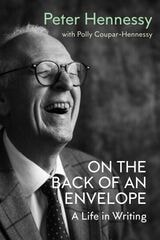
On the Back of an Envelope
A Life in WritingPeter Hennessy
Haus Publishing, 2025
As one of Britain’s foremost constitutional experts and contemporary historians, Peter Hennessy has spent his professional life unpicking the arcane world of Whitehall and Westminster. He began his career as a journalist for the Times, the Economist, and the Financial Times, developing a network of insider contacts who helped him shine a light on some of the dustiest corners of the British establishment. As a journalist, prize-winning contemporary historian, and political commentator, he has chronicled the workings of the British state with wit, affection, and a healthy sense of the absurd over a five-decade career. Now a crossbench peer, he has, in his own words, “moved in with his exhibits.” Hennessy is also a stalwart of BBC election night coverage and a regular commentator on BBC Radio 4, bringing a historical and constitutional perspective on current events.
In this new volume, he brings together selected journalism, unpublished lectures, and new writing alongside personal recollections and reflections on his time observing postwar Britain, how it is governed, and those who do the governing. He reflects on the making and unmaking of prime ministers from Attlee to Truss, life in the House of Lords, and the changing constitutional landscape in the wake of Brexit and amid uncertainty about the future of the Union. Interspersed with lectures, journalism, and new pieces, Hennessy also looks back at a fascinating career, reflecting on his own experiences as a young green graduate navigating the hard-nosed world of Fleet Street in the 1970s, bringing to life a cast of characters from a world now largely gone. He revisits his time as a public historian, academic, and crossbench peer with a levity reflected in his belief that history is “gossip with footnotes.”
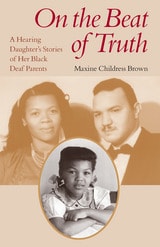
On the Beat of Truth
A Hearing Daughter’s Stories of Her Black Deaf ParentsMaxine Childress Brown
Gallaudet University Press, 2013
As an African American woman born in 1943, Maxine Childress Brown possessed a unique vantage point to witness the transformative events in her parents’ lives. Both came from the South -- her father, Herbert Childress, from Nashville, TN, and her mother, Thomasina Brown, from Concord, NC. The oldest of three daughters, Maxine was fascinated by her parents’ stories. She marveled at how they raised a well-respected, middle-class family in the midst of segregation with the added challenge of being deaf.
Her parents met in Washington, DC, where they married and settled down. Her father worked as a shoe repairman for $65 per week for more than 15 years. A gifted seamstress, her mother gave up sewing to clean houses. Because of their modest means, Maxine and her sisters lived more than modest lives. When Maxine’s tonsils became infected, her parents could not afford the operation to have them removed. For her high school prom, her mother bought her a dress on credit because she had no time to sew. Herbert Childress showed great love for his young daughters, but events turned him to bitterness and to drink. Throughout all, Thomasina encouraged her girls, always urging them to excel. She demanded their honest best with her signature phrase, her flat hand raised from her mouth straight up in the air, “on the beat of truth.”
On the Bus with Bill Monroe
My Five-Year Ride with the Father of Blue GrassMark Hembree
University of Illinois Press, 2022
The amusing story of a Yankee fish out of water, On the Bus with Bill Monroe mixes memoir with storytelling to recount the adventures of a Northerner learning new ways and the Old South.
On the Cusp
The Yale College Class of 1960 and a World on the Verge of ChangeDaniel Horowitz
University of Massachusetts Press, 2015
How did the 1950s become “The Sixties”? This is the question at the heart of Daniel Horowitz's On the Cusp. Part personal memoir, part collective biography, and part cultural history, the book illuminates the dynamics of social and political change through the experiences of a small, and admittedly privileged, generational cohort.
A Jewish “townie” from New Haven when he entered Yale College in fall 1956, Horowitz reconstructs the undergraduate career of the class of 1960 and follows its story into the next decade. He begins by looking at curricular and extracurricular life on the all-male campus, then ranges beyond the confines of Yale to larger contexts, including the local drama of urban renewal, the lingering shadow of McCarthyism, and decolonization movements around the world. He ponders the role of the university in protecting the prerogatives of class while fostering social mobility, and examines the growing significance of race and gender in American politics and culture, spurred by a convergence of the personal and the political. Along the way he traces the political evolution of his classmates, left and right, as Cold War imperatives lose force and public attention shifts to the civil rights movement and the war in Vietnam.
Throughout Horowitz draws on a broad range of sources, including personal interviews, writings by classmates, reunion books, issues of the Yale Daily News, and other undergraduate publications, as well as his own letters and college papers. The end product is a work consistent with much of Horowitz's previously published scholarship on postwar America, further exposing the undercurrent of discontent and dissent that ran just beneath the surface of the so-called Cold War consensus.
On the Fringes of History
A MemoirPhilip D. Curtin
Ohio University Press, 2005
In the 1950s, professional historians claiming to specialize in tropical Africa were no more than a handful. The teaching of world history was confined to high school courses, and even those were focused on European history, with a chapter added to account for the history of East and South Asia. The change over the ensuing decades was revolutionary.
Philip D. Curtin was a leader among a new generation of historians that emerged after the Second World War. Written with characteristic economy and telling detail, On the Fringes of History: A Memoir follows Curtin from his beginnings in central West Virginia in the 1920s, through a distinguished academic career in which Curtin founded African studies at the University of Wisconsin. He began the programs in comparative world history at Wisconsin and Johns Hopkins, producing many of the most influential historians and Africanists from the 1950s to today.
Always an independent thinker and controversial figure, Curtin revived the study of the Atlantic slave trade. His career stands as an example of the kind of dissatisfaction and struggles that brought about a sea change in higher education. On the Fringes of History traces the movement of African history and world history from the fringes of the history profession into the mainstream. This stunningly illustrated memoir illuminates both the career of a leading historian and the history of twentieth-century academia.