Results by title
480 books match the query 'Chicago' and 5 start with o
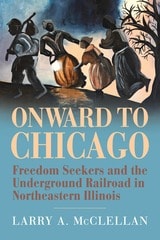
Onward to Chicago
Freedom Seekers and the Underground Railroad in Northeastern IllinoisLarry A. McClellan
Southern Illinois University Press, 2023
Uncovering stories of the freedom network in northeastern Illinois
Decades before the Civil War, Illinois’s status as a free state beckoned enslaved people, particularly those in Kentucky and Missouri, to cross porous river borders and travel toward new lives. While traditional histories of the Underground Railroad in Illinois start in 1839, and focus largely on the romanticized tales of white men, Larry A. McClellan reframes the story, not only introducing readers to earlier freedom seekers, but also illustrating that those who bravely aided them were Black and white, men and women. McClellan features dozens of individuals who made dangerous journeys to reach freedom as well as residents in Chicago and across northeastern Illinois who made a deliberate choice to break the law to help.
Onward to Chicago charts the evolution of the northeastern Illinois freedom network and shows how, despite its small Black community, Chicago emerged as a point of refuge. The 1848 completion of the I & M Canal and later the Chicago to Detroit train system created more opportunities for Black men, women, and children to escape slavery. From eluding authorities to confronting kidnapping bands working out of St. Louis and southern Illinois, these stories of valor are inherently personal. Through deep research into local sources, McClellan presents the engrossing, entwined journeys of freedom seekers and the activists in Chicagoland who supported them.
McClellan includes specific freedom seeker journey stories and introduces Black and white activists who provided aid in a range of communities along particular routes. This narrative highlights how significant biracial collaboration led to friendships as Black and white abolitionists worked together to provide support for freedom seekers traveling through the area and ultimately to combat slavery in the United States.
Organized Crime in Chicago
Beyond the MafiaRobert M. Lombardo
University of Illinois Press, 2013
Organizing Schools for Improvement
Lessons from ChicagoAnthony S. Bryk, Penny Bender Sebring, Elaine Allensworth, Stuart Luppescu, and John Q. Easton
University of Chicago Press, 2009
In 1988, the Chicago public school system decentralized, granting parents and communities significant resources and authority to reform their schools in dramatic ways. To track the effects of this bold experiment, the authors of Organizing Schools for Improvement collected a wealth of data on elementary schools in Chicago. Over a seven-year period they identified one hundred elementary schools that had substantially improved—and one hundred that had not. What did the successful schools do to accelerate student learning?
The authors of this illuminating book identify a comprehensive set of practices and conditions that were key factors for improvement, including school leadership, the professional capacity of the faculty and staff, and a student-centered learning climate. In addition, they analyze the impact of social dynamics, including crime, critically examining the inextricable link between schools and their communities. Putting their data onto a more human scale, they also chronicle the stories of two neighboring schools with very different trajectories. The lessons gleaned from this groundbreaking study will be invaluable for anyone involved with urban education.

Our Nazi
An American Suburb’s Encounter with EvilMichael Soffer
University of Chicago Press, 2024
Reinhold Kulle seemed like the perfect school employee. But in 1982, as his retirement neared, his long-concealed secret came to light. The chief custodian at Oak Park and River Forest High School outside Chicago had been a Nazi, a member of the SS, and a guard at a brutal slave labor camp during World War II.
Similar revelations stunned communities across the country. Hundreds of Reinhold Kulles were gradually discovered: men who had patrolled concentration camps, selected Jews for execution, and participated in mass shootings—and who were now living ordinary suburban lives. As the Office of Special Investigations raced to uncover Hitler’s men in the United States, neighbors had to reconcile horrific accusations with the helpful, kind, and soft-spoken neighbors they thought they knew. Though Nazis loomed in the American consciousness as evil epitomized, in Oak Park—a Chicago suburb renowned for its liberalism—people rose to defend Reinhold Kulle, a war criminal.
Drawing on archival research and insider interviews, Oak Park and River Forest High School teacher Michael Soffer digs into his community’s tumultuous response to the Kulle affair. He explores the uncomfortable truths of how and why onetime Nazis found allies in American communities after their gruesome pasts were uncovered.
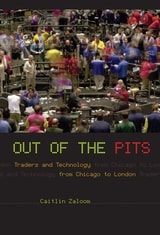
Out of the Pits
Traders and Technology from Chicago to LondonCaitlin Zaloom
University of Chicago Press, 2006
From New York to Singapore, from Chicago to London, the trading floors of the world’s financial markets are icons of global capitalism. Images of them are used on the news all the time—traders burying their heads in their hands when the market is down, their arms flailing in a frenzy when fortunes are rising—to convey the current state of the economy. But these marketplaces, and the cultural life that sustains them, are dissolving into the ether of the digital age: powerful financial institutions are shutting down the trading pits, replacing face-to-face exchanges with an electronic network where traders sit, face to screen, finger to mouse, and compete in a global arena made up of digits and charts.
Out of the Pits considers the implications of this sea change for everyone involved, from the traders and brokers to the market as a whole. Caitlin Zaloom takes us down to the floor at the Chicago Board of Trade and into a digital dealing room in the City of London. Drawing on her own firsthand experiences as a clerk and a trader and on her unusual access to these key sites of global finance, she explainshow changes at the world’s leading financial exchanges have transformed economic cultures and the craft of speculation; how people and places are responding to the digital transition; how traders are remaking themselves to compete in the contemporary marketplace; and how brokers, business managers, and software designers are collaborating to build new financial markets.
A penetrating and richly detailed account of how cities, culture, and technology shape everyday life in the new global economy, Out of the Pits will be must reading for business buffs or anyone who has ever wondered how financial markets work.