Results by title
1882 books match the query 'Criticism and interpretation' and 55 start with o
Object Lessons
The Novel as a Theory of ReferenceJami Bartlett
University of Chicago Press, 2016
Observing Film Art
Themes from the Work of David BordwellCharlie Keil
Rutgers University Press, 2027
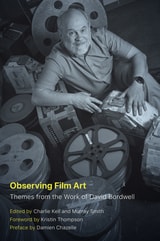
When David Bordwell died in 2024, he left behind a legacy of film scholarship and criticism whose influence is unmatched. Coauthor of a pair of textbooks adopted across the globe and the main force behind a blog read by thousands, Bordwell has influenced generations of film students, filmmakers, and film critics. Observing Film Art examines the breadth of Bordwell’s work through the perspectives of those who knew him best, collaborators, former students, and critics among them. This is the first collection devoted to the work of Bordwell, and it gives equal attention to each facet of his prodigious scholarship, structured to highlight his interest in theory, history, and analysis and criticism. The cornerstones of his approach to film study, including formalism, cognitivism, and historical poetics, are all examined in detail, as are key works, including The Classical Hollywood Cinema (coauthored with Kristin Thompson and Janet Staiger) and Narration in the Fiction Film.
Odd Affinities
Virginia Woolf’s Shadow GenealogiesElizabeth Abel
University of Chicago Press, 2024
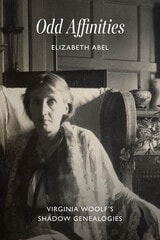
In recent decades, Virginia Woolf’s contribution to literary history has been located primarily within a female tradition. Elizabeth Abel dislodges Woolf from her iconic place within this tradition to uncover her shadowy presence in other literary genealogies. Abel elicits unexpected echoes of Woolf in four major writers from diverse cultural contexts: Nella Larsen, James Baldwin, Roland Barthes, and W. G. Sebald. By mapping the wayward paths of what Woolf called “odd affinities” that traverse the boundaries of gender, race, and nationality, Abel offers a new account of the arc of Woolf’s career and the transnational modernist genealogy constituted by her elusive and shifting presence. Odd Affinities will appeal to students and scholars working in New Modernist studies, comparative literature, gender and sexuality studies, and African American studies.
Odd Man Out
Readings of the Work and Reputation of Edgar DegasCarol M. Armstrong
University of Chicago Press, 1991
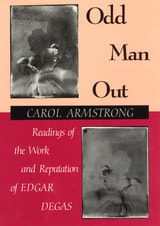
By reading several groups of the artist's images through the lens of a sequence of critical texts, Armstrong shows how our critical and popular expectations of Degas are overturned and subverted. Each of these groups of images is matched to different interpretive moves, each highlighting distinct themes: economics and vocation; narrative and semiotics; gender and corporeality; and the author and self. Armstrong's provocative analysis celebrates the tantalizing qualities of the artist's elusive career: the pluralism of his work, its conflation of positivistic and negational tactics, the modern and the traditional, the abstract and the representational.
"A lucid and searching study. . . . Armstrong has produced one of the most elegant and persuasive examples of the historian's use of 19th-century art criticism. In the process, she has achieved a reading of the artist which makes a difference to the way we understand the difference of Degas himself."—Neil McWilliam, Times Higher Education Supplement
"This is a brilliant, original, and beautifully articulated study. Carol Armstrong's scholarship is impressive in its richness, ambition, and sophistication: Degas's works have rarely been given such detailed, penetrating, and suggestive readings as those offered in this book."—Linda Nochlin, Yale University
"With brilliant insight and incisive analytical intelligence, Carol Armstrong introduces new ways to conceptualize the structural ambiguities of Degas's work. Her subtle and probing readings clarify the fundamental contrariness of Degas's images—their disturbing negativity, their anti-modern modernism. Odd Man Out catapults the criticism of Degas from the hinterlands of traditional art history to the foreground of contemporary critical theory in both literature and the visual arts."—Charles Bernheimer, University of Pennsylvania
Odes
Horace, Translated with commentary by David R. Slavitt
University of Wisconsin Press, 2014
This edition is also notable for Slavitt’s extensive notes and commentary about the art of translation. He presents the problems he encountered in making the translation, discussing possible solutions and the choices he made among them. The effect of the notes is to bring the reader even closer to the original Latin and to understand better how to gauge the distance between the two languages.
Odysseys of Recognition
Performing Intersubjectivity in Homer, Aristotle, Shakespeare, Goethe, and KleistWiggins, Ellwood
Bucknell University Press, 2019
Published by Bucknell University Press. Distributed worldwide by Rutgers University Press.
Of What One Cannot Speak
Doris Salcedo's Political ArtMieke Bal
University of Chicago Press, 2010
Doris Salcedo, a Colombian-born artist, addresses the politics of memory and forgetting in work that embraces fraught situations in dangerous places. Noted critic and theorist Mieke Bal narrates between the disciplines of contemporary culture in order to boldly reimagine the role of the visual arts. Both women are pathbreaking figures, globally renowned and widely respected. Doris Salcedo, meet Mieke Bal.
In Of What One Cannot Speak, Bal leads us into intimate encounters with Salcedo’s art, encouraging us to consider each work as a “theoretical object” that invites—and demands—certain kinds of considerations about history, death, erasure, and grief. Bal ranges widely through Salcedo’s work, from Salcedo’s Atrabiliarios series—in which the artist uses worn shoes to retrace los desaparecidos (“the disappeared”) from nations like Argentina, Chile, and Colombia—to Shibboleth, Salcedo’s once-in-a-lifetime commission by the Tate Modern, for which she created a rupture, as if by earthquake, that stretched the length of the museum hall’s concrete floor. In each instance, Salcedo’s installations speak for themselves, utilizing household items, human bones, and common domestic architecture to explore the silent spaces between violence, trauma, and identity. Yet Bal draws out even deeper responses to the work, questioning the nature of political art altogether and introducing concepts of metaphor, time, and space in order to contend with Salcedo’s powerful sculptures and installations.
An unforgettable fusion of art and essay, Of What One Cannot Speak takes us to the very core of events we are capable of remembering—yet still uncomfortably cannot speak aloud.
Off-Screen Cinema
Isidore Isou and the Lettrist Avant-GardeKaira M. Cabañas
University of Chicago Press, 2015
Off-Screen Cinema is the first monograph in English of the Lettrists. Offering a full portrait of the avant-garde scene of 1950s Paris, it focuses on the film works of key Lettrist figures like Gil J Wolman, Maurice Lemaître, François Dufrêne, and especially the movement's founder, Isidore Isou, a Romanian immigrant whose “discrepant editing” deliberately uncoupled image and sound. Through Cabañas's history, we see not only the full scope of the Lettrist project, but also its clear influence on Situationism, the French New Wave, the New Realists, as well as American filmmakers such as Stan Brakhage.
Old Town Road
A Song by Lil Nas X with Billy Ray CyrusChris Molanphy
Duke University Press, 2023
Omnicompetent Modernists
Poetry, Politics, and the Public SphereMatthew Hofer
University of Alabama Press, 2022
An innovative exploration of early twentieth-century avant-garde poetry’s relationship to the public sphere
“It is difficult / to get the news from poems / yet men die miserably every day / for lack / of what is found there,” as the poet William Carlos Williams memorably declared. In Omnicompetent Modernists: Poetry, Politics, and the Public Sphere, Matthew Hofer examines, through a multilayered literary critique of interwar modernist poetry, what it might mean to get the news, and more, from a poet.
Using pragmatist ideas about the public sphere as a tool, Hofer reveals how Langston Hughes, Ezra Pound, and Mina Loy sought to use literature to both express and enable thought. In Hughes, Pound, and Loy, Hofer attends to poets whose work vigorously imagined possible new relationships between language, thinking, and public society. Each poet had different goals and used different methods, but all found both inspiration and encouragement in popular political theory. Hughes advocated for a more just vision of color and class in the United States. Pound sought to condemn those whom he associated with public harm, linguistically, socially, economically, and politically. Loy championed the “psycho-democratic” representation of women, in both public and private life.
Although Hughes, Pound, and Loy are rarely considered together, what unites these three writers is how each reconceived the public realm, and revolutionized aesthetic form to articulate those visions. Hofer combines sharp intellectual historiography with rigorous literary criticism and the result is a study that reinvigorates both the poems and poets under consideration and speaks to the immense power of language in manipulating public opinion—with pertinent implications for the politics of the present.
On Creaturely Life
Rilke, Benjamin, SebaldEric L. Santner
University of Chicago Press, 2006
Santner traces this theme of creaturely life from its poetic and philosophical beginnings in the first half of the twentieth century to the writings of the enigmatic German novelist W. G. Sebald. Sebald’s entire oeuvre, Santner argues, can be seen as an archive of creaturely life. For Sebald, the work on such an archive was inseparable from his understanding of what it means to engage ethically with another person’s history and pain, an engagement that transforms us from indifferent individuals into neighbors.
An indispensable book for students of Sebald, On Creaturely Life is also a significant contribution to critical theory.
On Edge
Gender and Genre in the Work of Shirley Jackson, Patricia Highsmith, and Leigh BrackettAshley Lawson
The Ohio State University Press, 2024
Honorable Mention, 2025 PCA Emily Toth Award For Best Single Work In Women’s Studies
Finalist, 2025 Mystery Writers of America's Edgar Awards, Best Critical/Biographical Category
Finalist, Bouchercon New Orleans 2025 Anthony Awards, Best Critical/Non-Fiction
Nominated for the 2025 Macavity Awards, Best Mystery-related Nonfiction/Critical
Ashley Lawson’s On Edge presents a new picture of postwar American literature, arguing that biases against genre fiction have unfairly disadvantaged the legacies of authors like Shirley Jackson, Patricia Highsmith, and Leigh Brackett. Each of these women navigated a male-dominated postwar publishing world without compromising their values. Their category-defying treatment of gender roles and genre classifications created suspense in their work that spoke to the tensions of the “Age of Anxiety.” Lawson engages with foundational voices in American literature, genre theory, and feminism to argue that, by merging the dominant mode of literary realism with fantastical or heightened elements, Brackett, Jackson, and Highsmith responded to the big questions of their era with startling and unnerving answers. By elevating genre play to a marker of literary skill, Lawson contends, we can secure these writers a more prominent place within the canon of midcentury American literature and open the door for the recovery of their similarly innovative peers.

On Emerson
The Best from American LiteratureEdwin H. Cady and Louis J. Budd, eds.
Duke University Press, 1988
Presented in order of their first appearance, the articles in each volume constitute a revealing record of developing insights and important shifts of critical emphasis. Each article has opened a fresh line of inquiry, established a fresh perspective on a familiar topic, or settled a question that engaged the interest of experts.
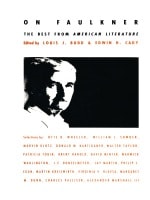
On Faulkner
The Best from American LiteratureEdwin H. Cady and Louis J. Budd, editors
Duke University Press, 1989
Presented in order of their first appearance, the articles in each volume constitute a revealing record of developing insights and important shifts of critical emphasis. Each article has opened a fresh line of inquiry, established a fresh perspective on a familiar topic, or settled a question that engaged the interest of experts.
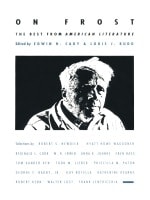
On Frost
The Best from American LiteratureEdwin H. Cady and Louis J. Budd, eds.
Duke University Press, 1991
Presented in order of their first appearance, the articles in each volume constitute a revealing record of developing insights and important shifts of critical emphasis. Each article has opened a fresh line of inquiry, established a fresh perspective on a familiar topic, or settled a question that engaged the interest of experts.
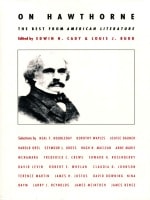
On Hawthorne
The Best from American LiteratureEdwin H. Cady and Louis J. Budd, eds.
Duke University Press, 1990
Presented in order of their first appearance, the articles in each volume constitute a revealing record of developing insights and important shifts of critical emphasis. Each article has opened a fresh line of inquiry, established a fresh perspective on a familiar topic, or settled a question that engaged the interest of experts.
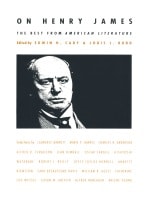
On Henry James
The Best from American LiteratureEdwin H. Cady and Louis J. Budd, eds.
Duke University Press, 1990
Presented in order of their first appearance, the articles in each volume constitute a revealing record of developing insights and important shifts of critical emphasis. Each article has opened a fresh line of inquiry, established a fresh perspective on a familiar topic, or settled a question that engaged the interest of experts.
On Howells
The Best from American LiteratureEdwin H. Cady and Louis J. Budd, eds.
Duke University Press, 1993
Presented in order of their first appearance, the articles in each volume constitute a revealing record of developing insights and important shifts of critical emphasis. Each article has opened a fresh line of inquiry, established a fresh perspective on a familiar topic, or settled a question that engaged the interest of experts.
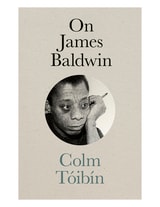
On James Baldwin
Colm Tóibín
Brandeis University Press, 2024
Acclaimed Irish novelist Colm Tóibín first read James Baldwin just after turning eighteen. He had completed his first year at an Irish university and was struggling to free himself from a religious upbringing. He had even considered entering a seminary and was searching for literature that would offer illumination and insight. Inspired by the novel Go Tell It on the Mountain, Tóibín found a writer who would be a lifelong companion and exemplar.
From On James Baldwin
Baldwin was interested in the hidden and dramatic areas in his own being, and was prepared as a writer to explore difficult truths about his own private life. In his fiction, he had to battle for the right of his protagonists to choose or influence their destinies. He knew about guilt and rage and bitter privacies in a way that few of his White novelist contemporaries did. And this was not simply because he was Black and homosexual; the difference arose from the very nature of his talent, from the texture of his sensibility. “All art,” he wrote, “is a kind of confession, more or less oblique. All artists, if they are to survive, are forced, at last, to tell the whole story, to vomit the anguish up.”
On James Baldwin is a magnificent contemporary author’s tribute to one of his most consequential literary progenitors.
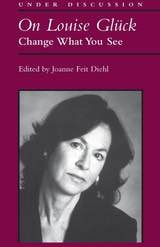
On Louise Gluck
Change What You SeeJoanne Feit Diehl, Editor
University of Michigan Press, 2005
Glück, author of nine books of poetry, including the Pulitzer Prize-winning The Wild Iris, is noted for her searing honesty and compelling first-person personae. Though compared to world-famous verse by Sappho and Dickinson, Glück's poetry has remained curiously undigested among readers of contemporary poetry for some time. On Louise Glück gathers for the first time a diverse array of essays by the leading critics of this preeminent poet. Featuring a probing, extended interview with Glück, On Louise Glück traces the critical reception of her work and offers new insights into her imaginative, mysterious poetry.
On Mark Twain
The Best from American LiteratureLouis J. Budd and Edwin H. Cady, eds.
Duke University Press, 1987
On Melville
The Best from American LiteratureLouis J. Budd and Edwin H. Cady, eds.
Duke University Press, 1988
Presented in order of their first appearance, the articles in each volume constitute a revealing record of developing insights and important shifts of critical emphasis. Each article has opened a fresh line of inquiry, established a fresh perspective on a familiar topic, or settled a question that engaged the interest of experts.
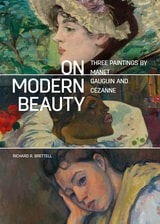
On Modern Beauty
Three Paintings by Manet, Gauguin, and CézanneRichard R. Brettell
J. Paul Getty Trust, The, 2019
Brettell shapes his manifesto around three masterworks from the collection of the J. Paul Getty Museum: Édouard Manet’s Jeanne (Spring), Paul Gauguin’s Arii Matamoe (The Royal End), and Paul Cézanne’s Young Italian Woman at a Table. The provocative discussion reveals how each of these exceptional paintings, though depicting very different subjects—a fashionable actress, a preserved head, and a weary working woman—enacts a revolutionary, yet enduring, icon of beauty.
On Monique Wittig
Theoretical, Political, and Literary EssaysEdited by Namascar Shaktini
University of Illinois Press, 2004
On Monique Wittig contains twelve essays, representing French, Francophone, and U.S. critics, including three previously unpublished pieces by Wittig herself. Among the essays is Diane Griffin Crowder's discussion of the U.S. feminist movement, Linda Zerilli's consideration of gender and will, and Teresa de Lauretis's examination of the development of lesbian theory. Together, these essays situate Wittig's work in terms of the cultural contexts of its production and reception. This volume also contains the first authenticated chronology of Wittig's life and features the first translation of "For a Movement of Women's Liberation," which Wittig published with other "militantes" in May 1970.
As the first book to appear on Wittig following her death, On Monique Wittig is an indispensable tool for feminist scholars.
On Obliteration
An Interview with Françoise Armengaud Concerning the Work of Sacha SosnoEmmanuel Levinas
Diaphanes, 2019
On Poe
The Best from American LiteratureLouis J. Budd and Edwin H. Cady, eds.
Duke University Press, 1993
Presented in order of their first appearance, the articles in each volume constitute a revealing record of developing insights and important shifts of critical emphasis. Each article has opened a fresh line of inquiry, established a fresh perspective on a familiar topic, or settled a question that engaged the interest of experts.
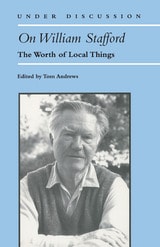
On William Stafford
The Worth of Local ThingsTom Andrews, Editor
University of Michigan Press, 1995
The late William Stafford's poetry and essays have had a major influence on contemporary American poetry. Since his book Traveling Through the Dark won the National Book Award in 1963, his awards have grown exponentially as new work has appeared. The range of writers in the past four decades who have celebrated Stafford's work-- from Margaret Atwood to James Dickey-- is remarkable. On William Stafford: The Worth of Local Things helps clarify the precise nature of Stafford's influence by assembling the responses of some of our best poets and critics to his work, including Richard Hugo, Charles Simic, Louis Simpson, Robert Coles, Linda Pastan, and Robert Creeley. This collection offers a unique view of Stafford's sometimes controversial work and insight into several of the liveliest recent debates in poetics.
Tom Andrews is Assistant Professor of English, Ohio University.
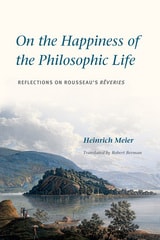
On the Happiness of the Philosophic Life
Reflections on Rousseau's "Rêveries" in Two BooksHeinrich Meier
University of Chicago Press, 2016
On the Happiness of the Philosophic Life presents Heinrich Meier’s confrontation with Rousseau’s Rêveries, the philosopher’s most beautiful and daring work, as well as his last and least understood. Bringing to bear more than thirty years of study of Rousseau, Meier unfolds his stunningly original interpretation in two parts.
The first part of On the Happiness of the Philosophic Life approaches the Rêveries not as another autobiographical text in the tradition of the Confessions and the Dialogues, but as a reflection on the philosophic life and the distinctive happiness it provides. The second turns to a detailed analysis of a work referred to in the Rêveries, the “Profession of Faith of the Savoyard Vicar,” which triggered Rousseau’s political persecution when it was originally published as part of Émile. In his examination of this most controversial of Rousseau’s writings, which aims to lay the foundations for a successful nonphilosophic life, Meier brings to light the differences between natural religion as expressed by the Vicar and Rousseau’s natural theology. Together, the two reciprocally illuminating parts of this study provide an indispensable guide to Rousseau and to the understanding of the nature of the philosophic life.
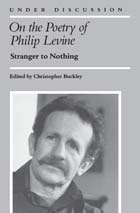
On the Poetry of Philip Levine
Stranger to NothingChristopher Buckley, Editor
University of Michigan Press, 1990
Readers and critics alike have applauded Philip Levine's poems for their eloquent and elegiac narrative and their vivas for the dignity of the human spirit. In 1987 Levine received the esteemed Ruth Lilly Prize, given by the Modern Poetry Association and the American Council for the Arts in recognition of outstanding poetic achievement. On the Poetry of Philip Levine, the first critical collection to focus on this original and highly acclaimed poet, selects essays and reviews that span three decades. Included are pieces by Richard Howard, Stephen Yenser, Ralph J. Mills, Jr., and Dave Smith.
UNDER DISCUSSION Donald Hall, General Editor
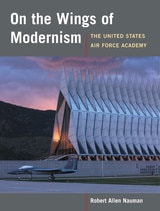
On the Wings of Modernism
The United States Air Force AcademyRobert Allen Nauman
University of Illinois Press, 2003
The United States Air Force Academy stands as one of the most extensive architectural projects of the cold war era. Key to a full understanding of American modernism, the project was also a volatile battleground involving competing ideas about aesthetics and politics. Arguing that the academy's production was squarely grounded in bureaucratic and political processes, Robert Allen Nauman demonstrates that selection of both the site and the design firm was the result of political maneuverings involving U.S. military leadership.
In the academy’s iconic design, myths and metaphors of flight and the American West were interwoven with those of modernism, both to justify the plan and to free it from any lingering socialist or European associations. Skidmore, Owings, and Merrill’s first public exhibition of plans and models for the project was designed by the former Bauhaus master Herbert Bayer, and it incorporated photographs of the Colorado Springs site by Ansel Adams and William Garnett. Using previously unexplored resources of the U.S. Air Force Academy, SOM, and the Air Force Academy Construction Agency, Nauman uncovered materials such as negatives of Adams’s original photographs of the sites. He also conducted extensive interviews with SOM’s project director for the academy, Walter Netsch, in tracing the complete history of the academy's construction, from its earliest conception to eventual completion.
One Fairy Story Too Many
The Brothers Grimm and Their TalesJohn M. Ellis
University of Chicago Press, 1983
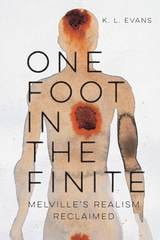
One Foot in the Finite
Melville's Realism ReclaimedK. L. Evans
Northwestern University Press, 2018
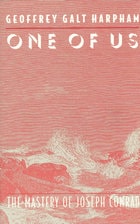
One of Us
The Mastery of Joseph ConradGeoffrey Galt Harpham
University of Chicago Press, 1996
In this book, Geoffrey Galt Harpham delves not only into Conrad's literary work and reputation but also into the concept of mastery. Outlining a psychology of composition that embraces Conrad's personal as well as historical circumstances, Harpham sheds new light on traditional issues in Conrad criticism, such as his Polish background and his preoccupation with the sea, by linking them to less frequently discussed subjects, including his elusive sexuality and his idiosyncratic relation to the English language.
One of Us represents both a methodological innovation in the practice of literary criticism and an important contribution to our understanding of how masters—and canons based on them—are made.
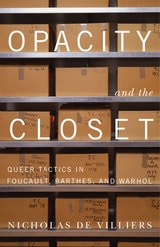
Opacity and the Closet
Queer Tactics in Foucault, Barthes, and WarholNicholas de Villiers
University of Minnesota Press, 2012
Opacity and the Closet interrogates the viability of the metaphor of “the closet” when applied to three important queer figures in postwar American and French culture: the philosopher Michel Foucault, the literary critic Roland Barthes, and the pop artist Andy Warhol. Nicholas de Villiers proposes a new approach to these cultural icons that accounts for the queerness of their works and public personas.
Rather than reading their self-presentations as “closeted,” de Villiers suggests that they invent and deploy productive strategies of “opacity” that resist the closet and the confessional discourse associated with it. Deconstructing binaries linked with the closet that have continued to influence both gay and straight receptions of these intellectual and pop celebrities, de Villiers illuminates the philosophical implications of this displacement for queer theory and introduces new ways to think about the space they make for queerness.
Using the works of Foucault, Barthes, and Warhol to engage each other while exploring their shared historical context, de Villiers also shows their queer appropriations of the interview, the autobiography, the diary, and the documentary—forms typically linked to truth telling and authenticity.
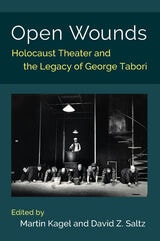
Open Wounds
Holocaust Theater and the Legacy of George TaboriEdited by Martin Kagel and David Z. Saltz
University of Michigan Press, 2022
This volume collects original essays on Hungarian-German playwright and screenwriter George Tabori (1914–2007) and his remarkable contributions to the stage. Tabori, a Jewish refugee and a truly transnational author, was best known for his work in New York theater that irreverently explored the Jewish experience, particularly the Holocaust. Although his illustrious career spanned a century, two continents, several languages, and a variety of literary genres, Tabori’s work has received scant attention in American letters, in spite of its significance for U.S. theater and Holocaust studies.
Until Tabori, most dramas about the Holocaust were either rooted in American domestic realism, striving to create a strong empathetic connection between the audience and Holocaust victims, or featured an unembellished documentary style. Tabori staked out a third position, beyond realism and documentation. The volume brings together the voices of international scholars to provide a comprehensive introduction to Tabori’s theater as well as in-depth analyses of his work, discussing all of his major plays. Individual essays address Tabori’s postdramatic theater in relation to sacrificial ritual, performance studies, and post-humanist approaches to the contemporary stage, as well as performance aspects of his productions, questions of ethics and aesthetics raised by his theater, and his plays’ relation to Holocaust representation in popular culture.
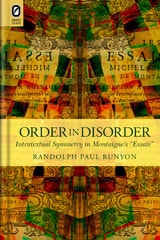
Order in Disorder
Intratextual Symmetry in Montaigne's “Essais”Randolph Paul Runyon
The Ohio State University Press, 2013
Order in Disorder: Intratextual Symmetry in Montaigne’s “Essais,” by Randolph Paul Runyon, offers a new answer to the question of how ordered the Essays may be. Following up on Montaigne’s likening them to a painter’s “grotesques” surrounding a central image, and seeing in this an allusion to the ancient Roman decorative style, rediscovered in the Renaissance, of symmetrical motifs on either side of a central image, Runyon uncovers an extensive network of symmetrical verbal echoes linking every chapter with another. Often two chapters of greatly different length and apparent importance (one on thumbs, for instance, balanced against one on the limits of human understanding) will in this way be brought together—not without, Runyon finds, an intended irony. The Essays emerge as even more self-reflexive than we thought, an amazingly intratextual work.
Ordinary Queerness in American Modernism
Jess Shollenberger
The Ohio State University Press, 2025

Organic Worldview of Nikolai Leskov
Irmhild Christina Sperrle
Northwestern University Press, 2002
Although little studied in the West, Nikolai Semenovich Leskov (1831-95) is accorded a place among major nineteenth-century writers in his native Russia. Irmhild Christina Sperrle's The Organic Worldview of Nikolai Leskov draws on previously unavailable archival and primary sources to offer English-speaking readers the opportunity to appreciate the work of this neglected author.
Leskov remarked to his contemporary Anatolii Faresov, "People talk about my 'language,' about its colorfulness and its national traits; about the richness of my plots, about my condensed way of writing, about 'similarity' and so on, but they do not notice the most important thing." It is this "most important thing," Leskov's consistent thematic adherence to an "organic" philosophical model, that Sperrle traces and elaborates here. Focusing on movement and transformation in "an organic manner"—a manner in which death and rebirth alternate and condition each other—Sperrle develops Leskov's notion of organicity and explores his relationship to the organic tradition in philosophy and literature. Her reading of key texts among his more than five hundred works entails a close look at Leskov's ideas about the Divine as freedom of belief, about truth as a continual renewal of previously held theories, and about death in both a physical and a spiritual sense. She examines Leskov's vexed relation to Tolstoyan ideas and shows how the notion of heresy—as a questioning rather than rejection of authority-is a crucial element in his worldview and his work.
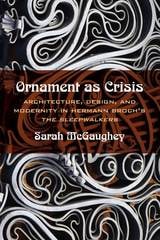
Ornament as Crisis
Architecture, Design, and Modernity in Hermann Broch's "The Sleepwalkers"Sarah McGaughey
Northwestern University Press, 2015
Ornament as Crisis explores the ways in which the novels of Hermann Broch’s Sleepwalkers (Schlafwandler) trilogy participate in and employ the history of architecture and architectural theory.
Beginning with the visual and architectural experiences of the figures in each novel, Sarah McGaughey analyzes the role of architecture in the trilogy as a whole, while discussing work by Broch’s contemporaries on architecture. She argues that The Sleepwalkers allows us to better understand how literature responds and contributes to social, theoretical, and spatial concepts of architecture. Ornament as Crisis guides readers through the spaces of Broch’s mdernist masterpiece and the architectural debates of his time.
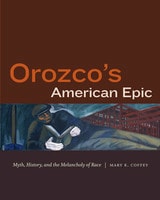
Orozco's American Epic
Myth, History, and the Melancholy of RaceMary K. Coffey
Duke University Press, 2020
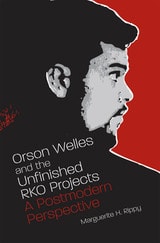
Orson Welles and the Unfinished RKO Projects
A Postmodern PerspectiveMarguerite H. Rippy
Southern Illinois University Press, 2009
Orson Welles and the Unfinished RKO Projects: A Postmodern Perspective traces the impact of legendary director Orson Welles on contemporary mass media entertainment and suggests that, ironically, we can see Welles’s performance genealogy most clearly in his unfinished RKO projects.
Author Marguerite H. Rippy provides the first in-depth examination of early film and radio projects shelved by RKO or by Welles himself. While previous studies of Welles largely fall into the categories of biography or modernist film studies, this book extends the understanding of Welles via postmodern narrative theory and performance analysis, weaving his work into the cultural and commercial background of its production. By identifying the RKO years as a critical moment in performance history, Rippy synthesizes scholarship that until now has been scattered among film studies, narrative theory, feminist critique, American studies, and biography.
Building a bridge between auteur and postmodern theories, Orson Welles and the Unfinished RKO Projects offers a fresh look at Welles in his full complexity. Rippy trains a postmodern lens on Welles’s early projects and reveals four emerging narrative modes that came to define his work: deconstructions of the first-person singular; adaptations of classic texts for mass media; explorations of the self via primitivism; and examinations of the line between reality and fiction. These four narrative styles would greatly influence the development of modern mass media entertainment.
Rippy finds Welles’s legacy alive and well in today’s mockumentaries and reality television. It was in early, unfinished projects where Welles first toyed with fact and fiction, and the pleasure of this interplay still resonates with contemporary culture. As Rippy suggests, the logical conclusion of Welles’s career-long exploration of “truthiness” lies in the laughs of fake news shows. Offering an exciting glimpse of a master early in his career, Orson Welles and the Unfinished RKO Projects documents Welles’s development as a storyteller who would shape culture for decades to come.
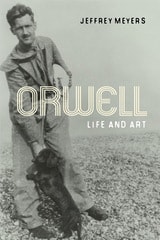
Orwell
Life and ArtJeffrey Meyers
University of Illinois Press, 2010
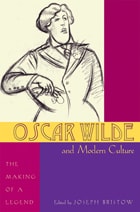
Oscar Wilde and Modern Culture
The Making of a LegendJoseph Bristow
Ohio University Press, 2009
Oscar Wilde and Modern Culture: The Making of a Legend explores the meteoric rise, sudden fall, and legendary resurgence of an immensely influential writer’s reputation from his hectic 1881 American lecture tour to recent Hollywood adaptations of his dramas. Always renowned—if not notorious—for his fashionable persona, Wilde courted celebrity at an early age. Later, he came to prominence as one of the most talented essayists and fiction writers of his time.
In the years leading up to his two-year imprisonment, Wilde stood among the foremost dramatists in London. But after he was sent down for committing acts of “gross indecency” it seemed likely that social embarrassment would inflict irreparable damage to his legacy. As this volume shows, Wilde died in comparative obscurity. Little could he have realized that in five years his name would come back into popular circulation thanks to the success of Richard Strauss’s opera Salome and Robert Ross’s edition of De Profundi. With each succeeding decade, the twentieth century continued to honor Wilde’s name by keeping his plays in repertory, producing dramas about his life, adapting his works for film, and devising countless biographical and critical studies of his writings.
This volume reveals why, more than a hundred years after his demise, Wilde’s value in the academic world, the auction house, and the entertainment industry stands higher than that of any modern writer.
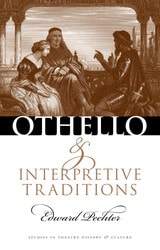
Othello and Interpretive Traditions
Edward Pechter
University of Iowa Press, 1999
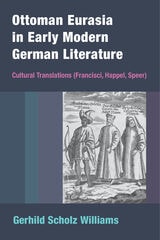
Ottoman Eurasia in Early Modern German Literature
Cultural Translations (Francisci, Happel, Speer)Gerhild Scholz Williams
University of Michigan Press, 2021
Even a casual perusal of seventeenth-century European print production makes clear that the Turk was on everyone’s mind. Europe’s confrontation of and interaction with the Ottoman Empire in the face of what appeared to be a relentless Ottoman expansion spurred news delivery and literary production in multiple genres, from novels and sermons to calendars and artistic representations. The trans-European conversation stimulated by these media, most importantly the regularly delivered news reports, not only kept the public informed but provided the basis for literary conversations among many seventeenth-century writers, three of whom form the center of this inquiry: Daniel Speer (1636-1707), Eberhard Werner Happel (1647-1690), and Erasmus Francisci (1626-1694). The expansion of the Ottoman Empire during the sixteenth and seventeenth centuries offers the opportunity to view these writers' texts in the context of Europe and from a more narrowly defined Ottoman Eurasian perspective.
Ottoman Eurasia in Early Modern German Literature: Cultural Translations (Francisci, Happel, Speer) explores the variety of cultural and commercial conversations between Europe and Ottoman Eurasia as they negotiated their competing economic and hegemonic interests. Brought about by travel, trade, diplomacy, and wars, these conversations were, by definition, “cross-cultural” and diverse. They eroded the antagonism of “us and them,” the notion of the European center and the Ottoman periphery that has historically shaped the view of European-Ottoman interactions.
Our Joyce
From Outcast to IconBy Joseph Kelly
University of Texas Press, 1997
James Joyce began his literary career as an Irishman writing to protest the deplorable conditions of his native country. Today, he is an icon in a field known as "Joyce studies." Our Joyce explores this amazing transformation of a literary reputation, offering a frank look into how and for whose benefit literary reputations are constructed.
Joseph Kelly looks at five defining moments in Joyce's reputation. Before 1914, when Joyce was most in control of his own reputation, he considered himself an Irish writer speaking to the Dublin middle classes. When T. S. Eliot and Ezra Pound began promoting Joyce in 1914, however, they initiated a cult of genius that transformed Joyce into a prototype of the "egoist," a writer talking only to other writers.
This view served the purposes of Morris Ernst in the 1930s, when he defended Ulysses against obscenity charges by arguing that geniuses were incapable of obscenity and that they wrote only for elite readers. That view of Joyce solidified in Richard Ellmann's award-winning 1950s biography, which portrayed Joyce as a self-centered genius who cared little for his readers and less for the world at war around him. The biography, in turn, led to Joyce's canonization by the academy, where a "Joyce industry" now flourishes within English departments.
Our Lady Of Victorian Feminism
The Madonna in the Work of Anna Jameson, Margaret Fuller, and George EliotKimberly VanEsveld Adams
Ohio University Press, 2000
Our Lady of Victorian Feminism is about three nineteenth-century women, Protestants by background and feminists by conviction, who are curiously and crucially linked by their extensive use of the Madonna in arguments designed to empower women.
In the field of Victorian studies, few scholars have looked beyond the customary identification of the Christian Madonna with the Victorian feminine ideal—the domestic Madonna or the Angel in the House. Kimberly VanEsveld Adams shows, however, that these three Victorian writers made extensive use of the Madonna in feminist arguments. They were able to see this figure in new ways, freely appropriating the images of independent, powerful, and wise Virgin Mothers.
In addition to contributions in the fields of literary criticism, art history, and religious studies, Our Lady of Victorian Feminism places a needed emphasis on the connections between the intellectuals and the activists of the nineteenth-century women's movement. It also draws attention to an often neglected strain of feminist thought, essentialist feminism, which proclaimed sexual equality as well as difference, enabling the three writers to make one of their most radical arguments, that women and men are made in the image of the Virgin Mother and the Son, the two faces of the divine.
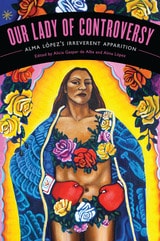
Our Lady of Controversy
Alma López's “Irreverent Apparition”Edited by Alicia Gaspar de Alba and Alma López
University of Texas Press, 2011
Months before Alma López's digital collage Our Lady was shown at the Museum of International Folk Art in 2001, the museum began receiving angry phone calls from community activists and Catholic leaders who demanded that the image not be displayed. Protest rallies, prayer vigils, and death threats ensued, but the provocative image of la Virgen de Guadalupe (hands on hips, clad only in roses, and exalted by a bare-breasted butterfly angel) remained on exhibition.
Highlighting many of the pivotal questions that have haunted the art world since the NEA debacle of 1988, the contributors to Our Lady of Controversy present diverse perspectives, ranging from definitions of art to the artist's intention, feminism, queer theory, colonialism, and Chicano nationalism. Contributors include the exhibition curator, Tey Marianna Nunn; award-winning novelist and Chicana historian Emma Pérez; and Deena González (recognized as one of the fifty most important living women historians in America).
Accompanied by a bonus DVD of Alma López's I Love Lupe video that looks at the Chicana artistic tradition of reimagining la Virgen de Guadalupe, featuring a historic conversation between Yolanda López, Ester Hernández, and Alma López, Our Lady of Controversy promises to ignite important new dialogues.
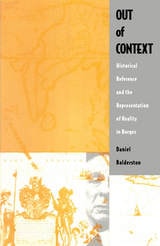
Out of Context
Historical Reference and the Representation of Reality in BorgesDaniel Balderston
Duke University Press, 1993
Through a detailed examination of seven stories, Daniel Balderston shows how Borges's historical and political references, so often misread as part of a literary game, actually open up a much more complex reality than the one made explicit to the reader. Working in tension with the fantastic aspects of Borges' work, these precise references to realities outside the text illuminate relations between literature and history as well as the author's particular understanding of both. In Borges's perspective as it is revealed here, history emerges as an "other" only partially recoverable in narrative form. From what can be recovered, Balderston is able to clarify Borges's position on historical episodes and trends such as colonialism, the Peronist movement, "Western culture," militarism, and the Spanish invasion of the Americas.
Informed by a wide reading of history, a sympathetic use of critical theory, and a deep understanding of Borges's work, this iconoclastic study provides a radical new approach to one of the most celebrated and—until now—hermetic authors of our time.

Out of History
Essays on the Writings of Sebastian BarryChristina Hunt Mahony
Catholic University of America Press, 2006